Showing posts with label Brightest Cluster Galaxies (BCGs). Show all posts

Saturday, July 01, 2023

Cool, Relaxed, but Way Out of Its Lane: The Most Distant Cooling-Flow Galaxy Cluster Yet Observed


Title: SPT-CL J2215-3537: A Massive Starburst at the Center of the Most Distant Relaxed Galaxy Cluster
Authors: Michael S. Calzadilla et al.
First Author’s Institution: Massachusetts Institute of Technology
Status: Published in ApJ

The largest gravitationally bound structures in the universe are galaxy clusters — hundreds to thousands of individual galaxies bound together by gravity and surrounded by dark matter and gas. Lurking at the center of these galaxy clusters are the brightest galaxies in the universe: the aptly named brightest cluster galaxies (BCGs).

Because BCGs are right at the center of their galaxy cluster’s gravitational field, the clusters themselves act like a well, funneling new material onto the BCGs. This means that BCGs grow very large, and the evolution of the BCG is intimately linked to the evolution of the full galaxy cluster. Traditionally, it has been thought that the clusters feed the BCG with other galaxies full of pre-made stars (this mechanism is referred to as, no joke, galactic cannibalism — here’s a video on the topic). However, many BCGs have been observed to actively grow new stars. In these cases, it seems like the cluster is feeding free-floating gas known as the intracluster medium (ICM) to the BCG. This ICM contains the ingredients for star formation (mostly hydrogen gas), and the BCG can process these ingredients into new stars itself.

Going with the Flow

In order for this second type of BCG growth to be happening, the galaxy cluster needs to obey some fairly specific criteria. There needs to be one specific BCG in the cluster, and it needs to be sitting at the center of the cluster’s gravitational field, in order to direct the ICM onto the BCG. The cluster itself also needs to be large enough to have a lot of concentrated ICM, and old enough that a lot of the initial heat (kinetic energy) in the ICM has had time to escape (if not, it will be moving around too fast to get caught by the BCG’s gravity). These types of clusters are known as “cool-core” clusters, and the flow of ICM onto the BCG is known as a “cooling flow.” All of these things typically happen naturally in clusters, but they all require time, so they’re far more common in much older clusters at times much closer to the present day. These clusters are called “relaxed.” That’s what makes today’s article so exciting — the authors of this article have found a relaxed cluster funneling material onto its BCG at redshift 1.16 (only about 5.3 billion years after the Big Bang). This is the earliest example of such a cluster found to date — so this cluster must have relaxed faster than previously thought possible.


Figure 1: Some of the wide variety of observations required to study this galaxy cluster. Clockwise from the top left, they are: the ASKAP radio observations showing the active galactic nucleus, the Chandra X-ray observations showing the ICM, a Hubble composite image showing the cluster, and zoom-ins on the BCG in optical and ultraviolet wavelengths (respectively), also from Hubble. Credit: Calzadilla et al. 2023


The Picture(s) of Relaxation

This cluster, known as SPT-CL J2215-3537, or SPT2215, was originally found using the Sunyaev–Zeldovich effect in a South Pole Telescope survey. Optical and ultraviolet imaging (Figure 1) from the Hubble Space Telescope and the Magellan Telescopes were used to find the galaxies associated with the cluster, and optical spectroscopy from Magellan was used to make sure that the galaxies were all associated with the cluster in all three dimensions. This optical spectroscopy also measured the distance to the cluster, using redshifting of spectral lines, and therefore confirmed that we’re observing this cluster earlier in the universe’s history than any other cluster of its kind. A faint radio-wavelength source (probably an active galactic nucleus) was also found to be associated with the cluster using the Australian Square Kilometre Array Pathfinder (ASKAP) (Figure 1).


Figure 2: The temperature profile of the ICM of the galaxy cluster, measured from the X-ray observations shown in Figure 1. The temperature is shown in energy units, because in this case it’s essentially a measure of the kinetic energy of the gas. The grey line shows the actual data points, and the green region is a fit to a known model of the temperature profile in cool-core clusters.
Adapted from Calzadilla et al. 2023

A Cool Customer

The ICM is very diffuse, and it isn’t typically visible in optical or ultraviolet measurements. In order to measure this cluster’s ICM properties, the authors had to take observations using the Chandra X-ray Observatory. From this, they noticed that the ICM is distributed extremely regularly in the cluster, and that the ICM’s luminosity peaks very strongly in the center. As mentioned above, both of these characteristics are good indicators that the cluster is relaxed. The authors also measured the spectrum of the X-rays in order to determine the temperature of the ICM. By measuring different X-ray spectra at different distances from the center of the cluster, the authors developed a temperature profile (Figure 2). This showed that the ICM in the middle of the cluster in particular had a very low temperature, making it a cool-core cluster. Filaments of gas are also visible surrounding the BCG in the ultraviolet imaging from Hubble, suggesting that ICM is indeed falling onto the BCG.

Relaxed, but Working Hard

Finally, the authors measured the spectral energy distribution of the BCG itself (Figure 3). This is a technique where the amount of light emitted from a galaxy is measured at as many different wavelengths as possible, and then the luminosity at these different wavelengths is compared. Different components of a galaxy (such as new stars, old stars, or gas) emit light at different wavelengths, so scientists can estimate how fast a galaxy forms stars by fitting measurements to models of these different components. In this case, the authors used the Hubble and Magellan measurements mentioned above (at optical and ultraviolet wavelengths), additional near-infrared Magellan measurements, and far-infrared (very long-wavelength) Spitzer Space Telescope observations to construct their spectral energy distribution. From the spectral energy distribution, they determined that the BCG in this cluster was forming 320 solar masses of new stars every year (about 300 times the Milky Way’s rate)!


Figure 3: The spectral energy distribution of the BCG inside SPT2215. The blue points show the observed values for this galaxy, and the red points show the model that was fit to these values. Using this technique, the authors determined that the BCG is forming stars at a much higher rate than expected. Credit: Calzadilla et al. 2023


All of this evidence seems to point to a BCG forming stars out of fuel from the cluster itself. If this is the case, this will be the earliest ever example of such a cluster, and it has some pretty exciting implications. The authors suggest that clusters relaxing this quickly may have a totally separate mechanism for BCG formation, independent from the cannibalism-driven growth we expect. It also implies that active galactic nuclei (such as the one seen in the ASKAP imaging of this cluster in Figure 1) could start powering on earlier than expected, feeding energy back into the BCG and the cluster and disrupting star formation. The authors are working with more X-ray observations to characterize the physics of this cluster more precisely, and hopefully figure out some of the specifics of these implications.

Original astrobite edited by William Lamb.


About the author, Delaney Dunne:

I’m a PhD student at Caltech, where I study how galaxies form and evolve by mapping their molecular gas! I do this using COMAP, a radio-frequency Line Intensity Mapping experiment based in California’s Owens Valley.


Friday, May 11, 2018

Massive Cluster Galaxies Move in Unexpected Ways

Figure 1. MS0440+02 galaxy cluster. The central galaxy is a multi-component BCG formed by six bright elliptical spheroids, all at the same redshift. This is a color composite GMOS South image (g, r, i) of the clusters. The size of the image is 2.6 x 2.6 arcmin2 (N up, E left). Credit: R. Carrasco (Gemini Observatory/AURA) and Tomás Verdugo (UNAM).  Full resolution TIFF

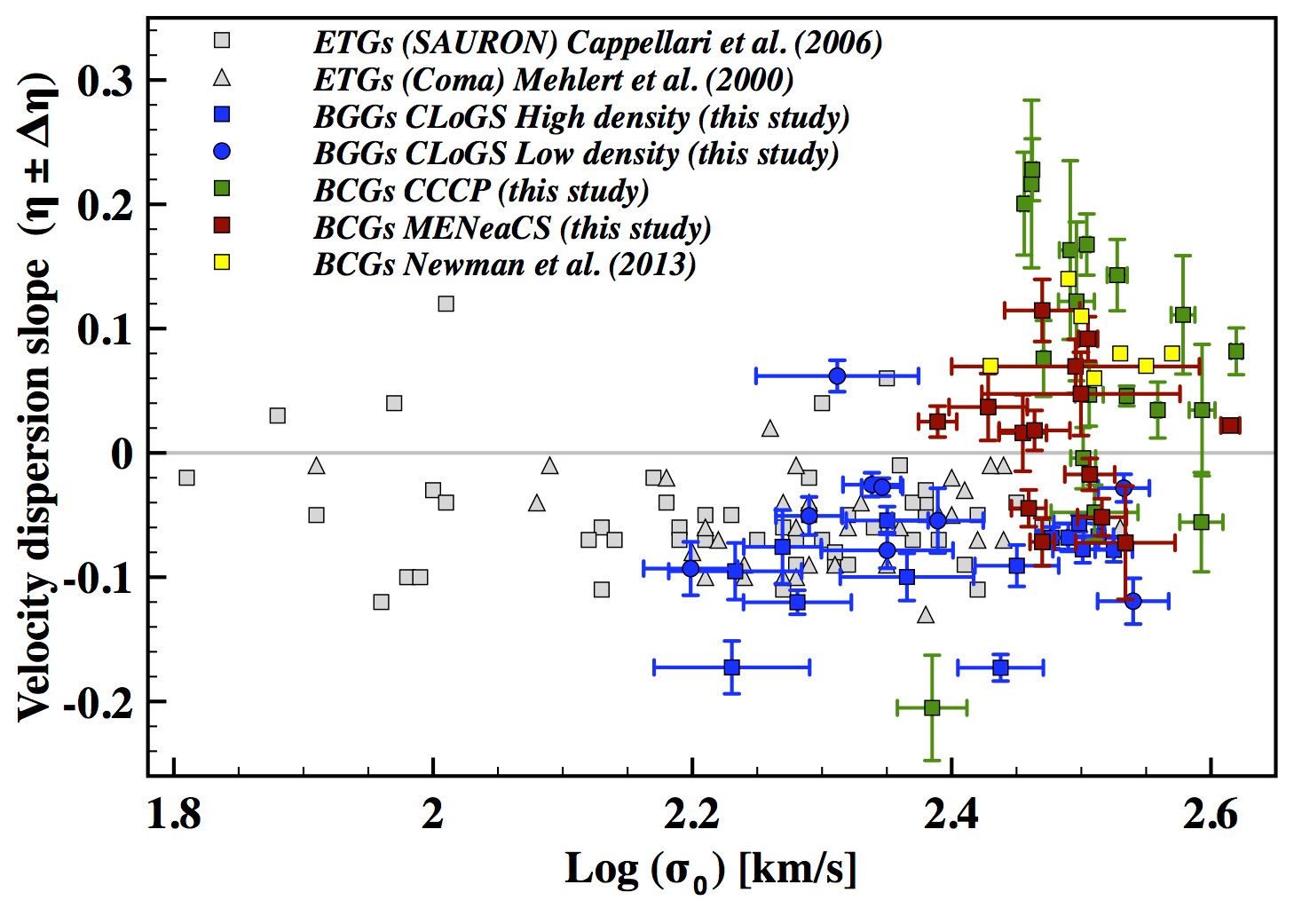
Figure 2. The slope η of the velocity dispersion profile is plotted against the central velocity dispersion σ0 for galaxies in multiple different samples. The blue points represent brightest galaxies in groups (BGGs) of high (square) and low (circles) density, while the green, red, and yellow points represent brightest cluster galaxies (BCGs) in various samples of galaxy clusters. The grey points indicate generic “early-type galaxies” (ETGs). The slope η is negative if the velocity dispersion decreases with radius and positive if it rises. Thus, massive BCGs tend to have rising profiles, with the stellar velocities responding to the cluster potential at larger radii. [Reproduced from Loubser et al. 2018, MNRAS, in press.]  Full resolution JPEG


Astronomers using data from both of the Gemini Multi-Object Spectrographs (GMOS - North and South) measured the motions of stars within a sample of 32 massive elliptical cluster galaxies and found the stellar motions inconsistent with these galaxies’ solitary cousins. 

The galaxies chosen are known as brightest cluster galaxies (BCGs) because they are the brightest members of large galaxy clusters. The international team of astronomers obtained Gemini spectra to find the relative velocities of stars within each galaxy and then determine the central stellar velocity dispersions and radial dispersion profiles for each galaxy. “This is similar to what we see in our own Solar System with the different velocities of the planets around the Sun,” said John Blakeslee, Gemini Observatory's Head of Science. “We use the planets’ velocities to determine our Solar System’s mass distribution and it is also how we know the Sun’s mass accurately.”

The researchers discovered a surprising variety in the shapes of the velocity dispersion profiles for the BCGs, with a large fraction showing rising dispersion profiles (Figure 2). A rising velocity dispersion profile means that the stars within these galaxies are moving faster as you look further from the galaxy’s core in response to an increasing gravitational force. In comparison, rising velocity dispersion profiles are much rarer in other massive ellipticals that are not BCGs, including many brightest galaxies in groups (BGGs).

“You would naively think that massive elliptical galaxies are a homogeneous, well-behaved class of objects, but the most massive beasts, those in the centers of groups and clusters, continue to surprise us,” said Ilani Loubser, an astronomer at North-West University in South Africa and the lead author of the study, which has been accepted for publication in Monthly Notices of the Royal Astronomical Society. She also noted, “The quality, and the wealth of information we can measure from the GMOS spectra (even in poor weather), is remarkable!”

BCGs tend to reside near the centers of their respective clusters, and are therefore generally embedded within extended distributions of both light and dark matter. The sample of BCGs in this study included some of the most massive known galaxies in the Universe out to a distance of about 3.2 billion light years (z ~ 0.3).

The study also found that the slopes of the velocity dispersion profiles correlate with the galaxy luminosity, in the sense that the increase in the speed of the stars is greater in brighter BCGs, as well as BGGs. Whether the full diversity in the observed velocity dispersion profiles is consistent with standard models for the growth of massive galaxies is not yet clear. More detailed comparisons with velocity dispersion profiles in cosmological simulations are needed.


Source:
Gemini Observatory

Wednesday, June 08, 2016

Black Hole Fed by Cold Intergalactic Deluge

Artist’s impression of cold intergalactic rain

Artist’s impression of cold intergalactic rain

Composite image of Abell 2597 Brightest Cluster Galaxy


Videos

Artist’s impression of cold intergalactic rain


An international team of astronomers using the Atacama Large Millimeter/submillimeter Array (ALMA) has witnessed a cosmic weather event that has never been seen before — a cluster of towering intergalactic gas clouds raining in on the supermassive black hole at the centre of a huge galaxy one billion light-years from Earth. The results will appear in the journal Nature on 9 June 2016.

The new ALMA observation is the first direct evidence that cold dense clouds can coalesce out of hot intergalactic gas and plunge into the heart of a galaxy to feed its central supermassive black hole. It also reshapes astronomers’ views on how supermassive black holes feed, in a process known as accretion.

Previously, astronomers believed that, in the largest galaxies, supermassive black holes fed on a slow and steady diet of hot ionised gas from the galaxy’s halo. The new ALMA observations show that, when the intergalactic weather conditions are right, black holes can also gorge on a clumpy, chaotic downpour of giant clouds of very cold molecular gas.

Although it has been a major theoretical prediction in recent years, this is one of the first unambiguous pieces of observational evidence for a chaotic, cold rain feeding a supermassive black hole,” said Grant Tremblay, an astronomer with Yale University in New Haven, Connecticut, USA, former ESO Fellow, and lead author on the new paper. “It’s exciting to think we might actually be observing this galaxy-spanning rainstorm feeding a black hole whose mass is about 300 million times that of the Sun.

Tremblay and his team used ALMA to peer into an unusually bright cluster of about 50 galaxies, collectively known as Abell 2597. At its core is a massive elliptical galaxy, descriptively named the Abell 2597 Brightest Cluster Galaxy. Suffusing the space between these galaxies is a diffuse atmosphere of hot ionised gas, which was previously observed with NASA’s Chandra X-ray Observatory.

"This very, very hot gas can quickly cool, condense, and precipitate in much the same way that warm, humid air in Earth's atmosphere can spawn rain clouds and precipitation," Tremblay said. "The newly condensed clouds then rain in on the galaxy, fueling star formation and feeding its supermassive black hole."

Near the centre of this galaxy the researchers discovered just this scenario: three massive clumps of cold gas are careening toward the supermassive black hole in the galaxy’s core at about a million kilometres per hour. Each cloud contains as much material as a million Suns and is tens of light-years across.

Normally, objects on that scale would be difficult to distinguish at these cosmic distances, even with ALMA’s amazing resolution. They were revealed, however, by the billion-light-year-long “shadows” they cast toward Earth [1].

Additional data from the National Science Foundation’s Very Long Baseline Array indicate that the gas clouds observed by ALMA are only about 300 light-years from the central black hole, essentially teetering on the edge of being devoured, in astronomical terms.

While ALMA was only able to detect three clouds of cold gas near the black hole, the astronomers speculate that there may be thousands like them in the vicinity, setting up the black hole for a continuing downpour that could fuel its activity for a long time.

The astronomers now plan to use ALMA to search for these "rainstorms" in other galaxies in order to determine whether such cosmic weather is as common as current theory suggests it might be. 


Notes

[1] The shadows are formed when the in-falling opaque gas clouds block out a portion of the bright background millimetre-wavelength light emitted by electrons spiraIling around magnetic fields very near the central supermassive black hole. 


More Information

This research was presented in a paper entitled “Cold, clumpy accretion onto an active supermassive black hole”, by Grant R. Tremblay et al., to appear in the journal Nature on 9 June 2016.

The team is composed of Grant R. Tremblay (Yale University, New Haven, Connecticut, USA; ESO, Garching, Germany), J. B. Raymond Oonk (ASTRON, Netherlands Institute for Radio Astronomy, Dwingeloo, the Netherlands; Leiden Observatory, Leiden University, Leiden, the Netherlands), Françoise Combes (LERMA, Observatoire de Paris, PSL Research University, College de France, CNRS, Sorbonne University, Paris, France), Philippe Salomé (LERMA, Observatoire de Paris, PSL Research University, College de France, CNRS, Sorbonne University, Paris, France), Christopher O’Dea (University of Manitoba, Winnipeg, Canada; Rochester Institute of Technology, Rochester, New York, USA), Stefi A. Baum (University of Manitoba, Winnipeg, Canada; Rochester Institute of Technology, Rochester, New York, USA), G. Mark Voit (Michigan State University, East Lansing, Michigan, USA), Megan Donahue (Michigan State University, East Lansing, Michigan, USA), Brian R. McNamara (Waterloo University, Waterloo, Ontario, Canada), Timothy A. Davis (Cardiff University, Cardiff, United Kingdom; ESO, Garching, Germany), Michael A. McDonald (Kavli Institute for Astrophysics & Space Research, MIT, Cambridge, Massachusetts, USA), Alastair C. Edge (Durham University, Durham, United Kingdom), Tracy E. Clarke (Naval Research Laboratory Remote Sensing Division, Washington DC, USA), Roberto Galván-Madrid (Instituto de Radioastronomía y Astrofísica, UNAM, Morelia, Michoacan, Mexico; ESO, Garching, Germany), Malcolm N. Bremer (University of Bristol, Bristol, United Kingdom), Louise O. V. Edwards (Yale University, New Haven, Connecticut, USA), Andrew C. Fabian (Institute of Astronomy, Cambridge University, Cambridge, United Kingdom), Stephen Hamer (LERMA, Observatoire de Paris, PSL Research University, College de France, CNRS, Sorbonne University, Paris, France) , Yuan Li (University of Michigan, Ann Arbor, Michigan, USA ), Anaëlle Maury (Laboratoire AIMParis-Saclay, CEA/DSM/Irfu CNRS, University Paris Diderot, CE-Saclay, Gif-sur-Yvette, France), Helen Russell (Institute of Astronomy, Cambridge University, Cambridge, United Kingdom), Alice C. Quillen (University of Rochester, Rochester, New York, USA), C. Megan Urry (Yale University, New Haven, Connecticut, USA), Jeremy S. Sanders (Max-Planck-Institut für extraterrestrische Physik, Garching bei München, Germany), and Michael Wise (ASTRON, Netherlands Institute for Radio Astronomy, Dwingeloo, the Netherlands).

The Atacama Large Millimeter/submillimeter Array (ALMA), an international astronomy facility, is a partnership of ESO, the U.S. National Science Foundation (NSF) and the National Institutes of Natural Sciences (NINS) of Japan in cooperation with the Republic of Chile. ALMA is funded by ESO on behalf of its Member States, by NSF in cooperation with the National Research Council of Canada (NRC) and the National Science Council of Taiwan (NSC) and by NINS in cooperation with the Academia Sinica (AS) in Taiwan and the Korea Astronomy and Space Science Institute (KASI).

ALMA construction and operations are led by ESO on behalf of its Member States; by the National Radio Astronomy Observatory (NRAO), managed by Associated Universities, Inc. (AUI), on behalf of North America; and by the National Astronomical Observatory of Japan (NAOJ) on behalf of East Asia. The Joint ALMA Observatory (JAO) provides the unified leadership and management of the construction, commissioning and operation of ALMA.

ESO is the foremost intergovernmental astronomy organisation in Europe and the world’s most productive ground-based astronomical observatory by far. It is supported by 16 countries: Austria, Belgium, Brazil, the Czech Republic, Denmark, France, Finland, Germany, Italy, the Netherlands, Poland, Portugal, Spain, Sweden, Switzerland and the United Kingdom, along with the host state of Chile. ESO carries out an ambitious programme focused on the design, construction and operation of powerful ground-based observing facilities enabling astronomers to make important scientific discoveries. ESO also plays a leading role in promoting and organising cooperation in astronomical research. ESO operates three unique world-class observing sites in Chile: La Silla, Paranal and Chajnantor. At Paranal, ESO operates the Very Large Telescope, the world’s most advanced visible-light astronomical observatory and two survey telescopes. VISTA works in the infrared and is the world’s largest survey telescope and the VLT Survey Telescope is the largest telescope designed to exclusively survey the skies in visible light. ESO is a major partner in ALMA, the largest astronomical project in existence. And on Cerro Armazones, close to Paranal, ESO is building the 39-metre European Extremely Large Telescope, the E-ELT, which will become “the world’s biggest eye on the sky”.


Links


Contacts

Grant Tremblay
Yale University
New Haven, Connecticut, USA
Tel: +1 207 504 4862
Email: grant.tremblay@yale.edu

Francoise Combes
LERMA, Paris Observatory
France
Email: francoise.combes@obspm.fr

Richard Hook
ESO Public Information Officer
Garching bei München, Germany
Tel: +49 89 3200 6655
Cell: +49 151 1537 3591
Email: rhook@eso.org

Source: ESO

Tuesday, November 04, 2014

Stars influence the central distribution of dark matter in galaxy clusters

Figure 1: A composite optical and X-ray image of Abell 383, one of the 7 relaxed rich clusters considered in the study by Newman et al. 2013a,b. This image shows the X-ray emission of the hot electron gas in the cluster (in purple), its member galaxies and its central Brightest Cluster Galaxy which exhibits an extended diffuse envelope of stars around it.  Credits: X-ray: NASA/CXC/Caltech/A.Newman et al/Tel Aviv/A.Morandi & M.Limousin; Optical: NASA/STScI, ESO/VLT, SDSS

Figure 2: A zoom on the BCG in Abell 383 taken with the Hubble Space Telescope. The central BCG is surrounded by an extended envelope of stars and the numerous distorted images around it are background galaxies which are getting lensed by the cluster. Because of their high masses, galaxy clusters can act as gravitational lenses: the background galaxies close to the line of sight of the cluster get multiply imaged or distorted into large arcs like the one visible south of the BCG. Some of the cluster galaxies (e.g. the bright elliptical galaxy one on the south-east of the BCG) act as additional lenses which further distort some of the multiple images. Credits: NASA

Figure 3: Density profiles of simulated and real clusters. Left Panel: Density profile for one of the re-simulated galaxy cluster. The black, red and blue lines represent the distribution of total (stars+dark matter), dark matter and stellar mass. The magenta line corresponds to the distribution of matter in a dark-matter-only run of the cluster (where the contribution of stars in galaxies was completely neglected). The total mass profile as a whole is very similar to the dark-matter-only run except where the density of stars overtakes that of the dark matter. The final dark matter profile on the other hand is shallower than the original dark-matter-only run already at the half-light radius of the BCG marked by the red arrow. The black arrow shows the radius where effects from black hole mergers would significantly affect the distribution of stars and dark matter in the BCG core. Right Panel: Density profile for one of the clusters in the Newman et al. (2013) sample, Abell 611. Black, red and blue lines represent the contributions from total, stellar and dark matter respectively. The dashed lines mark the 1-sigma error on the modelling. The mass distribution in this cluster is quite similar to one of the simulated clusters in the left panel.  Credits: Laporte & White 2014

Dark matter is at the centre of our understanding of the physics of the early Universe, of cosmic large-scale structure and of galaxy formation. In its simplest form, "cold dark matter" consists of non-relativistic weakly interacting particles of a kind not included in the standard model of particle physics. On astrophysical scales the dark matter only interacts with baryons (ordinary matter) through the force of gravity. Because of the simple physics this entails, its dynamics and clustering can be followed through N-body simulations. Recently, scientists at the MPA have performed cosmological N-body simulations showing that the mergers of galaxies (containing both stars and dark matter) at the centre of galaxy clusters can alter the central distribution of dark matter in a way that alleviates recent discrepancies found between observations and simulations.

The Cosmic Microwave Background provides important information on how dark matter was distributed in the early Universe. Cosmological N-body simulations can be used to follow this distribution as it evolves forward in time, ultimately giving rise to today's cosmic web, made up of voids, filaments and the halos in which the galaxies live. It is an important task to characterise, both theoretically and observationally, the internal structure of these halos, since this constrains both the nature of the dark matter particle and the way galaxies form and evolve. Already in the 1990s, cosmological N-body simulations were able to characterise the density profiles of dark matter halos, showing that, to a good approximation, these have a universal shape from the scales of dwarf galaxies to those of galaxy clusters. The physical origin of this universal profile remains a mystery to this day. An important task in modern astronomy is to infer the distribution of dark matter in galaxies in order to test this prediction of the standard LCDM paradigm for halo structure. 

Galaxy clusters are objects of prime interest to study dark matter because they give astronomers the largest number of independent probes of halo structure (stellar kinematics, strong gravitational lensing, weak gravitational lensing, X-ray emission from hot gas, galaxy motions). This helps considerably in obtaining robust and precise results which can put firm constraints on total mass profiles. Recent observations of galaxy clusters and of their central galaxies (Brightest Cluster Galaxies or BCGs) have combined a number of probes, revealing that the clusters' total density profiles are well described by the "universal" profile found in cosmological dark-matter-only simulations. However, their dark matter profiles are systematically shallower in the innermost regions (well inside the visible BCG). 

As gas cools and condenses near the centre of a dark matter halo and begins to form stars, simple arguments suggest the dark matter should be pulled inwards, thus steepening its density profile. While this appears to contradict the observations, this is not the full story for BCGs because their growth can be more complicated than that of more typical galaxies. It was proposed in the 1970s that BCGs may grow through multiple mergers of preformed galaxies which will occur preferentially at the centres of clusters. This suggestion seems to hold up according to current detailed simulations of the formation of galaxies and clusters in the LCDM paradigm. However, previous work did not investigate whether this picture could explain the observed structural evolution of BCGs in detail (e.g. their stellar masses, sizes, shapes, surface brightness profiles and dark matter content, all as a function of redshift). A year ago, a team of scientists at the MPA and the National Astronomical Observatories in China have provided further support for this formation channel by comparing observations at low and high redshift with sophisticated methods for ?painting" the stars onto cosmological dark matter N-body simulations of galaxy cluster formation. 

More recently, MPA scientists conducted N-body simulations which explicitly and self-consistently followed the evolution of both stars and dark matter in clusters. These high-resolution simulations began with a dark matter distribution consistent with LCDM expectations and a galaxy population consistent with that observed in the z~2 universe (about 3 billion years after the Big Bang) and they followed evolution down to the present day. This required a new scheme to insert equilibrium galaxies of a prescribed structure into dark matter halos that had already formed in a cosmological simulation, while mimicking the contraction of the dark-matter halos induced by baryon condensation at their centres. 

While the earlier conclusions on BCG evolution held up, the new simulations showed that the central mass re-distributes itself significantly as mergers proceed. By the present day, the mixture of dark and stellar matter in the BCGs had the same total mass density profiles as in test simulations which included dark matter alone. This demonstrated that evolution tends to drive the total mass density profile (stars and dark matter) towards the "universal" shape. Since the stars contribute most of the mass near the middle of the final BCGs, this meant that their dark matter density profiles were actually less centrally concentrated than in the dark-matter-only simulations, even though they started out more concentrated in the initial galaxies. As a result, the simulated BCGs appear to have dark matter profiles consistent with those inferred observationally.
The simulated BCGs typically experienced 6 or 7 mergers which, in real galaxies, would be accompanied by a merger of the central supermassive black holes. Such mergers pump energy into the innermost regions, causing the stars and dark matter to move outwards. Estimates of the size of this effect based on the simulations suggest that it might explain the large stellar cores often observed in BCGs. So far, the effects of supermassive black holes in BCGs cannot be directly simulated in a full cosmological context, so the current simulations offer realistic initial conditions for simplified numerical studies of supermassive black hole merging in the central regions of BCGs. 

This study suggests that observations of the mass distribution in the centres of galaxy clusters can be understood if BCG evolution is primarily driven by dissipationless mergers. Within the standard LCDM paradigm, such an evolutionary path naturally explains a total density profile similar to those found in dark-matter-only simulations, together with a shallower dark matter density profile. There seems no need to appeal to the more radical explanations proposed in some recent papers such as new physics in the dark matter sector or dynamical effects driven by star and black hole formation which are much more violent than any observed.

Chervin Laporte and Simon White


References:

Laporte C. F. P., White S. D. M., Naab T., Gao L. 2013, MNRAS, 435, 901
Laporte & White 2014, http://arxiv.org/abs/1409.1924
Newman 2013a, ApJ, 765, 24
Newman 2013b, ApJ, 765, 25