Showing posts with label Abell 383. Show all posts

Saturday, October 28, 2017

Hubble discovers “wobbling galaxies”

Abell S1063, the final frontier

Hubble image of galaxy cluster MACS J1206 

Lensing cluster Abell 383

Brightest galaxy in Abell 2261

Galaxy cluster MACS J1720+35

 
Wide-field image of Abell S1063 (ground-based image)

Wide field view of MACS 1206 (ground-based image)


Videos
Pan across the galaxy cluster Abell S1063

Pan across Abell 383

Pan across MACS 1206


Observations may hint at nature of dark matter


Using the NASA/ESA Hubble Space Telescope, astronomers have discovered that the brightest galaxies within galaxy clusters “wobble” relative to the cluster’s centre of mass. This unexpected result is inconsistent with predictions made by the current standard model of dark matter. With further analysis it may provide insights into the nature of dark matter, perhaps even indicating that new physics is at work.

Dark matter constitutes just over 25 percent of all matter in the Universe but cannot be directly observed, making it one of the biggest mysteries in modern astronomy. Invisible halos of elusive dark matter enclose galaxies and galaxy clusters alike. The latter are massive groupings of up to a thousand galaxies immersed in hot intergalactic gas. Such clusters have very dense cores, each containing a massive galaxy called the “brightest cluster galaxy” (BCG).

The standard model of dark matter (cold dark matter model) predicts that once a galaxy cluster has returned to a “relaxed” state after experiencing the turbulence of a merging event, the BCG does not move from the cluster’s centre. It is held in place by the enormous gravitational influence of dark matter.
But now, a team of Swiss, French, and British astronomers have analysed ten galaxy clusters observed with the NASA/ESA Hubble Space Telescope, and found that their BCGs are not fixed at the centre as expected [1].

The Hubble data indicate that they are “wobbling” around the centre of mass of each cluster long after the galaxy cluster has returned to a relaxed state following a merger. In other words, the centre of the visible parts of each galaxy cluster and the centre of the total mass of the cluster — including its dark matter halo — are offset, by as much as 40 000 light-years.

“We found that the BCGs wobble around centre of the halos,” explains David Harvey, astronomer at EPFL, Switzerland, and lead author of the paper. “This indicates that, rather than a dense region in the centre of the galaxy cluster, as predicted by the cold dark matter model, there is a much shallower central density. This is a striking signal of exotic forms of dark matter right at the heart of galaxy clusters.”

The wobbling of the BCGs could only be analysed as the galaxy clusters studied also act as gravitational lenses. They are so massive that they warp spacetime enough to distort light from more distant objects behind them. This effect, called strong gravitational lensing, can be used to make a map of the dark matter associated with the cluster, enabling astronomers to work out the exact position of the centre of mass and then measure the offset of the BCG from this centre.

If this “wobbling” is not an unknown astrophysical phenomenon and in fact the result of the behaviour of dark matter, then it is inconsistent with the standard model of dark matter and can only be explained if dark matter particles can interact with each other — a strong contradiction to the current understanding of dark matter. This may indicate that new fundamental physics is required to solve the mystery of dark matter.

Co-author Frederic Courbin, also at EPFL, concludes: “We’re looking forward to larger surveys — such as the Euclid survey — that will extend our dataset. Then we can determine whether the wobbling of BGCs is the result of a novel astrophysical phenomenon or new fundamental physics. Both of which would be exciting!”


Notes

[1] The study was performed using archive data from Hubble. The observations were originally made for the CLASH and LoCuSS surveys.


More Information

The Hubble Space Telescope is a project of international cooperation between ESA and NASA.

This research was presented in a paper entitled “A detection of wobbling Brightest Cluster Galaxies within massive galaxy clusters” by Harvey et al., which appeared in the Monthly Notices of the Royal Astronomical Society.

The international team of astronomers in this study consists of David Harvey (Laboratoire d’Astrophysique EPFL, Switzerland), F. Courbin (Laboratoire d’Astrophysique EPFL, Switzerland), J.P. Kneib (Laboratoire d’Astrophysique EPFL, Switzerland; CNRS, France), and Ian G. McCarthy (Liverpool John Moores University, UK).

Image credit: NASA, ESA, J. Lotz (STScI), M. Postman (STScI), J. Richard (CRAL) and J.-P. Kneib (LAM), T. Lauer (NOAO), S. Perlmutter (UC Berkeley, LBNL), A. Koekemoer (STScI), A. Riess (STScI/JHU), J. Nordin (LBNL, UC Berkeley), D. Rubin (Florida State), C. McCully (Rutgers University) and the CLASH Team


Links


Contacts

David Harvey
Laboratoire d’Astrophysique EPFL
Versoix, Switzerland
Tel: +41 22 37 92277

Frederic Courbin
Laboratoire d’Astrophysique EPFL
Versoix, Switzerland
Tel: +41 22 37 92418

Jean-Paul Kneib
Laboratoire d’Astrophysique - EPFL
Versoix, Switzerland
Tel: +41 79 733 21 11

Mathias Jäger
ESA/Hubble Public Information Officer
Garching bei München, Germany
Cell: +49 176 62397500


Tuesday, November 04, 2014

Stars influence the central distribution of dark matter in galaxy clusters

Figure 1: A composite optical and X-ray image of Abell 383, one of the 7 relaxed rich clusters considered in the study by Newman et al. 2013a,b. This image shows the X-ray emission of the hot electron gas in the cluster (in purple), its member galaxies and its central Brightest Cluster Galaxy which exhibits an extended diffuse envelope of stars around it.  Credits: X-ray: NASA/CXC/Caltech/A.Newman et al/Tel Aviv/A.Morandi & M.Limousin; Optical: NASA/STScI, ESO/VLT, SDSS

Figure 2: A zoom on the BCG in Abell 383 taken with the Hubble Space Telescope. The central BCG is surrounded by an extended envelope of stars and the numerous distorted images around it are background galaxies which are getting lensed by the cluster. Because of their high masses, galaxy clusters can act as gravitational lenses: the background galaxies close to the line of sight of the cluster get multiply imaged or distorted into large arcs like the one visible south of the BCG. Some of the cluster galaxies (e.g. the bright elliptical galaxy one on the south-east of the BCG) act as additional lenses which further distort some of the multiple images. Credits: NASA

Figure 3: Density profiles of simulated and real clusters. Left Panel: Density profile for one of the re-simulated galaxy cluster. The black, red and blue lines represent the distribution of total (stars+dark matter), dark matter and stellar mass. The magenta line corresponds to the distribution of matter in a dark-matter-only run of the cluster (where the contribution of stars in galaxies was completely neglected). The total mass profile as a whole is very similar to the dark-matter-only run except where the density of stars overtakes that of the dark matter. The final dark matter profile on the other hand is shallower than the original dark-matter-only run already at the half-light radius of the BCG marked by the red arrow. The black arrow shows the radius where effects from black hole mergers would significantly affect the distribution of stars and dark matter in the BCG core. Right Panel: Density profile for one of the clusters in the Newman et al. (2013) sample, Abell 611. Black, red and blue lines represent the contributions from total, stellar and dark matter respectively. The dashed lines mark the 1-sigma error on the modelling. The mass distribution in this cluster is quite similar to one of the simulated clusters in the left panel.  Credits: Laporte & White 2014

Dark matter is at the centre of our understanding of the physics of the early Universe, of cosmic large-scale structure and of galaxy formation. In its simplest form, "cold dark matter" consists of non-relativistic weakly interacting particles of a kind not included in the standard model of particle physics. On astrophysical scales the dark matter only interacts with baryons (ordinary matter) through the force of gravity. Because of the simple physics this entails, its dynamics and clustering can be followed through N-body simulations. Recently, scientists at the MPA have performed cosmological N-body simulations showing that the mergers of galaxies (containing both stars and dark matter) at the centre of galaxy clusters can alter the central distribution of dark matter in a way that alleviates recent discrepancies found between observations and simulations.

The Cosmic Microwave Background provides important information on how dark matter was distributed in the early Universe. Cosmological N-body simulations can be used to follow this distribution as it evolves forward in time, ultimately giving rise to today's cosmic web, made up of voids, filaments and the halos in which the galaxies live. It is an important task to characterise, both theoretically and observationally, the internal structure of these halos, since this constrains both the nature of the dark matter particle and the way galaxies form and evolve. Already in the 1990s, cosmological N-body simulations were able to characterise the density profiles of dark matter halos, showing that, to a good approximation, these have a universal shape from the scales of dwarf galaxies to those of galaxy clusters. The physical origin of this universal profile remains a mystery to this day. An important task in modern astronomy is to infer the distribution of dark matter in galaxies in order to test this prediction of the standard LCDM paradigm for halo structure. 

Galaxy clusters are objects of prime interest to study dark matter because they give astronomers the largest number of independent probes of halo structure (stellar kinematics, strong gravitational lensing, weak gravitational lensing, X-ray emission from hot gas, galaxy motions). This helps considerably in obtaining robust and precise results which can put firm constraints on total mass profiles. Recent observations of galaxy clusters and of their central galaxies (Brightest Cluster Galaxies or BCGs) have combined a number of probes, revealing that the clusters' total density profiles are well described by the "universal" profile found in cosmological dark-matter-only simulations. However, their dark matter profiles are systematically shallower in the innermost regions (well inside the visible BCG). 

As gas cools and condenses near the centre of a dark matter halo and begins to form stars, simple arguments suggest the dark matter should be pulled inwards, thus steepening its density profile. While this appears to contradict the observations, this is not the full story for BCGs because their growth can be more complicated than that of more typical galaxies. It was proposed in the 1970s that BCGs may grow through multiple mergers of preformed galaxies which will occur preferentially at the centres of clusters. This suggestion seems to hold up according to current detailed simulations of the formation of galaxies and clusters in the LCDM paradigm. However, previous work did not investigate whether this picture could explain the observed structural evolution of BCGs in detail (e.g. their stellar masses, sizes, shapes, surface brightness profiles and dark matter content, all as a function of redshift). A year ago, a team of scientists at the MPA and the National Astronomical Observatories in China have provided further support for this formation channel by comparing observations at low and high redshift with sophisticated methods for ?painting" the stars onto cosmological dark matter N-body simulations of galaxy cluster formation. 

More recently, MPA scientists conducted N-body simulations which explicitly and self-consistently followed the evolution of both stars and dark matter in clusters. These high-resolution simulations began with a dark matter distribution consistent with LCDM expectations and a galaxy population consistent with that observed in the z~2 universe (about 3 billion years after the Big Bang) and they followed evolution down to the present day. This required a new scheme to insert equilibrium galaxies of a prescribed structure into dark matter halos that had already formed in a cosmological simulation, while mimicking the contraction of the dark-matter halos induced by baryon condensation at their centres. 

While the earlier conclusions on BCG evolution held up, the new simulations showed that the central mass re-distributes itself significantly as mergers proceed. By the present day, the mixture of dark and stellar matter in the BCGs had the same total mass density profiles as in test simulations which included dark matter alone. This demonstrated that evolution tends to drive the total mass density profile (stars and dark matter) towards the "universal" shape. Since the stars contribute most of the mass near the middle of the final BCGs, this meant that their dark matter density profiles were actually less centrally concentrated than in the dark-matter-only simulations, even though they started out more concentrated in the initial galaxies. As a result, the simulated BCGs appear to have dark matter profiles consistent with those inferred observationally.
The simulated BCGs typically experienced 6 or 7 mergers which, in real galaxies, would be accompanied by a merger of the central supermassive black holes. Such mergers pump energy into the innermost regions, causing the stars and dark matter to move outwards. Estimates of the size of this effect based on the simulations suggest that it might explain the large stellar cores often observed in BCGs. So far, the effects of supermassive black holes in BCGs cannot be directly simulated in a full cosmological context, so the current simulations offer realistic initial conditions for simplified numerical studies of supermassive black hole merging in the central regions of BCGs. 

This study suggests that observations of the mass distribution in the centres of galaxy clusters can be understood if BCG evolution is primarily driven by dissipationless mergers. Within the standard LCDM paradigm, such an evolutionary path naturally explains a total density profile similar to those found in dark-matter-only simulations, together with a shallower dark matter density profile. There seems no need to appeal to the more radical explanations proposed in some recent papers such as new physics in the dark matter sector or dynamical effects driven by star and black hole formation which are much more violent than any observed.

Chervin Laporte and Simon White


References:

Laporte C. F. P., White S. D. M., Naab T., Gao L. 2013, MNRAS, 435, 901
Laporte & White 2014, http://arxiv.org/abs/1409.1924
Newman 2013a, ApJ, 765, 24
Newman 2013b, ApJ, 765, 25

Friday, May 02, 2014

Hubble Astronomers Check the Prescription of a Cosmic Lens

MACSJ1720, MACS J1720.2+3536
 
What could be more exciting than watching the fireworks of cataclysmic stellar explosions outshining entire galaxies of stars? How about watching them through the funhouse lens of a massive cluster of galaxies whose powerful gravity warps space around it?

In fact, distant exploding stars observed by NASA's Hubble Space Telescope are providing astronomers with a powerful tool to check the prescription of these natural "cosmic lenses," which are used to provide a magnified view of the remote universe.

Two teams of astronomers working independently have found three such exploding stars, called supernovae, far behind massive clusters of galaxies. Their light was amplified and brightened by the immense gravity of the foreground clusters in a phenomenon called gravitational lensing. First predicted by Albert Einstein, this effect is similar to a glass lens bending light to form an image. Astronomers use the gravitational-lensing technique to search for distant objects that might otherwise be too faint to see, even with today's largest telescopes.

Astronomers from the Supernova Cosmology Project and the Cluster Lensing And Supernova survey with Hubble (CLASH), are using these supernovae in a new method to check the predicted magnification, or prescription, of the gravitational lenses. Luckily, two and possibly all three of the supernovae appear to be a special type of exploding star called Type Ia supernovae, prized by astronomers because they provide a consistent level of peak brightness that makes them reliable for making distance estimates.

"Here we have found Type Ia supernovae that can be used like an eye chart for each lensing cluster," explained Saurabh Jha of Rutgers University in Piscataway, N.J., a member of the CLASH team. "Because we can estimate the intrinsic brightness of the Type Ia supernovae, we can independently measure the magnification of the lens, unlike for other background sources."

Having a precise prescription for a gravitational lens will help astronomers probe objects in the early universe and better understand a galaxy cluster's structure and its distribution of dark matter, say researchers. Dark matter cannot be seen directly but is believed to make up most of the universe's matter.

How much a gravitationally lensed object is magnified depends on the amount of matter in a cluster, including dark matter, which is the source of most of a cluster's gravity. Astronomers develop maps that estimate the location and amount of dark matter in a cluster based on theoretical models and on the observed amplification and bending of light from sources behind the cluster. The maps are the lens prescriptions that predict how distant objects behind the cluster are magnified when their light passes through it.

"Building on our understanding of these lensing models also has implications for a wide range of key cosmological studies," explained Supernova Cosmology Project leader Saul Perlmutter of the E.O. Lawrence Berkeley National Laboratory (Berkeley Lab) and the University of California, Berkeley. "These lens prescriptions yield measurements of the cluster masses, allowing us to probe the cosmic competition between gravity and dark energy as matter in the universe gets pulled into galaxy clusters." Dark energy is a mysterious, invisible energy that is accelerating the universe's expansion.

The three supernovae in the Hubble study were each gravitationally lensed by a different cluster. The teams measured the brightnesses of the lensed supernovae and compared them to the explosions' intrinsic brightnesses to calculate how much they were magnified due to gravitational lensing. One supernova in particular stood out, appearing to be about twice as bright as would have been expected if not for the cluster's magnification power.

The supernovae were discovered in the CLASH survey, a Hubble census that probed the distribution of dark matter in 25 galaxy clusters. Two of the supernovae were found in 2012, the other in 2010. The three supernovae exploded between 7 billion and 9 billion years ago, when the universe was slightly more than half its current age of 13.8 billion years old.

To perform their analyses, both teams of astronomers used observations in visible light from Hubble's Advanced Camera for Surveys and in infrared light from the Wide Field Camera 3. The research teams also obtained spectra from both space and ground-based telescopes that provided independent estimates of the distances to these exploding stars. In some cases the spectra allowed direct confirmation of a Type Ia pedigree. In other cases the supernova spectrum was weak or overwhelmed by the light of its parent galaxy. In those cases the astronomers also used different colored filters on Hubble to help establish the supernova type.

Each team then compared its results with independent theoretical models of the clusters' dark-matter content, concluding that the predictions fit the models.

"It is encouraging that the two independent studies reach quite similar conclusions," explained Supernova Cosmology Project team member Jakob Nordin of Berkeley Lab and the University of California, Berkeley. "These pilot studies provide very good guidelines for making future observations of lensed supernovae even more accurate." Nordin also is the lead author on the team's science paper describing the findings.

Now that the researchers have proven the effectiveness of this method, they need to find more Type Ia supernovae behind behemoth lensing galaxy clusters. In fact, the astronomers estimate they need about 20 supernovae spread out behind a cluster so they can map the entire cluster field and ensure that the lens model is correct.

They are optimistic that Hubble and future telescopes, including NASA's James Webb Space Telescope, an infrared observatory, will nab more of these unique exploding stars.

"Hubble is already hunting for them in the Frontier Fields, a three-year Hubble survey of the distant universe using massive galaxy clusters as gravitational lenses," said CLASH team member Brandon Patel of Rutgers University, the lead author on the science paper announcing the CLASH team's results. Steven Rodney of Johns Hopkins University, and co-leader of the CLASH supernova team, will direct the search for Type Ia supernovae in the Frontier Fields data.

The CLASH team's results will appear in the May 1 issue of The Astrophysical Journal and the Supernova Cosmology Project's findings in the May 1 edition of the Monthly Notices of the Royal Astronomical Society.

The CLASH survey is led by Marc Postman of the Space Telescope Science Institute in Baltimore, Md. The CLASH supernova project is co-led by Rodney and Adam Riess of the Space Telescope Science Institute and Johns Hopkins University. Aiding with the analysis on the Hubble study are Curtis McCully of Rutgers University, Or Graur of the American Museum of Natural History in New York City, and Julian Merten and Adi Zitrin of the California Institute of Technology in Pasadena.

Other members of the Supernova Cosmology Project who worked on the supernova analysis are David Rubin of Florida State University in Tallahassee and Greg Aldering of Berkeley Lab. The project's galaxy cluster models were created by Johan Richard of the University of Lyon in France and Jean-Paul Kneib of École Polytechnique Fédérale de Lausanne in Switzerland.

Image Credits:

Credit: NASA, ESA, S. Perlmutter (UC Berkeley, LBNL), A. Koekemoer (STScI), M. Postman (STScI), A. Riess (STScI/JHU), J. Nordin (LBNL, UC Berkeley), D. Rubin (Florida State University), and C. McCully (Rutgers University)


Photo Credit: NASA, ESA, S. Perlmutter (UC Berkeley, LBNL), A. Koekemoer (STScI), M. Postman (STScI), A. Riess (STScI/JHU), J. Nordin (LBNL, UC Berkeley), D. Rubin (Florida State University), and C. McCully (Rutgers University)


Science Credit: NASA, ESA, the Supernova Cosmology Project [J. Nordin (E.O. Lawrence Berkeley National Lab/University of California, Berkeley), D. Rubin (Florida State University), J. Richard (University of Lyon), E. Rykoff (Kavli Institute for Particle Astrophysics and Cosmology, SLAC National Accelerator Laboratory), G. Aldering (E.O. Lawrence Berkeley National Lab), R. Amanullah (The Oskar Klein Centre, Stockholm University), H. Atek (École Polytechnique Fédérale de Lausanne), K. Barbary (Argonne National Laboratory), S. Deustua (STScI), H. Fakhouri (E.O. Lawrence Berkeley National Lab/University of California, Berkeley), A. Fruchter (STScI), A. Goobar (The Oskar Klein Centre, Stockholm University), I. Hook (University of Oxford/INAF-Osservatorio Astronomico di Roma), E. Hsiao (Carnegie Observatories, Chile), X. Huang (University of California, Berkeley/University of San Francisco) J.-P. Kneib (École Polytechnique Fédérale de Lausanne/Laboratoire d’Astrophysique de Marseille), C. Lidman (Australian Astronomical Observatory), J. Meyers (Stanford University), S. Perlmutter and C. Saunders (E.O. Lawrence Berkeley National Lab/University of California, Berkeley), A. Spadafora (E.O. Lawrence Berkeley National Lab), and N. Suzuki (Kavli Institute for the Physics and Mathematics of the Universe, University of Tokyo)], and the CLASH Team [B. Patel, C. McCully, and S. Jha (Rutgers University), S. Rodney and D. Jones (Johns Hopkins University), O. Graur (Johns Hopkins University/Tel Aviv University/American Museum of Natural History/New York University), J. Merten (Jet Propulsion Laboratory), A. Zitrin (California Institute of Technology), A. Riess (STScI/Johns Hopkins University), T. Matheson (National Optical Astronomy Observatory), M. Sako (University of Pennsylvania), T. W.-S. Holoien (Rutgers University), M. Postman and D. Coe (STScI), M. Bartelmann (University of Heidelberg), I. Balestra (INAF-Osservatorio Astronomico di Trieste/INAF- Osservatorio Astronomico di Capodimonte), N. Benitez (Instituto de Astrofisica de Andalucia), R. Bouwens (Leiden Observatory), L. Bradley (STScI), T. Broadhurst (University of the Basque Country), S.B. Cenko (Goddard Space Flight Center/University of California, Berkeley), M. Donahue (Michigan State University), A. Filippenko (University of California, Berkeley), H. Ford (Johns Hopkins University), P. Garnavich (University of Notre Dame), C. Grillo (Niels Bohr Institute), L. Infante (Pontificia Universidad Catolica de Chile), S. Jouvel (Institut de Ciències de l'Espai), D. Kelson (Observatories of the Carnegie Institution of Washington), A. Koekemoer (STScI), O. Lahav (University College, London), D. Lemze (Johns Hopkins University), D. Maoz (Tel Aviv University), E. Medezinski (Johns Hopkins University), P. Melchior (Ohio State University), M. Meneghetti (INAF-Osservatorio Astronomico di Bologna), A. Molino (Instituto de Astrofisica de Andalucia), J. Moustakas (Siena College), M. Nonino (INAF-Osservatorio Astronomico di Trieste), P. Rosati (Universita di Ferrara/ESO), S. Seitz (Universitats-Sternwarte), L. Strolger (STScI), K. Umetsu (Academia Sinica), and W. Zheng (Johns Hopkins University)]

CONTACT:

Donna Weaver / Ray Villard
Space Science Telescope Institute, Baltimore, Md.
410-338-4493 / 410-338-4514

dweaver@stsci.edu / villard@stsci.edu

Source: HubbleSite


Wednesday, March 14, 2012

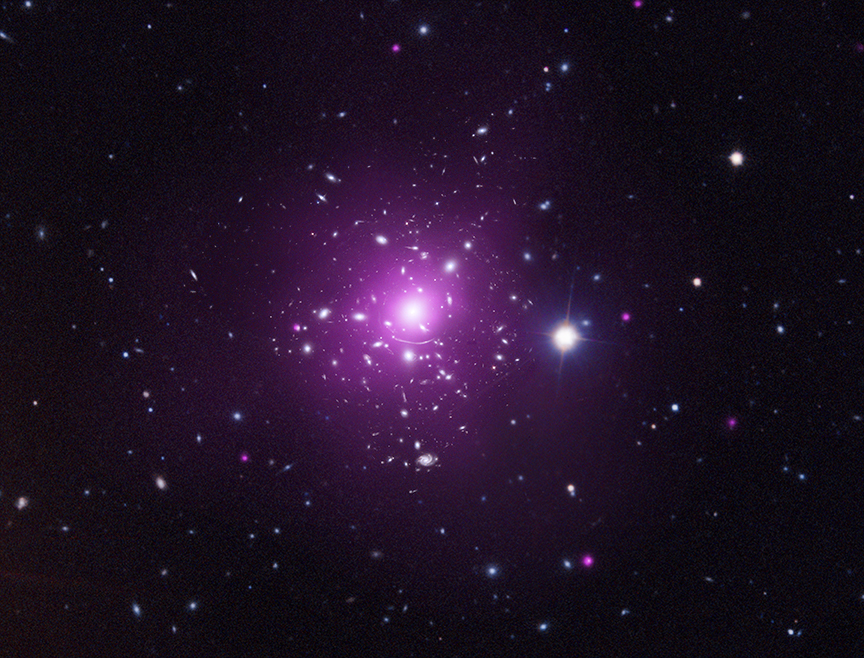
Abell 383: Getting a Full Picture of an Elusive Subject

Abell 383
Credit: X-ray: NASA/CXC/Caltech/A.Newman et al/Tel Aviv/A.Morandi & M.Limousin; Optical: NASA/STScI, ESO/VLT, SDSS

Two teams of astronomers have used data from NASA's Chandra X-ray Observatory and other telescopes to map the distribution of dark matter in a galaxy cluster known as Abell 383, which is located about 2.3 billion light years from Earth. Not only were the researchers able to find where the dark matter lies in the two dimensions across the sky, they were also able to determine how the dark matter is distributed along the line of sight.

Dark matter is invisible material that does not emit or absorb any type of light, but is detectable through its gravitational effects. Several lines of evidence indicate that there is about six times as much dark matter as "normal", or baryonic, matter in the Universe. Understanding the nature of this mysterious matter is one of the outstanding problems in astrophysics.

Galaxy clusters are the largest gravitationally-bound structures in the universe, and play an important role in research on dark matter and cosmology, the study of the structure and evolution of the universe. The use of clusters as dark matter and cosmological probes hinges on scientists' ability to use objects such as Abell 383 to accurately determine the three-dimensional structures and masses of clusters.

The recent work on Abell 383 provides one of the most detailed 3-D pictures yet taken of dark matter in a galaxy cluster. Both teams have found that the dark matter is stretched out like a gigantic football, rather than being spherical like a basketball, and that the point of the football is aligned close to the line of sight.

The X-ray data (purple) from Chandra in the composite image show the hot gas, which is by far the dominant type of normal matter in the cluster. Galaxies are shown with the optical data from the Hubble Space Telescope (HST), the Very Large Telescope, and the Sloan Digital Sky Survey, colored in blue and white.

Both teams combined the X-ray observations of the "normal matter" in the cluster with gravitational lensing information determined from optical data. Gravitational lensing - an effect predicted by Albert Einstein - causes the material in the galaxy cluster, both normal and dark matter, to bend and distort the optical light from background galaxies. The distortion is severe in some parts of the image, producing an arc-like appearance for some of the galaxies. In other parts of the image the distortion is subtle and statistical analysis is used to study the distortion effects and probe the dark matter.

A considerable amount of effort has gone into studying the center of galaxy clusters, where the dark matter has the highest concentration and important clues about its behavior might be revealed. Both of the Abell 383 studies reported here continue that effort.

The team of Andrea Morandi from Tel Aviv University in Israel and Marceau Limousin from Université de Provence in France and University of Copenhagen in Denmark concluded that the increased concentration of the dark matter toward the center of the cluster is in agreement with most theoretical simulations. Their lensing data came from HST images.

The team led by Andrew Newman of the California Institute of Technology and Tommaso Treu of University of California, Santa Barbara (UCSB) used lensing data from HST and the Japanese telescope Subaru, but added Keck observations to measure the velocities of stars in the galaxy in the center of the cluster, allowing for a direct estimate of the amount of matter there. They found evidence that the amount of dark matter is not peaked as dramatically toward the center as the standard cold dark matter model predicts. Their paper describes this as being the "most robust case yet" made for such a discrepancy with the theory.

The contrasting conclusions reached by the two teams most likely stem from differences in the data sets and the detailed mathematical modeling used. One important difference is that because the Newman et al. team used velocity information in the central galaxy, they were able to estimate the density of dark matter at distances that approached as close as only 6,500 light years from the center of the cluster. Morandi and Limousin did not use velocity data and their density estimates were unable to approach as close to the cluster's center, reaching to within 80,000 light years.

Another important difference is that Morandi and Limousin used a more detailed model for the 3-D map of dark matter in the cluster. For example, they were able to estimate the orientation of the dark matter "football" in space and show that it is mostly edge-on, although slightly tilted with respect to the line of sight.

As is often the case with cutting-edge and complex results, further work will be needed to resolve the discrepancy between the two teams. In view of the importance of resolving the dark matter mystery, there will undoubtedly be much more research into Abell 383 and other objects like it in the months and years to come.

If the relative lack of dark matter in the center of Abell 383 is confirmed, it may show that improvements need to be made in our understanding of how normal matter behaves in the center of galaxy clusters, or it may show that dark matter particles can interact with each other, contrary to the prevailing model.

The Newman et al. paper was published in the February 20, 2011 issue of the Astrophysical Journal Letter and the Morandi and Limousin paper has been accepted for publication in the Monthly Notices of the Royal Astronomical Society. Other members of the Newman et al. team were Richard Ellis from Caltech, and David Sand from Las Cumbres Global Telescope Network and UCSB.

Fast Facts for Abell 383:

Scale: 7.26 arcmin across (4.84 million light years)
Category: Groups & Clusters of Galaxies
Coordinates: (J2000) RA 02h 48m 06.96s | Dec -03º 29' 31.81"
Constellation: Eridanus
Observation Date: 3 pointings between Sep and Nov 2000
Observation Time: 13 hours 43 min.
Obs. ID: 524, 2320, 2321
Color Code: X-ray (Purple), Optical (White & Blue)
Instrument: ACIS
References: Newman,A. et al. 2011 ApJ 728:L39; arXiv:1101.3553; Morandi, A., Limousin, M. 2011 MNRAS (in press);arXiv:1108.0769
Distance Estimate: 2.3 billion light years (z=0.189)

Tuesday, April 12, 2011

First galaxies were born much earlier than expected

PR Image heic1106a
Lensing cluster Abell 383

PR Image heic1106b
Annotated view of Abell 383

PR Image heic1106c
Gravitational lensing in action

PR Image heic1106d
Wide field view of Abell 383

PR Video heic1106a
Gravitational lensing in action

Zoom on Abell 383

PR Video heic1106c
Pan across Abell 383

Using the amplifying power of a cosmic gravitational lens, astronomers have discovered a distant galaxy whose stars were born unexpectedly early in cosmic history. This result sheds new light on the formation of the first galaxies, as well as on the early evolution of the Universe.

Johan Richard, the lead author of a new study [1] says: “We have discovered a distant galaxy that began forming stars just 200 million years after the Big Bang. This challenges theories of how soon galaxies formed and evolved in the first years of the Universe. It could even help solve the mystery of how the hydrogen fog that filled the early Universe was cleared.”

Richard’s team spotted the galaxy in recent observations from the NASA/ESA Hubble Space Telescope, verified it with observations from the NASA Spitzer Space Telescope and measured its distance using W. M. Keck Observatory in Hawaii.

The distant galaxy is visible through a cluster of galaxies called Abell 383, whose powerful gravity bends the rays of light almost like a magnifying glass [2]. The chance alignment of the galaxy, the cluster and the Earth amplifies the light reaching us from this distant galaxy, allowing the astronomers to make detailed observations. Without this gravitational lens, the galaxy would have been too faint to be observed even with today’s largest telescopes.

After spotting the galaxy in Hubble and Spitzer images, the team carried out spectroscopic observations with the Keck-II telescope in Hawaii. Spectroscopy is the technique of breaking up light into its component colours. By analysing these spectra, the team was able to make detailed measurements of its redshift [3] and infer information about the properties of its component stars.

The galaxy’s redshift is 6.027, which means we see it as it was when the Universe was around 950 million years old [4]. This does not make it the most remote galaxy ever detected — several have been confirmed at redshifts of more than 8, and one has an estimated redshift of around 10 (heic1103), placing it 400 million years earlier. However the newly discovered galaxy has dramatically different features from other distant galaxies that have been observed, which generally shine brightly with only young stars.

“When we looked at the spectra, two things were clear,” explains co-author Eiichi Egami. “The redshift placed it very early in cosmic history, as we expected. But the Spitzer infrared detection also indicated that the galaxy was made up of surprisingly old and relatively faint stars. This told us that the galaxy was made up of stars already nearly 750 million years old — pushing back the epoch of its formation to about 200 million years after the Big Bang, much further than we had expected.”

Co-author Dan Stark continues: “Thanks to the amplification of the galaxy’s light by the gravitational lens, we have some excellent quality data. Our work confirms some earlier observations that had hinted at the presence of old stars in early galaxies. This suggests that the first galaxies have been around for a lot longer than previously thought.”

The discovery has implications beyond the question of when galaxies first formed, and may help explain how the Universe became transparent to ultraviolet light in the first billion years after the Big Bang. In the early years of the cosmos, a diffuse fog of neutral hydrogen gas blocked ultraviolet light in the Universe. Some source of radiation must therefore have progressively ionised the diffuse gas, clearing the fog to make it transparent to ultraviolet rays as it is today — a process known as reionisation.

Astronomers believe that the radiation that powered this reionisation must have come from galaxies. But so far, nowhere near enough of them have been found to provide the necessary radiation. This discovery may help solve this enigma.

“It seems probable that there are in fact far more galaxies out there in the early Universe than we previously estimated — it’s just that many galaxies are older and fainter, like the one we have just discovered,” says co-author Jean-Paul Kneib. “If this unseen army of faint, elderly galaxies is indeed out there, they could provide the missing radiation that made the Universe transparent to ultraviolet light.”

As of today, we can only discover these galaxies by observing through massive clusters that act as cosmic telescopes. In coming years, the NASA/ESA/CSA James Webb Space Telescope, scheduled for launch later this decade, will specialise in high resolution observations of distant, highly redshifted objects. It will therefore be in an ideal position to solve this mystery once and for all.

Notes

The Hubble Space Telescope is a project of international cooperation between NASA and ESA.

[1] The research will appear in a paper entitled “Discovery of a possibly old galaxy at z=6.027, multiply imaged by the massive cluster Abell 383”, to be published in the Monthly Notices of the Royal Astronomical Society. The international team of astronomers in this study consists of Johan Richard (CRAL, Observatoire de Lyon, Université Lyon 1, France and Dark Cosmology Centre, Niels Bohr Institute, University of Copenhagen, Denmark), Jean-Paul Kneib (Laboratoire d’Astrophysique de Marseille, France), Harald Ebeling (University of Hawaii, USA), Daniel P Stark (University of Cambridge, UK), Eiichi Egami (University of Arizona, USA) and Andrew K Fiedler (University of Arizona, USA). Lead author Johan Richard is a former Marie Curie fellow. The European Union's Marie Curie research fund provides grants at post-graduate and post-doctoral level to encourage mobility among Europe's best researchers. The EU will allocate more than €4.5 billion through the scheme in 2007-2013.

[2] Gravity distorts space-time, the fabric of the cosmos. This means that for extremely massive objects with very strong gravitational fields, light is visibly bent as it travels through and around them. Massive galaxy clusters like Abell 383 therefore act like an enormous lens, concentrating the light from distant objects behind them, in a process known as gravitational lensing. While the galaxies seen through gravitational lenses are typically distorted and multiply imaged (this newly discovered galaxy is actually visible twice in the Hubble observations), using these gravitational lenses multiplies a telescope’s power and lets it see galaxies that would otherwise be too faint to be visible. Abell 383, the gravitational lens used in this study, was imaged as part of the CLASH survey (Cluster Lensing And Supernova survey with Hubble), a Multi Cycle Treasury project to observe a sample of 25 galaxy clusters using Hubble (PI: Marc Postman). Abell 383 is also one of the 50 clusters imaged with the Spitzer Warm mission large project led by Eiichi Egami.

[3] Because the Universe is expanding, the light from distant objects is stretched and reddened as it moves towards us, a phenomenon known as redshift. The further an object is away, the more heavily redshifted it is. For very remote objects, redshift can be used to quantify their distance.

[4] Because light travels at a finite speed, the further away an object is, the further back in time we see it. For an object at a redshift of 6, the light has taken around 12.8 billion years to travel to Earth. Since we know that the Universe is about 13.75 billion years old, this means we are seeing the object in the state it was in less than a billion years after the Big Bang. Redshift is therefore a measure of time elapsed since the Big Bang as well as of an object’s distance.

Image credit: NASA, ESA, J. Richard (CRAL) and J.-P. Kneib (LAM). Acknowledgement: Marc Postman (STScI)

Links
Images of Hubble
Research paper link
NASA Hubble release

Contacts

Johan Richard
Centre de Recherche Astrophysique de Lyon, Université Lyon 1, Observatoire de Lyon
France
Tel: +33 478 868 381
Email: johan.richard@univ-lyon1.fr

Jean-Paul Kneib
Laboratoire d’Astrophysique de Marseille — CNRS, Université de Provence
France
Tel: +33 685 988 265
Email: jean-paul.kneib@oamp.fr

Oli Usher
Hubble/ESA
Garching, Germany
Tel: +49-89-3200-6855
Email: ousher@eso.org

Ray Villard
Space Telescope Science Institute
Baltimore, USA
Tel: +1-410-338-4514
Email: villard@stsci.edu

Larry O’Hanlon
W. M. Keck Observatory
Mauna Kea, Hawaii, USA
Tel: +1-808-881-3827
Email: lohanlon@keck.hawaii.edu

Whitney Clavin
NASA’s Jet Propulsion Laboratory
Pasadena, USA
Tel: +1-818-354-4673
Email: whitney.clavin@jpl.nasa.gov