Copyright: ESA/Hubble & NASA; acknowledgement: M. Canale
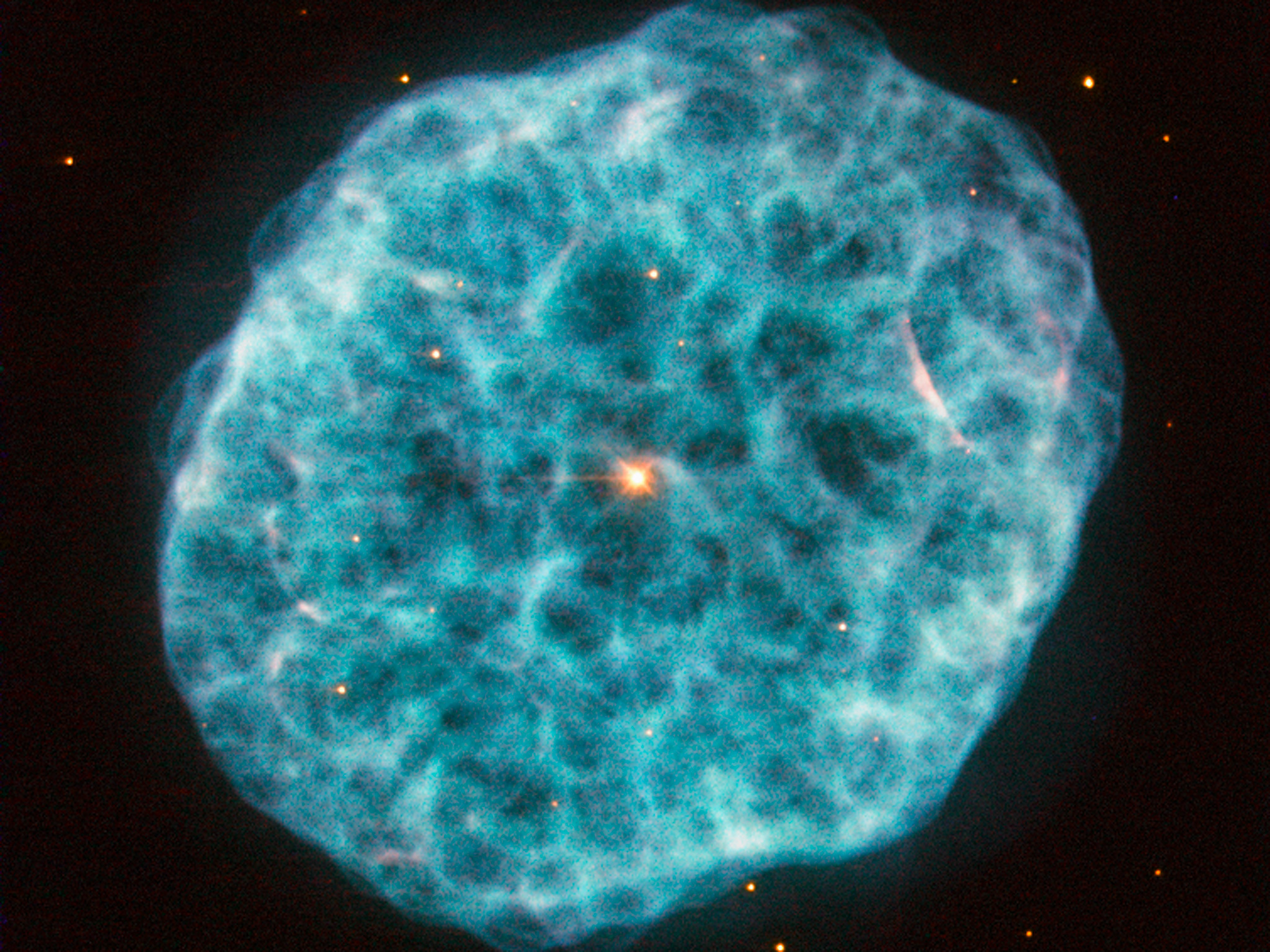
This image was captured using Hubble’s Wide Field Planetary Camera 2, the camera responsible for many of the telescope’s most beautiful images. It shows the appropriately nicknamed Oyster Nebula (more formally known as NGC 1501), a candescent cloud some 5000 light-years away from Earth in the constellation of Camelopardalis.
The Oyster Nebula is a
type of cosmic object that is essentially a giant cloud of dust and
electrically charged gases. Nebulas are often made to glow, as seen
here, by the radiation from a nearby star. In the case of the Oyster
Nebula, that star can be seen as a yellow–orange dot at the centre of
the turquoise cloud, resembling the oyster’s precious pearl.
This
is a planetary nebula, meaning that it was created when its progenitor
star – the ‘pearl’ – threw its outer layers of gas into space. This star
is just as notable as the beautiful structure surrounding it. It is a
pulsating star, meaning that its brightness varies regularly and
periodically. In the case of NGC 1501’s progenitor star, this is
incredibly fast, with the star’s brightness changing significantly in
just half an hour.
The complexity of the Oyster Nebula’s internal
structure is clearly evident in this detailed image, appearing almost
webbed or bubbly. Astronomers have modelled this object in 3D and found
it to be an irregularly shaped cloud filled with lumpy and bumpy
structures, such as knots and bubbles of gas and clumps of dust, all
knitted together.
These visible-light observations capture the
glow of gases including hydrogen and nitrogen. The bright colours shown
here are arbitrary. A version of this image was entered into the 2012 Hubble’s Hidden Treasures image processing competition by contestant Marc Canale.
Source: ESA/Space in Images