Showing posts with label Very Large Telescope Interferometer (VLTI). Show all posts

Saturday, February 07, 2026

AES Andes announces cancellation of INNA, the industrial complex planned near Paranal

PR Image eso2602a
Cerro Paranal and the Milky Way above it


AES Andes announced that it will step back from the megaproject INNA, planned to be located near the European Southern Observatory’s (ESO’s) Paranal Observatory. ESO welcomes this announcement and expects that the project will be withdrawn from Chile's Environmental Assessment Service (SEA) soon, which would formally confirm INNA is not going ahead.

“When the cancellation is confirmed, we’ll be relieved that the INNA industrial complex will not be built near Paranal,” said ESO Director General Xavier Barcons. “Due to its planned location, the project would pose a major threat to the darkest and clearest skies on Earth and to the performance of the most advanced astronomical facilities anywhere in the world.”

AES Andes, a subsidiary of the US company AES Corporation, announced on Friday 23 January that they had decided to discontinue INNA, a green hydrogen and green ammonia project, to focus on their renewable energy portfolio instead. A detailed technical analysis by ESO last year revealed that INNA would cause severe, irreversible damage to the dark skies of Paranal and to the capacity of its facilities to operate as designed. The most significant impacts, affecting facilities such as the Very Large Telescope (VLT), the VLT Interferometer (VLTI), the Extremely Large Telescope (ELT), and CTAO-South, would be caused by light pollution, micro-vibrations, dust, and an increase of the air turbulence in the area.

“As we have said before, ESO and its Member States are fullysupportive of energy decarbonisation and initiatives that ensure a more prosperous and sustainable future. Green-energy projects — and other industrial projects that drive national and regional development — are fully compatible with astronomical observatories, if the differentfacilities are located at sufficient distances from one another,” says Barcons.

The INNA case and its proposed location highlight the urgent need to establish clear protection measures in the areas around astronomical observatories. Such measures are essential to allow astronomical observatories to continue operating, particularly in a region widely regarded as the best in the world for optical astronomy facilities, owing to the exceptional darkness of the skies over northern Chile.

“We will continue to work in close collaboration with local, regional, and national authorities to protect the dark skies of northern Chile, an irreplaceable natural heritage that is essential for advancing our understanding of the Universe and to enable world-class astronomy for the benefit of Chile and the global scientific community,” says Itziar de Gregorio-Monsalvo, ESO’s Representative in Chile.

“It has been incredibly reassuring to see so many people in Chile and around the world care deeply about, and actively speak up for, the protection of dark and quiet skies in the context of the INNA project,” says Barcons. “We are sincerely grateful for this engagement and solidarity. It gives us confidence that, by working together, we can continue to protect dark and quiet skies in Chile and elsewhere — for astronomy research and for humankind.” Since the project was submitted to SEA in December 2024, members of the astronomy community in Chile, in ESO’s Member States and beyond, political leaders and authorities at international, national, regional and local level, as well as countless members of the public, have made their voices heard in support of this shared goal.

ESO will continue to intensify its efforts to ensure that the pristine skies of Paranal remain the world’s best window to observe the Universe, and is also committed to the broader fight against light pollution and satellite interference, helping secure the natural heritage of dark and quiet skies around the world for future generations.

Source: ESP/News


More information

AES Andes announced that it will step back from the megaproject INNA, planned to be located The European Southern Observatory (ESO) enables scientists worldwide to discover the secrets of the Universe for the benefit of all. We design, build and operate world-class observatories on the ground — which astronomers use to tackle exciting questions and spread the fascination of astronomy — and promote international collaboration for astronomy. Established as an intergovernmental organisation in 1962, today ESO is supported by 16 Member States (Austria, Belgium, Czechia, Denmark, France, Finland, Germany, Ireland, Italy, the Netherlands, Poland, Portugal, Spain, Sweden, Switzerland and the United Kingdom), along with the host state of Chile and with Australia as a Strategic Partner. ESO’s headquarters and its visitor centre and planetarium, the ESO Supernova, are located close to Munich in Germany, while the Chilean Atacama Desert, a marvellous place with unique conditions to observe the sky, hosts our telescopes. ESO operates three observing sites: La Silla, Paranal and Chajnantor. At Paranal, ESO operates the Very Large Telescope and its Very Large Telescope Interferometer, as well as survey telescopes such as VISTA. Also at Paranal, ESO will host and operate the south array of the Cherenkov Telescope Array Observatory, the world’s largest and most sensitive gamma-ray observatory. Together with international partners, ESO operates ALMA on Chajnantor, a facility that observes the skies in the millimetre and submillimetre range. At Cerro Armazones, near Paranal, we are building “the world’s biggest eye on the sky” — ESO’s Extremely Large Telescope. From our offices in Santiago, Chile we support our operations in the country and engage with Chilean partners and society.


Links


Contacts:

Francisco Rodríguez
Head of ESO Communications Chile
Santiago, Chile
Tel: +56 2 2463 3151
Email:
francisco.rodriguez@eso.org

Bárbara Ferreira
ESO Media Manager
Garching bei München, Germany
Tel: +49 89 3200 6670
Email:
press@eso.org

Connect with ESO on social media


Wednesday, November 12, 2025

Laser trial run kickstarts new era of interferometry

PR Image eso2519a
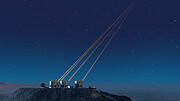
Four lasers for the VLTI

PR Image eso2519b
Artificial stars created by lasers as the VLTI pointed at the Tarantula Nebula

PR Image eso2519c
Closer view of the four lasers for the VLTI

PR Image eso2519d
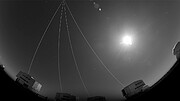
View of the four lasers from the ALPACA camera

PR Image eso2519e
Binary star imaged by GRAVITY+


Videos

Laser trial run kickstarts new era of interferometry | Chasing Starlight
PR Video eso2519a
Laser trial run kickstarts new era of interferometry | Chasing Starlight

Timelapse of the VLTI lasers (colour)
PR Video eso2519b
Timelapse of the VLTI lasers (colour)

Animation of the light path through the VLTI's GRAVITY+ instrument
PR Video eso2519c
Animation of the light path through the VLTI's GRAVITY+ instrument

Timelapse of VLTI lasers
PR Video eso2519d
Timelapse of VLTI lasers


Last week, four lasers were projected into the skies above the European Southern Observatory’s (ESO’s) Paranal site in Chile. The lasers are each used to create an artificial star, which astronomers use to measure and then correct the blur caused by Earth's atmosphere. The striking launch of these lasers, one from each of the eight-metre telescopes at Paranal, is a significant milestone of the GRAVITY+ project — a large and complex upgrade to ESO’s Very Large Telescope Interferometer (VLTI). GRAVITY+ unlocks a greater observing power and a much wider sky coverage for the VLTI than previously possible.

“This is a very important milestone for a facility that is completely unique in the world,” says Antoine Mérand, an ESO astronomer and VLTI Programme Scientist.

The VLTI combines light from several individual telescopes of the VLT (either the four eight-metre Unit Telescopes (UTs) or the four smaller Auxiliary Telescopes) using interferometry. GRAVITY+ is an upgrade to the VLTI, with a focus on GRAVITY, a very successful VLTI instrument that has been used to image exoplanets;observe stars near and far and perform detailed observations of faint objects;orbiting the Milky Way’s supermassive black hole. GRAVITY+ also encompasses infrastructural changes to the telescopes and upgrades to the VLTI underground tunnels, where the light beams are brought together. The installation of a laser at each of the previously unequipped UTs is a key achievement of this long-term project, transforming the VLTI into the most powerful optical interferometer in the world.

“The VLTI with GRAVITY has already enabled so many unpredicted discoveries, we are excited to see how GRAVITY+ will push the boundaries even further,” says GRAVITY+ Principal Investigator Frank Eisenhauer of the Max-Planck Institute for Extraterrestrial Physics (MPE), Germany, which led the consortium carrying out the upgrade. [1]

The series of upgrades has been ongoing for a few years and includes revised adaptive-optics technology — a system to correct the blur caused by the Earth’s atmosphere — with advanced state-of-the-art sensors and deformable mirrors. Until now, for the VLTI, adaptive-optics corrections have been done by pointing to bright reference stars that need to be close to the target, limiting the number of objects we can observe. With the installation of a laser at each of the UTs, a bright artificial star is created 90 km above Earth’s surface, enabling the correction of atmospheric blur anywhere on the sky. This unlocks the whole southern sky to the VLTI and enhances its observing power dramatically.

“This opens up the instrument to observations of objects in the early distant Universe, such as the quasar we observed on the second night where we resolved the hot, oxygen emitting gas very close to the black hole,” says Taro Shimizu, an MPE astronomer who is a member of the instrument consortium. With lasers on the telescopes used by the VLTI, astronomers will be able to study distant active galaxies and directly measure the mass of the supermassive black holes that power them, as well as observe young stars and the planet-forming discs around them.

The VLTI’s improved capabilities will drastically increase the amount of light that can travel through the system, making the facility up to 10 times more sensitive. “A big goal of GRAVITY+ is to allow for deep observations of faint targets,” explains Julien Woillez, an ESO astronomer and GRAVITY+ project scientist. This increased ability to detect dimmer objects will allow observations of isolated stellar black holes, free-floating planets that do not orbit a parent star and stars closest to the Milky Way’s supermassive black hole Sgr A*.

A first target for the GRAVITY+ and ESO teams at Paranal performing test observations using the new lasers was a cluster of massive stars at the centre of the Tarantula Nebula, a star-forming region in our neighbouring galaxy the Large Magellanic Cloud. These first observations revealed that a bright object in the nebula, thought to be an extremely massive single star, is actually a binary of two stars close together. This showcases the stunning capabilities and scientific potential of the upgraded VLTI.

This improvement is beyond just an update and was first envisioned decades ago. The laser system was suggested in the final report of the “Very Large Telescope Project” in 1986 before the VLTI even existed: “If it could work in practice, it would be a breakthrough,” the report stated. Now this breakthrough is a reality.

Source: ESO/News


Notes

[1] The GRAVITY+ consortium consists of the following partners:

  • Max Planck Institute for Extraterrestrial Physics (MPE); Max Planck Institute for Astronomy; University of Cologne (Germany)
  • Institut National des Sciences de l'Univers, French National Centre for Scientific Research; Institut de Planétologie et d'Astrophysique de Grenoble; Laboratoire d’instrumentation et de recherche en astrophysique (LIRA); Lagrange Laboratory; Centre de Recherche Astrophysique de Lyon (France)
  • Instituto Superior Técnico’s Centre for Astrophysics and Gravitation (CENTRA); University of Lisbon; University of Porto (Portugal)
  • University of Southampton (UK)
  • Katholieke Universiteit Leuven (Belgium)
  • University College Dublin (Ireland)
  • Instituto de Astronomia – Universidad Nacional Autónoma de México (Mexico)
  • European Southern Observatory.


More information

The GRAVITY+ Co-Investigators are: Frank Eisenhauer (PI; MPE, Germany), Paulo Garcia (Faculdade de Engenharia, Universidade do Porto and CENTRA research unit, Portugal), Sebastian Hönig (University of Southampton, UK), Laura Kreidberg (Max Planck Institute for Astronomy, Germany), Jean-Baptiste Le Bouquin (Institut de Planétologie et d'Astrophysique de Grenoble, Université Grenoble Alpes, France), Thibaut Paumard (LIRA, Observatoire de Paris, France), Christian Straubmeier (University of Cologne, Germany).

At ESO, the GRAVITY+ upgrade is led by Frederic Gonte (Project Manager), Julien Woillez (Project Scientist), Sylvain Oberti (Project Engineer), and Luis Esteras Otal (VLTI Systems Engineer).

ESO’s Paranal Observatory in Chile is currently under threat by the planned INNA project, set to be located just 11 kilometres from the VLTI. An especially worrying impact from INNA is due to microvibrations since they make combining light in the VLTI tunnels much more challenging. In fact, a detailed technical analysis performed earlier this year revealed that INNA’s wind turbines could produce an increase in ground vibrations large enough to impair VLTI operations. Relocating planned projects such as INNA from the areas surrounding Paranal is key to allowing world-class astronomical facilities to operate at their maximum potential, as well as to protecting a truly special place with pristine dark skies and other conditions that make it an astronomy world-leader.
The European Southern Observatory (ESO) enables scientists worldwide to discover the secrets of the Universe for the benefit of all. We design, build and operate world-class observatories on the ground — which astronomers use to tackle exciting questions and spread the fascination of astronomy — and promote international collaboration for astronomy. Established as an intergovernmental organisation in 1962, today ESO is supported by 16 Member States (Austria, Belgium, Czechia, Denmark, France, Finland, Germany, Ireland, Italy, the Netherlands, Poland, Portugal, Spain, Sweden, Switzerland and the United Kingdom), along with the host state of Chile and with Australia as a Strategic Partner. ESO’s headquarters and its visitor centre and planetarium, the ESO Supernova, are located close to Munich in Germany, while the Chilean Atacama Desert, a marvellous place with unique conditions to observe the sky, hosts our telescopes. ESO operates three observing sites: La Silla, Paranal and Chajnantor. At Paranal, ESO operates the Very Large Telescope and its Very Large Telescope Interferometer, as well as survey telescopes such as VISTA. Also at Paranal, ESO will host and operate the south array of the Cherenkov Telescope Array Observatory, the world’s largest and most sensitive gamma-ray observatory. Together with international partners, ESO operates ALMA on Chajnantor, a facility that observes the skies in the millimetre and submillimetre range. At Cerro Armazones, near Paranal, we are building “the world’s biggest eye on the sky” — ESO’s Extremely Large Telescope. From our offices in Santiago, Chile we support our operations in the country and engage with Chilean partners and society.


Links


Contacts:

Frank Eisenhauer
Max Planck Institute for Extraterrestrial Physics
Garching bei München, Germany
Tel: +49 89 30000 3100
Email:
eisenhau@mpe.mpg.de

Taro Shimizu
Max Planck Institute for Extraterrestrial Physics
Garching bei München, Germany
Tel: +49 89 30000 3392
Email:
shimizu@mpe.mpg.de

Jean-Baptiste Le Bouquin
Institut National des Sciences de l’Univers, CNRS
Grenoble, France
Tel: +33 4 76 14 36 82
Email:
jean-baptiste.lebouquin@univ-grenoble-alpes.fr

Antoine Mérand
European Southern Observatory
Garching bei München, Germany
Tel: +49 89 3200 6630
Email:
amerand@eso.org

Julien Woillez
European Southern Observatory
Garching bei München, Germany
Tel: +49 89 3200 6273
Email:
jwoillez@eso.org

Bárbara Ferreira
ESO Media Manager
Garching bei München, Germany
Tel: +49 89 3200 6670
Cell: +49 151 241 664 00
Email:
press@eso.org


Monday, November 03, 2014

VLTI Detects Exozodiacal Light

Artist’s impression of bright exozodiacal light
 
Zodiacal light seen from Paranal
 
Zodiacal Light over La Silla


*********************

Videos


Artist’s impression of bright exozodiacal light


New challenge for direct imaging of exo-Earths


By using the full power of the Very Large Telescope Interferometer an international team of astronomers has discovered exozodiacal light close to the habitable zones around nine nearby stars. This light is starlight reflected from dust created as the result of collisions between asteroids, and the evaporation of comets. The presence of such large amounts of dust in the inner regions around some stars may pose an obstacle to the direct imaging of Earth-like planets in the future.

Using the Very Large Telescope Interferometer (VLTI) in near-infrared light [1], the team of astronomers observed 92 nearby stars to probe exozodiacal light from hot dust close to their habitable zones and combined the new data with earlier observations [2]. Bright exozodiacal light, created by the glowing grains of hot exozodiacal dust, or the reflection of starlight off these grains, was observed around nine of the targeted stars. 

From dark clear sites on Earth, zodiacal light looks like a faint diffuse white glow seen in the night sky after the end of twilight, or before dawn. It is created by sunlight reflected off tiny particles and appears to extend up from the vicinity of the Sun. This reflected light is not just observed from Earth but can be observed from everywhere in the Solar System. 

The glow being observed in this new study is a much more extreme version of the same phenomenon. While this exozodiacal light — zodiacal light around other star systems — had been previously detected, this is the first large systematic study of this phenomenon around nearby stars. 

In contrast to earlier observations the team did not observe dust that will later form into planets, but dust created in collisions between small planets of a few kilometres in size — objects called planetesimals that are similar to the asteroids and comets of the Solar System. Dust of this kind is also the origin of the zodiacal light in the Solar System.

“If we want to study the evolution of Earth-like planets close to the habitable zone, we need to observe the zodiacal dust in this region around other stars,” said Steve Ertel, lead author of the paper, from ESO and the University of Grenoble in France. “Detecting and characterising this kind of dust around other stars is a way to study the architecture and evolution of planetary systems.”

Detecting faint dust close to the dazzling central star requires high resolution observations with high contrast. Interferometry — combining light collected at the exact same time at several different telescopes — performed in infrared light is, so far, the only technique that allows this kind of system to be discovered and studied. 

By using the power of the VLTI and pushing the instrument to its limits in terms of accuracy and efficiency, the team was able to reach a performance level about ten times better than other available instruments in the world.

For each of the stars the team used the 1.8-metre Auxiliary Telescopes to feed light to the VLTI. Where strong exozodiacal light was present they were able to fully resolve the extended discs of dust, and separate their faint glow from the dominant light of the star [3]. 

By analysing the properties of the stars surrounded by a disc of exozodiacal dust, the team found that most of the dust was detected around older stars. This result was very surprising and raises some questions for our understanding of planetary systems. Any known dust production caused by collisions of planetesimals should diminish over time, as the number of planetesimals is reduced as they are destroyed.

The sample of observed objects also included 14 stars for which the detection of exoplanets has been reported. All of these planets are in the same region of the system as the dust in the systems showing exozodiacal light. The presence of exozodiacal light in systems with planets may create a problem for further astronomical studies of exoplanets.

Exozodiacal dust emission, even at low levels, makes it significantly harder to detect Earth-like planets with direct imaging. The exozodiacal light detected in this survey is a factor of 1000 times brighter than the zodiacal light seen around the Sun. The number of stars containing zodiacal light at the level of the Solar System is most likely much higher than the numbers found in the survey. These observations are therefore only a first step towards more detailed studies of exozodiacal light.

“The high detection rate found at this bright level suggests that there must be a significant number of systems containing fainter dust, undetectable in our survey, but still much brighter than the Solar System’s zodiacal dust,” explains Olivier Absil, co-author of the paper, from the University of Liège. “The presence of such dust in so many systems could therefore become an obstacle for future observations, which aim to make direct images of Earth-like exoplanets.”


Notes


[1] The team used the VLTI visitor instrument PIONIER, which is able to interferometrically connect all four Auxiliary Telescopes or all four Unit Telescopes of the VLT at the Paranal Observatory. This led to not only extremely high resolution of the targets but also allowed for a high observing efficiency. 

[2] Previous observations were made with the CHARA array — an optical astronomical interferometer operated by the Center for High Angular Resolution Astronomy (CHARA) of the Georgia State University, and its fibred beam combiner FLUOR.  

[3] As a by-product, these observations have also led to the discovery of new, unexpected stellar companions orbiting around some of the most massive stars in the sample. "These new companions suggest that we should revise our current understanding of how many of this type of star are actually double," says Lindsay Marion, lead author of an additional paper dedicated to this complementary work using the same data.


More information


This research was presented in a paper “A near-infrared interferometric survey of debris-disc stars. IV. An unbiased sample of 92 southern stars observed in H-band with VLTI/PIONIER”, by S. Ertel et al., to appear in the journal Astronomy & Astrophysics. The complementary paper on companion stars found in the survey is "Searching for faint companions with VLTI/PIONIER. II. 92 main sequence stars from the Exozodi survey", by L. Marion et al., in the same edition of the journal.

The team is composed of S. Ertel (Université Grenoble Alpes, France; ESO, Chile), O. Absil (University of Liège, Belgium), D. Defrère (University of Arizona, USA), J.-B. Le Bouquin (Université Grenoble Alpes), J.-C. Augereau (Université Grenoble Alpes), L. Marion (University of Liège), N. Blind (Max-Planck Institute for Extraterrestrial Physics, Garching, Germany), A. Bonsor (University of Bristol, United Kingdom), G. Bryden (California Institute of Technology, Pasadena, USA), J. Lebreton (California Institute of Technology), and J. Milli (Université Grenoble Alpes)

ESO is the foremost intergovernmental astronomy organisation in Europe and the world’s most productive ground-based astronomical observatory by far. It is supported by 15 countries: Austria, Belgium, Brazil, the Czech Republic, Denmark, France, Finland, Germany, Italy, the Netherlands, Portugal, Spain, Sweden, Switzerland and the United Kingdom. ESO carries out an ambitious programme focused on the design, construction and operation of powerful ground-based observing facilities enabling astronomers to make important scientific discoveries. ESO also plays a leading role in promoting and organising cooperation in astronomical research. ESO operates three unique world-class observing sites in Chile: La Silla, Paranal and Chajnantor. At Paranal, ESO operates the Very Large Telescope, the world’s most advanced visible-light astronomical observatory and two survey telescopes. VISTA works in the infrared and is the world’s largest survey telescope and the VLT Survey Telescope is the largest telescope designed to exclusively survey the skies in visible light. ESO is the European partner of a revolutionary astronomical telescope ALMA, the largest astronomical project in existence. ESO is currently planning the 39-metre European Extremely Large optical/near-infrared Telescope, the E-ELT, which will become “the world’s biggest eye on the sky”.


Links


Contacts


Steve Ertel
European Southern Observatory
Santiago, Chile
Email: sertel@eso.org

Lindsay Marion
University of Liège
Liège, Belgium
Tel: +32 4 366 97 58
Cell: +32 472 347 742
Email: lindsay.marion@ulg.ac.be

Jean-Charles Augereau
Institut de Planétologie et d'Astrophysique de Grenoble (IPAG)
Grenoble, France
Tel: +33 (0)4 76 51 47 86
Email:
Jean-Charles.Augereau@obs.ujf-grenoble.fr


Richard Hook
ESO education and Public Outreach Department
Garching bei München, Germany
Tel: +49 89 3200 6655
Cell: +49 151 1537 3591
Email: rhook@eso.org

Source: ESO