Showing posts with label All-Sky Automated Survey for Supernovae (ASASSN). Show all posts

Monday, May 17, 2021

Supermassive black holes devour gas just like their petite counterparts


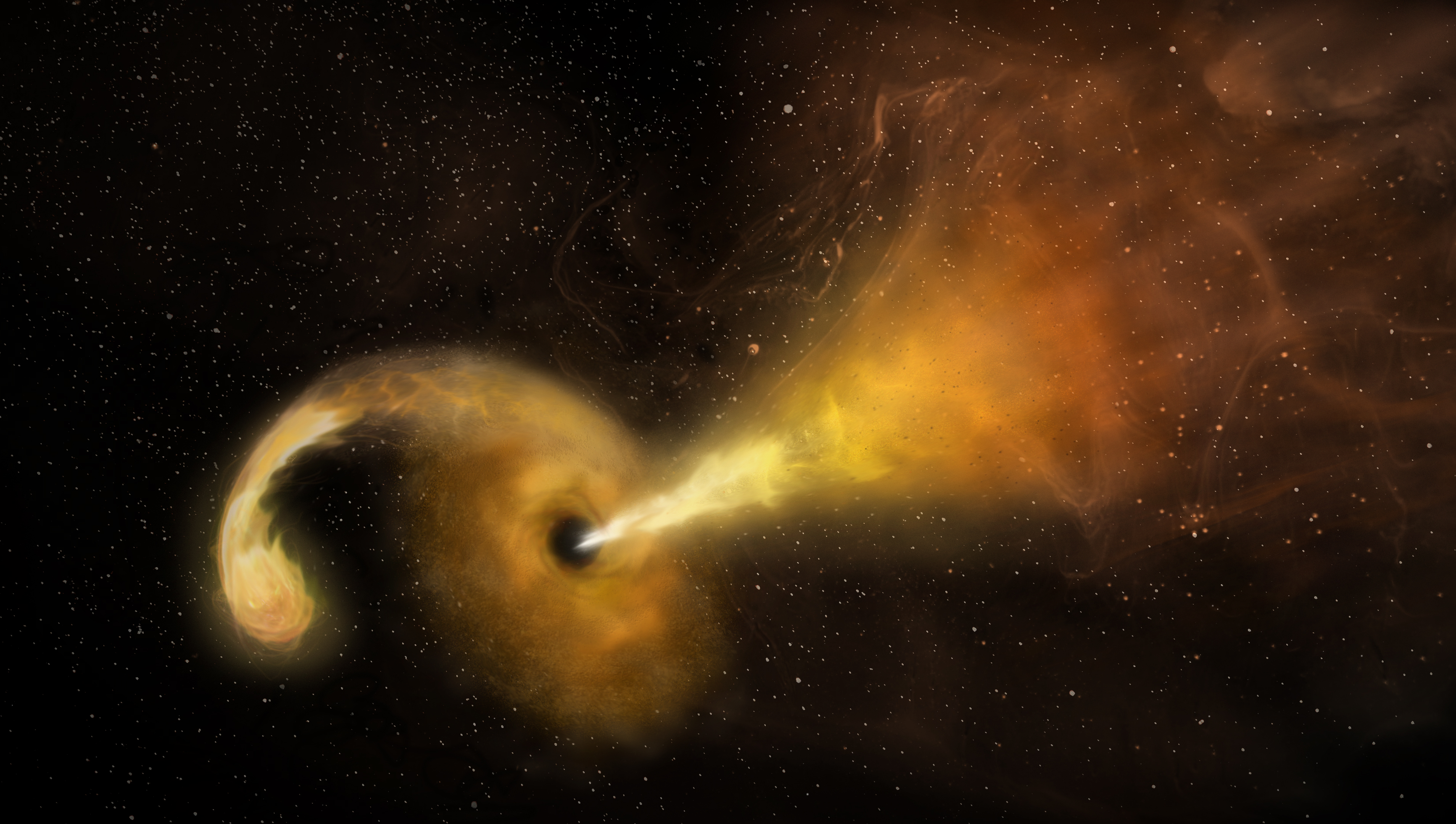
As a supermassive black hole consumed a star, researchers were surprised it exhibited properties that were similar to that of much smaller, stellar-mass black holes.Credits: Image: Christine Daniloff, MIT 

Regardless of size, all black holes experience similar accretion cycles, a new study finds.

On Sept. 9, 2018, astronomers spotted a flash from a galaxy 860 million light years away. The source was a supermassive black hole about 50 million times the mass of the sun. Normally quiet, the gravitational giant suddenly awoke to devour a passing star in a rare instance known as a tidal disruption event. As the stellar debris fell toward the black hole, it released an enormous amount of energy in the form of light.

Researchers at MIT, the European Southern Observatory, and elsewhere used multiple telescopes to keep watch on the event, labeled AT2018fyk. To their surprise, they observed that as the supermassive black hole consumed the star, it exhibited properties that were similar to that of much smaller, stellar-mass black holes.

The results, published today in the Astrophysical Journal, suggest that accretion, or the way black holes evolve as they consume material, is independent of their size.

“We’ve demonstrated that, if you’ve seen one black hole, you’ve seen them all, in a sense,” says study author Dheeraj “DJ” Pasham, a research scientist in MIT’s Kavli Institute for Astrophysics and Space Research. “When you throw a ball of gas at them, they all seem to do more or less the same thing. They’re the same beast in terms of their accretion.”

Pasham’s co-authors include principal research scientist Ronald Remillard and former graduate student Anirudh Chiti at MIT, along with researchers at the European Southern Observatory, Cambridge University, Leiden University, New York University, the University of Maryland, Curtin University, the University of Amsterdam, and the NASA Goddard Space Flight Center.

A stellar wake-up

When small stellar-mass black holes with a mass about 10 times our sun emit a burst of light, it’s often in response to an influx of material from a companion star. This outburst of radiation sets off a specific evolution of the region around the black hole. From quiescence, a black hole transitions into a “soft” phase dominated by an accretion disk as stellar material is pulled into the black hole. As the amount of material influx drops, it transitions again to a “hard” phase where a white-hot corona takes over. The black hole eventually settles back into a steady quiescence, and this entire accretion cycle can last a few weeks to months.

Physicists have observed this characteristic accretion cycle in multiple stellar-mass black holes for several decades. But for supermassive black holes, it was thought that this process would take too long to capture entirely, as these goliaths are normally grazers, feeding slowly on gas in the central regions of a galaxy.

“This process normally happens on timescales of thousands of years in supermassive black holes,” Pasham says. “Humans cannot wait that long to capture something like this.”

But this entire process speeds up when a black hole experiences a sudden, huge influx of material, such as during a tidal disruption event, when a star comes close enough that a black hole can tidally rip it to shreds.

“In a tidal disruption event, everything is abrupt,” Pasham says. “You have a sudden chunk of gas being thrown at you, and the black hole is suddenly woken up, and it’s like, ‘whoa, there’s so much food — let me just eat, eat, eat until it’s gone.’ So, it experiences everything in a short timespan. That allows us to probe all these different accretion stages that people have known in stellar-mass black holes.”

A supermassive cycle

In September 2018, the All-Sky Automated Survey for Supernovae (ASASSN) picked up signals of a sudden flare. Scientists subsequently determined that the flare was the result of a tidal disruption event involving a supermassive black hole, which they labeled TDE AT2018fyk. Wevers, Pasham, and their colleagues jumped at the alert and were able to steer multiple telescopes, each trained to map different bands of the ultraviolet and X-ray spectrum, toward the system.

The team collected data over two years, using X-ray space telescopes XMM-Newton and the Chandra X-Ray Observatory, as well as NICER, the X-ray-monitoring instrument aboard the International Space Station, and the Swift Observatory, along with radio telescopes in Australia.

“We caught the black hole in the soft state with an accretion disk forming, and most of the emission in ultraviolet, with very few in the X-ray,” Pasham says. “Then the disk collapses, the corona gets stronger, and now it’s very bright in X-rays. Eventually there’s not much gas to feed on, and the overall luminosity drops and goes back to undetectable levels.”

The researchers estimate that the black hole tidally disrupted a star about the size of our sun. In the process, it generated an enormous accretion disk, about 12 billion kilometers wide, and emitted gas that they estimated to be about 40,000 Kelvin, or more than 70,000 degrees Fahrenheit. As the disk became weaker and less bright, a corona of compact, high-energy X-rays took over as the dominant phase around the black hole before eventually fading away.

“People have known this cycle to happen in stellar-mass black holes, which are only about 10 solar masses. Now we are seeing this in something 5 million times bigger,” Pasham says.

“The most exciting prospect for the future is that such tidal disruption events provide a window into the formation of complex structures very close to the supermassive black hole such as the accretion disk and the corona,” says lead author Thomas Wevers, a fellow at the European Southern Observatory. “Studying how these structures form and interact in the extreme environment following the destruction of a star, we can hopefully start to better understand the fundamental physical laws that govern their existence.”

In addition to showing that black holes experience accretion in the same way, regardless of their size, the results represent only the second time that scientists have captured the formation of a corona from beginning to end.

“A corona is a very mysterious entity, and in the case of supermassive black holes, people have studied established coronas but don’t know when or how they formed,” Pasham says. “We’ve demonstrated you can use tidal disruption events to capture corona formation. I’m excited about using these events in the future to figure out what exactly is the corona.”

This research was partially supported by the Australian Government through the Australian Research Council's Discovery Projects funding scheme.

Thursday, February 25, 2021

VLA Helps Astronomers Make New Discoveries About Star-Shredding Events

Artist's conception of a Tidal Disruption Event (TDE) -- a star being shredded by the powerful gravity of a supermassive black hole. Material from the star spirals into a disk rotating around the black hole, and a jet of particles is ejected.  Credit: Sophia Dagnello, NRAO/AUI/NSF.Hi-res image

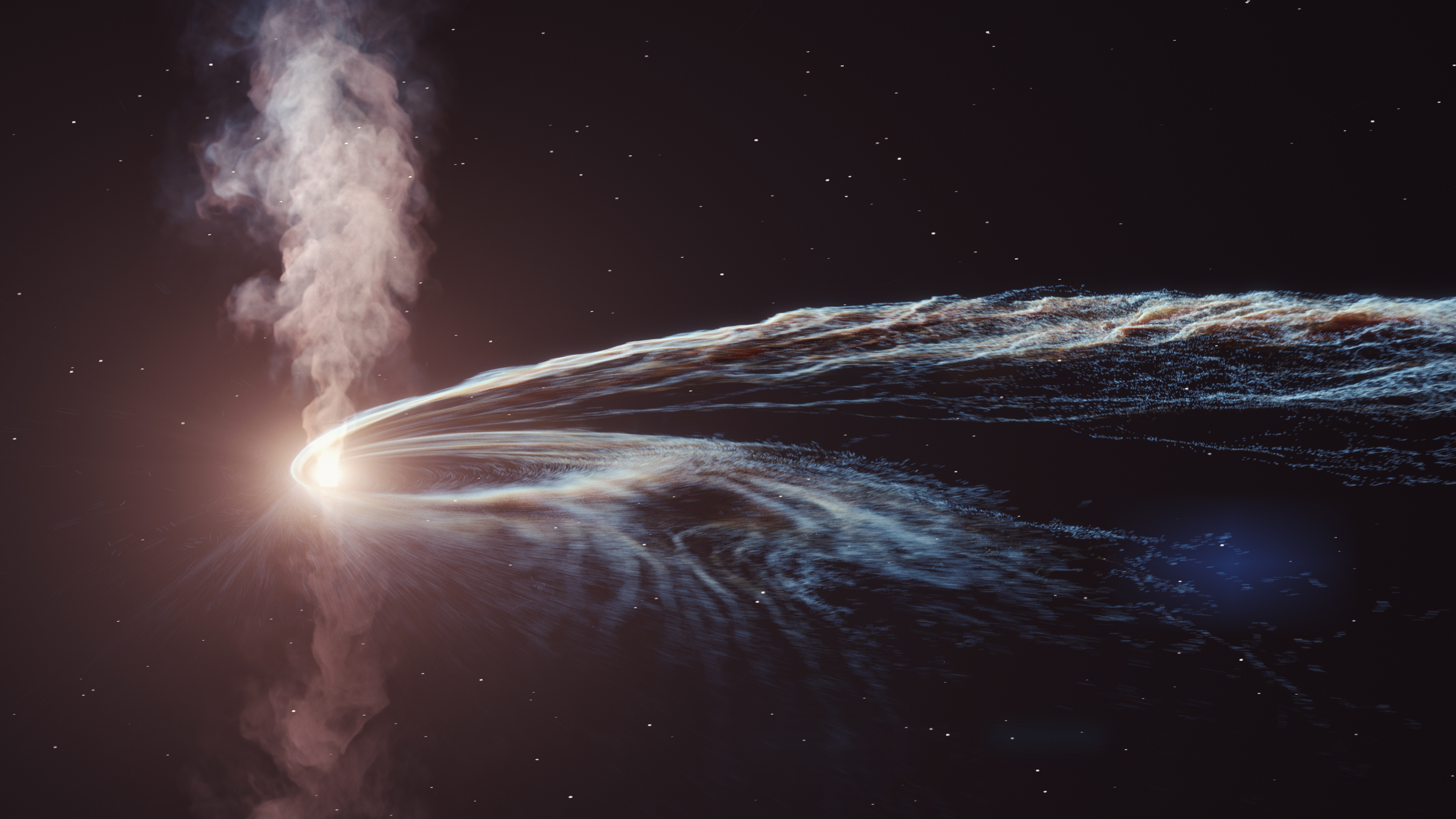
After the supermassive black hole tore the star apart, roughly half of the star debris was flung back out into space, as seen in this artist's conception, while the remainder formed a glowing accretion disc around the black hole. The system shone brightly across many wavelengths and is thought to have produced energetic, jet-like outflows perpendicular to the accretion disc. A central, powerful engine near the accretion disc spewed out these fast subatomic particles. Credit: DESY, Science Communication Lab.
Hi-res image 


This animation shows how, as the star approaches the black hole, the enormous tidal forces stretch it more and more until it is finally shredded. Half of the stellar debris is flung back into space, while the remaining part forms a rotating accretion disk from which two strong outflows of matter shoot up and down. The system acts as a powerful natural particle accelerator. Credit: Animation by DESY, Science Communication Lab

Black holes that are millions or billions of times more massive than the Sun lurk at the cores of large galaxies and can have profound effects on their surroundings. One of the more exciting of those effects comes when a star ventures too close to the black hole and falls victim to that monster’s powerful gravitational pull. The star is shredded by tidal forces in a process colorfully termed spaghettification.

When that happens, some of the star’s material is pulled into a disk that orbits the black hole, heating rapidly and launching jets of fast-moving particles outward in two opposite directions. This produces an outburst that can be observed with a variety of telescopes, including radio, visible, ultraviolet, and X-ray instruments.

Over the past couple of decades, astronomers have seen a number of outbursts that they have concluded are either the star-shredding Tidal Disruption Events (TDEs) or candidates for such events. In 2018, astronomers used the National Science Foundation’s Very Long Baseline Array (VLBA) to directly image the formation and expansion of a jet coming from a TDE.

The 22 February edition of Nature Astronomy includes reports on observations of two different TDEs, each of which adds to our knowledge of these phenomena but also raises new questions for scientists to tackle. The NSF’s Karl G. Jansky Very Large Array (VLA) was used to study both of these events, occurring in 2015 and 2019 respectively.

One of these star-shredding events is the first known to produce a high-energy neutrino — an elusive subatomic particle moving at nearly the speed of light. The other is the first seen to emit flares of radio waves long after the initial event. Both discoveries are forcing astronomers to rethink their explanations for some of the processes involved in TDEs.

The neutrino-producing TDE, called AT2019dsg, was discovered on 9 April 2019 by the Zwicky Transient Facility (ZTF), a robotic optical telescope at the Palomar Observatory in California. Astronomers subsequently observed it with the VLA, NASA’s Neil Geherels Swift Observatory, and the European Space Agency’s XMM-Newton. They found that it occurred in a galaxy called 2MASX J20570298+1412165, more than 690 million light-years from Earth in the constellation Delphinus.

On 1 October, 2019, the NSF’s IceCube Neutrino Observatory in Antarctica detected a high-energy neutrino that came from the same region of sky as the April TDE. Neutrinos are pervasive throughout the universe but are extremely difficult to detect because they very rarely interact with other matter. In fact, this is only the second high-energy neutrino to be linked to an object outside our Milky Way galaxy. The detection was surprising because astronomers had expected that if TDEs produced such neutrinos it would happen relatively soon after the start of the event.

“Astrophysicists have long theorized that tidal disruptions could produce high-energy neutrinos, but this is the first time we’ve actually been able to connect them with observational evidence,” said Robert Stein, a doctoral student at the German Electron-Synchrotron (DESY) research center in Zeuthen, Germany, and Humboldt University in Berlin. “But it seems like this particular event, called AT2019dsg, didn’t generate the neutrino when or how we expected. It’s helping us better understand how these phenomena work.”

The other TDE, called ASASSN-15oi, was discovered at visible-light wavelengths by the All-Sky Automated Survey for SuperNovae (ASASSN) on 14 August 2015, in a galaxy more than 700 million light-years from Earth. Astronomers began observing it with the VLA eight days after its discovery, expecting to detect radio emission in the early stages of the event. Instead, they saw no radio emission from the object until six months later, in February of 2016.

In addition, they later learned that the ongoing VLA Sky Survey observed the region in July of 2019 and found evidence of another radio flare then, nearly four years after the initial event. The astronomers called the two delayed flares “a new puzzling phenomenon in TDEs.”

“Flares with such delays have not been observed before. Moreover, the delayed flares exhibit peculiar properties currently not supported by theories of TDE radio emission,” said Assaf Horesh, of the Hebrew University of Jerusalem.

In both cases, the researchers look forward to studying future TDEs for clues that can help resolve the new mysteries their work has unveiled. These dramatic events are an excellent example of how we can advance our understanding of the universe through multimessenger astronomy — studies that use electromagnetic radiation (visible light, radio waves, ultraviolet, etc.), particles such as neutrinos, and even gravitational waves — ripples in spacetime — to learn how cosmic objects work.

###

Link to TDE Neutrino paper

Link to Delayed Radio Flares pape

Source:  National Radio Astronomy Observatory (NRAO)/News


Friday, September 27, 2019

NASA’s TESS Mission Spots Its 1st Star-shredding Black Hole

This illustration shows a tidal disruption, which occurs when a passing star gets too close to a black hole and is torn apart into a stream of gas. Some of the gas eventually settles into a structure around the black hole called an accretion disk. Credit: NASA's Goddard Space Flight Center

For the first time, NASA’s planet-hunting Transiting Exoplanet Survey Satellite (TESS) watched a black hole tear apart a star in a cataclysmic phenomenon called a tidal disruption event. Follow-up observations by NASA’s Neil Gehrels Swift Observatory and other facilities have produced the most detailed look yet at the early moments of one of these star-destroying occurrences.

“TESS data let us see exactly when this destructive event, named ASASSN-19bt, started to get brighter, which we’ve never been able to do before,” said Thomas Holoien, a Carnegie Fellow at the Carnegie Observatories in Pasadena, California. “Because we identified the tidal disruption quickly with the ground-based All-Sky Automated Survey for Supernovae (ASAS-SN), we were able to trigger multiwavelength follow-up observations in the first few days. The early data will be incredibly helpful for modeling the physics of these outbursts.”

A paper describing the findings, led by Holoien, was published in the Sept. 27, 2019, issue of The Astrophysical Journal and is now available online.

When a star strays too close to a black hole, intense tides break it apart into a stream of gas. The tail of the stream escapes the system, while the rest of it swings back around, surrounding the black hole with a disk of debris. This video includes images of a tidal disruption event called ASASSN-19bt taken by NASA’s Transiting Exoplanet Survey Satellite (TESS) and Swift missions, as well as an animation showing how the event unfolded. Credits: NASA's Goddard Space Flight Center. Download this video in HD formats from NASA Goddard's Scientific Visualization Studio

ASAS-SN, a worldwide network of 20 robotic telescopes headquartered at Ohio State University (OSU) in Columbus, discovered the event on Jan. 29. Holoien was working at the Las Campanas Observatory in Chile when he received the alert from the project’s South Africa instrument. Holoien quickly trained two Las Campanas telescopes on ASASSN-19bt and then requested follow-up observations by Swift, ESA’s (European Space Agency’s) XMM-Newton and ground-based 1-meter telescopes in the global Las Cumbres Observatory network.

TESS, however, didn’t need a call to action because it was already looking at the same area. The planet hunter monitors large swaths of the sky, called sectors, for 27 days at a time. This lengthy view allows TESS to observe transits, periodic dips in a star’s brightness that may indicate orbiting planets.

ASAS-SN began spending more time looking at TESS sectors when the satellite started science operations in July 2018. Astronomers anticipated TESS could catch the earliest light from short-lived stellar outbursts, including supernovae and tidal disruptions. TESS first saw ASASSN-19bt on Jan. 21, over a week before the event was bright enough for ASAS-SN to detect it. However, the satellite only transmits data to Earth every two weeks, and once received they must be processed at NASA’s Ames Research Center in Silicon Valley, California. So the first TESS data on the tidal disruption were not available until March 13. This is why obtaining early follow-up observations of these events depends on coordination by ground-based surveys like ASAS-SN.

Fortunately, the disruption also occurred in TESS’s southern continuous viewing zone, which was always in sight of one of the satellite’s four cameras. (TESS shifted to monitoring the northern sky at the end of July.) ASASSN-19bt’s location allowed Holoien and his colleagues to follow the event across several sectors. If it had occurred outside this zone, TESS might have missed the beginning of the outburst.

“The early TESS data allow us to see light very close to the black hole, much closer than we’ve been able to see before,” said Patrick Vallely, a co-author and National Science Foundation Graduate Research Fellow at OSU. “They also show us that ASASSN-19bt’s rise in brightness was very smooth, which helps us tell that the event was a tidal disruption and not another type of outburst, like from the center of a galaxy or a supernova.”

Holoien’s team used UV data from Swift — the earliest yet seen from a tidal disruption — to determine that the temperature dropped by about 50%, from around 71,500 to 35,500 degrees Fahrenheit (40,000 to 20,000 degrees Celsius), over a few days. It’s the first time such an early temperature decrease has been seen in a tidal disruption before, although a few theories have predicted it, Holoien said.

More typical for these kinds of events was the low level of X-ray emission seen by both Swift and XMM-Newton. Scientists don’t fully understand why tidal disruptions produce so much UV emission and so few X-rays.

“People have suggested multiple theories — perhaps the light bounces through the newly created debris and loses energy, or maybe the disk forms further from the black hole than we originally thought and the light isn’t so affected by the object’s extreme gravity,” said S. Bradley Cenko, Swift’s principal investigator at NASA’s Goddard Space Flight Center in Greenbelt, Maryland. “More early-time observations of these events may help us answer some of these lingering questions.”

Astronomers think the supermassive black hole that generated ASASSN-19bt weighs around 6 million times the Sun’s mass. It sits at the center of a galaxy called 2MASX J07001137-6602251 located around 375 million light-years away in the constellation Volans. The destroyed star may have been similar in size to our Sun.

Tidal disruptions are incredibly rare, occurring once every 10,000 to 100,000 years in a galaxy the size of our own Milky Way. Supernovae, by comparison, happen every 100 years or so. In total, astronomers have observed only about 40 tidal disruptions so far, and scientists predicted TESS would see only one or two in its initial two-year mission.

“For TESS to observe ASASSN-19bt so early in its tenure, and in the continuous viewing zone where we could watch it for so long, is really quite extraordinary,” said Padi Boyd, the TESS project scientist at Goddard. “Future collaborations with observatories around the world and in orbit will help us learn even more about the different outbursts that light up the cosmos.”

TESS is a NASA Astrophysics Explorer mission led and operated by MIT in Cambridge, Massachusetts, and managed by NASA's Goddard Space Flight Center. Additional partners include Northrop Grumman, based in Falls Church, Virginia; NASA’s Ames Research Center in California’s Silicon Valley; the Harvard-Smithsonian Center for Astrophysics in Cambridge, Massachusetts; MIT’s Lincoln Laboratory; and the Space Telescope Science Institute in Baltimore. More than a dozen universities, research institutes and observatories worldwide are participants in the mission.

NASA's Goddard Space Flight Center manages the Swift mission in collaboration with Penn State in University Park, the Los Alamos National Laboratory in New Mexico and Northrop Grumman Innovation Systems in Dulles, Virginia. Other partners include the University of Leicester and Mullard Space Science Laboratory of the University College London in the United Kingdom, Brera Observatory and ASI.

By Jeanette Kazmierczak
NASA’s Goddard Space Flight Center, Greenbelt, Md.

Press Contacts

Claire Andreoli
claire.andreoli@nasa.gov, (301) 286-1940
NASA’s Goddard Space Flight Center, Greenbelt, Md.

Natasha Metzler
nmetzler@carnegiescience.edu, (202) 939-1142
Carnegie Institution, Strategic Communications

Laura Arenschield
Arenschield.2@osu.edu
The Ohio State University, Research Communications

Editor: Rob Garner

Source: NASA/TESS


Tuesday, December 04, 2018

Double Trouble: A White Dwarf Surprises Astronomers

ASASSN-16oh
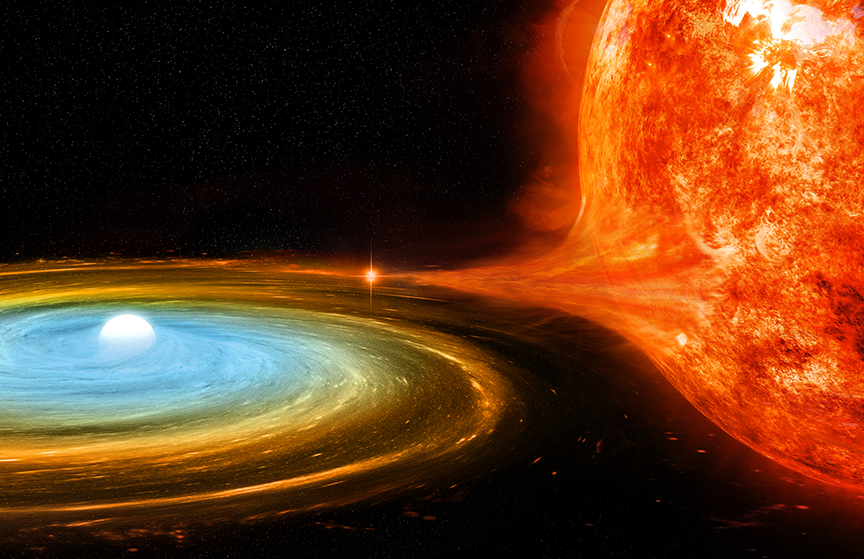
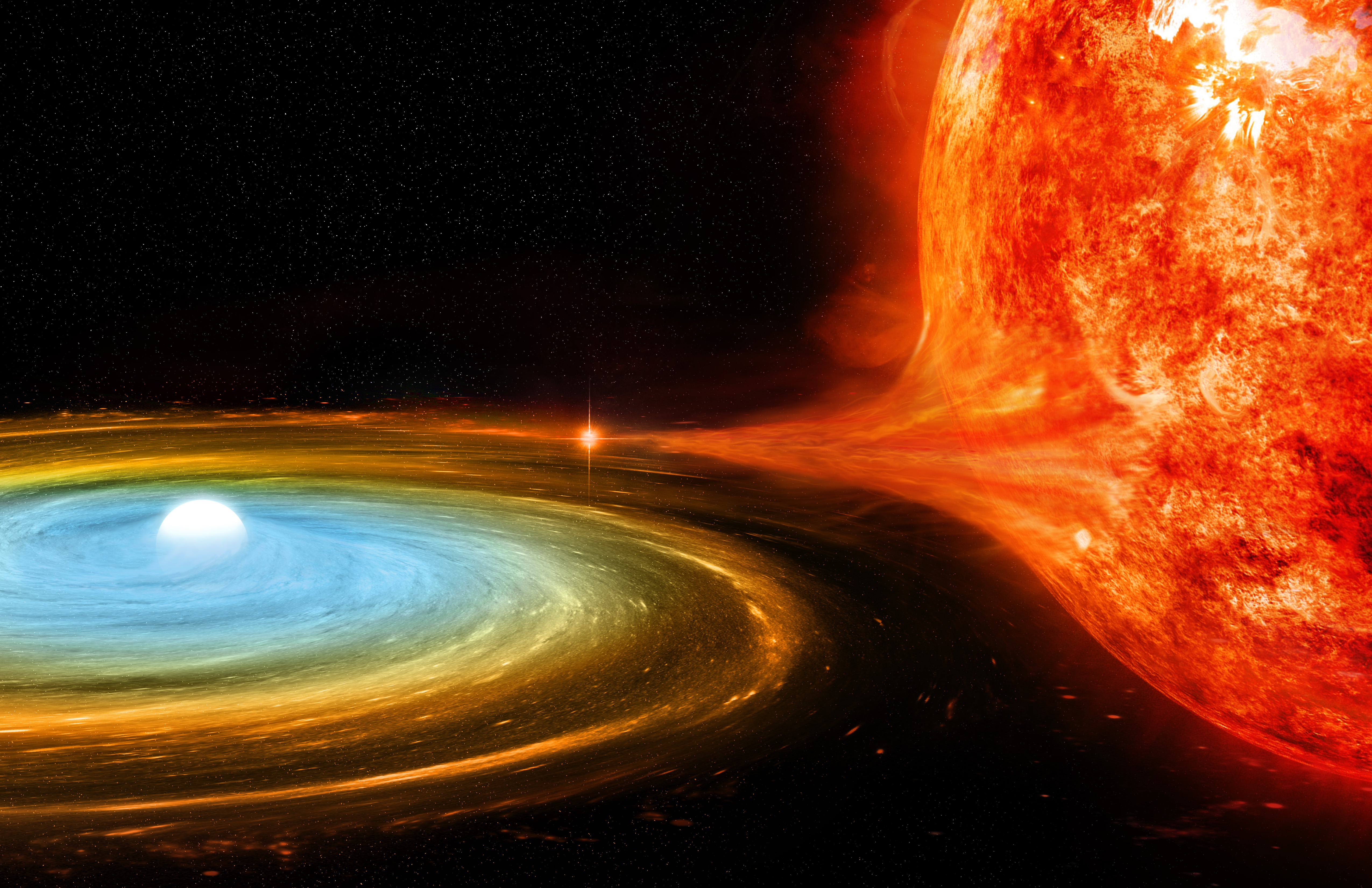
Illustration Credit NASA/CXC/M.Weiss


Astronomers have detected a bright X-ray outburst from a star in the Small Magellanic Cloud, a nearby galaxy almost 200,000 light years from Earth. A combination of X-ray and optical data indicate that the source of this radiation is a white dwarf star that may be the fastest-growing white dwarf ever observed.

In several billion years, our Sun will run out of most of its nuclear fuel and shrink down to a much smaller, fainter "white dwarf" star about the size of Earth. Because a mass equivalent to that of the Sun is packed into such a small volume, the gravity on the surface of a white dwarf is several hundred thousand times that of Earth.

Unlike our Sun, most stars including white dwarfs, do not exist in isolation, but instead are part of pairs called "binary systems." If the stars are close enough, the gravity of the white dwarf can pull matter away from its companion. 

A new study based on observations with NASA's Chandra X-ray Observatory and Neil Gehrels Swift Observatory has reported the discovery of distinctive X-ray emission from a binary system containing a white dwarf called ASASSN-16oh. The discovery involves the detection of low-energy — what astronomers refer to as "soft" — X-rays, produced by gas at temperatures of several hundred thousand degrees. In contrast, higher-energy X-rays reveal phenomena at temperatures of tens of millions of degrees. The X-ray emission from ASASSN-16oh is much brighter than the soft X-rays produced by the atmospheres of normal stars, placing it in the special category of a supersoft X-ray source. 

For years, astronomers have thought that supersoft X-ray emission from white dwarf stars is produced by nuclear fusion in a hot, dense layer of hydrogen and helium nuclei. This volatile material accumulated from the infall of matter from the companion star onto the surface of the white dwarf, and led to a nuclear fusion explosion much like a hydrogen bomb. 

However, ASASSN-16oh shows there is more to the story. This binary was first discovered by the All-Sky Automated Survey for Supernovae (ASASSN), a collection of about 20 optical telescopes distributed around the globe to automatically survey the entire sky every night for supernovas and other transient events. Astronomers then used Chandra and Swift to detect the supersoft X-ray emission. 

"In the past, the supersoft sources have all been associated with nuclear fusion on the surface of white dwarfs," said lead author Tom Maccarone, a professor in the Texas Tech Department of Physics & Astronomy who led the new paper that appears in the December 3rd issue of Nature Astronomy.

If nuclear fusion is the cause of the supersoft X-rays from ASASSN-16oh then it should begin with an explosion and the emission should come from the entire surface of the white dwarf. However, the optical light does not increase quickly enough to be caused by an explosion and the Chandra data show that the emission is coming from a region smaller than the surface of the white dwarf. The source is also a hundred times fainter in optical light than white dwarfs known to be undergoing fusion on their surface. These observations, plus the lack of evidence for gas flowing away from the white dwarf, provide strong arguments against fusion having taken place on the white dwarf.

Because none of the signs of nuclear fusion are present, the authors present a different scenario. As with the fusion explanation the white dwarf is pulling gas away from a companion star, a red giant. In a process called accretion, the gas is pulled onto a large disk surrounding the white dwarf and becomes hotter as it spirals toward the white dwarf, as shown in our illustration. The gas then falls onto the white dwarf, producing X-rays along a belt where the disk meets the star. The rate of inflow of matter through the disk varies by a large amount. When the material starts flowing more quickly, the X-ray brightness of the system becomes much higher.

"The transfer of mass is happening at a higher rate than in any system we've caught in the past," added Maccarone.

If the white dwarf keeps gaining mass it may reach a mass limit and destroy itself in a Type Ia supernova explosion, a type of event used to discover that the expansion of the universe is accelerating. The team's analysis suggests that the white dwarf is already unusually massive so ASASSN-16oh may be relatively close — in astronomical terms — to exploding as a supernova.

"Our result contradicts a decades-long consensus about how supersoft X-ray emission from white dwarfs is produced," said co-author Thomas Nelson from the University of Pittsburgh. "We now know that the X-ray emission can be made in two different ways: by nuclear fusion or by the accretion of matter from a companion."

Also involved in the study were scientists from Texas A&M University, NASA Goddard Space Flight Center, University of Southampton, University of the Free State in the Republic of South Africa, the South African Astronomical Observatory, Michigan State University, State University of New Jersey, Warsaw University Observatory, Ohio State University and the University of Warwick.

NASA's Marshall Space Flight Center in Huntsville, Alabama, manages the Chandra program for NASA's Science Mission Directorate in Washington. The Smithsonian Astrophysical Observatory in Cambridge, Massachusetts, controls Chandra's science and flight operations.


Fast Facts for ASASSN-16oh:

Category: White Dwarfs & Planetary Nebulas
Coordinates (J2000): RA 1h 57m 43s | Dec -73° 37´ 32.5"
Constellation: Tucana
Observation Date: December 28, 2016
Observation Time: 13 hours 36 minutes
Obs. ID: 19983
Instrument: HRC
References: Maccarone, T et al, 2018, Nature Astronomy (published Dec 3rd)
Distance Estimate: About 200,000 light years