Showing posts with label Messier 1. Show all posts

Friday, February 12, 2021

Spectacular ‘honeycomb heart’ revealed in iconic stellar explosion

3D reconstruction of the Crab nebula remnant as seen from Earth (right), and from another point of view showing its heart-shaped morphology (left). Thomas Martin, Danny Milisavljevic and Laurent Drissen. Licence type Attribution (CC BY 4.0)

A unique ‘heart-shape’, with wisps of gas filaments showing an intricate honeycomb-like arrangement, has been discovered at the centre of the iconic supernova remnant, the Crab Nebula. Astronomers have mapped the void in unprecedented detail, creating a realistic three-dimensional reconstruction. The new work is published in Monthly Notices of the Royal Astronomical Society .

The Crab, formally known as Messier 1, exploded as a dramatic supernova in 1054 CE, and was observed over the subsequent months and years by ancient astronomers across the world. The resulting nebula - the remnant of this enormous explosion - has been studied by amateur and professional astronomers for centuries. However, despite this rich history of investigation, many questions remain about what type of star was originally there and how the original explosion took place.

Thomas Martin, the researcher at Université Laval who led the study, hopes to answer these questions using a new 3D reconstruction of the nebula. “Astronomers will now be able to move around and inside the Crab Nebula and study its filaments one by one,” said Martin.

The team used the powerful SITELLE imaging spectrometer on the Canada-Hawaii-France Telescope (CFHT) in Mauna Kea, Hawaii, to compare the 3D shape of the Crab to two other supernova remnants. Remarkably, they found that all three remnants had ejecta arranged in large-scale rings, suggesting a history of turbulent mixing and radioactive plumes expanding from a collapsed iron core.

Co-author Dan Milisavljevic, an assistant professor at Purdue University and supernova expert, concludes that the fascinating morphology of the Crab seems to go against the most popular explanation of the original explosion.

“The Crab is often understood as being the result of an electron-capture supernova triggered by the collapse of an oxygen-neon-magnesium core, but the observed honeycomb structure may not be consistent with this scenario,” Milisavljevic said.

The new reconstruction was made possible by the ground-breaking technology used by SITELLE, which incorporates a Michelson interferometer design allowing scientists to obtain over 300,000 high-resolution spectra of every single point of the nebula.

“SITELLE was designed with objects like the Crab Nebula in mind; but its wide field of view and adaptability make it ideal to study nearby galaxies and even clusters of galaxies at large distances,” said co-author Laurent Drissen.

Supernova explosions are among the most energetic and influential phenomena in the universe. Consequently, Milisavljevic adds: “It is vital that we understand the fundamental processes in supernovae which make life possible. SITELLE will play a new and exciting role in this understanding.”


This 3D reconstruction of the Crab Nebula is made of 406,472 individual points where nebular emission has been detected in SITELLE spectra. The velocity of each element has been translated into a spatial position by assuming an unaccelerated outward motion. The glowing blue sphere at the centre is artificial and simulates the continuum emitted by the pulsar wind nebula. The Milky Way background (credit: NASA / Goddard Space Flight Center Scientific Visualization Studio) simulates the perspective as observed when moving around the nebula. The soundtrack is a sonification of the data set: using the interferograms directly as a sound wave, multiple samples have been mixed and played at different rates. The sound volume is proportional to the distance to the nebula, and the playing speed simulates the Doppler effect.  Credit: Thomas Martin, Danny Milisavljevic and Laurent Drissen.


Source: Royal Astronomical Society (RAS)/News


Media Contacts

Dr Morgan Hollis
Royal Astronomical Society
Mob: +44 (0)7802 877 700

press@ras.ac.uk

Dr Robert Massey
Royal Astronomical Society
Mob: +44 (0)7802 877 699

press@ras.ac.uk

Science Contacts

Dr Thomas Martin
Université Laval
Quebec City
Canada

thomas.martin.1@ulaval.ca

Dr Dan Milisavljevic
Purdue University
Indiana
USA

dmilisav@purdue.edu

Dr Laurent Drissen
Université Laval
Quebec City
Canada

ldrissen@phy.ulaval.ca


Further Information

The new work appears in, “3D mapping of the Crab Nebula with SITELLE. I. Deconvolution and kinematic reconstruction”, T. Martin, L. Drissen, D. Milisavljevic, Monthly Notices of the Royal Astronomical Society (2021), in press (DOI: 10.1093/mnras/staa4046).

The paper is available from: https://doi.org/10.1093/mnras/staa4046

 SITELLE is the result of a joint collaboration between Université Laval, ABB Inc.-Québec, Université de Montréal and the CFHT, under the scientific leadership of co-author Laurent Drissen.

Notes for Editor

The Royal Astronomical Society (RAS), founded in 1820, encourages and promotes the study of astronomy, solar-system science, geophysics and closely related branches of science. The RAS organises scientific meetings, publishes international research and review journals, recognises outstanding achievements by the award of medals and prizes, maintains an extensive library, supports education through grants and outreach activities and represents UK astronomy nationally and internationally. Its more than 4,400 members (Fellows), a third based overseas, include scientific researchers in universities, observatories and laboratories as well as historians of astronomy and others.

The RAS accepts papers for its journals based on the principle of peer review, in which fellow experts on the editorial boards accept the paper as worth considering. The Society issues press releases based on a similar principle, but the organisations and scientists concerned have overall responsibility for their content.


Friday, April 19, 2019

Hubble Celebrates its 29th Birthday with Unrivaled View of the Southern Crab Nebula

The Crab of the Southern Sky

Southern Crab Nebula

Formation of the Southern Crab Nebula (artist's impression)


Videos

Hubblecast 119: Hubble’s 29th anniversary

Zooming in on the Southern Crab Nebula

Formation of the Southern Crab Nebula


This incredible image of the hourglass-shaped Southern Crab Nebula was taken to mark the NASA/ESA Hubble Space Telescope’s 29th anniversary in space. The nebula, created by a binary star system, is one of the many objects that Hubble has demystified throughout its productive life. This new image adds to our understanding of the nebula and demonstrates the telescope’s continued capabilities.

On 24 April 1990, the NASA/ESA Hubble Space Telescope was launched on the space shuttle Discovery. It has since revolutionised how astronomers and the general public see the Universe. The images it provides are spectacular from both a scientific and a purely aesthetic point of view.

Each year the telescope dedicates a small portion of its precious observing time to take a special anniversary image, focused on capturing particularly beautiful and meaningful objects. This year’s image is the Southern Crab Nebula, and it is no exception [1].

This peculiar nebula, which exhibits nested hourglass-shaped structures, has been created by the interaction between a pair of stars at its centre. The unequal pair consists of a red giant and a white dwarf. The red giant is shedding its outer layers in the last phase of its life before it too lives out its final years as a white dwarf. Some of the red giant’s ejected material is attracted by the gravity of its companion.

When enough of this cast-off material is pulled onto the white dwarf, it too ejects the material outwards in an eruption, creating the structures we see in the nebula. Eventually, the red giant will finish throwing off its outer layers, and stop feeding its white dwarf companion. Prior to this, there may also be more eruptions, creating even more intricate structures
Astronomers did not always know this, however. The object was first written about in 1967, but was assumed to be an ordinary star until 1989, when it was observed using telescopes at the European Southern Observatory’s La Silla Observatory. The resulting image showed a roughly crab-shaped extended nebula, formed by symmetrical bubbles of gas and dust.

These observations only showed the outer hourglass emanating from a bright central region that could not be resolved. It was not until Hubble observed the Southern Crab in 1999 that the entire structure came into view. This image revealed the inner nested structures, suggesting that the phenomenon that created the outer bubbles had occurred twice in the (astronomically) recent past.

It is fitting that Hubble has returned to this object twenty years after its first observation. This new image adds to the story of an active and evolving object and contributes to the story of Hubble’s role in our evolving understanding of the Universe.


Notes

[1] The Southern Crab Nebula is so named to distinguish it from the better-known Crab Nebula, a supernova remnant visible in the constellation of Taurus.


More Information

  • The Hubble Space Telescope is a project of international cooperation between ESA and NASA.
  • Image credit: NASA, ESA, and STScI


Links


Contacts

Bethany Downer
ESA/Hubble, Public Information Officer
Garching, Germany
Email: bethany.downer@partner.eso.org


Thursday, October 27, 2016

A Dead Star's Ghostly Glow

The eerie glow of a dead star, which exploded long ago as a supernova, reveals itself in this NASA Hubble Space Telescope image of the Crab Nebula. But don't be fooled. The ghoulish-looking object still has a pulse. Buried at its center is the star's tell-tale heart, which beats with rhythmic precision.

Astronomers discovered a real "tell-tale heart" in space, 6,500 light-years from Earth. The "heart" is the crushed core of a long-dead star, called a neutron star, which exploded as a supernova and is now still beating with rhythmic precision. Evidence of its heartbeat are rapid-fire, lighthouse-like pulses of energy from the fast-spinning neutron star. The stellar relic is embedded in the center of the Crab Nebula, the expanding, tattered remains of the doomed star. Credits: NASA and ESA, Acknowledgment: M. Weisskopf/Marshall Space Flight Center

This time-lapse movie of the Crab Nebula, made from NASA Hubble Space Telescope observations, reveals wave-like structures expanding outward from the "heart" of an exploded star. The waves look like ripples in a pond. The heart is the crushed core of the exploded star, or supernova. Called a neutron star, it has about the same mass as the sun but is squeezed into an ultra-dense sphere that is only a few miles across and 100 billion times stronger than steel. This surviving relic is a tremendous dynamo, spinning 30 times a second. The rapidly spinning neutron star is visible in the image as the bright object just below center. The bright object to the left of the neutron star is a foreground or background star. The movie is assembled from 10 Hubble exposures taken between September and November 2005 by the Advanced Camera for Surveys.  Credits: NASA and ESA, Acknowledgment: J. Hester (Arizona State University)


The "heart" is the crushed core of the exploded star. Called a neutron star, it has about the same mass as the sun but is squeezed into an ultra-dense sphere that is only a few miles across and 100 billion times stronger than steel. The tiny powerhouse is the bright star-like object near the center of the image.
This surviving remnant is a tremendous dynamo, spinning 30 times a second. The wildly whirling object produces a deadly magnetic field that generates an electrifying 1 trillion volts. This energetic activity unleashes wisp-like waves that form an expanding ring, most easily seen to the upper right of the pulsar.

The nebula's hot gas glows in radiation across the electromagnetic spectrum, from radio to X-rays. The Hubble exposures were taken in visible light as black-and-white exposures. The Advanced Camera for Surveys made the observations between January and September 2012. The green hue has been added to give the image a Halloween theme.

The Crab Nebula is one of the most historic and intensively studied supernova remnants. Observations of the nebula date back to 1054 A.D., when Chinese astronomers first recorded seeing a "guest star" during the daytime for 23 days. The star appeared six times brighter than Venus. Japanese, Arabic, and Native American stargazers also recorded seeing the mystery star. In 1758, while searching for a comet, French astronomer Charles Messier discovered a hazy nebula near the location of the long-vanished supernova. He later added the nebula to his celestial catalog as "Messier 1," marking it as a "fake comet." Nearly a century later British astronomer William Parsons sketched the nebula. Its resemblance to a crustacean led to M1's other name, the Crab Nebula. In 1928 astronomer Edwin Hubble first proposed associating the Crab Nebula to the Chinese "guest star" of 1054.

The nebula, bright enough to be visible in amateur telescopes, is located 6,500 light-years away in the constellation Taurus.


Ray Villard
Space Telescope Science Institute, Baltimore, Maryland
Villard@stsci.edu
410-338-4514

Editor: Karl Hille


Saturday, April 23, 2016

Microscopic "Timers" Reveal Likely Source of Galactic Space Radiation

A cluster of massive stars seen with the Hubble Space Telescope. The cluster is surrounded by clouds of interstellar gas and dust called a nebula. The nebula, located 20,000 light-years away in the constellation Carina, contains the central cluster of huge, hot stars, called NGC 3603. Credits: NASA/U. Virginia/INAF, Bologna, Italy/USRA/Ames/STScI/AURA.  Full caption


Most of the cosmic rays that we detect at Earth originated relatively recently in nearby clusters of massive stars, according to new results from NASA's Advanced Composition Explorer (ACE) spacecraft. ACE allowed the research team to determine the source of these cosmic rays by making the first observations of a very rare type of cosmic ray that acts like a tiny timer, limiting the distance the source can be from Earth.

"Before the ACE observations, we didn't know if this radiation was created a long time ago and far, far away, or relatively recently and nearby," said Eric Christian of NASA's Goddard Space Flight Center in Greenbelt, Maryland. Christian is co-author of a paper on this research published April 21 in Science.

Cosmic rays are high-speed atomic nuclei with a wide range of energy -- the most powerful race at almost the speed of light. Earth's atmosphere and magnetic field shield us from less-energetic cosmic rays, which are the most common. However, cosmic rays will present a hazard to unprotected astronauts traveling beyond Earth's magnetic field because they can act like microscopic bullets, damaging structures and breaking apart molecules in living cells. NASA is currently researching ways to reduce or mitigate the effects of cosmic radiation to protect astronauts traveling to Mars.

Cosmic rays are produced by a variety of violent events in space. Most cosmic rays originating within our solar system have relatively low energy and come from explosive events on the Sun, like flares and coronal mass ejections. The highest-energy cosmic rays are extremely rare and are thought to be powered by massive black holes gorging on matter at the center of other galaxies. The cosmic rays that are the subject of this study come from outside our solar system but within our Galaxy and are called galactic cosmic rays. They are thought to be generated by shock waves from exploding stars called supernovae.

The galactic cosmic rays detected by ACE that allowed the team to estimate the age of the cosmic rays, and the distance to their source, contain a radioactive form of iron called Iron-60 (60Fe). It is created inside massive stars when they explode and then blasted into space by the shock waves from the supernova. Some 60Fe in the debris from the destroyed star is accelerated to cosmic-ray speed when another nearby massive star in the cluster explodes and its shock wave collides with the remnants of the earlier stellar explosion.

60Fe galactic cosmic rays zip through space at half the speed of light or more, about 90,000 miles per second. This seems very fast, but the 60Fe cosmic rays won't travel far on a galactic scale for two reasons. First, they can't travel in straight lines because they are electrically charged and respond to magnetic forces. Therefore they are forced to take convoluted paths along the tangled magnetic fields in our Galaxy. Second, 60Fe is radioactive and over a period of about 2.6 million years, half of it will self-destruct, decaying into other elements (Cobalt-60 and then Nickel-60). If the 60Fe cosmic rays were created hundreds of millions of years or more ago, or very far away, eventually there would be too little left for the ACE spacecraft to detect.

"Our detection of radioactive cosmic-ray iron nuclei is a smoking gun indicating that there has likely been more than one supernova in the last few million years in our neighborhood of the Galaxy," said Robert Binns of Washington University, St. Louis, Missouri, lead author of the paper.

"In 17 years of observing, ACE detected about 300,000 galactic cosmic rays of ordinary iron, but just 15 of the radioactive Iron-60," said Christian. "The fact that we see any Iron-60 at all means these cosmic ray nuclei must have been created fairly recently (within the last few million years) and that the source must be relatively nearby, within about 3,000 light years, or approximately the width of the local spiral arm in our Galaxy." A light year is the distance light travels in a year, almost six trillion miles. A few thousand light years is relatively nearby because the vast swarm of hundreds of billions of stars that make up our Galaxy is about 100,000 light years wide.

There are more than 20 clusters of massive stars within a few thousand light years, including Upper Scorpius (83 stars), Upper Centaurus Lupus (134 stars), and Lower Centaurus Crux (97 stars). These are very likely major contributors to the 60Fe that ACE detected, owing to their size and proximity, according to the research team.

ACE was launched on August 25, 1997 to a point 900,000 miles away between Earth and the Sun where it has acted as a sentinel, detecting space radiation from solar storms, the Galaxy, and beyond. This research was funded by NASA's ACE program.

Additional co-authors on this paper were: Martin Israel and Kelly Lave at Washington University, St. Louis, Missouri; Alan Cummings, Rick Leske, Richard Mewaldt and Ed Stone at Caltech in Pasadena, California; Georgia de Nolfo and Tycho von Rosenvinge at Goddard; and Mark Wiedenbeck at NASA's Jet Propulsion Laboratory in Pasadena, California.


Karen C. Fox
NASA Goddard Space Flight Center, Greenbelt, Maryland
301-286-6284
karen.c.fox@nasa.gov

 Source: NASA/Supernova

Tuesday, June 09, 2015

Wide View of the Crab Nebula

Credit: ESO / Manu Mejias


The Crab Nebula, which also goes by the names Messier 1, NGC 1952 and Taurus A, is one of the best studied astronomical objects in the sky. It is the remnant of a supernova explosion which was observed by Chinese astronomers in 1054. The tangled filaments visible in this image are the remains of the exploded star, which are still expanding outwards at about 1500 kilometres per second.

Although not visible to the naked eye due to foreground filaments of helium and hydrogen the heart of the nebula hosts two faint stars. It is one of these that is responsible for the nebula that we see today — a star that is known as the Crab Pulsar, or CM Tau. This is the small, dense, corpse of the original star that caused the supernova. It is now only about 20 kilometres in diameter and rotates around its axis 30 times every second!

The star emits pulses of radiation in all wavelengths, ranging from gamma rays — for which it is one of the brightest sources in the sky — to radio waves. The radiation from the star is so strong that it is creating a wave of material that is deforming the inner parts of the nebula. The appearance of these structures changes so fast that astronomers can actually observe how they reshape. This provides a rare opportunity as cosmic timescales are usually much too long for change to be observed to this extent.

The data from the Wide Field Imager on the MPG/ESO 2.2-metre telescope at ESO’s La Silla Observatory in Chile used to make this image were selected from the ESO archive by Manu Mejias as part of the Hidden Treasures competition.

Source: ESO/Images

Monday, December 16, 2013

Herschel spies active argon in Crab Nebula

Herschel image and spectrum of the Crab Nebula, with emission lines from the molecular ion argon hydride. Credit: ESA/Herschel/PACS, SPIRE/MESS Key Programme Supernova Remnant Team.  Hi-Res Image
 
Herschel (red) and Hubble (blue) composite image of the Crab Nebula. Credit: ESA/Herschel/PACS/MESS Key Programme Supernova Remnant Team; NASA, ESA and Allison Loll/Jeff Hester (Arizona State University). Hi-Res Image

Using ESA's Herschel Space Observatory, a team of astronomers has found first evidence of a noble-gas based molecule in space. A compound of argon, the molecule was detected in the gaseous filaments of the Crab Nebula, one of the most famous supernova remnants in our Galaxy. While argon is a product of supernova explosions, the formation and survival of argon-based molecules in the harsh environment of a supernova remnant is an unforeseen surprise. 

Just like a group of people, the periodic table of chemical elements has its share of team players and loners. While some elements tend to react more easily with other species, forming molecules and other compounds, others hardly ever take part in chemical reactions and are mainly found in isolation. 'Inert' elements par excellence are the noble gases: helium, neon, argon, krypton, xenon and radon.

The name of one of them – argon – derives from the Greek word for idle, to emphasise its highly inert nature. But noble gases are not entirely inactive. While at first scientists doubted that chemical compounds could even contain noble gases, several such species are now known and have been extensively studied in the laboratory.

Things are more complex in space. Over the decades, astronomers have detected atoms and ions of noble gases in a variety of cosmic environments, ranging from the Solar System to the atmospheres of stars, from dense nebulae to the diffuse interstellar medium. But the search for noble-gas based compounds had until now proved unsuccessful, suggesting that these almost inert elements might have a hard time reacting with other species in space.

A new study, led by Michael Barlow from University College London, UK, and based on data from ESA's Herschel Space Observatory, has found the first evidence of such a compound in space. The results are published in the journal Science.

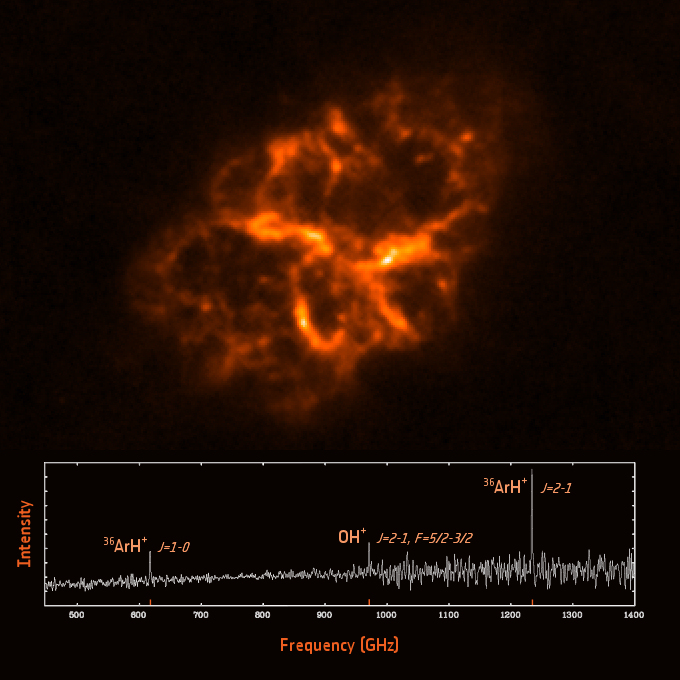
The team of astronomers has detected emission from argon hydride (ArH+), a molecular ion containing the noble gas argon, in the Crab Nebula. A wispy and filamentary cloud of gas and dust, the Crab Nebula is the remnant of a supernova explosion that was observed by Chinese astronomers in the year 1054.

"At first, the discovery seemed bizarre," comments Barlow.

"With hot gas still expanding at high speeds after the explosion, a supernova remnant is a harsh, hostile environment, and one of the places where we least expected to find a noble-gas based molecule," he adds.

Argon hydride is produced when ions of argon (Ar+) react with hydrogen molecules (H2), but these two species are usually found in different regions of a nebula. While ions form in the most energetic regions, where radiation from a star or stellar remnant ionises the gas, molecules take shape in the denser, colder pockets of gas that are shielded from this powerful radiation.


"But we soon realised that even in the Crab Nebula, there are places where the conditions are just right for a noble gas to react and combine with other elements.

"There, in the transition regions between ionised and molecular gas, argon hydride can form and survive," explains Barlow.

This new picture was supported by the comparison of the Herschel data with observations of the Crab Nebula performed at other wavelengths, which revealed that the regions where they had found ArH+ also exhibit higher concentrations of both Ar+ and H2. There, argon ions can react with hydrogen molecules forming argon hydride and atomic hydrogen.

In the partly ionised gas filling these regions, molecules collide frequently with ions and free electrons. These collisions excite the molecular structure of ArH+ making it rotate; in turn, molecular rotations produce the emission features detected in the spectrum of the Crab Nebula by Herschel.

"The discovery was truly serendipitous: we were observing the Crab Nebula to study its dust content. But then, on top of the emission from dust, we found two emission lines that had never been seen before," says co-author Bruce Swinyard, also from University College London.

The identification of these lines was a challenging task. To this end, the astronomers exploited two extensive databases of molecular spectra and, after lengthy investigation, they matched the observed features with two characteristic lines emitted by ArH+.

"And there's icing on the cake: from a molecule's emission, we can determine the isotope of the elements that form it – something that we can't do when we see only ions," adds Swinyard.

The Herschel data indicate that the argon hydride found in the Crab Nebula is made up of the argon isotope 36Ar. This is the first time that astronomers could identify the isotopic nature of an element in a supernova remnant.

"Finding that argon in the Crab Nebula consists of 36Ar was not surprising because this is the dominant isotope of argon across the Universe.

"And it's also the main argon isotope to be synthesised in the nuclear reactions during supernova explosions, so its detection in the Crab Nebula confirms that this iconic nebula was created by the explosive death of a massive star," explains Barlow.

The astronomers are planning further observations with other facilities to seek new emission lines in the Crab Nebula's spectrum, possibly from molecules containing different isotopes of argon. The detection of such a molecule would enable them to study the ratio of different isotopes produced by supernovae and to learn more about the nuclear reactions that take place when a massive star dies.

"This is not only the first detection of a noble-gas based molecule in space, but also a new perspective on the Crab Nebula. Herschel has directly measured the argon isotope we expect to be produced via explosive nucleosynthesis in a core-collapse supernova, refining our understanding of the origin of this supernova remnant," concludes Göran Pilbratt, Herschel Project Scientist at ESA.

Background information

The results described in this article are reported in "Detection of a Noble Gas Molecular Ion, 36ArH+, in the Crab Nebula", by M. J. Barlow et al., published in Science, 342, 6163, 1343-1345, 13 December 2013. DOI: 10.1126/science.124358213.

The argon isotope found in the Crab Nebula is different from the one that dominates in Earth's atmosphere, 40Ar, which derives from the decay of a radioactive isotope of potassium (40K) present in our planet's rocks. 
At almost one per cent, argon is the third most abundant gas in the atmosphere of Earth after nitrogen and oxygen, and was discovered at the end of the 19th century.

The study is based on data collected with the Spectral and Photometric Imaging Receiver (SPIRE) on board ESA's Herschel Space Observatory. The team of astronomers detected two emission lines corresponding to the first two rotational transitions of argon hydride (ArH+) at frequencies of 617.5 GHz and 1234.6 GHz, respectively. To identify the lines, they made use of two extensive databases of molecular lines: the Cologne Database for Molecular Spectroscopy (CDMS) and the Madrid Molecular Spectroscopy Excitation (MADEX) code.

Herschel is an ESA space observatory with science instruments provided by European-led Principal Investigator consortia and with important participation from NASA.

The SPIRE instrument contains an imaging photometer (camera) and an imaging spectrometer. The camera operates in three wavelength bands centred on 250, 350 and 500 µm, and so can make images of the sky simultaneously in three sub-millimetre colours; the spectrometer covers the wavelength range between 194 and 671 μm. SPIRE has been developed by a consortium of institutes led by Cardiff Univ. (UK) and including Univ. Lethbridge (Canada); NAOC (China); CEA, LAM (France); IFSI, Univ. Padua (Italy); IAC (Spain); Stockholm Observatory (Sweden); Imperial College London, RAL, UCL-MSSL, UKATC, Univ. Sussex (UK); Caltech, JPL, NHSC, Univ. Colorado (USA). This development has been supported by national funding agencies: CSA (Canada); NAOC (China); CEA, CNES, CNRS (France); ASI (Italy); MCINN (Spain); SNSB (Sweden); STFC, UKSA  (UK); and NASA (USA).

Herschel was launched on 14 May 2009 and completed science observations on 29 April 2013.

Contacts

Michael J. Barlow
Department of Physics & Astronomy
University College London
London, UK
Email:
mjb@star.ucl.ac.uk
Phone: +44-20-7679-7160
Mobile: +44-77-5894-5482


Bruce M. Swinyard
Department of Physics & Astronomy
University College London
London, UK
Email
: bms@star.ucl.ac.uk; bruce.swinyard@stfc.ac.uk
Phone: +44-20-7679-1352
Mobile: +44-79-0834-3567


Göran Pilbratt
Herschel Project Scientist
Research and Scientific Support Department
Science and Robotic Exploration Directorate
ESA, The Netherlands
Email:
gpilbratt@rssd.esa.int
Phone: +31-71-565-3621


Friday, December 14, 2012

Crab Nebula

 The Crab Nebula
Credit: ESA/Herschel/SPIRE/PACS/MESS

See this object in:
Chromoscope  -  Google Sky

Herschel has produced an intricate view of the remains of a star that died in a stellar explosion a millennium ago. It has provided further proof that the interstellar dust which lies throughout our Galaxy is created when massive stars reach the end of their lives.

The Crab Nebula lies about six and a half thousand light years away from Earth and is the remnant of a dramatic explosion, called a supernova, originally seen by Chinese Astronomers in 1054 AD. Starting out at 12-15 times more massive than the Sun, all that was left after the dramatic death of the star is a tiny, rapidly rotating neutron star and a complex network of ejected stellar material.

The Crab Nebula is well known for its intricate nature, with beautiful filamentary structures seen at visible wavelengths. Now, for the first time, thanks to Herschel’s exquisite resolution, we can see these filaments of dust in the far-infrared region of the electromagnetic spectrum. After ruling out other sources, astronomers using Herschel showed that these filaments are made of cosmic dust, lying in exactly the same place that we see the densest clumps of supernova ejecta. This provides definitive evidence that the Crab Nebula is an efficient dust factory, containing enough dust to make around 30,000-40,000 planet Earths. The dust is made of a combination of carbon and silicate materials, which are crucial for the formation of planetary systems like our own Solar System.

The Crab Nebula and surrounding area, showing the lack of contaminating dust in the foreground and background. (large image)

Previous infrared images of the Crab Nebula, using the Spitzer Space Telescope, used much shorter wavelengths and so only showed the warmer dust. Spitzer found only a tiny amount of dust, simply because it missed the massive reservoir of colder dust now known to exist. Herschel, observing at longer wavelengths, is able to detect both warm dust (shown in green/blue in the image) and also cool dust (shown as yellow/orange), some as cold as -260 Celsius. This has allowed astronomers to measure the total mass of dust for the first time.

Large amounts of dust have been seen in supernova remnants before, but the Crab Nebula is particularly exciting as it provides the the cleanest view of what is going on. Unlike many other remnants there is almost no dusty Galactic material in front of or behind the Crab Nebula, so the image is uncontaminated by material in between it and the Earth. This also allows astronomers to rule out the possibility that the dust was swept up as the shockwave expanded throughout the surrounding region.

Large amounts of dust have been seen in supernova remnants before, but the Crab Nebula is particularly exciting as it provides the the cleanest view of what is going on. Unlike many other remnants there is almost no dusty Galactic material in front of or behind the Crab Nebula, so the image is uncontaminated by material in between it and the Earth. This also allows astronomers to rule out the possibility that the dust was swept up as the shockwave expanded throughout the surrounding region.

In most supernova remnants, much of the dust is destroyed as it ploughs into the surrounding interstellar gas and dust, crushed by violent shockwaves. A final treat is that the Crab Nebula is a much kinder environment for dust grains, so the dust does not seem to be destroyed. This may be the first observed case of dust being freshly-cooked in a supernova and surviving its outward journey carried along by the shock wave. We now have definitive evidence that supernovae created the raw materials for the first solid particles, the building blocks of rocky planets and life itself, in a blink of an eye.

The Crab Nebula as seen in visible (left), showing the glow from hot, energised gas, and far-infrared (right), showing warm dust (green/blue) and cooler dust (yellow/orange) shining in the remnant. Image credit: ESA/Herschel/SPIRE/PACS/MESS (Far-IR); NASA/ESA/STScI (Visible)

Detailed Information

Object Name:  Crab Nebula (Messier 1)
Type of Object:  Supernova remnant
Image Scale:  The image is around 10 arcminutes across
Coordinates:  Right Ascension: 5h 34m 30s ; Declination: 22° 00′ 57″
Constellation:  Taurus the Bull
Instrument:  SPIRE and PACS
Wavelengths:  70 microns (blue), 160 microns(green), 250 microns (red)
Distance of Object:  6500 light years
Date of Release: 13/12/2012
Key Programme:
Mass Loss from Evolved StarsS
Publication: Gomez et al. (2012) Astrophysical Journal 760 96 "A Cool Dust Factory in the Crab Nebula: A Herschel Study of the Filaments"