Showing posts with label GSN 069. Show all posts

Friday, April 24, 2020

Star Survives Close Call with a Black Hole

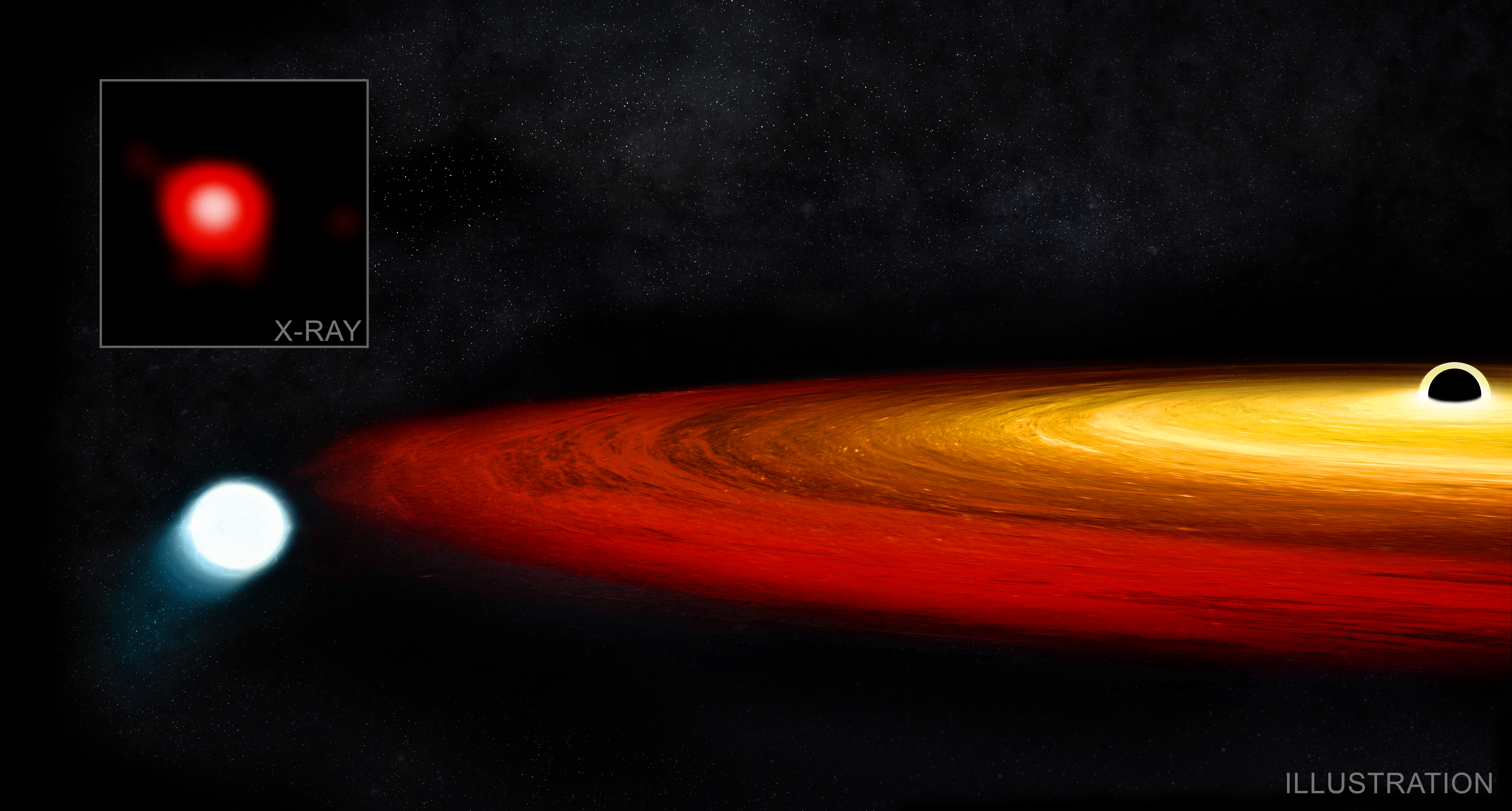
GSN 069
Credit: X-ray: NASA/CXO/CSIC-INTA/G.Miniutti et al.; Illustration: NASA/CXC/M. Weiss;


 A Tour of a Star Survives Close Call with a Black Hole - More Animations


Data from NASA's Chandra X-ray Observatory and ESA's XMM-Newton indicate that a star survived a close call with a black hole, as described in our latest press release. As a red giant star approached a supermassive black hole in the galaxy GSN 069, it was caught in the black hole's gravity. Once captured, the outer layers of the red giant containing hydrogen were stripped off and careened toward the black hole, leaving the core of the star — known as a white dwarf — behind. 

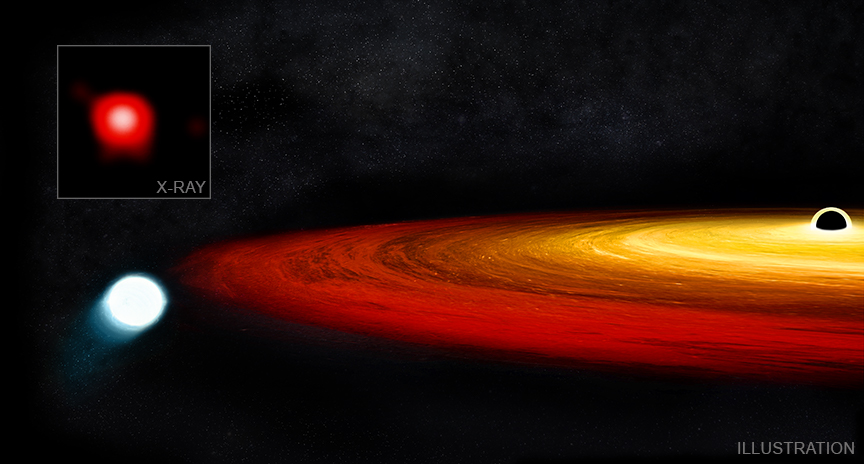
The white dwarf is now in a highly elliptical orbit that completes one cycle about once every 9 hours. As its nearest point in its oval-shaped path, the white dwarf is no more than 15 times the radius of the event horizon — the point of no return — away from the black hole. This artist's illustration shows the white dwarf (on the left) when it is nearing the point of closest approach, and is being stretched by the strong gravity of the black hole (on the far right). The white dwarf should be travelling at a noticeable fraction of the speed of light at this point. At closest approach the black hole pulls material from the white dwarf into an encircling disk. This transfer releases a burst of X-rays that Chandra and XMM-Newton can detect every 9 hours. The inset is a time-lapse of Chandra data taken over a period of about 20 hours on February 14 and 15, 2019, centered on the X-ray source in the middle of GSN 069. The sequence loops to show that the X-ray brightness of the source changes regularly and dramatically over the Chandra observation. The black hole and white dwarf pair should also emit gravitational waves, especially at their nearest point.

Because the white dwarf is so close to the black hole, effects from the Theory of General Relativity mean that the direction of the orbit's axis should rotate with time, or "precess", so that multiple orbits make a rosette-shaped pattern. This rotation should repeat every two days and may be detectable with sufficiently long observations.

Schematic Showing White Dwarf Orbit
Credit: NASA/CXC/M. Weiss

What would be the future of the star and its orbit? The combined effect of gravitational waves and an increase in the star's size as it loses mass should cause the orbit to become more circular and grow in size over time. In this case, the rate of mass loss steadily slows down, and the white dwarf slowly spirals away from the black hole. About a trillion years in the future, the white dwarf could lose enough mass to become a planet with a mass similar to Jupiter.

Astronomers have found many stars that have been completely torn apart by encounters with black holes (so-called tidal disruption events), but there are very few reported cases of near misses, where the star likely survived. Grazing encounters like this should be more common than direct collisions given the statistics of cosmic traffic patterns, but they could easily be missed for a couple of reasons. First, it can take a more massive, surviving star too long to complete an orbit around a black hole for astronomers to see repeated bursts. Another issue is that supermassive black holes that are much more massive than the one in GSN 069 may directly swallow a star rather than the star falling into orbits where they periodically lose mass. In these cases, astronomers wouldn't observe anything.

A paper describing these results by Andrew King (University of Leicester, United Kingdom) appears in the March 2020 issue of the Monthly Notices of the Royal Astronomical Society, and is available online. NASA's Marshall Space Flight Center manages the Chandra program. The Smithsonian Astrophysical Observatory's Chandra X-ray Center controls science and flight operations from Cambridge and Burlington, Massachusetts.

What would be the future of the star and its orbit? The combined effect of gravitational waves and an increase in the star's size as it loses mass should cause the orbit to become more circular and grow in size over time. In this case, the rate of mass loss steadily slows down, and the white dwarf slowly spirals away from the black hole. About a trillion years in the future, the white dwarf could lose enough mass to become a planet with a mass similar to Jupiter.

Astronomers have found many stars that have been completely torn apart by encounters with black holes (so-called tidal disruption events), but there are very few reported cases of near misses, where the star likely survived. Grazing encounters like this should be more common than direct collisions given the statistics of cosmic traffic patterns, but they could easily be missed for a couple of reasons. First, it can take a more massive, surviving star too long to complete an orbit around a black hole for astronomers to see repeated bursts. Another issue is that supermassive black holes that are much more massive than the one in GSN 069 may directly swallow a star rather than the star falling into orbits where they periodically lose mass. In these cases, astronomers wouldn't observe anything.

A paper describing these results by Andrew King (University of Leicester, United Kingdom) appears in the March 2020 issue of the Monthly Notices of the Royal Astronomical Society, and is available online. NASA's Marshall Space Flight Center manages the Chandra program. The Smithsonian Astrophysical Observatory's Chandra X-ray Center controls science and flight operations from Cambridge and Burlington, Massachusetts.

A Quick Look at a Star Survives Close Call with a Black Hole


Source: NASA’s Chandra X-ray Observatory


Fast Facts for GSN 069:

Scale: X-ray image is about 11 arcsec (13,000 light years) across.
Category: Quasars & Active Galaxies, Black Holes
Coordinates (J2000): RA 1h 19m 08.67s | Dec -34° 11´ 30.1"
Constellation: Sculptor
Observation Date: Feb 14, 2019
Observation Time: 16 hours 33 minutes
Obs. ID: 22096
Instrument: ACIS
References: King, A., 2020, MNRAS, 493, L120; arXiv:2002.00970
Color Code: X-ray: red
Distance Estimate: About 250 million light years


Wednesday, September 11, 2019

Unexpected periodic flares may shed light on black hole accretion

XMM-Newton observations
Copyright: ESA/XMM-Newton; G. Miniutti & M. Giustini (CAB, CSIC-INTA, Spain)

ESA’s X-ray space telescope XMM-Newton has detected never-before-seen periodic flares of X-ray radiation coming from a distant galaxy that could help explain some enigmatic behaviours of active black holes.

XMM-Newton, the most powerful X-ray observatory, discovered some mysterious flashes from the active black hole at the core of the galaxy GSN 069, about 250 million light years away. On 24 December 2018, the source was seen to suddenly increase its brightness by up to a factor 100, then dimmed back to its normal levels within one hour and lit up again nine hours later.

“It was completely unexpected,” says Giovanni Miniutti, of the Centro de Astrobiología in Madrid, Spain, lead author of a new paper published in the journal Nature today.

“Giant black holes regularly flicker like a candle but the rapid, repeating changes seen in GSN 069 from December onwards are something completely new.”

Further observations, performed with XMM-Newton as well as NASA’s Chandra X-ray observatory in the following couple of months, confirmed that the distant black hole was still keeping the tempo, emitting nearly periodic bursts of X-rays every nine hours. The researchers are calling the new phenomenon ‘quasi-periodic eruptions’, or QPEs.

Optical and X-ray view
Copyright X-ray: NASA/CXO/CSIC-INTA/G.Miniutti et al.; Optical: DSS

“The X-ray emission comes from material that is being accreted into the black hole and heats up in the process,” explains Giovanni.

“There are various mechanisms in the accretion disc that could give rise to this type of quasi-periodic signal, potentially linked to instabilities in the accretion flow close to the central black hole.

“Alternatively, the eruptions could be due to the interaction of the disc material with a second body – another black hole or perhaps the remnant of a star previously disrupted by the black hole.”

Although never before observed, Giovanni and colleagues think periodic flares like these might actually be quite common in the Universe.

It is possible that the phenomenon had not been identified before because most black holes at the cores of distant galaxies, with masses millions to billions of times the mass of our Sun, are much larger than the one in GSN 069, which is only about 400 000 times more massive than our Sun.

The bigger and more massive the black hole, the slower the fluctuations in brightness it can display, so a typical supermassive black hole would erupt not every nine hours, but every few months or years. This would make detection unlikely as observations rarely span such long periods of time.

And there is more. Quasi-periodic eruptions like those found in GSN 069 could provide a natural framework to interpret some puzzling patterns observed in a significant fraction of active black holes, whose brightness seems to vary too fast to be easily explained by current theoretical models.

“We know of many massive black holes whose brightness rises or decays by very large factors within days or months, while we would expect them to vary at a much slower pace,” says Giovanni.

“But if some of this variability corresponds to the rise or decay phases of eruptions similar to those discovered in GSN 069, then the fast variability of these systems, which appears currently unfeasible, could naturally be accounted for. New data and further studies will tell if this analogy really holds.”

Quasi-periodic eruptions in GSN 069
Copyright ESA/XMM-Newton; NASA/CXC; G. Miniutti (CAB, CSIC-INTA, Spain)

The quasi-periodic eruptions spotted in GSN 069 could also explain another intriguing property observed in the X-ray emission from nearly all bright, accreting supermassive black holes: the so-called ‘soft excess’.

It consists in enhanced emission at low X-ray energies, and there is still no consensus on what causes it, with one leading theory invoking a cloud of electrons heated up near the accretion disc.

Like similar black holes, GSN 069 exhibits such a soft X-ray excess during bursts, but not between eruptions.

“We may be witnessing the formation of the soft excess in real time, which could shed light on its physical origin,” says co-author Richard Saxton from the XMM-Newton operation team at ESA’s astronomy centre in Spain.

“How the cloud of electrons is created is currently unclear, but we are trying to identify the mechanism by studying the changes in the X-ray spectrum of GSN 069 during the eruptions.”

The team is already trying to pinpoint the defining properties of GSN 069 at the time when the periodic eruptions were first detected to look for more cases to study.

"One of our immediate goals is to search for X-ray quasi-periodic eruptions in other galaxies, to further understand the physical origin of this new phenomenon,” adds co-author Margherita Giustini of Madrid’s Centro de Astrobiología.

“GSN 069 is an extremely fascinating source, with the potential to become a reference in the field of black hole accretion,” says Norbert Schartel, ESA’s XMM-Newton project scientist.

The discovery would not have been possible without XMM-Newton’s capabilities.

“These bursts happen in the low energy part of the X-ray band, where XMM-Newton is unbeatable. We will certainly need to use the observatory again if we want to find more of these kinds of events in the future,” concludes Norbert.


Notes for editors

Nine-hour X-ray quasi-periodic eruptions from a low-mass black hole galactic nucleus’ by G. Miniutti et al. is published in Nature. DOI: 10.1038/s41586-019-1556-x

The international research team used astronomical data from ESA’s XMM-Newton, NASA’s Chandra and Swift X-ray observatories, the NASA/ESA Hubble Space Telescope, NRAO’s Karl G. Jansky Very Large Array in New Mexico, USA, CSIRO’sAustralia Telescope Compact Array in Australia, and SARAO’sMeerKAT radio telescope in South Africa.


For more information, please contact:

Giovanni Miniutti
Centro de Astrobiología (CAB, CSIC-INTA)
Madrid, Spain
Email: gminiutti@cab.inta-csic.es

Richard Saxton
Telespazio-Vega UK for ESA
XMM-Newton Science Operations Centre
European Space Agency
Email: richard.saxton@sciops.esa.int

Margherita Giustini
Centro de Astrobiología (CAB, CSIC-INTA)
Madrid, Spain
Email: mgiustini@cab.inta-csic.es

Norbert Schartel
XMM-Newton project scientist
European Space Agency
Email: norbert.schartel@sciops.esa.int