Showing posts with label 3C 58. Show all posts

Monday, November 04, 2024

Planets Beware: NASA Unburies Danger Zones of Star Cluster

Cygnus OB2

Credit X-ray: NASA/CXC/SAO/J. Drake et al, IR: NASA/JPL-Caltech/Spitzer; Image Processing: NASA/CXC/SAO/N. Wolk

JPEG (697.3 kb) - Large JPEG (14.3 MB) - Tiff (24 MB - More Images

A Tour of 3C 58 - More Videos


Most stars form in collections, called clusters or associations, that include very massive stars. These giant stars send out large amounts of high-energy radiation, which can disrupt relatively fragile disks of dust and gas that are in the process of coalescing to form new planets.

A team of astronomers used NASA’s Chandra X-ray Observatory, in combination with ultraviolet, optical, and infrared data, to show where some of the most treacherous places in a star cluster may be, where planets’ chances to form are diminished.

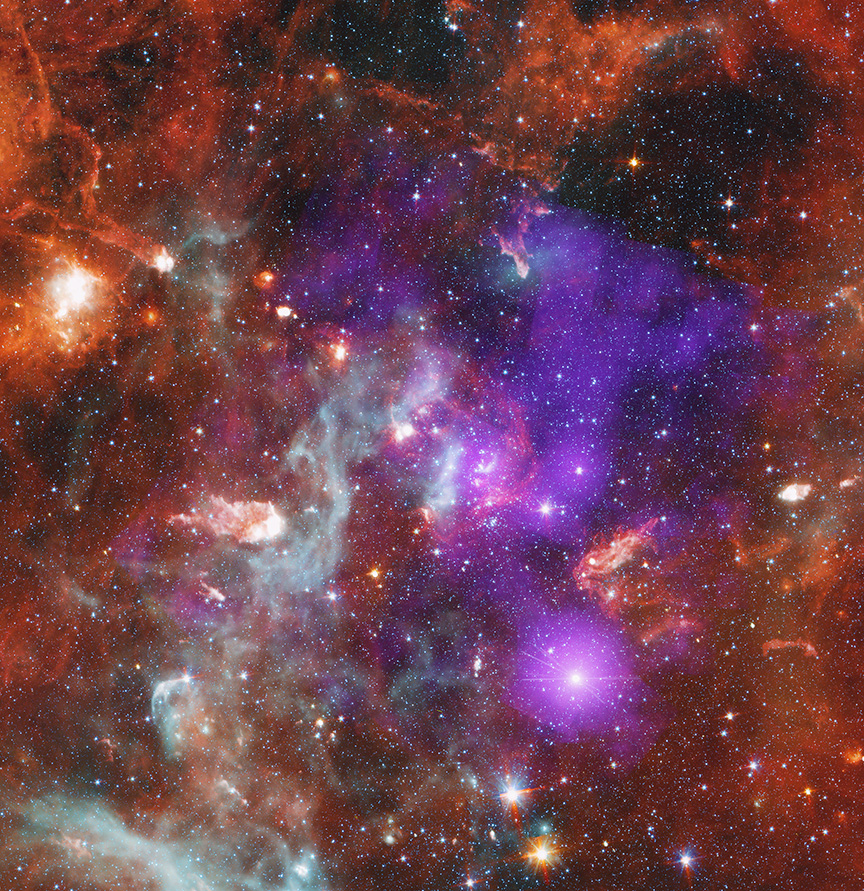
The target of the observations was Cygnus OB2, which is the nearest large cluster of stars to our Sun — at a distance of about 4,600 light-years. The cluster contains hundreds of massive stars as well as thousands of lower-mass stars. The team used long Chandra observations pointing at different regions of Cygnus OB2, and the resulting set of images were then stitched together into one large image.

The deep Chandra observations mapped out the diffuse X-ray glow in between the stars, and they also provided an inventory of the young stars in the cluster. This inventory was combined with others using optical and infrared data to create the best census of young stars in the cluster.

In this new composite image, the Chandra data (purple) shows the diffuse X-ray emission and young stars in Cygnus OB2, and infrared data from NASA’s now-retired Spitzer Space Telescope (red, green, blue, and cyan) reveals young stars and the cooler dust and gas throughout the region.
In these crowded stellar environments, copious amounts of high-energy radiation produced by stars and planets are present. Together, X-rays and intense ultraviolet light can have a devastating impact on planetary disks and systems in the process of forming.

Planet-forming disks around stars naturally fade away over time. Some of the disk falls onto the star and some is heated up by X-ray and ultraviolet radiation from the star and evaporates in a wind. The latter process, known as “photoevaporation,” usually takes between 5 and 10 million years with average-sized stars before the disk disappears. If massive stars, which produce the most X-ray and ultraviolet radiation, are nearby, this process can be accelerated.

The researchers using this data found clear evidence that planet-forming disks around stars indeed disappear much faster when they are close to massive stars producing a lot of high-energy radiation. The disks also disappear more quickly in regions where the stars are more closely packed together.

For regions of Cygnus OB2 with less high-energy radiation and lower numbers of stars, the fraction of young stars with disks is about 40%. For regions with more high-energy radiation and higher numbers of stars, the fraction is about 18%. The strongest effect — meaning the worst place to be for a would-be planetary system — is within about 1.6 light-years of the most massive stars in the cluster.

A separate study by the same team examined the properties of the diffuse X-ray emission in the cluster. They found that the higher-energy diffuse emission comes from areas where winds of gas blowing away from massive stars have collided with each other. This causes the gas to become hotter and produce X-rays. The less energetic emission probably comes from gas in the cluster colliding with gas surrounding the cluster.

Two separate papers describing the Chandra data of Cygnus OB2 are available. The paper about the planetary danger zones, led by Mario Giuseppe Guarcello (National Institute for Astrophysics in Palermo, Italy), appeared in the November 2023 issue of the Astrophysical Journal Supplement Series, and is available here. The paper about the diffuse emission, led by Juan Facundo Albacete-Colombo (University of Rio Negro in Argentina) was published in the same issue of Astrophysical Journal Supplement, and is available here.

NASA's Marshall Space Flight Center in Huntsville, Alabama, manages the Chandra program. The Smithsonian Astrophysical Observatory's Chandra X-ray Center controls science operations from Cambridge, Massachusetts, and flight operations from Burlington, Massachusetts.

JPL managed the Spitzer Space Telescope mission for NASA’s Science Mission Directorate in Washington until the mission was retired in January 2020. Science operations were conducted at the Spitzer Science Center at Caltech. Spacecraft operations were based at Lockheed Martin Space in Littleton, Colorado. Data are archived at the Infrared Science Archive operated by IPAC at Caltech. Caltech manages JPL for NASA.


Visual Description:

This release features a composite image of the Cygnus OB2 star cluster, which resembles a night sky blanketed in orange, purple, and grey clouds.

The center of the square image is dominated by purple haze. This haze represents diffuse X-ray emissions, and young stars, detected by the Chandra X-ray observatory. Surrounding the purple haze is a mottled, streaky, brick orange cloud. Another cloud resembling a tendril of grey smoke stretches from our lower left to the center of the image. These clouds represent relatively cool dust and gas observed by the Spitzer Space Telescope.

Although the interwoven clouds cover most of the image, the thousands of stars within the cluster shine through. The lower-mass stars present as tiny specks of light. The massive stars gleam, some with long refraction spikes.


Fast Facts for Cygnus OB2:

Scale: Image is about 1.5 arcmin (120 light-years) across.
Category: Normal Stars & Star Clusters
Coordinates (J2000): RA 20h 33m 12s | Dec +41° 19´ 00"
Constellation: Cygnus
Observation Dates: 40 pointings between January 2004 and March 2010
Observation Time: 331 hours 30 minutes (13 days 19 hours 30 minutes)
Obs. ID: 4501, 4511, 7426, 10939-10974, 12099
Instrument: ACIS
References: Guarcell, M.G. et al, 2023, ApJS, 269, 13; Albacete-Colombo, J.F. et al, 2023, ApJS, 269, 14.
Color Code: X-ray: purple; Infrared (IRAC): red, green, blue; Infrared (MIPS): cyan;
Distance Estimate: About 4,600 light-years


Saturday, June 29, 2024

NASA's Chandra Peers Into Densest and Weirdest Stars

3C 58
Credit: X-ray: NASA/CXC/ICE-CSIC/A. Marino et al.; Optical: SDSS; Image Processing: NASA/CXC/SAO/J. Major


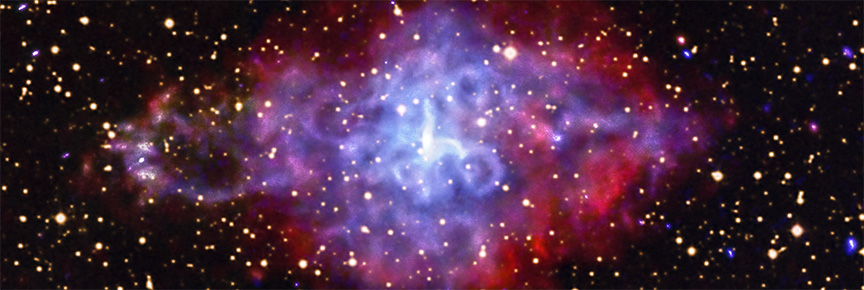
The supernova remnant 3C 58 contains a spinning neutron star, known as PSR J0205+6449, at its center. Astronomers studied this neutron star and others like it to probe the nature of matter inside these very dense objects. A new study, made using NASA’s Chandra X-ray Observatory and ESA’s XMM-Newton, reveals that the interiors of neutron stars may contain a type of ultra-dense matter not found anywhere else in the Universe, as reported in our latest press release.

In this image of 3C 58, low-energy X-rays are colored red, medium-energy X-rays are green, and the high-energy band of X-rays is shown in blue. The X-ray data have been combined with an optical image in yellow from the Digitized Sky Survey. The Chandra data show that the rapidly rotating neutron star (also known as a “pulsar”) at the center is surrounded by a torus of X-ray emission and a jet that extends for several light-years. The optical data shows stars in the field.

The team in this new study analyzed previously released data from neutron stars to determine the so-called equation of state. This refers to the basic properties of the neutron stars including the pressures and temperatures in different parts of their interiors.

The authors used machine learning, a type of artificial intelligence, to compare the data to different equations of state. Their results imply that a significant fraction of the equations of state — the ones that do not include the capability for rapid cooling at higher masses — can be ruled out.

The researchers capitalized on some neutron stars in the study being located in supernova remnants, including 3C 58. Since astronomers have age estimates of the supernova remnants, they also have the ages of the neutron stars that were created during the explosions that created both the remnants and the neutron stars. The astronomers found that the neutron star in 3C 58 and two others were much cooler than the rest of the neutron stars in the study.

Illustration of a Neutron Star
Credit: ICE-CSIC/D. Futselaar/Marino et al.

The team thinks that part of the explanation for the rapid cooling is that these neutron stars are more massive than most of the rest. Because more massive neutron stars have more particles, special processes that cause neutron stars to cool more rapidly might be triggered.

One possibility for what is inside these neutron stars is a type of radioactive decay near their centers where neutrinos — low mass particles that easily travel through matter — carry away much of the energy and heat, causing rapid cooling.

Another possibility is that there are types of exotic matter found in the centers of these more rapidly cooling neutron stars.

The Nature Astronomy paper describing these results is available here. The authors of the paper are Alessio Marino (Institute of Space Sciences (ICE) in Barcelona, Spain), Clara Dehman (ICE), Konstantinos Kovlakas (ICE), Nanda Rea (ICE), J. A. Pons (University of Alicante in Spain), and Daniele Viganò (ICE).

NASA's Marshall Space Flight Center manages the Chandra program. The Smithsonian Astrophysical Observatory's Chandra X-ray Center controls science from Cambridge Massachusetts and flight operations from Burlington, Massachusetts.


Visual Description:

This is an image of the leftovers from an exploded star called 3C 58, shown in X-ray and optical light. At the center of the remnant is a rapidly spinning neutron star, called a pulsar, that presents itself as a bright white object that's somewhat elongated in shape.

Loops and swirls of material, in shades of blue and purple, extend outward from the neutron star in many directions, resembling the shape of an octopus and its arms.

Surrounding the octopus-like structure is a cloud of material in shades of red that is wider horizontally than it is vertically. A ribbon of purple material extends to the left edge of the red cloud, curling upward at its conclusion. Another purple ribbon extends to the right edge of the red cloud, though it is less defined than the one on the other side. Stars of many shapes and sizes dot the entire image.


Fast Facts for 3C 58:

Scale: Image is about 12 arcmin (26 light-years) across.
Category: Neutron Stars/X-ray Binaries, Supernovas & Supernova Remnants
Coordinates (J2000): RA 02h 05m 37.0s | Dec +64° 49´ 48.0"
Constellation: Cassiopeia
Observation Dates: 4 observations from Sep 2000 to Apr 2003
Observation Time: 108 hours 52 minutes (4 days 12 hours 52 minutes)
Obs. ID: 728, 3832, 4382, 4383
Instrument: ACIS
References: Marino, A. et al., 2024, Nature Astronomy;
Color Code: X-ray: red = 0.5-1.2 keV, green = 1.2-2.0 keV, blue = 2.0-7.0 keV; Optical: yellow
Distance Estimate: About 6,500 light-years


Wednesday, April 10, 2024

SNR 1181: Stunning Echo of 800-year-old Explosion

SNR 1181 / Pa 30
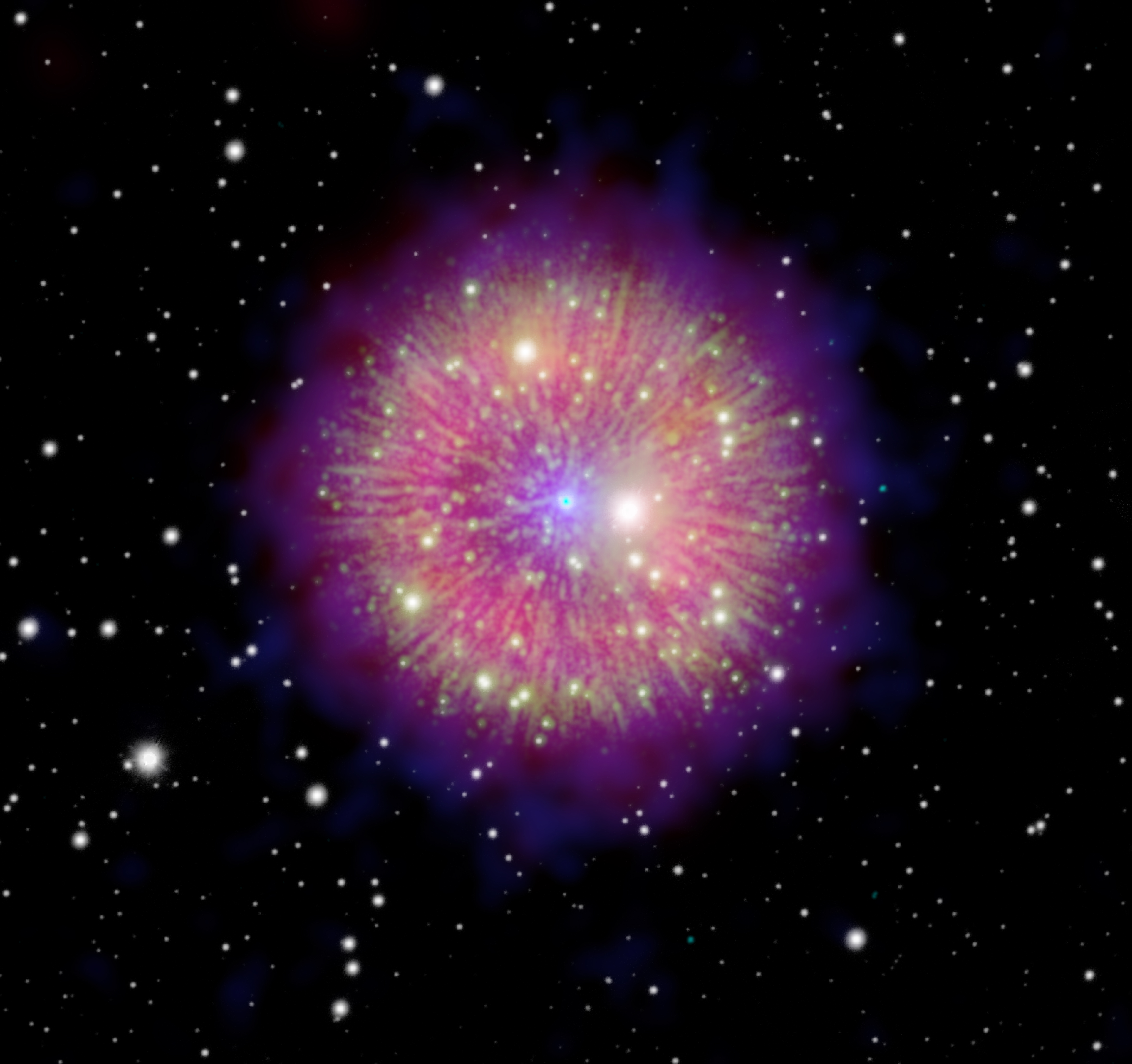
Credit: X-ray: (Chandra) NASA/CXC/U. Manitoba/C. Treyturik, (XMM-Newton) ESA/C. Treyturik; Optical: (Pan-STARRS) NOIRLab/MDM/Dartmouth/R. Fesen; Infrared: (WISE) NASA/JPL/Caltech/; Image Processing: Univ. of Manitoba/Gilles Ferrand and Jayanne English


In the year 1181 a rare supernova explosion appeared in the night sky, staying visible for 185 consecutive days. Historical records show that the supernova looked like a temporary ‘star’ in the constellation Cassiopeia shining as bright as Saturn.

Ever since, scientists have tried to find the supernova’s remnant. At first it was thought that this could be the nebula around the pulsar — the dense core of a collapse star — named 3C 58. However closer investigations revealed that the pulsar is older than supernova 1181.

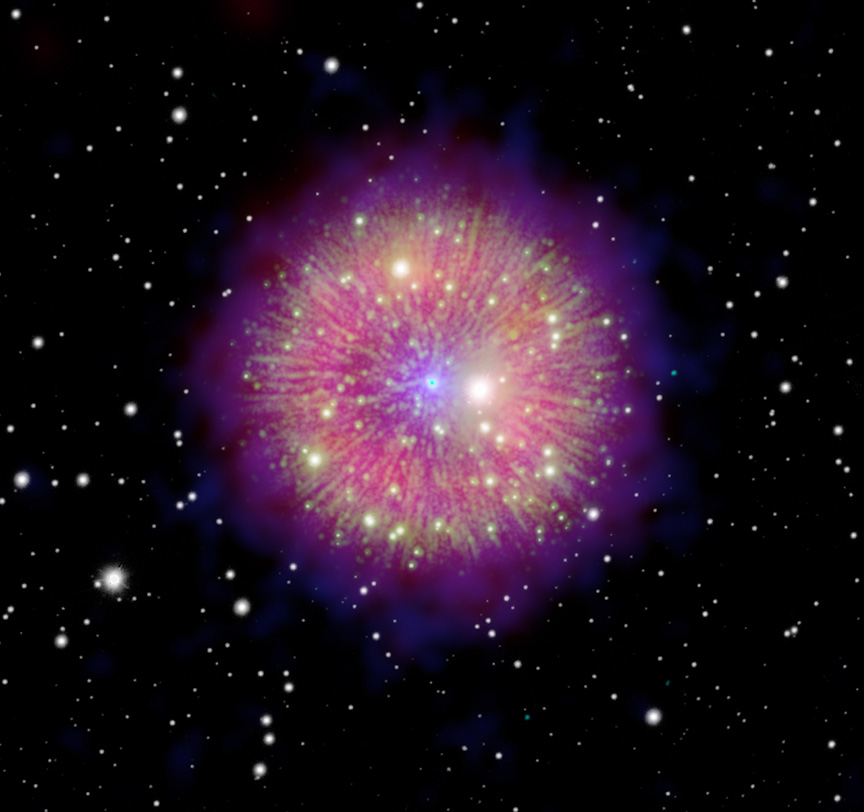
In the last decade, another contender was discovered; Pa 30 is a nearly circular nebula with a central star in the constellation Cassiopeia. It is pictured here combining images from several telescopes. This composite image uses data across the electromagnetic spectrum and shows a spectacular new view of the supernova remnant. This allows us to marvel at the same object that appeared in our ancestors’ night sky more than 800 years ago.

X-ray observations by ESA’s XMM-Newton (blue) show the full extent of the nebula and NASA’s Chandra X-ray Observatory (cyan) pinpoints its central source. The nebula is barely visible in optical light but shines bright in infrared light, collected by NASA’s Wide-field Infrared Space Explorer (red and pink). Interestingly, the radial structure in the image consists of heated sulfur that glows in visible light, observed with the ground-based Hiltner 2.4 m telescope at the MDM Observatory (green) in Arizona, USA, as do the stars in the background by Pan-STARRS (white) in Hawaii, USA.

Studies of the composition of the different parts of the remnant have led scientists to believe that it was formed in a thermonuclear explosion, and more precisely a special kind of supernova called a sub-luminous Type Iax event. During this event two white dwarf stars merged, and typically no remnant is expected for this kind of explosion. But incomplete explosions can leave a kind of ‘zombie’ star, such as the massive white dwarf star in this system. This very hot star, one of the hottest stars in the Milky Way (about 200 000 degrees Celsius), has a fast stellar wind with speeds up to 16,000 km/s. The combination of the star and the nebula makes it a unique opportunity for studying such rare explosions.

The Smithsonian Astrophysical Observatory's Chandra X-ray Center controls science operations from Cambridge, Massachusetts, and flight operations from Burlington, Massachusetts.


Visual Description:

This is a composite image of SNR 1181, the remains of an explosion hundreds of years ago caused by the merger of two stars.

A bright, multi-colored, spherical nebula sits in the middle of the canvas surrounded by a field of stars that appear as white dots. In the center of the nebula is a small point of aqua-colored light. This is the hot white dwarf star that was left behind after the likely merger of two smaller white dwarfs caused an explosion. From this single point of aqua light, several spectacular rays expand outward, resembling a single firework bursting in celebration in the night sky.


Fast Facts for SNR 1181 / Pa 30:

Scale: Image is about 5.6 arcmin (16 light-years) across.
Category: Supernovas & Supernova Remnants
Coordinates (J2000): RA 00h 53m 11.2s | Dec +67° 30´ 02.4"
Constellation: Cassiopeia
Observation Dates: 6 observations from May 12, 2021 to Dec 15, 2021
Observation Time: 39 hours 55 minutes (1 day 15 hours 55 minutes)
Obs. ID: 23419, 24342-24345, 25045
Instrument: ACIS
Color Code: X-ray: blue (XMM) and cyan (Chandra); Optical: green (MDM), white (Pan-STARRS); Infrared: red and pink
Distance Estimate: About 10,100 light-years