Showing posts with label Abell 370. Show all posts

Thursday, January 09, 2025

A Treasure Trove of Unseen Stars Seen Beyond the 'Dragon Arc'

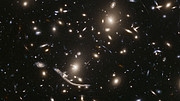
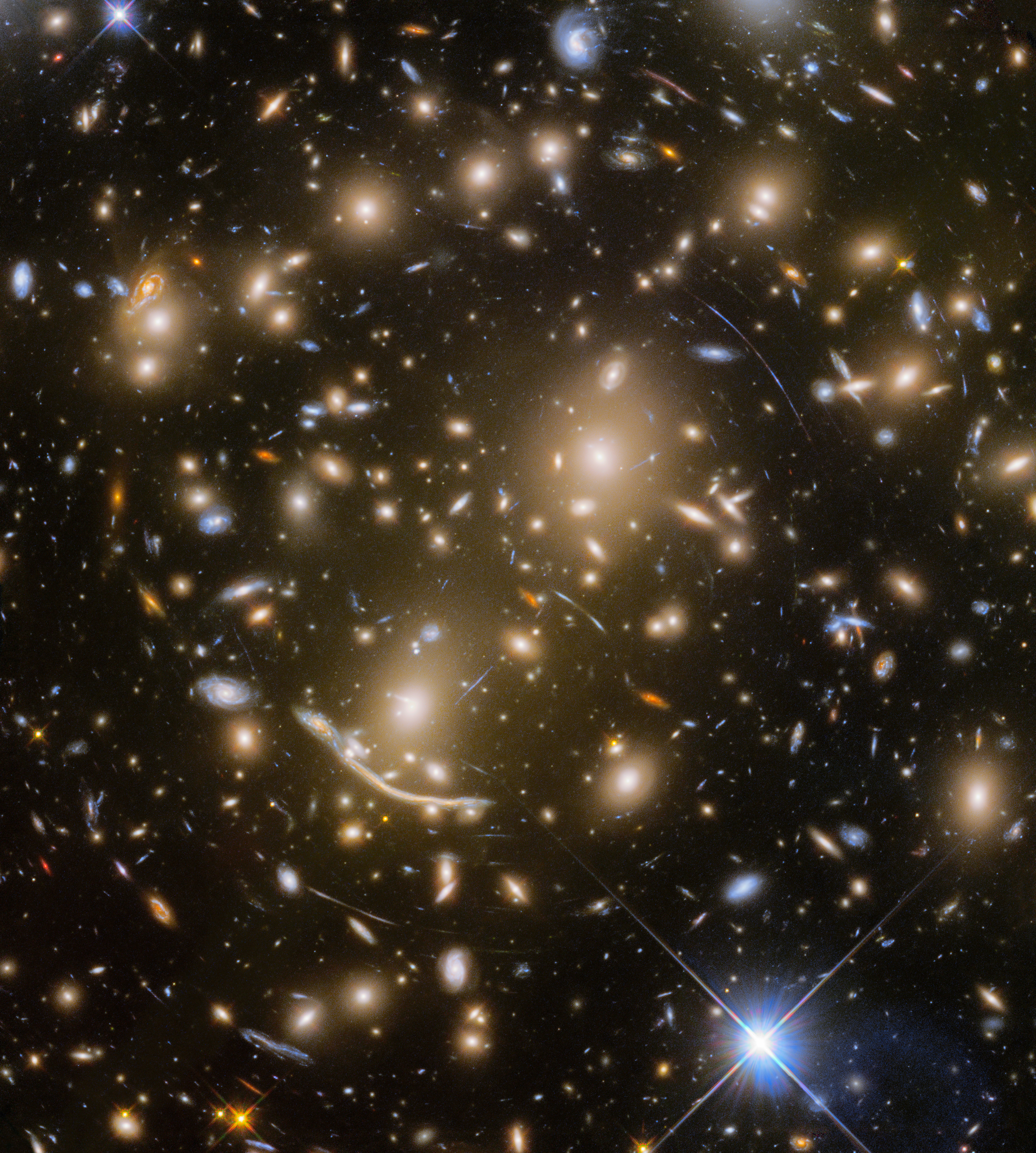
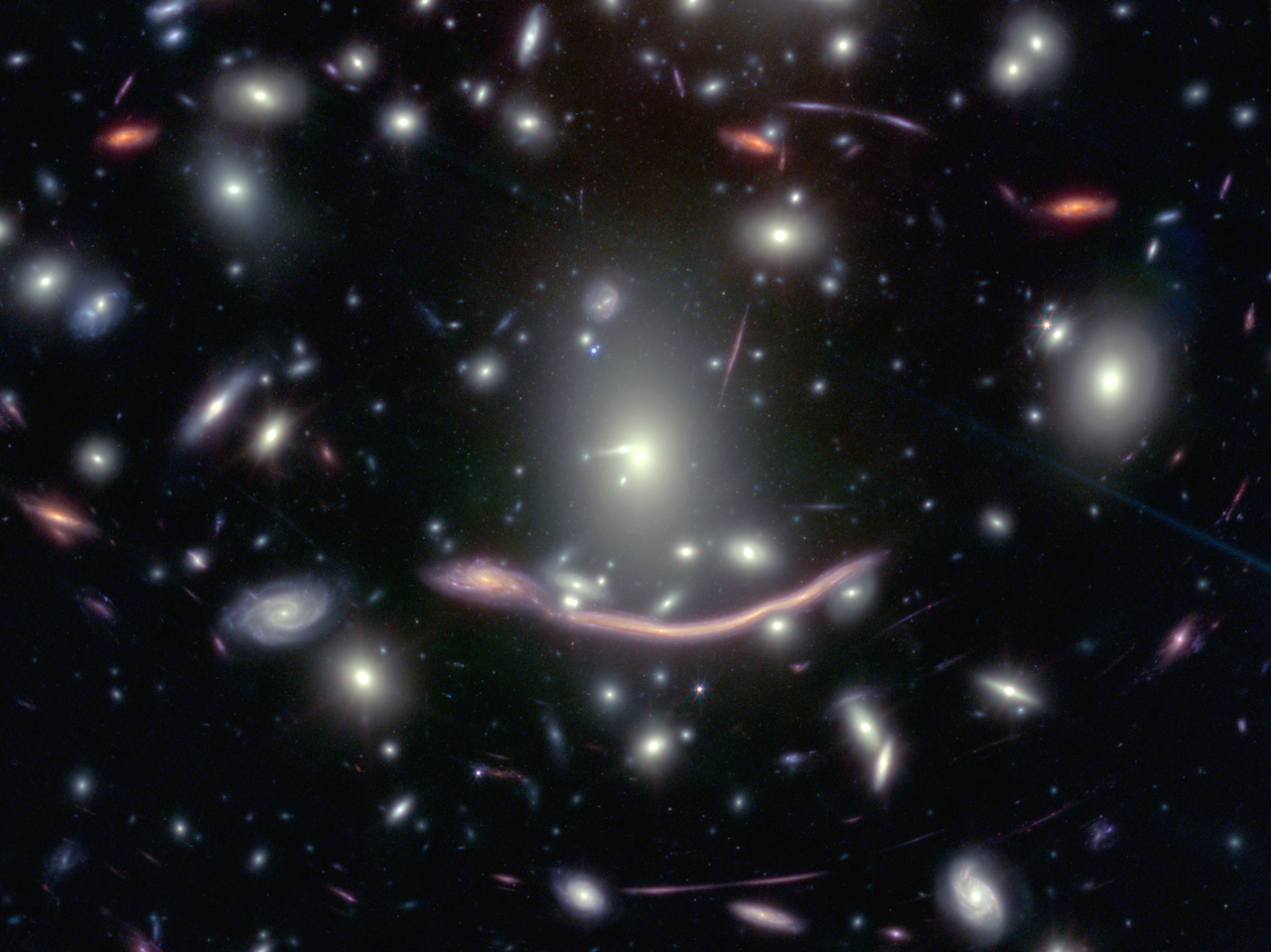
Abell 370, a galaxy cluster located nearly 4 billion light-years away from Earth features several arcs of light, including the "Dragon Arc" (lower left of center). These arcs are caused by gravitational lensing: Light from distant galaxies far behind the massive galaxy cluster coming toward Earth is bent around Abell 370 by its massive gravity, resulting in contorted images.  Credit: NASA.High Resolution Image

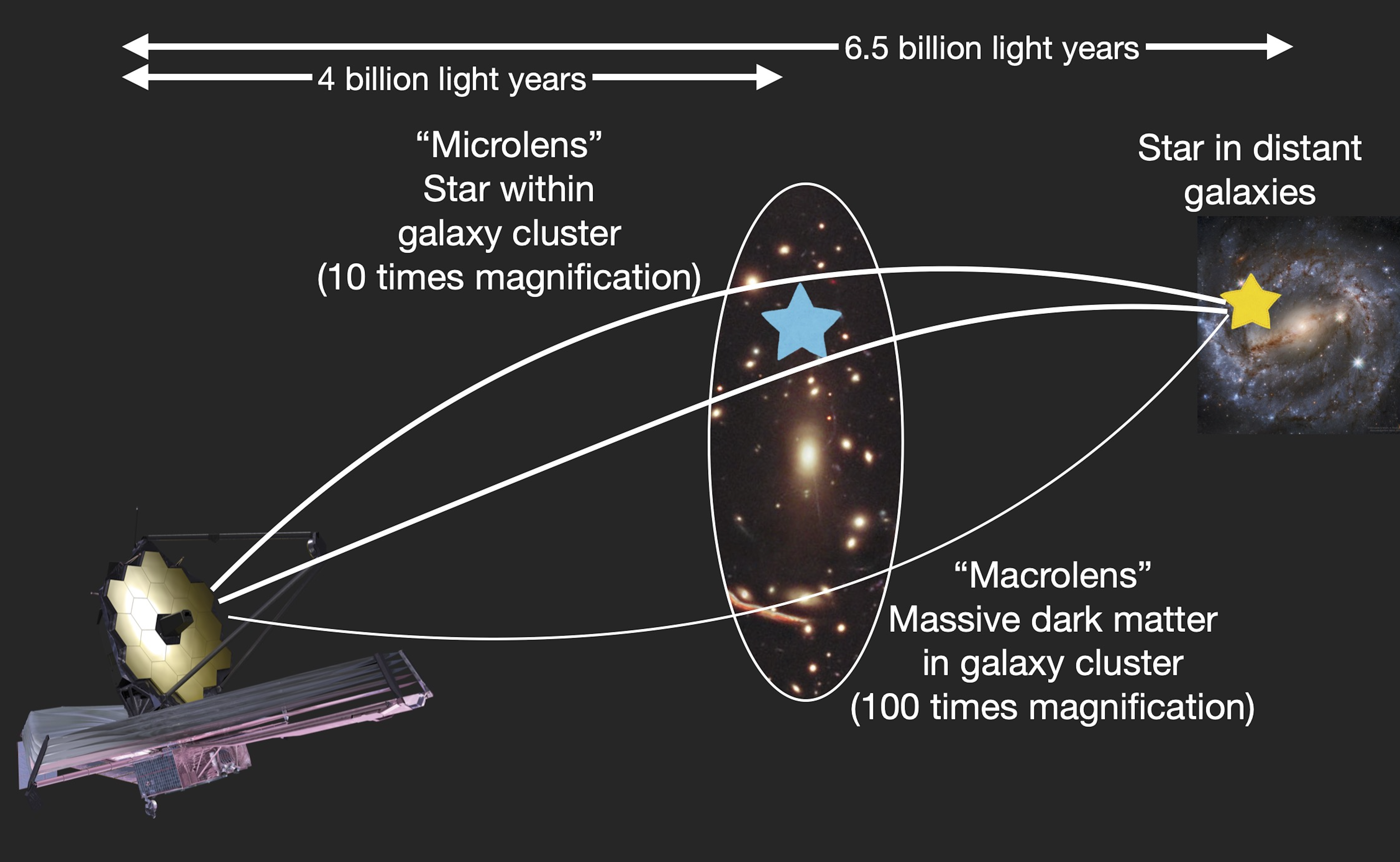
The massive, yet invisible halo of dark matter of a galaxy cluster works as a "macrolens,", while lone, unbound stars drifting through the cluster act as additional "microlenses, multiplying the factor of magnification.  Credit: Yoshinobu Fudamoto. High Resolution Image

In this zoomed-in detail of the Hubble image of Abell 370, the host galaxy where the 44 stars were discovered appears several times: in a normal image (left), and a distorted image appearing as a drawn-out smear of light.  Credit: NASA. High Resolution Image


An international team of astronomers took pictures of more than 40 individual stars in a galaxy so far away its light dates back to when the universe was only half its present age.

Cambridge, MA — Looking halfway across the observable universe and expecting to see individual stars is considered a non-starter in astronomy, a bit like raising a pair of binoculars at the moon in hopes of making out individual grains of dust inside its craters. Thanks to a cosmic quirk of nature, however, an international team of astronomers did just that.

Using NASA's James Webb Space Telescope (JWST), postdoctoral researcher Fengwu Sun at the Center for Astrophysics | Harvard & Smithsonian (CfA) and his team observed a galaxy nearly 6.5 billion light-years from Earth, at a time when the universe was half its current age. In this distant galaxy, the team identified 44 individual stars, made visible thanks to an effect known as gravitational lensing and JWST's high light collecting power.

Published in the journal Nature Astronomy, the discovery marks this record-breaking achievement – the largest number of individual stars detected in the distant universe. It also provides a way to investigate one of the universe's greatest mysteries – dark matter.

"This groundbreaking discovery demonstrates, for the first time, that studying large numbers of individual stars in a distant galaxy is possible," Sun, a co-author on the study, said. “While previous studies with the Hubble Space Telescope found around seven stars, we now have the capability to resolve stars that were previously outside of our capability. Importantly, observing more individual stars will also help us better understand dark matter in the lensing plane of these galaxies and stars, which we couldn’t do with only the handful of individual stars observed previously."

CfA's Sun found this treasure trove of stars while inspecting JWST images of a galaxy known as the Dragon Arc, located along the line of sight from Earth behind a massive cluster of galaxies called Abell 370. Due to its gravitational lensing effect, Abell 370 stretches the Dragon Arc's signature spiral into an elongated shape – like a hall of mirrors of cosmic proportions.

The research team carefully analyzed colors of each of the stars inside the Dragon Arc and found that many are red supergiants, similar to Betelgeuse in the constellation of Orion, which is in the final stages of its life. This contrasts with earlier discoveries, which predominantly identified blue "supergiants" similar to Rigel and Deneb, which are among the brightest stars in the night sky. According to the researchers, this difference in stellar types also highlights the unique power of JWST observations at infrared wavelengths that could reveal stars at lower temperatures.

"When we discovered these individual stars, we were actually looking for a background galaxy that is lensing-magnified by the galaxies in this massive cluster,” said Sun. “But when we processed the data, we realized that there were what appeared to be a lot of individual star points. It was an exciting find because it was the first time we were able to see so many individual stars so far away."

Sun, in particular, is excited for the next opportunity to study these red supergiants. "We know more about red supergiants in our local galactic neighborhood because they are closer and we can take better images and spectra, and sometimes even resolve the stars. We can use the knowledge we’ve gained from studying red supergiants in the local universe to interpret what happens next for them at such an early epoch of galaxy formation in future studies."

Most galaxies, including the Milky Way, contain tens of billions of stars. In nearby galaxies such as the Andromeda galaxy, astronomers can observe stars one by one. However, in galaxies billions of light-years away, stars appear blended together as their light needs to travel for billions of light-years before it reaches us, presenting a long-standing challenge to scientists studying how galaxies form and evolve.

"To us, galaxies that are very far away usually look like a diffuse, fuzzy blob," said lead study author Yoshinobu Fudamoto, an assistant professor at Chiba University in Japan. "But actually, those blobs consist of many, many individual stars. We just can't resolve them with our telescopes."

Recent advances in astronomy have opened new possibilities by leveraging gravitational lensing – a natural magnification effect caused by the strong gravitational fields of massive objects. As predicted by Albert Einstein, gravitational lenses can amplify the light of distant stars by factors of hundreds or even thousands, making them detectable with sensitive instruments like JWST.

"These findings have typically been limited to just one or two stars per galaxy," Fudamoto said. "To study stellar populations in a statistically meaningful way, we need many more observations of individual stars."

Future JWST observations are expected to capture more magnified stars in the Dragon Arc galaxy. These efforts could lead to detailed studies of hundreds of stars in distant galaxies. Moreover, observations of individual stars could provide insight into the structure of gravitational lenses and even shed light on the elusive nature of dark matter.


About the Center for Astrophysics | Harvard & Smithsonian

The Center for Astrophysics | Harvard & Smithsonian is a collaboration between Harvard and the Smithsonian designed to ask—and ultimately answer—humanity's greatest unresolved questions about the nature of the universe. The Center for Astrophysics is headquartered in Cambridge, MA, with research facilities across the U.S. and around the world.


Resource

Y. Fudamoto, F. Sun, et al, "More than Forty Gravitationally Magnified Stars in a Galaxy at Redshift of 0.725," Nature Astronomy., doi: 10.1038/s41550-024-02432-3


Media Contact:

Amy C. Oliver
Public Affairs Officer, Fred Lawrence Whipple Observatory
Center for Astrophysics | Harvard & Smithsonian

amy.oliver@cfa.harvard.edu


Wednesday, November 09, 2022

Hubble Captures 3 Faces of Evolving Supernova in Early Universe

Lensed Supernova in Abell 370
Credits: Science: NASA, ESA, STScI, Wenlei Chen (UMN), Patrick Kelly (UMN), Hubble Frontier Fields


Multiple Light Paths of Single, Lensed Supernova
Credits: Illustration: NASA, ESA, Alyssa Pagan (STScI)


Three different moments in a far-off supernova explosion were captured in a single snapshot by NASA's Hubble Space Telescope. The star exploded more than 11 billion years ago, when the universe was less than a fifth of its current age of 13.8 billion years.

This is the first detailed look at a supernova so early in the universe's history. The research could help scientists learn more about the formation of stars and galaxies in the early universe. The supernova images are also special because they show the early stages of a stellar explosion.

"It is quite rare that a supernova can be detected at a very early stage, because that stage is really short," explained Wenlei Chen, first author of the paper and a postdoctoral researcher in the University of Minnesota School of Physics and Astronomy. "It only lasts for hours to a few days, and it can be easily missed even for a nearby detection. In the same exposure, we are able to see a sequence of the images—like multiple faces of a supernova."

This was possible through a phenomenon called gravitational lensing, which was first predicted in Einstein's theory of general relativity. In this case, the immense gravity of the galaxy cluster Abell 370 acted as a cosmic lens, bending and magnifying the light from the more distant supernova located behind the cluster.

The warping also produced multiple images of the explosion over different time periods that all arrived at Earth at the same time and were caught in one Hubble image. That was possible only because the magnified images took different routes through the cluster due both to differences in the length of the pathways the supernova light followed, and to the slowing of time and curvature of space due to gravity.

The Hubble exposure also captured the fading supernova's rapid change of color, which indicates temperature change. The bluer the color means the hotter the supernova is. The earliest phase captured appears blue. As the supernova cooled its light turned redder.

"You see different colors in the three different images," said Patrick Kelly, study leader and an assistant professor in the University of Minnesota's School of Physics and Astronomy. "You've got the massive star, the core collapses, it produces a shock, it heats up, and then you're seeing it cool over a week. I think that's probably one of the most amazing things I've ever seen!"

This is also the first time astronomers were able to measure the size of a dying star in the early universe. This was based on the supernova's brightness and rate of cooling, both of which depend on the size of the progenitor star. Hubble observations show that the red supergiant whose supernova explosion the researchers discovered was about 500 times larger than the Sun.

Chen, Kelly, and an international team of astronomers found this supernova by sifting through the Hubble data archives, looking for transient events. Chen wrote machine-learning algorithms to find these events, but this was the only multiply imaged supernova identified.

Chen and Kelly both have time planned for NASA's James Webb Space Telescope to observe even more distant supernovae. They hope to contribute to a catalog of very far-off supernovae to help astronomers understand if the stars that existed many billions of years ago are different from those in the nearby universe.

The team's paper, entitled "Shock cooling of a red-supergiant supernova at redshift 3 in lensed images ," will be published in Nature on November 10.

The Hubble Space Telescope is a project of international cooperation between NASA and ESA. NASA's Goddard Space Flight Center in Greenbelt, Maryland, manages the telescope. The Space Telescope Science Institute (STScI) in Baltimore conducts Hubble science operations. STScI is operated for NASA by the Association of Universities for Research in Astronomy, in Washington, D.C.


About This Release:

Credits

Media Contact:

Ann Jenkins
Space Telescope Science Institute, Baltimore, Maryland

Ray Villard
Space Telescope Science Institute, Baltimore, Maryland

Science Contact:

Wenlei Chen
University of Minnesota, Minneapolis, Minnesota

Patrick Kelly
University of Minnesota, Minneapolis, Minnesota

Permissions: Content Use Policy

Contact Us: Direct inquiries to the News Team.

Related Links and Documentshttps:


Saturday, May 14, 2022

Global Citizen Science Project Finds Over 1700 Asteroid Trails in Hubble Images

PR Image heic2207a
Asteroid Trails Mosaic

PR Image opo1733a
Abell 370 Parallel Field with Asteroids

PR Image opo9810e
Broken Asteroid Trail in NGC 4548

PR Image sci19011a
Asteroid in the Crab Nebula (M1)


Combining artificial intelligence with many keen human eyes, astronomers have found 1701 new asteroid trails in archival data from the NASA/ESA Hubble Space Telescope, consisting of more than 37 000 images that span two decades. The project reflects both Hubble’s value to scientists as an asteroid hunter and how the public can effectively contribute to citizen science initiatives.

On International Asteroid Day in June 2019 an international group of astronomers launched the Hubble Asteroid Hunter, a citizen science project to identify asteroids in archival Hubble data. The initiative was developed by researchers and engineers at the European Science and Technology Centre (ESTEC) and the European Space Astronomy Centre’s Science Data Centre (ESDC), in collaboration with the Zooniverse platform, the world’s largest and most popular citizen science platform, and Google.

The astronomers collectively identified more than 37 000 composite images taken between April 2002 and March 2021 with Hubble’s ACS and WFC3 instruments. With a typical observation time of 30 minutes, asteroid trails appear as curved lines or streaks in these images. Over 11 400 members of the public classified and analysed these images. More than 1000 trails were identified, providing a training set for an automated algorithm based on artificial intelligence. The combination of citizen science and AI resulted in a final dataset containing 1701 trails in 1316 Hubble images. Project participants also tagged various other astronomical objects, such as gravitational lenses, galaxies and nebulae. Volunteers discussed their findings and sought assistance from scientists and other participants via the project’s forum.

Roughly one third of the asteroid trails seen could be identified and attributed to known asteroids in the International Astronomical Union’s Minor Planet Centre, the largest database of Solar System objects. This left 1031 unidentified trails that are faint and likely to be smaller asteroids than those detected in ground-based surveys. The vast majority of these asteroids are expected to be located in the Main Belt between Mars and Jupiter, where asteroids of such small size are as yet poorly studied. These trails could give the astronomers insightful clues about the conditions in the early Solar System when the planets were forming.

The project highlights Hubble’s potential to image faint, previously unknown asteroids and represents a new approach to finding asteroids in astronomical archives spanning decades, which may be effectively applied to other datasets. In addition to illustrating Hubble’s value as an asteroid hunter, it also reinforced the public’s interest in contributing towards scientific endeavours and the value of citizen science efforts.

Next, the project will explore the 1031 streaks of previously unknown asteroids to characterise their orbits and study their properties, such as their sizes and rotation periods. As most of these asteroid streaks were captured by Hubble many years ago, it is not possible to follow them up now to determine their orbits [1]. However, using Hubble, astronomers can use the parallax effect to determine the distance to the unknown asteroids and put constraints on their orbits. As Hubble moves around the Earth, it changes its point of view while observing the asteroid which also moves on its own orbit. By knowing the position of Hubble during the observation and measuring the curvature of the streaks, scientists can determine the distances to the asteroids and estimate the shapes of their orbits. Some of the longer Hubble observations facilitate the measurement of a light curve [2] for the asteroids, from which the team can measure their rotation periods and infer their shapes.


More information

The Hubble Space Telescope is a project of international cooperation between ESA and NASA.

The international team of astronomers in this study consists of S. Kruk (European Space Agency and ​​Max-Planck-Institut für extraterrestrische Physik), P. G. Martín (Universidad Autónoma de Madrid), M. Popescu ( Astronomical Institute of the Romanian Academy), B. Merín (European Space Agency), M. Mahlke (Université Côte d’Azur, Observatoire de la Côte d’Azur), B. Carry (Université Côte d’Azur, Observatoire de la Côte d’Azur), R. Thomson (Google Cloud), S. Karadağ (Google), J. Durán (RHEA for European Space Agency), E. Racero (SERCO for European Space Agency), F. Giordano (SERCO for European Space Agency), D. Baines (Quasar Science Resources for European Space Agency), G. de Marchi (European Space Agency), and R. Laureijs (European Space Agency).

Image credit: ESA/Hubble & NASA, S. Kruk (ESA/ESTEC), Hubble Asteroid Hunter citizen science team, M. Zamani (ESA/Hubble)


Links


Contacts:

Bethany Downer
ESA/Hubble Chief Science Communications Officer
Email:
Bethany.Downer@esahubble.org


Tuesday, December 18, 2018

Chandra Serves up Cosmic Holiday Assortment

Chandra Archive Collection
Credit  NASA/CXC/SAO


Chandra Archive Collection:   


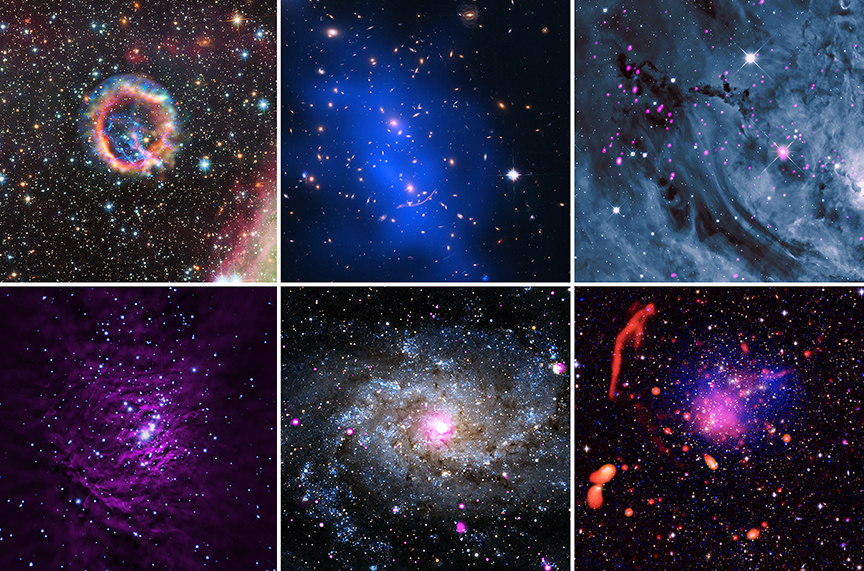
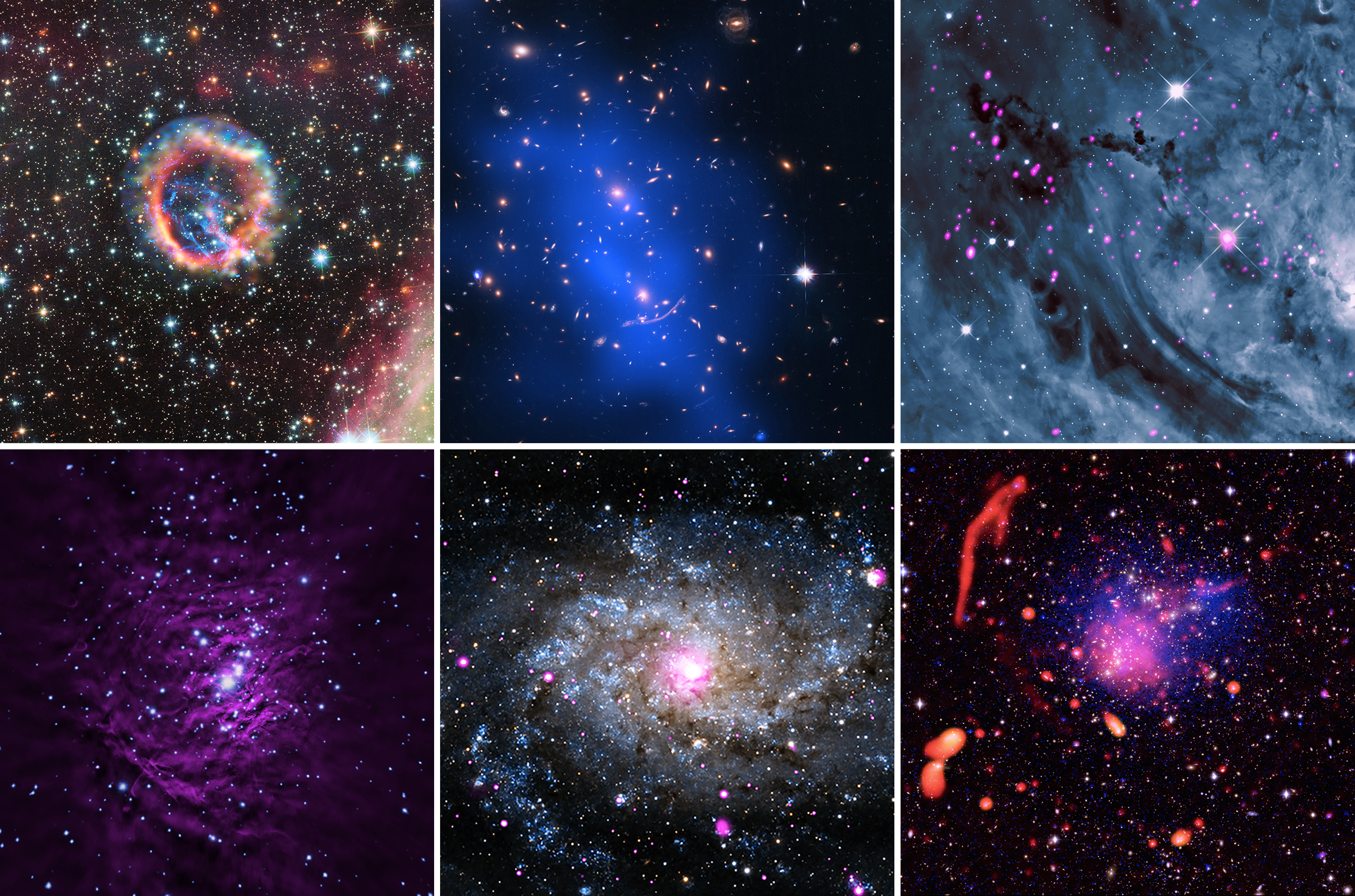
This is the season of celebrating, and the Chandra X-ray Center has prepared a platter of cosmic treats from NASA's Chandra X-ray Observatory to enjoy. This selection represents different types of objects — ranging from relatively nearby exploded stars to extremely distant and massive clusters of galaxies — that emit X-rays detected by Chandra. Each image in this collection blends Chandra data with other telescopes, creating a colorful medley of light from our Universe.


Top row (left to right):

E0102-72.3
This supernova remnant was produced by a massive star that exploded in a nearby galaxy called the Small Magellanic Cloud. X-rays from Chandra (blue and purple) have helped astronomers confirm that most of the oxygen in the universe is synthesized in massive stars. The amount of oxygen in the E0102-72.3 ring shown here is enough for thousands of solar systems. This image also contains optical data from NASA's Hubble Space Telescope and the Very Large Telescope in Chile (red and green).

Abell 370
Located about 4 billion light years from Earth, Abell 370 is a galaxy cluster containing several hundred galaxies. Galaxy clusters are the largest objects in the Universe held together by gravity. In addition to the individual galaxies, they contain vast amounts of multimillion-degree gas that emits X-rays, and dark matter that supplies most of the gravity of the cluster, yet does not produce any light. Chandra reveals the hot gas (diffuse blue regions) in a combined image with optical data from Hubble (red, green, and blue).

Messier 8 (M8)
Also known as NGC 6523 or the Lagoon Nebula, Messier 8 is a giant cloud of gas and dust where stars are currently forming. At a distance of about 4,000 light years from Earth, Messier 8 provides astronomers an excellent opportunity to study the properties of very young stars. Many infant stars give off copious amounts of high-energy light including X-rays, which are seen in the Chandra data (pink). The X-ray data have been combined with an optical image of Messier 8 from the Mt. Lemmon Sky Center in Arizona (blue and white).


Bottom row (left to right):

Orion Nebula
Look just below the middle of the three stars of belt in the constellation of Orion to find the Orion Nebula, which can be seen without a telescope. With a telescope like Chandra, however, the view is much different. In this image, X-rays from Chandra (blue) reveal individual young stars, which are hot and energetic. When combined with radio emission from the NSF's Very Large Array (purple), a vista of this stellar nursery is created that the unaided human eye could never capture.

Messier 33 (M33)
The Triangulum Galaxy, a.k.a., Messier 33, is a spiral galaxy about 3 million light years from Earth. It belongs to the Local Group of galaxies that includes the Milky Way and Andromeda galaxies. Chandra's X-ray data (pink) reveal a diverse range of objects including neutron stars and black holes that are pulling material from a companion star, and supernova remnants. An optical image from amateur astronomer Warren Keller (red, green, and blue) shows the majestic arms of this spiral galaxy that in many ways is a cousin to our own Milky Way.

Abell 2744
This composite image contains the aftermath of a giant collision involving four separate galaxy clusters at a distance of about 3.5 billion light years. Officially known as Abell 2744, this system is also referred to by astronomers as "Pandora's Cluster" because all of the different structures found within it. This view of Abell 2744 contains X-ray data from Chandra (blue) showing hot gas, optical data from Subaru and the VLT (red, green and blue), and radio data from the NSF's Karl G. Jansky Very Large Array (red).

NASA's Marshall Space Flight Center in Huntsville, Alabama, manages the Chandra program for NASA's Science Mission Directorate in Washington. The Smithsonian Astrophysical Observatory in Cambridge, Massachusetts, controls Chandra's science and flight operations.


Friday, September 14, 2018

BUFFALO charges towards the earliest galaxies

BUFFALO’s view on Abell 370

PR Image heic1816b
The last of the Frontier Fields — Abell 370

Comparison between Frontier Fields and BUFFALO

Digitized sky survey image of Abell 370 (ground-based image)


Videos

Zooming onto the galaxy cluster Abell 370

Pan across Abell 370


New Hubble project provides wide-field view of the galaxy cluster Abell 370


The NASA/ESA Hubble Space Telescope has started a new mission to shed light on the evolution of the earliest galaxies in the Universe. The BUFFALO survey will observe six massive galaxy clusters and their surroundings. The first observations show the galaxy cluster Abell 370 and a host of magnified, gravitationally lensed galaxies around it.

Learning about the formation and evolution of the very first galaxies in the Universe is crucial for our understanding of the cosmos. While the NASA/ESA Hubble Space Telescope has already detected some of the most distant galaxies known, their numbers are small, making it hard for astronomers to determine if they represent the Universe at large.

Massive galaxy clusters like Abell 370, which is visible in this new image, can help astronomers find more of these distant objects. The immense masses of galaxy clusters make them act as cosmic magnifying glasses. A cluster’s mass bends and magnifies light from more distant objects behind it, uncovering objects otherwise too faint for even Hubble’s sensitive vision. Using this cosmological trick — known as strong gravitational lensing — Hubble is able to explore some of the earliest and most distant galaxies in the Universe.

Numerous galaxies are lensed by the mass of Abell 370. The most stunning demonstration of gravitational lensing can be seen just below the centre of the cluster. Nicknamed “the Dragon”, this extended feature is made up of a multitude of duplicated images of a spiral galaxy which lies beyond the cluster.

This image of Abell 370 and its surroundings was made as part of the new Beyond Ultra-deep Frontier Fields And Legacy Observations (BUFFALO) survey. This project, led by European astronomers from the Niels Bohr Institute (Denmark) and Durham University (UK), was designed to succeed the successful Frontier Fields project [1]. 101 Hubble orbits — corresponding to 160 hours of precious observation time — have been dedicated to exploring the six Frontier Field galaxy clusters. These additional observations focus on the regions surrounding the galaxy clusters, allowing for a larger field of view.

BUFFALO’s main mission, however, is to investigate how and when the most massive and luminous galaxies in the Universe formed and how early galaxy formation is linked to dark matter assembly. This will allow astronomers to determine how rapidly galaxies formed in the first 800 million years after the Big Bang — paving the way for observations with the upcoming NASA/ESA/CSA James Webb Space Telescope.

Driven by the Frontier Fields observations, BUFFALO will be able to detect the most distant galaxies approximately ten times more efficiently than its progenitor programme. The BUFFALO survey will also take advantage of other space telescopes which have already observed the regions around the clusters. These datasets will be included in the search for the first galaxies.

The extended fields of view will also allow better 3-dimensional mapping of the mass distribution — of both ordinary and dark matter — within each galaxy cluster. These maps help astronomers learn more about the evolution of the lensing galaxy clusters and about the nature of dark matter.


Notes

[1] Frontier Fields was a Hubble programme that ran from 2013 to 2017. Hubble spent 630 hours of observation time probing six notable galaxy clusters, all of which showed effects of strong gravitational lensing.


More information

The Hubble Space Telescope is a project of international cooperation between ESA and NASA.

Image credit: NASA, ESA, A. Koekemoer, M. Jauzac, C. Steinhardt, and the BUFFALO team


Links


Contacts

Charles Steinhardt
Niels Bohr Institute
Copenhagen, Denmark
Tel: +45 35 33 50 10

Mathilde Jauzac
Durham University
Durham, UK
Tel: +44 7445218614

Mathias Jäger
ESA/Hubble, Public Information Officer
Garching, Germany
Tel: +49 176 62397500


Sunday, May 07, 2017

The final frontier of the Frontier Fields

 PR Image heic1711a
The last of the Frontier Fields — Abell 370

PR Image heic1711b
Abell 370 parallel field

Digitized sky survey image of Abell 370 (ground-based image)

Abell 370 (seen in 2009)


Videos

Zoom-in on Abell 370

Pan across Abell 370

Increased depth of Abell 370


Image Comparisons 

Comparison of Abell 370 in 2009 and 2016


The NASA/ESA Hubble Telescope has peered across six billion light years of space to resolve extremely faint features of the galaxy cluster Abell 370 that have not been seen before. Imaged here in stunning detail, Abell 370 is part of the Frontier Fields programme which uses massive galaxy clusters to study the mysteries of dark matter and the very early Universe.

Six billion light-years away in the constellation Cetus (the Sea Monster), Abell 370 is made up of hundreds of galaxies [1]. Already in the mid-1980s higher-resolution images of the cluster showed that the giant luminous arc in the lower left of the image was not a curious structure within the cluster, but rather an astrophysical phenomenon: the gravitationally lensed image of a galaxy twice as far away as the cluster itself. Hubble helped show that this arc is composed of two distorted images of an ordinary spiral galaxy that just happens to lie behind the cluster.

Abell 370’s enormous gravitational influence warps the shape of spacetime around it, causing the light of background galaxies to spread out along multiple paths and appear both distorted and magnified. The effect can be seen as a series of streaks and arcs curving around the centre of the image. Massive galaxy clusters can therefore act like natural telescopes, giving astronomers a close-up view of the very distant galaxies behind the cluster — a glimpse of the Universe in its infancy, only a few hundred million years after the Big Bang.

This image of Abell 370 was captured as part of the Frontier Fields programme, which used a whopping 630 hours of Hubble observing time, over 560 orbits of the Earth. Six clusters of galaxies were imaged in exquisite detail, including Abell 370 which was the very last one to be finished. An earlier image of this object  — using less observation time and therefore not recording such faint detail — was published in 2009.

During the cluster observations, Hubble also looked at six “parallel fields”, regions near the galaxy clusters which were imaged with the same exposure times as the clusters themselves. Each cluster and parallel field were imaged in infrared light by the Wide Field Camera 3 (WFC3), and in visible light by the Advanced Camera for Surveys (ACS).

The Frontier Fields programme produced the deepest observations ever made of galaxy clusters and the magnified galaxies behind them. These observations are helping astronomers understand how stars and galaxies emerged out of the dark ages of the Universe, when space was dark, opaque, and filled with hydrogen.

Studying massive galaxy clusters like Abell 370 also helps with measuring the distribution of normal matter and dark matter within such clusters [heic1506]. By studying its lensing properties, astronomers have determined that Abell 370 contains two large, separate clumps of dark matter, contributing to the evidence that this massive galaxy cluster is actually the result of two smaller clusters merging together.

Now that the observations for the Frontier Fields programme are complete, astronomers can use the full dataset to explore the clusters, their gravitational lensing effects and the magnified galaxies from the early Universe in full detail.


Notes


[1] Galaxy clusters are the most massive structures in the Universe that are held together by gravity, generally thought to have formed when smaller groups of galaxies smashed into each other in ever-bigger cosmic collisions. Such clusters can contain up to 1000 galaxies, along with hot intergalactic gas that often shines brightly at X-ray wavelengths, all bound together primarily by the gravity of dark matter.


More Information

The Hubble Space Telescope is a project of international cooperation between ESA and NASA.
Image credit: NASA, ESA, HST Frontier Fields


Links


Contacts

Mathias Jäger
ESA/Hubble, Public Information Officer
Garching bei München, Germany
Tel: +49 176 6239750


Source: ESO/Hubble/News

Sunday, October 02, 2016

The Frontier Fields: Where Primordial Galaxies Lurk

This image of galaxy cluster Abell 2744, also called Pandora's Cluster, was taken by the Spitzer Space Telescope. The cluster is also being studied by NASA's Hubble Space Telescope and Chandra X-Ray Observatory in a collaboration called the Frontier Fields project. Image credit:NASA/JPL-Caltech.  › Full image and caption


In the ongoing hunt for the universe's earliest galaxies, NASA's Spitzer Space Telescope has wrapped up its observations for the Frontier Fields project. This ambitious project has combined the power of all three of NASA's Great Observatories -- Spitzer, the Hubble Space Telescope and the Chandra X-ray Observatory -- to delve as far back in time and space as current technology can allow.

Even with today's best telescopes, it is difficult to gather enough light from the very first galaxies, located more than 13 billion light years away, to learn much about them beyond their approximate distance. But scientists have a tool of cosmic proportions to help in their studies. The gravity exerted by massive, foreground clusters of galaxies bends and magnifies the light of faraway, background objects, in effect creating cosmic zoom lenses. This phenomenon is called gravitational lensing.

The Frontier Fields observations have peered through the strongest zoom lenses available by targeting six of the most massive galaxy clusters known. These lenses can magnify tiny background galaxies by as much as a factor of one hundred. With Spitzer's new Frontier Fields data, along with data from Chandra and Hubble, astronomers will learn unprecedented details about the earliest galaxies.

"Spitzer has finished its Frontier Fields observations and we are very excited to get all of this data out to the astronomical community," said Peter Capak, a research scientist with the NASA/JPL Spitzer Science Center at Caltech in Pasadena, California, and the Spitzer lead for the Frontier Fields project.

A recent paper published in the journal Astronomy & Astrophysics presented the full catalog data for two of the six galaxy clusters studied by the Frontier Fields: Abell 2744 -- nicknamed Pandora's Cluster -- and MACS J0416, both located about four billion light years away. The other galaxy clusters selected for Frontier Fields are RXC J2248, MACS J1149, MACS J0717 and Abell 370.

Eager astronomers will comb the Frontier Fields catalogs for the tiniest, dimmest-lensed objects, many of which should prove to be the most distant galaxies ever glimpsed. The current record-holder, a galaxy called GN-z11, was reported in March by Hubble researchers at the astonishing distance of 13.4 billion light-years, only a few hundred million years after the big bang. The discovery of this galaxy did not require gravitational lenses because it is an outlying, extremely bright object for its epoch. With the magnification boost provided by gravitational lenses, the Frontier Fields project will allow researchers to study typical objects at such incredible distances, painting a more accurate and complete picture of the universe's earliest galaxies.

Astronomers want to understand how these primeval galaxies arose, how their constituent mass developed into stars, and how these stars have enriched the galaxies with chemical elements fused in their thermonuclear furnaces. To learn about the origin and evolution of the earliest galaxies, which are quite faint, astronomers need to collect as much light as possible across a range of frequencies.

With sufficient light from these galaxies, astronomers can perform spectroscopy, pulling out details about stars' compositions, temperatures and their environments by examining the signatures of chemical elements imprinted in the light.

"With the Frontier Fields approach," said Capak, "the most remote and faintest galaxies are made bright enough for us to start to say some definite things about them, such as their star formation histories."

Because the universe has expanded over its 13.8-billion-year history, light from extremely distant objects has been stretched out, or redshifted, on its long journey to Earth. Optical light emitted by stars in the gravitational-lensed, background galaxies viewed in the Frontier Fields has therefore redshifted into infrared. Spitzer can use this infrared light to gauge the population sizes of stars in a galaxy, which in turn gives clues to the galaxy's mass. Combining the light seen by Spitzer and Hubble allows astronomers to identify galaxies at the edge of the observable universe.

Hubble, meanwhile, scans the Frontier Fields galaxy clusters in optical and near-infrared light, which has redshifted from ultraviolet light on its journey to Earth. Chandra, for its part, observes the foreground galaxy clusters in high-energy X-rays emitted by black holes and ambient hot gas. Along with Spitzer, the space telescopes size up the masses of the galaxy clusters, including their unseen but substantial dark matter content. Nailing down the clusters' total mass is a critical step in quantifying the magnification and distortion they produce on background galaxies of interest. Recent multi-wavelength results in this vein from the Frontier Fields project regarding the MACS J0416 and MACS J0717 clusters were published in October 2015 and February 2016. These results also brought in radio wave observations from the Karl G. Jansky Very Large Array to see star-forming regions otherwise hidden by gas and dust.

The Frontier Fields collaboration has inspired scientists involved in the effort as they look ahead to delving even deeper into the universe with the James Webb Space Telescope, which is planned for launch in 2018.

"The Frontier Fields has been an entirely community-led project, which is different from the way many projects of this magnitude are typically pursued," said Lisa Storrie-Lombardi of the Spitzer Science Center, also with the Frontier Fields project. "People have gotten together and really embraced Frontier Fields."

In addition to the six Frontier Fields galaxy clusters, Spitzer has done follow-up observations on other, slightly shallower fields Hubble has gazed into, expanding the overall number of cosmic regions where fairly deep observations have been taken. These additional fields will further serve as rich areas of investigation for Webb and future instruments.

NASA's Jet Propulsion Laboratory, Pasadena, California, manages the Spitzer Space Telescope mission for NASA's Science Mission Directorate, Washington. Science operations are conducted at the Spitzer Science Center at Caltech. Spacecraft operations are based at Lockheed Martin Space Systems Company, Littleton, Colorado. Data are archived at the Infrared Science Archive, housed at the Infrared Processing and Analysis Center at Caltech. Caltech manages JPL for NASA.

For more information about Spitzer, visit: http://www.nasa.gov/spitzer - http://spitzer.caltech.edu


Written by Adam Hadhaz


News Media Contact

Elizabeth Landau
Jet Propulsion Laboratory, Pasadena, Calif.
818-354-6425

elizabeth.landau@jpl.nasa.gov

Source: JPL-Caltech

Friday, March 27, 2015

Hubble and Chandra Discover Dark Matter Is Not as Sticky as Once Thought

Six Cluster Collisions, with Dark-Matter Maps (Hubble and Chandra — Annotated)
The clusters shown here are, from left to right and top to bottom: MACS J0416.1-2403, MACS J0152.5-2852, MACS J0717.5+3745, Abell 370, Abell 2744, and ZwCl 1358+62.

Science Credit: NASA, ESA, D. Harvey (École Polytechnique Fédérale de Lausanne, Switzerland; University of Edinburgh, UK), R. Massey (Durham University, UK), T. Kitching (University College London, UK), and A. Taylor and E. Tittley (University of Edinburgh, UK).  Image Credit: NASA, ESA, STScI, and CXC.   


Astronomers using observations from NASA's Hubble Space Telescope and Chandra X-ray Observatory have found that dark matter does not slow down when colliding with each other. This means that it interacts with itself even less than previously thought. Researchers say this finding narrows down the options for what this mysterious substance might be.

Dark matter is a transparent form of matter that makes up most of the mass in the universe. Because dark matter does not reflect, absorb, or emit light, it can only be traced indirectly, such as by measuring how it warps space through gravitational lensing, where the light from distant sources is magnified and distorted by the gravitational effects of dark matter.

The two space observatories were used to study how dark matter in clusters of galaxies behaves when the clusters collide. Hubble was used to map the post-collision distribution of stars and dark matter, which was traced through its gravitational lensing effects on background light. Chandra was used to see the X-ray emission from the colliding gas. The results will be published in the journal Science on March 27.

"Dark matter is an enigma we have long sought to unravel," said John Grunsfeld, assistant administrator of NASA's Science Mission Directorate in Washington. "With the combined capabilities of these great observatories, both in extended mission, we are ever closer to understanding this cosmic phenomenon."

To learn more about dark matter, researchers can study it in a way similar to experiments on visible matter — by watching what happens when it bumps into celestial objects. An excellent natural laboratory for this analysis can be found in collisions between galaxy clusters.

Galaxy clusters are made of three main ingredients: galaxies, clouds of gas, and dark matter. During collisions, the clouds of gas enveloping the galaxies crash into each other and slow down or stop. The galaxies are much less affected by the drag from the gas and, because of the huge gaps between the stars within them, do not have a slowing effect on each other.

"We know how gas and galaxies react to these cosmic crashes and where they emerge from the wreckage. Comparing how dark matter behaves can help us to narrow down what it actually is," explained David Harvey of the École Polytechnique Fédérale de Lausanne, Switzerland, lead author of the new study.

Harvey and his team used data from Hubble and Chandra to study 72 large cluster collisions. The collisions happened at different times, and are seen from different angles — some from the side, and others head-on.

The team found that, like the galaxies, the dark matter continued straight through the violent collisions without slowing down relative to the galaxies. Because galaxies pass through unimpeded, if astronomers observe a separation between the distribution of the galaxies and the dark matter then they know it has slowed down. If the dark matter does slow, it will drag and lie somewhere between the galaxies and the gas, which tells researchers how much it has interacted.

The leading theory is that dark matter particles spread throughout the galaxy clusters do not frequently bump into each other. The reason the dark matter doesn't slow down is because not only does it not interact with visible particles, it also infrequently interacts with other dark matter. The team has measured this "self-interaction" and found it occurs even less frequently than previously thought.

"A previous study had seen similar behavior in the Bullet Cluster," said team member Richard Massey of Durham University, U.K. "But it's difficult to interpret what you're seeing if you have just one example. Each collision takes hundreds of millions of years, so in a human lifetime we only get to see one freeze-frame from a single camera angle. Now that we have studied so many more collisions, we can start to piece together the full movie and better understand what is going on."

By finding that dark matter interacts with itself even less than previously thought, the team has successfully narrowed down the properties of dark matter. Particle physics theorists now have a smaller set of unknowns to work with when building their models.

"It is unclear how much we expect dark matter to interact with itself because dark matter is already going against everything we know, said Harvey. "We know from previous observations that it must interact with itself reasonably weakly, however this study has now placed it below that of two protons interacting with one another — which is one theory for dark matter." Harvey said that the results suggest that dark matter is unlikely to be only a kind of dark proton. If dark matter scattered like protons do with one another (electrostatically) it would have been detected. "This challenges the idea that there exists 'dark photons,' the dark matter equivalent of photons," he said.

Dark matter could potentially have rich and complex properties, and there are still several other types of interactions to study. These latest results rule out interactions that create a strong frictional force, causing dark matter to slow down during collisions. Other possible interactions could make dark matter particles bounce off each other like billiard balls, causing dark matter particles to be ejected from the clouds by collisions or for dark matter blobs to change shape. The team will be studying these next.

To further increase the number of collisions that can be studied, the team is also looking to study collisions involving individual galaxies, which are much more common.

"There are still several viable candidates for dark matter, so the game is not over, but we are getting nearer to an answer," concludes Harvey. "These 'astronomically large' particle colliders are finally letting us gimpse the dark world all around us but just out of reach."


Contact
 
Ray Villard
Space Telescope Science Institute, Baltimore, Md.
410-338-4514
villard@stsci.edu

Felicia Chou
NASA Headquarters, Washington, D.C.
202-358-0257
felicia.chou@nasa.gov

Megan Watzke
Chandra X-ray Center, Cambridge, Mass.
617-496-7998
mwatzke@cfa.harvard.edu

Georgia Bladon
ESA/Hubble, Garching, Germany
011-44-7816-291261
gbladon@partner.eso.org

Richard Massey
Durham University, Durham, UK
011-44-7740-648080
r.j.massey@durham.ac.uk
 
David Harvey
EPFL, Lausanne, Switzerland;
University of Edinburgh, Edinburgh, UK
011-41-22-3792475
david.harvey@epfl.ch


Source: HubbleSite