Showing posts with label Sagittarius B2. Show all posts

Wednesday, December 03, 2025

Sagittarius B2 Molecular Cloud

Credit: NASA, ESA, CSA, STScI, Adam Ginsburg (University of Florida), Nazar Budaiev (University of Florida), Taehwa Yoo (University of Florida); Image Processing: Alyssa Pagan (STScI)

The Mid-Infrared Instrument (MIRI) on NASA’s James Webb Space Telescope captured glowing cosmic dust heated by very young massive stars in unprecedented detail in this image of the Sagittarius B2 (Sgr B2) molecular cloud released on Sept. 24, 2025.

Sgr B2 is the most massive, and active star-forming region in our galaxy, located only a few hundred light years from our central supermassive black hole. While Sgr B2 has only 10% of the galactic center’s gas, it produces 50% of its stars. Astronomers want to figure out why it is so much more active than the rest of the galactic center.

MIRI has both a camera and a spectrograph that sees light in the mid-infrared region of the electromagnetic spectrum. MIRI’s view reveals colorful stars punctuated occasionally by bright clouds of gas and dust. Further research into these stars will reveal details of their masses and ages, which will help astronomers better understand the process of star formation in this dense, active galactic center region.


Saturday, September 27, 2025

NASA’s Webb Explores Largest Star-Forming Cloud in Milky Way

Stars, gas and cosmic dust in the Sagittarius B2 molecular cloud glow in near-infrared light, captured by Stars, gas and cosmic dust in the Sagittarius B2 molecular cloud glow in near-infrared light, captured by Webb’s NIRCam instrument. The darkest areas of the image are not empty space but are areas where stars are still forming inside dense clouds that block their light. Image: NASA, ESA, CSA, STScI, Adam Ginsburg (University of Florida), Nazar Budaiev (University of Florida), Taehwa Yoo (University of Florida); Image Processing: Alyssa Pagan (STScI)

Webb’s MIRI instrument shows the Sagittarius B2 region in mid-infrared light, with warm dust glowing brightly. Only the brightest stars emit strongly enough to appear through the dense clouds as blue pinpoints. Image: NASA, ESA, CSA, STScI, Adam Ginsburg (University of Florida), Nazar Budaiev (University of Florida), Taehwa Yoo (University of Florida); Image Processing: Alyssa Pagan (STScI)


NASA’s James Webb Space Telescope has revealed a colorful array of massive stars and glowing cosmic dust in the Sagittarius B2 molecular cloud, the most massive and active star-forming region in our Milky Way galaxy.

“Webb’s powerful infrared instruments provide detail we’ve never been able to see before, which will help us to understand some of the still-elusive mysteries of massive star formation and why Sagittarius B2 is so much more active than the rest of the galactic center,” said astronomer Adam Ginsburg of the University of Florida, principal investigator of the program.

The difference longer wavelengths of light make, even within the infrared spectrum, are stark when comparing the images from Webb’s MIRI and NIRCam (Near-Infrared Camera) instruments. Glowing gas and dust appear dramatically in mid-infrared light, while all but the brightest stars disappear from view.

In contrast to MIRI, colorful stars steal the show in Webb’s NIRCam image, punctuated occasionally by bright clouds of gas and dust. Further research into these stars will reveal details of their masses and ages, which will help astronomers better understand the process of star formation in this dense, active galactic center region. Has it been going on for millions of years? Or has some unknown process triggered it only recently?

Astronomers hope Webb will shed light on why star formation in the galactic center is so disproportionately low. Though the region is stocked with plenty of gaseous raw material, on the whole it is not nearly as productive as Sagittarius B2. While Sagittarius B2 has only 10 percent of the galactic center’s gas, it produces 50 percent of its stars.

“Humans have been studying the stars for thousands of years, and there is still a lot to understand,” said Nazar Budaiev, a graduate student at the University of Florida and the co-principal investigator of the study. “For everything new Webb is showing us, there are also new mysteries to explore, and it’s exciting to be a part of that ongoing discovery.”

The James Webb Space Telescope is the world’s premier space science observatory. Webb is solving mysteries in our solar system, looking beyond to distant worlds around other stars, and probing the mysterious structures and origins of our universe and our place in it. Webb is an international program led by NASA with its partners, ESA (European Space Agency) and CSA (Canadian Space Agency).


Related Information

Read more: NASA’s Webb Reveals New Features in Heart of Milky Way

Explore: ViewSpace interactive image tour of the center of the Milky Way

Explore: ViewSpace interactive views of the Eagle Nebula in different forms of light

Read more: Webb’s Star Formation Discoveries

Read more: Star formation in the Cat’s Paw Nebula

More Webb News

More Webb Images

Webb Science Themes

Webb Mission Page


Related For Kids

What is the Webb Telescope?

SpacePlace for Kids


En Español

Ciencia de la NASA

NASA en español

Space Place para niños


Tuesday, March 30, 2021

Stellar Eggs near Galactic Center Hatching into Baby Stars

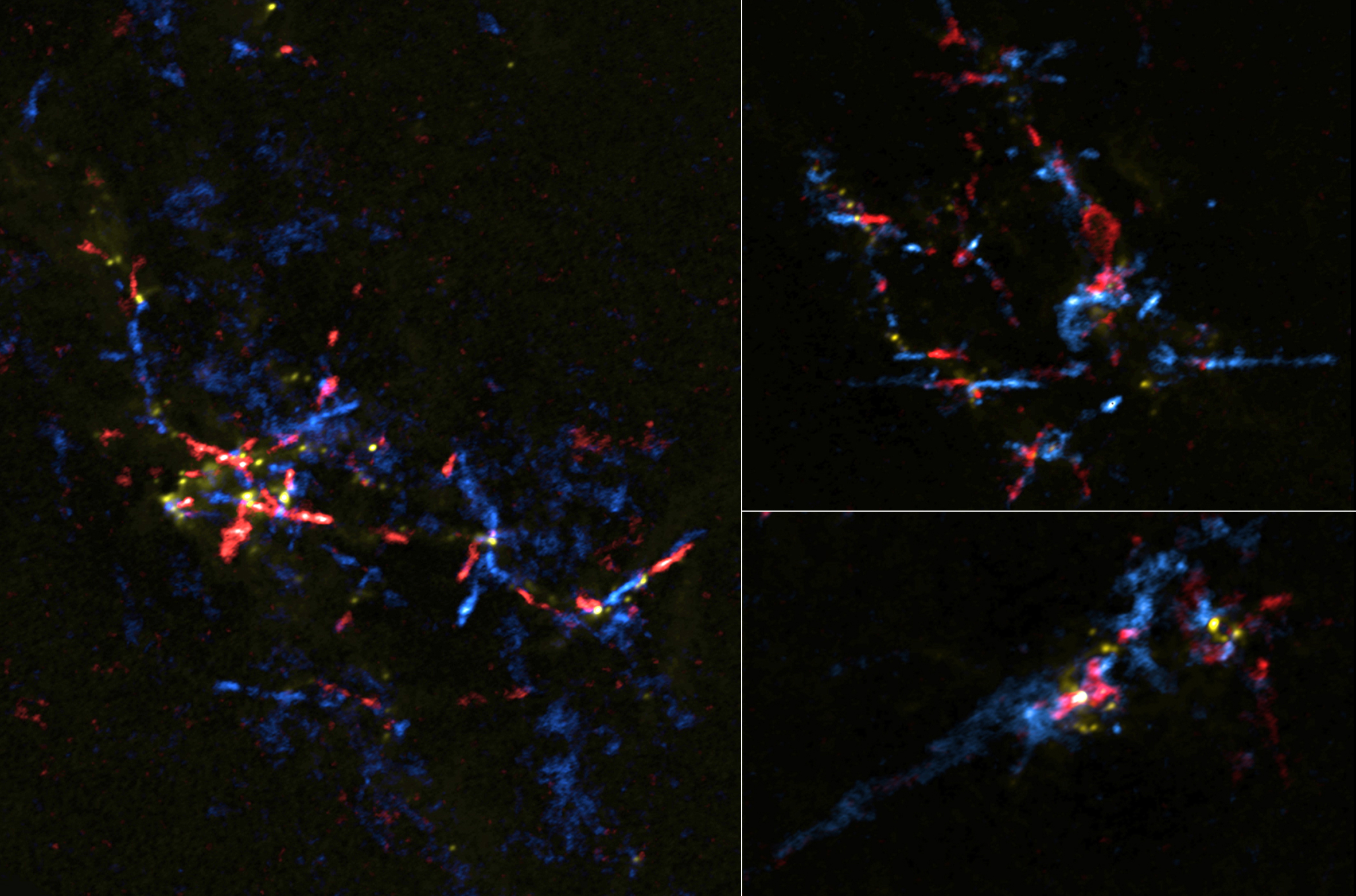
ALMA pseudo-color composite image of the gas outflows from baby stars in the Galactic Center region. Gas moving toward us is shown in blue and gas moving away from us is shown in red. Credit: ALMA (ESO/NAOJ/NRAO), Lu et al.
Hi-res image

Astronomers found a number of baby stars hiding around the center of the Milky Way using the Atacama Large Millimeter/submillimeter Array (ALMA). Previous studies had suggested that the environment there is too harsh to form stars because of the strong tidal forces, strong magnetic fields, high energy particles, and frequent supernova explosions. These findings indicate that star formation is more resilient than researchers thought. These observations suggest there is ubiquitous star formation activity hidden deep in dense molecular gas, which may allow for the possibility of a future burst of star formation around the Galactic Center. 

“It is like hearing babies’ cries in a place we expected to be barren,” says Xing Lu, an astronomer at the National Astronomical Observatory of Japan. “It is very difficult for babies to be born and grow up healthily in an environment that is too noisy and unstable. However, our observations prove that even in the strongly disturbed areas around the Galactic Center, baby stars still form.”

Stars are formed in cosmic clouds gathered by gravity. If something interferes with the gravity driven processes, star formation will be suppressed. There are many potential sources of interference in the Central Molecular Zone (CMZ) of the Milky Way, located within a radius of 1000 light-years from the Galactic Center. Examples include strong turbulence which stirs up the clouds and prevents them from contracting, or strong magnetic fields can support the gas against self-gravitational collapse. In fact, previous observations indicated that star formation here is much less efficient; with the exception of one active star forming region called Sagittarius B2 (Sgr B2).

Lu and his colleagues used ALMA to tackle the mystery of suppressed star formation in most of the CMZ. The target regions contain an ample amount of gas, but no star formation has been expected. Contrary to the traditional picture, the team discovered more than 800 dense cores of gas and dust particles in the CMZ. “The discovery leads to the question of whether they are actually ‘stellar eggs’ or not,” says Lu. To look for telltale signs of star formation indicative of stellar eggs, the team again used ALMA to search for energetic gas outflows, which are like the birth cries of baby stars. Thanks to ALMA’s high sensitivity and high spatial resolution, for the first time, they detected 43 small and faint outflows in the clouds. This is unambiguous evidence of ongoing star formation. It turned out that many baby stars were hiding in the regions that were thought to be unsuitable for stellar growth.

The small number of detected outflows is another mystery. Considering the fact that more than 800 “stellar eggs” have been found, the small number of “stellar babies” might indicate that the star formation activity in the CMZ is in the very early phase. “Although a large number of outflows might be still hidden in the regions, our results may suggest we are seeing the beginning of the next wave of active star formation,” says Lu.

“Although previous observations have suggested that overall star formation rates are suppressed to about 10% in the giant molecular clouds in the Galactic Center, this observation shows that the star formation processes hidden in dense molecular gas clouds are not very different from those of the Solar neighborhood,” explains Shu-ichiro Inutsuka, a professor at Nagoya University and a co-author of the research paper. “The ratio of the number of star-forming cores to star-less cores seems to be only a few times smaller than that in the Solar neighborhood. This can be regarded as the ratio of their respective lifetimes. We think that the average duration of the star-less core stage in the Galactic Center might be somewhat longer than in the Solar neighborhood. More research is needed to explain why it is so.”

The research team is now analyzing ALMA’s higher resolution observation data for the CMZ and aims to study the properties of the accretion disks around the baby stars which drive the gas outflows. By comparing with other star forming regions, they hope to better understand star formation in the CMZ, from clouds to protostars, and from chemistry to magnetic fields.

 
Paper information

These observation results were presented in Xing Lu et al. “ALMA Observations of Massive Clouds in the Central Molecular Zone: Ubiquitous Protostellar Outflows” in the Astrophysical Journal on March 16, 2021.

This research was supported by the Japan Society of Promotion of Science (JSPS) KAKENHI (No. 18K13589 & 20K14528), the Deutsche Forschungsgemeinschaft (DFG, German Research Foundation) through an Emmy Noether Research Group (grant number KR4801/1-1), the DFG Sachbeihilfe (grant number KR4801/2-1), the SFB 881 “The Milky Way System” (subproject B2), the European Union’s Horizon 2020 research and innovation programme via the ERC Starting Grant MUSTANG (grant agreement number 714907), and the National Science Foundation under Award No. 1816715.

The Atacama Large Millimeter/submillimeter Array (ALMA), an international astronomy facility, is a partnership of the European Organization for Astronomical Research in the Southern Hemisphere (ESO), the U.S. National Science Foundation (NSF) and the National Institutes of Natural Sciences (NINS) of Japan in cooperation with the Republic of Chile. ALMA is funded by ESO on behalf of its Member States, by NSF in cooperation with the National Research Council of Canada (NRC) and the Ministry of Science and Technology (MOST) and by NINS in cooperation with the Academia Sinica (AS) in Taiwan and the Korea Astronomy and Space Science Institute (KASI).

ALMA construction and operations are led by ESO on behalf of its Member States; by the National Radio Astronomy Observatory (NRAO), managed by Associated Universities, Inc. (AUI), on behalf of North America; and by the National Astronomical Observatory of Japan (NAOJ) on behalf of East Asia. The Joint ALMA Observatory (JAO) provides the unified leadership and management of the construction, commissioning and operation of ALMA.

 Source:  Atacama Large Millimeter/submillimeter Array (ALMA)


Monday, September 29, 2014

Interstellar molecules are branching out

Dust and molecules in the central region of our Galaxy: The background image shows the dust emission in a combination of ... [more] © MPIfR/A. Weiß (background image), University of Cologne/M. Koerber (molecular models), MPIfR/A. Belloche (montage).

The central region of the Milky Way above the antennas of the ALMA observatory. The direction to the Galactic center is ... [more] © Y. Beletsky (LCO)/ESO


Detection of iso-propyl cyanide with ALMA, the Atacama Large Millimeter/submillimeter Array

Scientists from the Max Planck Institute for Radio Astronomy (Bonn, Germany), Cornell University (USA), and the University of Cologne (Germany) have for the first time detected a carbon-bearing molecule with a "branched" structure in interstellar space. The molecule, iso-propyl cyanide (i-C3H7CN), was discovered in a giant gas cloud called Sagittarius B2, a region of ongoing star formation close to the center of our galaxy that is a hot-spot for molecule-hunting astronomers. The branched structure of the carbon atoms within the iso-propyl cyanide molecule is unlike the straight-chain carbon backbone of other molecules that have been detected so far, including its sister molecule normal-propyl cyanide. The discovery of iso-propyl cyanide opens a new frontier in the complexity of molecules found in regions of star formation, and bodes well for the presence of amino acids, for which this branched structure is a key characteristic.
The results are published in this week’s issue of “Science”.

While various types of molecules have been detected in space, the kind of hydrogen-rich, carbon-bearing (organic) molecules that are most closely related to the ones necessary for life on Earth appear to be most plentiful in the gas clouds from which new stars are being formed. "Understanding the production of organic material at the early stages of star formation is critical to piecing together the gradual progression from simple molecules to potentially life-bearing chemistry," says Arnaud Belloche from the Max Planck Institute for Radio Astronomy, the lead author of the paper.

The search for molecules in interstellar space began in the 1960's, and around 180 different molecular species have been discovered so far. Each type of molecule emits light at particular wavelengths, in its own characteristic pattern, or spectrum, acting like a fingerprint that allows it to be detected in space using radio telescopes.

Until now, the organic molecules discovered in star-forming regions have shared one major structural characteristic: they each consist of a "backbone" of carbon atoms that are arranged in a single and more or less straight chain. The new molecule discovered by the team, iso-propyl cyanide, is unique in that its underlying carbon structure branches off in a separate strand. "This is the first ever interstellar detection of a molecule with a branched carbon backbone," says Holger Müller, a spectroscopist at the University of Cologne and co-author on the paper, who measured the spectral fingerprint of the molecule in the laboratory, allowing it to be detected in space.

But it is not just the structure of the molecule that surprised the team - it is also plentiful, at almost half the abundance of its straight-chain sister  molecule, normal-propyl cyanide (n-C3H7CN), which the team had already  detected using the single-dish radio telescope of the Institut de Radioastronomie Millimétrique (IRAM) a few years ago. "The enormous abundance of iso-propyl cyanide suggests that branched molecules may in fact be the rule, rather than the exception, in the interstellar medium," says Robin Garrod, an astrochemist at Cornell University and a co-author of the paper.

The team used the Atacama Large Millimeter/submillimeter Array (ALMA), in Chile, to probe the molecular content of the star-forming region Sagittarius B2 (Sgr B2). This region is located close to the Galactic Center, at a distance of about 27,000 light years from the Sun, and is uniquely rich in emission from complex interstellar organic molecules. "Thanks to the new capabilities offered by ALMA, we were able to perform a full spectral survey toward Sgr B2 at wavelengths between 2.7 and 3.6 mm, with sensitivity and spatial resolution ten times greater than our previous survey," explains Belloche. "But this took only a tenth of the time." The team used this spectral survey to search systematically for the fingerprints of new interstellar molecules. "By employing predictions from the Cologne Database for Molecular Spectroscopy, we could identify emission features from both varieties of propyl cyanide," says Müller. As many as 50 individual features for i-propyl cyanide and even 120 for n-propyl cyanide were unambiguously identified in the ALMA spectrum of Sgr B2. The two molecules, each consisting of 12 atoms, are also the joint-largest molecules yet detected in any star-forming region.

The team constructed computational models that simulate the chemistry of formation of the molecules detected in Sgr B2. In common with many other complex organics, both forms of propyl cyanide were found to be efficiently formed on the surfaces of interstellar dust grains. "But," says Garrod, "the models indicate that for molecules large enough to produce branched side-chain structure, these may be the prevalent forms. The detection of the next member of the alkyl cyanide series, n-butyl cyanide (n-C4H9CN), and its three branched isomers would allow us to test this idea".

"Amino acids identified in meteorites have a composition that suggests they originate in the interstellar medium," adds Belloche. “Although no interstellar amino acids have yet been found, interstellar chemistry may be responsible for the production of a wide range of important complex molecules that eventually find their way to planetary surfaces."

"The detection of iso-propyl cyanide tells us that amino acids could indeed be present in the interstellar medium because the side-chain structure is a key characteristic of these molecules", says Karl Menten, director at MPIfR and head of its Millimeter and Submillimeter Astronomy research department. "Amino acids have already been identified in meteorites and we hope to detect them in the interstellar medium in the future", he concludes.

Original Paper


Contact

Dr. Arnaud Belloche
Phone:+49 228 525-376
Max-Planck-Institut für Radioastronomie, Bonn
Email: belloche@mpifr-bonn.mpg.de

Dr. Robin T. Garrod
Phone:+1 607-255-8967
Center for Radiophysics and Space Research, Cornell University, U.S.A.
Email: rgarrod@astro.cornell.edu

Dr. Holger Müller
Phone:+49 221 470-4528
I. Physikalisches Institut, Universität zu Köln
Email: hspm@ph1.uni-koeln.de

Dr. Norbert Junkes
Presse- und Öffentlichkeitsarbeit
Phone:+49 228 525-399
Max-Planck-Institut für Radioastronomie, Bonn
Email: njunkes@mpifr-bonn.mpg.de