Showing posts with label Green Bank Telescope (GBT). Show all posts

Wednesday, January 10, 2024

Mystery of Star Formation Revealed by Hearts of Molecular Clouds


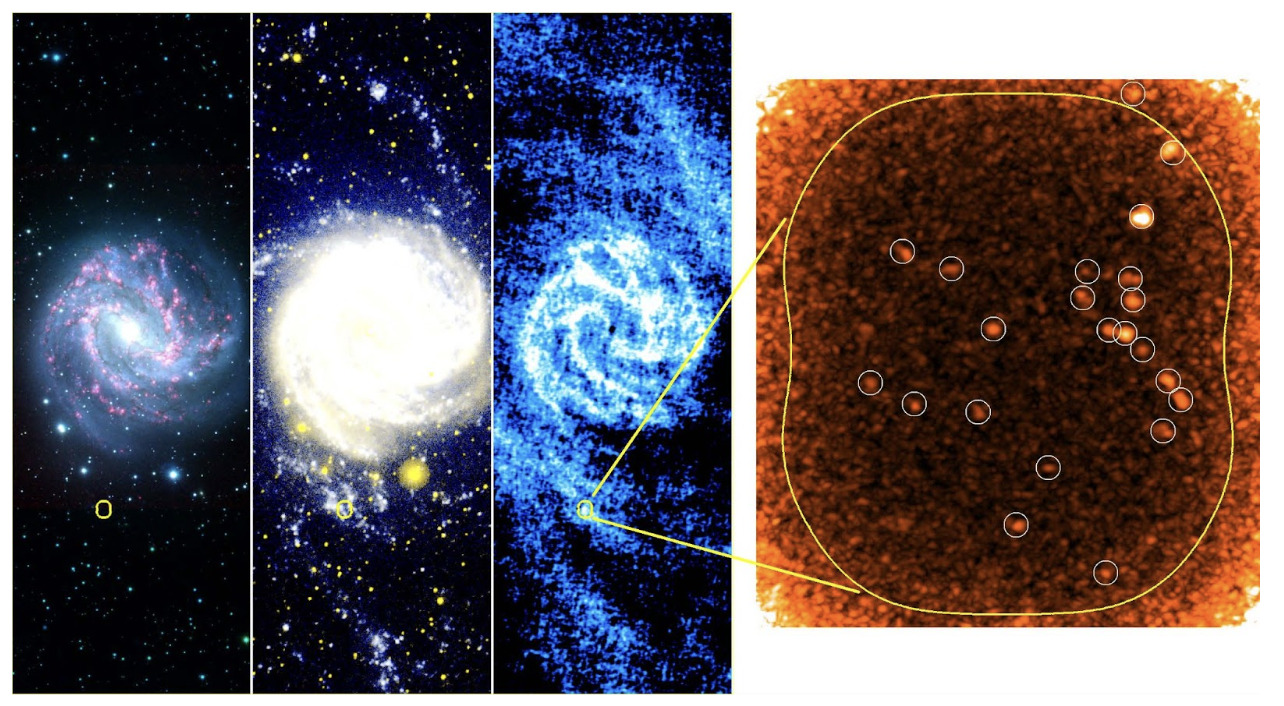
Research on the far edge of galaxy M83 reveals unusual star formation in an extreme environment. This area, outlined in yellow, is shown in data from several different instruments. From left to right: optical image from CTIO, ultraviolet image from GALEX, HI 21cm image from VLA and GBT, and CO(3-2) image from ALMA. In this last image, the star-forming “hearts” of molecular clouds, circled with white, are shown. Credit: J. Koda et al. Large Image


Data from the world's largest radio telescopes holds clues

An international team of astronomers has revealed mysterious star formation at the far edge of the galaxy M83. This research was presented today in a press conference at the 243rd American Astronomical Society (AAS) meeting in New Orleans, Louisiana.

The research used several instruments, including the Atacama Large Millimeter/submillimeter Array (ALMA), the Karl G. Jansky Very Large Array (VLA) and the Green Bank Telescope (GBT) from NRAO, along with the National Astronomical Observatory of Japan's (NAOJ) Subaru Telescope and the NASA Galaxy Evolution Explorer (GALEX).

Commonly, new stars form due to diffuse atomic gas shrinking into concentrations of molecular gas, called molecular clouds, whose high-density cores at their center trigger star formation. This process is expected in the inner part of galaxies but becomes increasingly rare toward galaxy outskirts.

Mónica Rubio, astronomer from Universidad de Chile and part of the research team, finds it "exciting to discover this small molecular cloud so far from the optical edge of M83 and exposed to a high field of ultraviolet radiation." She further explains that "ALMA's unprecedented sensitivity and resolving power made this discovery possible. It shows that these molecular clouds are not resolved at 6 pc resolution. They are even smaller! This is great."

A surprising number of very young stars exist at the far edges of many galaxies, but scientists could not understand how and why these stars were made because they could not pinpoint their formation sites. This research discovered 23 molecular clouds that showed a different type of star formation. The large bodies of these clouds were not visible like "normal" molecular clouds—only their star-forming dense cores, the "hearts" of the clouds, were observed. This discovery provides an essential clue to understanding the physical processes that generally lead to star formation.

"The star formation at galaxy edges has been a nagging mystery since their discovery by the NASA GALEX satellite 18 years ago," said astronomer Jin Koda of Stony Brook University, who led this research, "Previous searches for molecular clouds in this environment turned out unsuccessful." David Thilker of Johns Hopkins University, who originally discovered the star formation activity occurring in the outskirts of M83 and other galaxies, commented, "It has been gratifying to see the search for dense clouds associated with the outer disk finally come to fruition, revealing a characteristically different observational fingerprint for the molecular clouds."

The revelation of these molecular clouds uncovered a link to an extensive reservoir of diffuse atomic gas, another discovery of this research. Typically, atomic gas condenses into dense molecular clouds, where even denser cores develop and form stars. This process is in operation even at galaxy edges, but the conversion of this atomic gas to molecular clouds was not evident for reasons that are yet unresolved.

Amanda Lee, an undergraduate student on Koda's research team, processed GBT & VLA data for these findings. Through this, she discovered the atomic gas reservoir at the galaxy's edge. "We still do not understand why this atomic gas does not efficiently become dense molecular clouds and form stars." As is often the case in astronomy, pursuing answers to one mystery can lead to another. "That's why research in astronomy is exciting," adds Lee, who is now pursuing her Ph.D. in astronomy at UMass Amherst.

Thilker added, "I am excited to see this new opportunity leveraged more broadly in the outer disk environment in order to gain a deeper insight for physical processes central to the inside-out growth of galaxies still happening in the current cosmic epoch.'

"When I started, I didn't know what role my work would play. It was very exciting to see it contribute to the big picture of star formation," said Lee.


Additional Information

Watch the press conference here.

The National Radio Astronomy Observatory (NRAO), an ALMA partner on behalf of North America, published the original press release.

The Atacama Large Millimeter/submillimeter Array (ALMA), an international astronomy facility, is a partnership of the European Organisation for Astronomical Research in the Southern Hemisphere (ESO), the U.S. National Science Foundation (NSF) and the National Institutes of Natural Sciences (NINS) of Japan in cooperation with the Republic of Chile. ALMA is funded by ESO on behalf of its Member States, by NSF in cooperation with the National Research Council of Canada (NRC) and the Ministry of Science and Technology (MOST), and by NINS in cooperation with the Academia Sinica (AS) in Taiwan and the Korea Astronomy and Space Science Institute (KASI).

ALMA construction and operations are led by ESO on behalf of its Member States; by the National Radio Astronomy Observatory (NRAO), managed by Associated Universities, Inc. (AUI), on behalf of North America; and by the National Astronomical Observatory of Japan (NAOJ) on behalf of East Asia. The Joint ALMA Observatory (JAO) provides the unified leadership and management of the construction, commissioning, and operation of ALMA.


Contacts:

Nicolás Lira
Education and Public Outreach Coordinator
Joint ALMA Observatory, Santiago - Chile
Phone:
+56 2 2467 6519
Cel: +56 9 9445 7726
Email: nicolas.lira@alma.cl

Jill Malusky
Public Information Officer
NRAO
Phone:
+1 304-456-2236
Email: jmalusky@nrao.edu

Naoko Inoue
EPO officer, ALMA Project
National Astronomical Observatory of Japan (NAOJ)
Email:
naoko.inoue@nao.ac.jp

Bárbara Ferreira
ESO Media Manager
Garching bei München, Germany
Phone: +49 89 3200 6670
Email:
press@eso.org


Monday, January 17, 2022

Are astronomers seeing a signal from giant black holes?


Artist’s impression of the IPTA experiment — an array of pulsars around the Earth embedded in a gravitational wave background from supermassive black hole binaries. The signals from the pulsars measured with a network of global radio telescopes are affected by the gravitational waves and allow for the study of the origin of the background. Image by Carl Knox (OxGrav).

World-wide radio telescope network strengthens evidence for signal that may hint at ultra-low frequency gravitational waves

An international team of astronomers has discovered what could be the early sign of a background signal arising from supermassive black holes, observed through low-frequency gravitational waves. These scientists are comparing data collected from several instruments, including the National Science Foundation’s Green Bank Telescope (GBT.)

Gravitational Waves ripple through spacetime at a light-year-scale, and could originate from mergers of the most massive black holes in the Universe—or from events occurring soon after the formation of the Universe in the Big Bang.

The International Pulsar Timing Array (IPTA) joins the work of several astrophysics collaborations from around the world, including independent data sets of the European Pulsar Timing Array (EPTA), the North American Nanohertz Observatory for Gravitational Waves (NANOGrav), and the Parkes Pulsar Timing Array in Australia (PPTA). The IPTA has shared a new data release, known as Data Release 2 (DR2) consisting of precision timing data from 65 millisecond pulsars—stellar remnants which spin hundreds of times per second, sweeping narrow beams of radio waves that appear as pulses due to the spinning. 20 of these pulsars were observed by the Green Bank Telescope.

“The GBT contributes to the IPTA as one of the most important telescopes used by NANOGrav. The combination of the GBT’s excellent sensitivity, instruments, and ability to see so much of the sky make it a critical part of the IPTA’s efforts,” shares Dr. Ryan Lynch, a Green Bank Observatory scientist and NANOGrav member.

Research of the combined IPTA DR2, and other independent data sets from the three constituent collaborations, has revealed strong evidence for this new low-frequency gravitational wave background signal, correlated many of the pulsars. The characteristics of this common-among-pulsars signal are in broad agreement with those expected from a GW “background” (GWB). This background is formed by many different overlapping GW signals emitted from the cosmic population of supermassive binary black holes (i.e., two supermassive black holes orbiting each other and eventually merging), analogous to background noise from the many overlapping voices in a crowded hall. This result further strengthens the gradual emergence of similar signals that have been found in the individual data sets of the participating collaborations over the past few years.

But scientists caution they do not yet have definitive evidence for the GWB, and are still looking into what else this signal could be, and gathering more information to strengthen their findings. The “smoking gun” for a gravitational wave detection is a unique relationship in the strength of the signal between pulsars in different parts of the sky. While these “spatial correlations” have not yet been detected, the existing signal is consistent with what scientists expect to see at first. The IPTA is working diligently to analyze more recent data, which could confirm the nature of the new signal. In addition, contributions from new telescopes such as MeerKAT and from other collaborations, such as the India Pulsar Timing Array, will be important in the future. Dr. Maura McLaughlin of West Virginia University, who uses the GBT for data collection for NANOGrav, says that, “If the signal we are currently seeing is the first hint of a GWB, then based on our simulations, it is possible we will have more definite measurements of the spatial correlations necessary to conclusively identify the origin of the common signal in the near future.”

“The IPTA is a great example of scientists and instruments from around the world coming together to advance our understanding of the cosmos,” shares Lynch. The Green Bank Observatory is developing new technology to enhance the GBT’s capabilities for this research, “New instruments, like our upcoming ultrawideband receiver [funded by the Moore Foundation], will ensure that the GBT continues to make essential contributions to NANOGrav and the IPTA. If what we are seeing here is indeed the signature of gravitational waves, then the next few years are going to be really exciting.”

Written by Jill Malusky


International Pulsar Timing Array Steering Committee, Megan DeCesar - megandecesar@gmail.com

Green Bank Observatory, Jill Malusky - jmalusky@nrao.edu


Sunday, June 20, 2021

New image captures galaxy cluster emerging from cosmic web


Composite image using MUSTANG-2, Chandra, and SDSS data. The faint red glow shows the hot gas at large radii. galaxies present in MUSTANG-2 and Chandra appear as point sources (in magenta) and density of the comparatively cool gas (in blue); galaxies in optical (SDSS) data are in the foreground. Credit: Phillip Cigan/Stefano Andreon/Charles Romero


The tumultuous evolution of a galaxy cluster captured close to its formation in the cosmic web

An international team of astronomers using the National Science Foundation’s Green Bank Telescope (GBT) in Green Bank, West Virginia, and the NASA’s Chandra X-ray Observatory have captured a snapshot of a massive galaxy cluster, very close to the epoch when it began to emerge from the cosmic web.

The light of the galaxy cluster IDCSJ1426+3508, located at z=1.75, has been captured after travelling almost 10 Gyr (75% of the Universe’s age.) This new measurement allows astronomers to record the properties of its tenuous hot gas, which fills the whole cluster – at the earliest epochs probed so far – and more precisely than for any other very distant cluster.

The incredible age recorded by this measurement – and the unprecedented precision – is made possible by the joint use of ACIS-I on Chandra, allowing the team to measure the gas density of the cluster, and the MUSTANG-2 camera on GBT, allowing them to measure the gas pressure at the various cluster locations. The red color of the outer cluster region indicates that the gas gets hotter with increasing distance from the center, from 50 to 150-million degrees Celsius.

MUSTANG-2 is a 223-feedhorn bolometer camera, with the current fastest mapping speed for continuum observations at 90 GHz with resolution of 10″ or less. ACIS-I is a wide field X-ray camera and delivers the sharpest resolution, 1″, among all X-ray missions.

By comparing the gas properties of IDCSJ1426+3508 to plausible present-day descendants, the team identified the cluster’s potential evolution. “It was quite tumultuous – everywhere but in the center­ – temperatures get hotter in spite of new cold gas incorporated from peripheral regions,” commented Stefano Andreon, lead author of the article, of the INAF-Osservatorio Astronomico di Brera. “Instead,” continued Charles Romero of the Green Bank Observatory and the University of Pennsylvania, “the cluster center has preserved its properties in spite of the many perturbations excerced by the tumultuous and hostile environment, indicating that a feedback mechanism is counter-balancing every disturbance.”

“One swallow doesn’t make a summer,” Stefano intervened, “The evolution of galaxy clusters is likely diverse, the reason why we are observing, and inviting colleagues to observe other clusters emerging from the cosmic web in the hope of identifying an overall common pattern and also individual differences.” Charles concludes, “Of course, we’re interested in how clusters evolve through time, not just from the perspective of astrophysics, for example ‘heat transport’, but cluster evolution is a foundational component of our ability to learn about cosmology from clusters of galaxies.”

To learn more about Green Bank Observatory Observatory science and to see research opportunities visit our website.

The Green Bank Observatory is a facility of the National Science Foundation and is operated by Associated Universities, Inc. MUSTANG-2 was developed by Simon Dicker and the University of Pennsylvania with funding provided by the University and the National Science Foundation.

Written by

Contacts:

Jill Malusky,
Green Bank Observatory Public Relations,

jmalusky@nrao.edu


Tuesday, August 11, 2015

Gravitational Constant Appears Universally Constant, Pulsar Study Suggests

A 21-year study of a pair of ancient stars -- one a pulsar and the other a white dwarf -- helps astronomers understand how gravity works across the cosmos. The study was conducted with the NSF's Green Bank Telescope and the Arecibo Observatory. Credit: B. Saxton (NRAO/AUI/NSF)

The NSF's Robert C. Byrd Green Bank Telescope, part of the National Radio Astronomy Observatory
Credit: NRAO/AUI/NSF


Gravity, one of the four fundamental forces of nature, appears reassuringly constant across the Universe, according to a decades-long study of a distant pulsar. This research helps to answer a long-standing question in cosmology: Is the force of gravity the same everywhere and at all times? The answer, so far, appears to be yes.

Astronomers using the National Science Foundation’s (NSF) Green Bank Telescope (GBT) in West Virginia and its Arecibo Observatory in Puerto Rico conducted a 21-year study to precisely measure the steady "tick-tick-tick" of a pulsar known as PSR J1713+0747. This painstaking research produced the best constraint ever of the gravitational constant measured outside of our Solar System.

Pulsars are the rapidly spinning, superdense remains of massive stars that detonated as supernova. They are detected from Earth by the beams of radio waves that emanate from their magnetic poles and sweep across space as the pulsar rotates. Since they are phenomenally dense and massive, yet comparatively small – a mere 20–25 kilometers across – some pulsars are able to maintain their rate of spin with a consistency that rivals the best atomic clocks on Earth. This makes pulsars exceptional cosmic laboratories to study the fundamental nature of space, time, and gravity.

This particular pulsar is approximately 3,750 light-years from Earth. It orbits a companion white dwarf star and is one of the brightest, most stable pulsars known. Previous studies show that it takes about 68 days for the pulsar to orbit its white dwarf companion, meaning they share an uncommonly wide orbit. This separation is essential for the study of gravity because the effect of gravitational radiation – the steady conversion of orbital velocity to gravitational waves as predicted by Einstein – is incredibly small and would have negligible impact on the orbit of the pulsar. A more pronounced orbital change would confound the accuracy of the pulsar timing experiment.

"The uncanny consistency of this stellar remnant offers intriguing evidence that the fundamental force of gravity – the big 'G' of physics – remains rock-solid throughout space," said Weiwei Zhu, an astronomer formerly with the University of British Columbia in Canada and lead author on a study accepted for publication in the Astrophysical Journal. "This is an observation that has important implications in cosmology and some of the fundamental forces of physics."

"Gravity is the force that binds stars, planets, and galaxies together," said Scott Ransom, a co-author and astronomer with the National Radio Astronomy Observatory in Charlottesville, Va. "Though it appears on Earth to be constant and universal, there are some theories in cosmology that suggest gravity may change over time or may be different in different corners of the Universe."

The data taken throughout this experiment are consistent with an unchanging gravitational constant in a distant star system. Earlier related research in our own Solar System, which was based on precise laser ranging studies of the Earth-Moon distance, found the same consistency over time.

"These results – new and old – allow us to rule out with good confidence that there could be 'special' times or locations with different gravitational behavior," added Ingrid Stairs, a co-author from the University of British Columbia in Canada. "Theories of gravity that are different from general relativity often make such predictions, and we have put new restrictions on the parameters that describe these theories."

Zhu concluded: "The gravitational constant is a fundamental constant of physics, so it is important to test this basic assumption using objects at different places, times, and gravitational conditions. The fact that we see gravity perform the same in our Solar System as it does in a distant star system helps to confirm that the gravitational constant truly is universal."

This work was part of the North American Nanohertz Observatory for Gravitational Waves (NANOGrav), a Physics Frontiers Center funded by the NSF.

The GBT is located in the National Radio Quiet Zone, which protects the incredibly sensitive telescope from unwanted radio interference, enabling it to study pulsars and other astronomical objects.

The National Radio Astronomy Observatory is a facility of the National Science Foundation, operated under cooperative agreement by Associated Universities, Inc.


Contact: 

Charles E. Blue
(434) 296-0314 

Email: cblue@nrao.edu


Thursday, April 02, 2015

Race to Detect Gravitational Waves Advances with New NSF-funded NANOGrav Physics Frontiers Center

A network of pulsars being used to search for gravitational waves, or ripples in space-time predicted by general relativity. These waves cause changes in the arrival times of pulsar radio signals that are correlated between pulsars in a way that depends on their separation on the sky. They are detectable from Earth with sensitive radio timing observations. Credit: David Champion.

The NSF's Robert C. Byrd Green Bank Telescope, which will join in the NANOGrav hunt for gravitational waves. 
Credit: NRAO/AUI/NSF

An animation demonstrating interacting supermassive black holes in merging galaxies and how this generates low frequency gravitational waves. As these waves propagate through space, they cause coordinated changes in the arrival times of radio signals from pulsars, the universe’s most stable natural clocks, as seen from Earth. These telltale variations can be detected by powerful radio telescopes, like the Arecibo Observatory in Puerto Rico and the Green Bank Telescope in West Virginia. Credit: John Rowe, Swinbourne


The National Science Foundation (NSF) has awarded the North American Nanohertz Observatory for Gravitational Waves (NANOGrav) $14.5 million over 5 years to create and operate a Physics Frontiers Center (PFC).

The NANOGrav PFC will address a transformational challenge in astrophysics: the detection of low-frequency gravitational waves. Gravitational waves are elusive ripples in the fabric of space-time, which theories predict should arise from extremely energetic and large-scale cosmic events, such as orbiting pairs of massive black holes found at the centers of merging galaxies, phase transitions in the very early Universe, or as relics from cosmic inflation, the period just after the Big Bang when all of the Universe that we can see expanded rapidly from a minuscule volume in a tiny fraction of a second.

In Einstein’s theory of gravity, these events produce waves that distort, or ripple, the actual fabric of the cosmos as they propagate throughout space. These low-frequency waves have such a long wavelength -- significantly larger than our Solar System -- that we cannot build a detector large enough to observe them. Fortunately, the Universe itself has created its own detection tool, millisecond pulsars -- the rapidly spinning, superdense remains of massive stars that have exploded as supernovas. These ultra-stable stars are nature’s most precise celestial clocks, appearing to “tick” every time their beamed emissions sweep past the Earth like a lighthouse beacon. Gravitational waves may be detected in the small but perceptible fluctuations -- a few tens of nanoseconds over five or more years -- they cause in the measured arrival times at Earth of radio pulses from these millisecond pulsars.

NANOGrav was founded in 2007 and at the time consisted of 17 members in the United States and Canada. It has since grown to 55 scientists and students at 15 institutions. The NANOGrav PFC will provide funding for 23 senior personnel, 6 postdoctoral researchers, 10 graduate students, and 25 undergraduate students distributed across 11 institutions.

Xavier Siemens, a physicist at the University of Wisconsin-Milwaukee, is the principal investigator for the project and will serve as director of the center. Maura McLaughlin, an astronomer at West Virginia University in Morgantown, will serve as co-director.

NSF currently supports nine other PFCs, which range in research areas from theoretical biological physics and the physics of living cells to quantum information and nuclear astrophysics. By bringing together astronomers and physicists from across the United States and Canada to search for the telltale signature of gravitational waves buried in the incredibly steady ticking of distant pulsars, NANOGrav is advancing the PFC mission to "foster research at the intellectual frontiers of physics” and to “enable transformational advances in the most promising research areas.”

“For pulsar astronomers to be able to detect these gravitational waves, we really need the best and most sensitive radio telescopes in the world,” said Scott Ransom, an astronomer with the National Radio Astronomy Observatory (NRAO) in Charlottesville, Va., and one of the founding members of NANOGrav. “In the United States, we have the two best -- the Green Bank Telescope in West Virginia with its fantastic sky coverage and the Arecibo Observatory in Puerto Rico with its unmatched sensitivity. These instruments have given us a huge edge in this research.”

“NANOGrav is now poised to detect low-frequency gravitational waves,” said Siemens. “This center will ensure that researchers have the resources necessary to explore one of the most exciting frontiers in all of physics and astronomy.”

This research makes use of the unique capabilities and sensitivity of the Arecibo Observatory in Puerto Rico and NRAO’s Green Bank Telescope (GBT). The GBT is located in the National Radio Quiet Zone, which protects the incredibly sensitive telescope from unwanted radio interference, enabling it to study pulsars and other astronomical objects.  Arecibo is the largest single dish radio telescope in the world today.

“NANOGrav is fortunate to have access to the two most sensitive telescopes in the world for this groundbreaking research,” McLaughlin stated. “Furthermore, as many of our observations are performed by students, the telescopes are serving a vital role in creating a pipeline for science and technology fields.”

The National Radio Astronomy Observatory is a facility of the National Science Foundation, operated under cooperative agreement by Associated Universities, Inc.

#  #  #

Contact: 


Charles Blue
NRAO Public Information Officer
(434) 296-0314;
cblue@nrao.edu


The research performed by the PFC is distributed among the participating institutions and members of NANOGrav. The personnel funded by the NANOGrav PFC include:

California Institute of Technology
Curt Cutler
Joseph Lazio
Walid Majid
Michele Vallisneri

Cornell University
James Cordes
Rachel Bean
Adam Brazier
Shamibrata Chatterjee

Franklin and Marshall College
Andrea Lommen
Fronefield Crawford

Lafayette College
David Nice

Montana State University
Neil Cornish

Universities Space Research Association and NASA’s Goddard Space Flight Center
Zaven Arzoumanian

National Radio Astronomy Observatory
Paul Demorest
Scott Ransom

Oberlin College
Daniel Stinebring

University of Texas at Brownsville
Fredrick Jenet
Joseph Romano

University of Wisconsin–Milwaukee
David Kaplan
Xavier Siemens

West Virginia University
Duncan Lorimer
Maura McLaughlin
Sean McWilliams

They collaborate closely with Ingrid Stairs at the University of British Columbia in Vancouver, Canada, and Victoria Kaspi at McGill University in Montreal, Canada.


Saturday, March 21, 2015

Image Release: Venus, If You Will, as Seen in Radar with the GBT

A projection of the radar data of Venus collected in 2012. Striking surface features -- like mountains and ridges -- are easily seen. The black diagonal band at the center represents areas too close to the Doppler “equator” to obtain well-resolved image data. Credit: B. Campbell, Smithsonian, et al., NRAO/AUI/NSF, Arecibo

From earthbound optical telescopes, the surface of Venus is shrouded beneath thick clouds made mostly of carbon dioxide. To penetrate this veil, probes like NASA’s Magellan spacecraft use radar to reveal remarkable features of this planet, like mountains, craters, and volcanoes.

Recently, by combining the highly sensitive receiving capabilities of the National Science Foundation’s (NSF) Green Bank Telescope (GBT) and the powerful radar transmitter at the NSF’s Arecibo Observatory, astronomers were able to make remarkably detailed images of the surface of this planet without ever leaving Earth.

The radar signals from Arecibo passed through both our planet’s atmosphere and the atmosphere of Venus, where they hit the surface and bounced back to be received by the GBT in a process known as bistatic radar.

This capability is essential to study not only the surface as it appears now, but also to monitor it for changes. By comparing images taken at different periods in time, scientists hope to eventually detect signs of active volcanism or other dynamic geologic processes that could reveal clues to Venus's geologic history and subsurface conditions.

High-resolution radar images of Venus were first obtained by Arecibo in 1988 and most recently by Arecibo and GBT in 2012, with additional coverage in the early 2000s by Lynn Carter of NASA's Goddard Spaceflight Center in Greenbelt, Md. The first of those observations was an early science commissioning experiment for the GBT.

“It is painstaking to compare radar images to search for evidence of change, but the work is ongoing. In the meantime, combining images from this and an earlier observing period is yielding a wealth of insight about other processes that alter the surface of Venus,” said Bruce Campbell, Senior Scientist with the Center for Earth and Planetary Studies at the Smithsonian’s National Air and Space Museum in Washington, D.C. A paper discussing the comparison between these two observations was accepted for publication in the journal Icarus. 

The 100-meter Green Bank Telescope is the world's largest fully steerable radio telescope. Its location in the National Radio Quiet Zone and the West Virginia Radio Astronomy Zone protects the incredibly sensitive telescope from unwanted radio interference, enabling it to perform unique observations.

The National Radio Astronomy Observatory is a facility of the National Science Foundation, operated under cooperative agreement by Associated Universities, Inc.

#  #  # 

Contact: Charles Blue
NRAO Public Information Officer
(434) 296-0314;
cblue@nrao.edu


Wednesday, February 11, 2015

Astronomers catch ‘Tatooine’ multiple-star system as it forms

An image of a binary star system in formation
A triple star system forming within a dense gas filament in a numerical simulation modeling a group of forming stars. The color indicates the gas density, where lighter colors are higher densities. Rhe image is about 10,000 astronomical units across where the projected separations between the three objects is about 2,000 and 4,000 AU. Credit:  UMass Amherst 


For the first time astronomers have caught a multiple-star system as it is created, and their observations are providing new insight into how such systems, and possibly the solar system, are formed.

Amazing images taken from a series of telescopes on Earth show clouds of gas which are in the process of developing into stars.

Scientists from The University of Manchester, Liverpool John Moores University and other institutes in Europe and around the world, looked at a cloud of gas some 800 light-years from Earth, homing in on a core of gas that contains one young protostar and three dense pockets of matter that they say will collapse into stars over the next 40,000 years. Of the eventual four stars, the astronomers predict that three may become a stable triple-star system. The findings are published today in the journal Nature.

“These kind of multi-star systems are quite common in the Universe. Think of Tatooine in Star Wars, where there are two ‘suns’ in the sky, that isn’t too far away from something that could be a real formation. In fact nearly half of all stars are in this type of system,” said Professor Gary Fuller, of the Jodrell Bank Centre for Astrophysics, The University of Manchester.

“Seeing such a multiple star system in its early stages of formation has been a longstanding challenge, but the combination of the Very Large Array (VLA) and the Green Bank Telescope (GBT) has given us the first look at such a young system.”

Dr Richard Parker, of the Astrophysics Research Institute at LJMU who performed the stability analysis calculations on the system, said: “Observing the formation and subsequent destruction of these systems will ultimately help us to understand whether our own Sun was once part of such a system and if it was, what happened to its stellar siblings.”

The scientists used the VLA and GBT, along with the James Clerk Maxwell Telescope (JCMT) in Hawaii, to study a dense core of gas called Barnard 5 (B5) in a region where young stars are forming in the constellation Perseus. This object was known to contain one young forming star.

When the research team used the VLA to map radio emission from ammonia molecules, they discovered that filaments of gas in B5 are fragmenting, and the fragments are beginning to contract to form additional stars ultimately becoming a multiple-star system.

Jaime Pineda, of the Institute for Astronomy, ETH Zurich, in Switzerland, who led the project, said: “We know that these stars eventually will form a multi-star system because our observations show that these gas condensations are gravitationally bound.  This is the first time we've been able to show that such a young system is gravitationally bound.”

“This provides fantastic evidence that fragmentation of gas filaments is a process that can produce multiple-star systems," Dr Pineda said. Other proposed mechanisms include fragmentation of the main gas core, fragmentation within a disk of material orbiting a young star, and gravitational capture. “We've now convincingly added fragmentation of gas filaments to this list," Dr Pineda added.

The condensations in B5 that will produce stars now range from one-tenth to more than one-third the mass of the Sun, the scientists said. Their separations will range from 3,000 to 11,000 times the Earth-Sun distance.

The astronomers analyzed the dynamics of the gas condensations and predict that, when they form into stars, they will form a stable system of an inner binary. The other two stars, they suggest, will be ejected from the system.


Notes for Editors


Ref. 'The formation of a quadruple star system with wide separation ' has been scheduled for publication in Nature on 12 February 2015.


Media contacts

Sam Wood
Media Relations Officer
University of Manchester
Tel: +44 (0)161 2758155
Mob: +44 (0)7886 473422
Email: samuel.wood@manchester.ac.uk 


Friday, October 17, 2014

Milky Way Ransacks Nearby Dwarf Galaxies, Stripping All Traces of Star-Forming Gas

Artist's impression of the Milky Way. Its hot halo appears to be stripping away the star-forming atomic hydrogen from its companion dwarf spheroidal galaxies. Credit: NRAO/AUI/NSF 

Astronomers using the National Science Foundation’s Green Bank Telescope (GBT) in West Virginia, along with data from other large radio telescopes, have discovered that our nearest galactic neighbors, the dwarf spheroidal galaxies, are devoid of star-forming gas, and that our Milky Way Galaxy is to blame.

These new radio observations, which are the highest sensitivity of their kind ever undertaken, reveal that within a well-defined boundary around our Galaxy, dwarf galaxies are completely devoid of hydrogen gas; beyond this point, dwarf galaxies are teeming with star-forming material.

The Milky Way Galaxy is actually the largest member of a compact clutch of galaxies that are bound together by gravity. Swarming around our home Galaxy is a menagerie of smaller dwarf galaxies, the smallest of which are the relatively nearby dwarf spheroidals, which may be the leftover building blocks of galaxy formation. Further out are a number of similarly sized and slightly misshaped dwarf irregular galaxies, which are not gravitationally bound to the Milky Way and may be relative newcomers to our galactic neighborhood.

“Astronomers wondered if, after billions of years of interaction, the nearby dwarf spheroidal galaxies have all the same star-forming ‘stuff’ that we find in more distant dwarf galaxies,” said astronomer Kristine Spekkens, assistant professor at the Royal Military College of Canada and lead author on a paper published in the Astrophysical Journal Letters.

Previous studies have shown that the more distant dwarf irregular galaxies have large reservoirs of neutral hydrogen gas, the fuel for star formation. These past observations, however, were not sensitive enough to rule out the presence of this gas in the smallest dwarf spheroidal galaxies.

By bringing to bear the combined power of the GBT (the world’s largest fully steerable radio telescope) and other giant telescopes from around the world, Spekkens and her team were able to probe the dwarf galaxies that have been swarming around the Milky Way for billions of years for tiny amounts of atomic hydrogen.

“What we found is that there is a clear break, a point near our home Galaxy where dwarf galaxies are completely devoid of any traces of neutral atomic hydrogen,” noted Spekkens. Beyond this point, which extends approximately 1,000 light-years from the edge of the Milky Way’s star-filled disk to a point that is thought to coincide with the edge of its dark matter distribution, dwarf spheroidals become vanishingly rare while their gas-rich, dwarf irregular counterparts flourish.

There are many ways that larger, mature galaxies can lose their star-forming material, but this is mostly tied to furious star formation or powerful jets of material driven by supermassive black holes. The dwarf galaxies that orbit the Milky Way contain neither of these energetic processes. They are, however, susceptible to the broader influences of the Milky Way, which itself resides within an extended, diffuse halo of hot hydrogen plasma.

The researchers believe that, up to a certain distance from the galactic disk, this halo is dense enough to affect the composition of dwarf galaxies. Within this “danger zone,” the pressure created by the million-mile-per-hour orbital velocities of the dwarf spheroidals can actually strip away any detectable traces of neutral hydrogen. The Milky Way thus shuts down star formation in its smallest neighbors.

"These observations therefore reveal a great deal about size of the hot halo and about how companions orbit the Milky Way," concludes Spekkens.

#  #  #

The National Radio Astronomy Observatory is a facility of the National Science Foundation, operated under cooperative agreement by Associated Universities, Inc.


Contact: 

Charles E. Blue, Public Information Officer
(434) 296-0314
Email: cblue@nrao.edu


Thursday, September 04, 2014

Newly Identified Galactic Supercluster Is Home to the Milky Way

A slice of the Laniakea Supercluster in the supergalactic equatorial plane -- an imaginary plane containing many of the most massive clusters in this structure. The colors represent density within this slice, with red for high densities and blue for voids -- areas with relatively little matter. Individual galaxies are shown as white dots. Velocity flow streams within the region gravitationally dominated by Laniakea are shown in white, while dark blue flow lines are away from the Laniakea local basin of attraction. The orange contour encloses the outer limits of these streams, a diameter of about 160 Mpc. This region contains the mass of about 100 million billion suns. Credit: SDvision interactive visualization software by DP at CEA/Saclay, France.

Two views of the Laniakea Supercluster. The outer surface shows the region dominated by Laniakea’s gravity. The streamlines shown in black trace the paths along which galaxies flow as they are pulled closer inside the supercluster. Individual galaxies’ colors distinguish major components within the Laniakea Supercluster: the historical Local Supercluster in green, the Great Attractor region in orange, the Pavo-Indus filament in purple, and structures including the Antlia Wall and Fornax-Eridanus cloud in magenta. Credit: SDvision interactive visualization software by DP at CEA/Saclay, France.


This is a short video about Laniakea that gives the viewer a general sense of the structure of our home supercluster and of galaxy motions in the nearby Universe. Credit: This video is a preview of "Laniakea Supercluster", a film produced as part of the following publication: "The Laniakea Supercluster of Galaxies" published in Nature, volume 513, number 7516, p.71 (4 September 2014) by R. Brent Tully, Hélène Courtois, Yehuda Hoffman, and Daniel Pomarède.

Astronomers using the National Science Foundation’s Green Bank Telescope (GBT) -- among other telescopes -- have determined that our own Milky Way galaxy is part of a newly identified ginormous supercluster of galaxies, which they have dubbed “Laniakea,” which means “immense heaven” in Hawaiian.

This discovery clarifies the boundaries of our galactic neighborhood and establishes previously unrecognized linkages among various galaxy clusters in the local Universe.

“We have finally established the contours that define the supercluster of galaxies we can call home,” said lead researcher R. Brent Tully, an astronomer at the University of Hawaii at Manoa. “This is not unlike finding out for the first time that your hometown is actually part of much larger country that borders other nations.”

The paper explaining this work is the cover story of the September 4 issue of the journal Nature.

Superclusters are among the largest structures in the known Universe. They are made up of groups, like our own Local Group, that contain dozens of galaxies, and massive clusters that contain hundreds of galaxies, all interconnected in a web of filaments. Though these structures are interconnected, they have poorly defined boundaries.

To better refine cosmic mapmaking, the researchers are proposing a new way to evaluate these large-scale galaxy structures by examining their impact on the motions of galaxies. A galaxy between structures will be caught in a gravitational tug-of-war in which the balance of the gravitational forces from the surrounding large-scale structures determines the galaxy’s motion.

By using the GBT and other radio telescopes to map the velocities of galaxies throughout our local Universe, the team was able to define the region of space where each supercluster dominates. “Green Bank Telescope observations have played a significant role in the research leading to this new understanding of the limits and relationships among a number of superclusters,” said Tully.

The Milky Way resides in the outskirts of one such supercluster, whose extent has for the first time been carefully mapped using these new techniques. This so-called Laniakea Supercluster is 500 million light-years in diameter and contains the mass of one hundred million billion Suns spread across 100,000 galaxies.

This study also clarifies the role of the Great Attractor, a gravitational focal point in intergalactic space that influences the motion of our Local Group of galaxies and other galaxy clusters.

Within the boundaries of the Laniakea Supercluster, galaxy motions are directed inward, in the same way that water streams follow descending paths toward a valley. The Great Attractor region is a large flat bottom gravitational valley with a sphere of attraction that extends across the Laniakea Supercluster.

The name Laniakea was suggested by Nawa‘a Napoleon, an associate professor of Hawaiian Language and chair of the Department of Languages, Linguistics, and Literature at Kapiolani Community College, a part of the University of Hawaii system. The name honors Polynesian navigators who used knowledge of the heavens to voyage across the immensity of the Pacific Ocean.

The other authors are Hélène Courtois (University Claude Bernard Lyon 1, Lyon, France), Yehuda Hoffman (Racah Institute of Physics, Hebrew University, Jerusalem), and Daniel Pomarède (Institute of Research on Fundamental Laws of the Universe, CEA/Saclay, France).

The GBT is the world's largest fully steerable radio telescope. Its location in the National Radio Quiet Zone and the West Virginia Radio Astronomy Zone protects the incredibly sensitive telescope from unwanted radio interference.

The National Radio Astronomy Observatory is a facility of the National Science Foundation, operated under cooperative agreement by Associated Universities, Inc.

Founded in 1967, the Institute for Astronomy at the University of Hawaii at Manoa conducts research into galaxies, cosmology, stars, planets, and the sun. Its faculty and staff are also involved in astronomy education, deep space missions, and in the development and management of the observatories on Haleakala and Maunakea. The Institute operates facilities on the islands of Oahu, Maui, and Hawaii.

Contacts:

Mr. Charles E. Blue, NRAO Public Information Officer
(434) 296-0314; cblue@nrao.edu

Dr. R. Brent Tully
+1 808-956-8606; tully@ifa.hawaii.edu

Dr. Roy Gal
Cell: +1 301-728-8637, rgal@ifa.hawaii.edu 

Ms. Talia Ogliore, Media Contact
(808) 956-4531; togliore@hawaii.edu


Monday, September 01, 2014

Orion Rocks! Pebble-Size Particles May Jump-Start Planet Formation

Radio/optical composite of the Orion Molecular Cloud Complex showing the OMC-2/3 star-forming filament. GBT data is shown in orange. Uncommonly large dust grains there may kick-start planet formation. Credit: S. Schnee, et al.; B. Saxton, B. Kent (NRAO/AUI/NSF); We acknowledge the use of NASA's SkyView Facility located at NASA Goddard Space Flight Center. 

Zoom in of the OMC-2/3 region
Credit: S. Schnee, et al.; B. Saxton, B. Kent (NRAO/AUI/NSF); We acknowledge the use of NASA's SkyView Facility located at NASA Goddard Space Flight Center.

GBT data of the filaments in OMC-2/3 region
Credit: S. Schnee et al.; B. Saxton (NRAO/AUI/NSF)

Rocky planets like Earth start out as microscopic bits of dust tinier than a grain of sand, or so theories predict.

Astronomers using the National Science Foundation’s (NSF) Green Bank Telescope (GBT) have discovered that filaments of star-forming gas near the Orion Nebula may be brimming with pebble-size particles -- planetary building blocks 100 to 1,000 times larger than the dust grains typically found around protostars. If confirmed, these dense ribbons of rocky material may well represent a new, mid-size class of interstellar particles that could help jump-start planet formation.

"The large dust grains seen by the GBT would suggest that at least some protostars may arise in a more nurturing environment for planets," said Scott Schnee, an astronomer with the National Radio Astronomy Observatory (NRAO) in Charlottesville, Virginia. "After all, if you want to build a house, it’s best to start with bricks rather than gravel, and something similar can be said for planet formation."

The new GBT observations extend across the northern portion of the Orion Molecular Cloud Complex, a star-forming region that includes the famed Orion Nebula. The star-forming material in the section studied by the GBT, called OMC-2/3, has condensed into long, dust-rich filaments. The filaments are dotted with many dense knots known as cores. Some of the cores are just starting to coalesce while others have begun to form protostars -- the first early concentrations of dust and gas along the path to star formation. Astronomers speculate that in the next 100,000 to 1 million years, this area will likely evolve into a new star cluster. The OMC-2/3 region is located approximately 1,500 light-years from Earth and is roughly 10 light-years long. 
Based on earlier maps of this region made with the IRAM 30 meter radio telescope in Spain, the astronomers expected to find a certain brightness to the dust emission when they observed the filaments at slightly longer wavelengths with the GBT.

Instead, the GBT discovered that the area was shining much brighter than expected in millimeter-wavelength light. 

"This means that the material in this region has different properties than would be expected for normal interstellar dust,” noted Schnee. “In particular, since the particles are more efficient than expected at emitting at millimeter wavelengths, the grains are very likely to be at least a millimeter, and possibly as large as a centimeter across, or roughly the size of a small Lego-style building block."

Though incredibly small compared to even the most modest of asteroids, dust grains on the order of a few millimeters to a centimeter are incredibly large for such young star-forming regions. Due to the unique environment in the Orion Molecular Cloud Complex, the researchers propose two intriguing theories for their origin.

The first is that the filaments themselves helped the dust grains grow to such unusual proportions. These regions, compared to molecular clouds in general, have lower temperatures, higher densities, and lower velocities -- all of which would encourage grain growth.

The second scenario is that the rocky particles originally grew inside a previous generation of cores or perhaps even protoplanetary disks. The material could then have escaped back into the surrounding molecular cloud rather than becoming part of the original newly forming star system.

"Rather than typical interstellar dust, these researchers appear to have detected vast streamers of gravel -- essentially a long and winding road in space," said NRAO astronomer Jay Lockman, who was not involved in these observations. "We've known about dust specks and we have known that there are things the size of asteroids and planets, but if we can confirm these results it would add a new population of rocky particles to interstellar space."  

The most recent data were taken with the Green Bank Telescope's high frequency imaging camera, MUSTANG. These data were compared with earlier studies as well as temperature estimates obtain from observations of ammonia molecules in the clouds.

"Though our results suggest the presence of unexpectedly large dust grains, measuring the mass of dust is not a straightforward process and there could be other explanations for the bright signature we detected in the emission from the Orion Molecular Cloud," concluded Brian Mason, an astronomer at the NRAO and co-author on the paper. "Our team continues to study this fascinating area. Since it contains one of the highest concentrations of protostars of any nearby molecular cloud it will continue to excite the curiosity of astronomers."

A paper detailing these results is accepted for publication in the Monthly Notices of the Royal Astronomical Society.

The GBT is the world's largest fully steerable radio telescope. Its location in the National Radio Quiet Zone and the West Virginia Radio Astronomy Zone protects the incredibly sensitive telescope from unwanted radio interference.

Later this year, the GBT will receive two new, more advanced high frequency cameras: MUSTANG-1.5, the even-more-sensitive successor to MUSTANG, and ARGUS, a camera designed for mapping the distribution of organic molecules in space.

The National Radio Astronomy Observatory is a facility of the National Science Foundation, operated under cooperative agreement by Associated Universities, Inc.