Showing posts with label globular clusters. Show all posts

Wednesday, September 30, 2026

An Early Discovery by Rubin Observatory

A field of stars seen by the NSF–DOE Vera C. Rubin Observatory
Credit
: NSF–DOE Vera C. Rubin Observatory/NOIRLab/SLAC/AURA; CC BY 4.0

Authors: William Cerny et al.
First Author’s Institution: Yale University
Status: Published in
RNAAS

Warming Up the World’s Largest Camera

Today’s bite covers one of the NSF–DOE Vera C. Rubin Observatory‘s first major discoveries, which was found in testing data before the observatory began its decade of observations. Perched atop a mountain in Chile, the brand-new Rubin Observatory is just beginning a 10-year survey called the Legacy Survey of Space and Time (LSST). LSST will be the deepest and widest sky survey ever conducted, taking images of the entire southern night sky every three nights. This ultra-wide, ultra-high-definition time-lapse of the universe will help answer fundamental questions about dark matter and dark energy, study objects in our solar system, find distant supernova explosions, and more.

LSST is a photometric survey, meaning its main data product is images in several filters. These images are taken with the largest digital camera ever constructed, about the size of a Mini Cooper. The LSST camera has a resolution of 3.2 gigapixels. To put that number into perspective, you would need about 13 copies of the Las Vegas Sphere to display just a single LSST image… and hundreds of these images will be taken every night!

The authors of today’s article use the first dataset from the LSST camera, called Early Data Preview 2 (EDP2). EDP2 was taken from April 2025 to January 2026, covered about 3,000 square degrees (about 7% of the entire night sky), and primarily served as a test before beginning the 10-year LSST (which began in June 2026).

Small Galaxies, Big Questions

Since LSST will survey a large area at unprecedented depths, one field of interest is to study extremely dim and small galaxies called ultra-faint dwarf galaxies (UFDs). These galaxies are so faint that we can only find them close to home, orbiting the Milky Way and other nearby galaxies as satellites. UFDs don’t have much luminous matter, meaning they are likely dominated by their dark matter halos. This makes them useful test beds for our theories of dark matter and galaxy formation, if we can spot them.

Many UFDs don’t look like normal galaxies that resemble blobs of diffuse light with stars; instead, they’re more like a handful of individual stars in an image that also contains foreground stars and background galaxies. So how do you identify them? The trick is that stars born together at the same time from the same gas follow a predictable track in color and brightness called an isochrone. The authors slide a model isochrone for an ancient, metal-poor population through the data at a range of assumed distances and ask: at any spot in EDP2, are there more stars sitting on that track than random chance would predict? Cerny and coauthors found a new spot, which they call Aquarius IV, a new UFD candidate (Figure 1).

Figure 1: Left: A Rubin image centered on Aquarius IV, combining images in the g, r, and z filters. The dashed circle marks the half-light radius, the region enclosing half the galaxy’s light. Aquarius IV is only a scattering of individual faint stars. The yellow star marks a likely blue horizontal-branch member. Right: A plot of brightness against color for the stars inside twice the half-light radius (first panel) and inside a ring of sky just outside the galaxy (second panel). Stars born at the same time from the same gas fall along the isochrone (blue line; any stars in the grey regions are deemed to follow the isochrone). All the stars follow the isochrone in the first panel but not the second, indicating that the stars are associated. Adapted from Cerny et al. 2026


Aquarius IV had not been identified previously by any other observatory. However, the authors combed through data from LSST’s predecessor (the Dark Energy Survey, which concluded taking data in 2019) and found previously missed evidence that supports their discovery, namely an excess of faint, blue, marginally resolved stars. As a sanity check, they confirm that all previously known UFDs within the EDP2 footprint (Sagittarius II, Aquarius II, Aquarius III, and Virgo III) are also detected using their methods.

The authors also infer several properties of Aquarius IV, including its centroid coordinates, half-light radius, ellipticity, distance, and absolute magnitude. They find that its radius is larger than almost all Milky Way globular clusters (tight gravitationally bound systems of old stars that don’t reside in their own dark matter halos), suggesting that Aquarius IV is a true dwarf galaxy

Currently, there are about 40 known UFDs around the Milky Way, and LSST is expected to roughly double this number (see this Astrobite), allowing us to study these tiny galaxies at a population level. This article proves that LSST has the potential to revolutionize many areas of astrophysics! If you are a researcher in the US or Chile and want to play with the EDP2 data yourself, you can access it via the Rubin Science Platform. For researchers from other countries, see more info here.

Original astrobite edited by Katya Gozman.


Editor’s Note: Astrobites is a graduate-student-run organization that digests astrophysical literature for undergraduate students. As part of the partnership between the AAS and astrobites, we occasionally repost astrobites content here at AAS Nova. We hope you enjoy this post from astrobites; the original can be viewed at astrobites.org.


About the author, Ben Sherwin:

I am a physics PhD student and NSF Graduate Research Fellow at Stanford University. I am interested in theoretical and observational cosmology, specifically in cross-correlations between the cosmic microwave background and tracers of large-scale structure. Outside of work, I enjoy seeing the latest movies in theaters and exploring the San Francisco Bay Area.


Monday, June 08, 2026

STScI Scientists Surprised to Find Brightness ‘Gap’ in Ancient Star Cluster

This Euclid image of globular cluster NGC 6397 is speckled with hundreds of thousands of stars, which vary in size and color. Most stars are located at the cluster’s center, where they are bound together by gravity. Scientists studying NGC 6397 found that when they grouped the cluster’s stars by brightness and color they observed a thin brightness “gap” of expected but missing low-mass stars called red dwarfs. This gap is thought to be linked to changes occurring within some stars’ interiors. This is the first time the gap feature was discovered in a globular cluster.Credits Image: ESA, NASA, Euclid Consortium - Image Processing: Jean-Charles Cuillandre (CEA-Saclay), Giovanni Anselmi (ESA)

This graph shows the brightness gap that scientists found using Euclid when they grouped the globular cluster NGC 6397’s stars by brightness and color. What they observed was a thin “gap” of expected but missing low-mass stars called red dwarfs. The observations fit well with their model prediction. This gap is thought to be linked to changes occurring within some stars’ interiors, giving astronomers a glimpse at processes happening inside stars even from thousands of light-years away. This is the first time the gap feature was discovered in a globular cluster. Credits Illustration: Massimo Griggio (STScI), Leah Hustak (STScI)


Scientists from the Space Telescope Science Institute (STScI) in Baltimore, Maryland, sought to study one stellar subject and ended up finding something even more exciting.

Using data from the European Space Agency’s (ESA’s) Euclid space telescope and NASA’s Hubble Space Telescope, the team planned to analyze the motions of stars within an ancient collection of stars called a globular cluster. But what they found when they grouped the cluster’s stars by brightness and color as observed by Euclid was a thin “gap” of expected but missing low-mass stars called red dwarfs. This gap is thought to be linked to changes occurring within some stars’ interiors, giving astronomers a glimpse at processes happening inside stars even from thousands of light-years away.

This is the first time the gap feature was discovered in a globular cluster. “The discovery was serendipitous,” said STScI’s Andrea Bellini, one of the research paper’s primary authors. “We were not looking for the gap, but we found it.”

Understanding the Gap

The presence of this gap in relatively nearby stars was discovered in 2018 by scientists analyzing data from ESA’s Gaia observatory. That team plotted nearly 250,000 stars from the Gaia archive on a Hertzsprung-Russell (HR) diagram, one of the most important tools in stellar studies. This is the graph that astronomers use to classify stars and trace their life cycles.

On the HR diagram, stellar luminosities are plotted against their colors, which serve as a proxy for their temperatures. The positions of stars on the diagram reveal specific stellar evolutionary stages. Perhaps the most distinctive feature is the swath of main-sequence stars that cuts diagonally across the diagram.

As the precision and sensitivity of modern astronomy improves, astronomers can place stars more accurately on the plot. The Gaia data revealed a previously unknown feature — a narrow, diagonal slice of mostly missing stars through the main sequence in the middle of the red dwarf region.

So what causes this gap? It appears that in some red dwarf stars, fuel built up in their centers can trigger an energy burst that results in structural instability in a star’s interior. Between 0.34 and 0.36 times the mass of the Sun, red dwarfs undergo small variations that change their size, brightness, and temperature. Because only a small number of stars are undergoing these changes, there is a dearth of red dwarfs with these specific brightnesses. This is reflected in the HR diagram as a gap.

Enabling More Accurate Distance Estimates

In the Gaia case, stars were at a multitude of different distances and had varying ages, histories, and chemical compositions. In contrast, stars within a globular cluster share a common history, having formed in the same environment at roughly the same point in cosmic time.

“Globular clusters are the ideal laboratories to study stellar evolution and stellar populations,” said STScI’s Massimo Griggio, the principal author on the research paper. “In this globular cluster, the stars are basically at the same distance and have approximately the same age.”

The STScI team used Euclid to study NGC 6397, one of the closest globular clusters to Earth. Located approximately 8,000 light-years away in the southern constellation Ara, it contains hundreds of thousands of stars and is estimated to be 13.4 billion years old.

“Because we can determine the brightness where the gap is with very high precision and know for what stellar masses it occurs, we can use this information to estimate the cluster’s distance,” said STScI’s Russell Ryan, another of the primary researchers.

Gaia found the gap while viewing stars in the local neighborhood, which are typically younger than stars in globular clusters. Now, the Euclid team found the exact same process happening in more distant stellar interiors.

Hubble Tools Pave the Way for New Discoveries

This finding would not have been possible without the software and techniques originally developed at STScI for NASA’s Hubble Space Telescope over more than two decades. The team used these tools, which were pioneered primarily by STScI’s Jay Anderson, to make the high-precision measurements needed to detect this feature in the extremely crowded environment of a globular cluster. Though Hubble’s field of view is much, much smaller, when these tools were coupled with Euclid’s panoramic view, the gap clearly appeared.

“With these tools, we show that we can push the limits of Euclid, and in the future, the Roman Space Telescope, across a wide field of view,” said team member Mattia Libralato, formerly of STScI and currently with the Italian National Institute for Astrophysics (INAF) in Padova, Italy.  “Further investigations with Euclid and, in the future, Roman, will hopefully allow us to better characterize this feature also in other globular clusters.”

The team’s results published today in Astronomy & Astrophysics.

The Space Telescope Science Institute is expanding the frontiers of space astronomy by hosting the science operations center of the Hubble Space Telescope, the science and mission operations centers for the James Webb Space Telescope, and the science operations center for the Nancy Grace Roman Space Telescope. STScI also houses the Barbara A. Mikulski Archive for Space Telescopes (MAST) which is a NASA-funded project to support and provide to the astronomical community a variety of astronomical data archives, and is the data repository for the Hubble, Webb, Roman, Kepler, K2, TESS missions and more. STScI is operated by the Association of Universities for Research in Astronomy in Washington, D.C.


About This Release

Credits:

Media Contacts:

Ann Jenkins
Space Telescope Science Institute, Baltimore

Christine Pulliam
Space Telescope Science Institute, Baltimore

Permissions:
Content Use Policy

Related Links and Documents

Euclid: Early Release Observations – Internal kinematics and the convective-transition gap of NGC 6397


Tuesday, January 07, 2025

Reading a Chapter of Galactic History from a Single Star

The globular cluster Terzan 5, one of the oldest and most massive globular clusters in the Milky Way
Credit:
ESO/F. Ferraro; CC BY 4.0

The Milky Way, like the galaxy NGC 1300 shown here in an image from the Hubble Space Telescope, has a central bar of stars. Credit: NASA, ESA, and The Hubble Heritage Team (STScI/AURA); Acknowledgment: P. Knezek (WIYN)

The star SOS1 is not like its neighbors. Using chemical and dynamical data, stellar sleuths have tracked this star from its current home in the Milky Way’s central bar back to its likely origin in one of the most massive globular clusters in our galaxy.

A Star in a Bar

Today, the Milky Way has an intricate and interlocking structure: thin and thick disks of stars surrounded by an extended halo, with a bulge of old stars at the center. A bar of stars cuts across the center of our galaxy, and globular clusters — ancient collections of thousands to millions of stars — dot the galactic bulge and halo. These structures didn’t always exist, and a major goal for galactic research is understanding when and how the many components of our galaxy were assembled.

One piece of the puzzle might be provided by the star 2M17454705-2639109, also known as SOS1. This star is located in the busy galactic downtown of the Milky Way’s center, orbiting within the central bar of stars. Data from the Apache Point Observatory Galactic Evolution Experiment (APOGEE) show that SOS1 has a curious chemical composition that sets it apart from its neighbors. Now, researchers have shown that these chemical differences may be evidence that SOS1 originated far from its current location — and that many other stars in the galactic bar might have completed similar journeys.

The reddish stars of the globular cluster Liller 1 glow behind bright blue stars in the foregroun
Credit:
ESA/Hubble & NASA, F. Ferraro; CC BY 4.0

SOS1: Far from Home?

A team led by Stefano Souza (Leibniz Institute for Astrophysics Potsdam; University of São Paolo; Max Planck Institute for Astronomy) investigated SOS1’s origins by first comparing its chemical abundance pattern to those of different populations of stars in the Milky Way. The observed pattern of low carbon, high nitrogen, and high aluminum matches expectations for second-generation stars in globular clusters: densely packed, roughly spherical collections of thousands to millions of stars.

Chemical (left) and age (right) comparison between SOS1 and stars in the globular cluster Terzan 5.
Credit: Souza et al. 2024

But how would a star born in a globular cluster end up in the Milky Way’s central bar? Souza’s team highlighted two possible scenarios: SOS1 might have been ejected from its home cluster by a gravitational interaction with a binary star system, or — deemed more likely — it could have been stolen from its home cluster by the tidal forces of the Milky Way.

Candidate Clusters

Souza’s team used N-body simulations to determine if SOS1 once called one of the existing globular clusters home. (The team notes that it’s possible that SOS1’s parent star cluster no longer exists, having been pulled apart by the Milky Way’s powerful tidal forces.) The likeliest candidate is Terzan 5, which is among the most massive and most ancient globular clusters in the Milky Way. The simulations suggest that SOS1 might have been bound to this cluster 353 million years ago.

The chemical abundances of SOS1 support this hypothesis, since SOS1’s curious chemical makeup is consistent with that of the oldest and most metal-poor stars in the cluster. The final clue would be a comparison of the ages of Terzan 5 and SOS1. Though the data did not allow for a precise determination of the star’s age, the preliminary analysis suggests that it is of a similar age to the cluster.

The chemical similarities and dynamical properties make it likely that SOS1 once resided in a globular cluster, possibly Terzan 5. Its current residence in the Milky Way’s central bar supports the idea that ancient globular clusters contributed stars to the bar through tidal stripping.

By Kerry Hensley

Citation

“Tracing Back a Second-Generation Star Stripped from Terzan 5 by the Galactic Bar,” Stefano O. Souza et al 2024 ApJL 977 L33.

doi:10.3847/2041-8213/ad91af


Saturday, January 04, 2025

Dark Energy Camera Captures the Glittering Galaxies of the Antlia Cluster

PR Image noirlab2501a
DECam Deep View of the Antlia Cluster

PR Image noirlab2501b
Cosmic Gems Within the Antlia Cluster

PR Image noirlab2501c
Ultra-compact Dwarf Galaxy in the Antlia Cluster

PR Image noirlab2501d
Spiral Galaxy in the Antlia Cluster


PR Image noirlab2501e
Elliptical Galaxy in the Antlia Cluster

PR Image noirlab2501f
Galaxy Cluster in the Antlia Cluster


Videos

Cosmoview Episode 91: Dark Energy Camera Captures the Glittering Galaxies of the Antlia Cluster
PR Video noirlab2430a
Cosmoview Episode 91: Dark Energy Camera Captures the Glittering Galaxies of the Antlia Cluster

Cosmoview Episodio 91: Miles de galaxias capturadas en una sola foto desde Cerro Tololo 
PR Video noirlab2430b
Cosmoview Episodio 91: Miles de galaxias capturadas en una sola foto desde Cerro Tololo

Pan on the Antlia Cluster
PR Video noirlab2430c
Pan on the Antlia Cluster

Zooming into the Antlia Cluster
PR Video noirlab2430d
Zooming into the Antlia Cluster


Thousands of sparkling galaxies revealed in new ultra-deep DECam image featuring the Antlia Cluster

NSF NOIRLab rings in the New Year with a glittering galaxyscape captured with the Department of Energy-fabricated Dark Energy Camera, mounted on the U.S. National Science Foundation Víctor M. Blanco 4-meter Telescope at Cerro Tololo Inter-American Observatory in Chile, a Program of NSF NOIRLab. This ultra-deep view of the Antlia Cluster reveals a spectacular array of galaxy types amongst the hundreds that make up its population.

Galaxy clusters are some of the largest known structures in the known Universe. Current models suggest that these massive structures form as clumps of dark matter and the galaxies that form within them are pulled together by gravity to form groups of dozens of galaxies, which in turn merge to form clusters of hundreds, even thousands. One such group is the Antlia Cluster (Abell S636), located around 130 million light-years from Earth in the direction of the constellation Antlia (the Air Pump).

This image was taken with the 570-megapixel Department of Energy-fabricated Dark Energy Camera (DECam), mounted on the U.S. National Science Foundation (NSF) Víctor M. Blanco 4-meter Telescope at Cerro Tololo Inter-American Observatory in Chile, a Program of NSF NOIRLab. It captures only a portion of the 230 galaxies that so far have been found to make up the Antlia Cluster, as well as thousands of background galaxies. DECam’s ultra-deep view showcases the variety of galaxy types within and beyond the cluster in incredible detail.

Several Programs of NOIRLab (NOAO before 2019) have contributed observations of the Antlia Cluster over the past 20 years. Scientists from Chile have used both the Blanco telescope (with its predecessor camera MOSAIC II) and the Gemini South telescope, one half of the International Gemini Observatory, funded in part by NSF and operated by NSF NOIRLab, to examine the cluster through the Antlia Cluster Project. In more recent years, researchers have investigated the cluster from space- and ground-based observatories. These combined efforts have revealed a dynamic menagerie of rarer galaxy types within the cluster.

The Antlia Cluster is dominated by two massive elliptical galaxies — NGC 3268 (center) and NGC 3258 (lower right). These central galaxies are surrounded by a number of faint dwarf galaxies (see this finder chart showing the Altia Cluster in a different orientation). Researchers believe these two galaxies are in the process of merging, based on X-ray observations that revealed a ‘rope’ of globular clusters along the peak area of light between them. This may be evidence that the Antlia cluster is really two smaller clusters that are combining.

The cluster is rich in lenticular galaxies — a type of disk galaxy that has little interstellar matter and thus little ongoing star formation — and also hosts some irregular galaxies. A plethora of rarer, low-luminosity dwarf galaxies have been found in the cluster, including ultra-compact dwarfs, compact ellipticals, and blue compact dwarfs. The cluster may also contain dwarf spheroidal galaxies and the ultra-diffuse galaxy sub-type, though further investigations are needed to confirm them.

Many of these galaxy types have only been identified within the past few decades because of advances in observational equipment and data analysis techniques that can better capture the low luminosity and relatively smaller size of these galaxies. Evaluating galaxy types allows astronomers to plot the fine details of galaxy evolution, and some galaxies rich with dark matter provide further opportunities for astronomers to understand this mysterious substance that makes up 25% of the Universe.

The development of larger and more highly sensitized cameras like DECam allows astronomers to see the fainter details of these superstructures, such as the diffuse light between the cluster galaxies, which is a combination of intracluster light — the feeble glow of stars flung out into the gravitational field of the cluster by the churn of interacting galaxies — and faded light from the nearby Antlia Supernova Remnant discovered in 2002.

NSF–DOE Vera C. Rubin Observatory’s upcoming Legacy Survey of Space and Time will be the first astronomical survey to provide scientists with the data they need to detect intracluster light in thousands of galaxy clusters, unlocking clues to the distribution of dark matter around galaxy clusters and the evolutionary history of the Universe on large scales.


More information

NSF NOIRLab, the U.S. National Science Foundation center for ground-based optical-infrared astronomy, operates the International Gemini Observatory (a facility of NSF, NRC–Canada, ANID–Chile, MCTIC–Brazil, MINCyT–Argentina, and KASI–Republic of Korea), NSF Kitt Peak National Observatory (KPNO), NSF Cerro Tololo Inter-American Observatory (CTIO), the Community Science and Data Center (CSDC), and NSF–DOE Vera C. Rubin Observatory (in cooperation with DOE’s SLAC National Accelerator Laboratory). It is managed by the Association of Universities for Research in Astronomy (AURA) under a cooperative agreement with NSF and is headquartered in Tucson, Arizona.

The scientific community is honored to have the opportunity to conduct astronomical research on I’oligam Du’ag (Kitt Peak) in Arizona, on Maunakea in Hawai‘i, and on Cerro Tololo and Cerro Pachón in Chile. We recognize and acknowledge the very significant cultural role and reverence of I’oligam Du’ag (Kitt Peak) to the Tohono O’odham Nation, and Maunakea to the Kanaka Maoli (Native Hawaiians) community.


Links


Contacts

Josie Fenske
Jr. Public Information Officer
NSF NOIRLab
Email:
josie.fenske@noirlab.edu


Friday, November 29, 2024

Hats Off to NASA's Webb: Sombrero Galaxy Dazzles in New Image

Sombrero Galaxy (MIRI Image)
Credits/Image: NASA, ESA, CSA, STScI

Sombrero Galaxy (Hubble and Webb Image)
Credits/Image: NASA, ESA, CSA, STScI, Hubble Heritage Project (STScI, AURA)

Sombrero Galaxy Fade (Spitzer, Webb, Hubble)
Credits/Video: NASA, ESA, CSA, IPAC, STScI


In a new image from NASA’s James Webb Space Telescope, a galaxy named for its resemblance to a broad-brimmed Mexican hat appears more like an archery target.

In Webb’s mid-infrared view of the Sombrero galaxy, also known as Messier 104 (M104), the signature, glowing core seen in visible-light images does not shine, and instead a smooth inner disk is revealed. The sharp resolution of Webb’s MIRI (Mid-Infrared Instrument) also brings into focus details of the galaxy’s outer ring, providing insights into how the dust, an essential building block for astronomical objects in the universe, is distributed. The galaxy’s outer ring, which appeared smooth like a blanket in imaging from NASA’s retired Spitzer Space Telescope, shows intricate clumps in the infrared for the first time.

Researchers say the clumpy nature of the dust, where MIRI detects carbon-containing molecules called polycyclic aromatic hydrocarbons, can indicate the presence of young star-forming regions. However, unlike some galaxies studied with Webb, including Messier 82, where 10 times as many stars are born than the Milky Way galaxy, the Sombrero galaxy is not a particular hotbed of star formation. The rings of the Sombrero galaxy produce less than one solar mass of stars per year, in comparison to the Milky Way’s roughly two solar masses a year.

Even the supermassive black hole, also known as an active galactic nucleus, at the center of the Sombrero galaxy is rather docile, even at a hefty 9-billion-solar masses. It’s classified as a low luminosity active galactic nucleus, slowly snacking on infalling material from the galaxy, while sending off a bright, relatively small, jet.

Also within the Sombrero galaxy dwell some 2,000 globular clusters, collections of hundreds of thousands of old stars held together by gravity. This type of system serves as a pseudo laboratory for astronomers to study stars — thousands of stars within one system with the same age, but varying masses and other properties is an intriguing opportunity for comparison studies.

In the MIRI image, galaxies of varying shapes and colors litter the background of space. The different colors of these background galaxies can tell astronomers about their properties, including how far away they are.

The Sombrero galaxy is around 30 million light-years from Earth in the constellation Virgo.

A Bright Future Ahead

Stunning images like this, and an array of discoveries in the study of exoplanets, galaxies through time, star formation, and our own solar system, are still just the beginning. Recently, scientists from all over the world applied for observation time with Webb during its fourth year of science operations, which begins in July 2025.

General Observer time with Webb is more competitive than ever. A record-breaking 2,377 proposals were submitted by the Oct. 15, 2024 deadline, requesting about 78,000 hours of observation time. This is an oversubscription rate, the ratio defining the observation hours requested versus the actual time available in one year of Webb’s operations, of around 9 to 1.

The proposals cover a wide array of science topics, with distant galaxies being among the most requested observation time, followed by exoplanet atmospheres, stars and stellar populations, then exoplanet systems.

The Space Telescope Science Institute manages the proposal and program selection process for NASA. The submissions will now be evaluated by a Telescope Allocation Committee, a group of hundreds of members of the worldwide astronomical community, on a dual-anonymous basis, with selections announced in March 2025.

While time on Webb is limited, data from all of Webb’s programs is publicly archived, immediately after it’s taken, or after a time of exclusive access, in the Mikulski Archive for Space Telescopes (MAST) so it can be used by anyone in the world.

The James Webb Space Telescope is the world’s premier space science observatory. Webb is solving mysteries in our solar system, looking beyond to distant worlds around other stars, and probing the mysterious structures and origins of our universe and our place in it. Webb is an international program led by NASA with its partners, ESA (European Space Agency) and CSA (Canadian Space Agency).


About This Release

Credits:

Media Contact:

Hannah Braun
Space Telescope Science Institute, Baltimore, Maryland

Christine Pulliam
Space Telescope Science Institute, Baltimore, Maryland

Permissions: Content Use Policy

Contact Us: Direct inquiries to the News Team.


Friday, July 12, 2024

NASA's Hubble Finds Strong Evidence for Intermediate-Mass Black Hole in Omega Centauri

Omega Centauri
Credits: Image: ESA/Hubble, NASA, Maximilian Häberle (MPIA)

IMBH Candidate in Omega Centauri
Credits: Image: ESA/Hubble, NASA, Maximilian Häberle (MPIA)

Omega Centauri (cropped)
Credits: Image: ESA/Hubble, NASA, Maximilian Häberle (MPIA)


Most known black holes are either extremely massive, like the supermassive black holes that lie at the cores of large galaxies, or relatively lightweight, with a mass of under 100 times that of the Sun. Intermediate-mass black holes (IMBHs) are scarce, however, and are considered rare "missing links" in black hole evolution.

Now, an international team of astronomers has used more than 500 images from NASA's Hubble Space Telescope — spanning two decades of observations — to search for evidence of an intermediate-mass black hole by following the motion of seven fast-moving stars in the innermost region of the globular star cluster Omega Centauri.

These stars provide new compelling evidence for the presence of the gravitational pull from an intermediate-mass black hole tugging on them. Only a few other IMBH candidates have been found to date.

Omega Centauri consists of roughly 10 million stars that are gravitationally bound. The cluster is about 10 times as massive as other big globular clusters — almost as massive as a small galaxy.

Among the many questions scientists want to answer: Are there any IMBHs, and if so, how common are they? Does a supermassive black hole grow from an IMBH? How do IMBHs themselves form? Are dense star clusters their favored home?

The astronomers have now created an enormous catalog for the motions of these stars, measuring the velocities for 1.4 million stars gleaned from the Hubble images of the cluster. Most of these observations were intended to calibrate Hubble's instruments rather than for scientific use, but they turned out to be an ideal database for the team's research efforts.

"We discovered seven stars that should not be there," explained Maximilian Häberle of the Max Planck Institute for Astronomy in Germany, who led this investigation. "They are moving so fast that they would escape the cluster and never come back. The most likely explanation is that a very massive object is gravitationally pulling on these stars and keeping them close to the center. The only object that can be so massive is a black hole, with a mass at least 8,200 times that of our sun."

Several studies have suggested the presence of an IMBH in Omega Centauri. However, other studies proposed the mass could be contributed by a central cluster of stellar-mass black holes, and had suggested the lack of fast-moving stars above the necessary escape velocity made an IMBH less likely in comparison.

"This discovery is the most direct evidence so far of an IMBH in Omega Centauri," added team lead Nadine Neumayer of the Max Planck Institute for Astronomy in Germany, who initiated the study, together with Anil Seth from the University of Utah, Salt Lake City. "This is exciting because there are only very few other black holes known with a similar mass. The black hole in Omega Centauri may be the best example of an IMBH in our cosmic neighborhood."

If confirmed, at a distance of 17,700 light-years the candidate black hole resides closer to Earth than the 4.3-million-solar-mass black hole in the center of the Milky Way, located 26,000 light-years away.

Omega Centauri is visible from Earth with the naked eye and is one of the favorite celestial objects for stargazers living in the southern hemisphere. Located just above the plane of the Milky Way, the cluster appears almost as large as the full Moon when seen from a dark rural area. It was first listed in Ptolemy’s catalog nearly 2,000 years ago as a single star. Edmond Halley reported it as a nebula in 1677. In the 1830s the English astronomer John Herschel was the first to recognize it as a globular cluster.

The discovery paper led by Häberle et al. is published online today in the journal Nature.

The Hubble Space Telescope has been operating for over three decades and continues to make ground-breaking discoveries that shape our fundamental understanding of the universe. Hubble is a project of international cooperation between NASA and ESA (European Space Agency). NASA's Goddard Space Flight Center in Greenbelt, Maryland, manages the telescope and mission operations. Lockheed Martin Space, based in Denver, Colorado, also supports mission operations at Goddard. The Space Telescope Science Institute in Baltimore, Maryland, which is operated by the Association of Universities for Research in Astronomy, conducts Hubble science operations for NASA.


About This Release

Credits:

Media Contact:

Ray Villard
Space Telescope Science Institute, Baltimore, Maryland

Bethany Downer
ESA/Hubble.org

Science Contact:

Maximilian Häberle
Max Planck Institute for Astronomy, Heidelberg, Germany

Permissions: Content Use Policy

Contact Us: Direct inquiries to the News Team.

Related Links and Documents


Tuesday, February 27, 2024

Celestial fossils

A cluster of stars. Most of the stars are very small and uniform in size, and they are notably bluish and cluster more densely together towards the centre of the image. Some appear larger in the foreground. The stars give way to a dark background at the corners. Credit: ESA/Hubble & NASA, A. Sarajedini, F. Niederhofer

This densely populated group of stars is the globular cluster known as NGC 1841, which is found within the Large Magellanic Cloud (LMC), a satellite galaxy to the Milky Way galaxy that lies about 162 000 light-years away. Satellite galaxies are galaxies that are bound by gravity in orbits around a more massive host galaxy. We typically think of our galaxy’s nearest galactic companion as being the Andromeda Galaxy, but it would be more accurate to say that Andromeda is the nearest galaxy that is not in orbit around the Milky Way galaxy. In fact, our galaxy is orbited by tens of known satellite galaxies that are far closer than Andromeda, the largest and brightest of which is the LMC, which is easily visible to the naked eye from the southern hemisphere (although this is decreasingly the case thanks to light pollution).

The LMC is home to many globular clusters. These celestial bodies fall somewhere between open clusters — which are much less dense and tightly bound — and small, compact galaxies. Increasingly sophisticated observations have revealed the stellar populations and other characteristics of globular clusters to be varied and complex, and it is not well understood how these tightly-packed clusters form. However, there are certain consistencies across all globular clusters: they are very stable and so are capable of lasting a long time, and can therefore be very old. This means that globular clusters often contain large numbers of very old stars, which make them something akin to celestial ‘fossils’. Just as fossils provide insight into the early development of life on Earth, globular clusters such as NGC 1841 can provide insights into very early star formation in galaxies.


Thursday, December 07, 2023

NASA's Chandra Catches Spider Pulsars Destroying Nearby Stars

Omega Centauri
Credit: X-ray: NASA/CXC/San Francisco State Univ./A. Cool et al.;
Optical: NASA/ESA/STScI; IR: NASA/JPL/Caltech; Image Processing: NASA/CXC/SAO/N. Wolk


A group of dead stars known as “spider pulsars” are obliterating companion stars within their reach. Data from NASA’s Chandra X-ray Observatory of the globular cluster Omega Centauri is helping astronomers understand how these spider pulsars prey on their stellar companions.

A pulsar is the spinning dense core that remains after a massive star collapses into itself to form a neutron star. Rapidly rotating neutron stars can produce beams of radiation. Like a rotating lighthouse beam, the radiation can be observed as a powerful, pulsing source of radiation, or pulsar. Some pulsars spin around dozens to hundreds of times per second, and these are known as millisecond pulsars.

Spider pulsars are a special class of millisecond pulsars, and get their name for the damage they inflict on small companion stars in orbit around them. Through winds of energetic particles streaming out from the spider pulsars, the outer layers of the pulsar’s companion stars are methodically stripped away.

Astronomers recently discovered 18 millisecond pulsars in Omega Centauri — located about 17,700 light-years from Earth — using the Parkes and MeerKAT radio telescopes. A pair of astronomers from the University of Alberta in Canada then looked at Chandra data of Omega Centauri to see if any of the millisecond pulsars give off X-rays.

They found 11 millisecond pulsars emitting X-rays, and five of those were spider pulsars concentrated near the center of Omega Centauri. The researchers next combined the data of Omega Centauri with Chandra observations of 26 spider pulsars in 12 other globular clusters.


Close-up of Omega Centauri, in X-ray & optical light, showing the locations of some of the objects. Credit: X-ray: NASA/CXC/San Francisco State Univ./A. Cool et al.; Optical: NASA/ESA/STScI/AURA; Image Processing: NASA/CXC/SAO/N. Wolk

There are two varieties of spider pulsars based on the size of the star being destroyed. “Redback” spider pulsars are damaging companion stars weighing between a tenth and a half the mass of the Sun. Meanwhile, the “black widow” spider pulsars are damaging companion stars with less than 5 percent of the Sun’s mass.

The team found a clear difference between the two classes of spider pulsars, with the redbacks being brighter in X-rays than the black widows, confirming previous work. The team is the first to show a general correlation between X-ray brightness and companion mass for spider pulsars, with pulsars that produce more X-rays being paired with more massive companions. This gives clear evidence that the mass of the companion to spider pulsars influences the X-ray dose the star receives.

The X-rays detected by Chandra are mainly thought to be generated when the winds of particles flowing away from the pulsars collide with winds of matter blowing away from the companion stars and produce shock waves, similar to those produced by supersonic aircraft.

Spider pulsars are typically separated from their companions by only about one to 14 times the distance between the Earth and Moon. This close proximity — cosmically speaking — causes the energetic particles from the pulsars to be particularly damaging to their companion stars.

This finding agrees with theoretical models that scientists have developed. Because more massive stars produce a denser wind of particles, there is a stronger shock — producing brighter X-rays — when their wind collides with the particles from the pulsar. The proximity of the companion stars to their pulsars means the X-rays can cause significant damage to the stars, along with the pulsar’s wind.

Chandra's sharp X-ray vision is crucial for studying millisecond pulsars in globular clusters because they often contain large numbers of X-ray sources in a small part of the sky, making it difficult to distinguish sources from each other. Several of the millisecond pulsars in Omega Centauri have other, unrelated X-ray sources only a few arc seconds away. (One arc second is the apparent size of a penny seen at a distance of 2.5 miles.)

The paper describing these results will be published in the December issue of the Monthly Notices of the Royal Astronomical Society, and a preprint of the accepted paper is available online. The authors of the paper are Jiaqi (Jake) Zhao and Craig Heinke, both from the University of Alberta in Canada.

NASA's Marshall Space Flight Center manages the Chandra program. The Smithsonian Astrophysical Observatory's Chandra X-ray Center controls science operations from Cambridge, Massachusetts, and flight operations from Burlington, Massachusetts.


Visual Description:

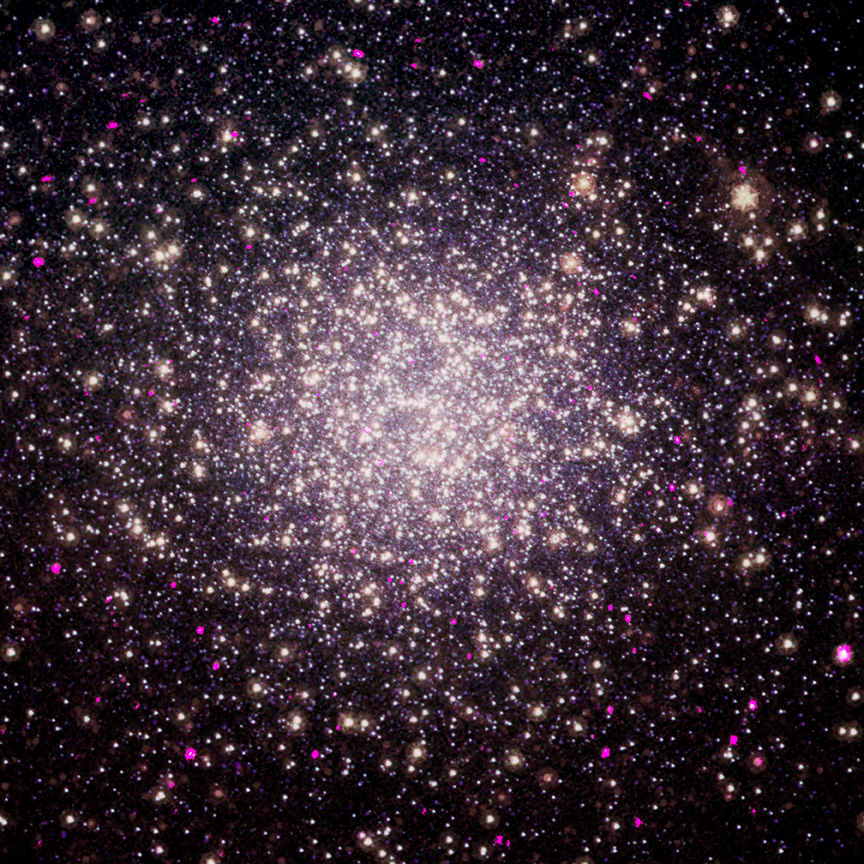
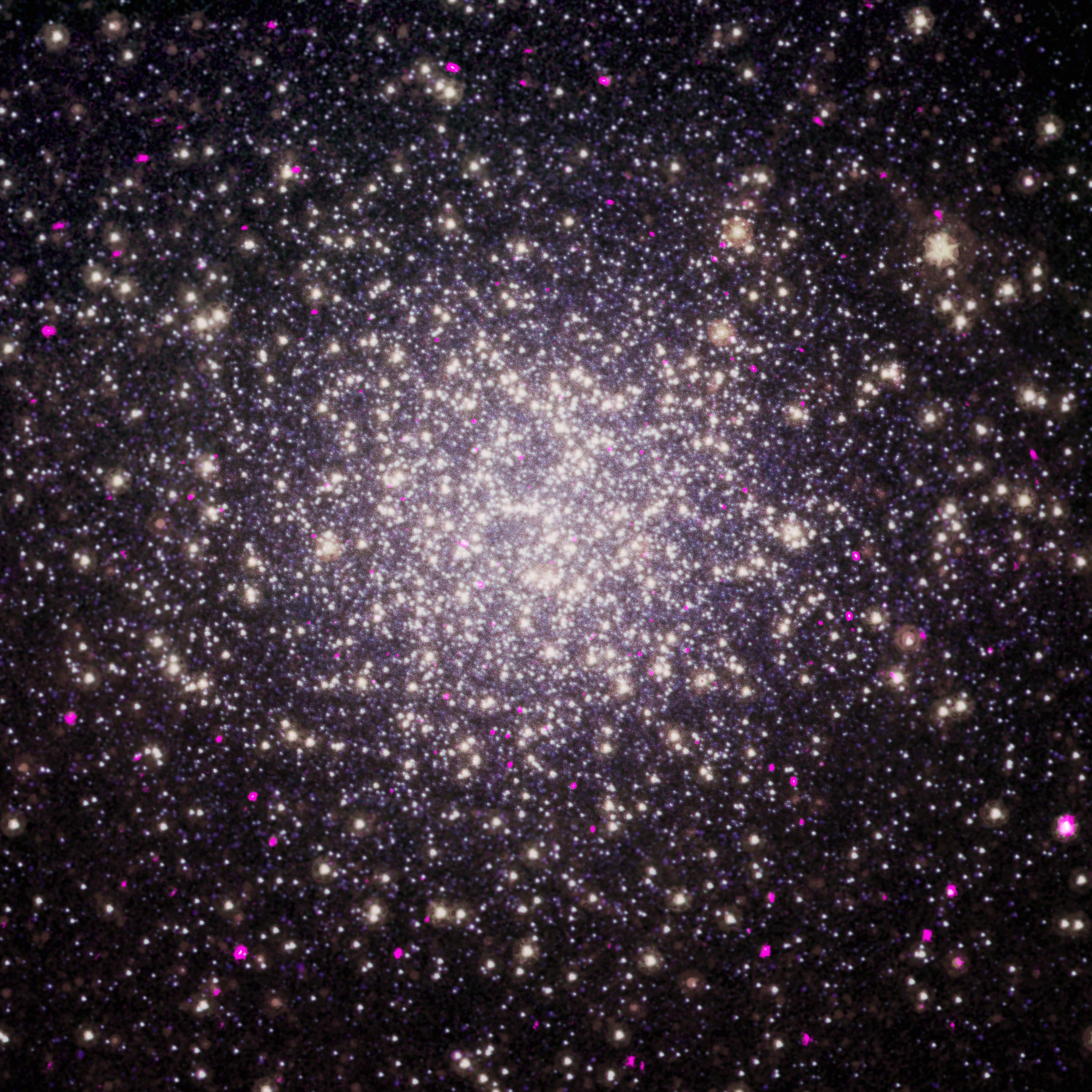
This release features a composite image of a globular cluster, a sphere-shaped collection of stars bound together by gravity. In this conglomeration are eleven spider pulsars, which obliterate their companion stars with strong winds of particles.

In the main image of this release, scores of tiny white stars dot the blackness of space, many appearing to glow with a white or hot pink aura. Like other globular clusters, this conglomeration, named Omega Centauri, is more densely packed near the center.

A close up image of this densely-packed center reveals even more stars, blanketing the frame from corner to corner. This close up is presented fully labeled, with a white ring encircling nine of the eleven marked spider pulsars.

Each spider pulsar is the spinning core of a collapsed massive star. As they spin, the spider pulsars emit beams of radiation, like light from a lighthouse. The pulsars also produce winds of particles that methodically strip away their companion stars, layer by layer.


Fast Facts for Omega Centauri:

Scale: Image is about 16 arcmin (80 light-years) across.
Category: Normal Stars & Star Clusters
Coordinates (J2000): RA 13h 26m 47s | Dec -47° 28´ 46"
Constellation: Centaurus
Observation Dates: 4 observations from Jan 24, 2000 to Apr 16, 2012
Observation Time: 80 hours 48 minutes (3 days, 8 hours 48 minutes)
Obs. ID: 653, 1519, 13726, 13727
Instrument: ACIS
References: Zhao, J. and Heinke, C, 2023, MNRAS, 526, 2736; arXiv:2309.13189
Distance Estimate: About 17,700 light-years


Friday, October 27, 2023

Gemini South Captures Cosmic ‘Cotton Candy’

PR Image noirlab2329a
Gemini South Reveals Tangled Spiral Arms of the Peculiar Galaxy NGC 7727


Videos

noirlab2329a 
noirlab2329a

noirlab2329b
noirlab2329b


Chaotic jumble of merging spiral galaxies hints at possible fate of Milky Way and Andromeda galaxies

Gemini South, one half of the International Gemini Observatory operated by NSF’s NOIRLab, captures the billion-year-old aftermath of a spiral galaxy collision. At the heart of this chaotic interaction, entwined and caught in the midst of the chaos, is a pair of supermassive black holes — the closest such pair ever recorded from Earth.

The swirling arms of a spiral galaxy are among the most recognized features in the cosmos: long sweeping bands spun off from a central core, each brimming with dust, gas, and dazzling pockets of newly formed stars. Yet this opulent figure can warp into a much more bizarre and amorphous shape during a merger with another galaxy. The same sweeping arms are suddenly perturbed into disarray, and two supermassive black holes at their respective centers become entangled in a tidal dance. This is the case of NGC 7727, a peculiar galaxy located in the constellation of Aquarius about 90 million light-years from the Milky Way.ever recorded from Earth.

Astronomers have captured an evocative image of this merger’s aftermath using the Gemini Multi-Object Spectrograph (GMOS) mounted on the Gemini South telescope in Chile, part of the International Gemini Observatory operated by NSF’s NOIRLab. The image reveals vast swirling bands of interstellar dust and gas resembling freshly-spun cotton candy as they wrap around the merging cores of the progenitor galaxies. From the aftermath has emerged a scattered mix of active starburst regions and sedentary dust lanes encircling the system.ever recorded from Earth.

What is most noteworthy about NGC 7727 is undoubtedly its twin galactic nuclei, each of which houses a supermassive black hole, as confirmed by astronomers using the European Southern Observatory’s Very Large Telescope (VLT). Astronomers now surmise the galaxy originated as a pair of spiral galaxies that became embroiled in a celestial dance about one billion years ago. Stars and nebulae spilled out and were pulled back together at the mercy of the black holes’ gravitational tug-of-war until the irregular tangled knots we see here were created.

The two supermassive black holes, one measuring 154 million solar masses and the other 6.3 million solar masses, are approximately 1600 light-years apart [1]. It is estimated that the two will eventually merge into one in about 250 million years to form an even more massive black hole while dispersing violent ripples of gravitational waves across spacetime.

Because the galaxy is still reeling from the impact, most of the tendrils we see are ablaze with bright young stars and active stellar nurseries. In fact, about 23 objects found in this system are considered candidates for young globular clusters. These collections of stars often form in areas where star formation is higher than usual and are especially common in interacting galaxies as we see here.

Once the dust has settled, NGC 7727 is predicted to eventually become an elliptical galaxy composed of older stars and very little star formation. Similar to Messier 87, an elliptical galaxy with a supermassive black hole at its heart, this may be the fate of the Milky Way and the Andromeda Galaxy when they fuse together in billions of years’ time.


More information

[1] The supermassive black hole at the center of the Milky Way contains a relatively modest 4.3 million solar masses. The most massive black hole observed to date contains approximately 66 billion solar masses.


NSF’s NOIRLab (National Optical-Infrared Astronomy Research Laboratory), the US center for ground-based optical-infrared astronomy, operates the International Gemini Observatory (a facility of NSF, NRC–Canada, ANID–Chile, MCTIC–Brazil, MINCyT–Argentina, and KASI–Republic of Korea), Kitt Peak National Observatory (KPNO), Cerro Tololo Inter-American Observatory (CTIO), the Community Science and Data Center (CSDC), and Vera C. Rubin Observatory (in cooperation with DOE’s SLAC National Accelerator Laboratory). It is managed by the Association of Universities for Research in Astronomy (AURA) under a cooperative agreement with NSF and is headquartered in Tucson, Arizona. The astronomical community is honored to have the opportunity to conduct astronomical research on Iolkam Du’ag (Kitt Peak) in Arizona, on Maunakea in Hawai‘i, and on Cerro Tololo and Cerro Pachón in Chile. We recognize and acknowledge the very significant cultural role and reverence that these sites have to the Tohono O’odham Nation, to the Native Hawaiian community, and to the local communities in Chile, respectively.


Links


Contacts

Josie Fenske
NSF’s NOIRLab Communications
Email:
josie.fenske@noirlab.edu

Wednesday, September 13, 2023

Measure of a great galactic disc

A large elliptical galaxy. It appears to be formed of faint, grey, concentric ovals that grow progressively brighter towards the core, where there is a very bright point, and fade away at the edge. Two threads of dark red dust cross the galaxy’s disc, near the centre. The background is black and mostly empty, with only a few point stars and small galaxies. Credit:  ESA/Hubble & NASA, R. Sharples, S. Kaviraj, W. Keel

This dream-like Picture of the Week features the galaxy known as NGC 3156. It is a lenticular galaxy, meaning that it falls somewhere between an elliptical and a spiral galaxy. It lies about 73 million light-years from Earth, in the minor equatorial constellation Sextans.

Sextans is a small constellation that belongs to the Hercules family of constellations. It itself is a constellation with an astronomical theme, being named for the instrument known as the sextant. Sextants are often thought of as navigational instruments that were invented in the 18th century. However, the sextant as an astronomical tool has been around for much longer than that: Islamic scholars developed astronomical sextants many hundreds of years earlier in order to measure angles in the sky. A particularly striking example is the enormous sextant with a radius of 36 metres that was developed by Ulugh Beg of the Timurid dynasty in the fifteenth century, located in Samarkand in present-day Uzbekistan. These early sextants may have been a development of the quadrant, a measuring device proposed by Ptolemy. A sextant, as the name suggests, is shaped like one-sixth of a circle, approximately the shape of the constellation.

Sextants are no longer in use in modern astronomy, having been replaced by instruments that are capable of measuring the positions of stars and astronomical objects much more accurately and precisely. NGC 3156 has been studied in many ways other than determining its precise position — from its cohort of globular clusters, to its relatively recent star formation, to the stars that are being destroyed by the supermassive black hole at its centre.


Friday, September 08, 2023

Hubble Sees a Glittering Globular Cluster Embedded Inside Our Milky Way

Terzam 12
Image: NASA, ESA, ESA/Hubble, Roger Cohen (RU)


This image shows a compact beehive-like structure of hundreds of thousands of stars crowded together. Because of scattering by interstellar dust, the stars on the left side of the image appear redder. The stars toward the right side of the image are bluish-white. The image is sprinkled with bright blue foreground stars. There is also a smattering of bright red giant stars across the image.

This colorful image of the globular star cluster Terzan 12 is a spectacular example of how dust in space affects starlight coming from background objects.

A globular star cluster is a conglomeration of stars, arranged in a spheroidal shape. Stars in globular clusters are bound together by gravity, with a higher concentration of stars towards the center. The Milky Way has about 150 ancient globular clusters at its outskirts. These clusters orbit around the galactic center, but far above and below the pancake-flat plane of our galaxy, like bees buzzing around a hive.

The location of this globular cluster, deep in the Milky Way in the constellation Sagittarius, means that it is shrouded in gas and dust which absorb and alter the starlight emanating from Terzan 12. The cluster is about 15,000 light-years from Earth. This location leaves a lot of room for intervening interstellar dust particles between us and the cluster to scatter blue light, causing only the redder wavelengths to come through to Earth. The interstellar dust clouds are mottled so that different parts of the cluster look redder than other parts along our line of sight.

The brightest red stars in the photo are bloated, aging giants, many times larger than our Sun. They lie between Earth and the cluster. Only a few may actually be members of the cluster. The very brightest hot, blue stars are also along the line of sight and not inside the cluster, which only contains aging stars.

Terzan 12 is one of 11 globular clusters discovered by the Turkish-Armenian astronomer Agop Terzan approximately a half-century ago. With its sharp vision, Hubble has revolutionized the study of globular clusters ever since its launch in 1990. Hubble observations have shed light on the relation between age and composition in the Milky Way galaxy's innermost globular clusters.

The Hubble Space Telescope is a project of international cooperation between NASA and ESA. NASA's Goddard Space Flight Center in Greenbelt, Maryland, manages the telescope. The Space Telescope Science Institute (STScI) in Baltimore, Maryland, conducts Hubble science operations. STScI is operated for NASA by the Association of Universities for Research in Astronomy, in Washington, D.C.


About This Release

Credits: Release: NASA, ESA, STScI

Media Contact:

Ray Villard
Space Telescope Science Institute, Baltimore, Maryland

Bethany Downer
ESA/Hubble.org

Permissions:
Content Use Policy

Contact Us: Direct inquiries to the News Team.

Related Links and Documents