Showing posts with label Messier 82. Show all posts

Wednesday, September 17, 2025

The smouldering heart of a celestial cigar

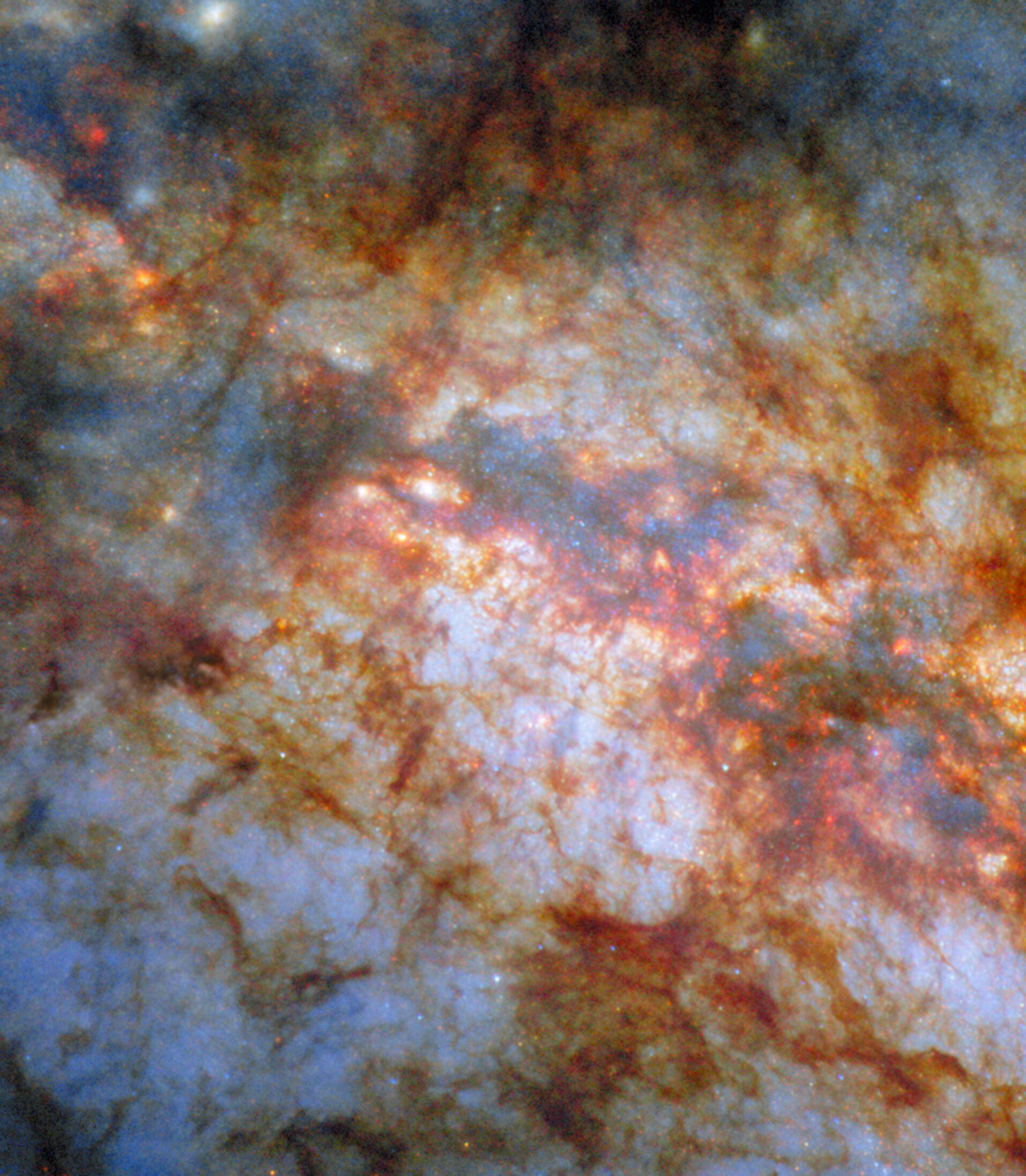
A close-in view of the centre of galaxy M82. Bright, bluish light radiating from the centre is due to stars actively forming there. A thick lane of gas, black in the centre and red around the edges, crosses the centre and blocks much of the light. Thinner strands and clumps of reddish dust cover much of the rest of the view. Credit: ESA/Hubble & NASA, W. D. Vacca

What lurks behind the dense, dusty clouds of this galactic neighbour? There lies the star-powered heart of the galaxy Messier 82 (M82), also known as the Cigar Galaxy. Located just 12 million light-years away in the constellation Ursa Major (The Great Bear), the Cigar Galaxy is considered a nearby galaxy. As this NASA/ESA Hubble Space Telescope Picture of the Week shows in great detail, it’s home to brilliant stars whose light is shaded by sculptural clouds, clumps and streaks of dust and gas.

It’s no surprise that the Cigar Galaxy is so packed with stars, obscured though they might be by the distinctive clouds pictured here. Forming stars 10 times faster than the Milky Way, the Cigar Galaxy is what astronomers call a starburst galaxy. The intense starburst period that grips this galaxy has given rise to super star clusters in the galaxy’s heart. Each of these super star clusters contains hundreds of thousands of stars and is more luminous than a typical star cluster. Researchers used Hubble to home in on these massive clusters and reveal how they form and evolve.

Hubble’s views of the Cigar Galaxy have been featured before, both as a previous Picture of the Week in 2012 and as an image released in celebration of Hubble’s 16th birthday. The NASA/ESA/CSA James Webb Space Telescope has also turned toward the Cigar Galaxy, producing infrared images in 2024 and earlier this year.

This image features something not seen in previously released Hubble images of the galaxy: data from the High Resolution Channel of the Advanced Camera for Surveys (ACS). The High Resolution Channel is one of three sub-instruments of ACS, which was installed in 2002. In five years of operation, the High Resolution Channel returned fantastically detailed observations of crowded, starry environments like the centres of starburst galaxies. An electronics fault in 2007 unfortunately left the High Resolution Channel disabled.

Links


Friday, November 29, 2024

Hats Off to NASA's Webb: Sombrero Galaxy Dazzles in New Image

Sombrero Galaxy (MIRI Image)
Credits/Image: NASA, ESA, CSA, STScI

Sombrero Galaxy (Hubble and Webb Image)
Credits/Image: NASA, ESA, CSA, STScI, Hubble Heritage Project (STScI, AURA)

Sombrero Galaxy Fade (Spitzer, Webb, Hubble)
Credits/Video: NASA, ESA, CSA, IPAC, STScI


In a new image from NASA’s James Webb Space Telescope, a galaxy named for its resemblance to a broad-brimmed Mexican hat appears more like an archery target.

In Webb’s mid-infrared view of the Sombrero galaxy, also known as Messier 104 (M104), the signature, glowing core seen in visible-light images does not shine, and instead a smooth inner disk is revealed. The sharp resolution of Webb’s MIRI (Mid-Infrared Instrument) also brings into focus details of the galaxy’s outer ring, providing insights into how the dust, an essential building block for astronomical objects in the universe, is distributed. The galaxy’s outer ring, which appeared smooth like a blanket in imaging from NASA’s retired Spitzer Space Telescope, shows intricate clumps in the infrared for the first time.

Researchers say the clumpy nature of the dust, where MIRI detects carbon-containing molecules called polycyclic aromatic hydrocarbons, can indicate the presence of young star-forming regions. However, unlike some galaxies studied with Webb, including Messier 82, where 10 times as many stars are born than the Milky Way galaxy, the Sombrero galaxy is not a particular hotbed of star formation. The rings of the Sombrero galaxy produce less than one solar mass of stars per year, in comparison to the Milky Way’s roughly two solar masses a year.

Even the supermassive black hole, also known as an active galactic nucleus, at the center of the Sombrero galaxy is rather docile, even at a hefty 9-billion-solar masses. It’s classified as a low luminosity active galactic nucleus, slowly snacking on infalling material from the galaxy, while sending off a bright, relatively small, jet.

Also within the Sombrero galaxy dwell some 2,000 globular clusters, collections of hundreds of thousands of old stars held together by gravity. This type of system serves as a pseudo laboratory for astronomers to study stars — thousands of stars within one system with the same age, but varying masses and other properties is an intriguing opportunity for comparison studies.

In the MIRI image, galaxies of varying shapes and colors litter the background of space. The different colors of these background galaxies can tell astronomers about their properties, including how far away they are.

The Sombrero galaxy is around 30 million light-years from Earth in the constellation Virgo.

A Bright Future Ahead

Stunning images like this, and an array of discoveries in the study of exoplanets, galaxies through time, star formation, and our own solar system, are still just the beginning. Recently, scientists from all over the world applied for observation time with Webb during its fourth year of science operations, which begins in July 2025.

General Observer time with Webb is more competitive than ever. A record-breaking 2,377 proposals were submitted by the Oct. 15, 2024 deadline, requesting about 78,000 hours of observation time. This is an oversubscription rate, the ratio defining the observation hours requested versus the actual time available in one year of Webb’s operations, of around 9 to 1.

The proposals cover a wide array of science topics, with distant galaxies being among the most requested observation time, followed by exoplanet atmospheres, stars and stellar populations, then exoplanet systems.

The Space Telescope Science Institute manages the proposal and program selection process for NASA. The submissions will now be evaluated by a Telescope Allocation Committee, a group of hundreds of members of the worldwide astronomical community, on a dual-anonymous basis, with selections announced in March 2025.

While time on Webb is limited, data from all of Webb’s programs is publicly archived, immediately after it’s taken, or after a time of exclusive access, in the Mikulski Archive for Space Telescopes (MAST) so it can be used by anyone in the world.

The James Webb Space Telescope is the world’s premier space science observatory. Webb is solving mysteries in our solar system, looking beyond to distant worlds around other stars, and probing the mysterious structures and origins of our universe and our place in it. Webb is an international program led by NASA with its partners, ESA (European Space Agency) and CSA (Canadian Space Agency).


About This Release

Credits:

Media Contact:

Hannah Braun
Space Telescope Science Institute, Baltimore, Maryland

Christine Pulliam
Space Telescope Science Institute, Baltimore, Maryland

Permissions: Content Use Policy

Contact Us: Direct inquiries to the News Team.


Saturday, June 08, 2024

A Starry Cigar

Messier 82

Starburst galaxies are prolific star factories, churning out tens to hundreds of stars each year. By contrast, the Milky Way crafts just a handful of stars annually. Recently, a team led by Alberto Bolatto (University of Maryland) turned JWST toward the cigar-shaped galaxy Messier 82, which is a starburst galaxy 12 million light-years away. Messier 82’s star formation rate has cooled from an impressive peak of 160 solar masses of stars per year 8–15 million years ago to 12 solar masses per year today. The team sought to study the powerful winds that whisk away star-forming gas from the galaxy’s center. In the image above, which shows the central few thousand light-years of the galaxy, red represents 3.3-micron (1 micron = 10-6 meter) emission that largely comes from polycyclic aromatic hydrocarbons: sooty molecules that contain multiple rings of carbon atoms bonded together. (Green and blue represent 2.5-micron and 1.6-micron emission, respectively; the compact green areas are mostly supernova remnants.) These new observations show in great detail the narrow, intertwined filaments and bubbles highlighted by the 3.3-micron emission. The filaments may have formed when dense, dusty clumps of gas were shredded by the outflowing galactic wind. To dive into the science behind this image, be sure to check out the full research article linked below.

By Kerry Hensley

Citation

“JWST Observations of Starbursts: Polycyclic Aromatic Hydrocarbon Emission at the Base of the M82 Galactic Wind,” Alberto D. Bolatto et al 2024 ApJ 967 63. doi:10.3847/1538-4357/ad33c8


Friday, April 12, 2024

NASA's Webb Probes an Extreme Starburst Galaxy

M82 (Hubble and Webb)
Credit: Image: NASA, ESA, CSA, STScI, Alberto Bolatto (UMD)

M82 (NIRCam Image)
Credit: Image: NASA, ESA, CSA, STScI, Alberto Bolatto (UMD)

M82 (NIRCam Image)
Credit: Image: NASA, ESA, CSA, STScI, Alberto Bolatto (UMD)


A team of astronomers has used NASA’s James Webb Space Telescope to survey the starburst galaxy Messier 82 (M82). Located 12 million light-years away in the constellation Ursa Major, this galaxy is relatively compact in size but hosts a frenzy of star formation activity. For comparison, M82 is sprouting new stars 10 times faster than the Milky Way galaxy.

Led by Alberto Bolatto at the University of Maryland, College Park, the team directed Webb’s NIRCam (Near-Infrared Camera) instrument toward the starburst galaxy’s center, attaining a closer look at the physical conditions that foster the formation of new stars.

“M82 has garnered a variety of observations over the years because it can be considered as the prototypical starburst galaxy,” said Bolatto, lead author of the study. “Both NASA’s Spitzer and Hubble space telescopes have observed this target. With Webb’s size and resolution, we can look at this star-forming galaxy and see all of this beautiful, new detail.”

A Vibrant Community of Stars

Star formation continues to maintain a sense of mystery because it is shrouded by curtains of dust and gas, creating an obstacle in observing this process. Fortunately, Webb’s ability to peer in the infrared is an asset in navigating these murky conditions. Additionally, these NIRCam images of the very center of the starburst were obtained using an instrument mode that prevented the very bright source from overwhelming the detector.

While dark brown tendrils of heavy dust are threaded throughout M82’s glowing white core even in this infrared view, Webb’s NIRCam has revealed a level of detail that has historically been obscured. Looking closer toward the center, small specks depicted in green denote concentrated areas of iron, most of which are supernova remnants. Small patches that appear red signify regions where molecular hydrogen is being lit up by a nearby young star’s radiation.

“This image shows the power of Webb,” said Rebecca Levy, second author of the study at the University of Arizona in Tucson. “Every single white dot in this image is either a star or a star cluster. We can start to distinguish all of these tiny point sources, which enables us to acquire an accurate count of all the star clusters in this galaxy.”

Finding Structure in Lively Conditions

Looking at M82 in slightly longer infrared wavelengths, clumpy tendrils represented in red can be seen extending above and below the galaxy’s plane. These gaseous streamers are a galactic wind rushing out from the core of the starburst.

One area of focus for this research team was understanding how this galactic wind, which is caused by the rapid rate of star formation and subsequent supernovae, is being launched and influencing its surrounding environment. By resolving a central section of M82, scientists could examine where the wind originates, and gain insight on how hot and cold components interact within the wind.

Webb’s NIRCam instrument was well-suited to trace the structure of the galactic wind via emission from sooty chemical molecules known as polycyclic aromatic hydrocarbons (PAHs). PAHs can be considered as very small dust grains that survive in cooler temperatures but are destroyed in hot conditions.

Much to the team’s surprise, Webb’s view of the PAH emission highlights the galactic wind’s fine structure – an aspect previously unknown. Depicted as red filaments, the emission extends away from the central region where the heart of star formation is located. Another unanticipated find was the similar structure between the PAH emission and that of hot, ionized gas.

“It was unexpected to see the PAH emission resemble ionized gas,” said Bolatto. “PAHs are not supposed to live very long when exposed to such a strong radiation field, so perhaps they are being replenished all the time. It challenges our theories and shows us that further investigation is required.”

Lighting a Path Forward

Webb’s observations of M82 in near-infrared light spur further questions about star formation, some of which the team hopes to answer with additional data gathered with Webb, including that of another starburst galaxy. Two other papers from this team characterizing the stellar clusters and correlations among wind components of M82 are almost finalized.

In the near future, the team will have spectroscopic observations of M82 from Webb ready for their analysis, as well as complementary large-scale images of the galaxy and wind. Spectral data will help astronomers determine accurate ages for the star clusters and provide a sense of timing for how long each phase of star formation lasts in a starburst galaxy environment. On a broader scale, inspecting the activity in galaxies like M82 can deepen astronomers’ understanding of the early universe.

“Webb’s observation of M82, a target closer to us, is a reminder that the telescope excels at studying galaxies at all distances,” said Bolatto. “In addition to looking at young, high-redshift galaxies, we can look at targets closer to home to gather insight into the processes that are happening here – events that also occurred in the early universe.”

These findings have been accepted for publication in The Astrophysical Journal.

The James Webb Space Telescope is the world’s premier space science observatory. Webb is solving mysteries in our solar system, looking beyond to distant worlds around other stars, and probing the mysterious structures and origins of our universe and our place in it. Webb is an international program led by NASA with its partners, ESA (European Space Agency) and the Canadian Space Agency.


About This Release

Credits:

Media Contact:

Abigail Major
Space Telescope Science Institute, Baltimore, Maryland

Christine Pulliam
Space Telescope Science Institute, Baltimore, Maryland

Science: Alberto Bolatto (UMD)

Permissions: Content Use Policy

Contact Us: Direct inquiries to the News Team

Related Links and Documents


Saturday, January 16, 2021

Magnetic ‘Highway’ Channels Material Out of Cigar Galaxy

Magnetic fields in Messier 82, or the Cigar galaxy, are shown as lines over a visible light and infrared composite image of the galaxy from the Hubble Space Telescope and the Spitzer Space Telescope. Stellar winds streaming from hot new stars form a galactic super wind that is blasting out plumes of hot gas (red) and a huge halo of smoky dust (yellow/orange) perpendicular to the narrow galaxy (white). Researchers used the Stratospheric Observatory for Infrared Astronomy magnetic field data and tools that have been used extensively to study the physics around the Sun to extrapolate the magnetic field’s strength 20,000 lights-years around the galaxy. They appear to extend indefinitely into intergalactic space, like the Sun’s solar wind, and may help explain how the gas and dust have traveled so far away from the galaxy.  Credits: NASA, SOFIA, L. Proudfit; NASA, ESA, Hubble Heritage Team; NASA, JPL-Caltech, C. Engelbracht. Hi-res image
 

What’s fueling the massive ejection of gas and dust out of the Cigar galaxy, otherwise known as Messier 82?

We know that thousands of stars bursting into existence are driving a powerful super-wind that’s blowing matter into intergalactic space. New research shows that magnetic fields are also contributing to the expulsion of material from Messier 82, a well-known example of a starburst galaxy with a distinctive, elongated shape.

The findings from NASA’s Stratospheric Observatory for Infrared Astronomy, or SOFIA, help explain how dust and gas can move from inside galaxies into intergalactic space, offering clues to how galaxies formed. This material is enriched with elements like carbon and oxygen that support life and are the building blocks for future galaxies and stars. The research was presented at the meeting of the American Astronomical Society.

SOFIA, a joint project of NASA and the German Aerospace Center, DLR, previously studied the direction of magnetic fields close to the core of Messier 82, as the Cigar galaxy is officially known. This time the team applied tools that have been used extensively to study the physics around the Sun, known as heliophysics, to understand the magnetic field’s strength surrounding the galaxy at a distance 10 times larger than before.

“This is old physics for studying the Sun, but new for galaxies,” said Joan Schmelz, an associate director at the Universities Space Research Association based at NASA’s Ames Research Center in Silicon Valley, and co-author of the upcoming paper about this research. “It’s helping us understand how the space between stars and galaxies became so rich with matter for future cosmic generations.”

Located 12 million light-years from Earth in the constellation Ursa Major, the Cigar galaxy is undergoing an exceptionally high rate of star formation called a starburst. The star formation is so intense that it creates a “super wind” that blows material out of the galaxy. As SOFIA previously found using the instrumented called the High-Resolution Airborne Wideband Camera, or HAWC+, the wind drags the magnetic field near the galaxy’s core so that it’s perpendicular to the plane of the galaxy across 2,000 light-years.

Researchers wanted to learn if the magnetic field lines would extend indefinitely into intergalactic space like the magnetic environment in the solar wind, or turn over to form structures similar coronal loops that are found in active regions of the Sun. They calculate that the galaxy’s magnetic fields extend out like the solar wind, allowing the material blown by the super wind to escape into intergalactic space.

These extended magnetic fields may help explain how gas and dust spotted by space telescopes have traveled so far away from the galaxy. NASA’s Spitzer Space Telescope detected dusty material 20,000 lightyears beyond the galaxy, but it was unclear why it had spread so far away from the stars in both directions instead of in a cone-shaped jet.

“The magnetic fields may be acting like a highway, creating lanes for galactic material to spread far and wide into intergalactic space,” said Jordan Guerra Aguilera, a postdoctoral researcher at Villanova University in Pennsylvania and co-author on the upcoming paper.

With rare exceptions, the magnetic field in the solar corona cannot be measured directly. So, about 50 years ago, scientists developed methods to accurately extrapolate magnetic fields from the Sun’s surface into interplanetary space, known in heliophysics as the potential field extrapolation. Using SOFIA’s existing observations of central magnetic fields, the research team modified this method to estimate the magnetic field about 25,000 light-years around the Cigar galaxy.

“We can’t easily measure the magnetic fields at scales this large, but we can extrapolate it with these tools from heliophysics,” said Enrique Lopez-Rodriguez, a Universities Space Research Association scientist for SOFIA based at Ames and lead author on the study. “This new, interdisciplinary method gives us the larger perspective that we need to understand starburst galaxies.”

SOFIA is a joint project of NASA and the German Aerospace Center. NASA’s Ames Research Center in California’s Silicon Valley manages the SOFIA program, science, and mission operations in cooperation with the Universities Space Research Association, headquartered in Columbia, Maryland, and the German SOFIA Institute at the University of Stuttgart. The aircraft is maintained and operated by NASA’s Armstrong Flight Research Center Building 703, in Palmdale, California. The High-Resolution Airborne Wideband Camera instrument was developed and delivered to NASA by a multi-institution team led by NASA’s Jet Propulsion Laboratory.

Media Contact: 

Elizabeth Landau 
NASA Headquarters, Washington 
202-358-0845
 
elizabeth.r.landau@nasa.gov 

Alison Hawkes 
NASA Ames Research Center, Silicon Valley, Calif. 
650-604-4789 

alison.hawkes@nasa.gov 

Editor: Kassandra Bell

Source: NASA/Galaxies


Friday, April 01, 2016

A distinctly disorganised dwarf

Credit:ESA/Hubble & NASA
Acknowledgement: Judy Schmidt (
Geckzilla)


Despite being less famous than their elliptical and spiral galactic cousins, irregular dwarf galaxies, such as the one captured in this NASA/ESA Hubble Space Telescope image, are actually one of the most common types of galaxy in the Universe. Known as UGC 4459, this dwarf galaxy is located approximately 11 million light-years away in the constellation of Ursa Major (The Great Bear), a constellation that is also home to the Pinwheel Galaxy (M101), the Owl Nebula (M97), Messier 81, Messier 82 and several other galaxies all part of the M81 group.

UGC 4459’s diffused and disorganised appearance is characteristic of an irregular dwarf galaxy. Lacking a distinctive structure or shape, irregular dwarf galaxies are often chaotic in appearance, with neither a nuclear bulge — a huge, tightly packed central group of stars — nor any trace of spiral arms — regions of stars extending from the centre of the galaxy. Astronomers suspect that some irregular dwarf galaxies were once spiral or elliptical galaxies, but were later deformed by the gravitational pull of nearby objects.

Rich with young blue stars and older red stars, UGC 4459 has a stellar population of several billion. Though seemingly impressive, this is small when compared to the 200 to 400 billion stars in the Milky Way!

Observations with Hubble have shown that because of their low masses, star formation is very low compared to larger galaxies. Only very little of their original gas has been turned into stars. Thus, these small galaxies are interesting to study to better understand primordial environments and the star formation process.


Monday, February 21, 2011

The Cigar Galaxy

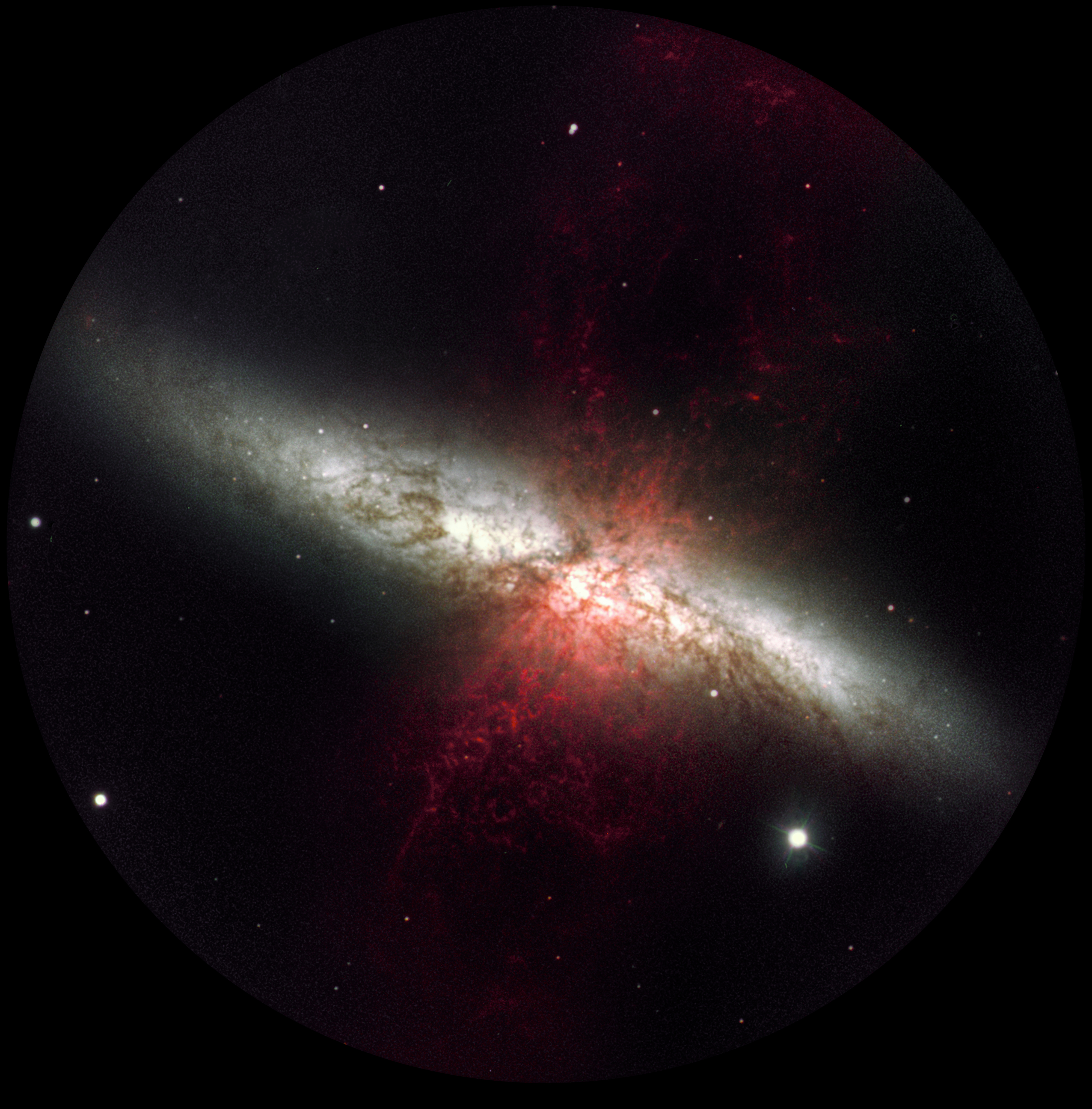
This image of the Cigar Galaxy, Messier 82 (M82) or NGC 3034, was obtained using ACAM on the William Herschel Telescope. It is a colour composite made from data collected using red (including hydrogen alpha), green and blue filters. Credit: Pablo Rodríguez-Gil (IAC) y Pablo Bonet (IAC) [ JPEG | PDF (with text) ].

M82 is an irregular prototype starburst galaxy, whose centre is believed to be experiencing an episode of intense star formation. The red glow is from a superwind of ionised hydrogen gas, expanding out from the centre as a result of the combined winds of many individual stars.

ACAM instrument is a versatile optical imager and low-resolution spectrograph designed and built by ING. It is permanently mounted at a folded-Cassegrain focus of the William Herschel Telescope, adding more flexibility to the observational operation of the telescope. More information can be found at the ACAM home page.

Javier Méndez

Public Relations Officer
The Isaac Newton Group of Telescopes

Thursday, January 13, 2011

Partner Galaxies Wildly Different In New WISE Image

This image from NASA's Wide-Field Infrared Survey Explorer, or WISE, features two stunning galaxies engaged in an intergalactic dance. The galaxies, Messier 81 and Messier 82, swept by each other a few hundred million years ago, and will likely continue to twirl around each other multiple times before eventually merging into a single galaxy. Image credit: NASA/JPL-Caltech/UCLA. Full image caption

PASADENA, Calif. -- NASA's Wide-field Infrared Survey Explorer has captured a new view of two companion galaxies -- a somewhat tranquil spiral beauty and its rambunctious partner blazing with smoky star formation.

The unlikely pair, named Messier 81 and Messier 82, got to know each other a lot better during an encounter that occurred a few hundred million years ago. As they swept by each other, gravitational interactions triggered new bursts of star formation. In the case of Messier 82, also known as the Cigar galaxy, the encounter has likely triggered a tremendous wave of new star birth at its core. Intense radiation from newborn massive stars is blowing copious amounts of gas and smoky dust out of the galaxy, as seen in the WISE image in yellow hues.

The new image is online at: http://www.nasa.gov/mission_pages/WISE/multimedia/gallery/pia13454.html . The Cigar galaxy is pictured above Messier 81.

"What's unique about the WISE view of this duo is that we can see both galaxies in one shot, and we can really see their differences," said Ned Wright of UCLA, the principal investigator of WISE. "Because the Cigar galaxy is bursting with star formation, it's really bright in the infrared, and looks dramatically different from its less active companion."

The WISE mission completed its main goal of mapping the sky in infrared light in October 2010, covering it one-and-one-half times before its frozen coolant ran out, as planned. During that time, it snapped pictures of hundreds of millions of objects, the first batch of which will be released to the astronomy community in April 2011. WISE is continuing its scan of the skies without coolant using two of its four infrared channels -- the two shorter-wavelength channels not affected by the warmer temperatures. The mission's ongoing survey is now focused primarily on asteroids and comets.

Because WISE has imaged the entire sky, it excels at producing large mosaics like this new picture of Messier 81 and Messier 82, which covers a patch of sky equivalent to three-by-three full moons, or 1.5 by 1.5 degrees.

It is likely these partner galaxies will continue to dance around each other, and eventually merge into a single entity. They are both spiral galaxies, but Messier 82 is seen from an edge-on perspective, and thus appears in visible light as a thin, cigar-like bar. When viewed in infrared light, Messier 82 is the brightest galaxy in the sky. It is what scientists refer to as a starburst galaxy because it is churning out large amounts of new stars.

"The WISE picture really shows how spectacular Messier 82 shines in the infrared even though it is relatively puny in both size and mass compared to its big brother, Messier 81," said Tom Jarrett, a member of the WISE team at the California Institute of Technology in Pasadena.

In this WISE view, infrared light has been color coded so that we can see it with our eyes. The shortest wavelengths (3.4 and 3.6 microns) are shown in blue and blue-green, or cyan, and the longer wavelengths (12 and 22 microns) are green and red. Messier 82 appears in yellow hues because its cocoon of dust gives off longer wavelengths of light (the yellow is a result of combining green and red). This dust is made primarily of polycyclic aromatic hydrocarbons, which are found on Earth as soot.

Messier 81, also known as Bode's galaxy, appears blue in the infrared image because it is not as dusty. The blue light is from stars in the galaxy. Knots of yellow seen dotting the spiral arms are dusty areas of recent star formation, most likely triggered by the galaxy's encounter with its rowdy partner.

"It's striking how the same event stimulated a classic spiral galaxy in Messier 81, and a raging starburst in Messier 82," said WISE Project Scientist Peter Eisenhardt of NASA's Jet Propulsion Laboratory in Pasadena, Calif. "WISE is finding the most extreme starbursts across the whole sky, out to distances over a thousand times greater than Messier 82."

Messier 81 is one of the brightest galaxies in the sky in visible light. Both it and its partner can be seen with binoculars on a dark, clear night in the northern constellation of Ursa Major, which contains the Big Dipper. The galaxies are 12 million light-years away from Earth.

JPL manages WISE for NASA's Science Mission Directorate. The mission was competitively selected under NASA's Explorers Program, which NASA's Goddard Space Flight Center in Greenbelt, Md., manages. The Space Dynamics Laboratory in Logan, Utah, built the science instrument, and Ball Aerospace & Technologies Corp. of Boulder, Colo., built the spacecraft. Science operations and data processing take place at the Infrared Processing and Analysis Center at the California Institute of Technology in Pasadena. More information is online at http://www.nasa.gov/wise , http://wise.astro.ucla.edu and http://www.jpl.nasa.gov/wise .

Whitney Clavin 818-354-4673
Jet Propulsion Laboratory, Pasadena, Calif.
whitney.clavin@jpl.nasa.gov

Friday, November 27, 2009

Herschel Takes a Peek at the Ingredients of the Galaxies

The European Space Agency has today (25th Nov) released spectacular new observations from the Herschel Space Observatory, including the UK-led SPIRE instrument. Spectrometers on board all three Hershel instruments have been used to analyse the light from objects inside our galaxy and from other galaxies, producing some of the best measurements yet of atoms and molecules involved in the birth and death of stars.

The SPIRE Fourier Transform Spectrometer (FTS), which covers the whole submillimetre wavelength range between 194 and 672 microns, will be invaluable to astronomers in determining the composition, temperature, density and mass of interstellar material in nearby galaxies and in star-forming clouds in our own galaxy.

Professor Keith Mason, Chief Executive of the Science and Technology Facilities Council (STFC), which provides the UK funding for Herschel, said “Herschel has once again returned some spectacular indications of what is to come. This wealth of new data exists because of the dedication and skill of the scientists working on this project and will vastly expand our knowledge of the life cycle of stars.”

Professor Matt Griffin of Cardiff University, who is the SPIRE Principal Investigator, said: “Some trial observations have been made during initial testing of the spectrometer, and it is clear that the data are of excellent quality, and even these initial results are very exciting scientifically, especially our ability to trace the presence of water throughout the Universe. The spectrometer was technically very challenging to build, and the whole team is delighted that it works so well.”

Professor Glenn White, of the Open University and STFC’s Rutherford Appleton Laboratory, and an expert in the field of molecular astronomy for which the SPIRE spectrometer is designed, said: "The exquisite sensitivity and quality of these early data reveal spectacular spectroscopic signatures that show the diversity and complexity of the birth processes common to the formation of star and planets. Herschel is going to help us trace the evolution and life of stars, to map the chemistry in our galactic neighbourhood, and allow us to detect water and complex molecules in distant galaxies."

Professor Mike Barlow of University College London, who will use the SPIRE instrument to study the material ejected into space by stars near the end of their lives, said: “The unprecedented spectral range and the wealth of detail revealed by the SPIRE spectrometer, in a hitherto almost unexplored region of the spectrum, promises to revolutionise our understanding of the formation of molecules and dust particles during the final stages of the lives of stars. These dust particles go on to play a crucial role in the formation of new stars and provide the raw material for the planetesimals and planets that form around them."


Figure 1 shows part of the SPIRE spectrum of VY Canis Majoris (VY CMa), a giant star near the end of its life, which is ejecting huge amounts of gas and dust into interstellar space, including elements such as carbon, oxygen and nitrogen (which form the raw material for future planets, and eventually life). The inset is a SPIRE camera image of VY CMa, in which it appears as a bright point-source near the edge of a large extended cloud. The spectrum is amazingly rich, with prominent features from carbon monoxide (CO) and water (H2O). More than 200 other spectral features have also been identified, many due to water, showing that the star is surrounded by large quantities of hot steam. Observations like these will help to establish a detailed picture of the mass loss from stars and the complex chemistry occurring in their extended envelopes.


Figure 2 is a spectrum of one position on the Orion Bar, part of the Orion nebula in which the gas on the edge of the nebula is partly ionised by intense radiation from nearby hot young stars. The inset shows a near infrared picture from NASA’s Spitzer Space Telescope. The SPIRE spectrum has many features from CO, appearing as the dominating narrow lines, seen here for the first time together in a single spectrum. These mean that the entire spectrum is observed at the same time and calibrated together. The brightness of the spectral features will allow astronomers to estimate the temperature and density of interstellar gas. The spectrum also shows the first detection of an emission feature from the molecular ion methylidynium (CH+), a key building block for larger carbon-bearing molecules. This and similar regions are large, and the SPIRE spectrometer’s will be extremely powerful in characterising how the gas properties vary within such sources.

Figure 3 shows a SPIRE spectrum of Arp 220, a galaxy 250 million light years away from Earthwith very active star formation triggered when two large spiral galaxies collided to produce the complex object we see today. Arp 220 is an important template for understanding even more distant galaxies and galaxy formation in the early universe. The spectrum shows many emission features of CO, and H2O features are seen both in emission and absorption. The inset is an optical image of Arp 220 made with the Hubble Space Telescope.

Figure 4 shows the spectrum of Messier 82 (M82), a nearby galaxy (only 12 million light years away) with very active star formation. It is part of an interacting group of galaxies including the large spiral M81. The accompanying image (inset) is a spectacular three-colour composite picture of the two galaxies made with the SPIRE camera, showing material being stripped from M81 by the gravitational interaction with M82. The SPIRE spectrum of M82 shows strong emission lines from CO over the whole wavelength range, as well as emission lines from atomic carbon and ionized nitrogen.

The SPIRE FTS observations were carried out as part of the performance verification of the observatory. The scientific rights of some of these observations are owned by Key Programme consortia: for Arp 220 and M82, the Nearby Galaxies consortium lead by C. Wilson; for VY CMa the MESS consortium led by M. Groenewegen; for the Orion Bar, the Evolution of Interstellar Dust consortium led by A. Abergel.

Notes for editors

Images (hires) :
Figure 1 - Figure 2 - Figure 3 - Figure 4

Further details of the new observations by SPIRE, and by the other two Herschel instruments, may be found at the ESA Herschel Science Centre web site .


The SPIRE Fourier Transform Spectrometer covers the submillimetre wavelength range (194–672 microns), and provides a complete survey of the source spectrum over that whole wavelength range in a single observation, something that has never been possible with previous submillimetre instruments.

At the same time as measuring the intensities of narrow spectral features from gas atoms and molecules, the SPIRE spectrometer also accurately measures the broadband emission from dust. With its multi-pixel detector arrays, it can also produce spectral images, allowing astronomers to measure the spatial variation in the interstellar material.

Herschel and SPIRE

The European Space Agency’s Herschel satellite carries the largest telescope to be flown in space and is designed to study the Universe at far infrared wavelengths. It will reveal the early stages of star birth and galaxy formation; it will examine the composition and chemistry of comets and planetary atmospheres in the Solar System; and it will examine the star-dust ejected by dying stars into interstellar space which form the raw material for planets like the Earth.

The SPIRE instrument has been built by a consortium of 18 institutes in eight countries (UK, France, Italy, Spain, Sweden, USA, Canada and China), led by Prof. Matt Griffin of Cardiff University. The instrument was assembled at the STFC’s Rutherford Appleton Laboratory in the UK.

UK Participation in Herschel

The UK contribution to Herschel includes leadership of the international consortium that designed and built the SPIRE instrument. The UK SPIRE team is also responsible for the development of software for instrument control and processing of the scientific data, and leads the in-flight testing and operation of SPIRE. The Herschel programme in the UK is funded by the Science and Technology Facilities Council.

SPIRE comprises a three band imaging photometer and an imaging Fourier transform spectrometer and has been designed and built by a consortium of institutes including a number from the UK (Cardiff University; Imperial College, London; University College London’s Mullard Space Science Laboratory; the University of Sussex; and STFC’s Rutherford Appleton Laboratory and UK Astronomy Technology Centre). The UK is also leading the development of software for controlling the instrument from the ground and processing the data to produce scientific results. The SPIRE Operations Centre, responsible for delivering all instrument software to ESA, and for day-to-day instrument monitoring, operation, and calibration, is located at the Rutherford Appleton Laboratory with contributions from the Imperial College and Cardiff groups. The UK SPIRE institutes, together with astronomers in many other UK universities, are also strongly involved in the Herschel scientific programmes which have already been selected for the first 18 months of Herschel observations, and cover a wide range of science topics from our own solar system to the most distant galaxies.

Contacts

Julia Short
Press Officer
Science and Technology Facilities Council
Tel: +44 (0) 1793 44 2012


Mr. Chris North
UK Herschel Outreach Officer
School of Physics and Astronomy
Cardiff University
Tel: +44 (0)29 208 70537 or 76403

Prof. Matt Griffin
Herschel-SPIRE Principal Investigator
School of Physics and Astronomy
Cardiff University
Tel: +44 (0)29 2087 4203


Prof. Glenn White
Dept. of Physics & Astronomy
The Open University
Walton Hall
Milton Keynes MK7 6AA
Tel: +44 (0)1908 652 735


Prof. Mike Barlow
Department of Physics and Astronomy
University College London
Gower Street
London WC1E 6BT
Tel: +44 (0)20 7679 7160