Showing posts with label Terzan 5. Show all posts

Wednesday, June 17, 2026

NASA Webb, Hubble Reveal History of Relic of Milky Way’s Formation

New observations from Webb combined with multiple observations from Hubble prove that Terzan 5 is a self-contained, self-enriching stellar system that contains up to four distinct star populations. It orbits within our Milky Way galaxy’s central bulge.Credit Image: NASA, ESA, CSA, STScI, Giorgia Zullo (University of Bologna), Francesco Ferraro (University of Bologna); Image Processing: Alyssa Pagan (STScI)

Yhis image of bulge fossil fragment Terzan 5 was captured by the James Webb and Hubble space telescopes. Webb’s data are from its NIRCam (Near-Infrared Camera) and Hubble’s from its Advanced Camera for Surveys (ACS). The image shows a scale bar, compass arrows, and color key for reference. The scale bar is labeled in light-years along the bottom, which is the distance that light travels in one Earth-year. (It takes two years for light to travel a distance equal to the length of the scale bar.) One light-year is equal to about 5.88 trillion miles or 9.46 trillion kilometers. The north and east compass arrows show the orientation of the image on the sky. Note that the relations hip between north and east on the sky (as seen from below) is flipped relative to direction arrows on a map of the ground (as seen from above). This image shows visible and near-infrared wavelengths of light that have been translated into visible-light colors. The color key shows which NIRCam and ACS filters were used when collecting the light. The color of each filter name is the visible-light color used to represent the infrared light that passes through that filter. Credit Image: NASA, ESA, CSA, STScI, Giorgia Zullo (University of Bologna), Francesco Ferraro (University of Bologna); Image Processing: Alyssa Pagan (STScI)

Zoom in to Terzan 5, a star cluster that lies within the crowded central region of our Milky Way galaxy known as the bulge. The scene starts with a ground-based image of our Milky Way bulge and zooms in on and circles Terzan 5, ending with the composite image of the star system from the James Webb and Hubble Space Telescopes. The Milky Way is shaped like a giant fried egg. The yolk in the middle is the galactic bulge, a crowded region packed with ancient stars of various masses and brightnesses. It’s also home to a number of globular star clusters that formed early in our galaxy’s history, which typically have only one ancient star population. In contrast, Terzan 5 was recently reclassified as a bulge fossil fragment because it has four generations of stars and has maintained its separate identity. Credit Video: NASA, ESA, CSA, Alyssa Pagan (STScI); Acknowledgment: ESO, Pan-STARRS, DSS2, Akira Fujii


Researchers using two of humanity’s most powerful observatories — NASA’s James Webb and Hubble Space Telescopes — have definitively shown that Terzan 5 is not a globular star cluster as it was once classified, offering new insight into how galaxies like our own form and evolve over time. A globular star cluster typically has only one ancient star population. New data not only confirms the existence of two distinct populations of stars in Terzan 5, but also provides evidence for two more recent rounds of star formation. Although located within the crowded bulge of our Milky Way, our galaxy’s central, spherical region of older stars, Terzan 5 was massive enough to maintain its separate identity while lighter weight systems spread out and mixed to form the bulge billions of years ago. It’s like a lump in an otherwise well-mixed cake batter.

“Webb’s new near-infrared observations, cross-referenced with Hubble’s archival observations, have given us a much clearer picture of the history of Terzan 5,” said Giorgia Zullo, who led the research and is a PhD student at the University of Bologna in Italy.

These results were presented at a press conference Tuesday at the 248th meeting of the American Astronomical Society in Pasadena, and were published in Astronomy & Astrophysics.

Four generations of stars

Discovered in 1968 by astronomer Azop Terzan, Terzan 5 resembles a globular cluster in many ways. However, in 2009 this system was discovered to harbor two distinct populations of stars. In 2016 Hubble provided the first estimate of their ages, showing that one formed roughly 12 billion years ago — as the Milky Way itself was assembling — and the other about 5 billion years ago, just before Earth started forming. This pointed to a more complex history than a typical globular cluster.

Studying Terzan 5 is complicated by its location in a region of our galaxy crowded with stars and heavily obscured by dust. This is where Webb stepped in. Its infrared view allowed the research team to peer through the dust and catalog many more stars, and fainter stars, than previous work. By measuring star colors and brightnesses, astronomers can classify them into populations of different ages and chemistries.

Webb was able to measure these key properties for every star within the field of view in the sky — both stars within Terzan 5 and unrelated foreground stars. To isolate the stars of Terzan 5, the team relied on the power and longevity of Hubble. The 12-year separation allowed the team to measure very small movements of individual stars, known as proper motions, to determine which stars belong to Terzan 5 and which are part of the Milky Way bulge.

By combining data from both Webb and Hubble, the researchers found strong evidence for two more stellar populations, one that formed 3.8 billion years ago and another only 2.5 billion years ago. They also were able to determine the ages of the previously known stellar populations with unprecedented precision, finding that they formed 12.5 billion and 4.7 billion years ago.

With the previously known two generations of stars, astronomers could not rule out the possibility that Terzan 5 interacted with another object, like a globular cluster or a giant molecular cloud, becoming enriched with new gas and dust that set off a second round of star formation. With four stellar generations, those explanations are ruled out.

Measurements of the stellar composition of Terzan 5 populations made at the W. M. Keck Observatory and European Southern Observatory’s Very Large Telescope also point toward very distinct populations. “Along with the ages of these populations, the cluster preserves a fossil record of progressive enrichment of heavy elements by supernovae,” said co-author R. Michael Rich, a research astronomer at the University of California, Los Angeles. Terzan 5 formed multiple generations of stars because it was able to retain the necessary raw materials. There is evidence of powerful supernova explosions in Terzan 5 that forged heavier elements that were swept up by subsequent generations of stars. In lighter weight systems, the force of the explosions themselves could have ejected the resulting elements as well as sweeping out leftover gas and dust. The progenitor of Terzan 5 had enough mass to retain those stars’ ejections, allowing new generations of stars to form over billions of years.

‘Bulge fossil fragment’

The results show that Terzan 5 is most likely the remnant of a much more massive stellar system that initially formed 12.5 billion years ago. Terzan 5 is extraordinary because it survived — and never merged or fully “mixed in” with the Milky Way’s bulge. “For some reason, this peculiar clump of stars formed separately from the bulge and was not destroyed as the bulge itself formed,” said Francesco R. Ferraro, a professor at the University of Bologna and principal investigator of the Webb observations. “Terzan 5 is what we now call a bulge fossil fragment because it resembles the primordial clumps that contributed to the formation of the bulge.”

To date, there’s one other known cosmic object like Terzan 5. Liller 1 was the second to be reclassified from a globular star cluster to a bulge fossil fragment. It also contains multiple generations of stars. There may be more objects like it. Between 40 to 50 additional globular clusters that orbit within the bulge will be examined by Ferraro’s team to determine if their stellar populations are all the same, like globular clusters, or have several generations, like bulge fossil fragments.


Details:

Last Updated: Jun 16, 2026
Location:
NASA Goddard Space Flight Center

Contact Media:

Laura Betz
NASA’s Goddard Space Flight Center
Greenbelt, Maryland

laura.e.betz@nasa.gov

Christine Pulliam
Space Telescope Science Institute
Baltimore, Maryland


Claire Blome
Space Telescope Science Institute
Baltimore, Maryland


Tuesday, January 07, 2025

Reading a Chapter of Galactic History from a Single Star

The globular cluster Terzan 5, one of the oldest and most massive globular clusters in the Milky Way
Credit:
ESO/F. Ferraro; CC BY 4.0

The Milky Way, like the galaxy NGC 1300 shown here in an image from the Hubble Space Telescope, has a central bar of stars. Credit: NASA, ESA, and The Hubble Heritage Team (STScI/AURA); Acknowledgment: P. Knezek (WIYN)

The star SOS1 is not like its neighbors. Using chemical and dynamical data, stellar sleuths have tracked this star from its current home in the Milky Way’s central bar back to its likely origin in one of the most massive globular clusters in our galaxy.

A Star in a Bar

Today, the Milky Way has an intricate and interlocking structure: thin and thick disks of stars surrounded by an extended halo, with a bulge of old stars at the center. A bar of stars cuts across the center of our galaxy, and globular clusters — ancient collections of thousands to millions of stars — dot the galactic bulge and halo. These structures didn’t always exist, and a major goal for galactic research is understanding when and how the many components of our galaxy were assembled.

One piece of the puzzle might be provided by the star 2M17454705-2639109, also known as SOS1. This star is located in the busy galactic downtown of the Milky Way’s center, orbiting within the central bar of stars. Data from the Apache Point Observatory Galactic Evolution Experiment (APOGEE) show that SOS1 has a curious chemical composition that sets it apart from its neighbors. Now, researchers have shown that these chemical differences may be evidence that SOS1 originated far from its current location — and that many other stars in the galactic bar might have completed similar journeys.

The reddish stars of the globular cluster Liller 1 glow behind bright blue stars in the foregroun
Credit:
ESA/Hubble & NASA, F. Ferraro; CC BY 4.0

SOS1: Far from Home?

A team led by Stefano Souza (Leibniz Institute for Astrophysics Potsdam; University of São Paolo; Max Planck Institute for Astronomy) investigated SOS1’s origins by first comparing its chemical abundance pattern to those of different populations of stars in the Milky Way. The observed pattern of low carbon, high nitrogen, and high aluminum matches expectations for second-generation stars in globular clusters: densely packed, roughly spherical collections of thousands to millions of stars.

Chemical (left) and age (right) comparison between SOS1 and stars in the globular cluster Terzan 5.
Credit: Souza et al. 2024

But how would a star born in a globular cluster end up in the Milky Way’s central bar? Souza’s team highlighted two possible scenarios: SOS1 might have been ejected from its home cluster by a gravitational interaction with a binary star system, or — deemed more likely — it could have been stolen from its home cluster by the tidal forces of the Milky Way.

Candidate Clusters

Souza’s team used N-body simulations to determine if SOS1 once called one of the existing globular clusters home. (The team notes that it’s possible that SOS1’s parent star cluster no longer exists, having been pulled apart by the Milky Way’s powerful tidal forces.) The likeliest candidate is Terzan 5, which is among the most massive and most ancient globular clusters in the Milky Way. The simulations suggest that SOS1 might have been bound to this cluster 353 million years ago.

The chemical abundances of SOS1 support this hypothesis, since SOS1’s curious chemical makeup is consistent with that of the oldest and most metal-poor stars in the cluster. The final clue would be a comparison of the ages of Terzan 5 and SOS1. Though the data did not allow for a precise determination of the star’s age, the preliminary analysis suggests that it is of a similar age to the cluster.

The chemical similarities and dynamical properties make it likely that SOS1 once resided in a globular cluster, possibly Terzan 5. Its current residence in the Milky Way’s central bar supports the idea that ancient globular clusters contributed stars to the bar through tidal stripping.

By Kerry Hensley

Citation

“Tracing Back a Second-Generation Star Stripped from Terzan 5 by the Galactic Bar,” Stefano O. Souza et al 2024 ApJL 977 L33.

doi:10.3847/2041-8213/ad91af


Monday, July 22, 2024

Telescope Tag-Team Discovers Galactic Cluster’s Bizarre Secrets

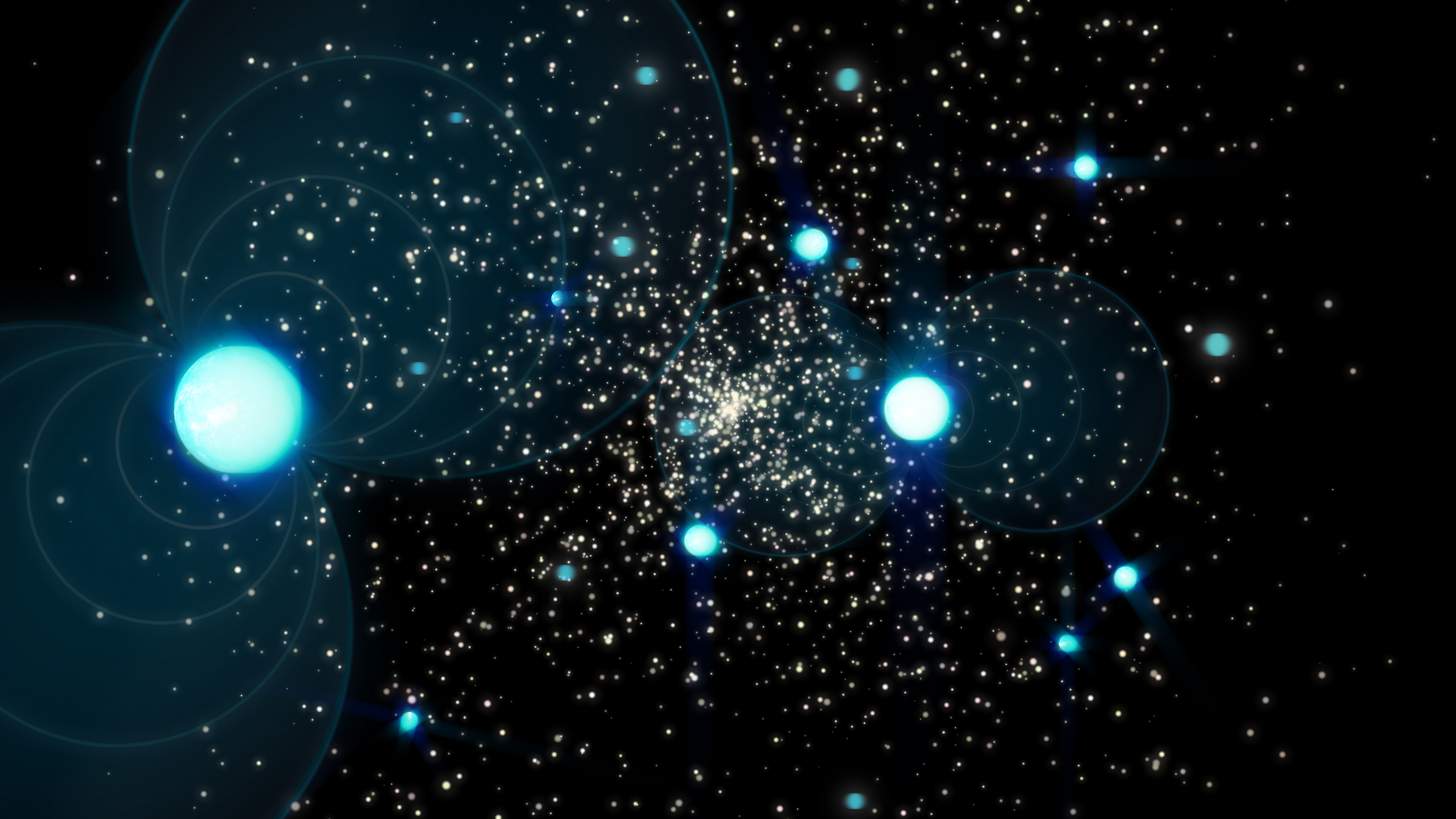
Terzan 5, located in the constellation Sagittarius, is a crowded globular cluster home to hundreds of thousands of stars.Ten unusual and exotic pulsars were recently discovered by an international team of astronomers from the U.S. National Science Foundation National Radio Astronomy Observatory, the Max Planck Institute for Gravitational Physics (Albert Einstein Institute) (AEI), and the Max Planck Institute for Radio Astronomy.Credit: US NSF, AUI, NSF NRAO, S. Dagnello. Hi-Res File


U.S. National Science Foundation Green Bank Telescope teams up with South African Radio Astronomy Observatory MeerKAT Telescope, discovers ten strange and exotic pulsars

Towards the center of our Milky Way Galaxy, in the constellation Sagittarius, astronomers have discovered  10 monstrous neutron stars. These particular stars, called pulsars, reside together in globular cluster Terzan 5, a crowded home for hundreds of thousands of different types of stars. Pulsars are millions (or even billions) of times more dense than other stars and rotate rapidly, emitting bright pulses of light from their strong magnetic fields, making them a beacon for astronomers to find. In one of the most jam-packed places in our Milky Way, many pulsars in Terzan 5 have evolved into bizarre and eccentric forms.

Astronomers already knew that 39 pulsars call Terzan 5 home. With the teamwork of the U.S. National Science Foundation Green Bank Telescope (NSF GBT) and the South African Radio Astronomy Observatory’s MeerKAT Telescope, ten more have been added to the count. “It’s very unusual to find exotic new pulsars. But what’s really exciting is the wide variety of such weirdos in a single cluster,” shared Scott Ransom, a scientist with the U.S. National Science Foundation National Radio Astronomy Observatory (NSF NRAO). The discoveries were made by an international team of astronomers from NSF NRAO, the Max Planck Institute for Gravitational Physics (Albert Einstein Institute) (AEI), and the Max Planck Institute for Radio Astronomy.

The Meerkat Telescope was able to determine the rough location of each pulsar by tracking and timing how quickly they rotate, matched against twenty years of Terzan 5 observations taken by the NSF GBT, which revealed the bizarre and eccentric details of these stars. “Without the NSF Green Bank Telescope’s archive, we wouldn’t have been able to characterize these pulsars and understand their astrophysics,” adds Ransom. The archival NSF GBT data allowed astronomers to pinpoint the pulsars’ position on the sky, measure their specific movements, and see how their orbits changed over time.

Among the discoveries, astronomers saw two likely neutron stars pulled into each other’s orbit as a binary system. Out of 3,600 known pulsars in the Galaxy, only 20 have been identified as double neutron-star binaries. When pulsars pair off in binaries, the gravitational pull from one to the other can steal material and energy, causing one to spin even faster, becoming a millisecond pulsar. This pair could be a record breaker, with a new contender for fastest spinning pulsar in a double neutron-star system, and the longest orbit of its kind. The current record holder for fastest spinning pulsar already resides in Terzan 5. Only future observations will reveal the truth.

Astronomers also observed three new rare pulsar “spider” binary systems (in addition to five already known in the cluster) called Redbacks or Black Widows, depending on the types of companion stars that they have. A companion star falls into the orbit of a spider pulsar, where a web of plasma fills the space between the two (caused by outflows from the companion star due to the pulsar’s energy) slowly dissolving the companion over time.

The discovery of these strange pulsars allows scientists to better understand globular clusters, neutron stars, and even test Einstein’s theory of general relativity, along with expanding what is known about pulsar categories. The research team is already making plans to find even more in Terzan 5, with the support of volunteers. Citizen scientists who’d like to share in the excitement of this discovery can help at Einstein@Home. This project, led by scientists at AEI, has already discovered more than 90 new neutron stars.

The Green Bank Observatory, home of the GBT, and the National Radio Astronomy Observatory are major facilities of the U.S. National Science Foundation and are operated by Associated Universities, Inc.


Media contacts:

Jill Malusky,
NRAO & GBO News & Public Information Manager

jmalusky@nrao.edu

Benjamin Knispel,
Max Planck Institute for Gravitational Physics (Albert Einstein Institute)

benjamin.knispel@aei.mpg.de


Friday, February 21, 2020

A Cosmic Jekyll and Hyde

Terzan 5
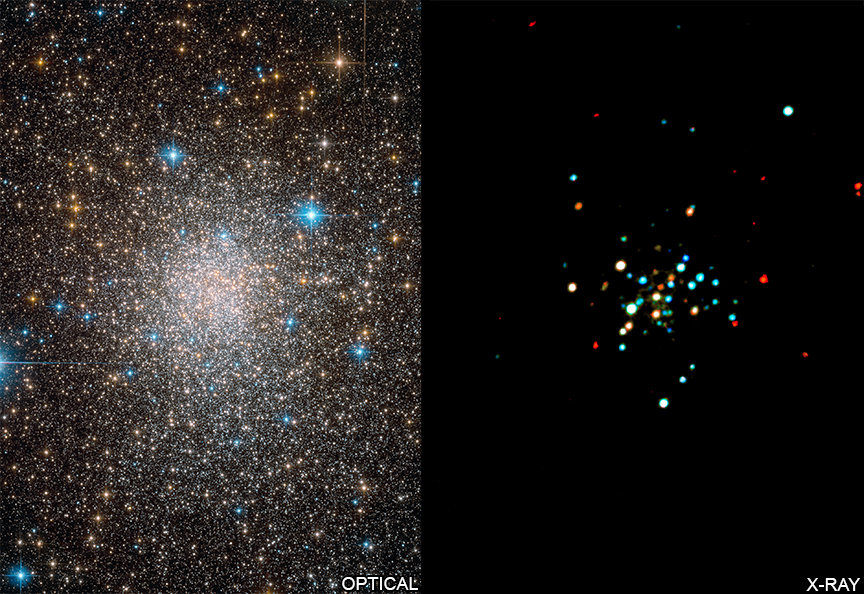
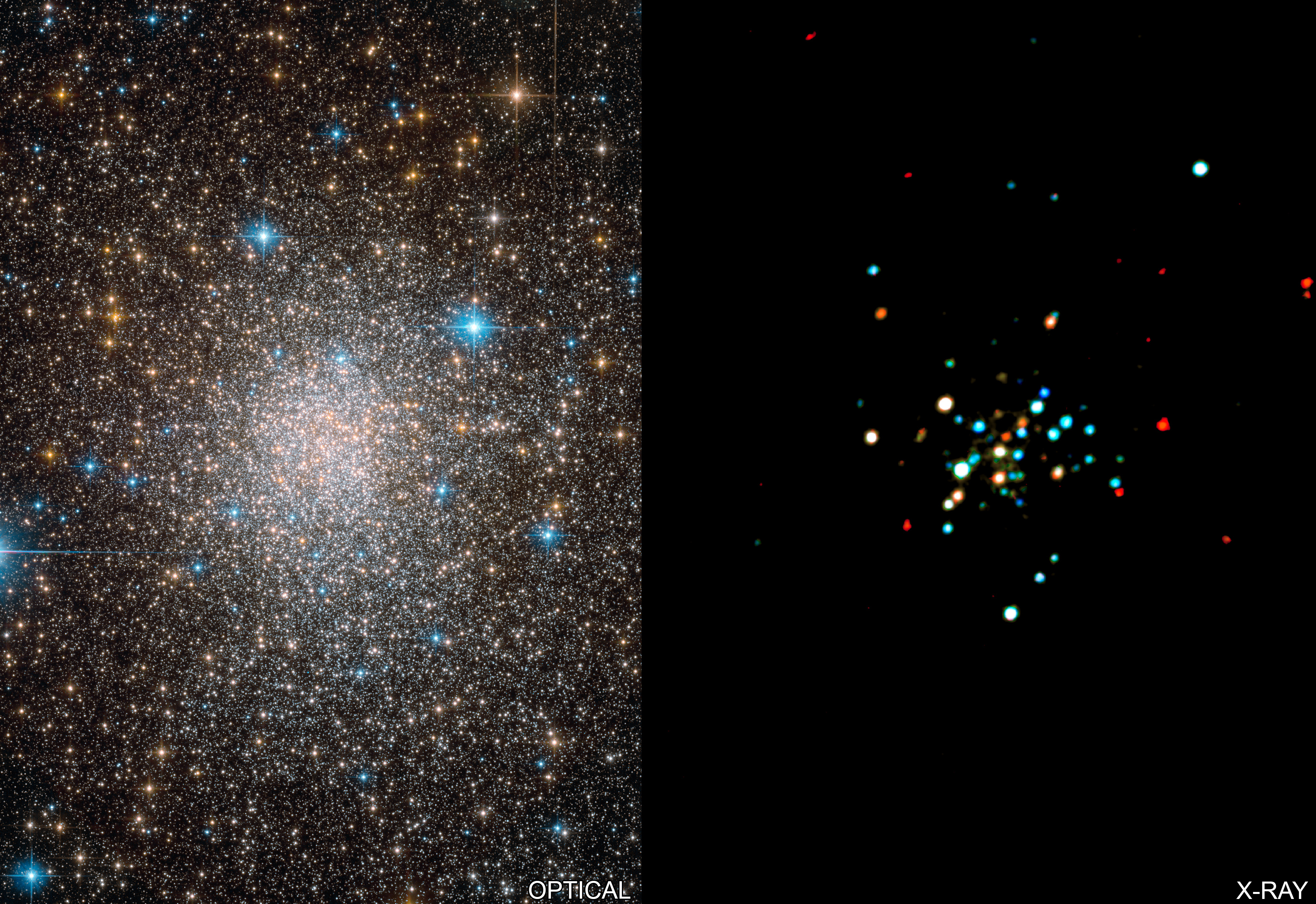
Credit: X-ray: NASA/CXC/Univ. of Amsterdam/N.Degenaar, et al.; Optical: NASA, ESA


A double star system has been flipping between two alter egos, according to observations with NASA's Chandra X-ray Observatory and the National Science Foundation's Karl F. Jansky Very Large Array (VLA). Using nearly a decade and a half worth of Chandra data, researchers noticed that a stellar duo behaved like one type of object before switching its identity, and then returning to its original state after a few years. This is a rare example of a star system changing its behavior in this way.
Astronomers found this volatile double, or binary, system in a dense collection of stars, the globular cluster Terzan 5, which is located about 19,000 light years from Earth in the Milky Way galaxy. This stellar duo, known as Terzan 5 CX1, has a neutron star (the extremely dense remnant left behind by a supernova explosion) in close orbit around a star similar to the Sun, but with less mass. 

In this new image of Terzan 5 (right), low, medium and high-energy X-rays detected by Chandra are colored red, green and blue respectively. On the left, an image from the Hubble Space Telescope shows the same field of view in optical light. Terzan 5 CX1 is labeled as CX1 in the Chandra image.

In binary systems like Terzan 5 CX1, the heavier neutron star pulls material from the lower-mass companion into a surrounding disk. Astronomers can detect these so-called accretion disks by their bright X-ray light, and refer to these objects as "low-mass X-ray binaries." 

Spinning material in the disk falls onto the surface of the neutron star, increasing its rotation rate. The neutron star can spin faster and faster until the roughly 10-mile-wide sphere, packed with more mass than the Sun, is rotating hundreds of times per second. Eventually, the transfer of matter slows down and the remaining material is swept away by the whirling magnetic field of the neutron star, which becomes a millisecond pulsar. Astronomers detect pulses of radio waves from these millisecond pulsars as the neutron star's beam of radio emission sweeps over the Earth during each rotation. 

While scientists expect the complete evolution of a low-mass X-ray binary into a millisecond pulsar should happen over several billion years, there is a period of time when the system can switch rapidly between these two states. Chandra observations of Terzan 5 CX1 show that it was acting like a low-mass X-ray binary in 2003, because it was brighter in X-rays than any of the dozens of other sources in the globular cluster. This was a sign that the neutron star was likely accumulating matter.

Terzan 5, Labeled
Credit: NASA/CXC/Univ. of Amsterdam/N.Degenaar, et al.

In Chandra data taken from 2009 to 2014, Terzan 5 CX1 had become about ten times fainter in X-rays. Astronomers also detected it as a radio source with the VLA in 2012 and 2014. The amount of radio and X-ray emission and the corresponding spectra (the amount of emission at different wavelengths) agree with expectations for a millisecond pulsar. Although the radio data used did not allow a search for millisecond pulses, these results imply that Terzan 5 CX1 underwent a transformation into behaving like a millisecond pulsar and was blowing material outwards. By the time Chandra had observed Terzan 5 CX1 again in 2016, it had become brighter in X-rays and changed back to acting like a low-mass X-ray binary again.

To confirm this pattern of "Jekyll and Hyde" behavior, astronomers need to detect radio pulses while Terzan 5 CX1 is faint in X-rays. More radio and X-ray observations are planned to search for this behavior, along with sensitive searches for pulses in existing data. Only three confirmed examples of these identity-changing systems are known, with the first discovered in 2013 using Chandra and several other X-ray and radio telescopes.

The study of this binary was led by Arash Bahramian of the International Centre for Radio Astronomy Research (ICRAR), Australia and was published in the September 1st, 2018 issue of The Astrophysical Journal. A preprint is available here.

Two other recent studies have used Chandra observations of Terzan 5 to study how neutron stars in two different low-mass X-ray binaries recover after having had large amounts of material dumped on their surface by a companion star. Such studies are important for understanding the structure of a neutron star's outer layer, known as its crust.

In one of these studies, of the low-mass X-ray binary Swift J174805.3–244637 (T5 X-3 for short), material dumped onto the neutron star during an X-ray outburst detected by Chandra in 2012 heated up the star's crust. The crust of the neutron star then cooled down, taking about a hundred days to fall back to the temperature seen before the outburst. The rate of cooling agrees with a computer model for such a process.

In a separate Chandra study of a different low-mass X-ray binary in Terzan 5, IGR J17480–2446 (T5 X-2 for short) the neutron star was still cooling when its temperature was taken five and a half years after it was known to have an outburst. These results show this neutron star's crust ability to transfer, or conduct, heat may be lower than what astronomers have found in other cooling neutron stars in low-mass X-ray binaries. This difference in the ability to conduct heat may be related to T5 X-2 having a higher magnetic field compared to other cooling neutron stars, or being much younger than T5 X-3. 

Both T5 X-3 and T5 X-2 are labeled in the image.

The work on the rapidly cooling neutron star, led by Nathalie Degenaar of the University of Amsterdam in the Netherlands, was published in the June 2015 issue of the Monthly Notices of the Royal Astronomical Society and a preprint is available here. The study of the slowly cooling neutron star, led by Laura Ootes, then of the University of Amsterdam, was published in the July 2019 issue of the Monthly Notices of the Royal Astronomical Society and a preprint is available here.

NASA's Marshall Space Flight Center manages the Chandra program. The Smithsonian Astrophysical Observatory's Chandra X-ray Center controls science and flight operations from Cambridge and Burlington, Massachusetts. Source: NASA’s Chandra X-ray Observatory


Fast Facts for Terzan 5:

Scale: Each panel is about 3.1 arcmin (17 light years) across.
Category: Normal Stars & Star Clusters
Coordinates: (J2000): RA 17h 48m 4.8s | Dec -24° 46´ 45"
Constellation: Sagittarius
Observation Date: 17 observations from July 13, 2003 through July 20, 2014
Observation Time: 171 hours 37 minutes (7 days 3 hours 37 minutes)
Obs. ID: 3798, 10059, 12454, 13225, 13252, 13705, 13706, 14339, 14475-14479, 14625, 15615, 15750, 16638
Instrument: ACIS
References: Bahramian, A. et al., 2018, ApJ, 864, 28; arXiv:1807.11589v Degenaar, N. et al., 2015, MNRAS, 451, 2071; arXiv:1505.01862. Ootes, L.S. et al., 2019, MNRAS, 487, 1447; arXiv:1805.00610
Color Code: X-ray: Red: 0.3-1.2 keV Green: 1.2-2.0 keV Blue: 2.0-6.0 keV
Distance Estimate: About 19,000 light years


Thursday, September 08, 2016

Astronomers Discover Rare Fossil Relic of Early Milky Way

The unusual cluster Terzan 5

The location of the star cluster Terzan 5
Around the star cluster Terzan 5


Videos 

Zooming on the star cluster Terzan 5


Using ESO’s Very Large Telescope and other telescopes a fossilised remnant of the early Milky Way harbouring stars of hugely different ages has been revealed by an international team of astronomers. This stellar system resembles a globular cluster, but is like no other cluster known. It contains stars remarkably similar to the most ancient stars in the Milky Way and bridges the gap in understanding between our galaxy’s past and its present.

Terzan 5, 19 000 light-years from Earth in the constellation of Sagittarius (the Archer) and in the direction of the galactic centre, has been classified as a globular cluster for the forty-odd years since its detection. Now, an Italian-led team of astronomers have discovered that Terzan 5 is like no other globular cluster known.

The team scoured data from the Multi-conjugate Adaptive Optics Demonstrator [1], installed at the Very Large Telescope, as well as from a suite of other ground-based and space telescopes [2]. They found compelling evidence that there are two distinct kinds of stars in Terzan 5 which not only differ in the elements they contain, but have an age-gap of roughly 7 billion years [3].

The ages of the two populations indicate that the star formation process in Terzan 5 was not continuous, but was dominated by two distinct bursts of star formation. “This requires the Terzan 5 ancestor to have large amounts of gas for a second generation of stars and to be quite massive. At least 100 million times the mass of the Sun,” explains Davide Massari, co-author of the study, from INAF, Italy, and the University of Groningen, Netherlands.

Its unusual properties make Terzan 5 the ideal candidate for a living fossil from the early days of the Milky Way. Current theories on galaxy formation assume that vast clumps of gas and stars interacted to form the primordial bulge of the Milky Way, merging and dissolving in the process.

We think that some remnants of these gaseous clumps could remain relatively undisrupted and keep existing embedded within the galaxy,” explains Francesco Ferraro from the University of Bologna, Italy, and lead author of the study. “Such galactic fossils allow astronomers to reconstruct an important piece of the history of our Milky Way.”

While the properties of Terzan 5 are uncommon for a globular cluster, they are very similar to the stellar population which can be found in the galactic bulge, the tightly packed central region of the Milky Way. These similarities could make Terzan 5 a fossilised relic of galaxy formation, representing one of the earliest building blocks of the Milky Way.

This assumption is strengthened by the original mass of Terzan 5 necessary to create two stellar populations: a mass similar to the huge clumps which are assumed to have formed the bulge during galaxy assembly around 12 billion years ago. Somehow Terzan 5 has managed to survive being disrupted for billions of years, and has been preserved as a remnant of the distant past of the Milky Way.

Some characteristics of Terzan 5 resemble those detected in the giant clumps we see in star-forming galaxies at high-redshift, suggesting that similar assembling processes occurred in the local and in the distant Universe at the epoch of galaxy formation,“ continues Ferraro.

Hence, this discovery paves the way for a better and more complete understanding of galaxy assembly. “Terzan 5 could represent an intriguing link between the local and the distant Universe, a surviving witness of the Galactic bulge assembly process,” explains Ferraro while commenting on the importance of the discovery. The research presents a possible route for astronomers to unravel the mysteries of galaxy formation, and offers an unrivaled view into the complicated history of the Milky Way.


Notes

[1] The Multi-Conjugate Adaptive Optics Demonstrator (MAD) is a prototype multi-conjugate adaptive optics system which aims to demonstrate the feasibility of different MCAO reconstruction techniques in the framework of the E-ELT concept and the second generation VLT Instruments.

[2] The researchers also used data from the Wide Field Camera 3 on board the NASA/ESA Hubble Space Telescope and NIRC2 (the Near-Infrared Camera, second generation) at the W. M. Keck Observatory.

[3] The two detected stellar populations have ages of 12 billion years and 4.5 billion years respectively.


More Information

This research was presented in a paper entitled “The age of the young bulge-like population in the stellar system Terzan 5: linking the Galactic bulge to the high-z Universe”, by F. R. Ferraro et al., which will be published in the Astrophysical Journal.

The team is composed of F. R. Ferraro (Dipartimento di Fisica e Astronomia, Università degli Studi di Bologna, Italy) , D. Massari (INAF - Osservatorio Astronomico di Bologna, Italy & Kapteyn Astronomical Institute, University of Groningen, Netherlands), E. Dalessandro (Dipartimento di Fisica e Astronomia, Università degli Studi di Bologna, Italy; INAF - Osservatorio Astronomico di Bologna, Italy) , B. Lanzoni (Dipartimento di Fisica e Astronomia, Università degli Studi di Bologna, Italy), L. Origlia (INAF - Osservatorio Astronomico di Bologna, Italy), R. M. Rich (Department of Physics and Astronomy, University of California, Los Angeles, USA) and A. Mucciarelli (Dipartimento di Fisica e Astronomia, Università degli Studi di Bologna, Italy).

ESO is the foremost intergovernmental astronomy organisation in Europe and the world’s most productive ground-based astronomical observatory by far. It is supported by 16 countries: Austria, Belgium, Brazil, the Czech Republic, Denmark, France, Finland, Germany, Italy, the Netherlands, Poland, Portugal, Spain, Sweden, Switzerland and the United Kingdom, along with the host state of Chile. ESO carries out an ambitious programme focused on the design, construction and operation of powerful ground-based observing facilities enabling astronomers to make important scientific discoveries. ESO also plays a leading role in promoting and organising cooperation in astronomical research. ESO operates three unique world-class observing sites in Chile: La Silla, Paranal and Chajnantor. At Paranal, ESO operates the Very Large Telescope, the world’s most advanced visible-light astronomical observatory and two survey telescopes. VISTA works in the infrared and is the world’s largest survey telescope and the VLT Survey Telescope is the largest telescope designed to exclusively survey the skies in visible light. ESO is a major partner in ALMA, the largest astronomical project in existence. And on Cerro Armazones, close to Paranal, ESO is building the 39-metre European Extremely Large Telescope, the E-ELT, which will become “the world’s biggest eye on the sky”.


Links 


Contacts:

Francesco Ferraro
Università degli Studi di Bologna
Bologna, Italy
Tel: +39 051 20 9 5774
Email:
francesco.ferraro3@unibo.it

Davide Massari
INAF - Osservatorio Astronomico di Bologna
Bologna, Italy
Tel: +51 2095318
Email:
davide.massari@oabo.inaf.it

Richard Hook
ESO Public Information Officer
Garching bei München, Germany
Tel: +49 89 3200 6655
Cell: +49 151 1537 3591
Email:
rhook@eso.org


Source: ESO

Wednesday, June 17, 2015

Seeing Where Stars Collide

Gemini Observatory near-infrared image of the globular cluster Liller 1 obtained with the GeMS adaptive optics system on the Gemini South telescope in Chile.  Credit: Gemini Observatory/AURA.  Full-resolution image


Scientists have imaged a cluster of stars, heavily obscured by material in our galaxy, where stars are so densely packed that it is likely a rare environment where stars can collide. “It’s a bit like a stellar billiards table; where the probability of collisions depends on the size of the table and on the number of billiard balls on it,” said Francesco R. Ferraro of the University of Bologna (Italy), one of the team members who used the Gemini Observatory to make the observations. 

The cluster of stars, known as Liller 1, is a difficult target to study due to its distance and also because it is located close to the center of the Milky Way (about 3,200 light-years away from it), where the obscuration by dust is very high. The unprecedented ultra-sharp view of the cluster reveals a vast city of stars estimated by the team to contain a total mass of at least 1.5 million suns, very similar to the most massive globular clusters in our galaxy: Omega Centauri and Terzan 5. 

“Although our galaxy has upwards of 200 billion stars, there is so much vacancy between stars that there are very few places where suns actually collide,” said Douglas Geisler, Principal Investigator of the original observing proposal, from University of Concepcion (Chile). “The congested overcrowded central regions of globular clusters are one of these places. Our observations confirmed that, among globular clusters, Liller 1 is one of the best environments in our galaxy for stellar collisions.” 

Geisler’s team specializes in the study of globular clusters near the center of the Milky Way, while Ferraro’s team is adept at the reduction of infrared data on globular clusters. Both groups worked together to obtain the beautiful and detailed observations of Liller 1 with Gemini. 

Liller 1 is a tight sphere of stars known as a globular cluster. Globular clusters orbit in a large halo around the center, or nucleus, of our galaxy and many of the closer globular clusters are spectacular showpieces, even in small telescopes or binoculars. “This isn’t one of these showpieces, it is so obscured by material in the central bulge of our galaxy that is almost completely invisible in visual light,” observed Sara Saracino, lead author on the paper, from the University of Bologna. Indeed, Liller 1 is located at almost 30,000 light years from Earth, in one of the most inaccessible regions of our galaxy, where thick clouds of dust prevent the optical light from emerging. “Only infrared radiation can travel across these clouds and bring us direct information on its stars,” commented Emanuele Dalessandro of University of Bologna. 

The observations of the tightly packed cluster used Gemini Observatory’s powerful adaptive optics system at the Gemini South telescope in Chile. 

A technical jewel named GeMS (derived from “Gemini Multi-conjugate adaptive optics System”), in combination with the powerful infrared camera Gemini South Adaptive Optics Imager (GSAOI), was able to penetrate the dense fog surrounding Liller 1 and to provide astronomers with this unprecedented view of its stars. This has been made possible thanks to the combination of two specific characteristics of GeMS: first, the capability of operating at near-infrared wavelengths (especially in the K pass-band); second, an innovative and revolutionary way to remove the distortions (blurriness) that the Earth’s turbulent atmosphere inflicts on astronomical images. To compensate for the degradation effects of the Earth’s atmosphere, the GeMS system uses three natural guide stars, a constellation of five laser guide stars, and multiple deformable mirrors. The correction is so fine that astronomers are provided with images of unprecedented sharpness. In the best K-band exposures of Liller 1, stellar images have an angular resolution of only 75 milliarcseconds, just slightly larger than the theoretical limit of Gemini’s 8-meter mirror (known as the diffraction limit). This means that GeMS performed with almost perfect corrections of atmospheric distortions. 

The international research team published the results in The Astrophysical Journal (article 152, volume 806, issue 2, June 15, 2015). The astro-ph version of the article can be found here

The observations for this project also included several other globular clusters. The results achieved on their first target, Liller 1, have been so important that they have increased their collaboration and are currently working on the other clusters which promise to deliver even more exciting science.


Background: Stellar Collisions

Stellar collisions are important because they can provide the key to understand the origin of exotic objects that cannot be interpreted in terms of the passive evolution of single stars. Nearly head-on collisions in which the stars actually merge, mixing their nuclear fuel and re-stoking the fire of the nuclear fusion are suggested to be the origin of (at least part) of the so-called Blue Straggler Stars. But collisions can also involve binary systems, with the effect of shrinking the initial size of the system and thus promoting the two components to interact and producing a variety of objects like Low mass X-ray binaries, Millisecond pulsars etc. In particular Millisecond pulsars are old neutron stars reaccelerated to millisecond rotation period by mass accretion from a companion in a binary system. Indeed Liller 1 is suspected to have a large population of such exotic objects. Although no millisecond pulsar has been directly observed up to now, a large hidden population has been suggested because of the detection of an intense γ-ray emission (the most intense detected so far from a globular cluster). The Gemini observations indeed confirm that this is possible.

“Indeed our observations confirm Liller 1 as one of the best “laboratories” where the impact of star cluster dynamics on stellar evolution can be studied: it opens the window to a sort of stellar sociology study, aimed at measuring the impact of the reciprocal influence of stars when they are forced to live in conditions of extreme crowding and stress.” concludes Ferraro.

Additional information can be found at http://www.cosmic-lab.eu/Cosmic-Lab/Liller1.html


Media Contacts:

Peter Michaud
Public Information and Outreach Office
Gemini Observatory, Hilo, HI
Email: pmichaud@gemini.edu
Cell: (808) 936-6643

Manuel Paredes
Public Information and Outreach Office
Gemini Observatory, La Serena, Chile
Email: mparedes@gemini.edu
Phone: (56-51) 220-5671

Science Contacts:

Douglas Geisler
Departamento de Astronomía
Universidad de Concepción
Email: dgeisler@astro-udec.cl
Phone: (56-41) 220-3092

Francesco R. Ferraro
Department of Physics and Astronomy, University of Bologna
Email: francesco.ferraro3@unibo.it
Office: +39 051 2095774


Source: Gemini Observatory