Showing posts with label NGC 1300. Show all posts

Tuesday, January 07, 2025

Reading a Chapter of Galactic History from a Single Star

The globular cluster Terzan 5, one of the oldest and most massive globular clusters in the Milky Way
Credit:
ESO/F. Ferraro; CC BY 4.0

The Milky Way, like the galaxy NGC 1300 shown here in an image from the Hubble Space Telescope, has a central bar of stars. Credit: NASA, ESA, and The Hubble Heritage Team (STScI/AURA); Acknowledgment: P. Knezek (WIYN)

The star SOS1 is not like its neighbors. Using chemical and dynamical data, stellar sleuths have tracked this star from its current home in the Milky Way’s central bar back to its likely origin in one of the most massive globular clusters in our galaxy.

A Star in a Bar

Today, the Milky Way has an intricate and interlocking structure: thin and thick disks of stars surrounded by an extended halo, with a bulge of old stars at the center. A bar of stars cuts across the center of our galaxy, and globular clusters — ancient collections of thousands to millions of stars — dot the galactic bulge and halo. These structures didn’t always exist, and a major goal for galactic research is understanding when and how the many components of our galaxy were assembled.

One piece of the puzzle might be provided by the star 2M17454705-2639109, also known as SOS1. This star is located in the busy galactic downtown of the Milky Way’s center, orbiting within the central bar of stars. Data from the Apache Point Observatory Galactic Evolution Experiment (APOGEE) show that SOS1 has a curious chemical composition that sets it apart from its neighbors. Now, researchers have shown that these chemical differences may be evidence that SOS1 originated far from its current location — and that many other stars in the galactic bar might have completed similar journeys.

The reddish stars of the globular cluster Liller 1 glow behind bright blue stars in the foregroun
Credit:
ESA/Hubble & NASA, F. Ferraro; CC BY 4.0

SOS1: Far from Home?

A team led by Stefano Souza (Leibniz Institute for Astrophysics Potsdam; University of São Paolo; Max Planck Institute for Astronomy) investigated SOS1’s origins by first comparing its chemical abundance pattern to those of different populations of stars in the Milky Way. The observed pattern of low carbon, high nitrogen, and high aluminum matches expectations for second-generation stars in globular clusters: densely packed, roughly spherical collections of thousands to millions of stars.

Chemical (left) and age (right) comparison between SOS1 and stars in the globular cluster Terzan 5.
Credit: Souza et al. 2024

But how would a star born in a globular cluster end up in the Milky Way’s central bar? Souza’s team highlighted two possible scenarios: SOS1 might have been ejected from its home cluster by a gravitational interaction with a binary star system, or — deemed more likely — it could have been stolen from its home cluster by the tidal forces of the Milky Way.

Candidate Clusters

Souza’s team used N-body simulations to determine if SOS1 once called one of the existing globular clusters home. (The team notes that it’s possible that SOS1’s parent star cluster no longer exists, having been pulled apart by the Milky Way’s powerful tidal forces.) The likeliest candidate is Terzan 5, which is among the most massive and most ancient globular clusters in the Milky Way. The simulations suggest that SOS1 might have been bound to this cluster 353 million years ago.

The chemical abundances of SOS1 support this hypothesis, since SOS1’s curious chemical makeup is consistent with that of the oldest and most metal-poor stars in the cluster. The final clue would be a comparison of the ages of Terzan 5 and SOS1. Though the data did not allow for a precise determination of the star’s age, the preliminary analysis suggests that it is of a similar age to the cluster.

The chemical similarities and dynamical properties make it likely that SOS1 once resided in a globular cluster, possibly Terzan 5. Its current residence in the Milky Way’s central bar supports the idea that ancient globular clusters contributed stars to the bar through tidal stripping.

By Kerry Hensley

Citation

“Tracing Back a Second-Generation Star Stripped from Terzan 5 by the Galactic Bar,” Stefano O. Souza et al 2024 ApJL 977 L33.

doi:10.3847/2041-8213/ad91af


Friday, January 21, 2022

Capturing All That Glitters in Galaxies With NASA’s Webb


This image of spiral galaxy NGC 3351 combines observations from several observatories to reveal details about its stars and gas. Radio observations from the Atacama Large Millimeter/submillimeter Array (ALMA) show dense molecular gas in magenta. The Very Large Telescope’s Multi Unit Spectroscopic Explorer (MUSE) instrument highlights where young massive stars illuminate their surroundings, set off in red. The Hubble Space Telescope’s images highlight dust lanes in white and newly formed stars in blue. High-resolution infrared images from the Webb Space Telescope will help researchers identify where stars are forming behind dust and study the earliest stages of star formation in this galaxy. Credits: Science: NASA, ESA, ESO-Chile, ALMA, NAOJ, NRAO; image processing: Joseph DePasquale (STScI)

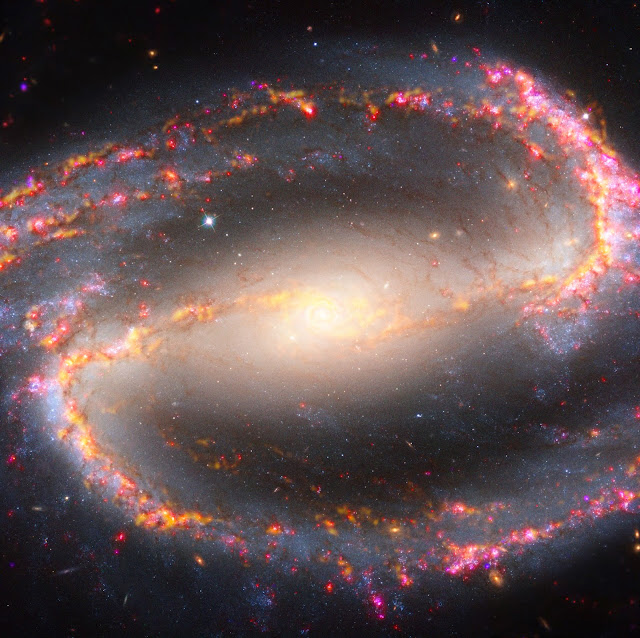
This image of spiral galaxy NGC 1300 combines multiple observations to map stellar populations and gas. Radio light observed by the Atacama Large Millimeter/submillimeter Array (ALMA), represented in yellow, highlight the clouds of cold molecular gas that provide the raw material from which stars form. Data from the Very Large Telescope’s Multi Unit Spectroscopic Explorer (MUSE) instrument is represented in red and magenta, capturing the impact of young, massive stars on their surrounding gas. Visible and ultraviolet light captured by the Hubble Space Telescope highlights dust lanes in gold and very young, hot stars in blue. High-resolution infrared images from the Webb Space Telescope will help researchers identify where stars are forming behind dust and study the earliest stages of star formation in this galaxy. Credits: Science: NASA, ESA, ESO-Chile, ALMA, NAOJ, NRAO; image processing: Alyssa Pagan (STScI)

An international research team will survey the stars, star clusters, and dust that lie within 19 nearby galaxies.

Spirals are some of the most captivating shapes in the universe. They appear in intricate seashells, carefully constructed spider webs, and even in the curls of ocean waves. Spirals on cosmic scales – as seen in galaxies – are even more arresting, not only for their beauty, but also for the overwhelming amount of information they contain. How do stars and star clusters form? Until recently, a complete answer used to lie out of reach, blocked by gas and dust. Within the first year of operations, NASA’s James Webb Space Telescope will help researchers complete a more detailed sketch of the stellar life cycle with high-resolution infrared-light images of 19 galaxies.

The telescope will also provide a few key “puzzle pieces” that were missing until now. “JWST touches on so many different phases of the stellar life cycle – all in tremendous resolution,” said Janice Lee, Gemini Observatory chief scientist at the National Science Foundation’s NOIRLab in Tucson, Arizona. “Webb will reveal star formation at its very earliest stages, right when gas collapses to form stars and heats up the surrounding dust.”

Lee is joined by David Thilker of the Johns Hopkins University in Baltimore, Maryland, Kathryn Kreckel of Heidelberg University in Germany, and 40 additional members of the multi-wavelength survey program known as PHANGS (Physics at High Angular resolution in Nearby GalaxieS). Their mission? Not only to unravel the mysteries of star formation with Webb’s high-resolution infrared images, but also to share the datasets with the entire astronomical community to accelerate discovery.

The Rhythms of Star Formation

PHANGS is novel, in part, because it brought together more than 100 international experts to study star formation from beginning to end. They are targeting galaxies that can be seen face-on from Earth and that are, on average, 50 million light-years away. The large collaboration began with microwave light images of 90 galaxies from the Atacama Large Millimeter/submillimeter Array (ALMA) in Chile. Astronomers use this data to produce molecular gas maps to study the raw materials for star formation. Once the Very Large Telescope’s Multi Unit Spectroscopic Explorer (MUSE) instrument, also in Chile, came online, they obtained data known as spectra to study later phases of star formation of 19 galaxies, particularly after star clusters have cleared nearby gas and dust. The space-based Hubble Space Telescope has provided visible and ultraviolet light observations of 38 galaxies to add high-resolution images of individual stars and star clusters.

The missing elements, which Webb will fill in, are largely in areas of the galaxies that are obscured by dust – regions where stars are actively beginning to form. “We’re going to clearly see star clusters in the hearts of these dense molecular clouds that before we only had indirect evidence of,” Thilker said. “Webb gives us a way to look inside these ‘star factories’ to see the freshly assembled star clusters and measure their properties before they evolve.”

The new data will also help the team pinpoint the ages of stellar populations in a diverse sample of galaxies, which will help researchers build more accurate statistical models. “We’re always putting the context of the small scales into the big picture of galaxies,” explained Kreckel. “With Webb, we’ll trace the evolutionary sequence of each galaxy’s stars and star clusters.”

Another important answer they’re seeking involves the dust surrounding the stars, within the interstellar medium. Webb will help them determine which areas of the gas and dust are associated with specific star-forming regions, and which are free-floating interstellar material. “This couldn't be done before, beyond the nearest galaxies. It will be transformative,” Thilker added. The team is also working to understand the timing of the star-formation cycle. “Timescales are critical in astronomy and physics,” Lee said. “How long does each stage of star formation last? How might those timelines vary in different galaxy environments? We want to measure when these stars free themselves from their gas clouds to understand how star formation is disrupted.”

Science for All

These Webb observations will be taken as part of a Treasury program, which means they are not only available immediately to the public, but they will also be of broad and enduring scientific value. The team will work to create and release data sets that align Webb’s data to each of the complementary data sets from ALMA, MUSE, and Hubble, allowing future researchers to sift through each galaxy and their stellar populations easily, toggling on and off various wavelengths – and zoom into individual pixels of the images. They will provide inventories of different phases of the star-formation cycle, including regions of star formation, young stars, star clusters, and local dust properties.

This research will be conducted as part of Webb’s General Observer (GO) programs, which are competitively selected using a dual-anonymous review system, the same system that is used to allocate time on the Hubble Space Telescope.

The James Webb Space Telescope is the world's premier space science observatory. Webb will solve mysteries in our solar system, look beyond to distant worlds around other stars, and probe the mysterious structures and origins of our universe and our place in it. Webb is an international program led by NASA with its partners, ESA (European Space Agency) and the Canadian Space Agency.

Related Links and Documents

PHANGS Survey
PHANGS Hubble Observation

Editor: Rob Garner


Saturday, July 17, 2021

Galactic fireworks: new ESO images reveal stunning features of nearby galaxies

Five galaxies as seen with MUSE on ESO’s VLT at several wavelengths of light

NGC 4303 as seen with MUSE on ESO’s VLT at several wavelengths of light 
 
NGC 4254 as seen with MUSE on ESO’s VLT at several wavelengths of light
 
NGC 3627 as seen with MUSE on ESO’s VLT at several wavelengths of light 
 
NGC 1087 as seen with MUSE on ESO’s VLT at several wavelengths of light 
 
NGC 1300 as seen with MUSE on ESO’s VLT at several wavelengths of light 
 
NGC 4303 as seen with the VLT and ALMA at several wavelengths of light 
 
NGC 4254 as seen with the VLT and ALMA at several wavelengths of light
 
NGC 3627 as seen with the VLT and ALMA at several wavelengths of light
 
NGC 1087 as seen with the VLT and ALMA at several wavelengths of light 
 
NGC 1300 as seen with the VLT and ALMA at several wavelengths of light


Videos

Cosmic fireworks reveal newborn stars (ESOcast Light 239)
Cosmic fireworks reveal newborn stars (ESOcast Light 239) 
 
Multiple views of the galaxy NGC 4303 as seen with the VLT and ALMA (with annotations)
Multiple views of the galaxy NGC 4303 as seen with the VLT and ALMA (with annotations) 
 
Multiple views of the galaxy NGC 4254 as seen with the VLT and ALMA
Multiple views of the galaxy NGC 4254 as seen with the VLT and ALMA 
 
Multiple views of the galaxy NGC 3627 as seen with the VLT and ALMA
 
Multiple views of the galaxy NGC 1087 as seen with the VLT and ALMA
Multiple views of the galaxy NGC 1087 as seen with the VLT and ALMA 
 
Multiple views of the galaxy NGC 1300 as seen with the VLT and ALMA
 
Multiple views of the galaxy NGC 4303 as seen with the VLT and ALMA
Multiple views of the galaxy NGC 4303 as seen with the VLT and ALMA 


Image Comparisons

Comparison of different views of the galaxy NGC 4303
 
Comparison of different views of the galaxy NGC 1300
 

A team of astronomers has released new observations of nearby galaxies that resemble colourful cosmic fireworks. The images, obtained with the European Southern Observatory’s Very Large Telescope (ESO’s VLT), show different components of the galaxies in distinct colours, allowing astronomers to pinpoint the locations of young stars and the gas they warm up around them. By combining these new observations with data from the Atacama Large Millimeter/submillimeter Array (ALMA), in which ESO is a partner, the team is helping shed new light on what triggers gas to form stars.

Astronomers know that stars are born in clouds of gas, but what sets off star formation, and how galaxies as a whole play into it, remains a mystery. To understand this process, a team of researchers has observed various nearby galaxies with powerful telescopes on the ground and in space, scanning the different galactic regions involved in stellar births.

“For the first time we are resolving individual units of star formation over a wide range of locations and environments in a sample that well represents the different types of galaxies,” says Eric Emsellem, an astronomer at ESO in Germany and lead of the VLT-based observations conducted as part of the Physics at High Angular resolution in Nearby GalaxieS (PHANGS) project. “We can directly observe the gas that gives birth to stars, we see the young stars themselves, and we witness their evolution through various phases.” 

Emsellem, who is also affiliated with the University of Lyon, France, and his team have now released their latest set of galactic scans, taken with the Multi-Unit Spectroscopic Explorer (MUSE) instrument on ESO’s VLT in the Atacama Desert in Chile. They used MUSE to trace newborn stars and the warm gas around them, which is illuminated and heated up by the stars and acts as a smoking gun of ongoing star formation.

The new MUSE images are now being combined with observations of the same galaxies taken with ALMA and released earlier this year. ALMA, which is also located in Chile, is especially well suited to mapping cold gas clouds — the parts of galaxies that provide the raw material out of which stars form.

By combining MUSE and ALMA images astronomers can examine the galactic regions where star formation is happening, compared to where it is expected to happen, so as to better understand what triggers, boosts or holds back the birth of new stars. The resulting images are stunning, offering a spectacularly colourful insight into stellar nurseries in our neighbouring galaxies.

“There are many mysteries we want to unravel,” says Kathryn Kreckel from the University of Heidelberg in Germany and PHANGS team member. “Are stars more often born in specific regions of their host galaxies — and, if so, why? And after stars are born how does their evolution influence the formation of new generations of stars?”

Astronomers will now be able to answer these questions thanks to the wealth of MUSE and ALMA data the PHANGS team have obtained. MUSE collects spectra — the “bar codes” astronomers scan to unveil the properties and nature of cosmic objects — at every single location within its field of view, thus providing much richer information than traditional instruments. For the PHANGS project, MUSE observed 30 000 nebulae of warm gas and collected about 15 million spectra of different galactic regions. The ALMA observations, on the other hand, allowed astronomers to map around 100 000 cold-gas regions across 90 nearby galaxies, producing an unprecedentedly sharp atlas of stellar nurseries in the close Universe.

In addition to ALMA and MUSE, the PHANGS project also features observations from the NASA/ESA Hubble Space Telescope. The various observatories were selected to allow the team to scan our galactic neighbours at different wavelengths (visible, near-infrared and radio), with each wavelength range unveiling distinct parts of the observed galaxies. “Their combination allows us to probe the various stages of stellar birth — from the formation of the stellar nurseries to the onset of star formation itself and the final destruction of the nurseries by the newly born stars — in more detail than is possible with individual observations,” says PHANGS team member Francesco Belfiore from INAF-Arcetri in Florence, Italy. "PHANGS is the first time we have been able to assemble such a complete view, taking images sharp enough to see the individual clouds, stars, and nebulae that signify forming stars."

The work carried out by the PHANGS project will be further honed by upcoming telescopes and instruments, such as NASA’s James Webb Space Telescope. The data obtained in this way will lay further groundwork for observations with ESO’s future Extremely Large Telescope (ELT), which will start operating later this decade and will enable an even more detailed look at the structures of stellar nurseries.

“As amazing as PHANGS is, the resolution of the maps that we produce is just sufficient to identify and separate individual star-forming clouds, but not good enough to see what’s happening inside them in detail,” pointed out Eva Schinnerer, a research group leader at the Max Planck Institute for Astronomy in Germany and principal investigator of the PHANGS project, under which the new observations were conducted. “New observational efforts by our team and others are pushing the boundary in this direction, so we have decades of exciting discoveries ahead of us.”


More Information 

The international PHANGS team is composed of over 90 scientists ranging from Master students to retirees working at 30 institutions across four continents. The MUSE data reduction working group within PHANGS is being led by Eric Emsellem (European Southern Observatory, Garching, Germany and Centre de Recherche Astrophysique de Lyon, Université de Lyon, ENS de Lyon, Saint-Genis Laval, France) and includes Francesco Belfiore (INAF Osservatorio Astrofisico di Arcetri, Florence, Italy), Guillermo Blanc (Carnegie Observatories, Pasadena, US), Enrico Congiu (Universidad de Chile, Santiago, Chile and Las Campanas Observatory, Carnegie Institution for Science, Atacama Region, Chile), Brent Groves (The University of Western Australia, Perth, Australia), I-Ting Ho (Max Planck Institute for Astronomy, Heidelberg, Germany [MPIA]), Kathryn Kreckel (Heidelberg University, Heidelberg, Germany), Rebecca McElroy (Sydney Institute for Astronomy, Sydney, Australia), Ismael Pessa (MPIA), Patricia Sanchez-Blazquez (Complutense University of Madrid, Madrid, Spain), Francesco Santoro (MPIA), Fabian Scheuermann (Heidelberg University, Heidelberg, Germany) and Eva Schinnerer (MPIA).

Go to the ESO public image archive to see a sample of PHANGS images.

ESO is the foremost intergovernmental astronomy organisation in Europe and the world’s most productive ground-based astronomical observatory by far. It has 16 Member States: Austria, Belgium, the Czech Republic, Denmark, France, Finland, Germany, Ireland, Italy, the Netherlands, Poland, Portugal, Spain, Sweden, Switzerland and the United Kingdom, along with the host state of Chile and with Australia as a Strategic Partner. ESO carries out an ambitious programme focused on the design, construction and operation of powerful ground-based observing facilities enabling astronomers to make important scientific discoveries. ESO also plays a leading role in promoting and organising cooperation in astronomical research. ESO operates three unique world-class observing sites in Chile: La Silla, Paranal and Chajnantor. At Paranal, ESO operates the Very Large Telescope and its world-leading Very Large Telescope Interferometer as well as two survey telescopes, VISTA working in the infrared and the visible-light VLT Survey Telescope. Also at Paranal ESO will host and operate the Cherenkov Telescope Array South, the world’s largest and most sensitive gamma-ray observatory. ESO is also a major partner in two facilities on Chajnantor, APEX and ALMA, the largest astronomical project in existence. And on Cerro Armazones, close to Paranal, ESO is building the 39-metre Extremely Large Telescope, the ELT, which will become “the world’s biggest eye on the sky”.


Links


Contacts 

Eric Emsellem
European Southern Observatory
Garching bei München, Germany
Tel: +49 89 3200 6914
Email:
eric.emsellem@eso.org

Eva Schinnerer
Max Planck Institute for Astronomy
Heidelberg, Germany
Tel: +49 6221 528 294
Email:
schinner@mpia.de

Kathryn Kreckel
Astronomisches Recheninstitut, Zentrum für Astronomie, Universität Heidelberg
Heidelberg, Germany
Email:
kathryn.kreckel@uni-heidelberg.de

Francesco Belfiore
INAF Osservatorio Astrofisico di Arcetri
Florence, Italy
Email:
francesco.belfiore@inaf.it

Bárbara Ferreira
ESO Media Manager
Garching bei München, Germany
Tel: +49 89 3200 6670
Cell: +49 151 241 664 00
Email:
press@eso.org

 Source: ESO/News


Saturday, May 08, 2021

A Barred Galaxy’s Massive Molecular Inflow


The barred spiral galaxy NGC1300 as seen by Hubble.  Astronomers think that galactic bars help funnel material into the nuclear regions of galaxies where they help trigger star formation and feed the supermassive black hole.  The nuclear region is heavily obscured in the optical, but infrared and submillimeter wavelengths can penetrate the dust.  Analyses of new infrared spectra of water vapor and other gases have now confirmed and quantified these processes in the barred spiral ESO320-G030.NASA, ESA, and the Hubble Heritage Team; STScI/AURA

Large amounts of gas are sometimes funneled to a galaxy's nuclear regions, with profound consequences. The gas triggers starburst activity and can also feed the supermassive black hole, converting it into an active galactic nucleus (AGN); indeed the supermassive black holes in AGN are thought to gain most of their mass in these accretion events. Eventually, outward pressure from supernovae, shocks, and/or AGN activity terminate the inflow. Galaxy mergers are thought to be one mechanism capable of triggering these massive inflows by disrupting the medium. A less dramatic cause may result from gas flows induced by a combination of galactic rotation and the gravitational instabilities generated by galactic bars, the elongated central structures (composed of stars) found in numerous spiral galaxies including the Milky Way.

What happens to infalling gas when it encounters a nuclear region is poorly understood because the very high obscuration around galactic nuclei makes optical observations challenging. Astronomers have therefore been relying on data from far-infrared and submillimeter wavelength observations which can penetrate the dust, although longer wavelength imaging typically lacks the high spatial resolution needed. Infrared spectroscopy has been one of the premier ways to overcome both difficulties because the radiation not only penetrates the dust, the strengths and shapes of spectral lines can be modeled to infer even small dimensions as well as temperatures, densities, and other characteristics of the emitting regions.

CfA astronomers Eduardo Gonzalez-Alfonso, Matt Ashby, and Howard Smith led a team that modeled infrared spectra of water vapor from the nuclear region of the ultraluminous galaxy ESO320-G030, about 160 million light-years away, a galaxy that emits about one hundred times as much energy as the Milky Way. The data were obtained with the Herschel Space Observatory and the ALMA submillimeter facility. This galaxy shows no signs of having been in a merger, nor does it show any signs of AGN activity, but it does have a clear and complex central bar structure and infalling gas that was previously discovered through infrared spectroscopy.

The astronomers observed and modeled twenty spectral features of water vapor, enough diagnostic lines to model the complexity of the emitting regions. The successful results required a three-component nuclear model: a warm envelope (about 50 kelvin) about 450 light-years in radius within which is a second component, a nuclear disk about 130 light-years in radius, and finally a much warmer compact core (100 kelvin) about 40 light-years in radius. These three components alone emit nearly 70% of the galaxy’s luminosity from a starburst that is making about 18 solar-masses of stars a year (the Milky Way averages about one per year). The mass inflow rate into the region is about the same as the star production – about 18 solar-masses per year. In addition to these conclusions about the nuclear region, the astronomers use their best-fit results to model successfully 17 other molecular species (besides water) seen in the far infrared spectra, including ionized molecules and carbon and nitrogen-bearing molecules. The combined results, in particular the extremely high abundance of ionized molecules, suggest the strong presence of enhanced ionizing cosmic rays and shed light on the chemistry of the complex nuclear zone.

Reference: 

"A Proto-Pseudobulge in ESO 320-G030 Fed by a Massive Molecular Inflow Driven by a Nuclear Bar," Eduardo González-Alfonso, Miguel Pereira-Santaella, Jacqueline Fischer, Santiago García-Burillo, Chentao Yang, Almudena Alonso-Herrero, Luis Colina, Matthew L. N. Ashby, Howard A. Smith, Fernando Rico-Villas, Jesús Martín-Pintado, Sara Cazzoli, and Kenneth P. Stewart, Astronomy & Astrophysics, 645, 49, 2021.

Source: Harvard-Smithsonian Center for Astrophysics (CfA)


Wednesday, February 15, 2017

New Light on Dark Matter Halos

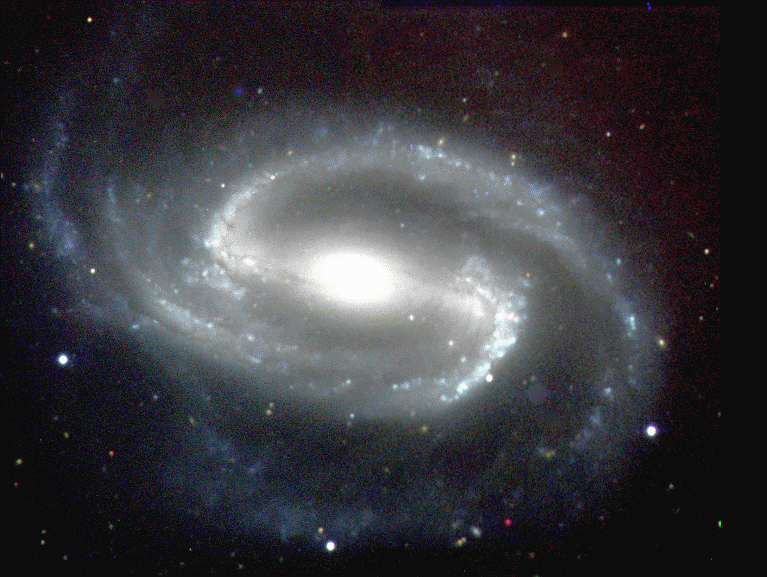
NGC 1300 is a classic barred spiral galaxy, similar to those observed in the present study. It is 17 Mpc away and relatively face-on, with an inclination of about 35 degrees. Shown here is a colour composition from B, V and I-band CCD images obtained using the Prime-Focus Camera on the Isaac Newton Telescope (INT) in 1996. Credit: J. A. López Aguerri, M. Prieto, C. Muñoz-Tuñón, and A. M. Varela (IAC). Large format: GIF


For the past twenty years observers have been trying to test the effects of the predicted dark matter halos on the bars in barred galaxies. The basic idea is that according to simulation models which include the halos, these should have acted as a gravitational brake and slowed down the rotation of the bars during the lifetimes of galaxy discs.

This could be tested by measuring the corotation radius corresponding to the bar, which is the radius at which the angular pattern speed of the bar is equal to the angular speed of the stars in the disc. Classical models as early as the 1980's showed that the corotation radius should be just outside the tip of the bar, while the simulations made just under 20 years ago suggested that the ratio of the corotation radius to the bar length should indeed be just bigger than unity, unless the bar has been slowed down by interaction with the halo.

In that case corotation would move progressively outwards in the disc. The simulators set a (somewhat arbitrary) criterion that if the ratio excedes 1.4 this is satisfactory evidence of braking by the halo, and this criterion has been used by observers as a test for the presence of halos.

The problem has been the difficulty of measuring the corotation radius. Until recently this had been done, by a few different methods, for only a few tens of galaxies, and the results were somewhat surprising. The ratio of corotation radius to bar length was, in almost all cases, below 1.4. The conclusion seemed to be that dark halos do not have the braking effect predicted.

However a group at the Instituto de Astrofísica de Canarias (IAC), including Joan Font and John Beckman, devised a new method for corotation, using data from high resolution two-dimensional spectra taken with Fabry-Perot spectrographs, the most accurate among them GHaFaS on the William Herschel Telescope (WHT). They previously published corotation measurements on over 100 galaxies, and then applied their measurements to find the corotation-bar length ratios, using Spitzer satellite infrared images for the bar lengths, to avoid problems of dust absorption.

In their results, they found ratios in the range 1 to 1.4, but that was not all. They also computed the ratio of the bar angular rotation velocity to those of the discs, and showed that many bars, notably long, massive bars, have small values for this ratio, suggesting that braking must have occurred

Puzzled by this, they asked themselves how these two opposite conclusions could be reconciled, and the only answer seemed to be that the bars, as well as slowing down, must be growing in length as the discs evolved, thus keeping the ratio of corotation radius to bar length below 1.4. They enlisted the help of Inma Martínez, a theorist at the IAC, who simulates bar evolution in galaxies, and she showed in her simulations that this is indeed what tends to occur, and had not been well taken into account in previous work.

The results of two of the simulations. They show the development of the corotation radius and the bar length with time. The wiggles are due to the fact that bars develop buckling instabilities which make their growth uneven. The green areas are those where the bar length would be called "fast" in previous studies. Although the corotation radius increases with time, in these simulations the bar length increases faster, so that at the end of the simulation, in both cases the bar would have been classfied as "fast" even though it has slowed down considerably. Large format: JPEG

The results of their joint study were published in the February 1st issue of the Astrophysical Journal. The overall conclusion is that dark matter halos are no longer threatened by observations of rotating bars.


More information:

"New evidence in favour of dark matter: the bars in galaxies are spinning more slowly than we thought", IAC press release, 7th February 2017.

J. Font, J. E. Beckman, I. Martínez-Valpuesta, A. S. Borlaff, P. A. James, S. Díaz-García, B. García-Lorenzo, A. Camps-Fariña, L. Gutiérrez, and P. Amram, 2017, "Kinematic Clues to Bar Evolution for Galaxies in the Local Universe: Why the Fastest Rotating Bars are Rotating Most Slowly", ApJ, 835, 279 [ Paper ].

GHaFaS web site.

Contact:

Javier Méndez
(Public Relations Officer)


Wednesday, October 27, 2010

Spiral Galaxies Stripped Bare

PR Image eso1042a
A gallery of spiral galaxies pictured in infrared light by HAWK-I
(annotated version)

PR Image eso1042h
A gallery of spiral galaxies pictured in infrared light by HAWK-I
(unannotated version)

PR Image eso1042b
HAWK-I image of NGC 5247

HAWK-I image of Messier 100

HAWK-I image of NGC 1300

HAWK-I image of NGC 4030

HAWK-I image of NGC 2997

HAWK-I image of NGC 1232

Six spectacular spiral galaxies are seen in a clear new light in images from ESO’s Very Large Telescope (VLT) at the Paranal Observatory in Chile. The pictures were taken in infrared light, using the impressive power of the HAWK-I camera, and will help astronomers understand how the remarkable spiral patterns in galaxies form and evolve.

HAWK-I [1] is one of the newest and most powerful cameras on ESO’s Very Large Telescope (VLT). It is sensitive to infrared light, which means that much of the obscuring dust in the galaxies’ spiral arms becomes transparent to its detectors. Compared to the earlier, and still much-used, VLT infrared camera ISAAC, HAWK-I has sixteen times as many pixels to cover a much larger area of sky in one shot and, by using newer technology than ISAAC, it has a greater sensitivity to faint infrared radiation [2]. Because HAWK-I can study galaxies stripped bare of the confusing effects of dust and glowing gas it is ideal for studying the vast numbers of stars that make up spiral arms.

The six galaxies are part of a study of spiral structure led by Preben Grosbøl at ESO. These data were acquired to help understand the complex and subtle ways in which the stars in these systems form into such perfect spiral patterns.

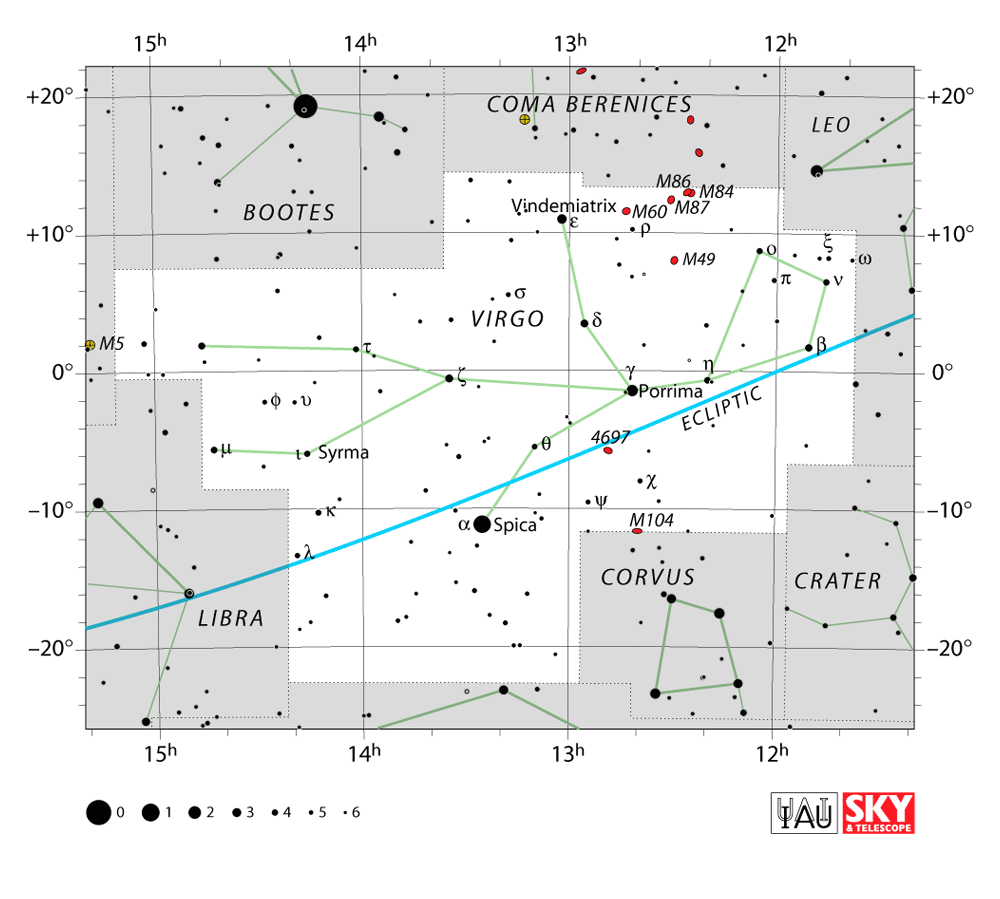
The first image shows NGC 5247, a spiral galaxy dominated by two huge arms, located 60–70 million light-years away. The galaxy lies face-on towards Earth, thus providing an excellent view of its pinwheel structure. It lies in the zodiacal constellation of Virgo (the Maiden).

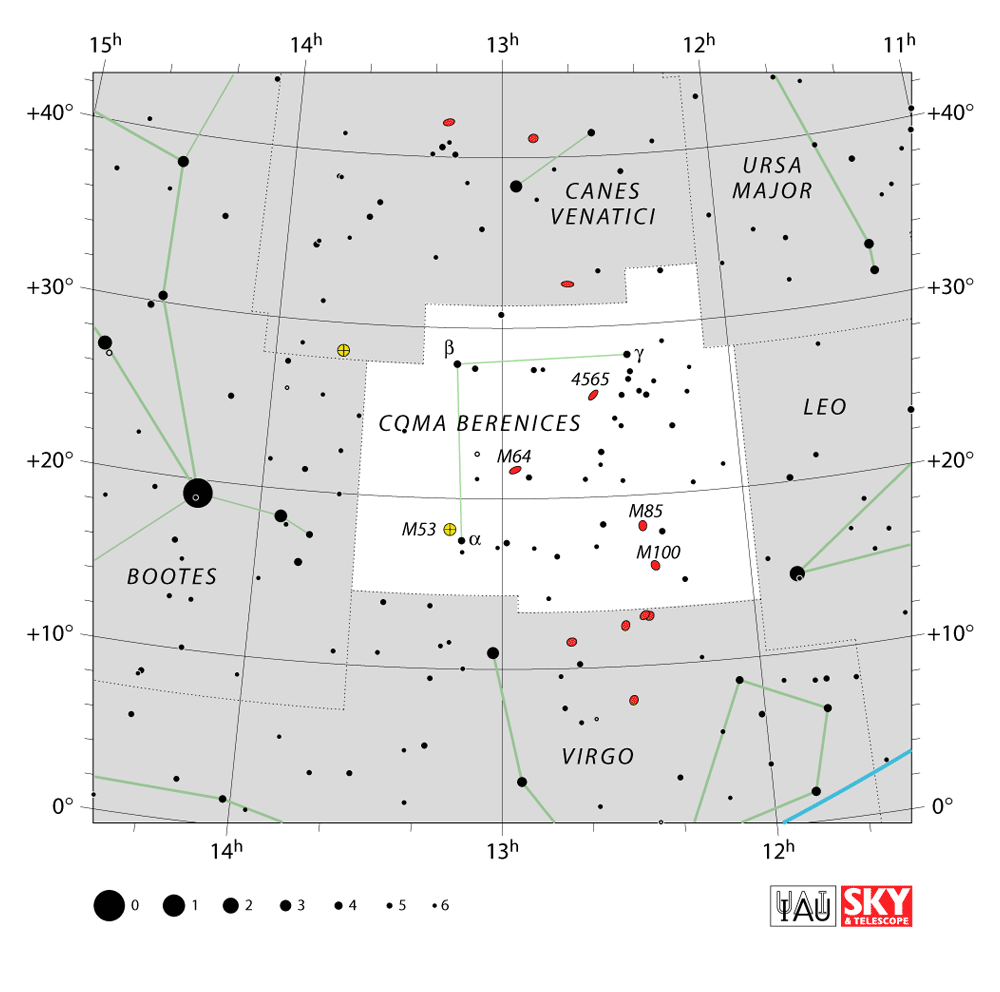
The galaxy in the second image is Messier 100, also known as NGC 4321, which was discovered in the 18th century. It is a fine example of a “grand design” spiral galaxy — a class of galaxies with very prominent and well-defined spiral arms. About 55 million light-years from Earth, Messier 100 is part of the Virgo Cluster of galaxies and lies in the constellation of Coma Berenices (Berenice’s Hair, named after the ancient Egyptian queen Berenice II).

The third image is of NGC 1300, a spiral galaxy with arms extending from the ends of a spectacularly prominent central bar. It is considered a prototypical example of barred spiral galaxies and lies at a distance of about 65 million light-years, in the constellation of Eridanus (the River).

The spiral galaxy in the fourth image, NGC 4030, lies about 75 million light-years from Earth, in the constellation of Virgo. In 2007 Takao Doi, a Japanese astronaut who doubles as an amateur astronomer, spotted a supernova — a stellar explosion that is briefly almost as bright as its host galaxy — going off in this galaxy.

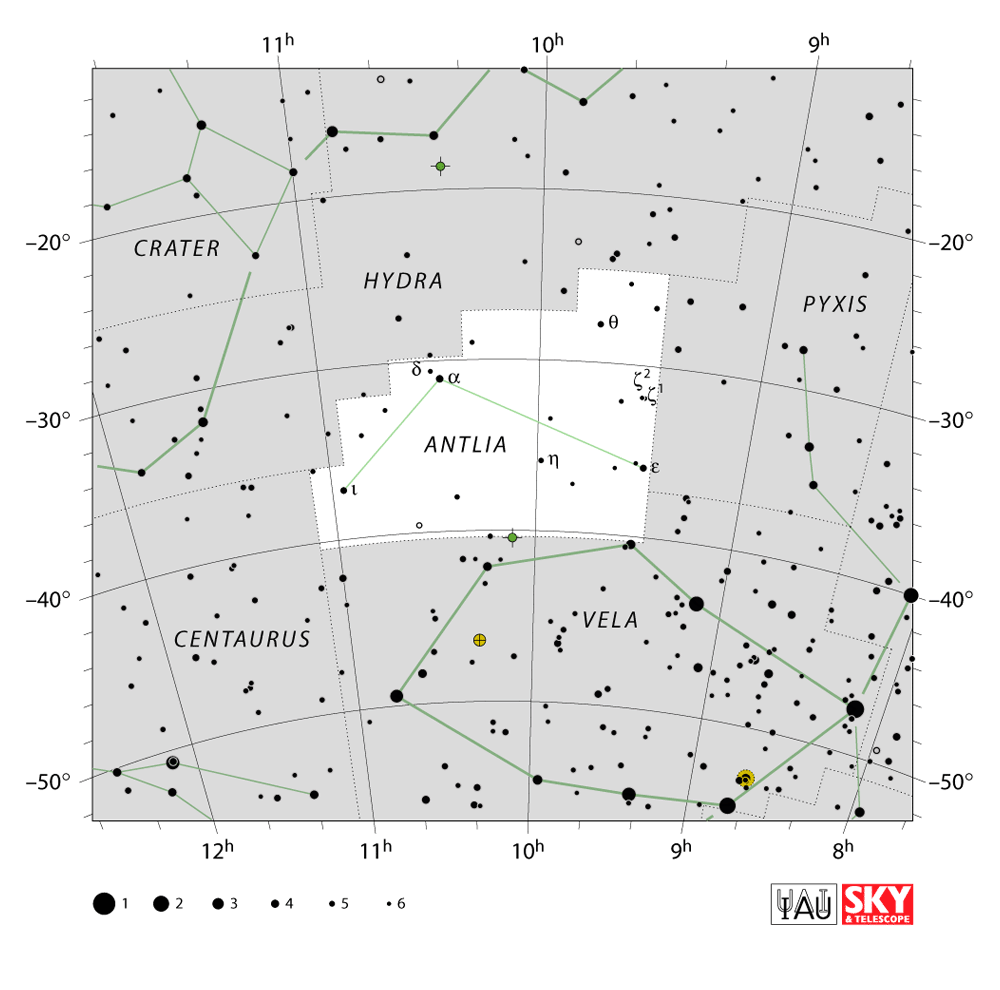
The fifth image, NGC 2997, is a spiral galaxy roughly 30 million light-years away in the constellation of Antlia (the Air Pump). NGC 2997 is the brightest member of a group of galaxies of the same name in the Local Supercluster of galaxies. Our own Local Group, of which the Milky Way is a member, is itself also part of the Local Supercluster.

Last but not least, NGC 1232 is a beautiful galaxy some 65 million light-years away in the constellation of Eridanus (the River). The galaxy is classified as an intermediate spiral galaxy — somewhere between a barred and an unbarred spiral galaxy. An image of this galaxy and its small companion galaxy NGC 1232A in visible light was one of the first produced by the VLT (eso9845). HAWK-I has now returned to NGC 1232 to show a different view of it at near-infrared wavelengths.

As this galactic gallery makes clear, HAWK-I lets us see the spiral structures in these six bright galaxies in exquisite detail and with a clarity that is only made possible by observing in the infrared.

Notes

[1] HAWK-I stands for High-Acuity Wide-field K-band Imager. More technical details about the camera can be found in an earlier press release (eso0736).

[2] More information about the VLT instruments can be found at: http://www.eso.org/public/teles-instr/vlt/vlt-instr.html.

More information


ESO, the European Southern Observatory, is the foremost intergovernmental astronomy organisation in Europe and the world’s most productive astronomical observatory. It is supported by 14 countries: Austria, Belgium, the Czech Republic, Denmark, France, Finland, Germany, Italy, the Netherlands, Portugal, Spain, Sweden, Switzerland and the United Kingdom. ESO carries out an ambitious programme focused on the design, construction and operation of powerful ground-based observing facilities enabling astronomers to make important scientific discoveries. ESO also plays a leading role in promoting and organising cooperation in astronomical research. ESO operates three unique world-class observing sites in Chile: La Silla, Paranal and Chajnantor. At Paranal, ESO operates the Very Large Telescope, the world’s most advanced visible-light astronomical observatory and VISTA, the world’s largest survey telescope. ESO is the European partner of a revolutionary astronomical telescope ALMA, the largest astronomical project in existence. ESO is currently planning a 42-metre European Extremely Large optical/near-infrared Telescope, the E-ELT, which will become “the world’s biggest eye on the sky”.

Contacts

Richard Hook
ESO, La Silla, Paranal, E-ELT and Survey telescopes Public Information Officer
Garching, Germany
Tel: +49 89 3200 6655
Cell: +49 151 1537 3591
Email: rhook@eso.org