Releases from NASA, HubbleSite, Spitzer, ESO, ESA, NASA’s Chandra X-ray Observatory, Royal Astronomical Society, Harvard-Smithsonian Center For Astrophysics, Max Planck Institute, Gemini Observatory, Subaru Telescope, W. M. Keck Observatory, JPL-Caltech, ICRAR, Webb Space Telescope, etc
Showing posts with label Stellar Cluster. Show all posts
Showing posts with label Stellar Cluster. Show all posts
This composite image shows in the RCW 38 stellar cluster in different wavelengths. In red are the X-rays from
young, hot stars and extended hot gas as imaged by Chandra, embedded in a molecular cloud (green) imaged in infrared by the ISAAC camera, and a ring of radio emission (blue) detected by ATCA from a region of gas heated by the radiation from the hot stars in the cluster. Image credit: NASA/CXC/CfA/S.Wolk et al./ISAAC/VLT/ATCA -Download Image
During the past week, NuSTAR observed RCW 38, a gigantic star-forming region full of young massive stars, each dozens of times heavier than the Sun. These stars blast out powerful winds—streams of hot, ionized gas—at speeds of up to 2000 km/s, releasing energy over their lifetimes comparable to a supernova explosion. Where many such stars are packed together, their winds collide with each other and create powerful shocks, which can accelerate atomic particles to extremely high energies—a possible source of cosmic rays. RCW 38 is especially interesting: it is compact, young (less than a million years old), and apparently free of any supernova explosions. This makes it a rare place to study the effects of stellar winds alone, without other contaminants. Past observations detected X-rays from RCW 38, but were not able to distinguish whether they came from hot gas or accelerated particles. NuSTAR's unique ability to focus high-energy X-rays will help tell the two apart, and the first NuSTAR observation of RCW 38 may be a step toward that answer.
Author: Haruki Kuramoto (PhD Student, University of Osaka, Japan)
Credit: X-ray: NASA/CXC; Infrared: ESA/Webb, NASA & CSA, P. Zeilder, E.Sabbi, A. Nota, M. Zamani; Image Processing: NASA/CXC/SAO/L. Frattare and K. Arcand
Since antiquity, wreaths have symbolized the cycle of life, death,
and rebirth. It is fitting then that one of the best places for
astronomers to learn more about the stellar lifecycle resembles a giant
holiday wreath itself.
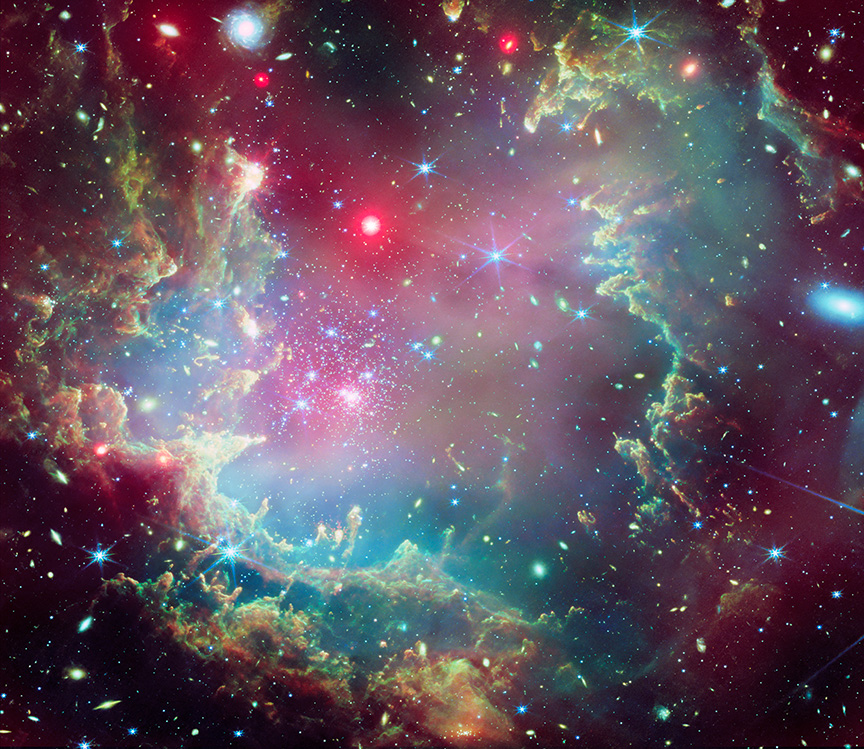
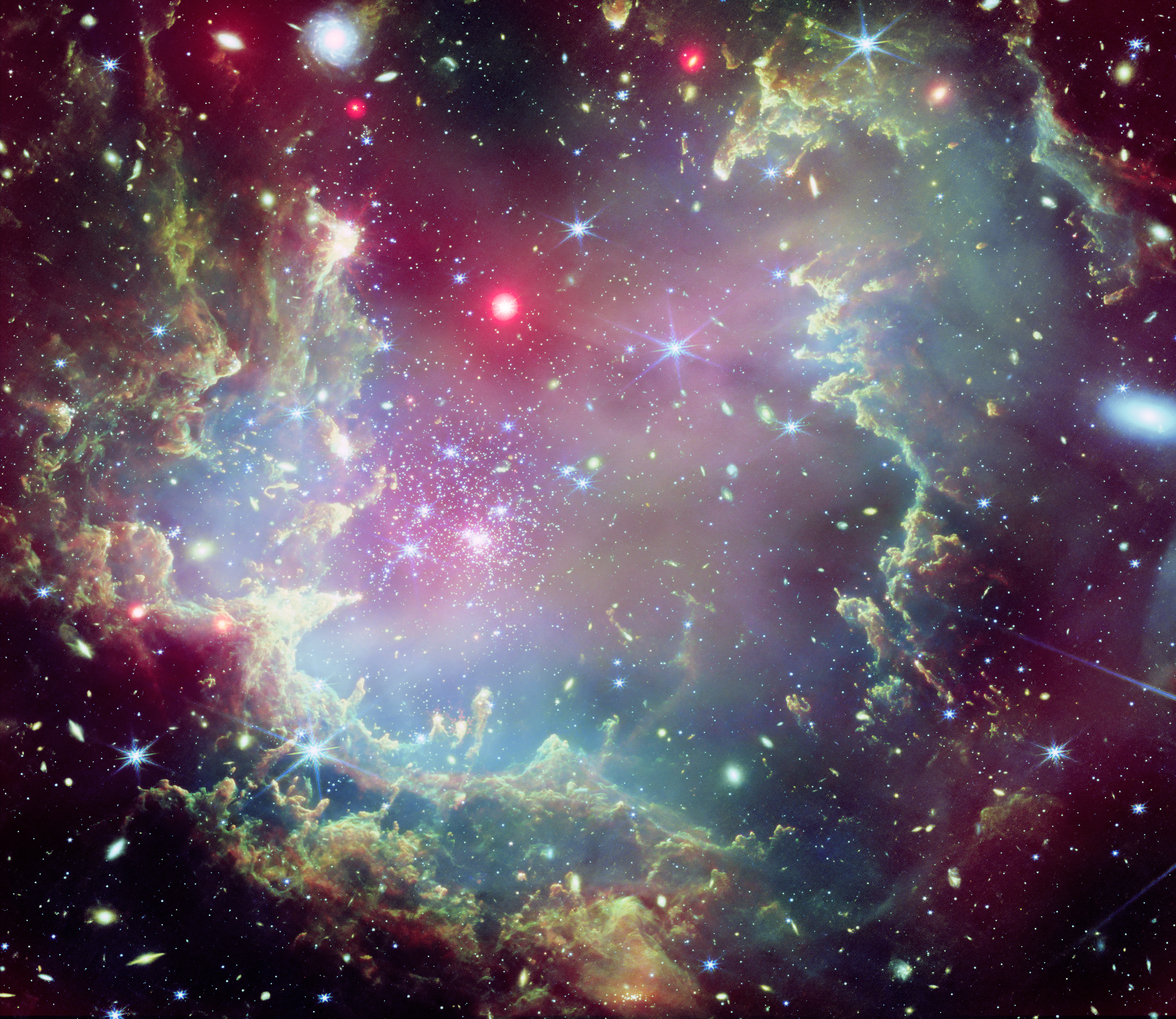
The star cluster NGC 602 lies on the outskirts of the Small Magellanic Cloud, which is one of the closest galaxies to the Milky Way, about 200,000 light-years from Earth. The stars in NGC 602 have fewer heavier elements compared to the Sun and most of the rest of the galaxy. Instead, the
conditions within NGC 602 mimic those for stars found billions of years
ago when the universe was much younger.
This new image combines data from NASA’s Chandra X-ray Observatory with a previously released image from the agency’s James Webb Space Telescope.
The dark ring-like outline of the wreath seen in Webb data (represented
as orange, yellow, green, and blue) is made up of dense clouds of
filled dust.
Meanwhile, X-rays from Chandra (red) show young, massive stars that are illuminating the wreath, sending high-energy light into interstellar space.
These X-rays are powered by winds flowing from the young, massive stars
that are sprinkled throughout the cluster. The extended cloud in the
Chandra data likely comes from the overlapping X-ray glow of thousands
of young, low-mass stars in the cluster.
NGC 2264, the “Christmas Tree Cluster”
Credit: X-ray: NASA/CXC/SAO; Optical: Clow, M.; Image Processing: NASA/CXC/SAO/L. Frattare and K. Arcand); View Animated Version
In addition to this cosmic wreath, a new version of the “Christmas tree cluster” is also now available. Like NGC 602, NGC 2264 is a cluster of young stars between one and five million years old. (For comparison, the Sun is a middle-aged star about 5 billion years old — about 1,000 times older.) In this image of NGC 2264, which is much closer than NGC 602 at a distance of about 2,500 light-years from Earth, Chandra data (red, purple, blue, and white) has been combined with optical data (green and violet) captured from by astrophotographer Michael Clow from his telescope in Arizona in November 2024.
NASA's Marshall Space Flight Center in Huntsville, Alabama, manages the Chandra program. The Smithsonian Astrophysical Observatory's Chandra X-ray Center controls science operations from Cambridge, Massachusetts, and flight operations from Burlington, Massachusetts.
This release includes two composite images, each featuring a star cluster that strongly resembles holiday greenery.
The first image depicts star cluster NGC 602 in vibrant and festive colors. The cluster includes a giant dust cloud ring, shown in greens, yellows, blues, and oranges. The green hues and feathery edges of the ring cloud create the appearance of a wreath made of evergreen boughs. Hints of red representing X-rays provide shading, highlighting layers within the wreath-like ring cloud.
The image is aglow with specks and dots of colorful, festive light, in blues, golds, whites, oranges, and reds. These lights represent stars within the cluster. Some of the lights gleam with diffraction spikes, while others emit a warm, diffuse glow. Upon closer inspection, many of the glowing specks have spiraling arms, indicating that they are, in fact, distant galaxies.
The second image in today's release is a new depiction of NGC 2264, known as the "Christmas Tree Cluster". Here, wispy green clouds in a conical shape strongly resemble an evergreen tree. Tiny specks of white, blue, purple, and red light, stars within the cluster, dot the structure, turning the cloud into a festive, cosmic Christmas tree!
Fast Facts for NGC 602:
Credit: X-ray: NASA/CXC; Infrared: ESA/Webb, NASA & CSA, P. Zeilder, E.Sabbi, A. Nota, M. Zamani; Image Processing: NASA/CXC/SAO/L. Frattare and K. Arcand Scale: Image is about 3 arcmin (175 light-years) across. Category: Normal Stars & Star Clusters Coordinates (J2000): RA 01h 29m 28.7s | Dec -73° 33´ 40.8" Constellation:Hydrus Observation Dates: 11 pointings between 31 March and 29 April, 2010 Observation Time: 80 hours 45 minutes (3 days 8 hours 45 minutes) Obs. ID: 10985-10986, 11978-11979, 11988-11989, 12130-12131, 12134, 12136, 12207 Instrument:ACIS References: Oskinova, L. et al, 2013, ApJ, 765 73;arXiv:1301.3500 Color Code: X-ray: red; Infrared: orange, yellow, green, and blue Distance Estimate: About 200,000 light-years
Fast Facts for NGC 2264:
Credit: X-ray: NASA/CXC/SAO; Optical: Clow, M.; Image Processing: NASA/CXC/SAO/L. Frattare and K. Arcand Scale: Image is about 77 arcmin (56 light-years) across. Category:Normal Stars & Star Clusters Coordinates (J2000): RA: 06h 40m 42.8s | Dec: +09° 49' 3.6" Constellation:Monoceros Observation Dates: 8 observations from February 2002 to December 2011 Observation Time: 137 hours 26 minutes ( 5 days 17 hours 26 mintues)
Obs. IDs: 2540, 2550, 9768, 9769, 13610, 13611, 14368, 14369 Instrument:ACIS References: Ramirez, S.V., et al., 2004, AJ, 127,2659;arXiv:astro-ph:0401533 Color Code: X-ray: red, green, and blue; Optical: green and white Distance Estimate: About 2,500 light-years
The largest gravitationally bound structures in the universe are galaxy clusters — hundreds to thousands of individual galaxies bound together by gravity and surrounded by dark matter and gas. Lurking at the center of these galaxy clusters are the brightest galaxies in the universe: the aptly named brightest cluster galaxies (BCGs).
Because BCGs are right at the center of their galaxy cluster’s gravitational field, the clusters themselves act like a well, funneling new material onto the BCGs. This means that BCGs grow very large, and the evolution of the BCG is intimately linked to the evolution of the full galaxy cluster. Traditionally, it has been thought that the clusters feed the BCG with other galaxies full of pre-made stars (this mechanism is referred to as, no joke, galactic cannibalism — here’s a video on the topic). However, many BCGs have been observed to actively grow new stars. In these cases, it seems like the cluster is feeding free-floating gas known as the intracluster medium (ICM) to the BCG. This ICM contains the ingredients for star formation (mostly hydrogen gas), and the BCG can process these ingredients into new stars itself.
Going with the Flow
In order for this second type of BCG growth to be happening, the galaxy cluster needs to obey some fairly specific criteria. There needs to be one specific BCG in the cluster, and it needs to be sitting at the center of the cluster’s gravitational field, in order to direct the ICM onto the BCG. The cluster itself also needs to be large enough to have a lot of concentrated ICM, and old enough that a lot of the initial heat (kinetic energy) in the ICM has had time to escape (if not, it will be moving around too fast to get caught by the BCG’s gravity). These types of clusters are known as “cool-core” clusters, and the flow of ICM onto the BCG is known as a “cooling flow.” All of these things typically happen naturally in clusters, but they all require time, so they’re far more common in much older clusters at times much closer to the present day. These clusters are called “relaxed.” That’s what makes today’s article so exciting — the authors of this article have found a relaxed cluster funneling material onto its BCG at redshift 1.16 (only about 5.3 billion years after the Big Bang). This is the earliest example of such a cluster found to date — so this cluster must have relaxed faster than previously thought possible.
Figure 1: Some of the wide variety of observations required to study this galaxy cluster. Clockwise from the top left, they are: the ASKAP radio observations showing the active galactic nucleus, the Chandra X-ray observations showing the ICM, a Hubble composite image showing the cluster, and zoom-ins on the BCG in optical and ultraviolet wavelengths (respectively), also from Hubble. Credit: Calzadilla et al. 2023
The Picture(s) of Relaxation
This cluster, known as SPT-CL J2215-3537, or SPT2215, was originally found using the Sunyaev–Zeldovich effect in a South Pole Telescope survey. Optical and ultraviolet imaging (Figure 1) from the Hubble Space Telescope and the Magellan Telescopes were used to find the galaxies associated with the cluster, and optical spectroscopy from Magellan was used to make sure that the galaxies were all associated with the cluster in all three dimensions. This optical spectroscopy also measured the distance to the cluster, using redshifting of spectral lines, and therefore confirmed that we’re observing this cluster earlier in the universe’s history than any other cluster of its kind. A faint radio-wavelength source (probably an active galactic nucleus) was also found to be associated with the cluster using the Australian Square Kilometre Array Pathfinder (ASKAP) (Figure 1).
Figure 2: The temperature profile of the ICM of the galaxy cluster, measured from the X-ray observations shown in Figure 1. The temperature is shown in energy units, because in this case it’s essentially a measure of the kinetic energy of the gas. The grey line shows the actual data points, and the green region is a fit to a known model of the temperature profile in cool-core clusters. Adapted from Calzadilla et al. 2023
A Cool Customer
The ICM is very diffuse, and it isn’t typically visible in optical or ultraviolet measurements. In order to measure this cluster’s ICM properties, the authors had to take observations using the Chandra X-ray Observatory. From this, they noticed that the ICM is distributed extremely regularly in the cluster, and that the ICM’s luminosity peaks very strongly in the center. As mentioned above, both of these characteristics are good indicators that the cluster is relaxed. The authors also measured the spectrum of the X-rays in order to determine the temperature of the ICM. By measuring different X-ray spectra at different distances from the center of the cluster, the authors developed a temperature profile (Figure 2). This showed that the ICM in the middle of the cluster in particular had a very low temperature, making it a cool-core cluster. Filaments of gas are also visible surrounding the BCG in the ultraviolet imaging from Hubble, suggesting that ICM is indeed falling onto the BCG.
Relaxed, but Working Hard
Finally, the authors measured the spectral energy distribution of the BCG itself (Figure 3). This is a technique where the amount of light emitted from a galaxy is measured at as many different wavelengths as possible, and then the luminosity at these different wavelengths is compared. Different components of a galaxy (such as new stars, old stars, or gas) emit light at different wavelengths, so scientists can estimate how fast a galaxy forms stars by fitting measurements to models of these different components. In this case, the authors used the Hubble and Magellan measurements mentioned above (at optical and ultraviolet wavelengths), additional near-infrared Magellan measurements, and far-infrared (very long-wavelength) Spitzer Space Telescope observations to construct their spectral energy distribution. From the spectral energy distribution, they determined that the BCG in this cluster was forming 320 solar masses of new stars every year (about 300 times the Milky Way’s rate)!
Figure 3: The spectral energy distribution of the BCG inside SPT2215. The blue points show the observed values for this galaxy, and the red points show the model that was fit to these values. Using this technique, the authors determined that the BCG is forming stars at a much higher rate than expected. Credit: Calzadilla et al. 2023
All of this evidence seems to point to a BCG forming stars out of fuel from the cluster itself. If this is the case, this will be the earliest ever example of such a cluster, and it has some pretty exciting implications. The authors suggest that clusters relaxing this quickly may have a totally separate mechanism for BCG formation, independent from the cannibalism-driven growth we expect. It also implies that active galactic nuclei (such as the one seen in the ASKAP imaging of this cluster in Figure 1) could start powering on earlier than expected, feeding energy back into the BCG and the cluster and disrupting star formation. The authors are working with more X-ray observations to characterize the physics of this cluster more precisely, and hopefully figure out some of the specifics of these implications.
I’m a PhD student at Caltech, where I study how galaxies form and evolve by mapping their molecular gas! I do this using COMAP, a radio-frequency Line Intensity Mapping experiment based in California’s Owens Valley.
Image credit: ESA/Hubble & NASA, J. Kalirai, A. Milone
Text credit: European Space Agency (ESA).Hi-res image
This image taken with the NASA/ESA Hubble Space Telescope depicts the open star cluster NGC 330, which lies around 180,000 light-years away inside the Small Magellanic Cloud. The cluster – which is in the constellation Tucana (the Toucan) – contains a multitude of stars, many of which are scattered across this striking image.
Because star clusters form from a single primordial cloud of gas and dust, all the stars they contain are roughly the same age. This makes them useful natural laboratories for astronomers to learn how stars form and evolve. This image uses observations from Hubble’s Wide Field Camera 3 and incorporates data from two very different astronomical investigations. The first aimed to understand why stars in star clusters appear to evolve differently from stars elsewhere, a peculiarity first observed with Hubble. The second aimed to determine how large stars can be before they become doomed to end their lives in cataclysmic supernova explosions.
Hubble images show us something new about the universe. This image, however, also contains clues about the inner workings of Hubble itself. The crisscross patterns surrounding the stars in this image, known as diffraction spikes, were created when starlight interacted with the four thin vanes supporting Hubble’s secondary mirror.
 young, hot stars and extended hot gas as imaged by Chandra, embedded in a molecular cloud (green) imaged in infrared by the ISAAC camera, and a ring of radio emission (blue) detected by ATCA from a region of gas heated by the radiation from the hot stars in the cluster. Image credit: NASA/CXC/CfA/S.Wolk et al./ISAAC/VLT/ATCA - Download Image