Showing posts with label NGC 4151. Show all posts

Tuesday, October 13, 2026

Chandra & Swift: Celebrating NASA's Chandra and Swift Exploring Space Together

>
SMC - NGC 1097 - NGC 4151 - NGC 1365
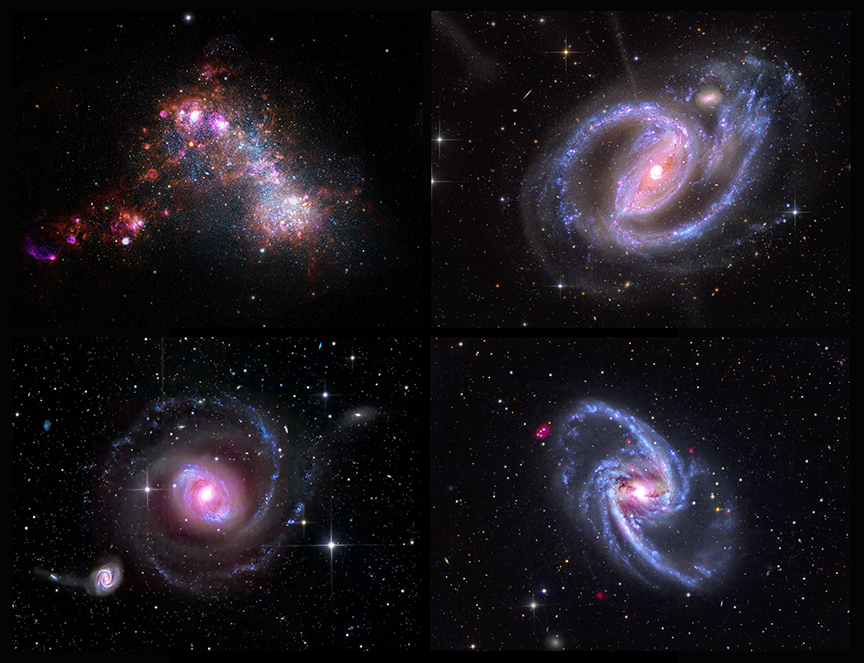
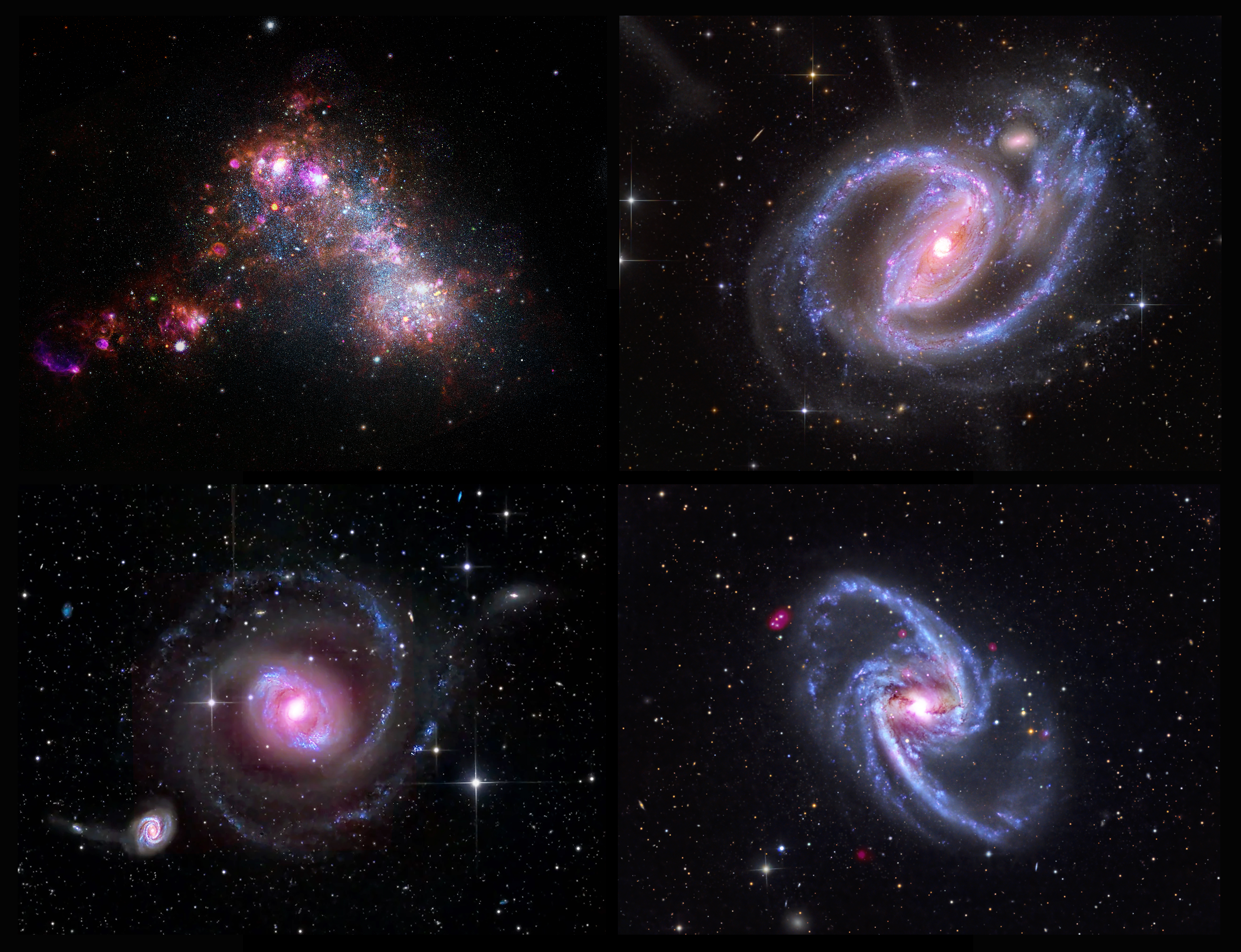
Chandra & Swift Galaxy Image Collection, Unlabeled.
Credit: NASA/CXC/SAO


JPEG (530.6 kb) - Large JPEG (12.1 MB) - Tiff (29.3 MB) - More Images

A Quick Look: Celebrating NASA's Chandra and Swift Exploring Space Together - More Videos


  • To help commemorate NASA’s Neil Gehrels Swift Observatory, four composite images are being released.

  • Swift, launched in 2004, can quickly observe changing events in space in ultraviolet, X-ray, and gamma-ray light.

  • NASA’s Chandra X-ray Observatory frequently worked in tandem with Swift to study mysterious objects and phenomena.
  • .
  • These new Chandra/Swift images include a view of the Small Magellanic Cloud, NGC 1097, NGC 4151, and NGC 1365.


As NASA’s Neil Gehrels Swift Observatory nears its final days in orbit, it is an excellent opportunity to celebrate this telescope and its place in NASA’s fleet of eyes on the universe.

NASA’s Chandra X-ray Observatory is one of the many telescopes that frequently teamed up with Swift to make important discoveries about the cosmos. Chandra and Swift have complementary abilities. While Swift can quickly capture rapidly-changing events in space in ultraviolet, X-ray, and gamma-ray light, Chandra is able to gather more detailed data with its sharp X-ray vision. When combined, these two telescopes helped provide a more complete picture of events and objects in space than either could alone.

This new image collection is just a sample of the many cosmic objects that Chandra and Swift have both observed in the pursuit of learning more about the mysteries of space

SMC - NGC 1097 - NGC 4151 - NGC 1365 (Labeled)
Chandra & Swift Galaxy Image Collection, Labeled.
Credit: NASA/CXC/SAO

Top left: The Small Magellanic Cloud (SMC) is one of the Milky Way’s closest galactic neighbors, and orbits around our home galaxy, at a distance of about 200,000 light-years from Earth. This new view of the SMC contains a multitude of layers of light including ultraviolet data from Swift (magenta and cyan), X-rays from the Chandra X-ray Observatory and ESA’s XMM-Newton (red, green and navy), infrared data from NASA’s retired Spitzer Space Telescope and ESA’s Herschel Space Observatory (orange), and optical data the Cerro Tololo Inter-American Observatory in Chile (pink, peach and purple).

Top right: NGC 1097 is a spiral galaxy about 48 million light-years from Earth that contains a supermassive black hole about 140 million times more massive than our Sun. The region around the black hole glows brightly in X-rays as material nearing the black hole is heated to millions of degrees. In this combined view, X-rays from Chandra (yellow and orange) have been combined with ultraviolet data from Swift (blue) along with an optical light image from Hubble and a ground-based telescope (red, green, and blue).

Bottom left: NGC 4151 is also a spiral galaxy with an actively-growing supermassive black hole at its center. The X-ray emission detected by Chandra (orange) has been attributed to an outburst powered by the black hole. Ultraviolet data and X-ray light detected by Swift (magenta) has been combined with the Chandra data and added to an optical light image taken from the ground by an astrophotographer.

Bottom right: There is another growing giant hole at the center of the galaxy NGC 1365. Astronomers call these very bright cores “active galactic nuclei” (or AGN), which are fueled by a steady flow of material streaming onto the black hole. In this composite, there are X-rays from Chandra (purple) and Swift (magenta), ultraviolet data from Swift (teal), and an optical light image from a ground-based telescope.

NASA's Marshall Space Flight Center in Huntsville, Alabama, manages the Chandra program. The Smithsonian Astrophysical Observatory's Chandra X-ray Center controls science operations from Cambridge, Massachusetts, and flight operations from Burlington, Massachusetts.


Visual Description:

Small Magellanic Cloud (SMC)

A multilayered, composite image of the Small Magellanic Cloud, which resembles a highly detailed splatter painting. Here, splashes of burnt orange, neon purple, cyan blue, and brilliant white, in flecks ranging from minuscule pinpricks to fat smears, form a cloud roughly shaped like an upside-down letter V.

NGC 1097
A bright, composite image of spiral galaxy NGC 1097, viewed face on. The galaxy has gleaming cyan blue and neon purple arms spiraling around a central black hole, which is awash in glowing yellow X-ray light. At our upper right, the ends of the neatly corkscrewing arms are diffused, spread around a neighboring satellite galaxy.

NGC 4151
A brilliantly crisp composite image of spiral galaxy NGC 4151, viewed face on. The galaxy has a bright, golden orange and purple core with spiraling neon blue arms that are tight around the actively growing supermassive black hole at the center, but spread and grow wispy as they extend outward. At our lower left is a second spiral galaxy, NGC 4156, which appears small by comparison, and whose colorful, tightly wound arms give it the appearance of a swirly lollipop.

NGC 1365
A composite image of spiral galaxy NGC 1365, viewed face on. The galaxy has a glowing pale-yellow core at its center, surrounded by a muddle of clouds in various shades of purple. Extending out of this dense core are cloudy, light blue arms, which spiral outwards in an oval shape, stretching toward our upper left and lower right.


Fast Facts for Small Magellanic Cloud (SMC):

Credit: X-ray: NASA/CXC/SAO and ESA/XMM-Newton; UV: NASA/Penn State Univ/Swift and NASA/CAS/CNES/John Hoplins Univ. Applied Physics Laboratory; Optical: NOIRLab/NSF/AURA/MCELS Team/Middlebury College/F. Winkler; Infrared: ESA/NASA/JPL-CalTech/STScI; Image Processing: NASA/CXC/SAO/L. Frattare
Release Date: October 8, 2026
Scale: Image is about 329 arcmin (19,000 light-years) across.
Category:
Normal Galaxies & Starburst Galaxies
Coordinates (J2000): RA: 00h 52m 44.8s | Dec: -72° 49' 43"
Constellation:
Tucana and Hydrus
Observation Date(s): 22 observations from Dec 2012 to Mar 2014
Observation Time: 265 hours and 19 minutes (11 days 1 hour 19 minutes)
Obs. IDs: 14665-14674, 15498-15507, 16367, 16490
Instrument:
ACIS
Color Code: X-ray: red, green, and blue; UV: magenta, green, and cyan; Optical: orange, green, blue, and magenta; Infrared: red, green, and blue
Distance Estimate: About 200,000 light-years from Earth


Fast Facts for NGC 1097:

Credit: X-ray: NASA/CXC/SAO; UV: NASA/Penn State Univ./Swift; Optical: Mark Hanson; Image Processing: NASA/CXC/SAO/L. Frattare
Release Date: October 8, 2026
Scale: Image is about 33.4 arcmin (440,000 light-years) across.
Category:
Normal Galaxies & Starburst Galaxies
Coordinates (J2000): RA: 2h 46m 19.1s | Dec: -30° 16' 29.6"
Constellation:
Fornax
Observation Date(s): 7 observations from Jan 2001 to May 2025
Observation Time: 19 hours 32 minutes
Obs. IDs: 1611, 2339, 29637, 30142, 30937, 30938, 30948
Instrument:
ACIS
Color Code: X-ray: red, green, and blue; UV: blue; Optical: red, green, and blue
Distance Estimate: About 45 million light-years from Earth


Fast Facts for NGC 4151:

Credit: X-ray: NASA/CXC/SAO; UV: NASA/Penn State Univ./Swift; Optical: Mark Hanson; Image Processing: NASA/CXC/SAO/L. Frattare
Release Date: October 8, 2026
Scale: Image is about 20 arcmin (300,000 light-years) across.
Category:
Normal Galaxies & Starburst Galaxies
Coordinates (J2000): RA: 12h 10m 32.60s | Dec: +39° 24' 20.40"
Constellation:
Canes Venatici
Observation Date(s): March 27th and 29th, 2008
Observation Time: 50 hours 31 minutes (2 days 2 hours 31 min)
Obs. IDs: 9217, 9218
Instrument:
ACIS
Color Code: X-ray: magenta; UV: blue; Optical: red, green, and blue
Distance Estimate: About 51 million light-years from Earth


Fast Facts for NGC 1365:

Credit: X-ray: NASA/CXC/SAO; UV: NASA/Penn State Univ/Swift; Optical:Armen Akopian; Image Processing: NASA/CXC/SAO/L. Frattare
Release Date: October 8, 2026
Scale: Image is about 3.25 arcmin (53,000 light-years) across.
Category:
Normal Galaxies & Starburst Galaxies
Coordinates (J2000): RA: 3h 33m 36.4s | Dec: -36° 08′ 24.7"
Constellation: Fornax
Observation Date(s): 22 observations from Dec 2002, to May 2021
Observation Time: 164 hours 50 minutes (6 days 20 hours 50 minutes)
Obs. IDs: 3554, 6868-6873, 13920, 13921, 24737, 24787-24795, 25015, 25024, 25036
Instrument:
ACIS
Color Code: X-ray: magenta; UV: red, green, and blue; Optical: red, green, and blue
Distance Estimate: About 56 million light-years from Earth


Saturday, May 30, 2026

I Spy with My Large Binocular Eyes: A Dusty Torus Around a Supermassive Black Hole?

Hubble Space Telescope image of the active galaxy NGC 4151.
Credit:
NASA, ESA, Joseph DePasquale (STScI)

Authors: Jacob W. Isbell et al.
First Author’s Institution: University of Arizona
Status: Published in ApJ


At the centre of nearly every galaxy lies a supermassive black hole that dominates this innermost region. Not only is there this millions-of-solar-masses dark beast, but usually too a whole bunch of stuff — stars, gas, dust, and more — which is often quite bright! When there is plenty of this material quite close to the black hole, we believe physics takes control to flatten it into a family of disk and toroidal structures in what we call the unified model of active galactic nuclei (AGNs; see Figure 1).

Figure 1: The unified model of AGNs asserts that there is an inner accretion disk, surrounded by a dusty torus that cohabitates with clouds moving at different velocities (the so-called broad and narrow line regions), and sometimes even relativistic jets extending from the accretion disk to galactic scales;
you can read more about AGN structure in this Astrobites guide. Credit:  Emma Alexander; CC BY 4.0

When astronomers look at different active galaxies (read: galaxies with active supermassive black holes at their core), we see a range of phenomenologies related to their brightness, spectra, morphologies, and more. The unified model of AGNs seeks to explain these different AGN appearances simultaneously by positing that they all have the same physical structure, and we are just viewing them from different angles, hence seeing different features.

The cores of AGNs are often imaged at the smallest scales (e.g., their accretion disks, viewed with interferometers like the Very Large Telescope Interferometer) and the largest scales (e.g., their relativistic jets, viewed with radio interferometers), but comparatively less effort has gone to directly observing the predicted dusty tori in the mid-infrared. That is exactly what today’s authors set out to do using the Large Binocular Telescope Interferometer (LBTI) — a pair of 8.4-metre-aperture mirrors separated by just over 14 metres and combined to simulate a telescope effectively 29 metres wide. This lets astronomers take direct images at a much higher resolution than a smaller-aperture telescope, and hence directly peer into the region around AGNs where this dusty torus should lie.

Today’s authors turn the LBTI towards NGC 4151, a medium-luminosity AGN. With the large effective aperture of the LBTI, they were able to resolve scales in the AGN region as small as 4.4–9.1 pc, about 14–30 light-years depending on the wavelength (see Figure 2), in the mid-infrared. These observations revealed warm dust emission in a complex structure around the central supermassive black hole. The authors note a central bar at all wavelengths, with a significant extension of cool dust arcing to the west (right in the image) and warmer dust localised to the centre (as evident by 3.7- and 4.8-micron emission only nearest to the supermassive black hole and its accretion disk).

Figure 2: The deconvolved images of the AGN core of NGC 4151 show a very bright central source (the innermost region around the supermassive black hole), as well as some complex surrounding structure particularly at long wavelengths. The interpreted morphology is described in Figure 3. These images are deconvolved, meaning that known optical effects are corrected for on the raw data to produce a sharper image. Adapted from Isbell et al. 2026


To explain the observed morphology in Figure 1, the authors compare three different interpretations based on this new high-resolution imagery together with the results of previous studies looking at other scales and the spectrum of the AGN core. Each interpretation is illustrated and briefed in Figure 3.

Figure 3: Three interpretations of the observed morphology are presented by the authors. The left panel illustrates the different regions surrounding the supermassive black hole (together with the results of other studies cited in the article). The right panel shows the suggested interpretations explaining the morphology. Credit: Isbell et al. 2026


The first interpretation is in keeping with the unified model of AGNs: a geometrically and optically thick torus of dust surrounds the inner region. In this interpretation, the surface of the dusty torus re-radiates light from the accretion disk to produce most of the mid-infrared emission. Additional mid-infrared emission could come from localised concentrations of gas or interactions between the outflow and the jet. The authors immediately disfavour this explanation, as other studies have shown bright ionised emission at the location of the would-be torus, which is not expected if an optically thick torus were to be present. Hence, these new observations somewhat challenge the one “flavour” of the unified model of AGNs.

The second interpretation aligns with a different version of the unified model: one in which a geometrically thin disk replaces a thick torus around the AGN core. Provided the disk is optically thin too, the authors favour this approach as it is consistent with the geometry of ionised emission that worked against the first interpretation. While other studies suggest that this thin disk should be optically thick, this morphology is at least better aligned with what we see in other AGNs.

The third interpretation suggests that the emission comes from only the radiation pressure–driven wind emanating from the AGN core. The authors disfavour this explanation, citing previous radiative transfer simulations that show that the flux should fall off with distance from the core too quickly to be consistent with the observations.

No matter the interpretation, these LBTI observations are an important glimpse into the future of mid-infrared AGN studies that will be done with 30-metre-class telescopes (such as the European Southern Observatory’s Extremely Large Telescope). This article, together with the group’s similar study on NGC 1068, is challenging and refining an accepted view of AGN morphology — the consequences of which apply to galaxies near and far — and poses new questions perfect for sophisticated hydrodynamic and radiative simulations.

Original astrobite edited by Margaret Verrico.


About the author, Ryan White:

I am a first-year PhD student at Macquarie University in Australia, working mainly on binary/multiple systems with massive stars (Wolf–Rayets in particular!). Outside of study, I’m probably drinking coffee, baking, reading, or going for a run. You can also find me procrastinating on Bluesky @astroryan.bsky.social.


Editor’s Note: Astrobites is a graduate-student-run organization that digests astrophysical literature for undergraduate students. As part of the partnership between the AAS and astrobites, we occasionally repost astrobites content here at AAS Nova. We hope you enjoy this post from astrobites; the original can be viewed at    astrobites.org.


Monday, January 13, 2025

Seeing an Active Galactic Nucleus with 20/20 X-Ray Vision with XRISM

This multiwavelength image shows X-rays (blue), optical light (yellow), and radio waves (red) from the galaxy NGC 4151, which hosts an active galactic nucleus. Credit:
X-ray: NASA/CXC/CfA/J.Wang et al.; Optical: Isaac Newton Group of Telescopes, La Palma/Jacobus Kapteyn Telescope, Radio: NSF/NRAO/VLA

Title: XRISM Spectroscopy of the Fe Kα Emission Line in the Seyfert Active Galactic Nucleus NGC 4151 Reveals the Disk, Broad-line Region, and Torus
Authors: XRISM Collaboration
Status: Published in ApJL

Today we’re going to be taking a high-resolution look at X-rays from close to a supermassive black hole! But before we get into the astrophysics of today’s article, we first need to discuss the instruments that were built to do this science. More than 50 years ago now, charge-coupled devices (CCDs) began revolutionizing astronomy, and they continue to be one of the most commonly used detectors on telescopes. CCDs rely on the photoelectric effect, through which an incoming photon can liberate electrons in some material (semiconductors in the case of CCDs). These electrons are trapped by strong potential wells and electric charge can be applied to move the charge along and read this signal (check out this Astrobite for more details). CCDs are particularly powerful in the X-ray band, where the number of electrons trapped in each pixel scales roughly with the photon energy. This means that you get energy information (i.e., a spectrum) for free with CCDs! However, CCDs have limited spectral resolution, meaning they can’t determine this energy very precisely and therefore cannot resolve and unlock the power of narrow emission and absorption lines.

Figure 1: Schematic showing how a microcalorimeter works. An X-ray photon with energy E will produce a spike in the temperature of the absorber of E/C, where C is the heat capacity of the absorber. The thermometer is extremely sensitive to small changes in temperature, which means that we can get very accurate energies for each of the incoming X-ray photons. Therefore, a microcalorimeter can produce an X-ray spectrum with the best energy resolution of any current instrumentation. Credit:
NASA

X-Ray Microcalorimetry and 20/20 Vision

There are other ways to get better spectral resolution in the X-ray, including using gratings that will disperse your spectrum, as is commonly done with optical spectroscopy. However, even these techniques can’t reach the high spectral resolution needed; instead, new technology called a microcalorimeter has been engineered to solve this long-standing issue. As the name suggests, this instrument detects incoming photons by measuring tiny (micro) changes to the temperature (calorimetry) of the detector. Figure 1 shows the basic set-up of a microcalorimeter and how the energy of the photon is encoded in the strength of the resulting temperature fluctuation. In order to detect tiny changes to the temperature, microcalorimeters need to be extremely cold, 50 millikelvin to be precise! This is a huge engineering feat, but one that has recently been achieved by the X-ray Imaging and Spectroscopy Mission (XRISM)! XRISM is a JAXA/NASA collaborative mission, and it has two instruments on board: a CCD camera called Xtend and a microcalorimeter called Resolve. It was launched in September 2023, and its first science results are just starting to roll in!

Now, XRISM isn’t actually the first X-ray microcalorimeter to fly, but it’s the first to live through its commissioning phase! Although the X-ray microcalorimeter has been in the works since the 1990s, previous X-ray microcalorimeters have been cut from missions, lost to launch failures, and left unable to operate due to loss of coolant for the detector. In 2016, JAXA successfully launched and operated the first X-ray microcalorimeter on the Hitomi Satellite. However, unfortunately, shortly after taking a beautiful spectrum of the Perseus Cluster, one of the best-studied galaxy clusters in the local universe, communication was lost with the satellite and never recovered. XRISM’s Resolve instrument has been the most successful X-ray microcalorimeter so far, and it has allowed us to start looking at the universe with 20/20 X-ray vision!

Figure 2: XRISM Resolve spectra of NGC 4151. The left panels show the spectrum in the 5.8-7.2 keV range from two separate observations, with the data in black and the best fit total model in red. The right panels show a zoom in on the iron Kα 6.4 keV line with the three different components for the line also shown. The magenta model corresponds to the widest line, arising potentially from a warped disk, the dark blue model corresponds to the intermediate width line coming from the inner edge of the broad line region (BLR), and the cyan model corresponds to the most narrow line that arises from the inner edge of the dusty torus. Credit: XRISM Collaboration et al. 2024 universe with 20/20 X-ray vision!

Supermassive Science with XRISM

Today we’re going to put on our high-resolution X-ray spectroscopy glasses to look at one of the first XRISM targets: NGC 4151, one of the most well-known active galactic nuclei in the local universe. An active galactic nucleus consists of a supermassive black hole that is gobbling down gas from its surroundings through a process known as accretion. While we’ve known about active galactic nuclei for more than 50 years now, we still don’t really understand how they are fueled and what the structure is around them. XRISM can unlock this information indirectly by resolving some of the key X-ray emission and absorption lines. In particular, the most prominent emission line in the X-ray spectrum of an active galactic nucleus is a neutral iron Kα line at 6.4 kiloelectronvolts (keV), which arises from material around the supermassive black hole being illuminated by the light from the accretion process. This line holds the keys to probing the structure of the surrounding gas, as its dynamics can tell us about the structure of the accretion disk and trace gas in the torus that is thought to connect the local host galaxy to the accretion flow.

Figure 2 shows the XRISM Resolve spectrum of NGC 4151 from two separate observations. The spectrum shows a prominent 6.4 keV line that is resolved, meaning that the measured width of the line is greater than the instrument’s resolution limit. Additionally, the line cannot be fit with a single emission line and instead requires multiple lines, signaling multiple physical scales contributing to this emission line. The right panels of this figure highlight that there are three distinct components to this emission line with broad (magenta), intermediate (dark blue), and narrow (cyan) widths. Since gas that is closer to the black hole will be moving faster than more distant gas, the authors can use these line widths to estimate where this gas is located. They find that these three lines range from about 100 gravitational radii (about 100 times the size of the black hole) to about 10,000 gravitational radii. Determining the multi-scale nature of this line has been extraordinarily difficult to detect with other instruments due to their limited energy resolution!

Together these three components to the iron Kα line provide a compelling picture for the nuclear structure, which is shown in Figure 3. There are some additional pieces of evidence from the data that support this model as well. For example, the broadest line (magenta) shows variability on timescales of less than a day. This timescale corresponds roughly to the distance light could travel before reaching the magenta part of this figure, supporting the idea that there is a broad component associated with the disk. In addition to the location of the emitting gas, the dynamics and density can be constrained using the energy and shape of the line, respectively. In this source, the line is at the rest-frame energy and the shape is relatively symmetric, which together suggest that the emission comes from relatively optically thin gas that has not been accelerated to high velocities. Together, these diagnostics give one of the most in-depth pictures of supermassive black hole environments to date and will be crucial for testing our models of black hole feeding!

Figure 3: Schematic highlighting where each of the iron Kα emission lines arise from. The magenta component corresponds to the broadest line, potentially from a warp in the disk. The dark blue component corresponds to the intermediate-width line and arises from the inner edge of the broad line region (BLR). The cyan component corresponds to the narrowest line and arises from the inner edge of the active galactic nucleus torus. Credit: XRISM Collaboration et al. 2024

What’s Next?

These XRISM observations are rich with information, and today’s article focused only on the 6.4 keV emission line. The authors are planning a series of further articles, including on the active galactic nucleus winds traced by the absorption lines (i.e., the major dips seen at ~6.7 and ~7 keV in the left panels of Figure 2), comparisons of the emission lines with optical emission lines, and looking for faint evidence of broader emission from even closer to the supermassive black hole. The next obvious steps are also to observe more active galactic nuclei to test whether this multi-zone emission is a common occurrence in active galactic nuclei. One thing’s for sure, this 20/20 vision is sure to reveal new secrets about the lives and environments of supermassive black holes!

Original astrobite edited by Roel Lefever


Editor’s Note: Astrobites is a graduate-student-run organization that digests astrophysical literature for undergraduate students. As part of the partnership between the AAS and astrobites, we occasionally repost astrobites content here at AAS Nova. We hope you enjoy this post from astrobites; the original can be viewed at astrobites.org.


About the author, Megan Masterson:

I’m a 4th-year PhD student at MIT studying transient accretion events around supermassive black holes, including tidal disruption events and changing-look active galactic nuclei. I primarily use multi-wavelength observations to study from the inner accretion flow to the obscuring material in these transients. In my free time, you’ll find me hiking, reading, and watching women’s soccer.


Sunday, May 12, 2024

NASA, JAXA XRISM Spots Iron Fingerprints in Nearby Active Galaxy

The Resolve instrument aboard XRISM (X-ray Imaging and Spectroscopy Mission) captured data from the center of galaxy NGC 4151, where a supermassive black hole is slowly consuming material from the surrounding accretion disk. The resulting spectrum reveals the presence of iron in the peak around 6.5 keV and the dips around 7 keV, light thousands of times more energetic that what our eyes can see. Background: An image of NGC 4151 constructed from a combination of X-ray, optical, and radio light. Spectrum: JAXA/NASA/XRISM Resolve. Background: X-rays, NASA/CXC/CfA/J.Wang et al.; optical, Isaac Newton Group of Telescopes, La Palma/Jacobus Kapteyn Telescope; radio, NSF/NRAO/VLA

After starting science operations in February, Japan-led XRISM (X-ray Imaging and Spectroscopy Mission) studied the monster black hole at the center of galaxy NGC 4151.

“XRISM’s Resolve instrument captured a detailed spectrum of the area around the black hole,” said Brian Williams, NASA’s project scientist for the mission at the agency’s Goddard Space Flight Center in Greenbelt, Maryland. “The peaks and dips are like chemical fingerprints that can tell us what elements are present and reveal clues about the fate of matter as it nears the black hole.”

XRISM (pronounced “crism”) is led by JAXA (Japan Aerospace Exploration Agency) in collaboration with NASA, along with contributions from ESA (European Space Agency). It launched Sept. 6, 2023. NASA and JAXA developed Resolve, the mission’s microcalorimeter spectrometer.

NGC 4151 is a spiral galaxy around 43 million light-years away in the northern constellation Canes Venatici. The supermassive black hole at its center holds more than 20 million times the Sun’s mass.

The galaxy is also active, which means its center is unusually bright and variable. Gas and dust swirling toward the black hole form an accretion disk around it and heat up through gravitational and frictional forces, creating the variability. Some of the matter on the brink of the black hole forms twin jets of particles that blast out from each side of the disk at nearly the speed of light. A puffy donut-shaped cloud of material called a torus surrounds the accretion disk.

In fact, NGC 4151 is one of the closest-known active galaxies. Other missions, including NASA’s Chandra X-ray Observatory and Hubble Space Telescope, have studied it to learn more about the interaction between black holes and their surroundings, which can tell scientists how supermassive black holes in galactic centers grow over cosmic time.

This artist’s concept shows the possible locations of iron revealed in XRISM’s X-ray spectrum of NGC 4151. Scientists think X-ray-emitting iron is in the hot accretion disk, close to the black hole. The X-ray-absorbing iron may be further away, in a cooler cloud of material called a torus. NASA's Goddard Space Flight Center Conceptual Image Lab.

The galaxy is uncommonly bright in X-rays, which made it an ideal early target for XRISM.

Resolve’s spectrum of NGC 4151 reveals a sharp peak at energies just under 6.5 keV (kiloelectron volts) — an emission line of iron. Astronomers think that much of the power of active galaxies comes from X-rays originating in hot, flaring regions close to the black hole. X-rays bouncing off cooler gas in the disk causes iron there to fluoresce, producing a specific X-ray peak. This allows astronomers to paint a better picture of both the disk and erupting regions much closer to the black hole.

The spectrum also shows several dips around 7 keV. Iron located in the torus caused these dips as well, although through absorption of X-rays, rather than emission, because the material there is much cooler than in the disk. All this radiation is some 2,500 times more energetic than the light we can see with our eyes.

Iron is just one element XRISM can detect. The telescope can also spot sulfur, calcium, argon, and others, depending on the source. Each tells astrophysicists something different about the cosmic phenomena scattered across the X-ray sky.

XRISM is a collaborative mission between JAXA and NASA, with participation by ESA. NASA’s contribution includes science participation from CSA (Canadian Space Agency).

Download high-resolution images on NASA's Scientific Visualization Studio

By Jeanette Kazmierczak
NASA’s Goddard Space Flight Center, Greenbelt, Md.


Media Contact:

Claire Andreoli
301-286-1940

claire.andreoli@nasa.gov
NASA’s Goddard Space Flight Center, Greenbelt, Md.


Saturday, October 20, 2018

How to Weigh a Black Hole Using NASA’s Webb Space Telescope

The spiral galaxy NGC 4151 has a bright, active core powered by a supermassive black hole. Webb will weigh the black hole by measuring the motions of stars at the galaxy’s center. Credits: NASA, ESA, and J. DePasquale (STScI). Hi-res image


Webb will use an innovative instrument called an integral field unit to capture images and spectra at the same time.
Credits: NASA, ESA, CSA, and L. Hustak (STScI)


At first glance, the galaxy NGC 4151 looks like an average spiral. Examine its center more closely, though, and you can spot a bright smudge that stands out from the softer glow around it. That point of light marks the location of a supermassive black hole weighing about 40 million times as much as our Sun.

Astronomers will use NASA’s James Webb Space Telescope to measure that black hole’s mass. The result might seem like a piece of trivia, but its mass determines how a black hole feeds and affects the surrounding galaxy. And since most galaxies contain a supermassive black hole, learning about this nearby galaxy will improve our understanding of many galaxies across the cosmos.

“Some central questions in astrophysics are: How does a galaxy’s central black hole grow with time; how does the galaxy itself grow with time; and how do they affect each other? This project is a step toward answering those questions,” explained Misty Bentz of Georgia State University, Atlanta, the principal investigator of the project.

Probing a galaxy’s core

There are several methods of weighing supermassive black holes. One technique relies on measuring the motions of stars in the galaxy’s core. The heavier the black hole, the faster nearby stars will move under its gravitational influence.

NGC 4151 represents a challenging target, because it contains a particularly active black hole that is feeding voraciously. As a result, the material swirling around the black hole, known as an accretion disk, shines brightly. The light from the accretion disk threatens to overwhelm the fainter light from stars in the region.

“With Webb’s beautifully shaped mirrors and sharp ‘vision,’ we should be able to probe closer to the galaxy’s center even though there’s a really bright accretion disk there,” said Bentz.

The team expects to be able to investigate the central 1,000 light-years of NGC 4151, and be able to resolve stellar motions on a scale of about 15 light-years.

A thousand spectra at once

To achieve this feat, the team will use Webb’s Near-Infrared Spectrograph (NIRSpec) integral field unit, or IFU. It will be the first IFU flown in space, and it has a unique capability.

Webb’s IFU takes the light from every location in an image and splits it into a rainbow spectrum. To do this it employs almost 100 mirrors, each of them precision crafted to a specific shape, all squeezed into an instrument the size of a shoebox. Those mirrors effectively slice a small square of the sky into strips, then spread the light from those strips out both spatially and in wavelength.

In this way a single image yields 1,000 spectra. Each spectrum tells astronomers not only about the elements that make up the stars and gas at that exact point of the sky, but also about their relative motions. Despite Webb’s exquisite resolution, the team won’t be able to measure the motions of individual stars. Instead, they will get information about groups of stars very close to the center of the galaxy. They will then apply computer models to determine the gravitational field affecting the stars, which depends on the size of the black hole.

“Our computer code generates a bunch of mock stars – tens of thousands of stars, mimicking the motions of real stars in the galaxy. We put in a variety of different black holes and see what matches the observations the best,” said Monica Valluri of the University of Michigan, a co-investigator on the project.

The result of this technique will be compared with a second one that focuses on the gas at the galaxy’s center, rather than the stars.

“We should get the same answer, no matter what technique we use, if we’re looking at the same black hole,” said Bentz. “NGC 4151 is one of the best targets for making that comparison.”

These observations will be taken as part of the Director’s Discretionary-Early Release Science program. The DD-ERS program provides time to selected projects enabling the astronomical community to quickly learn how best to use Webb’s capabilities, while also yielding robust science.

The James Webb Space Telescope will be the world's premier space science observatory. Webb will solve mysteries of our solar system, look beyond to distant worlds around other stars, and probe the mysterious structures and origins of our universe and our place in it. Webb is an international project led by NASA with its partners, the European Space Agency (ESA) and the Canadian Space Agency (CSA).

For more information about Webb, visit www.nasa.gov/webb


By Christine Pulliam
Space Telescope Science Institute, Baltimore, Md.

Editor: Lynn Jenner


Thursday, March 10, 2011

NGC 4151: An Active Black Hole in the "Eye of Sauron"

NGC 4151
Credit X-ray: NASA/CXC/CfA/J.Wang et al.;
Optical: Isaac Newton Group of Telescopes, La Palma/Jacobus Kapteyn Telescope,
Radio: NSF/NRAO/VLA


This composite image shows the central region of the spiral galaxy NGC 4151, dubbed the "Eye of Sauron" by astronomers for its similarity to the eye of the malevolent character in "The Lord of the Rings". In the "pupil" of the eye, X-rays (blue) from the Chandra X-ray Observatory are combined with optical data (yellow) showing positively charged hydrogen ("H II") from observations with the 1-meter Jacobus Kapteyn Telescope on La Palma. The red around the pupil shows neutral hydrogen detected by radio observations with the NSF's Very Large Array. This neutral hydrogen is part of a structure near the center of NGC 4151 that has been distorted by gravitational interactions with the rest of the galaxy, and includes material falling towards the center of the galaxy. The yellow blobs around the red ellipse are regions where star formation has recently occurred.

A recent study has shown that the X-ray emission was likely caused by an outburst powered by the supermassive black hole located in the white region in the center of the galaxy. Evidence for this idea comes from the elongation of the X-rays running from the top left to the bottom right and details of the X-ray spectrum. There are also signs of interactions between a central source and the surrounding gas, particularly the yellow arc of H II emission located above and to the left of the black hole.

Two different scenarios to explain the X-ray emission have been proposed. One possibility is that the central black hole was growing much more quickly about 25,000 years ago (in Earth's time frame) and the radiation from the material falling onto the black hole was so bright that it stripped electrons away from the atoms in the gas in its path. X-rays were then emitted when electrons recombined with these ionized atoms.

The second possibility also involved a substantial inflow of material into the black hole relatively recently. In this scenario the energy released by material flowing into the black hole in an accretion disk created a vigorous outflow of gas from the surface of the disk. This outflowing gas directly heated gas in its path to X-ray emitting temperatures. Unless the gas is confined somehow, it would expand away from the region in less than 100,000 years. In both of these scenarios, the relatively short amount of time since the last episode of high activity by the black hole may imply such outbursts occupy at least about 1% of the black hole's lifetime.

NGC 4151 is located about 43 million light years away from the Earth and is one of the nearest galaxies which contains an actively growing black hole. Because of this proximity, it offers one of the best chances of studying the interaction between an active supermassive black hole and the surrounding gas of its host galaxy. Such interaction, or "feedback", is recognized to play a key role in the growth of supermassive black holes and their host galaxies. If the X-ray emission in NGC 4151 originates from hot gas heated by the outflow from the central black hole, it would be strong evidence for feedback from active black holes to the surrounding gas on galaxy scales. This would resemble the larger scale feedback, observed on galaxy cluster scales, from active black holes interacting with the surrounding gas, as seen in objects like the Perseus Cluster.

These results were published in the August 20, 2010 issue of The Astrophysical Journal Letters. The authors were Junfeng Wang and Giuseppina Fabbiano from the Harvard Smithsonian Center for Astrophysics (CfA), Guido Risaliti from CfA and INAF-Arcetri Observatory, in Firenze, Italy, Martin Elvis from CfA, Carole Mundell from Liverpool John Moores University in Birkenhead, UK, Gaelle Dumas and Eva Schinnerer from the Max Planck Institute for Astrophysics in Heidelberg, Germany, and Andreas Zezas, from CfA and the University of Crete in Greece.

Fast Facts for NGC 4151:

Scale: Image is 3 arcmin across (about 37,540 light years across)
Category: Quasars & Active Galaxies
Coordinates: (J2000) RA 12h 10m 32.60s | Dec +39° 24' 20.40"
Constellation: Canes Venatici
Observation Date: March 27th and 29th, 2008
Observation Time: 55 hours 33 min (2 days 7 hours 33 min )
Obs. ID: 9217, 9218
Color Code: X-ray (Blue); Optical (Yellow); Radio (Red)
Instrument: ACIS
References: Wang, J. et al. (2011), ApJ, 729, 75; Wang, J et al. (2010) ApJ, 719, L208; Wang, J. et al. (2009), ApJ, 704, 1195
Distance Estimate: 43 million light years