Tuesday, January 19, 2016

The Properties of Pre-Stellar Cores

A false-color infrared image of a young, star-forming dust cloud with several embedded cores (identified in red). A new infrared study of 3218 cores in various stages of development has enabled astronomers to categorize the temperatures, densities, and evolutionary characters of young stellar nurseries. Credit: ASA/Spitzer and P. Myers


Stars like the Sun begin their lives as cold, dense cores of dust and gas that collapse under the influence of gravity until nuclear fusion is ignited. These cores contain hundreds to thousands of solar-masses of material and have gas densities about a thousand times greater than typical interstellar regions (the typical value is about one molecule per cubic centimeter). How the collapse process occurs in these embryos in poorly understood, from the number of stars that form to the factors that determine their ultimate masses, as well as the detailed timescale for stellar birth. Material, for example, might simply fall freely to the center of the core, but in most realistic scenarios the infall is inhibited by pressure from warm gas, turbulent motions, magnetic fields, or some combination of them.

Astronomers are actively studying these issues by observing young stars in the process of being born. The dust in these natal cores (or clumps), however, makes them opaque in the optical, thus requiring observations at other wavelengths, in particular infrared, submillimeter, and radio. In the early stages of star formation, an embryonic star heats the surrounding dust cloud to temperatures between about ten and thirty degrees kelvin before stellar winds and radiation blow the material away and expose the newborn star. CfA astronomers Andres Guzman and Howard Smith, together with their colleagues, have completed an analysis of 3246 star-forming cores, the largest sample ever done. The cold cores themselves were discovered with the APEX submillimeter-wavelength sky survey and then observed in sixteen submillimeter spectral lines; the spectral information enabled the astronomers to determine the distance to each core as well as to probe its chemistry and internal gas motions. The new paper combines these results with far-infrared measurements taken by Herschel Space Observatory surveys. The Herschel data allow the scientists to calculate the dust density, mass, and temperature of each core; the large dataset then permits useful statistical comparisons between cores with varyious parameters.


Sources in the sample fall generically into four categories: quiescent clumps, which have the coldest temperatures (16.8K) and the least infrared emission, protostellar clumps, which are sources with the youngest identifiable stellar objects, ionized hydrogen regions, which are cores within which the stars have ionized some of the surrounding gas, and "photo-dissociation" cores, the warmest of the set, which have dust temperatures around 28K, are slightly more evolved and brighter than the ionized hydrogen cores. Although the groups overlap in their properties, the large sample enables the scientists to conclude that, on average, in the quiescent clumps the dust temperature increases towards the outer regions, whereas the temperatures in protostellar and ionized hydrogen cores increase towards the inner region, consistent with the idea that they are being internally heated. The latter also tend to have dust densities that increase more steeply than the quiescent cores. This study has also identified a population of particularly cold and infrared-dark objects that are probably still in the stages of contraction, or else for some reason have had their star formation aborted. 

The new paper and its catalog are just the beginning: now that the dust in all these cores has been well characterized, astronomers can associate chemistry with dust temperature, for example, and study subgroups that might represent different stellar masses in gestation.


Reference(s): 

"Far-Infrared Dust Temperatures and Column Densities of the MALT90 Molecular Clump Sample," Andrés E. Guzmán, Patricio Sanhueza, Yanett Contreras, Howard A. Smith, James M. Jackson,Sadia Hoq, and Jill M. Rathborne, ApJ 815, 130, 2015.


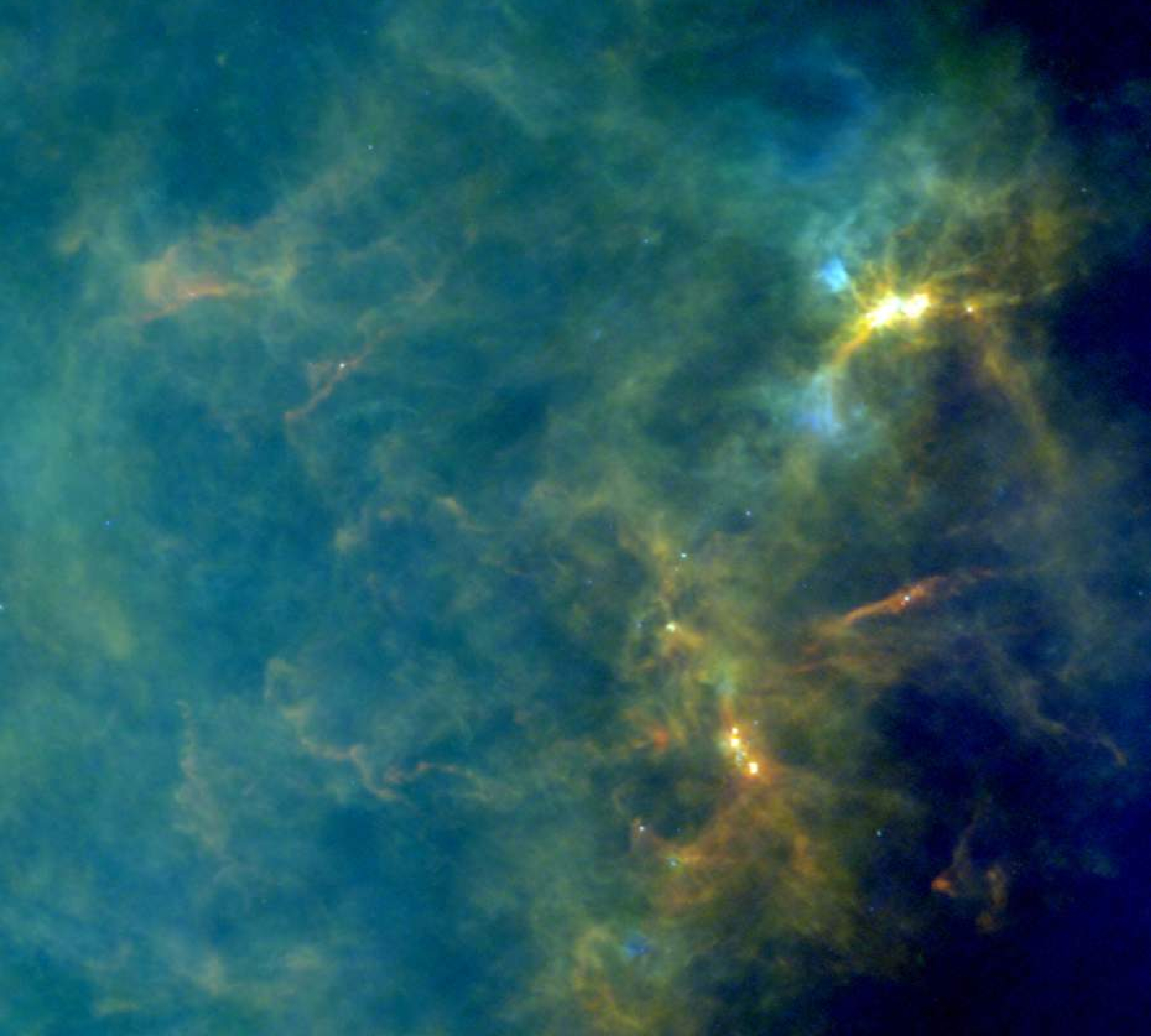
Herschel reveals filaments in the Serpens Core

Herschel reveals filaments in the Serpens Core
Copyright: ESA/Herschel/PACS/SPIRE/V. Roccatagliata (U. München, Germany)


The interstellar medium fills the ‘empty’ space between the stars in our galaxy. It is a mix of molecular clouds, cold and warm gases, regions of electrically charged hydrogen, and more.

Molecular clouds are the densest part of the interstellar medium, holding most of its mass in the form of hydrogen gas. ESA’s Herschel space observatory has revealed that many are built around filaments, with dense threads snaking throughout each cloud. These filaments potentially transport material, and, when massive enough, are known to form new stars.

This Herschel image shows the Serpens Core, the heart of a giant molecular cloud. The Core is the bright clump towards the upper right, with a more diffuse secondary cluster, named Ser G3-G6, shown at the bottom right. Also visible as a faint yellow glow towards the upper left of the frame is a region known as LDN 583 that shines brightly in the far-infrared.

Giant molecular clouds contain up to 10 million times the mass of the Sun, and can stretch for hundreds of light-years. Compared to the rest of space they are dense, holding up to a thousand atoms per cubic centimetre – and even more in star-forming regions. However, these properties are relative: even at their densest, these clouds are more than 10 times emptier than the best laboratory vacuums we can produce on Earth.

These giant clouds are complex formations, most often made up of filaments mixed with clumpy and irregular folds, sheets and bubble-like structures. A typical spiral galaxy like the Milky Way can contain thousands of them, accompanied by many of their smaller relatives.

Serpens is an ideal target for scientists wanting to know more about giant molecular clouds, because it lies just 1400 light-years from us. Scientists compared Herschel’s observations of this cloud to a state-of-the-art simulation to find out more about the cloud’s properties, and to test the accuracy of their model.

They discovered a radial network of filaments stretching throughout the Serpens Core, filaments that are predicted to break and fragment to form the cores of new stars. These filaments resemble the spokes of a wheel, with the Core forming the hub.

This three-colour image is made from observations with Herschel’s PACS camera (blue and green) and SPIRE camera (red). The size of the region shown is 1.7x1.9º on the sky, where 1º corresponds to about 25 light-years.


Monday, January 18, 2016

View over an alien world

View over an alien world
Copyright: ESA/NASA/JPL/University of Arizona
Hi-res JPG  (768.25 kB) - Hi-res JPG (4.20 MB)


At first glance, this scene may look like a reptilian eye or a textured splash of orange paint, but it is actually a fish-eye view of Saturn’s moon Titan. It was acquired at a height of about 5 km as ESA’s Huygens probe, part of the international Cassini–Huygens mission, descended through Titan’s atmosphere before landing.

In the late afternoon of 14 January 2005, engineers and scientists at ESA’s ESOC operations centre in Darmstadt, Germany, waited anxiously for data to arrive from Huygens, which touched down on Titan at around 12:34 GMT – the most distant landing of any craft.

Following its release from NASA’s Cassini on 25 December, Huygens reached Titan’s outer atmosphere after 20 days and a 4 million km cruise. The probe started its descent through Titan’s hazy cloud layers from an altitude of about 1270 km at 10:13 GMT. During the following three minutes Huygens decelerated from 18 000 km/h to 1400 km/h.

A sequence of parachutes then slowed it down to less than 300 km/h. At a height of about 160 km the probe’s scientific instruments were exposed to Titan’s atmosphere. Around 120 km, the main parachute was replaced by a smaller one to complete the descent.

The probe began transmitting data to Cassini four minutes into its descent and continued to transmit after landing at least as long as Cassini was above Titan’s horizon. The signals, relayed by Cassini, were picked up by NASA’s Deep Space Network and delivered immediately to ESOC. The first science data arrived at 16:19 GMT.

Huygens was humankind’s first attempt to land a probe on another world in the outer Solar System. “This is a great achievement for Europe and its US partners in this ambitious international endeavour to explore Saturn system,” said Jean-Jacques Dordain, then ESA’s Director General.

This image is a stereographic (fish-eye) projection taken with the descent imager/spectral radiometer on Huygens.

More information and a high-res TIFF version of the image is available at the NASA JPL website.


Friday, January 15, 2016

The Turbulent Birth of a Quasar

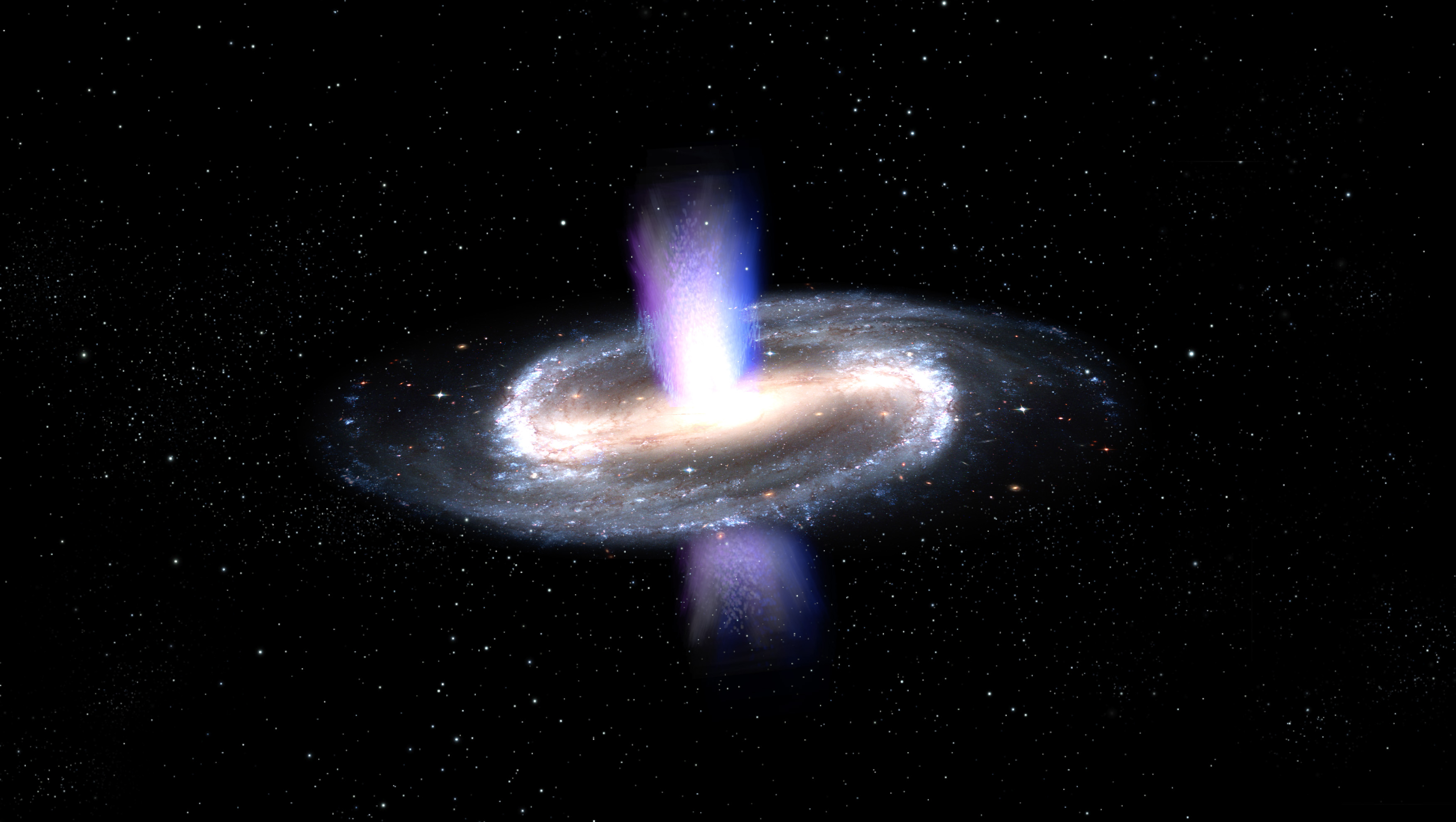
Artist's impression of the galaxy W2246-0526


The most luminous galaxy known in the Universe — the quasar W2246-0526, seen when the Universe was less than 10% of its current age — is so turbulent that it is in the process of ejecting its entire supply of star-forming gas, according to new observations with the Atacama Large Millimeter/submillimeter Array (ALMA).

Quasars are distant galaxies with very active supermassive black holes at their centres that spew out powerful jets of particles and radiation. Most quasars shine brightly, but a tiny fraction [1] of these energetic objects are of an unusual type known as Hot DOGs, or Hot, Dust-Obscured Galaxies, including the galaxy WISE J224607.57-052635.0 [2], the most luminous known galaxy in the Universe.

For the first time, a team of researchers led by Tanio Díaz-Santos of the Universidad Diego Portales in Santiago, Chile, has used the unique capabilities of ALMA [3] to peer inside W2246-0526 and trace the motion of ionised carbon atoms between the galaxy’s stars.

“Large amounts of this interstellar material were found in an extremely turbulent and dynamic state, careening throughout the galaxy at around two million kilometres per hour,” explains lead author Tanio Díaz-Santos.

The astronomers believe that this turbulent behaviour could be linked to the galaxy’s extreme luminosity. W2246-0526 blasts out as much light as roughly 350 trillion Suns. This startling brightness is powered by a disc of gas that is superheated as it spirals in on the supermassive black hole at the galaxy’s core. The light from the blazingly bright accretion disc in the centre of this Hot DOG does not escape directly, it is absorbed by a surrounding thick blanket of dust, which re-emits the energy as infrared light [4].

This powerful infrared radiation has a direct and violent impact on the entire galaxy. The region around the black hole is at least 100 times more luminous than the rest of the galaxy combined, thus releasing intense yet localised radiation in W2246-0526 that is exerting tremendous pressure on the entire galaxy [5].

“We suspected that this galaxy was in a transformative stage of its life because of the enormous amount of infrared energy,” said co-author Peter Eisenhardt, Project Scientist for WISE at NASA's Jet Propulsion Laboratory in Pasadena, California.

“ALMA has now shown us that the raging furnace in this galaxy is making the pot boil over,” adds Roberto Assef, also from Universidad Diego Portales and leader of the ALMA observations.

If these turbulent conditions continue, the intense infrared radiation would boil away all of the galaxy’s interstellar gas. Models of galaxy evolution based on the new ALMA data indicate that the interstellar gas is already being ejected from the galaxy in all directions.

“If this pattern continues, it is possible that W2246 will eventually mature into a more traditional quasar,” concludes Manuel Aravena, also from the Universidad Diego Portales. “Only ALMA, with its unparalleled resolution, can allow us to see this object in high definition and fathom such an important episode in the life of this galaxy.”


Notes

[1] Only one of every 3000 quasars observed are classified as Hot DOGs.

[2] The full name of this remarkable object is WISE J224607.57-052635.0, it was found by NASA’s Wide-field Infrared Survey Explorer (WISE) spacecraft and the rest of the name gives the precise location of the quasar on the sky.

[3] ALMA is uniquely capable of detecting the faint, millimetre-wavelength light naturally emitted by atomic carbon.


[4] Because of the expansion of the Universe the infrared radiation from W2246-0526 is redshifted to longer millimetre wavelengths — where ALMA is very sensitive — when it is observed from Earth.


[5] In most other quasars this ratio is much more modest. This process of mutual interaction between the central black hole of a galaxy and the rest of its material is known to astronomers as feedback.


More Information

This research was presented in a paper "The Strikingly Uniform, Highly Turbulent Interstellar Medium of The Most Luminous Galaxy in the Universe”, by T. Díaz-Santos et al., and will be published in the journal Astrophysical Journal Letters.

The team is composed of T. Díaz-Santos (Universidad Diego Portales, Santiago, Chile), R. J. Assef (Universidad Diego Portales, Santiago, Chile), A. W. Blain (University of Leicester, UK) , C.-W. Tsai (Jet Propulsion Laboratory, California Institute of Technology, Pasadena, California, USA) , M. Aravena (Universidad Diego Portales, Santiago, Chile), P. Eisenhardt (Jet Propulsion Laboratory, California Institute of Technology, Pasadena, California, USA), J. Wu (University of California Los Angeles, California, USA), D. Stern (Jet Propulsion Laboratory, California Institute of Technology, Pasadena, California, USA) and C. Bridge (Jet Propulsion Laboratory, California Institute of Technology, Pasadena, California, USA).

ESO is the foremost intergovernmental astronomy organisation in Europe and the world’s most productive ground-based astronomical observatory by far. It is supported by 16 countries: Austria, Belgium, Brazil, the Czech Republic, Denmark, France, Finland, Germany, Italy, the Netherlands, Poland, Portugal, Spain, Sweden, Switzerland and the United Kingdom, along with the host state of Chile. ESO carries out an ambitious programme focused on the design, construction and operation of powerful ground-based observing facilities enabling astronomers to make important scientific discoveries. ESO also plays a leading role in promoting and organising cooperation in astronomical research. ESO operates three unique world-class observing sites in Chile: La Silla, Paranal and Chajnantor. At Paranal, ESO operates the Very Large Telescope, the world’s most advanced visible-light astronomical observatory and two survey telescopes. VISTA works in the infrared and is the world’s largest survey telescope and the VLT Survey Telescope is the largest telescope designed to exclusively survey the skies in visible light. ESO is a major partner in ALMA, the largest astronomical project in existence. And on Cerro Armazones, close to Paranal, ESO is building the 39-metre European Extremely Large Telescope, the E-ELT, which will become “the world’s biggest eye on the sky”.


Links

Contacts

Tanio Díaz-Santos
Universidad Diego Portales
Santiago, Chile
Email: tanio.diaz@mail.udp.cl

Richard Hook
ESO Public Information Officer
Garching bei München, Germany
Tel: +49 89 3200 6655
Cell: +49 151 1537 3591
Email: rhook@eso.org

Source: ESO

A galactic mega-merger

Credit: ESA/Hubble & NASA
Acknowledgement: Judy Schmidt


The subject of this NASA/ESA Hubble Space Telescope image is known as NGC 3597. It is the product of a collision between two good-sized galaxies, and is slowly evolving to become a giant elliptical galaxy. This type of galaxy has grown more and more common as the Universe has evolved, with initially small galaxies merging and progressively building up into larger galactic structures over time.

NGC 3597 is located approximately 150 million light-years away in the constellation of Crater (The Cup). Astronomers study NGC 3597 to learn more about how elliptical galaxies form — many ellipticals began their lives far earlier in the history of the Universe. Older ellipticals are nicknamed “red and dead” by astronomers because these bloated galaxies are not anymore producing new, bluer, stars in ages, and are thus packed full of old and redder stellar populations.

Before infirmity sets in, some freshly formed elliptical galaxies experience a final flush of youth, as is the case with NGC 3597. Galaxies smashing together pool their available gas and dust, triggering new rounds of star birth. Some of this material ends up in dense pockets initially called proto-globular clusters, dozens of which festoon NGC 3597. These pockets will go on to collapse and form fully-fledged globular clusters, large spheres that orbit the centres of galaxies like satellites, packed tightly full of millions of stars.


Thursday, January 14, 2016

A Milky Way twin swept by an ultra-fast X-ray wind

Winds from a spiral galaxy
Copyright: ESA


ESA’s XMM-Newton has found a wind of high-speed gas streaming from the centre of a bright spiral galaxy like our own that may be reducing its ability to produce new stars.

It is not unusual to find hot winds blowing from the swirling discs of material around supermassive black holes at the centre of active galaxies.

If powerful enough, these winds can influence their surroundings in various ways. Their primary effect is to sweep away reservoirs of gas that might otherwise have formed stars, but it is also possible that they might trigger the collapse of some clouds to form stars.

Such processes are thought to play a fundamental role in galaxies and black holes throughout the Universe’s 13.8 billion years.

But they were thought to affect only the largest objects, such as massive elliptical galaxies formed through the dramatic collision and merging of two or more galaxies, which sometimes trigger the winds powerful enough to influence star formation.

Now, for the first time, these winds have been seen in a more normal kind of active galaxy known as a Seyfert, which does not appear to have undergone any merging. 

When observed in visible light, almost all Seyfert galaxies have a spiral shape similar to our own Milky Way.

However, unlike the Milky Way, Seyferts have bright cores that shine across the entire electromagnetic spectrum, a sign that the supermassive black holes at their centres are not idle but are devouring their surroundings.
 
The supermassive black hole at the heart of this particular Seyfert, known as IRAS17020+4544 and located 800 million light-years from Earth, has a mass of nearly six million Suns, drawing in nearby gas and making it shine moderately.

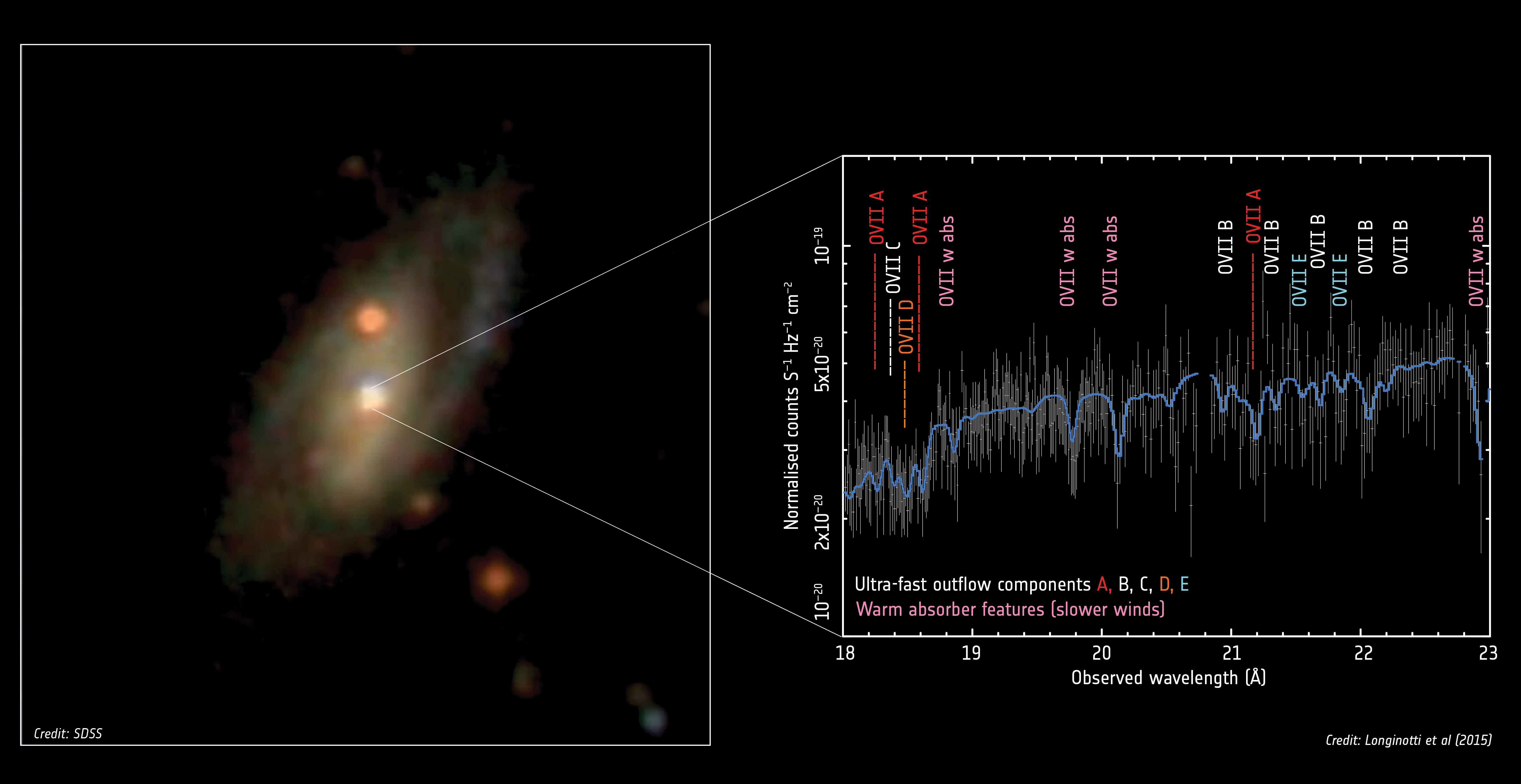
XMM-Newton has found that the winds from around the black hole are moving at 23 000–33 000 km/s, about 10% the speed of light.

An important finding is that the wind from the centre is sufficiently energetic to heat the gas in the galaxy and suppress star formation – the first time it has been seen in a relatively normal spiral galaxy. 

“It’s the first solid case of an ultra-fast X-ray outflow observed in a ‘normal’ Seyfert galaxy,” says Anna Lia Longinotti from the Instituto Nacional de Astrofísica, Óptica y Electrónica of Puebla, Mexico, lead author of the paper describing the results in Astrophysical Journal Letters.

The peculiar wind of a spiral galaxy
Copyright: Image: Sloan Digital Sky Survey; Spectrum: Longinotti et al (2015)


The galaxy has another surprise: the X-ray emission from the fast winds from galactic cores are usually dominated by iron atoms with many of their electrons stripped off, but this galaxy’s winds turn out to be rather unusual, exhibiting lighter elements like oxygen, with no iron detected

“I was actually very surprised to discover that this wind is made mostly of oxygen because nobody has seen a galaxy like this before,” says Anna Lia. 

Because the galaxy is broadly similar to our own, it raises questions about the history of the Milky Way and the role that our own central black hole may have played. 

“We know, also thanks to recent results obtained by XMM-Newton, that the four-million-solar-mass black hole in our own galaxy has undergone phases of much stronger activities, even only a few hundred years ago,” says co-author Matteo Guainazzi, ESA astronomer currently at the Institute of Space and Astronautical Science of the Japan Aerospace Exploration Agency. 

“Of course we cannot be sure, but our discovery implies that fast outflows like those found in IRAS17020+4544 may have once swept through our own Galaxy during one of these active phases.

“This possibility was not considered before, because this ‘feedback’ from X-ray winds was previously observed only in galaxies very different from the Milky Way.”

“XMM-Newton continues to make discoveries with the potential to question our understanding of how the stars in a galaxy and the supermassive black hole at its centre co-evolve throughout the history of the Universe,” says Norbert Schartel, ESA’s XMM-Newton project scientist.


 Notes for Editors


“X-ray high-resolution spectroscopy reveals feedback in a Seyfert Galaxy from an ultra fast wind with complex ionization and velocity structure,” by A.L Longinotti et al is published in The Astrophysical Journal Letters

The findings are based on measurements by XMM-Newton’s Reflection Grating Spectrometer and the European Photon Imaging Camera in 2004 and 2014.


For more information, please contact:
 
Markus Bauer
ESA Science and Robotic Exploration Communication Officer
Tel: +31 71 565 6799
Mob: +31 61 594 3 954
Email:
Markus.Bauer@esa.int

Anna Lia Longinotti
Catedrática CONACYT
Instituto Nacional de Astrofísica, Óptica y Electrónica (INAOE Puebla, Mexico)
Email:
annalia@inaoep.mx

Matteo Guainazzi
ESA ASTRO-H Resident Astronomer
Institute of Space and Astronautical Science
Japan Aerospace Exploration Agency

Email: Matteo.Guainazzi@sciops.esa.int

Norbert Schartel
ESA XMM-Newton project scientist
Email:
norbert.Schartel@esa.int


Exposed ice on Rosetta's comet confirmed as water

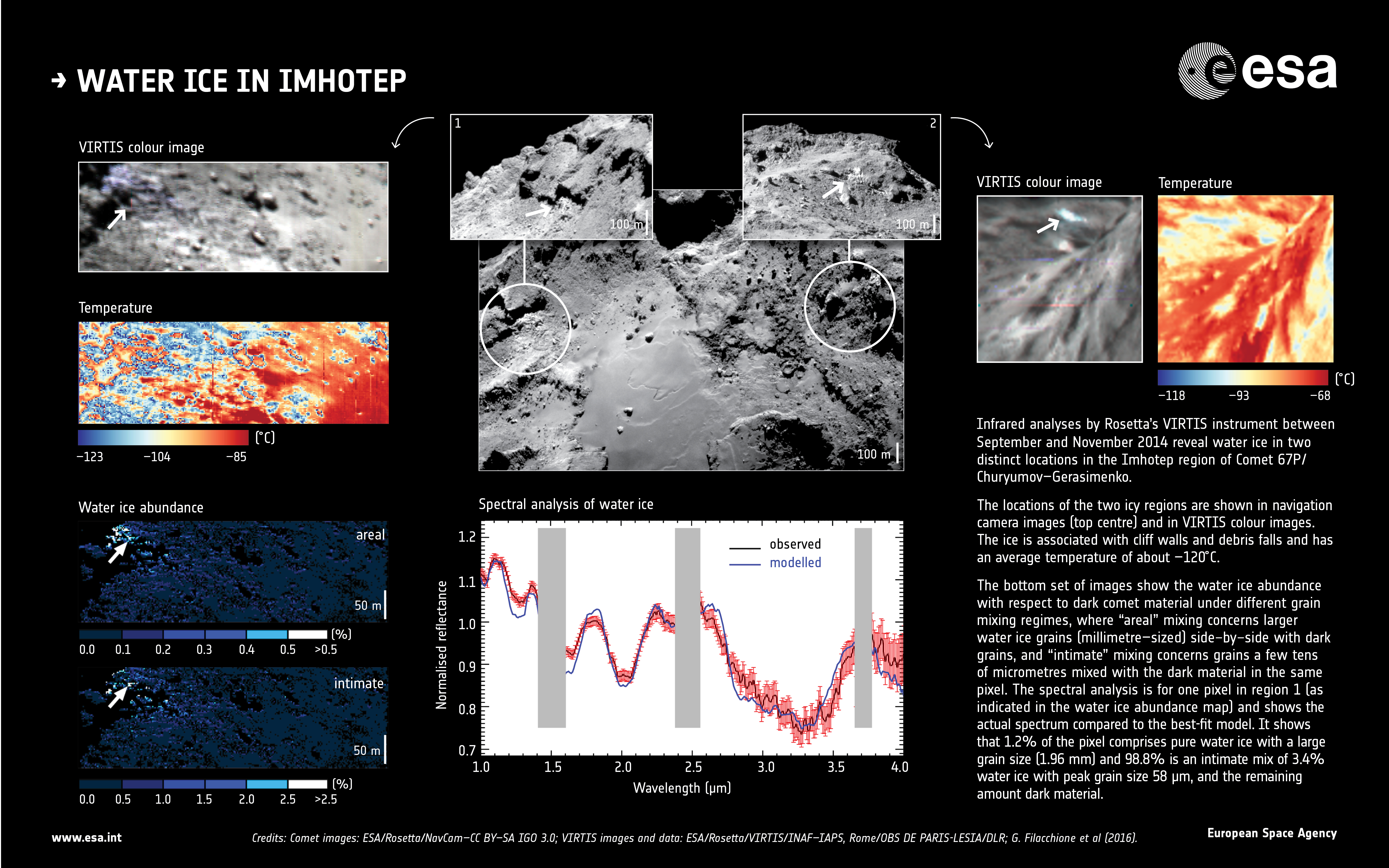
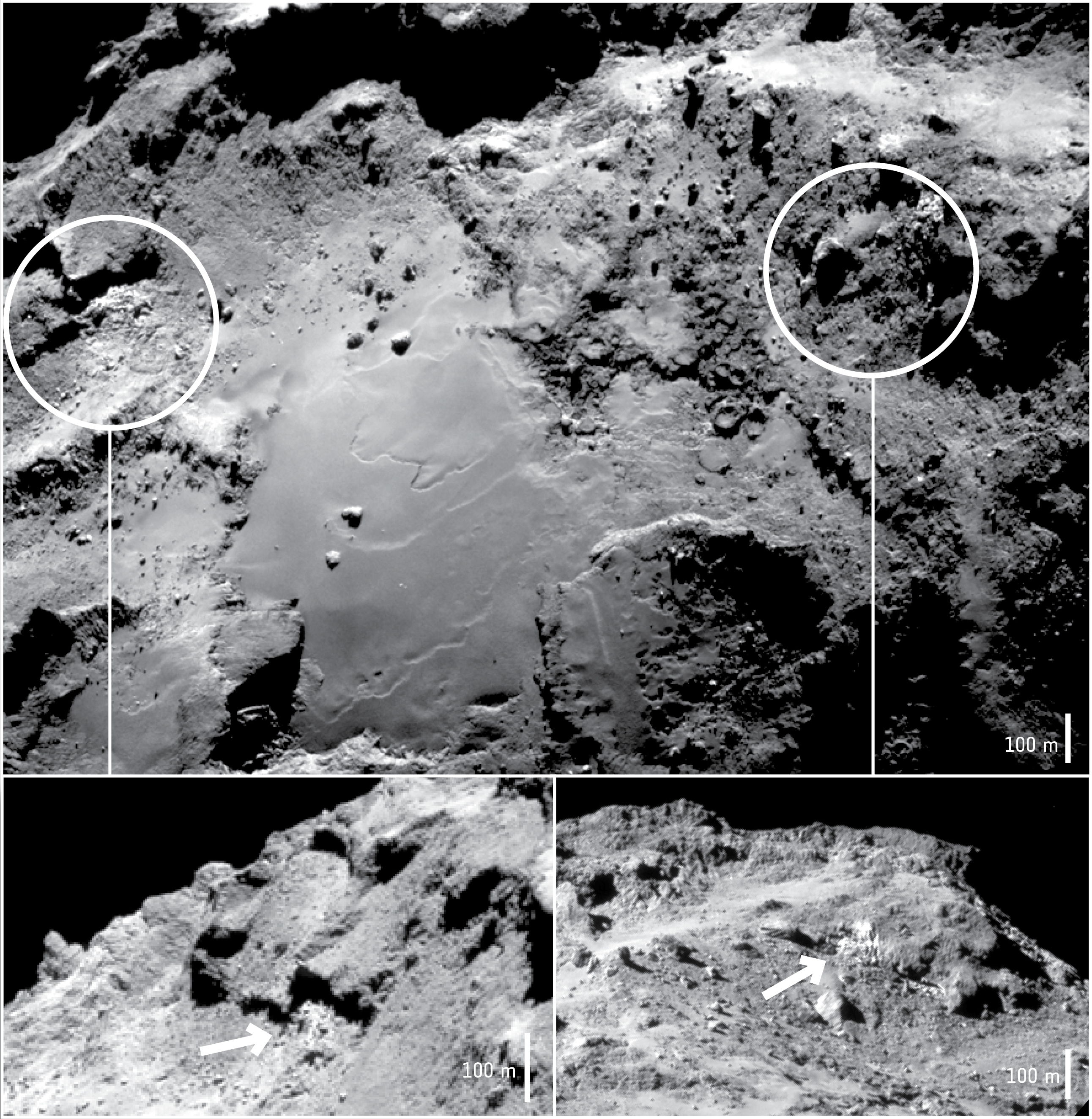
Infrared observations of water ice in Imhotep 
Copyright: Comet images: ESA/Rosetta/NavCam–CC BY–SA IGO 3.0; VIRTIS images and data: ESA/Rosetta/VIRTIS/INAF-IAPS, Rome/OBS DE PARIS-LESIA/DLR; G. Filacchione et al (2016).  Hi-res image

Ice in Imhotep
Copyright: ESA/Rosetta/NavCam – CC BY-SA IGO 3.0

 Hi-res image


Observations made shortly after Rosetta’s arrival at its target comet in 2014 have provided definitive confirmation of the presence of water ice.

Although water vapour is the main gas seen flowing from comet 67P/Churyumov–Gerasimenko, the great majority of ice is believed to come from under the comet’s crust, and very few examples of exposed water ice have been found on the surface.

However, a detailed analysis by Rosetta’s VIRTIS infrared instrument reveals the composition of the comet’s topmost layer: it is primarily coated in a dark, dry and organic-rich material but with a small amount of water ice mixed in.

In the latest study, which focuses on scans between September and November 2014, the team confirms that two areas several tens of metres across in the Imhotep region that appear as bright patches in visible light, do indeed include a significant amount of water ice.

The ice is associated with cliff walls and debris falls, and was at an average temperature of about –120ºC at the time.

In those regions, pure water ice was found to occupy around 5% of each pixel sampling area, with the rest made up of the dark, dry material. The abundance of ice was calculated by comparing Rosetta’s VIRTIS infrared measurements to models that consider how ice grains of different sizes might be mixed together in one pixel.

The data reveal two different populations of grains: one is several tens of micrometres in diameter, while the other is larger, around 2 mm.

These sizes contrast with the very small grains, just a few micrometres in diameter, found in the Hapi region on the ‘neck’ of the comet, as observed by VIRTIS in a different study.

“The various populations of icy grains on the surface of the comet imply different formation mechanisms, and different time scales for their formation,” says Gianrico Filacchione, lead author of the new study, published in the journal Nature.

At Hapi, the very small grains are associated with a thin layer of ‘frost’ that forms as part of the daily ice cycle, a result of fast condensation in this region over each comet rotation of just over 12 hours.

“By contrast, we think that layers of the larger millimetre-sized grains we see in Imhotep have a more complex history. They likely formed slowly over time, and are only occasionally exposed through erosion,” says Gianrico.

Assuming a typical grain size of tens of micrometres for ice grains on the surface, as inferred on other comets as well as Rosetta’s comet, then observations of millimetre-sized grains can be explained by the growth of secondary ice crystals.

One way this can occur is via ‘sintering’, whereby ice grains are compacted together. Another method is ‘sublimation’, in which heat from the Sun penetrates the surface, triggering the evaporation of buried ice. While some of the resulting water vapour may escape from the nucleus, a significant fraction of it recondenses in layers beneath the surface.

This idea is supported by laboratory experiments that simulate the sublimation behaviour of ice buried under dust, heated from above by sunlight.

These tests show that more than 80% of the released water vapour does not make it up through the dust mantle, but rather is redeposited below the surface.

Additional energy for sublimation could also be provided by a transformation in structure of the ice at a molecular level. At the low temperatures observed on comets, amorphous ice can change into crystalline ice, releasing energy as it does so.

“Ice grain growth can lead to ice-rich subsurface layers several metres thick, that can then affect the large-scale structure, porosity and thermal properties of the nucleus,” says Fabrizio Capaccioni, VIRTIS principal investigator.

“The thin ice-rich layers that we see exposed close to the surface may be a consequence of cometary activity and evolution, implying that global layering did not necessarily occur early in the comet’s formation history.”

“Understanding which features on the comet are left over from its formation and which have been created during its evolution is somewhat challenging, but this is why we are studying a comet up close: to try to discover what processes are important at different stages of a comet’s lifetime,” adds Matt Taylor, ESA’s Rosetta project scientist.

The Rosetta scientists are now analysing data captured later in the mission, as the comet moved closer to the Sun in mid-2015, to see how the amount of ice exposed on the surface evolved as the heating increased.


Notes for Editors
 
“Exposed water ice on the nucleus of comet 67P/Churyumov–Gerasimenko,” by G. Filacchione et al is published in the journal Nature.  
 

For more information, please contact:

 
Gianrico Filacchione
VIRTIS deputy principal investigator
INAF-IAPS, Rome, Italy
Email: gianrico.filacchione@iaps.inaf.it

Fabrizio Capaccioni
VIRTIS principal investigator
INAF-IAPS, Rome, Italy
Email: fabrizio.capaccioni@iaps.inaf.it

Matt Taylor
ESA Rosetta Project Scientist
Email: matt.taylor@esa.int

Markus Bauer 


ESA Science and Robotic Exploration Communication Officer


Tel: +31 71 565 6799


Mob: +31 61 594 3 954


Email: markus.bauer@esa.int


Source: ESA/Rosetta

Wednesday, January 13, 2016

First Light For Future Black Hole Probe

GRAVITY discovers new double star in Orion Trapezium Cluster

GRAVITY — future probe of black holes

 
GRAVITY — the instrument team during the first observations at Paranal

GRAVITY discovers new double star in the Orion Trapezium Cluster (annotated)


Videos
 
GRAVITY discovers new double star in Orion Trapezium Cluster


Successful commissioning of GRAVITY at the VLTI

Zooming in on black holes is the main mission for the newly installed instrument GRAVITY at ESO’s Very Large Telescope in Chile. During its first observations, GRAVITY successfully combined starlight using all four Auxiliary Telescopes. The large team of European astronomers and engineers, led by the Max Planck Institute for Extraterrestrial Physics in Garching, who designed and built GRAVITY, are thrilled with the performance. During these initial tests, the instrument has already achieved a number of notable firsts. This is the most powerful VLT Interferometer instrument yet installed.

The GRAVITY instrument combines the light from multiple telescopes to form a virtual telescope up to 200 metres across, using a technique called interferometry. This enables the astronomers to detect much finer detail in astronomical objects than is possible with a single telescope.

Since the summer of 2015, an international team of astronomers and engineers led by Frank Eisenhauer (MPE, Garching, Germany) has been installing the instrument in specially adapted tunnels under the Very Large Telescope at ESO’s Paranal Observatory in northern Chile [1]. This is the first stage of commissioning GRAVITY within the Very Large Telescope Interferometer (VLTI). A crucial milestone has now been reached: for the first time, the instrument successfully combined starlight from the four VLT Auxiliary Telescopes [2].

“During its first light, and for the first time in the history of long baseline interferometry in optical astronomy, GRAVITY could make exposures of several minutes, more than a hundred times longer than previously possible,” commented Frank Eisenhauer. “GRAVITY will open optical interferometry to observations of much fainter objects, and push the sensitivity and accuracy of high angular resolution astronomy to new limits, far beyond what is currently possible.”

As part of the first observations the team looked closely at the bright, young stars known as the Trapezium Cluster, located in the heart of the Orion star-forming region. Already, from these first commissioning data, GRAVITY made a small discovery: one of the components of the cluster was found to be a double star [3].

The key to this success was to stabilise the virtual telescope for long enough, using the light of a reference star, so that a deep exposure on a second, much fainter object becomes feasible. Furthermore, the astronomers also succeeded in stabilising the light from four telescopes simultaneously — a feat not achieved before.

GRAVITY can measure the positions of astronomical objects on the finest scales and can also perform interferometric imaging and spectroscopy [4]. If there were buildings on the moon, GRAVITY would be able to spot them. Such extremely high resolution imaging has many applications, but the main focus in the future will be studying the environments around black holes.

In particular, GRAVITY will probe what happens in the extremely strong gravitational field close to the event horizon of the supermassive black hole at the centre of the Milky Way — which explains the choice of the name of the instrument. This is a region where behaviour is dominated by Einstein's theory of general relativity. In addition, it will uncover the details of mass accretion and jets — processes that occur both around newborn stars (young stellar objects) and in the regions around the supermassive black holes at the centres of other galaxies. It will also excel at probing the motions of binary stars, exoplanets and young stellar discs, and in imaging the surfaces of stars.

So far, GRAVITY has been tested with the four 1.8-metre Auxiliary Telescopes. The first observations using GRAVITY with the four 8-metre VLT Unit Telescopes are planned for later in 2016.

The GRAVITY consortium is led by the Max Planck Institute for Extraterrestrial Physics, in Garching, Germany. The other partner institutes are:

  • LESIA, Observatoire de Paris, PSL Research University, CNRS, Sorbonne Universités, UPMC Univ. Paris 06, Univ. Paris Diderot, Sorbonne Paris Cité, Meudon, France
  • Max Planck Institute for Astronomy, Heidelberg, Germany
  • 1. Physikalisches Institut, University of Cologne, Cologne, Germany
  • IPAG, Université Grenoble Alpes/CNRS, Grenoble, France
  • Centro Multidisciplinar de Astrofísica, CENTRA (SIM), Lisbon and Oporto, Portugal
  • ESO, Garching, Germany


Notes


[1] The VLTI tunnels and beam-combining room have recently undergone significant construction work to accommodate GRAVITY as well as to prepare for other future instruments. 

[2] It would be more accurate to call this step “first fringes” as the milestone was the first successful combination of light from the different telescopes so that the beams interfered and fringes were formed and recorded.

[3] The newly discovered double star is Theta1 Orionis F, and the observations were made using the nearby brighter star Theta1 Orionis C as the reference.

[4] GRAVITY aims to measure the positions of objects on scales of order ten microarcseconds, and perform imaging with four milliarcsecond resolution.


Links


Contacts

Markus Schoeller
ESO
Garching bei München, Germany
Email:
mschoell@eso.org

Frank Eisenhauer
Max Planck Institute for Extraterrestrial Physics
Garching bei München, Germany
Email:
eisenhau@mpe.mpg.de

Richard Hook
ESO Public Information Officer
Garching bei München, Germany
Tel: +49 89 3200 6655
Cell: +49 151 1537 3591
Email:
rhook@eso.org

 Source: ESO

Tuesday, January 12, 2016

VLA Reveals Dramatic New Evidence About Star, Planet Formation

In this artist's conception, a widely-separated pair of young, still-forming stars is in the background, forming by fragmentation of the material in the larger cloud in which they are born. In the foreground, companions in a multiple-star system are forming through fragmentation of a dusty disk that surrounds the original young star. Credit: Bill Saxton, NRAO/AUI/NSF. Hi-res image

A young double-star system in the Perseus Molecular Cloud, imaged with the VLA. This pair would fit within the orbit of Neptune in our Solar System. 
Credit: Tobin, et al., NRAO/AUI/NSF. Hi-res image

A young triple-star system in the Perseus Molecular Cloud, imaged with the VLA. 
Credit: Tobin et al., NRAO/AUI/NSF. Hi-res image

Disks of material surrounding young stars in the Perseus Molecular Cloud, imaged with the VLA. Arrows indicate the direction of outflows from the young systems. Credit: Segura-Cox, et al., NRAO/AUI/NSF. Hi-res image


A detailed study of young stars and their surroundings has produced dramatic new evidence about how multiple-star systems form and how the dusty disks that are the raw material for planets grow around young stars. Teams of scientists used the National Science Foundation's Karl G. Jansky Very Large Array (VLA) radio telescope to study nearly 100 newborn stars in a cloud of gas and dust about 750 light-years from Earth, in which new stars are forming.

Images made from the study showed unprecedented detail of a number of the young stars, and are helping astronomers resolve important questions about how stars, binary stars, and planets get their starts. The astronomers presented their results to the American Astronomical Society's meeting in Kissimmee, Florida.

Looking at young multiple-star systems, one team concluded that two different formation mechanisms may be at work to produce such systems. They noted that the systems they studied fall into two distinct types, based on the distance between the stars in the system. The closer systems have stars separated by about 75 times the Sun-Earth distance, and another group has its stars separated by about 3,000 times the Sun-Earth distance. They also found that more than half of the youngest stars they studied are in multiple systems, suggesting that star formation tends to produce multiples rather than single stars.

"Several different processes have been suggested for how multiple-star systems form, and our results indicate that the separation between stars may tell us which of these processes is responsible for a particular system," said John Tobin, of Leiden Observatory in the Netherlands.

Stars form in giant clouds of gas and dust, when tenuous material in such clouds collapses gravitationally into cores that then begin to draw additional material inward. Infalling material forms a rotating disk around the young star. Eventually, the young star gathers enough mass to create the temperatures and pressures at its center that will trigger thermonuclear reactions. The rotating disk around the star provides the material from which planets may form.

The researchers concluded that the more widely-separated multiple-star systems form through turbulent fragmentation of the larger cloud, while the closer systems are the result of fragmentation within the disk of material orbiting the original protostar. They also found that somewhat older systems have fewer widely-separated companions than the youngest group of protostars. This, they said, suggests that perhaps some young stars that form as widely-separated systems are not gravitationally bound and simply drift apart over time.

Another team, led by Dominique Segura-Cox, of the University of Illinois, found that the dusty disks around some of the protostars are larger than some theoretical models predict. These disks are essential to the formation of planets, some binary companions, and the young star's ability to draw in additional material. Despite their central role in these processes, however, their formation mechanisms have been debated among astronomers.

As material falls inward toward a young star, it pulls magnetic fields along with it. Theorists suggested that these fields, which become stronger as they are concentrated closer to the star, could be aligned so that they drastically slow the disk's rotation, limiting the size of the disk. Theoretical models predicted that this effect, called magnetic braking, would limit the disks to a radius about 10 times the Earth-Sun distance, or slightly more than the distance from the Sun to Saturn.

"We found disks with radii that are at least 15-30 times the Earth-Sun distance, significantly larger than the magnetic-braking model would allow," Segura-Cox said. "This is a lower limit, and the disks may actually be larger. Studies of other systems have indicated that disks are larger when observed at radio frequencies different than the ones we used in this project," she added.

One explanation for the larger disk sizes may be that, in some systems, the magnetic field and the rotation axis of the star are misaligned, a configuration that reduces the magnetic-braking effect. Evidence for this has been seen in some objects, the researchers said.

In another study published last December, a team using data from the same project found that the material falling toward one protostar is twisting the magnetic field lines and changing their configuration as it drags them inward. That study, which measured the magnetic-field alignments near the star, indicates one mechanism for minimizing the magnetic-braking effect.

"These observations of disks around such young stars suggests that all the elements needed for planet formation are present very early in the life of a star. Plus, it is probable that there are already centimeter-sized particles in these young disks, meaning that the growth of solids progresses rapidly," Tobin said.

The images for this work came from a project called the VLA Nascent Disk and Multiplicity (VANDAM) Survey. This survey used 264 hours of VLA observing time from 2013 to 2015 to study protostars in the Perseus Molecular Cloud, about 750 light-years distant. The Perseus Molecular Cloud, containing as much material as 10,000 suns, is one of the closest regions where low- to intermediate-mass stars are actively forming, and thus serves as a valuable "laboratory" for astronomers seeking to understand star formation.

"This survey sampled the largest number of young stars, and revealed fainter objects than we could study previously, and did so in greater detail. The information it provided has dramatically improved our knowledge," Tobin said.

"The disks we studied are difficult to observe as they are obscured by the cloud in which they are forming, but these new VLA observations reveal the disks and provide critical data into their formation mechanism,” Segura-Cox said.

The National Radio Astronomy Observatory is a facility of the National Science Foundation, operated under cooperative agreement by Associated Universities, Inc.

*  *  *
Media Contact: 

Dave Finley, Public Information Officer
(575) 835-7302

dfinley@nrao.edu


Monday, January 11, 2016

Dwarf Galaxy Sends Ripples Through Milky Way’s Suburbs: A New Way to Explore Dark Matter

Computer simulation of gas distribution (left) and stars (right) after the Milky Way is perturbed by the dwarf satellite. 
Download the entire animation here.


Ripples in gas at the outer disk of our galaxy have puzzled astronomers since they were first revealed by radio observations a decade ago. Now, astronomers believe they have found the culprit – a dwarf galaxy, containing dark, unseen material, which skimmed the outskirts of our galaxy a few hundred million years ago. 

The research, led by Sukanya Chakrabarti of the Rochester Institute of Technology, presents the first plausible explanation for the galactic ripples. “It’s a bit like throwing a stone into a pond and making ripples,” said Chakrabarti at today’s press conference at the 227th meeting of the American Astronomical Society in Kissimmee, Florida. 

“Of course we aren’t talking about a pond, but our galaxy, which is tens of thousands of light years across, and made of stars and gas, but the result is the same – ripples!” Chakrabarti adds that this work is part of a new discipline called galactoseismology, “This is really the first non-theoretical application of this field, where we can infer things about the unseen composition of galaxies from analyzing galactic-quakes.” 

To reach their conclusion the research team studied a trio of stars, called Cepheid variables, which are part of the likely dwarf galaxy now estimated to lie about 300,000 light years away from our galaxy in the direction of the constellation Norma. “We have a pretty good idea of the distance to these stars because the intrinsic brightness of Cepheid variable stars depends on their period of pulsation, which we can measure,” says Chakrabarti. “What I wanted to know was how fast this speeding bullet was going when it passed by our galaxy – with that information we can begin to understand the dynamics, and ultimately how much unseen dark matter is there.” 

To do that, Chakrabarti and her team focused on three Cepheids in the tiny galaxy. Using spectroscopic observations obtained at the Gemini Observatory (as well as the Magellan Telescope, and the WiFeS spectrograph) the researchers found that the stars are all speeding away at similar velocities – about 450,000 mph (~ 200 kilometers/second). “This really implicates these stars as being part of an organized, fast-moving system which we believe is a dwarf galaxy. It’s also very likely that this dwarf satellite brushed our galaxy millions of years ago and left ripples in its wake,” said Chakrabarti. 

“This new, potentially powerful way to study how stars, gas and dust are distributed in galaxies is really quite exciting,” said Chris Davis, program director at the U.S. National Science Foundation that funds roughly 65% of Gemini as part of its international partnership, as well as this research program. "Known as galactoseismology, it can trace both visible and invisible materials, including the elusive dark matter. It’s a great way to better understand how galaxies and neighboring satellite dwarf galaxies interact as well." 

Gemini Observatory astronomer Rodolfo Angeloni oversaw the observations at the Gemini South telescope in Chile. He adds that Gemini South is uniquely well-equipped to make these types of observations. “The combination of Gemini’s silver-coated mirror and the versatility of the infrared spectrograph Flamingos-2 really made this work possible.” However, he continues, “These were especially faint and remote targets – we really had to push the limits." 

The team plans to continue this work by looking for more Cepheid variable stars in our galaxy’s halo. “There could be a population of yet undiscovered Cepheid variables that formed from a gas-rich dwarf galaxy falling into our galaxy’s halo,” said Chakrabarti. “With the capabilities of today’s telescopes and instruments we should be able to sample enough of the Milky Way’s halo to make reasonable estimates on dark matter content - one of the greatest mysteries in astronomy today!” 

The international research team includes Rodolfo Angeloni, Ken Freeman, Leo Blitz, among others, and RIT research scientist Benjamin Sargent and Andrew Lipnicky, a graduate student in the astrophysical sciences and technology program. The Gemini observations were made possible by an award of Director’s Discretionary Time, and the research was funded by NSF research grant #1517488. 

Additional background on this research on TEDx talk by Principal Investigator at: https://www.youtube.com/watch?v=I9tel-ZCswM


Science Contacts:

Media Contacts:
  • Peter Michaud
    Gemini Observatory
    Desk: +1 (808) 974-2510
    Cell: +1 (808) 936-6643

    pmichaud@gemini.edu

  • Alexis-Ann Acohido
    Media Relations Intern
    Gemini Observatory
    Desk: +1 (808) 974-2528

    aacohido@gemini.edu


Sunday, January 10, 2016

NuSTAR Finds Cosmic Clumpy Doughnut Around Black Hole

Galaxy NGC 1068 can be seen in close-up in this view from NASA's Hubble Space Telescope. NuSTAR's high-energy X-rays eyes were able to obtain the best view yet into the hidden lair of the galaxy's central, supermassive black hole. Image credit: NASA/JPL-Caltech.  › Full image and caption 

The most massive black holes in the universe are often encircled by thick, doughnut-shaped disks of gas and dust. This deep-space doughnut material ultimately feeds and nourishes the growing black holes tucked inside.

Until recently, telescopes weren't able to penetrate some of these doughnuts, also known as tori.

"Originally, we thought that some black holes were hidden behind walls or screens of material that could not be seen through," said Andrea Marinucci of the Roma Tre University in Italy, lead author of a new Monthly Notices of the Royal Astronomical Society study describing results from NASA's Nuclear Spectroscopic Telescope Array, or NuSTAR, and the European Space Agency's XMM-Newton space observatory.

With its X-ray vision, NuSTAR recently peered inside one of the densest of these doughnuts known to surround a supermassive black hole. This black hole lies at the center of a well-studied spiral galaxy called NGC 1068, located 47 million light-years away in the Cetus constellation.

The observations revealed a clumpy, cosmic doughnut.

"The rotating material is not a simple, rounded doughnut as originally thought, but clumpy," said Marinucci.

Doughnut-shaped disks of gas and dust around supermassive black holes were first proposed in the mid-1980s to explain why some black holes are hidden behind gas and dust, while others are not. The idea is that the orientation of the doughnut relative to Earth affects the way we perceive a black hole and its intense radiation. If the doughnut is viewed edge-on, the black hole is blocked. If the doughnut is viewed face-on, the black hole and its surrounding, blazing materials can be detected. This idea is referred to as the unified model because it neatly joins together the different black hole types, based solely upon orientation.

In the past decade, astronomers have been finding hints that these doughnuts aren't as smoothly shaped as once thought. They are more like defective, lumpy doughnuts that a doughnut shop might throw away.

The new discovery is the first time this clumpiness has been observed in an ultra-thick doughnut, and supports the idea that this phenomenon may be common. The research is important for understanding the growth and evolution of massive black holes and their host galaxies.

"We don't fully understand why some supermassive black holes are so heavily obscured, or why the surrounding material is clumpy," said co-author Poshak Gandhi of the University of Southampton in the United Kingdom. "This is a subject of hot research."

Both NuSTAR and XMM-Newton observed the supermassive black hole in NGC 1068 simultaneously on two occasions between 2014 to 2015. On one of those occasions, in August 2014, NuSTAR observed a spike in brightness. NuSTAR observes X-rays in a higher-energy range than XMM-Newton, and those high-energy X-rays can uniquely pierce thick clouds around the black hole. The scientists say the spike in high-energy X-rays was due to a clearing in the thickness of the material entombing the supermassive black hole.

"It's like a cloudy day, when the clouds partially move away from the sun to let more light shine through," said Marinucci.

NGC 1068 is well known to astronomers as the first black hole to give birth to the unification idea. "But it is only with NuSTAR that we now have a direct glimpse of its black hole through such clouds, albeit fleeting, allowing a better test of the unification concept," said Marinucci.

The team says that future research will address the question of what causes the unevenness in doughnuts. The answer could come in many flavors. It's possible that a black hole generates turbulence as it chomps on nearby material. Or, the energy given off by young stars could stir up turbulence, which would then percolate outward through the doughnut. Another possibility is that the clumps may come from material falling onto the doughnut. As galaxies form, material migrates toward the center, where the density and gravity is greatest. The material tends to fall in clumps, almost like a falling stream of water condensing into droplets as it hits the ground.

"We'd like to figure out if the unevenness of the material is being generated from outside the doughnut, or within it," said Gandhi.

"These coordinated observations with NuSTAR and XMM-Newton show yet again the exciting science possible when these satellites work together," said Daniel Stern, NuSTAR project scientist at NASA's Jet Propulsion Laboratory in Pasadena, California.

For more information on NuSTAR, visit:  http://www.nasa.gov/nustar  - http://www.nustar.caltech.edu/


Media Contact

Whitney Clavin
Jet Propulsion Laboratory, Pasadena, California
818-354-4673


Source: JPL-Caltech

Saturday, January 09, 2016

NASA's Fermi Space Telescope Sharpens its High-energy Vision

Major improvements to methods used to process observations from NASA's Fermi Gamma-ray Space Telescope have yielded an expanded, higher-quality set of data that allows astronomers to produce the most detailed census of the sky yet made at extreme energies. A new sky map reveals hundreds of these sources, including 12 that produce gamma rays with energies exceeding a trillion times the energy of visible light. The survey also discovered four dozen new sources that remain undetected at any other wavelength.

This image, constructed from more than six years of observations by NASA's Fermi Gamma-ray Space Telescope, is the first to show how the entire sky appears at energies between 50 billion (GeV) and 2 trillion electron volts (TeV). For comparison, the energy of visible light falls between about 2 and 3 electron volts. A diffuse glow fills the sky and is brightest in the middle of the map, along the central plane of our galaxy. The famous Fermi Bubbles, first detected in 2010, appear as red extensions north and south of the galactic center and are much more pronounced at these energies. Discrete gamma-ray sources include pulsar wind nebulae and supernova remnants within our galaxy, as well as distant galaxies called blazars powered by supermassive black holes. Labels show the highest-energy sources, all located within our galaxy and emitting gamma rays exceeding 1 TeV. Credits: NASA/DOE/Fermi LAT Collaboration. unlabeled image , labeled image

Watch Fermi scientists explain why they're so excited about Pass 8, a complete reprocessing of all data collected by the mission's Large Area Telescope. This analysis increased the LAT's sensitivity, widened its energy range, and effectively sharpened its view through improved backtracking of incoming gamma rays. Credits: NASA's Goddard Space Flight Center. Download the video in ultra-HD at NASA's Scientific Visualization Studio


Using 61,000 Pass 8 gamma rays collected over 80 months, Ajello and his colleagues constructed a map of the entire sky at energies ranging from 50 billion (GeV) to 2 trillion electron volts (TeV). For comparison, the energy of visible light ranges from about 2 to 3 electron volts.
Tour the best view of the high-energy gamma-ray sky yet seen. This video highlights the plane of our galaxy and identifies objects producing gamma rays with energies greater than 1 TeV. Credits: NASA's Goddard Space Flight Center. Download the video in ultra-HD at NASA's Scientific Visualization Studio


"Of the 360 sources we cataloged, about 75 percent are blazars, which are distant galaxies sporting jets powered by supermassive black holes," said co-investigator Alberto Domínguez at the Complutense University in Madrid. "The highest-energy sources, all located in our galaxy, are mostly remnants of supernova explosions and pulsar wind nebulae, places where rapidly rotating neutron stars accelerate particles to near the speed of light." One famous example, the Crab Nebula, tops the list of the highest-energy Fermi sources, producing a steady drizzle of gamma rays exceeding 1 TeV.

Astronomers think these very high-energy gamma rays are produced when lower-energy light collides with accelerated particles. This results in a small energy loss for the particle and a big gain for the light, transforming it into a gamma ray.


Gamma-ray emission from the highest-energy sources detected by Fermi is likely produced by what scientists call the inverse Compton process. When an electron moving near the speed of light strikes a low-energy photon, the collision slightly slows the electron and boosts the light's energy into the gamma-ray regime. Credits: NASA's Goddard Space Flight Center


For the first time, Fermi data now extend to energies previously seen only by ground-based detectors. Because ground-based telescopes have much smaller fields of view than the LAT, which scans the whole sky every three hours, they have detected only about a quarter of the objects in the catalog. This study provides ground facilities with more than 280 new targets for follow-up observations.

"An exciting aspect of this catalog is that we find many new sources that emit gamma rays over a comparatively large patch of the sky," explained Jamie Cohen, a University of Maryland graduate student working with the Fermi team at NASA's Goddard Space Flight Center in Greenbelt. "Finding more of these objects enables us to probe their structures as well as better understand mechanisms that accelerate the subatomic particles that ultimately produce gamma-ray emission." The new catalog identifies 25 of these extended objects, including three new pulsar wind nebulae and two new supernova remnants.

Ajello presented the findings Thursday at the 227th meeting of the American Astronomical Society in Kissimmee, Florida. A paper describing the catalog has been accepted for publication in The Astrophysical Journal Supplement.

NASA's Fermi Gamma-ray Space Telescope is an astrophysics and particle physics partnership, developed in collaboration with the U.S. Department of Energy and with important contributions from academic institutions and partners in France, Germany, Italy, Japan, Sweden and the United States.


For more information about NASA's Fermi, visit:  www.nasa.gov/fermi

Francis Reddy
NASA's Goddard Space Flight Center, Greenbelt, Maryland