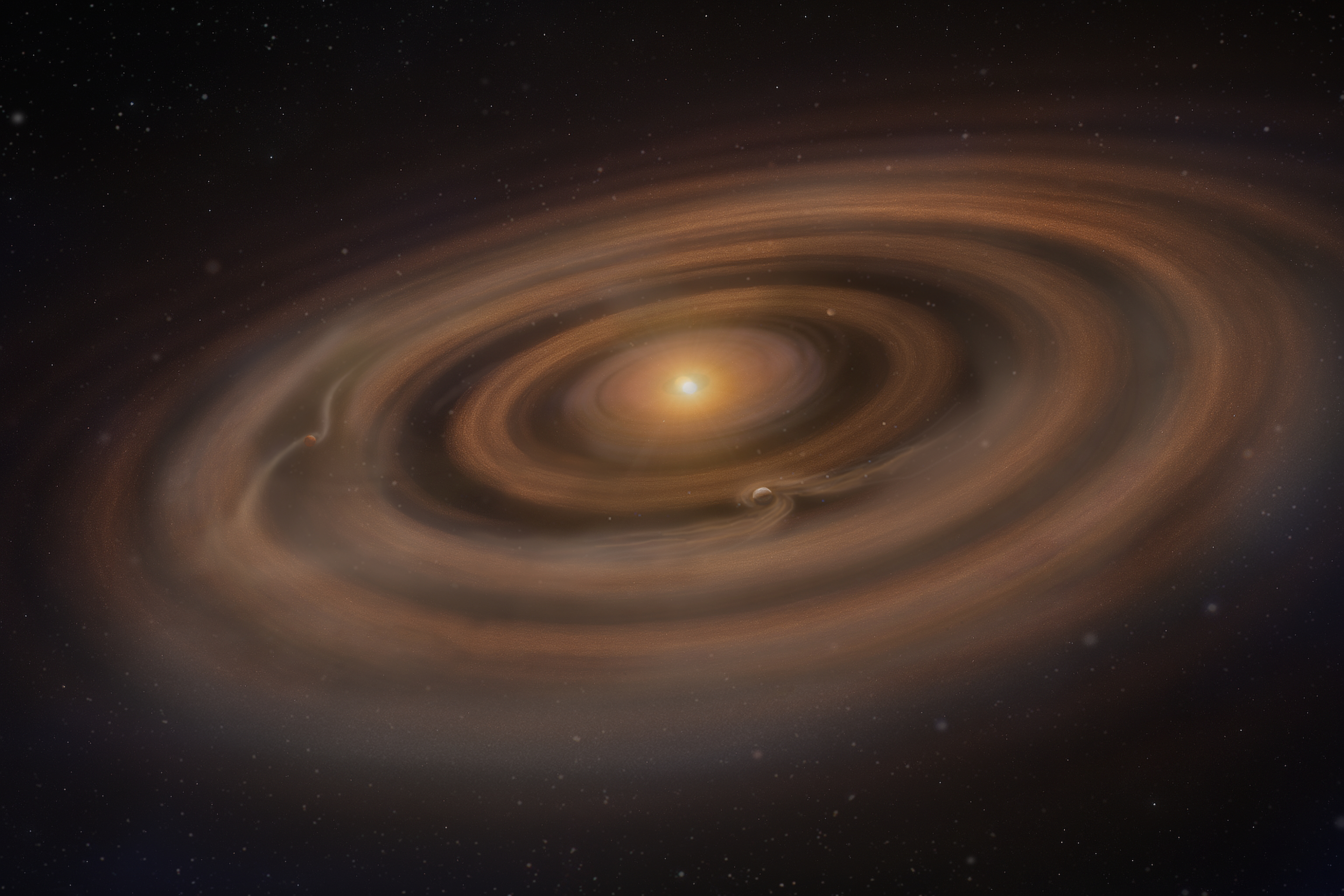
Showing posts with label planet formation. Show all posts

Friday, March 27, 2026

A Solar System in the making? Two planets spotted forming in disc around young star

PR Image eso2604a
VLT images of two planets forming around the young star WISPIT 2

PR Image eso2604b
Composite VLT image of two planets around the WISPIT 2 star

PR Image eso2604c
Spectrum of the baby exoplanet WISPIT 2c

PR Image eso2604d
Wide-field view of the area around the WISPIT 2 star

PR Image eso2604e
The young star WISPIT 2 in the constellation Aquila


Videos

Two planets spotted forming around a young star | ESO News
PR Video eso2604a
Two planets spotted forming around a young star | ESO News

Zooming into the young planetary system around the WISPIT 2 star
PR Video eso2604b
Zooming into the young planetary system around the WISPIT 2 star


Astronomers have observed two planets forming in the disc around a young star named WISPIT 2. Having previously detected one planet, the team have now employed European Southern Observatory (ESO) telescopes to confirm the presence of another. These observations, and the unique structure of the disc around the star, indicate that the WISPIT 2 system could resemble a young Solar System.

WISPIT 2 is the best look into our own past that we have to date,” says Chloe Lawlor, PhD student at the University of Galway, Ireland, and lead author of the study published today in The Astrophysical Journal Letters.

The system is only the second known, after PDS 70, where two planets have been directly observed in the process of forming around their host star. Unlike PDS 70, however, WISPIT 2 has a very extended planet-forming disc with distinctive gaps and rings. "These structures suggest that more planets are currently forming, which we will eventually detect,” Lawlor says.

"WISPIT 2 gives us a critical laboratory not just to observe the formation of a single planet but an entire planetary system," says Christian Ginski, study co-author and researcher at the University of Galway. With such observations, astronomers aim to better understand how baby planetary systems develop into mature ones, like our own.

The first newborn planet found in the system — named WISPIT 2b — was detected last year, with a mass almost five times that of Jupiter and orbiting the central star at around 60 times the distance between Earth and the Sun. “This detection of a new world in formation really showed the amazing potential of our current instrumentation,” said Richelle van Capelleveen, PhD student at Leiden Observatory, the Netherlands, and leader of the previous study. After an additional object was identified near the star [1], measurements made with ESO’s Very Large Telescope (VLT) and the VLT Interferometer (VLTI) confirmed its planetary nature. The new planet — WISPIT 2c — is four times closer to the central star and is twice as massive as WISPIT 2b. Both planets are gas giants, like the outer planets in our Solar System.

To confirm the existence of WISPIT 2c the team employed the SPHERE instrument on ESO's VLT, which captured an image of the object. The team then used the GRAVITY+ instrument on the VLTI to confirm that the object was indeed a planet. "Critically our study made use of the recent upgrade to GRAVITY+ without which we would not have been able to get such a clear detection of the planet so close to its star," says Guillaume Bourdarot, study co-author and researcher at the Max Planck Institute for Extraterrestrial Physics, Garching, Germany.

Both planets in WISPIT 2 appear in clear gaps within the disc of dust and gas circling the young star. These gaps result from each planet's development: particles in the disc accumulate, their gravity pulling in more material until an embryo planet forms. The remaining material, around each gap, creates distinctive dust rings in the disc.

Besides the gaps that the two planets were found in, there is at least one smaller gap farther out in the WISPIT 2 disc. "We suspect there may be a third planet carving out this gap" says Lawlor, "potentially of Saturn mass owing to the gap’s being much narrower and shallower". The team are eager to make follow-up observations, with Ginski noting that “with ESO’s upcoming Extremely Large Telescope, we may be able to directly image such a planet.


Source: ESO/News


Notes

[1] The first hints of the presence of a second planet came from observations made with the University of Arizona's MagAO-X on the 6.5-metre Magellan Telescopes in Chile and the University of Virginia's LMIRcam on the Large Binocular Telescope Interferometer in the USA.


More information

This research was presented in a paper to appear in The Astrophysical Journal Letters (https://doi.org/10.3847/2041-8213/ae4b3b).

The team is composed of C. Lawlor (School of Natural Sciences, Centre for Astronomy and Ryan Institute, University of Galway, Ireland [Galway]), R. F. van Capelleveen (Leiden Observatory, Leiden University,The Netherlands [Leiden]), G. Bourdarot (Max Planck Institute for Extraterrestrial Physics, Garching, Germany [MPE]), C. Ginski (Galway and Center for Astronomical Adaptive Optics, Department of Astronomy, University of Arizona, Tucson, USA [CAAO]), M. A. Kenworthy (Leiden), T. Stolker (Leiden), L. Close (CAAO), A. J. Bohn (Leiden), F. Eisenhauer (MPE and Department of Physics, Technical University of Munich, Garching, Germany), P. Garcia (Faculdade de Engenharia, Universidade do Porto, Portugal and CENTRA – Centro de Astrofísica e Gravitação, IST, Universidade de Lisboa, Portugal), S. F. Honig (School of Physics and Astronomy, University of Southampton, United Kingdom), J. Kammerer (European Southern Observatory, Garching Germany), L. Kreidberg (Max Planck Institute for Astronomy, Heidelberg, Germany), S. Lacour (LIRA, Observatoire de Paris, Université PSL, CNRS, Sorbonne Université, Université de Paris, Meudon, France), J.-B. Le Bouquin (Univ. Grenoble Alpes, CNRS, IPAG, Grenoble, France), E. Mamajek (Jet Propulsion Laboratory, California Institute of Technology, Pasadena, California, USA), M. Nowak (LIRA), T. Paumard (LIRA), C. Straubmeier (1st Institute of Physics, University of Cologne, Germany), N. van der Marel (Leiden) and the exoGRAVITY Collaboration.

The European Southern Observatory (ESO) enables scientists worldwide to discover the secrets of the Universe for the benefit of all. We design, build and operate world-class observatories on the ground — which astronomers use to tackle exciting questions and spread the fascination of astronomy — and promote international collaboration for astronomy. Established as an intergovernmental organisation in 1962, today ESO is supported by 16 Member States (Austria, Belgium, Czechia, Denmark, France, Finland, Germany, Ireland, Italy, the Netherlands, Poland, Portugal, Spain, Sweden, Switzerland and the United Kingdom), along with the host state of Chile and with Australia as a Strategic Partner. ESO’s headquarters and its visitor centre and planetarium, the ESO Supernova, are located close to Munich in Germany, while the Chilean Atacama Desert, a marvellous place with unique conditions to observe the sky, hosts our telescopes. ESO operates three observing sites: La Silla, Paranal and Chajnantor. At Paranal, ESO operates the Very Large Telescope and its Very Large Telescope Interferometer, as well as survey telescopes such as VISTA. Also at Paranal, ESO will host and operate the south array of the Cherenkov Telescope Array Observatory, the world’s largest and most sensitive gamma-ray observatory. Together with international partners, ESO operates ALMA on Chajnantor, a facility that observes the skies in the millimetre and submillimetre range. At Cerro Armazones, near Paranal, we are building “the world’s biggest eye on the sky” — ESO’s Extremely Large Telescope. From our offices in Santiago,Chile we support our operations in the country and engage with Chilean partners and society.


Links


Contacts:

Chloe Lawlor
University of Galway
Galway, Ireland
Email:
c.lawlor13@universityofgalway.ie

Christian Ginski
University of Galway
Galway, Ireland
Email
: christian.ginski@universityofgalway.ie

Richelle van Capelleveen
Leiden Observatory, Leiden University
Leiden, the Netherlands
Email:
capelleveen@strw.leidenuniv.nl

Guillaume Bourdarot
Max Planck Institute for Extraterrestrial Physics
Garching, Germany
Tel: +498930000-3295
Email:
bourdarot@mpe.mpg.de

Bárbara Ferreira
ESO Media Manager
Garching bei München, Germany
Tel: +49 89 3200 6670
Cell: +49 151 241 664 00
Email:
press@eso.org


Thursday, January 22, 2026

ALMA Reveals Teenage Years of New Worlds

This ARKS gallery of faint debris disks reveals details about their shape: belts with multiple rings, wide smooth halos, sharp edges, and unexpected arcs and clumps, which hint at the presence of planets shaping these disks; and chemical make-up: the amber colors highlight the location and abundance of the dust in the 24 disks surveyed, while the blue their carbon monoxide gas location and abundance in the six gas-rich disks. Credit: Sebastian Marino, Sorcha Mac Manamon, and the ARKS collaboration. Hi-Res File


New astronomical survey captures previously unknown growing pains in the lives of planets

Astronomers have, for the first time, captured a detailed snapshot of planetary systems in an era long shrouded in mystery. The ALMA survey to Resolve exoKuiper belt Substructures (ARKS), using the Atacama Large Millimeter/submillimeter Array (ALMA), has produced the sharpest images ever of 24 debris disks, the dusty belts left after planets finish forming. These disks are the cosmic equivalent of the teenage years for planetary systems—somewhat more mature than newborn, planet-forming disks, but not yet settled into adulthood.

A Missing Link in Planetary Family Albums

“We’ve often seen the ‘baby pictures’ of planets forming, but until now, the ‘teenage years’ have been a missing link,” says Meredith Hughes, an Associate Professor of Astronomy at Wesleyan University and co-PI of this study.

Our own Solar System’s counterpart to this phase is the Kuiper Belt, a ring of icy debris beyond Neptune that preserves a record of massive collisions and planetary migrations from billions of years ago. By studying 24 exoplanetary debris belts, the ARKS team has opened a window into what our Solar System went through as the Moon was forming and as planets jostled for their final places, and sometimes trading orbits!

Teenage Disks: Hard to “Photograph,” Impossible to Ignore

Debris disks are faint, hundreds or even thousands of times dimmer than the bright, gas-rich disks where planets are born. The ARKS team overcame these challenges and produced images of these disks in unprecedented detail. Like teenagers dodging the camera, these faint disks have managed to hide from astronomers for years. But, thanks to ALMA, astronomers can now see their complex structures: belts with multiple rings, wide smooth halos, sharp edges, and even unexpected arcs and clumps.

“We’re seeing real diversity—not just simple rings, but multi-ringed belts, halos, and strong asymmetries, revealing a dynamic and violent chapter in planetary histories,” adds Sebastián Marino, program lead for ARKS, and an Associate Professor at the University of Exeter.

Highlights and Firsts from ARKS
  • A New Benchmark: ARKS is the largest, highest-resolution survey of debris disks, akin to a ‘DSHARP-for-debris-disks’, setting a new gold standard.

  • A Dynamic, Violent Youth: About one-third of observed disks show clear substructures (multiple rings or distinct gaps) suggesting legacy features left from earlier, planet-building stages or sculpted by planets over much longer timescales.

  • Unexpected Diversity: While some disks inherit intricate structures from their earlier years, others mellow out and spread into broad belts, similar to how we expect the Solar System to have developed.

  • Clues to Planetary ‘Stirring’: Many disks show evidence for zones of calm and chaos, with vertically “puffed-up” regions, akin to our Solar System’s own mix of serene classical Kuiper Belt objects and those scattered by Neptune’s long-ago migration.

  • Surprising Gas Survivors: Several disks retain gas much longer than expected. In some systems, lingering gas may shape the chemistry of growing planets, or even push dust into wide halos.

  • Asymmetries and Arcs: Many disks are lopsided, with bright arcs or eccentric shapes, hinting at gravitational shoves from unseen planets, leftover birth scars from planetary migration, or interactions between the gas and dust.

  • Public Data Release: All ARKS observations and processed data are being made freely available to astronomers worldwide, enabling further discoveries.

Implications: Your Solar System Was Once a Wild Ride

The ARKS results show this teenage phase is a time of transition and turmoil. “These disks record a period when planetary orbits were being scrambled and huge impacts, like the one that forged Earth’s Moon, were shaping young solar systems,” says Luca Matrà, a co-PI on the survey, and Associate Professor at Trinity College Dublin.

By looking at dozens of disks around stars of different ages and types, ARKS helped decode whether chaotic features are inherited, sculpted by planets, or arise from other cosmic forces. Answering these questions could reveal whether our Solar System’s history was unique, or the norm.

Looking Ahead: Hunting for Planetary Architects

The ARKS survey’s findings are a treasure trove for astronomers hunting for young planets and seeking to understand how planet families, like our own, are built and rearranged.

“This project gives us a new lens for interpreting the craters on the Moon, the dynamics of the Kuiper Belt, and the growth of planets big and small. It’s like adding the missing pages to the Solar System’s family album,” adds Hughes.

The ARKS survey is the work of an international team of approximately 60 scientists, led by the University of Exeter, Trinity College Dublin, and Wesleyan University. For more information, visit https://arkslp.org/.


About ALMA

The Atacama Large Millimeter/submillimeter Array (ALMA), an international astronomy facility, is a partnership of the European Southern Observatory (ESO), the U.S. National Science Foundation (NSF) and the National Institutes of Natural Sciences (NINS) of Japan in cooperation with the Republic of Chile. ALMA is funded by ESO on behalf of its Member States, by NSF in cooperation with the National Research Council of Canada (NRC) and the National Science and Technology Council (NSTC) in Taiwan and by NINS in cooperation with the Academia Sinica (AS) in Taiwan and the Korea Astronomy and Space Science Institute (KASI). ALMA construction and operations are led by ESO on behalf of its Member States; by the National Radio Astronomy Observatory (NRAO), managed by Associated Universities, Inc. (AUI), on behalf of North America; and by the National Astronomical Observatory of Japan (NAOJ) on behalf of East Asia. The Joint ALMA Observatory (JAO) provides the unified leadership and management of the construction, commissioning and operation of ALMA.


About NRAO

The National Radio Astronomy Observatory (NRAO) is a facility of the U.S. National Science Foundation, operated under cooperative agreement by Associated Universities, Inc.


Leadership Team

S. Marino (University of Exeter), A. M. Hughes (Wesleyan University), and L. Matrà (Trinity College Dublin)


Collaboration Members

Y. Han (Caltech), B. Zawadzki (Wesleyan University), S. Mac Manamon (Trinity College Dublin), J. Milli (IPAG), J. B. Lovell (Center for Astrophysics, Harvard & Smithsonian), A. Brennan (Trinity College Dublin), P. Weber (Usach, Núcleo Milenio YEMS), M. R. Jankovic (University of Belgrade), M. C. Wyatt (University of Cambridge), T. Löhne (Friedrich-Schiller-Universität Jena), P. Ábrahám (Konkoly Observatory), M. Bonduelle (IPAG), A. S. Hales (NRAO), M. Booth (UKATC), C. del Burgo (Universidad de La Laguna; Instituto de Astrofísica de Canarias), J. M. Carpenter (ALMA), G. Cataldi (NAOJ), E. Chiang (Berkeley), E. Choquet (LAM), S. Ertel (University of Arizona), A. Fehr (Center for Astrophysics, Harvard & Smithsonian), J. Olofsson (ESO), Th. Henning (MPIA), J. Jennings (Flatiron Institute), G. M. Kennedy (Victoria University), Á. Kóspál (Konkoly Observatory), A. V. Krivov (Friedrich-Schiller-Universität Jena), P. Luppe (Trinity College Dublin), M. A. MacGregor (Johns Hopkins University), E. Mansell (Wesleyan University), J. P. Marshall (ASIAA), B. C. Matthews (University of Victoria), A. Moór (Konkoly Observatory), K. Öberg (Center for Astrophysics, Harvard & Smithsonian), N. Pawellek (University of Vienna), T. D. Pearce (University of Warwick), S. Pérez (Usach, Núcleo Milenio YEMS), A. A. Sefilian (University of Arizona), A. G. Sepulveda (UT Law), D. J. Wilner (Center for Astrophysics, Harvard & Smithsonian), C. Baruteau (IRAP), R. Bendahan-West (University of Exeter), A. Bayo (ESO), R. Booth (University of Leeds), F. Castillo (Usach, Núcleo Milenio YEMS), A. Cheruiyot (Wesleyan University), J. Ehrhardt (ESO), Th. M. Esposito (Berkeley), V. Gupta (University of Exeter), J. Hom (University of Arizona), A. Higuchi (Musashino University), C. Hou (Wesleyan University), J. Kittling (KIPAC), Hiroshi Kobayashi (Nagoya University), J. Lee (Wesleyan University), Y. Mpofu (Wesleyan University), R. Nakatani (UNIMI), A. Nurmohamed (Wesleyan University), M. Pan (Center for Astrophysics, Harvard & Smithsonian), V. Squicciarini (University of Exeter), J. Zander (Friedrich-Schiller-Universität Jena).

Funding Acknowledgement

ARKS would not have been possible without the support of ALMA and its partners—the European Southern Observatory representing its member states, the United States National Science Foundation, and the National Institutes of Natural Sciences of Japan, together with the National Research Council of Canada, the Ministry of Science and Technology of Taiwan and the Academia Sinica Institute of Astronomy and Astrophysics, and the Korea Astronomy and Space Science Institute, in cooperation with the Republic of Chile; the Beatriz Galindo grant program; the Brinson Foundation; the Canadian Advanced Network for Astronomy Research supported by the National Research Council of Canada, the Canadian Space Agency, CANARIE, the Canadian Foundation for Innovation, and the Digital Research Alliance of Canada; the Chilean National Agency for Research and Development including the FONDECYT programme and the Millennium Science Initiative Program; the Consejería de Economía, Conocimiento y Empleo of the Government of the Canary Islands; the European Research Council (grants FEED and E-BEANS, numbers 101162711 and 100117693 ); the French National Planetology Program; the French National Research Agency; the Gates Cambridge Trust; the Heising–Simons Foundation; the Hungarian Ministry of Culture and Innovation through the National Research, Development and Innovation Fund; the Irish Research Council; the Institute of Physics Belgrade; Marie Skłodowska-Curie Actions; the NASA Connecticut Space Grant Consortium; the NASA Exoplanet Research Program; the North American ALMA Science Center; the Opticon–RadioNet Pilot funded by the European Union’s Horizon 2020 research and innovation programme; the Royal Society; the Smithsonian Institution; the Simons Foundation; the Space Telescope Science Institute; the Spanish Ministry of Science, Innovation and Universities and the European Regional Development Fund; the United Kingdom node of the European ALMA Regional Centre; United Kingdom Research and Innovation; the United States National Science Foundation; the University of La Laguna; the Warwick Prize Fellowship; the Ministry of Science, Technological Development and Innovations of the Republic of Serbia; and the National Science and Technology Council of Taiwan.


Thursday, October 16, 2025

First-ever Detection of “Heavy Water” in a Planet-forming Disk

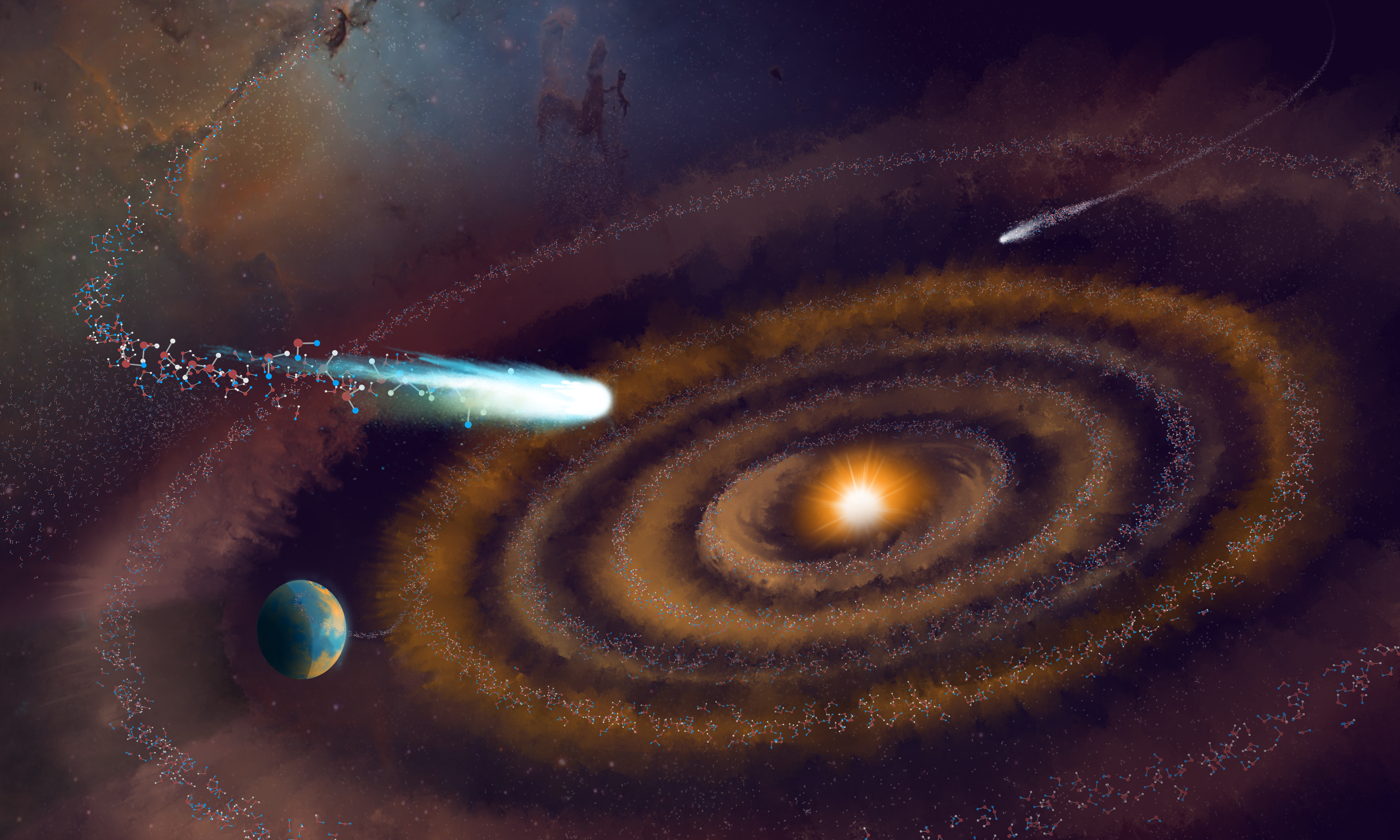
This artist’s impression shows the evolution of heavy water molecules (H2O, HDO, and D2O) as they have been observed in giant molecular clouds, a planet forming-disk, and comets—before they eventually may have made their way to Earth.Credit: NSF/AUI/NSF NRAO/P. Vosteen/B. Saxton.
Hi-Res File


New ALMA data traces water found in comets, and planet formation, back to the dawn of the cosmos

The discovery of ancient water in a planet-forming disk reveals that some of the water found in comets—and maybe even Earth—is older than the disk’s star itself, offering breakthrough insights into the history of water in our Solar System.

Astronomers using the Atacama Large Millimeter/submillimeter Array (ALMA) have made a first-ever detection of doubly deuterated water (D₂O, or “heavy water”) in a planet-forming disk around V883 Ori, a young star. This means that the water in this disk, and by extension the water in comets that form here, predates the birth of the star itself, having journeyed through space from ancient molecular clouds long before this solar system formed.

“Our detection indisputably demonstrates that the water seen in this planet-forming disk must be older than the central star and formed at the earliest stages of star and planet formation,” shares Margot Leemker, lead author on this paper, and a postdoc with the Department of Physics, University of Milan. “This presents a major breakthrough in understanding the journey of water through planet formation, and how this water made its way to our Solar System, and possibly Earth, through similar processes.”

Does this mean that the water in your morning cup of coffee could be older than the Sun? The chemical fingerprinting of D₂O shows that these water molecules have survived the violent processes of star and planet formation, travelling billions of kilometers through space and time before, ending up in planetary systems like our own. Instead of being destroyed and reformed in the disk, the bulk of this water is inherited from the earliest, coldest stages of star formation, a cosmic hand-me-down that may also be present on Earth today.

“Until now, we weren’t sure if most of the water in comets and planets formed fresh in young disks like V883 Ori, or if it’s ‘pristine,’ originating from ancient interstellar clouds,” shares John Tobin, a scientist with the U.S. National Science Foundation National Radio Astronomy Observatory, and second author on this new paper. The detection of heavy water, using sensitive isotopologue ratios (D₂O/H₂O), proves the water’s ancient heritage and provides a missing link between clouds, disks, comets, and ultimately planets. This finding is the first direct evidence of water’s interstellar journey from clouds to the materials that form planetary systems—unchanged and intact.

Water is fundamental to life and habitability. Knowing where planetary water comes from helps us understand the ingredients for life in our Solar System and in others. This discovery suggests that many young planets, and maybe even worlds beyond our own, could inherit water billions of years older than themselves, reminding us how deeply interconnected our existence is with the universe’s ancient past.


About NRAO

The National Radio Astronomy Observatory (NRAO) is a facility of the U.S. National Science Foundation, operated under cooperative agreement by Associated Universities, Inc.

About ALMA

The Atacama Large Millimeter/submillimeter Array (ALMA), an international astronomy facility, is a partnership of the European Southern Observatory (ESO), the U.S. National Science Foundation (NSF) and the National Institutes of Natural Sciences (NINS) of Japan in cooperation with the Republic of Chile. ALMA is funded by ESO on behalf of its Member States, by NSF in cooperation with the National Research Council of Canada (NRC) and the National Science and Technology Council (NSTC) in Taiwan and by NINS in cooperation with the Academia Sinica (AS) in Taiwan and the Korea Astronomy and Space Science Institute (KASI).

ALMA construction and operations are led by ESO on behalf of its Member States; by the National Radio Astronomy Observatory (NRAO), managed by Associated Universities, Inc. (AUI), on behalf of North America; and by the National Astronomical Observatory of Japan (NAOJ) on behalf of East Asia. The Joint ALMA Observatory (JAO) provides the unified leadership and management of the construction, commissioning and operation of ALMA.


Wednesday, June 25, 2025

New Super-resolution Imaging Reveals the First Step of Planet Formation after Star Birth

Artist’s impression of the distinctive substructure in a protoplanetary disk formed a few hundred thousand years after the birth of the central star. Credit: Y. Nakamura, A. Shoshi et al.

A scatter plot of bolometric temperatures and dust disk radii of the sources investigated in this study and those observed in the eDisk project. Purple, red, and yellow markings indicate disks with characteristic structures or potential ones with substructures. A bolometric temperature of 650 K corresponds to a disk around a central star that has evolved for about one million years since its formation, suggesting that characteristic substructures begin to emerge at even earlier stages. Credit: A. Shoshi et al.

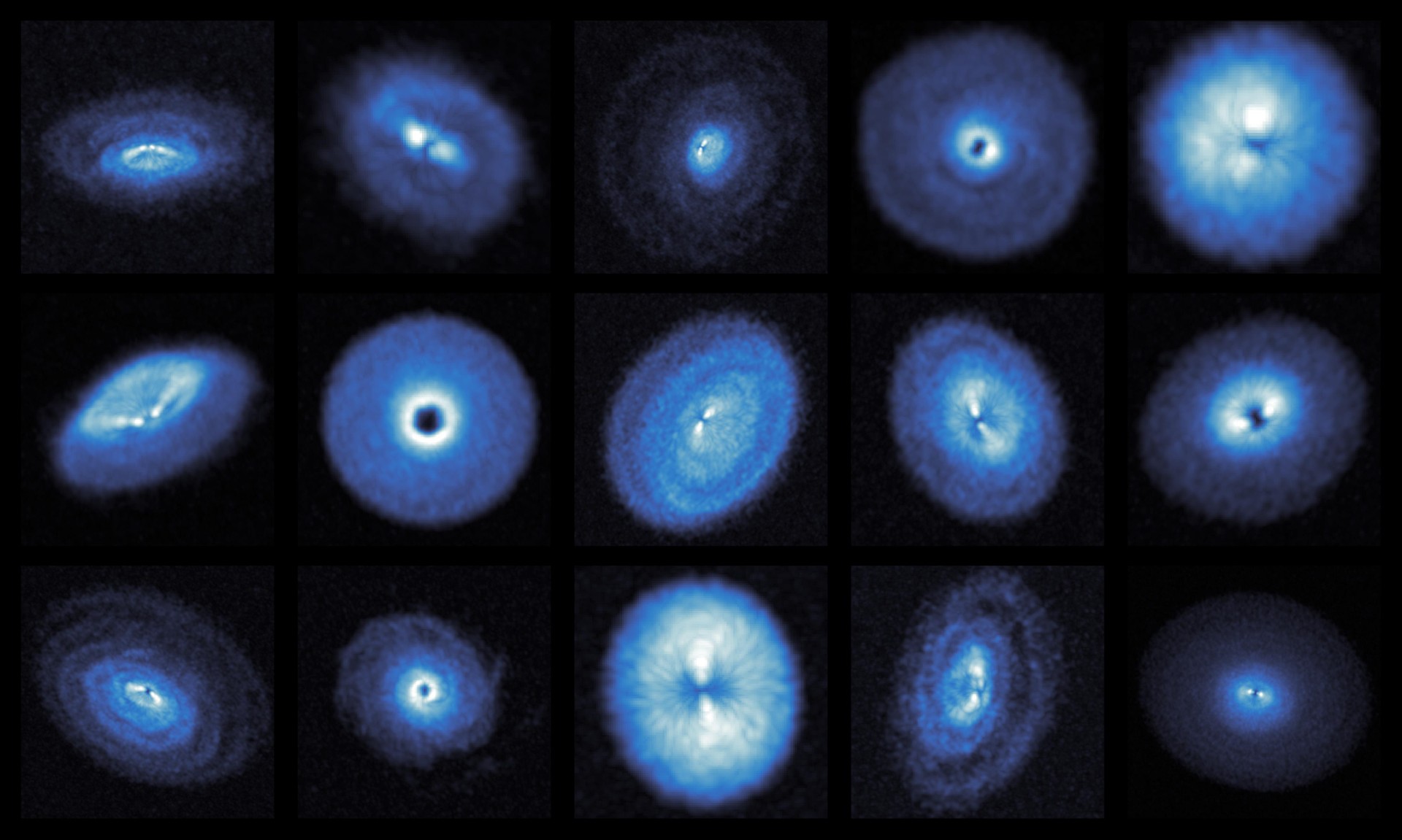
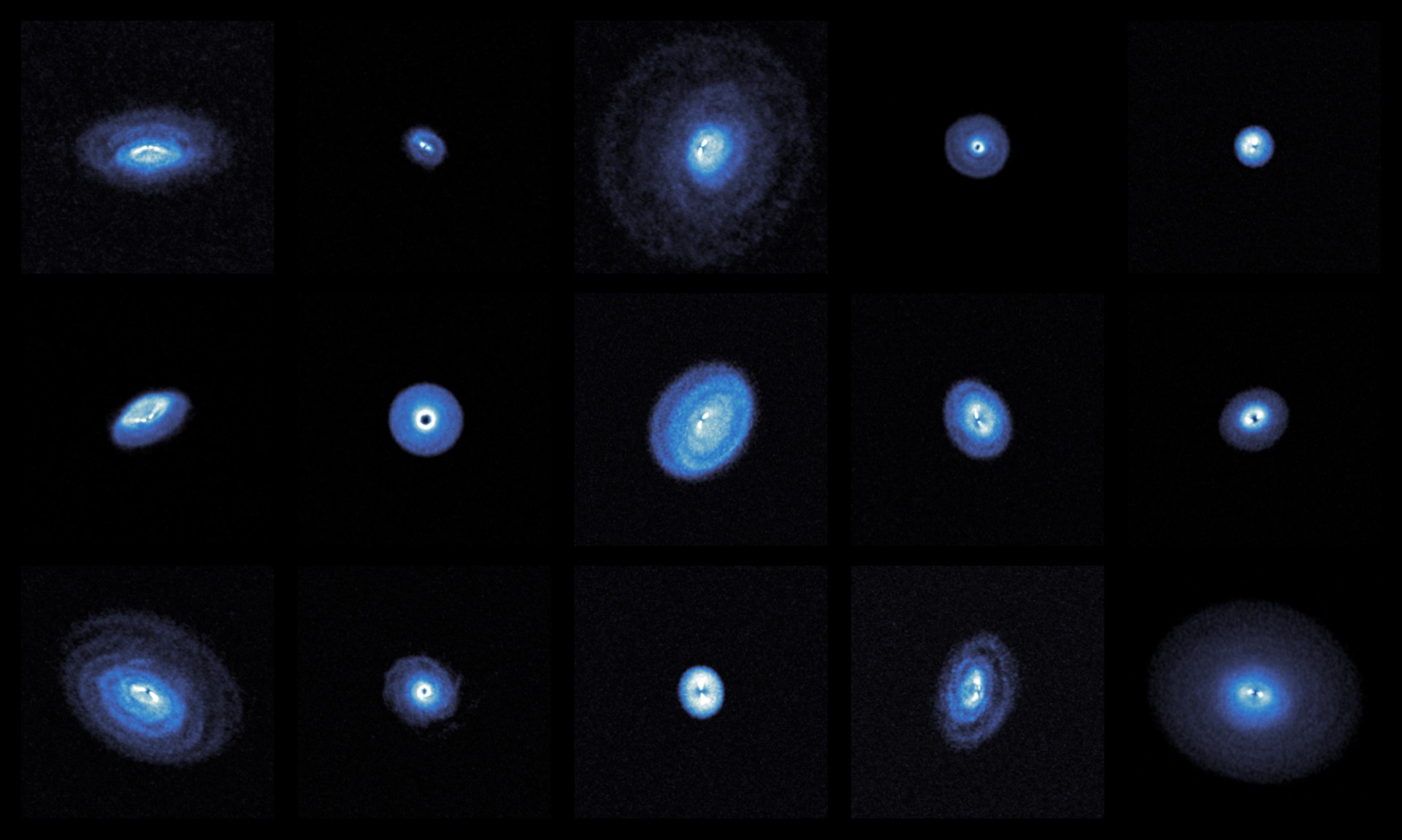
A comparison of images of protoplanetary disks in the Ophiuchus star-forming region, created with super-resolution imaging with sparse modelling versus a conventional imaging method. The resolution is indicated by the white ellipse in the lower left corner of each panel, with a smaller ellipse denoting higher resolution. The white line in the lower right of each panel indicates a scale of 30 AU. The evolution stage of the central stars progresses from left to right, and from top to bottom in the same row. Credit: ALMA(ESO/NAOJ/NRAO), A. Shoshi et al.


A research team led by Ayumu Shoshi of Kyushu University and the Academia Sinica Institute of Astronomy and Astrophysics (ASIAA) revealed protoplanetary disks around protostars that had not been clearly observed in previous analyses, by employing a new imaging technique with sparse modeling on ALMA archival data. The targets were 78 disks in the Ophiuchus star-forming region. These disks composed of gas and dust that form around protostars immediately after their birth are, so to speak, the cradles of planets. The new technique revealed various characteristic disk substructures, including rings and spirals, that were previously undetectable with conventional methods. Notably, these distinctive substructures were found for a significant number of stars in their early formation stages, approximately several hundred thousand years after the star birth. This suggests the possible coevolution of stars and planets in a gas and dust rich environment, providing an important clue to understanding the process of planet formation.

Identifying the formation period of planetary systems, such as our Solar System, could be the beginning of the journey to discover the origin of life. The key to this is the unique substructures found in protoplanetary disks – the sites of planet formation. A protoplanetary disk is composed of low-temperature molecular gas and dust, surrounding a protostar. If a planet exists in the disk, its gravity will gather or eject materials within the disk, forming characteristic substructures such as rings or spirals. In other words, various disk substructures can be interpreted as “messages” from the forming planets. To study these substructures in detail, high-resolution radio observations with ALMA are required.

Numerous ALMA observations of protoplanetary disks (or circumstellar disks) have been conducted so far. In particular, two ALMA large programs, DSHARP and eDisk, have revealed the detailed distribution of dust in protoplanetary disks through high-resolution observations. The DSHARP project discovered that distinctive structures are common in circumstellar disks around 20 young stars, each exceeding one million years since the onset of star formation (see note below). On the other hand, fewer distinctive structures were found by the eDisk project that investigated disks around 19 protostars in the accretion phase (the stage where mass accretion onto the star and the disk is active). This phase occurs approximately 10,000 to 100,000 years after star birth. This suggests that disks have diverse characteristics depending on the age of the star.

Here, the question is when do substructures, the signs of planet formation, appear in disks. To find the answer, it is necessary to observe disks of a wide range of intermediate ages that have yet to be explored. However, limitations on the number of disks observable at high resolution, due to distance and observational time, make it challenging to conduct a statistically significant survey with a sufficiently large sample size.

To overcome these limitations, the research team turned to super-resolution imaging with sparse modeling. In radio astronomy, images are commonly restored based on a specific assumption to compensate for missing observation data. The imaging method employed this time reconstructs based on a more accurate assumption than the conventional approach, producing higher-resolution images even though the same observation data is used. PRIISM (Python module for Radio Interferometry Imaging with Sparse Modeling), the public software developed by a Japanese research team was used in this study. The research team utilized this new imaging technique on ALMA archival data, targeting 78 disks in the Ophiuchus star-forming region, located 460 light years from the Solar System.

As a result, more than half of the images produced in this study achieved a resolution over three times higher than that of the conventional method, which is comparable to that of the DSHARP and eDisk projects (Figure 1). Moreover, the total number of samples in this study is nearly four times larger than that of the previous two projects, significantly improving the robustness of our statistical analysis. Among the analyzed 78 disks, 27 disks were revealed to have ring or spiral structures, 15 of which were identified for the first time in this study.

The team combined the Ophiuchus sample with those of the eDisk project to conduct a statistical analysis. As a result, they found that the characteristic disk substructures emerge in disks with radii larger than 30 astronomical units (au) during the early stage of star formation, just a few hundred thousand years after a star was born (Figure 2). This suggests that planets begin to form at a much earlier stage than previously believed, when the disk still possesses abundant gas and dust (Figure 3). In other words, planets grow together with their very young host stars. Ayumu Shoshi says, “These findings, bridging the gap between the eDisk and DSHARP projects, were enabled by the innovative imaging that allows for both achieving high resolution and a large number of samples. While these findings only pertain to the disks in the constellation Ophiuchus, future studies of other star-forming regions will reveal whether this tendency is universal.”

Scientific Paper


Note

The evolutionary stage of a protostar is estimated using the bolometric temperature around the star. The bolometric temperature is an apparent temperature derived from the total brightness of an object across all wavelengths. A higher bolometric temperature indicates a more advanced evolutionary stage, and a temperature of 650 K suggests that approximately one million years have passed since the birth of the star.


Additional Information

This research has been published in The Publications of the Astronomical Society of Japan on April 22, 2025, as Ayumu Shoshi et al. “ALMA 2D super-resolution imaging survey of Ophiuchus Class I/flat spectrum/II disks. I. Discovery of new disk substructures” (DOI:
https://doi.org/10.1093/pasj/psaf026)

Co-researchers: Masayuki Yamaguchi (ASIAA), Takayuki Muto (Kogakuin University), Naomi Hirano (ASIAA), Ryohei Kawabe (Graduate School of Advanced Studies, SOKENDAI/National Astronomical Observatory of Japan), Takashi Tsukagoshi (Ashikaga University), and Masahiro Machida (Kyushu University)

The
original press release was published by the National Astronomical Observatory of Japan (NAOJ), an ALMA partner on behalf of East Asia.

The Atacama Large Millimeter/submillimeter Array (ALMA), an international astronomy facility, is a partnership of the European Southern Observatory (ESO), the U.S. National Science Foundation (NSF), and the National Institutes of Natural Sciences (NINS) of Japan in cooperation with the Republic of Chile. ALMA is funded by ESO on behalf of its Member States, by NSF in cooperation with the National Research Council of Canada (NRC) and the National Science and Technology Council (NSTC) in Taiwan, and by NINS in cooperation with the Academia Sinica (AS) in Taiwan and the Korea Astronomy and Space Science Institute (KASI).

ALMA construction and operations are led by ESO on behalf of its Member States; by the National Radio Astronomy Observatory (NRAO), managed by Associated Universities, Inc. (AUI), on behalf of North America; and by the National Astronomical Observatory of Japan (NAOJ) on behalf of East Asia. The Joint ALMA Observatory (JAO) provides the unified leadership and management of ALMA's construction, commissioning, and operation.


Contacts:

Nicolás Lira
Education and Public Outreach Coordinator
Joint ALMA Observatory, Santiago - Chile
Phone:
+56 2 2467 6519
Cel: +56 9 9445 7726
Email: nicolas.lira@alma.cl

Yuichi Matsuda
ALMA EA-ARC Staff Member
NAOJ
Email:
yuichi.matsuda@nao.ac.jp

Jill Malusky
Public Information Officer
NRAO
Phone: +1 304-456-2236
Email:
jmalusky@nrao.edu

Bárbara Ferreira
ESO Media Manager
Garching bei München, Germany
Phone: +49 89 3200 6670
Email:
press@eso.org


Thursday, May 01, 2025

exoALMA Gives Astronomers A New Look At How Planets Are Formed

Deep ALMA observations of 12CO emission from fifteen protoplanetary disks reveal a stunning range of structures in the gas morphology including gaps, rings and spirals. Credit: Richard Teague and the exoALMA Collaboration.
Hi-Res File

Deep ALMA observations of 12CO emission, (all sources are to scale to emphasize size differences) from fifteen protoplanetary disks reveal a stunning range of structures in the gas morphology including gaps, rings and spirals. Credit: Richard Teague and the exoALMA Collaboration.
Hi-Res File

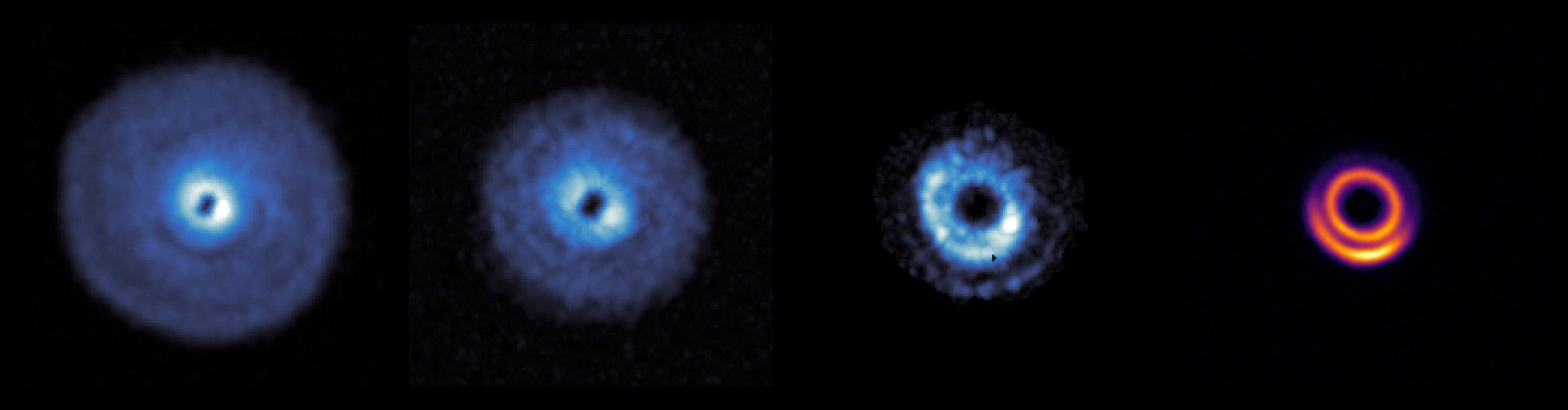
Four faces of HD 135344B: the 12CO, 13CO, CS and continuum emission form this protoplanetary disk all show a complex morphology suggestive of a vortex. Credit: Richard Teague and the exoALMA Collaboration.
Hi-Res File

An artist's impression of new data collected by the exoALMA large program, which studied young star systems to map the motions of gas to uncover the processes that form planetary systems and identify signs of infant planets, including gaps and rings in the dust disks around stars, swirling motions in the gas caused by a planet's gravity, and physical changes in the disk that might signal a planet's presence. Credit: NSF/AUI/NSF NRAO/S.Dagnello.
Hi-Res File


Beyond planet hunting, this survey will reveal the mechanics behind planet forming discs

A team of international astronomers have embarked on an exciting new project to hunt for planets forming around young stars. The exoALMA project, using the powerful Atacama Large Millimeter/submillimeter Array (ALMA) in Chile, is peering into the dusty disks where planets are born. Thanks to newly developed advanced imaging techniques, exoALMA has revealed the most exquisite images of young solar systems, never before seen by astronomers. This research project involved 17 papers published in a special issue of the Astrophysical Journal of Letters, with several more coming this summer. ALMA is supported in part by the U.S. National Science Foundation through the NSF National Radio Astronomy Observatory (NSF NRAO).

“The new approaches we’ve developed to gather this data and images are like switching from reading glasses to high-powered binoculars—they reveal a whole new level of detail in these planet-forming systems,” said Richard Teague, PI of the exoALMA project. “We’re seeing evidence of hugely perturbed and dynamic disks, highly suggestive of young planets shaping the disks they’re born in.” The team targeted 15 young star systems to map the motions of the gas in detail in order to uncover the processes that form planetary systems, and, in certain cases, identify the telltale signs of infant planets, including gaps and rings in the dust disks around stars, swirling motions in the gas caused by a planet’s gravity, and physical changes in the disk that might signal a planet’s presence.

Unlike traditional planet-hunting methods that look for a young planet’s direct light, exoALMA is searching for the effects planets have on their surroundings. This approach allows astronomers to potentially detect much younger planets than ever before. “It’s like trying to spot a fish by looking for ripples in a pond, rather than trying to see the fish itself,” adds Christophe Pinte, an astrophysicist at the Institute of Astrophysics and Planetology of Grenoble, Monash University, and co-PI of the exoALMA team.

The team emphasized the technical challenges involved in processing the massive amounts of data to produce such sharp images. “We developed new techniques to precisely align observations taken at different times and remove unwanted noise and distortions,” explained Dr. Ryan Loomis, a scientist with the U.S. National Science Foundation National Radio Astronomy Observatory, who led the data processing publication, “We had to carefully combine and clean up the data to reveal all the subtle details.”

These new calibration approaches and the development of tailored data-processing and analysis techniques from the exoALMA project will improve astronomers’ ability to map out the planet formation process in several key ways.

  • Higher resolution and sensitivity: The observations provide an unprecedented combination of high angular (100 mas, or 14 au at the typical distances of the sources) and spectral (26 m/s) resolution data of gas emission from protoplanetary disks, allowing astronomers to detect subtle structures and motions that reveal key processes of planet formation.
  • Multiple molecular tracers: By observing 12CO, 13CO, and CS emission simultaneously, astronomers can probe different vertical layers and physical conditions within the disks.
  • Improved imaging and calibration techniques: The careful alignment, self-calibration, and imaging procedures developed allow for higher fidelity images with fewer artifacts, enabling more confident detection of real disk features.
  • Development and validation of numerical and analytical methods: The refinement of new analysis techniques alongside comprehensive benchmarking efforts ensure all information is accurately extracted from the data while simulations offer robust predictions to be tested.
 
“It is through this joint analysis of the gas and dust which is shedding light on the processes which are active within a protoplanetary disk and which may be responsible for exciting the structure so commonly observed,” comments Stefano Facchini, co-PI of exoALMA based at the University of Milan.

Looking ahead, the exoALMA project promises to revolutionize scientists’ understanding of how planets interact with their natal environments, and tackle the challenge of highly asymmetric sources, as revealed by the complex 2-dimensional kinematical pattern in these disks. The first exoALMA findings are published in a series of papers in The Astrophysical Journal Letters. All of the data and images will be made publicly available to support further scientific discoveries.


About NRAO

The National Radio Astronomy Observatory (NRAO) is a facility of the U.S. National Science Foundation, operated under cooperative agreement by Associated Universities, Inc.


About ALMA

The Atacama Large Millimeter/submillimeter Array (ALMA), an international astronomy facility, is a partnership of the European Southern Observatory (ESO), the U.S. National Science Foundation (NSF) and the National Institutes of Natural Sciences (NINS) of Japan in cooperation with the Republic of Chile. ALMA is funded by ESO on behalf of its Member States, by NSF in cooperation with the National Research Council of Canada (NRC) and the National Science and Technology Council (NSTC) in Taiwan and by NINS in cooperation with the Academia Sinica (AS) in Taiwan and the Korea Astronomy and Space Science Institute (KASI).

ALMA construction and operations are led by ESO on behalf of its Member States; by the National Radio Astronomy Observatory (NRAO), managed by Associated Universities, Inc. (AUI), on behalf of North America; and by the National Astronomical Observatory of Japan (NAOJ) on behalf of East Asia. The Joint ALMA Observatory (JAO) provides the unified leadership and management of the construction, commissioning and operation of ALMA.


Monday, January 20, 2025

ALMA Uncover Surprising New Methods Planets May Form

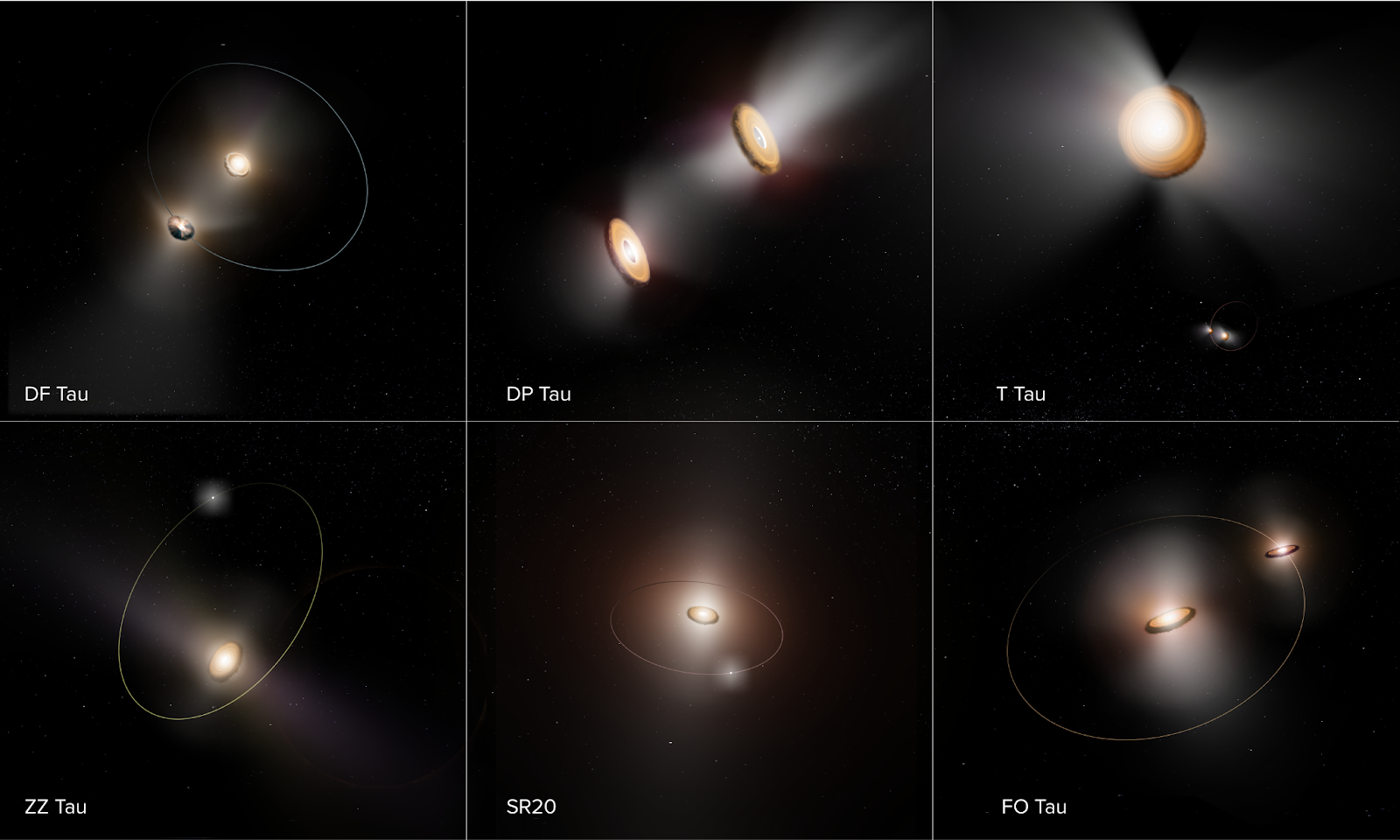
Circumstellar disks in young multiple star systems, as discovered by ALMA. Where the orbits are known, they are included with white lines. Credit: NSF/AUI/NSF NRAO/B. Saxton.
Original Image


Tucked away in a star-forming region in the Taurus constellation, a pair of circling stars display some unexpected differences in the circumstellar disks of dust and gas surrounding them. A new study led by researchers at Lowell Observatory, combining data from the Atacama Large Millimeter/submillimeter Array (ALMA) and Keck Observatory, has unveiled intriguing findings about planet formation in this binary star system, known as DF Tau, along with other systems in this region.

DF Tau consists of two young stars with nearly equal masses, orbiting each other every 48 years. Since both stars likely formed together, with the same composition in the same environment, astronomers would expect them to share different things in common, like having similar circumstellar disks. But this is not the case—while the brighter primary star has an active inner disk, the secondary star's inner disk appears to have almost completely disappeared. These unexpected differences challenge current theories of disk evolution and planet formation.

Like a potter's wheel shapes clay into various forms, a circumstellar disk provides the materials and environment for planets to form. Over time, the dust and gas in the disk will clump together, eventually forming planets, moons, and other celestial bodies. The disks won't last forever — as a star matures and planets form, the disk gradually disappears. So, what caused the unusual dissipation observed in the circumstellar disk of the secondary star?

High-resolution ALMA imaging, combined with optical and infrared data from other telescopes, allowed researchers to study, analyze, and compare the stars' properties and disks. This binary has a relatively small, tight orbit, which means gravity truncates the outer parts of the disk, but it is unlikely that the current binary orbit could alter the inner disk. Instead, other processes may be at work. "The dispersal of circumstellar disks is a complicated process with many unknowns. By looking at systems that form together, we can control one major variable: time. DF Tau and other systems in our survey tell us that disk evolution isn't strictly a function of time; other processes are at play," shares Taylor Kutra of Lowell Observatory, lead author of this research.

Binary systems like DF Tau and other sources in this ALMA survey offer a natural laboratory to study how circumstellar disks evolve. Understanding these processes is essential for refining models of planet formation because disk evolution sets the timescale on which planet formation occurs. This research highlights the diversity of disk behaviors and underscores the need for further studies to unravel the factors influencing their lifespans and structures. These findings deepen our understanding of binary star systems and shed light on the broader mechanisms shaping planetary systems across the galaxy.


Additional Information

The results of the observation are published in the following scientific article:

Kutra et.al "
Sites of Planet Formation in Binary Systems. II. Double the Disks in DF Tau".

The original press release was published by the National Radio Astronomical Observatory (NRAO) of the United States, an ALMA partner on behalf of North America.

The Atacama Large Millimeter/submillimeter Array (ALMA), an international astronomy facility, is a partnership of the European Organization for Astronomical Research in the Southern Hemisphere (ESO), the U.S. National Science Foundation (NSF) and the National Institutes of Natural Sciences (NINS) of Japan in cooperation with the Republic of Chile. ALMA is funded by ESO on behalf of its Member States, by NSF in cooperation with the National Research Council of Canada (NRC) and the National Science and Technology Council (NSTC) in Taiwan, and by NINS in cooperation with the Academia Sinica (AS) in Taiwan and the Korea Astronomy and Space Science Institute (KASI).

ALMA construction and operations are led by ESO on behalf of its Member States; by the National Radio Astronomy Observatory (NRAO), managed by Associated Universities, Inc. (AUI), on behalf of North America; and by the National Astronomical Observatory of Japan (NAOJ) on behalf of East Asia. The Joint ALMA Observatory (JAO) provides the unified leadership and management of the construction, commissioning, and operation of ALMA.


Contacts:

Nicolás Lira
Education and Public Outreach Coordinator
Joint ALMA Observatory, Santiago - Chile
Phone:
+56 2 2467 6519
Cel: +56 9 9445 7726
Email: nicolas.lira@alma.cl

Jill Malusky
Public Information Officer
NRAO
Phone:
+1 304-456-2236
Email: jmalusky@nrao.edu

Bárbara Ferreira
ESO Media Manager
Garching bei München, Germany
Phone:
+49 89 3200 6670
Email: press@eso.org

Yuichi Matsuda
ALMA EA-ARC Staff Member
NAOJ
Email:
yuichi.matsuda@nao.ac.jp


Thursday, November 07, 2024

Asteroid grains shed light on the outer solar system’s origins

Artist's conception of the dust and gas surrounding a newly formed planetary system
Credit: NASA

A weak magnetic field likely pulled matter inward to form the outer planetary bodies, from Jupiter to Neptune

Tiny grains from a distant asteroid are revealing clues to the magnetic forces that shaped the far reaches of the solar system over 4.6 billion years ago.

Scientists at MIT and elsewhere have analyzed particles of the asteroid Ryugu, which were collected by the Japanese Aerospace Exploration Agency’s (JAXA) Hayabusa2 mission and brought back to Earth in 2020. Scientists believe Ryugu formed on the outskirts of the early solar system before migrating in toward the asteroid belt, eventually settling into an orbit between Earth and Mars.

The team analyzed Ryugu’s particles for signs of any ancient magnetic field that might have been present when the asteroid first took shape. Their results suggest that if there was a magnetic field, it would have been very weak. At most, such a field would have been about 15 microtesla. (The Earth’s own magnetic field today is around 50 microtesla.)

Even so, the scientists estimate that such a low-grade field intensity would have been enough to pull together primordial gas and dust to form the outer solar system’s asteroids and potentially play a role in giant planet formation, from Jupiter to Neptune.

The team’s results, which are published today (November 6, 2024) in the journal AGU Advances, show for the first time that the distal solar system likely harbored a weak magnetic field. Scientists have known that a magnetic field shaped the inner solar system, where Earth and the terrestrial planets were formed. But it was unclear whether such a magnetic influence extended into more remote regions, until now.

“We’re showing that, everywhere we look now, there was some sort of magnetic field that was responsible for bringing mass to where the sun and planets were forming,” says study author Benjamin Weiss, the Robert R. Shrock Professor of Earth and Planetary Sciences at MIT. “That now applies to the outer solar system planets.”

The study’s lead author is Elias Mansbach PhD ’24, who is now a postdoc at Cambridge University. MIT co-authors include Eduardo Lima, Saverio Cambioni, and Jodie Ream, along with Michael Sowell and Joseph Kirschvink of Caltech, Roger Fu of Harvard University, Xue-Ning Bai of Tsinghua University, Chisato Anai and Atsuko Kobayashi of the Kochi Advanced Marine Core Research Institute, and Hironori Hidaka of Tokyo Institute of Technology.

A far-off field

Around 4.6 billion years ago, the solar system formed from a dense cloud of interstellar gas and dust, which collapsed into a swirling disk of matter. Most of this material gravitated toward the center of the disk to form the sun. The remaining bits formed a solar nebula of swirling, ionized gas. Scientists suspect that interactions between the newly formed sun and the ionized disk generated a magnetic field that threaded through the nebula, helping to drive accretion and pull matter inward to form the planets, asteroids, and moons.

“This nebular field disappeared around 3 to 4 million years after the solar system’s formation, and we are fascinated with how it played a role in early planetary formation,” Mansbach says.

Scientists previously determined that a magnetic field was present throughout the inner solar system — a region that spanned from the sun to about 7 astronomical units (AU), out to where Jupiter is today. (One AU is the distance between the sun and the Earth.) The intensity of this inner nebular field was somewhere between 50 to 200 microtesla, and it likely influenced the formation of the inner terrestrial planets. Such estimates of the early magnetic field are based on meteorites that landed on Earth and are thought to have originated in the inner nebula.

“But how far this magnetic field extended, and what role it played in more distal regions, is still uncertain because there haven’t been many samples that could tell us about the outer solar system,” Mansbach says.

Rewinding the tape

The team got an opportunity to analyze samples from the outer solar system with Ryugu, an asteroid that is thought to have formed in the early outer solar system, beyond 7 AU, and was eventually brought into orbit near the Earth. In December 2020, JAXA’s Hayabusa2 mission returned samples of the asteroid to Earth, giving scientists a first look at a potential relic of the early distal solar system.

The researchers acquired several grains of the returned samples, each about a millimeter in size. They placed the particles in a magnetometer — an instrument in Weiss’ lab that measures the strength and direction of a sample’s magnetization. They then applied an alternating magnetic field to progressively demagnetize each sample.

“Like a tape recorder, we are slowly rewinding the sample’s magnetic record,” Mansbach explains. “We then look for consistent trends that tell us if it formed in a magnetic field.” They determined that the samples held no clear sign of a preserved magnetic field. This suggests that either there was no nebular field present in the outer solar system where the asteroid first formed, or the field was so weak that it was not recorded in the asteroid’s grains. If the latter is the case, the team estimates such a weak field would have been no more than 15 microtesla in intensity.

The researchers also reexamined data from previously studied meteorites. They specifically looked at “ungrouped carbonaceous chondrites” — meteorites that have properties that are characteristic of having formed in the distal solar system. Scientists had estimated the samples were not old enough to have formed before the solar nebula disappeared. Any magnetic field record the samples contain, then, would not reflect the nebular field. But Mansbach and his colleagues decided to take a closer look.

“We reanalyzed the ages of these samples and found they are closer to the start of the solar system than previously thought,” Mansbach says. “We think these samples formed in this distal, outer region. And one of these samples does actually have a positive field detection of about 5 microtesla, which is consistent with an upper limit of 15 microtesla.”

This updated sample, combined with the new Ryugu particles, suggest that the outer solar system, beyond 7 AU, hosted a very weak magnetic field, that was nevertheless strong enough to pull matter in from the outskirts to eventually form the outer planetary bodies, from Jupiter to Neptune.

“When you’re further from the sun, a weak magnetic field goes a long way,” Weiss notes. “It was predicted that it doesn’t need to be that strong out there, and that’s what we’re seeing.”

The team plans to look for more evidence of distal nebular fields with samples from another far-off asteroid, Bennu, which were delivered to Earth in September 2023 by NASA’s OSIRIS-REx spacecraft.

“Bennu looks a lot like Ryugu, and we’re eagerly awaiting first results from those samples,” Mansbach says.

This research was supported, in part, by NASA.

Jennifer Chu | MIT News


Thursday, November 09, 2023

NASA's Webb Findings Support Long-Proposed Process of Planet Formation

Two Protoplanetary Disks (Artist Concept)
Credits: Illustration: NASA, ESA, CSA, Joseph Olmsted (STScI)

Water Abundance (MIRI Emission Spectrum)
Credits: Illustration: NASA, ESA, CSA, Leah Hustak (STScI))

Pebble Drift Infographic
Credits: Illustration: NASA, ESA, CSA, Joseph Olmsted (STScI)


Scientists using NASA’s James Webb Space Telescope just made a breakthrough discovery in revealing how planets are made. By observing water vapor in protoplanetary disks, Webb confirmed a physical process involving the drifting of ice-coated solids from the outer regions of the disk into the rocky-planet zone.

Theories have long proposed that icy pebbles forming in the cold, outer regions of protoplanetary disks — the same area where comets originate in our solar system — should be the fundamental seeds of planet formation. The main requirement of these theories is that pebbles should drift inward toward the star due to friction in the gaseous disk, delivering both solids and water to planets.

A fundamental prediction of this theory is that as icy pebbles enter into the warmer region within the "snowline" — where ice transitions to vapor — they should release large amounts of cold water vapor. This is exactly what Webb observed.

“Webb finally revealed the connection between water vapor in the inner disk and the drift of icy pebbles from the outer disk,” said principal investigator Andrea Banzatti of Texas State University, San Marcos, Texas. “This finding opens up exciting prospects for studying rocky planet formation with Webb!”

“In the past, we had this very static picture of planet formation, almost like there were these isolated zones that planets formed out of,” explained team member Colette Salyk of Vassar College in Poughkeepsie, New York. “Now we actually have evidence that these zones can interact with each other. It's also something that is proposed to have happened in our solar system.”

Harnessing the Power of Webb

The researchers used Webb’s MIRI (the Mid-Infrared Instrument) to study four disks — two compact and two extended — around Sun-like stars. All four of these stars are estimated to be between 2 and 3 million years old, just newborns in cosmic time.

The two compact disks are expected to experience efficient pebble drift, delivering pebbles to well within a distance equivalent to Neptune’s orbit. In contrast, the extended disks are expected to have their pebbles retained in multiple rings as far out as six times the orbit of Neptune.

The Webb observations were designed to determine whether compact disks have a higher water abundance in their inner, rocky planet region, as expected if pebble drift is more efficient and is delivering lots of solid mass and water to inner planets. The team chose to use MIRI’s MRS (the Medium-Resolution Spectrometer) because it is sensitive to water vapor in disks.

The results confirmed expectations by revealing excess cool water in the compact disks, compared with the large disks.

As the pebbles drift, any time they encounter a pressure bump — an increase in pressure — they tend to collect there. These pressure traps don’t necessarily shut down pebble drift, but they do impede it. This is what appears to be happening in the large disks with rings and gaps.

Current research proposes that large planets may cause rings of increased pressure, where pebbles tend to collect. This also could have been a role of Jupiter in our solar system — inhibiting pebbles and water delivery to our small, inner, and relatively water-poor rocky planets.


Solving the Riddle

When the data first came in, the results were puzzling to the research team. “For two months, we were stuck on these preliminary results that were telling us that the compact disks had colder water, and the large disks had hotter water overall,” remembered Banzatti. “This made no sense, because we had selected a sample of stars with very similar temperatures.”

Only when Banzatti overlaid the data from the compact disks onto the data from the large disks did the answer clearly emerge: The compact disks have extra cool water just inside the snowline, at about ten times closer than the orbit of Neptune.

“Now we finally see unambiguously that it is the colder water that has an excess,” said Banzatti. “This is unprecedented and entirely due to Webb’s higher resolving power!”

The team’s results appear in the Nov. 8 edition of the Astrophysical Journal Letters.

The James Webb Space Telescope is the world's premier space science observatory. Webb is solving mysteries in our solar system, looking beyond to distant worlds around other stars, and probing the mysterious structures and origins of our universe and our place in it. Webb is an international program led by NASA with its partners, ESA (European Space Agency) and the Canadian Space Agency.


About This Release

Credits:

Media Contact:

Ann Jenkins
Space Telescope Science Institute, Baltimore, Maryland

Christine Pulliam
Space Telescope Science Institute, Baltimore, Maryland

Permissions:
Content Use Policy

Contact Us: Direct inquiries to the News Team.

Related Links and Documents

The science paper by A. Banzatti et al.


Sunday, July 16, 2023

ALMA Digs Deeper into the Mystery of Planet Formation


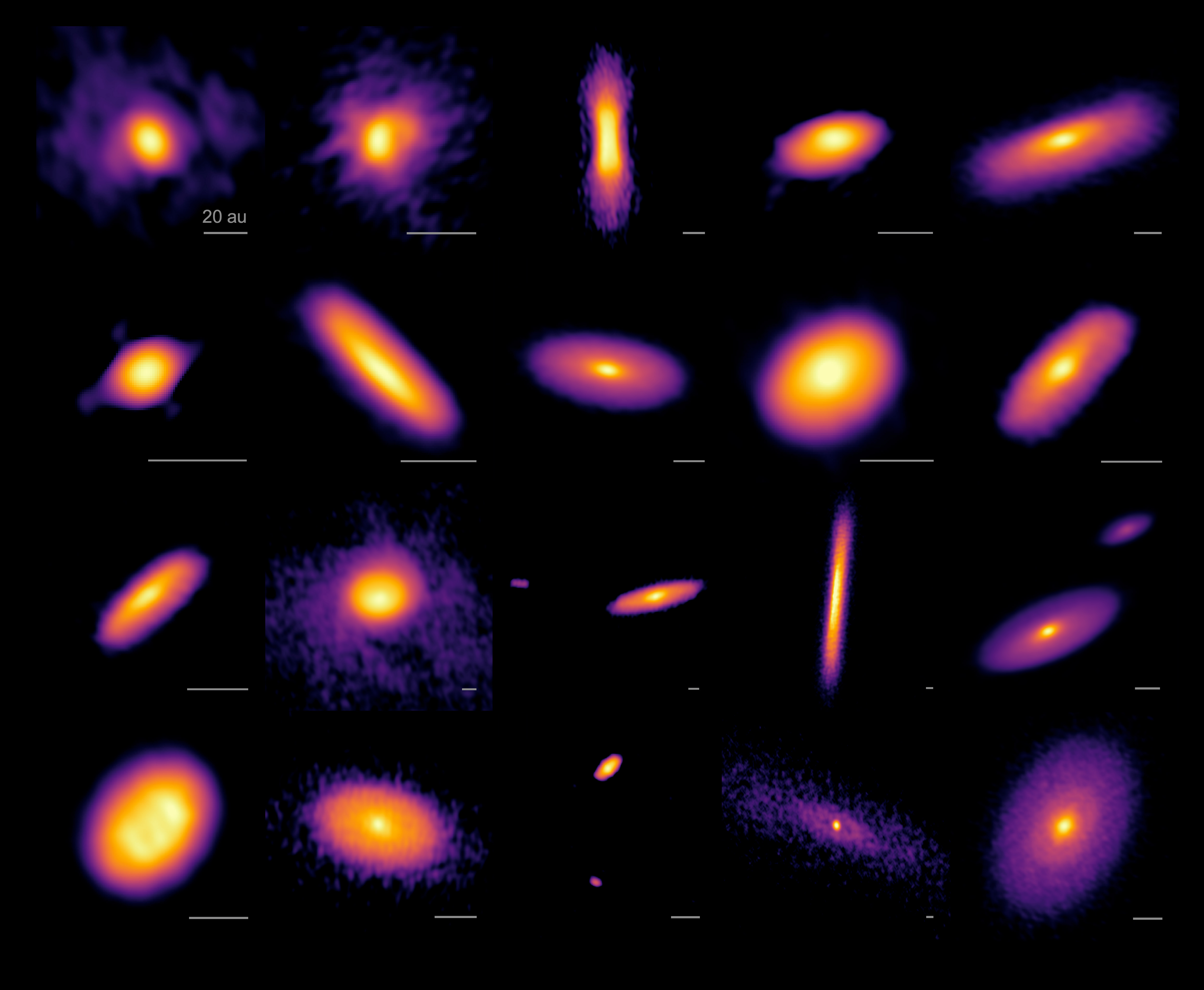
Images of disks around 19 protostars, including 4 binary systems observed with ALMA. For 1 binary system, disks around the primary and secondary are presented independently (2nd line rightmost and 3rd line leftmost). Disks are presented in the order of their evolutionary sequence (the one in the upper-left corner is the youngest while the one at the lower-right corner is the oldest). The two oldest disks show faint ring-gap structures. A scale bar of 20 au (roughly the distance between the Sun and Uranus) is shown for each disk image. (Credit: ALMA (ESO/NAOJ/NRAO), N. Ohashi et al.)
Original size (1.0MB)

An international research team used the Atacama Large Millimeter/submillimeter Array (ALMA) to observe disks around 19 protostars with a very high resolution to search for the earliest signs of planet formation. This survey was motivated by the recent findings that planet formation may be well-underway in the more-evolved proto-planetary disks, but until now there had been no systematic study to search for signs of planet formation in younger protostellar systems.

Planets form in a disk around a newborn star. These ‘proto-planetary’ disks only last a few million years, meaning that a forming planetary system only has this amount of time to finish its formation. However, it is still not clear just how rapidly planet formation begins within these disks. Recent ALMA observations have revealed that many proto-planetary disks have substructures such as gaps and rings, indicating that planets are already forming from the disk. “These previous results motivated us to examine even younger disks around protostars to answer the question, at what stage of star formation do planet forms,” says Nagayoshi Ohashi at Academia Sinica Institute of Astronomy and Astrophysics (ASIAA, Taiwan), who led the team.

The team observed disks around 19 protostars located within about 650 light-years from the Earth. This is the first systematic study to investigate the detailed structure of disks around a large sample of protostars with high angular resolution. The observations clearly show that the disks around protostars are different from more-evolved proto-planetary disks. Among the 19 protostars, rings, and gaps, which are signs of planet formation, were observed only in a few disks. Moreover, the ring structures are less distinct than those seen in the proto-planetary disks.

“We did not expect to see such clear differences between disks around protostars and more-evolved disks,” says Ohashi. John Tobin, a Co-PI of the program at the National Radio Astronomical Observatory (USA) adds “Our results suggest that disks around protostars are not fully ready for planet formation. We believe that the actual formation of the planetary system progresses rapidly in the 100,000 years to 1,000,000 years after star formation begins.”

This research was detailed in Nagayoshi Ohashi et al. “Early Planet Formation in Embedded Disks (eDisk). I. Overview of the Program and First Results” and 3 other papers (Lin et al., van 't Hoff et al., Yamato et al.) published on June 28, 2023 in the Astrophysical Journal, and one paper accepted for later publication in the same journal (Kido et al.).

Related Links


Wednesday, June 08, 2022

The Calm Before the — Planet Formation?


This simulation snapshot shows the structures that can arise in a protoplanetary disk, even without planets present. Credit: NASA's Goddard Space Flight Center


Editor’s Note: Astrobites is a graduate-student-run organization that digests astrophysical literature for undergraduate students. As part of the partnership between the AAS and astrobites, we occasionally repost astrobites content here at AAS Nova. We hope you enjoy this post from astrobites; the original can be viewed at astrobites.org.


Title: The Prospects for Hurricane-like Vortices in Protoplanetary Disks
Authors: Konstantin Gerbig and Gregory Laughlin
First Author’s Institution: Yale University
Status: Published in ApJ


What do hurricanes have to do with planet formation? At first glance, nothing. Planets form in protoplanetary disks, whereas hurricanes occur on a planet that has already formed: Earth. However, the authors of today’s article are searching for a connection between the two.

How Planets Form

Planets form in protoplanetary disks that are made of dust and gas. When dust in those disks clumps together, it can form pebble-sized nuggets that stick together to form boulders. The boulders can become kilometer-size protoplanets until they finally grow into planets. However, there still are some missing pieces in our understanding of planet formation. One of these is the meter-size barrier, which states that it’s really hard to get from a meter-size boulder to something larger. It is fairly well established how to get from dust to meter-size boulders and how to get from kilometer-size protoplanets to planets. It’s the step in between that is missing. However, the meter-size barrier cannot be a real physical barrier: we are living on the proof that planet formation must be possible. But how?

One mechanism proposed to facilitate the growth of boulders is a dust trap where dust and pebbles can be trapped together, allowing them to effectively grow to protoplanets. The authors of today’s article investigate a possible way such a dust trap could occur: a hurricane!

Hurricanes on Earth

For hurricanes on Earth, the key ingredient is water: a hurricane can only form above an ocean. As in planet formation, big things start small: the seed to a hurricane needs to be a small initial turbulence or spin flow of air.

The little seed is magnified by an interplay of strong winds and the evaporation and condensation of water. Strong winds on the surface of the ocean pick up water vapor. At some point, the air becomes saturated so that the water has to condensate again. This is when clouds start to form. The condensation releases heat into the air (called “latent heat”) and the heated air starts to rise. At a certain level in the atmosphere, the air is able to cool down by radiating away its energy, and it does not rise further. The air can flow away horizontally at that height. It leaves behind a void at the surface of the ocean that gives rise to more winds. With the right conditions, this mechanism intensifies the little initial turbulence and the spin flow becomes a large circulation of air mass: a hurricane.

As depicted in Figure 1, a hurricane has a center called the eye of a hurricane. Within the eye, moisturized air continues to flow upward, maintaining the storm as long it can pick up water vapor and rise upwards.


Figure 1: A hurricane on Earth can only exist for a significant time if it is above an ocean. Warm and moist air is rising leading to a circulation of air mass. More air flowing in at the ocean surface magnifies this process until an immense storm is formed.
[Wikipedia user Kevinsong; CC BY 3.0]

What About Hurricanes in Protoplanetary Disks?

The authors of today’s article propose that a similar process can occur in protoplanetary disks. A layer of dust grains that are covered with ice can act as a fuel tank for hurricane-like structures similar to the ocean on Earth. When a gas layer flows over the icy dust grains, it can pick up moisture. Just like on Earth, if there is an initial turbulence in the form of a spin flow, it can be magnified by the same mechanism as a hurricane.

Previous research has shown that such spin flows already exist in protoplanetary disks. They are called vortices. The main difference to a hurricane on Earth is that both gas and dust grains in a protoplanetary disk orbit the star. This motion around the star, also known as Keplerian motion, gives rise to shear forces that tear apart vortices. This means that there is something acting against the growth of vortices.

The authors construct a model to simulate hurricane-like conditions in protoplanetary disks. They seed their simulations with small initial vortices and observe whether they grow. The simulations show that the hurricane mechanism indeed can create large vortices out of small ones. Figure 2 presents the comparison between several simulations: one without the hurricane model (red line) and several with the hurricane model and different initial conditions (yellow and purple lines). The small initial vortices become larger over time and merge into a big one, possibly producing a dust trap.


Figure 2: Simulations with (yellow and purple lines) and without (red line) hurricane-like conditions in a protoplanetary disk. The lines show the time evolution of kinetic energy, which is a measure of the strength of a vortex. The four images show snapshots of a simulation with hurricane-like conditions at different times, showing the vortices growing when hurricane-like conditions are present. [Gerbig & Laughlin 2022]

The authors find a sweet spot for sustaining and magnifying vortices. This sweet spot is located just outside the ice line, which is the location in the disk where the temperature is low enough for water to freeze.

Can Hurricanes Help to Form Planets?

We’ve seen that these hurricane-like vortices are possible, but can they actually form planets?

Prior research has shown that a vortex can trap dust within its eye. As vortices are found to be short-lived, mechanisms prolonging the lifetime of a vortex, such as the hurricane mechanism, are essential to planet formation.

However, when planets form in a vortex, they draw from the dust grains that fuel the hurricane-like vortex. If a planet eats up too much of the dust, the vortex can no longer be kept alive. The authors of today’s article therefore argue that it is not obvious if this mechanism actually supports planet formation. For now, the question must remain unanswered. However, the first step is done — we know that hurricanes can occur in protoplanetary disks. Now it is up to future investigations to see if they can enhance planet formation.

Disclaimer: The first author of today’s article is an active astrobites author but was not involved in the publication of today’s bite.

Original astrobite edited by Macy Huston.


About the author, Lina Kimmig:

I’m a first-year PhD candidate working at Heidelberg University in the exciting field of planet formation. As planets form in protoplanetary disks that exist around most young stars, I am looking at the effects of different physical processes on those disks. To investigate those effects, I run astrophysical simulations. My main interest are warped disks that have a three-dimensional twisted shape (a little bit like Pringles crisps). Outside of research, I not only like eating Pringles crisps but also love dancing, sewing, skiing, and elephants.