Showing posts with label Fermi Gamma-ray Space Telescope. Show all posts

Thursday, November 27, 2025

After nearly 100 years, scientists may have detected dark matter

Gamma-ray intensity map excluding components other than the halo, spanning approximately 100 degrees in the direction of the Galactic center. The horizontal gray bar in the central region corresponds to the Galactic plane area, which was excluded from the analysis to avoid strong astrophysical radiation. Credit: Tomonori Totani, The University of Tokyo


In the early 1930s, Swiss astronomer Fritz Zwicky observed galaxies in space moving faster than their mass should allow, prompting him to infer the presence of some invisible scaffolding—dark matter—holding the galaxies together. Nearly 100 years later, NASA's Fermi Gamma-ray Space Telescope may have provided direct evidence of dark matter, allowing the invisible matter to be "seen" for the very first time.

The elusive nature of dark matter

Dark matter has remained largely a mystery since it was proposed so many years ago. Up to this point, scientists have only been able to indirectly observe dark matter through its effects on observable matter, such as its ability to generate enough gravitational force to hold galaxies together.

The reason dark matter can't be observed directly is that the particles that make up dark matter don't interact with electromagnetic force—meaning dark matter doesn't absorb, reflect or emit light.

Theories abound, but many researchers hypothesize that dark matter is made up of something called weakly interacting massive particles, or WIMPs, which are heavier than protons but interact very little with other matter. Despite this lack of interaction, when two WIMPs collide, it is predicted that the two particles will annihilate one another and release other particles, including gamma ray photons.

Researchers have targeted regions where dark matter is concentrated, such as the center of the Milky Way, through astronomical observations for years in search of these specific gamma rays.

Photon energy dependence of gamma-ray intensity of the halo emission (data points). The red and blue lines represent the expected gamma-ray emission spectrum when WIMP particles annihilate, initially producing a pair of bottom quarks (b) or a pair of W bosons, and they agree well with the data. Bottom quarks and W bosons are known elementary particles included in the standard model of particle physics. Credit: Tomonori Totani, The University of Tokyo

Breakthrough observations from Fermi telescope

Using the latest data from the Fermi Gamma-ray Space Telescope, Professor Tomonori Totani from the Department of Astronomy at the University of Tokyo believes he has finally detected the specific gamma rays predicted by the annihilation of theoretical dark matter particles.
>
Totani's study is published in the journal Journal of Cosmology and Astroparticle Physics.

"We detected gamma rays with a photon energy of 20 gigaelectronvolts (or 20 billion electronvolts, an extremely large amount of energy) extending in a halolike structure toward the center of the Milky Way galaxy. The gamma-ray emission component closely matches the shape expected from the dark matter halo," said Totani.

The observed energy spectrum, or range of gamma-ray emission intensities, matches the emission predicted from the annihilation of hypothetical WIMPs, with a mass approximately 500 times that of a proton. The frequency of WIMP annihilation estimated from the measured gamma-ray intensity also falls within the range of theoretical predictions.

Importantly, these gamma-ray measurements are not easily explained by other, more common astronomical phenomena or gamma-ray emissions. Therefore, Totani considers these data a strong indication of gamma-ray emission from dark matter, which has been sought for many years.

"If this is correct, to the extent of my knowledge, it would mark the first time humanity has 'seen' dark matter. And it turns out that dark matter is a new particle not included in the current standard model of particle physics. This signifies a major development in astronomy and physics," said Totani.

Gamma-ray intensity map excluding components other than the halo, spanning approximately 100 degrees in the direction of the Galactic center. The horizontal gray bar in the central region corresponds to the Galactic plane area, which was excluded from the analysis to avoid strong astrophysical radiation. Credit: Tomonori Totani, The University of Tokyo

Next steps and scientific verification

While Totani is confident that his gamma-ray measurements are detecting dark matter particles, his results must be verified through independent analysis by other researchers. Even with this confirmation, scientists will want additional proof that the halolike radiation is indeed the result of dark matter annihilation rather than originating from some other astronomical phenomena.

Additional proof of WIMP collisions in other locations that harbor a high concentration of dark matter would bolster these initial results. Detecting the same energy gamma-ray emissions from dwarf galaxies within the Milky Way halo, for example, would support Totani's analysis.

"This may be achieved once more data are accumulated, and if so, it would provide even stronger evidence that the gamma rays originate from dark matter," said Totani.

edited by Sadie Harley, reviewed by Robert Egan


More information: Tomonori Totani, 20 GeV halo-like excess of the Galactic diffuse emission and implications for dark matter annihilation, Journal of Cosmology and Astroparticle Physics (2025). iopscience.iop.org/article/10. … 475-7516/2025/11/080

On arXiv : DOI: 10.48550/arxiv.2507.07209

Journal information: arXiv

Provided by University of Tokyo

Explore further

Milky Way shows gamma ray excess due to dark matter annihilation, study suggests


Wednesday, August 26, 2020

NASA Missions Explore a 'TIE Fighter' Active Galaxyl

TXS 0128 at 15.4 gigahertz as observed by the Very Long Baseline Array (VLBA).
Credit: NRAO

Not so long ago, astronomers mapped a galaxy far, far away using radio waves and found it has a strikingly familiar shape. In the process, they discovered the object, called TXS 0128+554, experienced two powerful bouts of activity in the last century.

Around five years ago, NASA's Fermi Gamma-ray Space Telescope reported that TXS 0128+554 (TXS 0128 for short) is a faint source of gamma rays, the highest-energy form of light. Scientists have since taken a closer look using the Very Long Baseline Array (VLBA) and NASA's Chandra X-ray Observatory.

"After the Fermi announcement, we zoomed in a million times closer on the galaxy using the VLBA's radio antennas and charted its shape over time," said Matthew Lister, a professor of physics and astronomy at Purdue University in West Lafayette, Indiana. "The first time I saw the results, I immediately thought it looked like Darth Vader's TIE fighter spacecraft from 'Star Wars: A New Hope.' That was a fun surprise, but its appearance at different radio frequencies also helped us learn more about how active galaxies can change dramatically on decade time scales."

A paper describing the findings, led by Lister, was published in the Aug. 25 issue of The Astrophysical Journal Letters and is now available online.

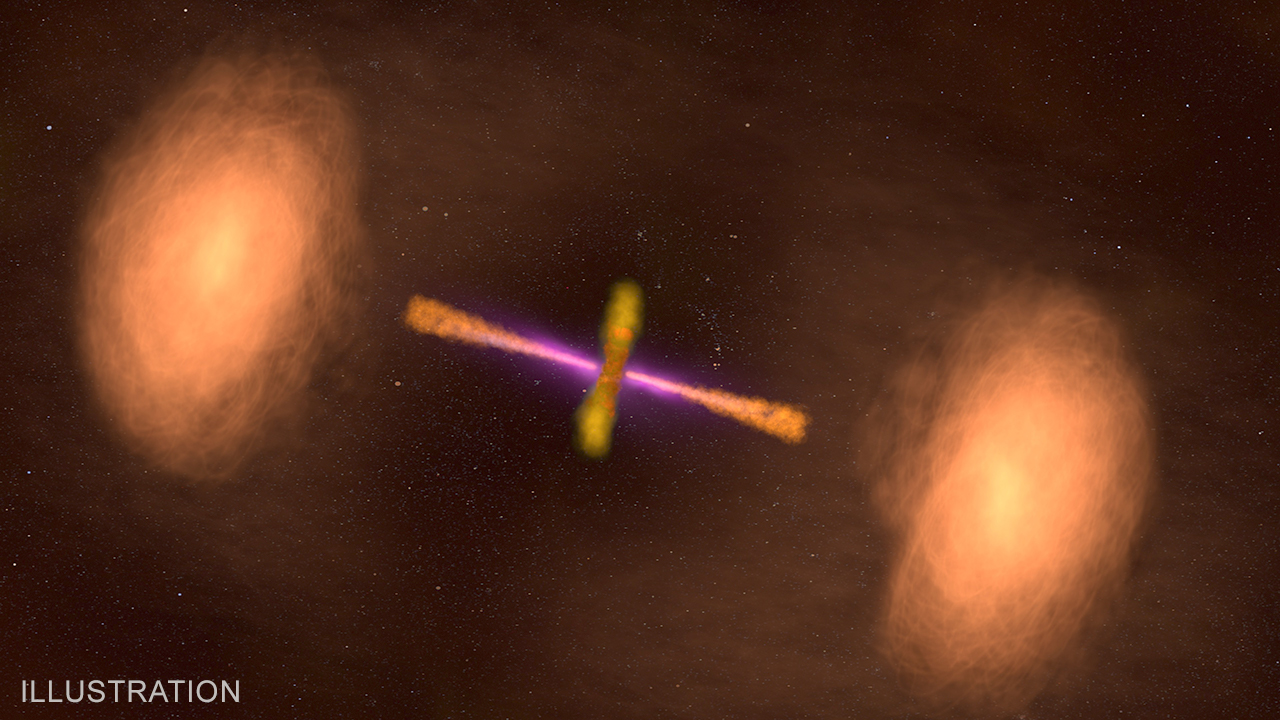
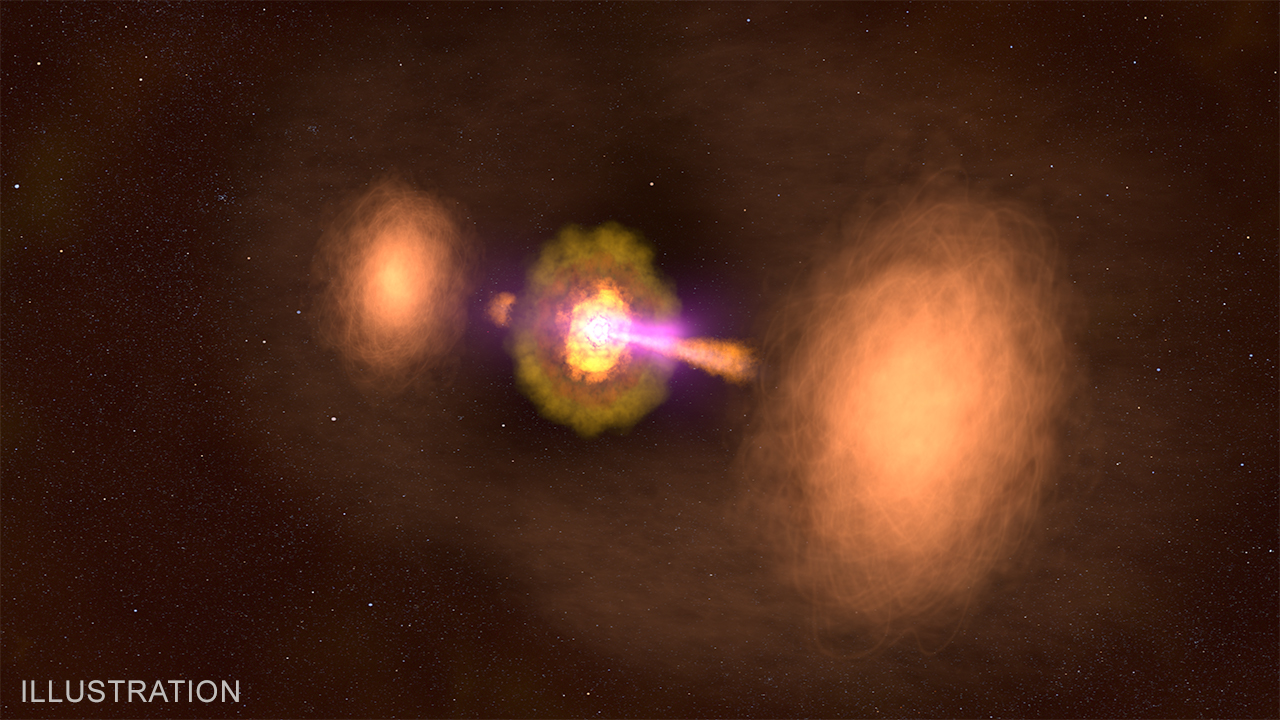
These illustrations show two views of the active galaxy TXS 0128+554, located around 500 million light-years away
.

Left: The galaxy's central jets appear as they would if we viewed them both at the same angle. The black hole, embedded in a disk of dust and gas, launches a pair of particle jets traveling at nearly the speed of light. Scientists think gamma rays (magenta) detected by NASA's Fermi Gamma-ray Space Telescope originate from the base of these jets. As the jets collide with material surrounding the galaxy, they form identical lobes seen at radio wavelengths (orange). The jets experienced two distinct bouts of activity, which created the gap between the lobes and the core.

Right: The galaxy appears in its actual orientation, with its jets tipped out of our line of sight by about 50 degrees.  Credit: NASA's Goddard Space Flight Center

TXS 0128 lies 500 million light-years away in the constellation Cassiopeia, anchored by a supermassive black hole around 1 billion times the Sun's mass. It's classified as an active galaxy, which means all its stars together can't account for the amount of light it emits.

An active galaxy's extra energy includes excess radio, X-ray, and gamma-ray light. Scientists think this emission arises from regions near its central black hole, where a swirling disk of gas and dust accumulates and heats up because of gravitational and frictional forces.

Around one-tenth of active galaxies produce a pair of jets, beams of high-energy particles traveling at nearly the speed of light in opposite directions. Astrophysicists think these jets produce gamma rays. In some cases, collisions with tenuous intergalactic gas eventually slow and halt the outward motion of jet particles, and the material starts to flow back toward the galaxy's center. This results in broad regions, or lobes, filled with fast-moving particles spiraling around magnetic fields. The particle interactions create bright radio emission.

Fermi has identified over 3,000 active galaxies using its Large Area Telescope, which surveys the entire sky every three hours. Nearly all of them ar

e aligned so that one jet points almost directly at Earth, which boosts their signals. TXS 0128, however, is around 100,000 times less powerful than most of them. In fact, even though it's relatively nearby, Fermi needed to accumulate five years of data from the galaxy before reporting it as a gamma-ray source in 2015.

Researchers then added the galaxy to a long-running survey conducted by the VLBA, a network of radio antennas operated by the National Radio Astronomy Observatory stretching from Hawaii to the U.S. Virgin Islands.

The array's measurements provide a detailed map of TXS 0128 at different radio frequencies. The radio structure they revealed spans 35 light-years across and tilts about 50 degrees out of our line of sight. This angle means the jets aren't pointed directly at us and may explain why the galaxy is so dim in gamma rays.

"The real-world universe is three-dimensional, but when we look out into space, we usually only see two dimensions," said Daniel Homan, a co-author and professor of astronomy at Denison University in Granville, Ohio. "In this case, we're lucky because the galaxy is angled in such a way, from our perspective, that the light from the farther lobe travels dozens more light-years to reach us than the light from the nearer one. This means we're seeing the farther lobe at an earlier point in its evolution."

If the galaxy was aligned so the jets and lobes were perpendicular to our line of sight, all the light would reach Earth at the same time. We would see both sides at the same stage of development, which they are in reality.

TXS 0128 lies 500 million light-years away in the constellation Cassiopeia, anchored by a supermassive black hole around 1 billion times the Sun's mass. It's classified as an active galaxy, which means all its stars together can't account for the amount of light it emits.

An active galaxy's extra energy includes excess radio, X-ray, and gamma-ray light. Scientists think this emission arises from regions near its central black hole, where a swirling disk of gas and dust accumulates and heats up because of gravitational and frictional forces.

Around one-tenth of active galaxies produce a pair of jets, beams of high-energy particles traveling at nearly the speed of light in opposite directions. Astrophysicists think these jets produce gamma rays. In some cases, collisions with tenuous intergalactic gas eventually slow and halt the outward motion of jet particles, and the material starts to flow back toward the galaxy's center. This results in broad regions, or lobes, filled with fast-moving particles spiraling around magnetic fields. The particle interactions create bright radio emission.

Fermi has identified over 3,000 active galaxies using its Large Area Telescope, which surveys the entire sky every three hours. Nearly all of them are aligned so that one jet points almost directly at Earth, which boosts their signals. TXS 0128, however, is around 100,000 times less powerful than most of them. In fact, even though it's relatively nearby, Fermi needed to accumulate five years of data from the galaxy before reporting it as a gamma-ray source in 2015.

Researchers then added the galaxy to a long-running survey conducted by the VLBA, a network of radio antennas operated by the National Radio Astronomy Observatory stretching from Hawaii to the U.S. Virgin Islands.

The array's measurements provide a detailed map of TXS 0128 at different radio frequencies. The radio structure they revealed spans 35 light-years across and tilts about 50 degrees out of our line of sight. This angle means the jets aren't pointed directly at us and may explain why the galaxy is so dim in gamma rays.

"The real-world universe is three-dimensional, but when we look out into space, we usually only see two dimensions," said Daniel Homan, a co-author and professor of astronomy at Denison University in Granville, Ohio. "In this case, we're lucky because the galaxy is angled in such a way, from our perspective, that the light from the farther lobe travels dozens more light-years to reach us than the light from the nearer one. This means we're seeing the farther lobe at an earlier point in its evolution."

If the galaxy was aligned so the jets and lobes were perpendicular to our line of sight, all the light would reach Earth at the same time. We would see both sides at the same stage of development, which they are in reality.

This animation shows the changing appearance of active galaxy TXS 0128 at six radio wavelengths measured by the Very Long Baseline Array: 2.3, 5, 6.6, 8.4, 15.4, and 22.2 gigahertz (GHz). Credit: NRAO/NASA's Goddard Space Flight Center

The galaxy's apparent shape depends on the radio frequency used. At 2.3 gigahertz (GHz), about 21 times greater than the maximum broadcast frequency of FM radio, it looks like an amorphous blob. The TIE fighter shape emerges at 6.6 GHz. Then, at 15.4 GHz, a clear gap in the radio emission appears between the galaxy's core and its lobes. Lister's team suspects a lull in TXS 0128's activity created this gap. The galaxy's jets appear to have started around 90 years ago, as observed from Earth, and then stopped about 50 years later, leaving behind the unconnected lobes. Then, roughly a decade ago, the jets turned on again, producing the emission seen closer to the core. What caused the sudden onset of these active periods remains unclear.

The radio emission also sheds light on the location of the galaxy's gamma-ray signal. Many theorists predicted that young, radio-bright active galaxies produce gamma rays when their jets collide with intergalactic gas. But in TXS 0128's case, at least, the particles in the lobes don't produce enough combined energy to generate the detected gamma rays. Instead, Lister's team thinks the galaxy's jets produce gamma rays closer to the core, like the majority of active galaxies Fermi sees.

The team observed the galaxy in X-rays using Chandra, looking for evidence of an enveloping cocoon of ionized gas. While their measurements couldn't confirm the presence or absence of a cocoon, there has been evidence for such structures in other active galaxies, like Cygnus A. The observations do indicate the galaxy has a large amount of dust and gas surrounding its core, which is consistent with a highly inclined viewing angle.

"This galaxy reminds us of the importance of multiwavelength observations, looking at objects across a wide range of the electromagnetic spectrum," said Elizabeth Hays, the Fermi project scientist at NASA's Goddard Space Flight Center in Greenbelt, Maryland. "Fermi, the VLBA, and Chandra each add a layer to our growing picture of this object, revealing their own surprises."

The Fermi Gamma-ray Space Telescope is an astrophysics and particle physics partnership managed by NASA's Goddard Space Flight Center in Greenbelt, Maryland. Fermi was developed in collaboration with the U.S. Department of Energy, with important contributions from academic institutions and partners in France, Germany, Italy, Japan, Sweden, and the United States.

NASA's Marshall Space Flight Center manages the Chandra program. The Smithsonian Astrophysical Observatory's Chandra X-ray Center controls science and flight operations from Cambridge and Burlington, Massachusetts.

By Jeanette Kazmierczak
NASA's Goddard Space Flight Center, Greenbelt, Md.

Media Contact:

Claire Andreoli
NASA's Goddard Space Flight Center, Greenbelt, Md.
(301) 286-1940


Source:  NASA’s Chandra X-ray Observatory/Press Room


Monday, June 08, 2020

First optical measurements of Milky Way’s Fermi Bubbles probe their origin

Astronomers used the WHAM telescope to measure huge outflows of gas extending from the Milky Way’s center known as the Fermi Bubbles. They were able to measure the velocity, density and pressure of the gas for the first time, confirming and extending previous measurements made by using a distant quasar as a light source to look through and measure the gas.
Image by Dhanesh Krishnarao and NASA. Hi-res image

Using the Wisconsin H-Alpha Mapper telescope, astronomers have for the first time measured the Fermi Bubbles in the visible light spectrum. The Fermi Bubbles are two enormous outflows of high-energy gas that emanate from the Milky Way and the finding refines our understanding of the properties of these mysterious blobs.

The research team from the University of Wisconsin–Madison, UW–Whitewater and Embry-Riddle Aeronautical University measured the emission of light from hydrogen and nitrogen in the Fermi Bubbles at the same position as recent ultraviolet absorption measurements made by the Hubble Telescope.

“We combined those two measurements of emission and absorption to estimate the density, pressure and temperature of the ionized gas, and that lets us better understand where this gas is coming from,” says Dhanesh Krishnarao, lead author of the new study and an astronomy graduate student at UW–Madison.

The researchers announced their findings June 3 at the 236th meeting of the American Astronomical Society, which was held virtually for the first time since 1899, in response to the COVID-19 pandemic.

Extending 25,000 light years both above and below the center of the Milky Way, the Fermi Bubbles were discovered in 2010 by the Fermi Gamma Ray Telescope. These faint but highly energetic outflows of gas are racing away from the center of the Milky Way at millions of miles per hour. But while the origin of the phenomenon has been inferred to date back several million years ago, the events that produced the bubbles remain a mystery.

Now, with new measurements of the density and pressure of the ionized gas, researchers can test models of the Fermi Bubbles against observations.

“The other significant thing is that we now have the possibility of measuring the density and pressure and the velocity structure in many locations,” with the all-sky WHAM telescope, says Bob Benjamin, a professor of astronomy at UW–Whitewater and co-author of the study. “We can do an extensive mapping effort across the Fermi Bubbles above and below the plane of the galaxy to see if the models that people have developed are holding up. Because, unlike the ultraviolet data, we’re not limited to just specific lines of sight.”

Matt Haffner, professor of physics and astronomy at Embry-Riddle Aeronautical University and a co-author of the report, says the work demonstrates the usefulness of the WHAM telescope, developed at UW–Madison, to tell us more about the workings of the Milky Way. The central region of our home galaxy has long been difficult to study because of gas blocking out view, but WHAM has provided new opportunities to gather the kind of information we have for distant galaxies.

“There are regions of the galaxy we can target with very sensitive instruments like WHAM to get this kind of new information toward the center that previously we are only able to do in the infrared and radio,” says Haffner. “We can make comparisons to other galaxies by making the same kind of measurements towards the center of the Milky Way.”


Contact:

Dhanesh Krishnarao

Bob Benjamin

Matt Haffner

Friday, December 20, 2019

NASA’s Fermi Mission Links Nearby Pulsar’s Gamma-ray ‘Halo’ to Antimatter Puzzle

This animation shows a region of the sky centered on the pulsar Geminga. The first image shows the total number of gamma rays detected by Fermi’s Large Area Telescope at energies from 8 to 1,000 billion electron volts (GeV) — billions of times the energy of visible light — over the past decade. By removing all bright sources, astronomers discovered the pulsar’s faint, extended gamma-ray halo. Credit: NASA/DOE/Fermi LAT Collaboration

NASA’s Fermi Gamma-ray Space Telescope has discovered a faint but sprawling glow of high-energy light around a nearby pulsar. If visible to the human eye, this gamma-ray “halo” would appear about 40 times bigger in the sky than a full Moon. This structure may provide the solution to a long-standing mystery about the amount of antimatter in our neighborhood.

“Our analysis suggests that this same pulsar could be responsible for a decade-long puzzle about why one type of cosmic particle is unusually abundant near Earth,” said Mattia Di Mauro, an astrophysicist at the Catholic University of America in Washington and NASA’s Goddard Space Flight Center in Greenbelt, Maryland. “These are positrons, the antimatter version of electrons, coming from somewhere beyond the solar system.”

A paper detailing the findings was published in the journal Physical Review D on Dec. 17 and is available online.


Astronomers using data from NASA’s Fermi mission have discovered a pulsar with a faint gamma-ray glow that spans a huge part of the sky. Watch to learn more.Credits: NASA’s Goddard Space Flight Center. Download additional multimedia from NASA Goddard's Scientific Visualization Studio

A neutron star is the crushed core left behind when a star much more massive than the Sun runs out of fuel, collapses under its own weight and explodes as a supernova. We see some neutron stars as pulsars, rapidly spinning objects emitting beams of light that, much like a lighthouse, regularly sweep across our line of sight.

Geminga (pronounced geh-MING-ga), discovered in 1972 by NASA’s Small Astronomy Satellite 2, is among the brightest pulsars in gamma rays. It is located about 800 light-years away in the constellation Gemini. Geminga’s name is both a play on the phrase “Gemini gamma-ray source” and the expression “it’s not there” —  referring to astronomers’ inability to find the object at other energies — in the dialect of Milan, Italy.

Geminga was finally identified in March 1991, when flickering X-rays picked up by Germany’s ROSAT mission revealed the source to be a pulsar spinning 4.2 times a second.

A pulsar naturally surrounds itself with a cloud of electrons and positrons. This is because the neutron star’s intense magnetic field pulls the particles from the pulsar’s surface and accelerates them to nearly the speed of light.

Electrons and positrons are among the speedy particles known as cosmic rays, which originate beyond the solar system. Because cosmic ray particles carry an electrical charge, their paths become scrambled when they encounter magnetic fields on their journey to Earth. This means astronomers cannot directly track them back to their sources.

For the past decade, cosmic ray measurements by Fermi, NASA’s Alpha Magnetic Spectrometer (AMS-02) aboard the International Space Station, and other space experiments near Earth have seen more positrons at high energies than scientists expected. Nearby pulsars like Geminga were prime suspects.

Then, in 2017, scientists with the High-Altitude Water Cherenkov Gamma-ray Observatory (HAWC) near Puebla, Mexico, confirmed earlier ground-based detections of a small gamma-ray halo around Geminga. They observed this structure at energies from 5 to 40 trillion electron volts — light with trillions of times more energy than our eyes can see.

Scientists think this emission arises when accelerated electrons and positrons collide with nearby starlight. The collision boosts the light up to much higher energies. Based on the size of the halo, the HAWC team concluded that Geminga positrons at these energies only rarely reach Earth. If true, it would mean that the observed positron excess must have a more exotic explanation.

This model of Geminga's gamma-ray halo shows how the emission changes at different energies, a result of two effects. The first is the pulsar's rapid motion through space over the decade Fermi's Large Area Telescope has observed it. Second, lower-energy particles travel much farther from the pulsar before they interact with starlight and boost it to gamma-ray energies. This is why the gamma-ray emission covers a larger area at lower energies. One GeV represents 1 billion electron volts — billions of times the energy of visible light. Credits: NASA’s Goddard Space Flight Center/M. Di Mauro.

Scientists think this emission arises when accelerated electrons and positrons collide with nearby starlight. The collision boosts the light up to much higher energies. Based on the size of the halo, the HAWC team concluded that Geminga positrons at these energies only rarely reach Earth. If true, it would mean that the observed positron excess must have a more exotic explanation.

But interest in a pulsar origin continued, and Geminga was front and center. Di Mauro led an analysis of a decade of Geminga gamma-ray data acquired by Fermi’s Large Area Telescope (LAT), which observes lower-energy light than HAWC.

“To study the halo, we had to subtract out all other sources of gamma rays, including diffuse light produced by cosmic ray collisions with interstellar gas clouds,” said co-author Silvia Manconi, a postdoctoral researcher at RWTH Aachen University in Germany. “We explored the data using 10 different models of interstellar emission.”

What remained when these sources were removed was a vast, oblong glow spanning some 20 degrees in the sky at an energy of 10 billion electron volts (GeV). That’s similar to the size of the famous Big Dipper star pattern — and the halo is even bigger at lower energies.

“Lower-energy particles travel much farther from the pulsar before they run into starlight, transfer part of their energy to it, and boost the light to gamma rays. This is why the gamma-ray emission covers a larger area at lower energies ,” explained co-author Fiorenza Donato at the Italian National Institute of Nuclear Physics and the University of Turin. “Also, Geminga’s halo is elongated partly because of the pulsar’s motion through space.”

The team determined that the Fermi LAT data were compatible with the earlier HAWC observations. Geminga alone could be responsible for as much as 20% of the high-energy positrons seen by the AMS-02 experiment. Extrapolating this to the cumulative emission from all pulsars in our galaxy, the scientists say it’s clear that pulsars remain the best explanation for the positron excess.

“Our work demonstrates the importance of studying individual sources to predict how they contribute to cosmic rays,” Di Mauro said. “This is one aspect of the exciting new field called multimessenger astronomy, where we study the universe using multiple signals, like cosmic rays, in addition to light.”

The Fermi Gamma-ray Space Telescope is an astrophysics and particle physics partnership managed by NASA's Goddard Space Flight Center in Greenbelt, Maryland. Fermi was developed in collaboration with the U.S. Department of Energy, with important contributions from academic institutions and partners in France, Germany, Italy, Japan, Sweden and the United States.

Illustration of NASA’s Fermi Gamma-ray Space Telescope in orbit.
Credits: NASA's Goddard Space Flight Center  

By Francis Reddy
NASA’s Goddard Space Flight Center, Greenbelt, Md.

Editor: Rob Garner


Thursday, November 21, 2019

NASA’s Fermi, Swift Missions Enable a New Era in Gamma-ray Science


A pair of distant explosions discovered by NASA’s Fermi Gamma-ray Space Telescope and Neil Gehrels Swift Observatory have produced the highest-energy light yet seen from these events, called gamma-ray bursts (GRBs). The record-setting detections, made by two different ground-based observatories, provide new insights into the mechanisms driving gamma-ray bursts.

Astronomers first recognized the GRB phenomenon 46 years ago. The blasts appear at random locations in the sky about once a day, on average.

The most common type of GRB occurs when a star much more massive than the Sun runs out of fuel. Its core collapses and forms a black hole, which then blasts jets of particles outward at nearly the speed of light. These jets pierce the star and continue into space. They produce an initial pulse of gamma rays — the most energetic form of light — that typically lasts about a minute.

As the jets race outward, they interact with surrounding gas and emit light across the spectrum, from radio to gamma rays. These so-called afterglows can be detected up to months — and rarely, even years — after the burst at longer wavelengths.

“Much of what we’ve learned about GRBs over the past couple of decades has come from observing their afterglows at lower energies,” said Elizabeth Hays, the Fermi project scientist at NASA’s Goddard Space Flight Center in Greenbelt, Maryland. “Now, thanks to these new ground-based detections, we’re seeing the gamma rays from gamma-ray bursts in a whole new way.”

Two papers published in the journal Nature describe each of the discoveries. A third paper analyzes one of the bursts using a rich set of multiwavelength data from observatories in space and on the ground. A fourth paper, accepted by The Astrophysical Journal, explores the Fermi and Swift data in greater detail. 

On Jan. 14, 2019, just before 4 p.m. EST, both the Fermi and Swift satellites detected a spike of gamma rays from the constellation Fornax. The missions alerted the astronomical community to the location of the burst, dubbed GRB 190114C.

One facility receiving the alerts was the Major Atmospheric Gamma Imaging Cherenkov (MAGIC) observatory, located on La Palma in the Canary Islands, Spain. Both of its 17-meter telescopes automatically turned to the site of the fading burst. They began observing the GRB just 50 seconds after it was discovered and captured the most energetic gamma rays yet seen from these events.

The energy of visible light ranges from about 2 to 3 electron volts. In 2013, Fermi’s Large Area Telescope (LAT) detected light reaching an energy of 95 billion electron volts (GeV), then the highest seen from a burst. This falls just shy of 100 GeV, the threshold for so-called very high-energy (VHE) gamma rays. With GRB 190114C, MAGIC became the first facility to report unambiguous VHE emission, with energies up to a trillion electron volts (1 TeV). That’s 10 times the peak energy Fermi has seen to date.

“Twenty years ago, we designed MAGIC specifically to search for VHE emission from GRBs, so this is a tremendous success for our team,” said co-author Razmik Mirzoyan, a scientist at the Max Planck Institute for Physics in Munich and the spokesperson for the MAGIC collaboration. “The discovery of TeV gamma rays from GRB 190114C shows that these explosions are even more powerful than thought before. More importantly, our detection facilitated an extensive follow-up campaign involving more than two dozen observatories, offering important clues to the physical processes at work in GRBs.”

These included NASA’s NuSTAR mission, the European Space Agency’s XMM-Newton X-ray satellite, the NASA/ESA Hubble Space Telescope, in addition to Fermi and Swift, along with many ground-based observatories. Hubble images acquired in February and March captured the burst’s optical afterglow. They show that the blast originated in a spiral galaxy about 4.5 billion light-years away. This means the light from this GRB began traveling to us when the universe was two-thirds of its current age.

Another paper presents observations of a different burst, which Fermi and Swift both discovered on July 20, 2018. Ten hours after their alerts, the High Energy Stereoscopic System (H.E.S.S.) pointed its large, 28-meter gamma-ray telescope to the location of the burst, called GRB 180720B. A careful analysis carried out during the weeks following the event revealed that H.E.S.S. clearly detected VHE gamma rays with energies up to 440 GeV. Even more remarkable, the glow continued for two hours following the start of the observation. Catching this emission so long after the GRB’s detection is both a surprise and an important new discovery.

Scientists suspect that most of the gamma rays from GRB afterglows originate in magnetic fields at the jet’s leading edge. High-energy electrons spiraling in the fields directly emit gamma rays through a mechanism called synchrotron emission.


But both the H.E.S.S. and MAGIC teams interpret the VHE emission as a distinct afterglow component, which means some additional process must be at work. The best candidate, they say, is inverse Compton scattering. High-energy electrons in the jet crash into lower-energy gamma rays and boost them to much higher energies.

In the paper detailing the Fermi and Swift observations, the researchers conclude that an additional physical mechanism may indeed be needed to produce the VHE emission. Within the lower energies observed by these missions, however, the flood of synchrotron gamma rays makes uncovering a second process much more difficult.

“With Fermi and Swift, we don’t see direct evidence of a second emission component,” said Goddard’s S. Bradley Cenko, the principal investigator for Swift and a co-author of the Fermi-Swift and multiwavelength papers. “However, if the VHE emission arises from the synchrotron process alone, then fundamental assumptions used in estimating the peak energy produced by this mechanism will need to be revised.”

Future burst observations will be needed to clarify the physical picture. The new VHE data open a new pathway for understanding GRBs, one that will be further extended by MAGIC, H.E.S.S. and a new generation of ground-based gamma-ray telescopes now being planned.

The Fermi Gamma-ray Space Telescope is an astrophysics and particle physics partnership managed by NASA's Goddard Space Flight Center in Greenbelt, Maryland. Fermi was developed in collaboration with the U.S. Department of Energy, with important contributions from academic institutions and partners in France, Germany, Italy, Japan, Sweden and the United States.

Goddard manages the Swift mission in collaboration with Penn State in University Park, the Los Alamos National Laboratory in New Mexico and Northrop Grumman Innovation Systems in Dulles, Virginia. Other partners include the University of Leicester and Mullard Space Science Laboratory in the United Kingdom, Brera Observatory and the Italian Space Agency in Italy.


Editor: Rob Garner


Friday, August 16, 2019

Moon Glows Brighter Than Sun in Images From NASA's Fermi

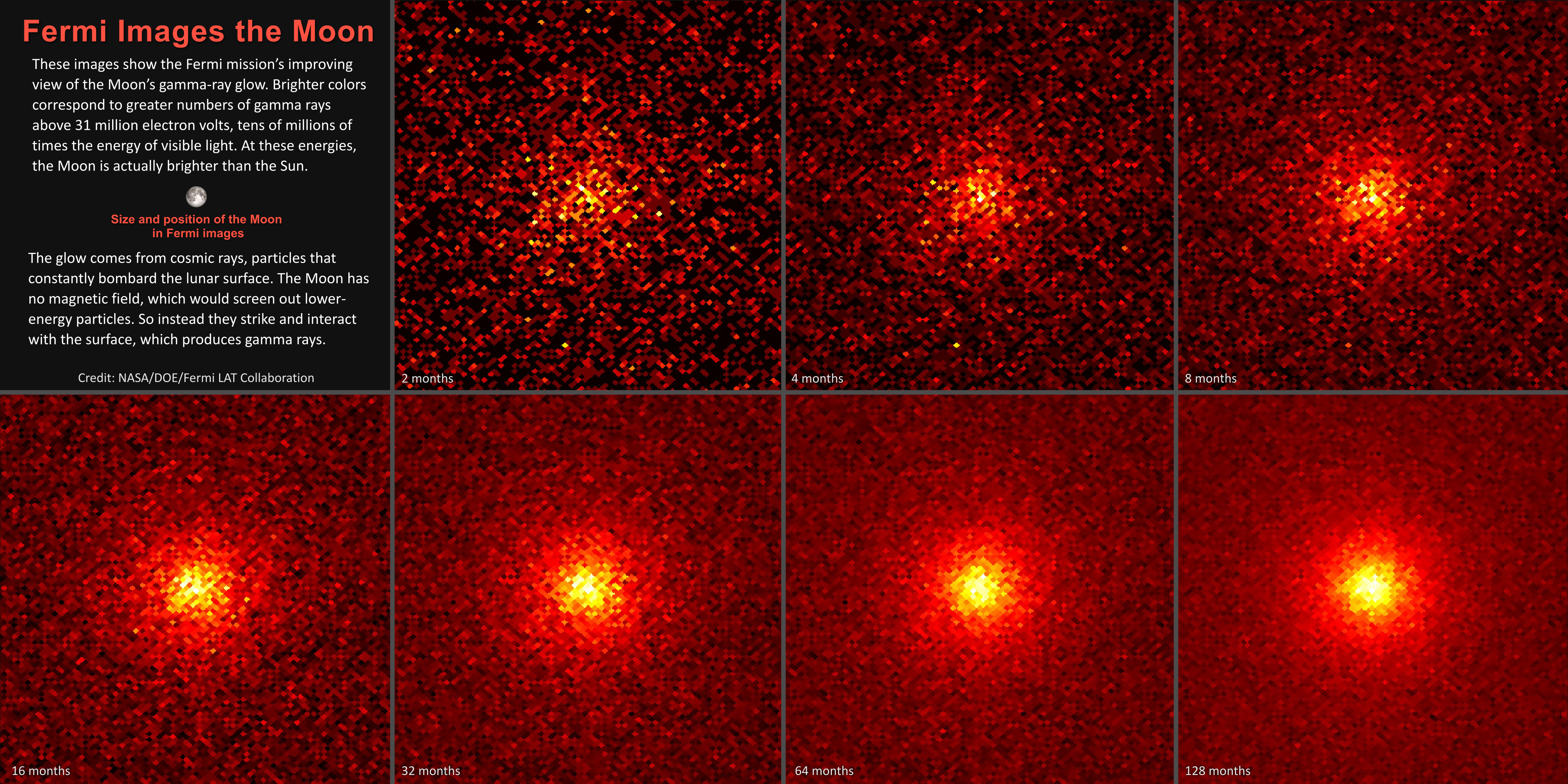
The Moon shines brightly in gamma rays as seen in this time sequence from NASA’s Fermi Gamma-ray Space Telescope. Each 5-by-5-degree image is centered on the Moon and shows gamma rays with energies above 31 million electron volts, or tens of millions of times that of visible light. At these energies, the Moon is actually brighter than the Sun. Brighter colors indicate greater numbers of gamma rays. This animation shows how longer exposure, ranging from two to 128 months (10.7 years), improved the view. Credit: NASA/DOE/Fermi LAT Collaboration. Download

If our eyes could see high-energy radiation called gamma rays, the Moon would appear brighter than the Sun! That’s how NASA’s Fermi Gamma-ray Space Telescope has seen our neighbor in space for the past decade.

Gamma-ray observations are not sensitive enough to clearly see the shape of the Moon’s disk or any surface features. Instead, Fermi’s Large Area Telescope (LAT) detects a prominent glow centered on the Moon’s position in the sky.

Mario Nicola Mazziotta and Francesco Loparco, both at Italy’s National Institute of Nuclear Physics in Bari, have been analyzing the Moon’s gamma-ray glow as a way of better understanding another type of radiation from space: fast-moving particles called cosmic rays.

“Cosmic rays are mostly protons accelerated by some of the most energetic phenomena in the universe, like the blast waves of exploding stars and jets produced when matter falls into black holes,” explained Mazziotta.

Because the particles are electrically charged, they’re strongly affected by magnetic fields, which the Moon lacks. As a result, even low-energy cosmic rays can reach the surface, turning the Moon into a handy space-based particle detector. When cosmic rays strike, they interact with the powdery surface of the Moon, called the regolith, to produce gamma-ray emission. The Moon absorbs most of these gamma rays, but some of them escape.

Mazziotta and Loparco analyzed Fermi LAT lunar observations to show how the view has improved during the mission. They rounded up data for gamma rays with energies above 31 million electron volts — more than 10 million times greater than the energy of visible light — and organized them over time, showing how longer exposures improve the view.

“Seen at these energies, the Moon would never go through its monthly cycle of phases and would always look full,” said Loparco.

These images show the steadily improving view of the Moon’s gamma-ray glow from NASA’s Fermi Gamma-ray Space Telescope. Each 5-by-5-degree image is centered on the Moon and shows gamma rays with energies above 31 million electron volts, or tens of millions of times that of visible light. At these energies, the Moon is actually brighter than the Sun. Brighter colors indicate greater numbers of gamma rays. This image sequence shows how longer exposure, ranging from two to 128 months (10.7 years), improved the view.  Credit: NASA/DOE/Fermi LAT Collaboration. Hi-res image


As NASA sets its sights on sending humans to the Moon by 2024 through the Artemis program, with the eventual goal of sending astronauts to Mars, understanding various aspects of the lunar environment take on new importance. These gamma-ray observations are a reminder that astronauts on the Moon will require protection from the same cosmic rays that produce this high-energy gamma radiation.

While the Moon’s gamma-ray glow is surprising and impressive, the Sun does shine brighter in gamma rays with energies higher than 1 billion electron volts. Cosmic rays with lower energies do not reach the Sun because its powerful magnetic field screens them out. But much more energetic cosmic rays can penetrate this magnetic shield and strike the Sun’s denser atmosphere, producing gamma rays that can reach Fermi.

Although the gamma-ray Moon doesn’t show a monthly cycle of phases, its brightness does change over time. Fermi LAT data show that the Moon’s brightness varies by about 20% over the Sun’s 11-year activity cycle. Variations in the intensity of the Sun’s magnetic field during the cycle change the rate of cosmic rays reaching the Moon, altering the production of gamma rays.

By Francis Reddy
NASA’s Goddard Space Flight Center, Greenbelt, Md.

Editor: Rob Garner


Saturday, August 03, 2019

NASA Scientist to Discuss “Cosmic Explosions and Cosmic Accelerators” at Library of Congress Lecture

Recently, astronomers have been able to coordinate observations of multiple “messengers” from the same event, such as merging neutron stars (background) that produced both gamma rays detected by NASA’s Fermi Gamma-ray Space Telescope (right) and gravitational waves detected by the Laser Interferometer Gravitational-Wave Observatory on Aug. 17, 2017. NASA Goddard’s Dr. Regina Caputo will discuss the burgeoning field of multimessenger astronomy. Credits: NASA/Frank Reddy

The public is invited to a free lecture called ‘Cosmic Explosions and Cosmic Accelerators: Gamma-rays and Multi-messenger Astronomy,' with Dr. Regina Caputo, NASA research scientist. The talk will occur in the Pickford Theater, third floor, Madison Building, 101 Independence Avenue SE, Library of Congress, Washington, D.C., on Thursday, August 8 from 11:30 a.m. to 12:30 p.m. EDT.

Dr. Caputo works at NASA’s Goddard Space Flight Center in Greenbelt, Md. on the NASA Fermi Gamma Ray Space Telescope team with data from the Fermi Large Area Telescope instrument to study. She is interested in dark matter searches, searches for new physics and all the astrophysics one must understand before discovering something new. She is also working on future gamma-ray instruments.

Astronomical processes, such as supernovae or gamma ray bursts, give off a variety of messenger signals. Astronomers observing these signals can get different information from different signals, and recently, by coordinating their observations of multiple messengers from the same event, they have begun to revolutionize our understanding of the extreme universe. Dr. Regina Caputo will discuss these jointly observed messengers and the contribution of the Fermi Gamma-ray Space Telescope at the forefront of this new era of astronomy.

She is a speaker in the 2019 NASA Goddard Lectures Series at the Library of Congress. Earlier talks in the NASA series included the topics of space weather, improved global water security and sustainability, how Mars has changed over time, NASA's Hubble Space Telescope and the upcoming James Webb Space Telescope.

The Library of Congress maintains one of the largest and most diverse collections of scientific and technical information in the world. The Library of Congress is the nation's oldest federal cultural institution and the largest library in the world and holds nearly 151.8 million items in various languages, disciplines and formats. The Library serves both Congress and the nation online and on-site in its reading rooms on Capitol Hill.

For inquiries about this or upcoming talks at the Library of Congress, the public can contact the library’s Science, Technology and Business Division at 202-707-5664. ADA accommodations should be requested five business days in advance at 202-707-6382 (voice/tty) or ada@loc.gov.

The lecture will be later broadcast on the library’s webcast page and YouTube channel “Topics in Science” playlist.

For directions, visit: http://www.loc.gov/visit/maps-and-floor-plans/ or www.loc.gov

For information about Dr. Caputo, visit: https://science.gsfc.nasa.gov/sed/bio/regina.caputo

For NASA’s Fermi website, visit: www.nasa.gov/fermi


Contact:

Rob Gutro
NASA’s Goddard Space Flight Center, Greenbelt, Md.
301-286-4044
Robert.j.gutro@nasa.gov

Stephanie Marcus
Library of Congress, Washington
202-707-1192
smar@loc.gov

Editor: Karl Hille


Monday, February 27, 2017

NASA's Fermi Finds Possible Dark Matter Ties in Andromeda Galaxy

NASA’s Fermi telescope has detected a gamma-ray excess at the center of the Andromeda galaxy that's similar to a signature Fermi previously detected at the center of our own Milky Way. Watch to learn more. Credits: NASA’s Goddard Space Flight Center/Scott Wiessinger, producer 

The gamma-ray excess (shown in yellow-white) at the heart of M31 hints at unexpected goings-on in the galaxy's central region. Scientists think the signal could be produced by a variety of processes, including a population of pulsars or even dark matter.  Credits: NASA/DOE/Fermi LAT Collaboration and Bill Schoening, Vanessa Harvey/REU program/NOAO/AURA/NSF


NASA’s Fermi Gamma-ray Space Telescope has found a signal at the center of the neighboring Andromeda galaxy that could indicate the presence of the mysterious stuff known as dark matter. The gamma-ray signal is similar to one seen by Fermi at the center of our own Milky Way galaxy.

Gamma rays are the highest-energy form of light, produced by the universe’s most energetic phenomena. They’re common in galaxies like the Milky Way because cosmic rays, particles moving near the speed of light, produce gamma rays when they interact with interstellar gas clouds and starlight.

Surprisingly, the latest Fermi data shows the gamma rays in Andromeda — also known as M31 — are confined to the galaxy’s center instead of spread throughout. To explain this unusual distribution, scientists are proposing that the emission may come from several undetermined sources. One of them could be dark matter, an unknown substance that makes up most of the universe.

“We expect dark matter to accumulate in the innermost regions of the Milky Way and other galaxies, which is why finding such a compact signal is very exciting,” said lead scientist Pierrick Martin, an astrophysicist at the National Center for Scientific Research and the Research Institute in Astrophysics and Planetology in Toulouse, France. “M31 will be a key to understanding what this means for both Andromeda and the Milky Way.”

A paper describing the results will appear in an upcoming issue of The Astrophysical Journal.

Another possible source for this emission could be a rich concentration of pulsars in M31’s center. These spinning neutron stars weigh as much as twice the mass of the sun and are among the densest objects in the universe. One teaspoon of neutron star matter would weigh a billion tons on Earth. Some pulsars emit most of their energy in gamma rays. Because M31 is 2.5 million light-years away, it’s difficult to find individual pulsars. To test whether the gamma rays are coming from these objects, scientists can apply what they know about pulsars from observations in the Milky Way to new X-ray and radio observations of Andromeda.

Now that Fermi has detected a similar gamma-ray signature in both M31 and the Milky Way, scientists can use this information to solve mysteries within both galaxies. For example, M31 emits few gamma rays from its large disk, where most stars form, indicating fewer cosmic rays roaming there. Because cosmic rays are usually thought to be related to star formation, the absence of gamma rays in the outer parts of M31 suggests either that the galaxy produces cosmic rays differently, or that they can escape the galaxy more rapidly. Studying Andromeda may help scientists understand the life cycle of cosmic rays and how it is connected to star formation.

“We don’t fully understand the roles cosmic rays play in galaxies, or how they travel through them,” said Xian Hou, an astrophysicist at Yunnan Observatories, Chinese Academy of Sciences in Kunming, China, also a lead scientist in this work. “M31 lets us see how cosmic rays behave under conditions different from those in our own galaxy.”

The similar discovery in both the Milky Way and M31 means scientists can use the galaxies as models for each other when making difficult observations. While Fermi can make more sensitive and detailed observations of the Milky Way’s center, its view is partially obscured by emission from the galaxy’s disk. But telescopes view Andromeda from an outside vantage point impossible to attain in the Milky Way.

“Our galaxy is so similar to Andromeda, it really helps us to be able to study it, because we can learn more about our galaxy and its formation,” said co-author Regina Caputo, a research scientist at NASA’s Goddard Space Flight Center in Greenbelt, Maryland. “It’s like living in a world where there’s no mirrors but you have a twin, and you can see everything physical about the twin.” 

While more observations are necessary to determine the source of the gamma-ray excess, the discovery provides an exciting starting point to learn more about both galaxies, and perhaps about the still elusive nature of dark matter.

“We still have a lot to learn about the gamma-ray sky,” Caputo said. “The more information we have, the more information we can put into models of our own galaxy.”

NASA's Fermi Gamma-ray Space Telescope is an astrophysics and particle physics partnership, developed in collaboration with the U.S. Department of Energy and with important contributions from academic institutions and partners in France, Germany, Italy, Japan, Sweden and the United States.


For more information on Fermi, visit:  http://www.nasa.gov/fermi


Editor: Rob Garner


Tuesday, January 31, 2017

NASA's Fermi Sees Gamma Rays from 'Hidden' Solar Flares

An international science team says NASA's Fermi Gamma-ray Space Telescope has observed high-energy light from solar eruptions located on the far side of the sun, which should block direct light from these events. This apparent paradox is providing solar scientists with a unique tool for exploring how charged particles are accelerated to nearly the speed of light and move across the sun during solar flares.

"Fermi is seeing gamma rays from the side of the sun we're facing, but the emission is produced by streams of particles blasted out of solar flares on the far side of the sun," said Nicola Omodei, a researcher at Stanford University in California. "These particles must travel some 300,000 miles within about five minutes of the eruption to produce this light."

Omodei presented the findings on Monday, Jan. 30, at the American Physical Society meeting in Washington, and a paper describing the results will be published online in The Astrophysical Journal on Jan. 31.


On three occasions, NASA's Fermi Gamma-ray Space Telescope has detected gamma rays from solar storms on the far side of the sun, emission the Earth-orbiting satellite shouldn't be able to detect. Particles accelerated by these eruptions somehow reach around to produce a gamma-ray glow on the side of the sun facing Earth and Fermi. Watch to learn more. Credits: NASA's Goddard Space Flight Center/Scott Wiessinger, producer.
Download this video in HD formats from NASA Goddard's Scientific Visualization Studio

Fermi has doubled the number of these rare events, called behind-the-limb flares, since it began scanning the sky in 2008. Its Large Area Telescope (LAT) has captured gamma rays with energies reaching 3 billion electron volts, some 30 times greater than the most energetic light previously associated with these "hidden" flares.

Thanks to NASA's Solar Terrestrial Relations Observatory (STEREO) spacecraft, which were monitoring the solar far side when the eruptions occurred, the Fermi events mark the first time scientists have direct imaging of beyond-the-limb solar flares associated with high-energy gamma rays.
These solar flares were imaged in extreme ultraviolet light by NASA's STEREO satellites, which at the time were viewing the side of the sun facing away from Earth. All three events launched fast coronal mass ejections (CMEs). Although NASA's Fermi Gamma-ray Space Telescope couldn't see the eruptions directly, it detected high-energy gamma rays from all of them. Scientists think particles accelerated by the CMEs rained onto the Earth-facing side of the sun and produced the gamma rays. The central image was returned by the STEREO A spacecraft, all others are from STEREO B.Credits: NASA/STEREO
Combined images from NASA's Solar Dynamics Observatory (center) and the NASA/ESA Solar and Heliospheric Observatory (red and blue) show an impressive coronal mass ejection departing the far side of the sun on Sept. 1, 2014. This massive cloud raced away at about 5 million mph and likely accelerated particles that later produced gamma rays Fermi detected. Credits: NASA/SDO and NASA/ESA/SOHO


"Observations by Fermi's LAT continue to have a significant impact on the solar physics community in their own right, but the addition of STEREO observations provides extremely valuable information of how they mesh with the big picture of solar activity," said Melissa Pesce-Rollins, a researcher at the National Institute of Nuclear Physics in Pisa, Italy, and a co-author of the paper. 

The hidden flares occurred Oct. 11, 2013, and Jan. 6 and Sept. 1, 2014. All three events were associated with fast coronal mass ejections (CMEs), where billion-ton clouds of solar plasma were launched into space. The CME from the most recent event was moving at nearly 5 million miles an hour as it left the sun. Researchers suspect particles accelerated at the leading edge of the CMEs were responsible for the gamma-ray emission.

Large magnetic field structures can connect the acceleration site with distant part of the solar surface. Because charged particles must remain attached to magnetic field lines, the research team thinks particles accelerated at the CME traveled to the sun's visible side along magnetic field lines connecting both locations. As the particles impacted the surface, they generated gamma-ray emission through a variety of processes. One prominent mechanism is thought to be proton collisions that result in a particle called a pion, which quickly decays into gamma rays.

In its first eight years, Fermi has detected high-energy emission from more than 40 solar flares. More than half of these are ranked as moderate, or M class, events. In 2012, Fermi caught the highest-energy emission ever detected from the sun during a powerful X-class flare, from which the LAT detected high­energy gamma rays for more than 20 record-setting hours.

NASA's Fermi Gamma-ray Space Telescope is an astrophysics and particle physics partnership, developed in collaboration with the U.S. Department of Energy and with important contributions from academic institutions and partners in France, Germany, Italy, Japan, Sweden and the United States. 


For more information on Fermi, visit:  https://www.nasa.gov/fermi
 

By Francis Reddy
NASA's Goddard Space Flight Center
Editor: Rob Garner


Saturday, October 01, 2016

NASA's Fermi Finds Record-breaking Binary in Galaxy Next Door

Using data from NASA's Fermi Gamma-ray Space Telescope and other facilities, an international team of scientists has found the first gamma-ray binary in another galaxy and the most luminous one ever seen. The dual-star system, dubbed LMC P3, contains a massive star and a crushed stellar core that interact to produce a cyclic flood of gamma rays, the highest-energy form of light.

"Fermi has detected only five of these systems in our own galaxy, so finding one so luminous and distant is quite exciting," said lead researcher Robin Corbet at NASA's Goddard Space Flight Center in Greenbelt, Maryland. "Gamma-ray binaries are prized because the gamma-ray output changes significantly during each orbit and sometimes over longer time scales. This variation lets us study many of the emission processes common to other gamma-ray sources in unique detail."

These rare systems contain either a neutron star or a black hole and radiate most of their energy in the form of gamma rays. Remarkably, LMC P3 is the most luminous such system known in gamma rays, X-rays, radio waves and visible light, and it's only the second one discovered with Fermi.
Editor: Rob Garner