Showing posts with label comet 67P/Churyumov-Gerasimenko (67P/CG). Show all posts

Thursday, January 14, 2016

Exposed ice on Rosetta's comet confirmed as water

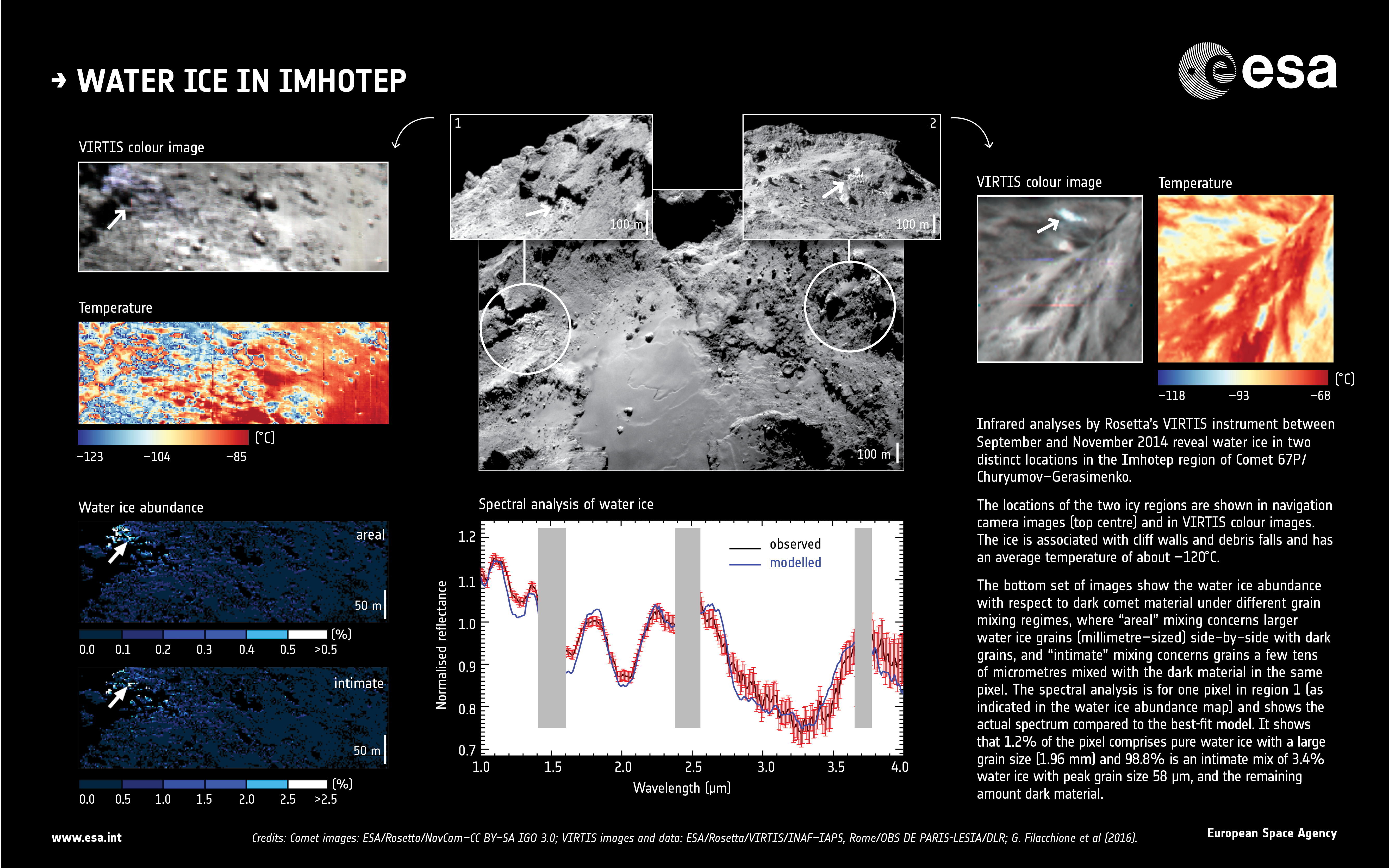
Infrared observations of water ice in Imhotep 
Copyright: Comet images: ESA/Rosetta/NavCam–CC BY–SA IGO 3.0; VIRTIS images and data: ESA/Rosetta/VIRTIS/INAF-IAPS, Rome/OBS DE PARIS-LESIA/DLR; G. Filacchione et al (2016).  Hi-res image

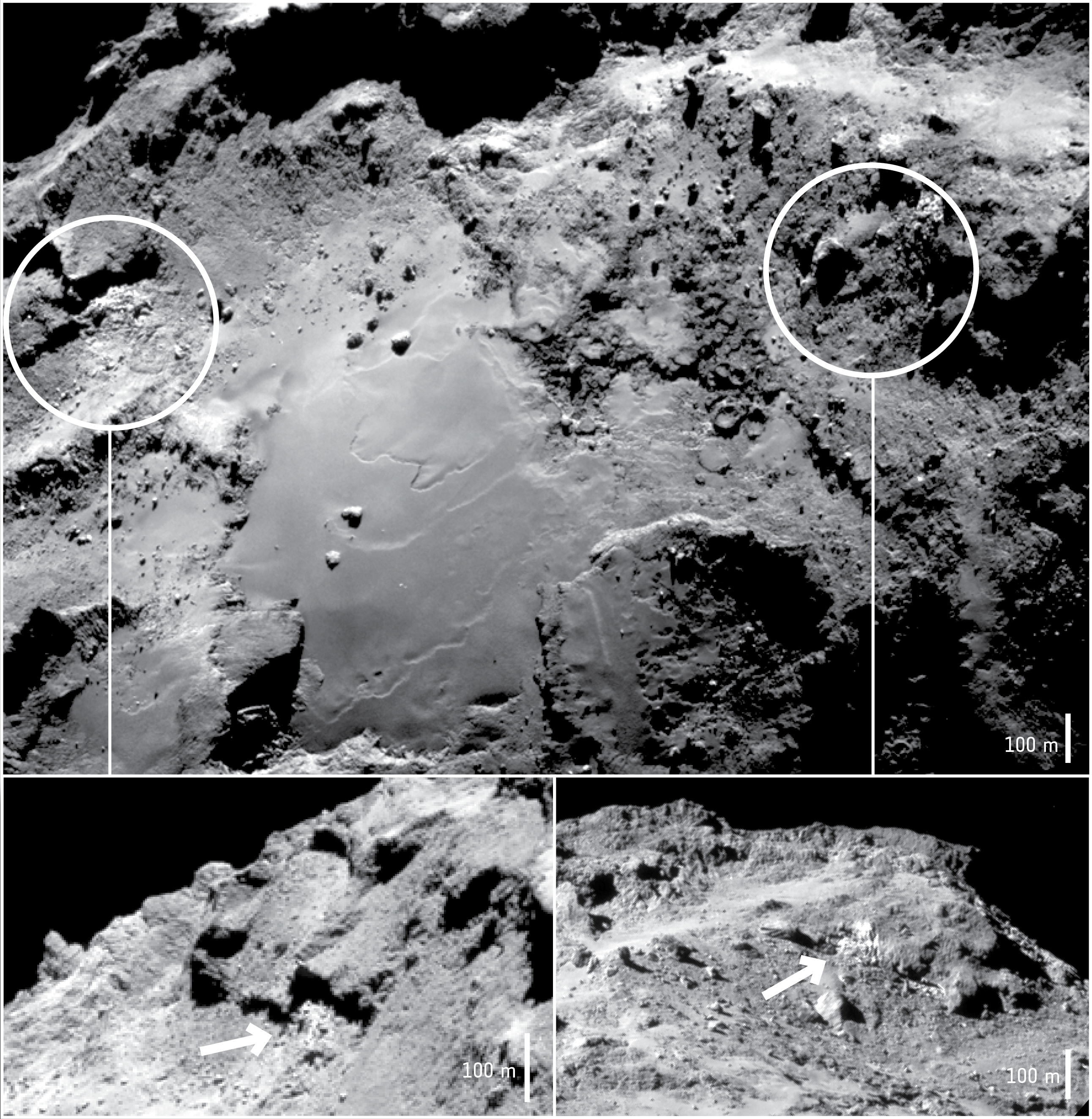
Ice in Imhotep
Copyright: ESA/Rosetta/NavCam – CC BY-SA IGO 3.0

 Hi-res image


Observations made shortly after Rosetta’s arrival at its target comet in 2014 have provided definitive confirmation of the presence of water ice.

Although water vapour is the main gas seen flowing from comet 67P/Churyumov–Gerasimenko, the great majority of ice is believed to come from under the comet’s crust, and very few examples of exposed water ice have been found on the surface.

However, a detailed analysis by Rosetta’s VIRTIS infrared instrument reveals the composition of the comet’s topmost layer: it is primarily coated in a dark, dry and organic-rich material but with a small amount of water ice mixed in.

In the latest study, which focuses on scans between September and November 2014, the team confirms that two areas several tens of metres across in the Imhotep region that appear as bright patches in visible light, do indeed include a significant amount of water ice.

The ice is associated with cliff walls and debris falls, and was at an average temperature of about –120ºC at the time.

In those regions, pure water ice was found to occupy around 5% of each pixel sampling area, with the rest made up of the dark, dry material. The abundance of ice was calculated by comparing Rosetta’s VIRTIS infrared measurements to models that consider how ice grains of different sizes might be mixed together in one pixel.

The data reveal two different populations of grains: one is several tens of micrometres in diameter, while the other is larger, around 2 mm.

These sizes contrast with the very small grains, just a few micrometres in diameter, found in the Hapi region on the ‘neck’ of the comet, as observed by VIRTIS in a different study.

“The various populations of icy grains on the surface of the comet imply different formation mechanisms, and different time scales for their formation,” says Gianrico Filacchione, lead author of the new study, published in the journal Nature.

At Hapi, the very small grains are associated with a thin layer of ‘frost’ that forms as part of the daily ice cycle, a result of fast condensation in this region over each comet rotation of just over 12 hours.

“By contrast, we think that layers of the larger millimetre-sized grains we see in Imhotep have a more complex history. They likely formed slowly over time, and are only occasionally exposed through erosion,” says Gianrico.

Assuming a typical grain size of tens of micrometres for ice grains on the surface, as inferred on other comets as well as Rosetta’s comet, then observations of millimetre-sized grains can be explained by the growth of secondary ice crystals.

One way this can occur is via ‘sintering’, whereby ice grains are compacted together. Another method is ‘sublimation’, in which heat from the Sun penetrates the surface, triggering the evaporation of buried ice. While some of the resulting water vapour may escape from the nucleus, a significant fraction of it recondenses in layers beneath the surface.

This idea is supported by laboratory experiments that simulate the sublimation behaviour of ice buried under dust, heated from above by sunlight.

These tests show that more than 80% of the released water vapour does not make it up through the dust mantle, but rather is redeposited below the surface.

Additional energy for sublimation could also be provided by a transformation in structure of the ice at a molecular level. At the low temperatures observed on comets, amorphous ice can change into crystalline ice, releasing energy as it does so.

“Ice grain growth can lead to ice-rich subsurface layers several metres thick, that can then affect the large-scale structure, porosity and thermal properties of the nucleus,” says Fabrizio Capaccioni, VIRTIS principal investigator.

“The thin ice-rich layers that we see exposed close to the surface may be a consequence of cometary activity and evolution, implying that global layering did not necessarily occur early in the comet’s formation history.”

“Understanding which features on the comet are left over from its formation and which have been created during its evolution is somewhat challenging, but this is why we are studying a comet up close: to try to discover what processes are important at different stages of a comet’s lifetime,” adds Matt Taylor, ESA’s Rosetta project scientist.

The Rosetta scientists are now analysing data captured later in the mission, as the comet moved closer to the Sun in mid-2015, to see how the amount of ice exposed on the surface evolved as the heating increased.


Notes for Editors
 
“Exposed water ice on the nucleus of comet 67P/Churyumov–Gerasimenko,” by G. Filacchione et al is published in the journal Nature.  
 

For more information, please contact:

 
Gianrico Filacchione
VIRTIS deputy principal investigator
INAF-IAPS, Rome, Italy
Email: gianrico.filacchione@iaps.inaf.it

Fabrizio Capaccioni
VIRTIS principal investigator
INAF-IAPS, Rome, Italy
Email: fabrizio.capaccioni@iaps.inaf.it

Matt Taylor
ESA Rosetta Project Scientist
Email: matt.taylor@esa.int

Markus Bauer 


ESA Science and Robotic Exploration Communication Officer


Tel: +31 71 565 6799


Mob: +31 61 594 3 954


Email: markus.bauer@esa.int


Source: ESA/Rosetta

Friday, July 24, 2015

NASA Researchers Find "Frozen" Recipe for Extraterrestrial Vitamin

Vitamin B3 could have been made on icy dust grains in space, and later delivered to Earth by meteorites and comets, according to new laboratory experiments by a team of NASA-funded researchers. Vitamin B3, also known as niacin or nicotinic acid, is used to build NAD (nicotinamide adenine dinucleotide), which is essential to metabolism and probably ancient in origin. The result supports a theory that the origin of life may have been assisted by a supply of biologically important molecules produced in space and brought to Earth by comet and meteor impacts.

The new work builds on earlier research by the team in which they analyzed carbon-rich meteorites and discovered that vitamin B3 was present at concentrations ranging from about 30 to 600 parts-per-billion. In that work, the team performed preliminary laboratory experiments that showed vitamin B3 could be made from a simpler building-block organic molecule called pyridine in carbon dioxide ice under conditions that simulated the environment in space.

The new experiments made the simulation more realistic by adding water ice to the mixture and using amounts closer to what is expected for interstellar ices and comets. The team found that even with the addition of water, the vitamin could be made under a wide variety of scenarios where the water ice abundance varied by up to ten times.

"We found that the types of organic compounds in our laboratory-produced ices match very well to what is found in meteorites," said Karen Smith of NASA's Goddard Space Flight Center in Greenbelt, Maryland. "This result suggests that these important organic compounds in meteorites may have originated from simple molecular ices in space. This type of chemistry may also be relevant for comets, which contain large amounts of water and carbon dioxide ices. These experiments show that vitamin B3 and other complex organic compounds could be made in space and it is plausible that meteorite and comet impacts could have added an extraterrestrial component to the supply of vitamin B3 on ancient Earth."

Smith, who is lead author of a paper on this research published online June 17, 2015 in Chemical Communications, performed the work with her team at NASA Goddard, including her postdoctoral research advisor, Perry Gerakines of NASA Goddard. "This work is part of a broad research program in the field of Astrobiology at NASA Goddard," Gerakines said. "We are working to understand the origins of biologically important molecules and how they came to exist throughout the Solar System and on Earth. The experiments performed in our laboratory demonstrate an important possible connection between the complex organic molecules formed in cold interstellar space and those we find in meteorites."

Exploding stars (supernovae) and the winds from red giant stars near the end of their lives produce vast clouds of gas and dust. Solar systems are born when shock waves from stellar winds and other nearby supernovae compress and concentrate a cloud of ejected stellar material until dense clumps of that cloud begin to collapse under their own gravity, forming a new generation of stars and planets.

This is an artist's concept of a protoplanetry disk surrounding a forming star that is ejecting jets of material (yellow beams). Such disks contain countless tiny dust grains, many of which become incorporated into asteroids, comets, and planets. Credits: NASA Goddard. Hi-res image

These clouds contain countless dust grains. Just as frost forms on car windows during cold, humid nights, carbon dioxide, water, and other gases form a layer of frost on the surface of these grains. Radiation in space powers chemical reactions in this frost layer to produce complex organic molecules, possibly including vitamin B3. The icy grains become incorporated into comets and asteroids, some of which impact young planets like ancient Earth, delivering the organic molecules contained within them.

This is an artist's concept of a nebula containing gas, dust, and asteroids that will later form stars and planets.
Credits: NASA Goddard

The researchers tested this theory by simulating the space environment in the Cosmic Ice Laboratory at NASA Goddard. An aluminum plate cooled to around minus 423 degrees Fahrenheit (minus 253 Celsius) was used to represent the frigid surface of an interstellar dust grain. The plate was chilled in a vacuum chamber to replicate space conditions, and gases containing water, carbon dioxide, and pyridine were released into the chamber, where they froze onto the plate. The plate was then bombarded with protons at about 1 million volts from a particle accelerator to simulate space radiation. 

A picture of the aluminum plate with a chemical deposit on it.
Credits: Karen Smith/NASA Goddard

The team performed an initial analysis of the contents of the frozen layer by shining infrared light on it to identify absorption patterns – certain molecules absorb infrared light at specific colors, or frequencies. The plate was then heated to room temperature so the ice residue could be analyzed in greater detail at Goddard's Astrobiology Analytical Laboratory. The team found that this experiment produced a variety of complex organic molecules, including vitamin B3.

Observations from the European Space Agency's Rosetta mission, now in orbit around Comet 67P/Churyumov-Gerasimenko, might add more support to the theory that comets brought organic matter to Earth. "Rosetta could help validate these experiments if it finds some of the same complex organic molecules in the gases released by the comet or in the comet’s nucleus," said Smith.

This work was supported by a NASA Postdoctoral Program Fellowship administered by Oak Ridge Associated Universities through a contract with NASA, the NASA Astrobiology Institute (NAI) via the Goddard Center for Astrobiology (GCA), and the NASA Cosmochemistry Program. NASA's Ames Research Center in Mountain View, California, administers the NAI.


Bill Steigerwald
​NASA Goddard Space Flight Center, Greenbelt, Maryland


Thursday, March 19, 2015

Rosetta makes first detection of molecular nitrogen at a comet

First detection of molecular nitrogen at a comet  
Copyright Spacecraft: ESA/ATG medialab; comet: ESA/Rosetta/NavCam – CC BY-SA IGO 3.0; 
Data: Rubin et al (2015). Hi-Res Image

Comet on 14 March 2015 – NavCam  
Copyright: ESA/Rosetta/NAVCAM – CC BY-SA IGO 3.0  Hi-Res Image

Comet’s orbit
Copyright: ESA

ESA’s Rosetta spacecraft has made the first measurement of molecular nitrogen at a comet, providing clues about the temperature environment in which Comet 67P/Churyumov–Gerasimenko formed. 

Rosetta arrived last August, and has since been collecting extensive data on the comet and its environment with its suite of 11 science instruments. 

The in situ detection of molecular nitrogen has long been sought at a comet. Nitrogen had only previously been detected bound up in other compounds, including hydrogen cyanide and ammonia, for example. 

Its detection is particularly important since molecular nitrogen is thought to have been the most common type of nitrogen available when the Solar System was forming. In the colder outer regions, it likely provided the main source of nitrogen that was incorporated into the gas planets. It also dominates the dense atmosphere of Saturn’s moon, Titan, and is present in the atmospheres and surface ices on Pluto and Neptune’s moon Triton. 

It is in these cold outer reaches of our Solar System in which the family of comets that includes Rosetta’s comet is believed to have formed. 

The new results are based on 138 measurements collected by the Rosetta Orbiter Spectrometer for Ion and Neutral Analysis instrument, ROSINA, during 17–23 October 2014, when Rosetta was about 10 km from the centre of the comet. 

“Identifying molecular nitrogen places important constraints on the conditions in which the comet formed, because it requires very low temperatures to become trapped in ice,” says Martin Rubin of the University of Bern, lead author of the paper presenting the results published today in the journal Science. 

The trapping of molecular nitrogen in ice in the protosolar nebula is thought to take place at temperatures similar to those required to trap carbon monoxide. So in order to put constraints on comet formation models, the scientists compared the ratio of molecular nitrogen to carbon monoxide measured at the comet to that of the protosolar nebula, as calculated from the measured nitrogen to carbon ratio in Jupiter and the solar wind. 

That ratio for Comet 67P/Churyumov–Gerasimenko turns out to be about 25 times less than that of the expected protosolar value. The scientists think that this depletion may be a consequence of the ice forming at very low temperatures in the protosolar nebula. 

One scenario involves temperatures of between roughly –250ºC and perhaps –220ºC, with relatively inefficient trapping of molecular nitrogen in either amorphous water ice or cage-like water ice known as a clathrate, in both cases yielding a low ratio directly. 

Alternatively, the molecular nitrogen could have been trapped more efficiently at even lower temperatures of around –253ºC in the same region as Pluto and Triton, resulting in relatively nitrogen-rich ices as seen on them. 

Subsequent heating of the comet through the decay of radioactive nuclides, or as Rosetta’s comet moved into orbits closer to the Sun, could have been sufficient to trigger outgassing of the nitrogen and thus a reduction of the ratio over time.

“This very low-temperature process is similar to how we think Pluto and Triton have developed their nitrogen-rich ice and is consistent with the comet originating from the Kuiper Belt,” says Martin.

The only other body in the Solar System with a nitrogen-dominated atmosphere is Earth. The current best guess at its origin is via plate tectonics, with volcanoes releasing nitrogen locked in silicate rocks in the mantle. 

However, the question remains as to the role played by comets in delivering this important ingredient. 

“Just as we wanted to learn more about the role of comets in bringing water to Earth, we would also like to place constraints on the delivery of other ingredients, especially those that are needed for the building blocks of life, like nitrogen,” says Kathrin Altwegg, also at the University of Bern, and principal investigator for ROSINA. 

To assess the possible contribution of comets like Rosetta’s to the nitrogen in Earth’s atmosphere, the scientists assumed that the isotopic ratio of 14N to 15N in the comet is the same as that measured for Jupiter and solar wind, which reflects the composition of the protosolar nebula. 

However, this isotopic ratio is much higher than measured for other nitrogen-bearing species present in comets, such as hydrogen cyanide and ammonia. 

Earth’s 14N/15N ratio lies roughly between these two values, and thus if there was an equal mix of the molecular form on the one hand, and in hydrogen cyanide and ammonia on the other in comets, it would be at least conceivable that Earth’s nitrogen could have come from comets. 

“However, the amount of nitrogen found in 67P/Churyumov–Gerasimenko is not an equal mix between molecular nitrogen and the other nitrogen-bearing molecules. Rather, there is 15 times too little molecular nitrogen, and therefore Earth’s 14N/15N ratio cannot be reproduced through delivery of Jupiter family comets like Rosetta’s,” says Martin. 

“It’s another piece of the puzzle in terms of the role of Jupiter family comets in the evolution of the Solar System, but the puzzle is by no means finished yet,” says ESA’s Rosetta project scientist, Matt Taylor.
“Rosetta is about five months away from perihelion now, and we’ll be watching how the composition of the gases changes over this period, and trying to decipher what that tells us about the past life of this comet.”


Notes for Editors

“Molecular nitrogen in comet 67P/Churyumov-Gerasimenko indicates a low formation temperature,” by M. Rubin et al is published in the 20 March issue of the journal Science. 10.1126/science.aaa6100 

ROSINA is the Rosetta Orbiter Spectrometer for Ion and Neutral Analysis instrument and comprises two mass spectrometers: the Double Focusing Mass Spectrometer (DFMS) and the Reflectron Time of Flight mass spectrometer (RTOF) – and the COmetary Pressure Sensor (COPS). The measurements reported here were conducted with DFMS. The ROSINA team is led by Kathrin Altwegg of the University of Bern, Switzerland. 

An average ratio of N2/CO = (5.70 +/- 0.66) x 10–3 was determined for the period 17–23 October 2014. The minimum and maximum values measured were 1.7 x 10⁻³ and 1.6 x 10⁻², respectively. Because the amount and composition of the gases change with comet rotation and position of the spacecraft with respect to the comet’s surface, an average value is used. 

The 14N/15N ratio for the N2 in Comet 67P/Churyumov–Gerasimenko is assumed to be 441, the value for the protosolar nebula as measured from Jupiter and the solar wind, while the corresponding value for nitrogen in hydrogen cyanide and ammonia is 130, as measured at other comets. The value for the Earth’s nitrogen is 272.

 More about Rosseta

Rosetta is an ESA mission with contributions from its Member States and NASA. Rosetta’s Philae lander was provided by a consortium led by DLR, MPS, CNES and ASI. Rosetta is the first mission in history to rendezvous with a comet. It is escorting the comet as they orbit the Sun together. Philae landed on the comet on 12 November 2014. Comets are time capsules containing primitive material left over from the epoch when the Sun and its planets formed. By studying the gas, dust and structure of the nucleus and organic materials associated with the comet, via both remote and in situ observations, the Rosetta mission should become the key to unlocking the history and evolution of our Solar System.


For further information, please contact:

Markus Bauer


ESA Science and Robotic Exploration Communication Officer


Tel: +31 71 565 6799


Mob: +31 61 594 3 954


Email: markus.bauer@esa.int

Martin Rubin
University of Bern, Switzerland
Email: martin.rubin@space.unibe.ch

Kathrin Altwegg

Principal investigator for ROSINA

University of Bern, Switzerland

Email: kathrin.altwegg@space.unibe.ch

Matt Taylor


ESA Rosetta project scientist


Email: matthew.taylor@esa.int

Source: ESA

Thursday, July 17, 2014

The Dual Personality of Comet 67P/C-G

Comet 67P/C-G on 14 July 2014
Credits: ESA/Rosetta/MPS for OSIRIS Team MPS/UPD/LAM/IAA/SSO/INTA/UPM/DASP/IDA

Comet 67P/C-G on 14 July 2014 - (processed view)
Credits: ESA/Rosetta/MPS for OSIRIS Team MPS/UPD/LAM/IAA/SSO/INTA/UPM/DASP/IDA

This week's images of comet 67P/Churyumov-Gerasimenko reveal an extraordinarily irregular shape. We had hints of that in last week's images and in the unscheduled previews that were seen a few days ago, and in that short time it has become clear that this is no ordinary comet. Like its name, it seems that comet 67P/C-G is in two parts. 

What the spacecraft is actually seeing is the pixelated image shown at right, which was taken by Rosetta's OSIRIS narrow angle camera on 14 July from a distance of 12 000 km.

A second image and a movie show the comet after the image has been processed. The technique used, called "sub-sampling by interpolation", only acts to remove the pixelisation and make a smoother image, and it is important to note that the comet's surface features won't be as smooth as the processing implies. The surface texture has yet to be resolved simply because we are still too far away; any apparent brighter or darker regions may turn out to be false interpretations at this early stage.

But the movie, which uses a sequence of 36 interpolated images each separated by 20 minutes, certainly provides a truly stunning 360-degree preview of the overall complex shape of the comet. Regardless of surface texture, we can certainly see an irregular shaped world shining through. Indeed, some people have already likened the shape to a duck, with a distinct body and head.

Although less obvious in the 'real' image, the movie of interpolated images supports the presence of two definite components. One segment seems to be rather elongated, while the other appears more bulbous.

Rotating view of comet 67P/C-G on 14 July 2014.  
Credits: ESA/Rosetta/MPS for OSIRIS Team MPS/UPD/LAM/IAA/SSO/INTA/UPM/DASP/IDA

Dual objects like this – known as 'contact binaries' in comet and asteroid terminology – are not uncommon.

Indeed, comet 8P/Tuttle is thought to be such a contact binary; radio imaging by the ground-based Arecibo telescope in Puerto Rico in 2008 suggested that it comprises two sphere-like objects. Meanwhile, the bone-shaped comet 103P/Hartley 2, imaged during NASA's EPOXI flyby in 2011, revealed a comet with two distinct halves separated by a smooth region. In addition, observations of asteroid 25143 Itokawa by JAXA's Hayabusa mission, combined with ground-based data, suggest an asteroid comprising two sections of highly contrasting densities.

Is Rosetta en-route to rendezvous with a similar breed of comet? The scientific rewards of studying such a comet would be high, as a number of possibilities exist as to how they form.

One popular theory is that such an object could arise when two comets – even two compositionally distinct comets – melded together under a low velocity collision during the Solar System's formation billions of years ago, when small building blocks of rocky and icy debris coalesced to eventually create planets. Perhaps comet 67P/C-G will provide a unique record of the physical processes of accretion.

Or maybe it is the other way around – that is, a single comet could be tugged into a curious shape by the strong gravitational pull of a large object like Jupiter or the Sun; after all, comets are rubble piles with weak internal strength as directly witnessed in the fragmentation of comet Shoemaker-Levy 9 and the subsequent impacts into Jupiter, 20 years ago this week. Perhaps the two parts of comet 67P/C-G will one day separate completely.

On the other hand, perhaps comet 67P/C-G may have once been a much rounder object that became highly asymmetric thanks to ice evaporation. This could have happened when the comet first entered the Solar System from the Kuiper Belt, or on subsequent orbits around the Sun.

One could also speculate that the striking dichotomy of the comet's morphology is the result of a near catastrophic impact event that ripped out one side of the comet. Similarly, it is not unreasonable to think that a large outburst event may have weakened one side of the comet so much that it simply gave away, crumbling into space.

But, while the interpolated images are certainly brilliant, we need to be closer still to see a better three-dimensional view – not to mention to perform a spectroscopic analysis to determine the comet's composition – in order to draw robust scientific conclusions about this exciting comet.

Rosetta Mission Manager Fred Jansen comments: "We currently see images that suggest a rather complex cometary shape, but there is still a lot that we need to learn before jumping to conclusions. Not only in terms of what this means for comet science in general, but also regarding our planning for science observations, and the operational aspects of the mission such as orbiting and landing.

"We will need to perform detailed analyses and modelling of the shape of the comet to determine how best we can fly around such a uniquely shaped body, taking into account flight control and astrodynamics, the science requirements of the mission, and the landing-related elements like landing site analysis and lander-to-orbiter visibility. But, with fewer than 10 000 km to go before the 6 August rendezvous, our open questions will soon be answered."


Source: ESA/Rosseta


Monday, January 20, 2014

Rosetta's Comet

 Credit: ESO, Colin Snodgrass 
(Max Planck Institute for Solar System Research, Germany)
 
ESA's Rosetta spacecraft will wake up today, 20 January, after 31 months in deep space hibernation, to finally close in on comet 67P/Churyumov-Gerasimenko (67P/CG).

This image shows the most recent observations of the 4-kilometre diameter comet, taken on 5 October 2013 by ESO's Very Large Telescope (VLT) when the comet was around 500 million kilometres away — before it passed behind the Sun and out of view from Earth's perspective.

For this image, a long series of observations was processed to reveal both the comet without the background stars (on the left panel), and the star field with the track of the comet marked (on the right). Viewed against a crowded star field towards the centre of the Milky Way, the comet was still so far from the Sun that the icy nucleus was not releasing any gas or dust, and appears as a simple spot. As it approaches the Sun, its surface will heat up and its ices will sublimate, dragging dust out to form a tail.

The observation marks the start of a close collaboration between ESA and ESO to monitor the comet from the ground during Rosetta's encounter with 67P/CG later this year. Rosetta was launched in 2004 and aims to explore the surface of the comet, deploying a lander down onto 67P/CG to see what its surface is like [1].
The comet is on a 6.5-year orbit around the Sun and is currently out towards the orbit of Jupiter. It will be closest to the Sun — roughly between the orbits of Earth and Mars — in August 2015. This image suggests that the comet is not yet active, so scientists will be keen to check in on the comet again in February, when it is next observable by the VLT, and much closer to the Sun.

In the meantime, the observations carried out in October have been used to confirm the comet's orbit ahead of the major rendezvous manoeuvre planned for Rosetta in May, to line it up for orbiting 67P/CG in August. Further calculations will be made once Rosetta sights the comet in its own imaging system.

Notes

[1] Since its launch, Rosetta has travelled around the Sun five times, picking up speed and aligning itself with its final destination. For the coldest leg of the mission, as Rosetta ventured out beyond the orbit of Jupiter, the spacecraft was put into deep-space hibernation. 67P/CG is on a reasonably stable and well-known orbit, meaning that calculations for Rosetta's trajectory could be made far in advance of the spacecraft's launch, and it is far enough away from the Sun to make it a safe target.

Links


Source: ESO (imagens)