Showing posts with label Very Large Array (VLA). Show all posts

Thursday, July 24, 2025

Groundbreaking Magnetic Field Discovery Near Massive Protostar Made Possible by NSF NRAO’s Very Large Array

Schematic of circular polarization being detected in radio waves from a massive protostar surrounded by a disk and driving a bipolar jet. This is an artistic image, not drawn to scale. Credit: AG Cheriyan/IIST


The U.S. National Science Foundation National Radio Astronomy Observatory (NSF NRAO) proudly announces a major breakthrough in our understanding of star formation, thanks to the unparalleled capabilities of the U.S. National Science Foundation Karl G. Jansky Very Large Array (NSF VLA). An international team, led by astronomers from the Indian Institute of Space Science and Technology (IIST) and the Indian Institute of Science (IISc), has for the first time detected circular polarization in radio emission originating from a massive protostar, IRAS 18162-2048—unveiling fresh clues about the cosmic forces shaping our universe.

Circularly polarized radio waves have been directly observed from a young, massive protostar, a phenomenon previously recorded only near black holes and low-mass protostars, demonstrating a new link between diverse cosmic environments. This rare signal, detected using the NSF VLA, has enabled astronomers to infer magnetic field strengths of about 20–35 Gauss close to the forming star. These values are roughly 100 times stronger than Earth’s magnetic field—providing the first direct clues to magnetic field strengths in such extreme environments. The findings reinforce a long-standing theory that the mechanisms launching powerful astrophysical jets are fundamentally similar, from low-mass stars through to supermassive black holes.

NSF NRAO is honored to contribute this critical technology and support to discoveries that deepen humanity’s knowledge of the cosmos. You can read the full releases from IIST and IISc here and here.


About NRAO

The National Radio Astronomy Observatory (NRAO) is a facility of the U.S. National Science Foundation, operated under cooperative agreement by Associated Universities, Inc.


Tuesday, September 19, 2017

VLA Begins Huge Project of Cosmic Discovery

The new VLA Sky Survey (VLASS) sharpens the view. Here is the same radio-emitting object as seen, from left to right, with the NRAO VLA Sky Survey (NVSS), the FIRST Survey, and the VLASS. The VLASS image, unlike the others, allows astronomers to positively identify the image as jets of material propelled outward from the center of a galaxy that also is seen in the visible-light Sloan Digital Sky Survey. Technical data: NVSS image at 1.4 GHz in VLA's D configuration; FIRST image at 1.4 GHz in B configuration; VLASS image at 3 GHz in B configuration. Credit: Bill Saxton, NRAO/AUI/NSF. Hi-res images


nrao17df09e from NRAO Outreach on Vimeo
Images of the same celestial object from the NVSS, FIRST, and VLASS surveys, in order, showing increased resolution, or ability to discern detail. Credit: Bill Saxton, NRAO/AUI/NSF.


New sky survey is largest observing project in VLA's history

Astronomers have embarked on the largest observing project in the more than four-decade history of the National Science Foundation’s Karl G. Jansky Very Large Array (VLA) — a huge survey of the sky that promises a rich scientific payoff over many years.

Over the next 7 years, the iconic array of giant dish antennas in the high New Mexico desert will make three complete scans of the sky visible from its latitude — about 80 percent of the entire sky. The survey, called the VLA Sky Survey (VLASS), will produce the sharpest radio view ever made of such a large portion of the sky, and is expected to detect 10 million distinct radio-emitting celestial objects, about four times as many as are now known.

“This survey puts to work the tremendously improved capabilities of the VLA produced by the upgrade project that was completed in 2012. The result will be a unique and extremely valuable tool for frontier research over a diverse range of fields in astrophysics,” said Tony Beasley, Director of the National Radio Astronomy Observatory (NRAO).

Astronomers expect the VLASS to discover powerful cosmic explosions, such as supernovae, gamma ray bursts, and the collisions of neutron stars, that are obscured from visible-light telescopes by thick clouds of dust, or that otherwise have eluded detection. The VLA’s ability to see through dust will make the survey a tool for finding a variety of structures within our own Milky Way that also are obscured by dust.

 The survey will reveal many additional examples of powerful jets of superfast particles propelled by the energy of supermassive black holes at the cores of galaxies. This will yield important new information on how such jets affect the growth of galaxies over time. The VLA’s ability to measure magnetic fields will help scientists gain new understanding of the workings of individual galaxies and of the interactions of giant clusters of galaxies.

“In addition to what we think VLASS will discover, we undoubtedly will be surprised by discoveries we aren’t anticipating now. That is the lesson of scientific history, and perhaps the most exciting part of a project like this,” said Claire Chandler, VLASS Project Director.

The survey began observations on September 7. It plans to complete three scans of the sky, each separated by approximately 32 months. Data from all three scans will be combined to make sensitive radio images, while comparing images from the individual scans will allow discovery of newly-appearing or short-lived objects. For the survey, the VLA will receive cosmic radio emissions at frequencies between 2 and 4 GigaHertz, frequencies also used for satellite communications and microwave ovens.

NRAO will release data products from the survey as quickly as they can be produced. Raw data, which require processing to turn into images, will be released as soon as observations are made. “Quick look” images, produced by an automated processing pipeline, typically will be available within a week of the observations. More sophisticated images, and catalogs of objects detected, will be released on timescales of months, depending on the processing time required.

In addition, other institutions are expected to enhance the VLASS output by performing additional processing for more specialized analysis, and make those products available to the research community. The results of VLASS also will be available to students, educators, and citizen scientists.

Completing the VLASS will require 5,500 hours of observing time. It is the third major sky survey undertaken with the VLA. From 1993-1996, the NRAO VLA Sky Survey (NVSS) used 2932 observing hours to cover the same area of sky as VLASS, but at lower resolution. The FIRST (Faint Images of the Radio Sky at Twenty centimeters) Survey studied a smaller portion of sky in more detail, using 3200 observing hours from 1993 to 2002.

“The NVSS and FIRST surveys have been cited more than 4,500 times in scientific papers, and that number still is growing,” said Project Scientist Mark Lacy. “That’s an excellent indication of the value such surveys provide to the research community,” he added.

Since the NVSS and FIRST surveys were completed, the VLA underwent a complete technical transformation. From 2001-2012, the original electronic systems designed and built during the 1970s were replaced with state-of-the-art technology that vastly expanded the VLA’s capabilities.

“This upgrade made the VLA a completely new scientific tool. We wanted to put that tool to use to produce an all-sky survey that would benefit the entire astronomical community to the maximum extent possible,” Beasley said.

In 2013, NRAO announced that it would consider conducting a large survey, and invited astronomers from around the world to submit ideas and suggestions for the scientific and technical approaches that would best serve the needs of researchers. Ideas were also solicited during scientific meetings, and a Survey Science Group was formed to advise NRAO on the survey’s scientific priorities that includes astronomers from a wide variety of specialties and institutions.

Based on the recommendations from the scientific community, NRAO scientists and engineers devised a design for the survey. In 2016, a pilot survey, using 200 observing hours, was conducted to test and refine the survey’s techniques. The Project Team underwent several design and operational readiness reviews, and finally obtained the go-ahead to begin the full survey earlier this year.

“Astronomy fundamentally is exploring — making images of the sky to see what’s there. The VLASS is a new and powerful resource for exploration,” said Steve Myers, VLASS Technical Lead.

The National Radio Astronomy Observatory is a facility of the National Science Foundation, operated under cooperative agreement by Associated Universities, Inc.


Thursday, May 25, 2017

VLA Reveals New Object Near Supermassive Black Hole in Famous Galaxy

Artist's conception of newly-discovered secondary supermassive black hole orbiting the main, 
central supermassive black hole of galaxy Cygnus A. 
Credit: Bill Saxton, NRAO/AUI/NSF

VLA radio images (orange) of central region of Cygnus A, overlaid on Hubble Space Telescope image, from 1989 and 2015. 
Animated GIF. Credit: Perley, et al., NRAO/AUI/NSF, NASA

VLA radio image (orange) of central region of Cygnus A, overlaid on Hubble Space Telescope image, from 1989. 
Credit: Perley, et al., NRAO/AUI/NSF, NASA

2015 VLA radio image (orange) of Cygnus A, overlaid on Hubble Space Telescope image. 
Credit: Perley, et al., NRAO/AUI/NSF, NASA

1989 VLA radio image of the central region of Cygnus 
A. Credit: Perley, et al., NRAO/AUI/NSF

2015 VLA radio image of the central region of Cygnus A. 
Credit: Perley, et al., NRAO/AUI/NSF


Pointing the National Science Foundation’s Very Large Array (VLA) at a famous galaxy for the first time in two decades, a team of astronomers got a big surprise, finding that a bright new object had appeared near the galaxy’s core. The object, the scientists concluded, is either a very rare type of supernova explosion or, more likely, an outburst from a second supermassive black hole closely orbiting the galaxy’s primary, central supermassive black hole.

The astronomers observed Cygnus A, a well-known and often-studied galaxy discovered by radio-astronomy pioneer Grote Reber in 1939. The radio discovery was matched to a visible-light image in 1951, and the galaxy, some 800 million light-years from Earth, was an early target of the VLA after its completion in the early 1980s. Detailed images from the VLA published in 1984 produced major advances in scientists’ understanding of the superfast “jets” of subatomic particles propelled into intergalactic space by the gravitational energy of supermassive black holes at the cores of galaxies.

“This new object may have much to tell us about the history of this galaxy,” said Daniel Perley, of the Astrophysics Research Institute of Liverpool John Moores University in the U.K., lead author of a paper in the Astrophysical Journal announcing the discovery.

“The VLA images of Cygnus A from the 1980s marked the state of the observational capability at that time,” said Rick Perley, of the National Radio Astronomy Observatory (NRAO). “Because of that, we didn’t look at Cygnus A again until 1996, when new VLA electronics had provided a new range of radio frequencies for our observations.” The new object does not appear in the images made then.

“However, the VLA’s upgrade that was completed in 2012 made it a much more powerful telescope, so we wanted to have a look at Cygnus A using the VLA’s new capabilities,” Perley said.

Daniel and Rick Perley, along with Vivek Dhawan, and Chris Carilli, both of NRAO, began the new observations in 2015, and continued them in 2016.

“To our surprise, we found a prominent new feature near the galaxy’s nucleus that did not appear in any previous published images. This new feature is bright enough that we definitely would have seen it in the earlier images if nothing had changed,” said Rick Perley. “That means it must have turned on sometime between 1996 and now,” he added.

The scientists then observed Cygnus A with the Very Long Baseline Array (VLBA) in November of 2016, clearly detecting the new object. A faint infrared object also is seen at the same location in Hubble Space Telescope and Keck observations, originally made between 1994 and 2002. The infrared astronomers, from Lawrence Livermore National Laboratory, had attributed the object to a dense group of stars, but the dramatic radio brightening is forcing a new analysis.

What is the new object? Based on its characteristics, the astronomers concluded it must be either a supernova explosion or an outburst from a second supermassive black hole near the galaxy’s center. While they want to watch the object’s future behavior to make sure, they pointed out that the object has remained too bright for too long to be consistent with any known type of supernova.

“Because of this extraordinary brightness, we consider the supernova explanation unlikely,” Dhawan said.

While the new object definitely is separate from Cygnus A’s central supermassive black hole, by about 1500 light-years, it has many of the characteristics of a supermassive black hole that is rapidly feeding on surrounding material.

“We think we’ve found a second supermassive black hole in this galaxy, indicating that it has merged with another galaxy in the astronomically-recent past,” Carilli said. “These two would be one of the closest pairs of supermassive black holes ever discovered, likely themselves to merge in the future.”

The astronomers suggested that the second black hole has become visible to the VLA in recent years because it has encountered a new source of material to devour. That material, they said, could either be gas disrupted by the galaxies’ merger or a star that passed close enough to the secondary black hole to be shredded by its powerful gravity.

“Further observations will help us resolve some of these questions. In addition, if this is a secondary black hole, we may be able to find others in similar galaxies,” Daniel Perley said.

Rick Perley was one of the astronomers who made the original Cygnus A observations with the VLA in the 1980s. Daniel Perley is his son, now also a research astronomer.

“Daniel was only two years old when I first observed Cygnus A with the VLA,” Rick said. As a high school student in Socorro, New Mexico, Daniel used VLA data for an award-winning science fair project that took him to the international level of competition, then went on to earn a doctoral degree in astronomy.

Also at the time of those first VLA observations of Cygnus A, Carilli and Dhawan were office mates as graduate students at MIT.

Carilli, now NRAO’s Chief Scientist, was Rick’s graduate student while working as a predoctoral fellow at NRAO. His doctoral dissertation was on detailed analysis of 1980s VLA images of Cygnus A.

The National Radio Astronomy Observatory is a facility of the National Science Foundation, operated under cooperative agreement by Associated Universities, Inc.


Media Contact:

Dave Finley, Public Information Officer
(575) 835-7302
dfinley@nrao.edu


Monday, December 26, 2016

VLA, ALMA Team Up to Give First Look at Birthplaces of Most Current Stars

Radio/Optical combination images of distant galaxies as seen with NSF's Very Large Array and NASA's Hubble Space Telescope. Their distances from Earth are indicated in the top set of images. Below, the same images, without labels. Credit: K. Trisupatsilp, NRAO/AUI/NSF, NASA.


Astronomers have gotten their first look at exactly where most of today's stars were born. To do so, they used the National Science Foundation's Karl G. Jansky Very Large Array (VLA) and the Atacama Large Millimeter/submillimeter Array (ALMA) to look at distant galaxies seen as they were some 10 billion years ago.

At that time, the Universe was experiencing its peak rate of star formation. Most stars in the present Universe were born then.

"We knew that galaxies in that era were forming stars prolifically, but we didn't know what those galaxies looked like, because they are shrouded in so much dust that almost no visible light escapes them," said Wiphu Rujopakam, of the Kavli Institute for the Physics and Mathematics of the Universe at the University of Tokyo and Chulalongkorn University in  Bangkok, who was lead author on the research paper.

Radio waves, unlike visible light, can get through the dust. However, in order to reveal the details of such distant -- and faint -- galaxies, the astronomers had to make the most sensitive images ever made with the VLA.

The new observations, using the VLA and ALMA, have answered longstanding questions about just what mechanisms were responsible for the bulk of star formation in those galaxies. They found that intense star formation in the galaxies they studied most frequently occured throughout the galaxies, as opposed to much smaller regions in present-day galaxies with similar high star-formation rates.

The astronomers used the VLA and ALMA to study galaxies in the Hubble Ultra Deep Field, a small area of sky observed since 2003 with NASA's Hubble Space Telescope (HST). The HST made very long exposures of the area to detect galaxies in the far-distant Universe, and numerous observing programs with other telescopes have followed up on the HST work.

"We used the VLA and ALMA to see deeply into these galaxies, beyond the dust that obscured their innards from Hubble," said Kristina Nyland, of the National Radio Astronomy Observatory (NRAO). "The VLA showed us where star formation was occurring, and ALMA revealed the cold gas that is the fuel for star formation," she added.

"In this study, we made the most sensitive image ever made with the VLA," said Preshanth Jagannathan, also of NRAO. "If you took your cellphone, which transmits a weak radio signal, and put it at more than twice the distance to Pluto, near the outer edge of the solar system, its signal would be roughly as strong as what we detected from these galaxies," he added.

The study of the galaxies was done by an international team of astronomers. Others involved include James Dunlop of the University of Edinburgh and Rob Ivison of the University of Edinburgh and the European Southern Observatory. The researchers reported their findings in the Dec. 1 issue of the Astrophysical Journal.

ALMA is a partnership of ESO (representing its member states), NSF (USA) and NINS (Japan), together with NRC (Canada), NSC and ASIAA (Taiwan), and KASI (Republic of South Korea), in cooperation with the Republic of Chile. The Joint ALMA Observatory is operated by ESO, AUI/NRAO and NAOJ.

The National Radio Astronomy Observatory is a facility of the National Science Foundation, operated under cooperative agreement by Associated Universities, Inc.


Media Contact:  

Dave Finley, Public Information Officer
(575) 835-7302
dfinley@nrao.edu


Friday, June 10, 2016

VLA Reveals New Information on Workings of Jupiter's Atmosphere

Radio image (top), made with the VLA, and visible-light image (bottom) made with the Hubble Space Telescope, of Jupiter's famous Great Red Spot, a giant storm in the planet's atmosphere. The radio image shows the complex upwellings and downwellings of ammonia gas 30-90 kilometers below the visible clouds. CREDIT: de Pater, et al., NRAO/AUI/NSF; NASA.

Animated GIF, alternating between the radio and optical images above.


Observations with the National Science Foundation's Very Large Array (VLA) have given scientists an unprecedented look into the atmosphere of Jupiter, revealing that features seen in visible light at the planet's cloud surfaces have effects tens of kilometers downward.

The scientists used the VLA to study the dynamics of Jupiter's atmosphere from the visible cloud surfaces down to about 100 kilometers below the clouds.

"This region was previously unexplored," said Imke de Pater, of the University of California, Berkeley. "These observations give us important new information about the temperatures, pressures, and motions of gas at these levels of the atmosphere," she added.

The new images provide detail that was unavailable before. In order to make sensitive radio images, multi-antenna telescopes such as the VLA must gather the radio waves emitted by an object for a significant amount of time, like a time exposure in a camera. However, Jupiter rotates so swiftly, with a "day" of less than 10 hours, that a conventional radio image would be smeared in just a few minutes.

To overcome this obstacle, the researchers took advantage of the added sensitivity of the upgraded VLA, then developed an innovative data-reduction technique to "unsmear" the data from many hours of observing. The results showed a level of detail that provided new insights into the structure and dynamics of the giant planet's atmosphere.

"We were able to make maps of Jupiter as seen at different radio wavelengths, then compare these to visible-light images made at nearly the same times," said Bryan Butler, of the National Radio Astronomy Observatory.

Jupiter's familar light-colored zones and darker belts, visible even through small telescopes, were thought to be well-correlated to radio features, but the new radio images showed some similar structures unconnected to visible-light features. The radio images showed evidence of what the scientists think are rising plumes of gas that are part of the wave pattern that produces "hot spots' in the planet's atmosphere.

The Great Red Spot, perhaps the most famous feature on Jupiter, is also prominent, along with similar, smaller storms, in the radio images.

The new data allowed the scientists to construct graphs showing the concentrations of ammonia, an important constituent of Jupiter's atmosphere, as it changes with altitude.

"All told, there is a wealth of information about the structure of Jupiter's atmosphere in these new VLA images," de Pater said. "We hope to resolve a number of outstanding questions with these and future studies using similar techniques," she added.

Butler and de Pater worked with Robert Sault of the University of Melbourne, Australia, and David DeBoer and Michael Wong, of the University of California, Berkeley. The astronomers are reporting their results in the 3 June edition of the journal Science.

The National Radio Astronomy Observatory is a facility of the National Science Foundation, operated under cooperative agreement by Associated Universities, Inc.


Contact:
 
Dave Finley, Public Information Officer
(575) 835-7302
dfinley@nrao.edu


Tuesday, January 12, 2016

VLA Reveals Dramatic New Evidence About Star, Planet Formation

In this artist's conception, a widely-separated pair of young, still-forming stars is in the background, forming by fragmentation of the material in the larger cloud in which they are born. In the foreground, companions in a multiple-star system are forming through fragmentation of a dusty disk that surrounds the original young star. Credit: Bill Saxton, NRAO/AUI/NSF. Hi-res image

A young double-star system in the Perseus Molecular Cloud, imaged with the VLA. This pair would fit within the orbit of Neptune in our Solar System. 
Credit: Tobin, et al., NRAO/AUI/NSF. Hi-res image

A young triple-star system in the Perseus Molecular Cloud, imaged with the VLA. 
Credit: Tobin et al., NRAO/AUI/NSF. Hi-res image

Disks of material surrounding young stars in the Perseus Molecular Cloud, imaged with the VLA. Arrows indicate the direction of outflows from the young systems. Credit: Segura-Cox, et al., NRAO/AUI/NSF. Hi-res image


A detailed study of young stars and their surroundings has produced dramatic new evidence about how multiple-star systems form and how the dusty disks that are the raw material for planets grow around young stars. Teams of scientists used the National Science Foundation's Karl G. Jansky Very Large Array (VLA) radio telescope to study nearly 100 newborn stars in a cloud of gas and dust about 750 light-years from Earth, in which new stars are forming.

Images made from the study showed unprecedented detail of a number of the young stars, and are helping astronomers resolve important questions about how stars, binary stars, and planets get their starts. The astronomers presented their results to the American Astronomical Society's meeting in Kissimmee, Florida.

Looking at young multiple-star systems, one team concluded that two different formation mechanisms may be at work to produce such systems. They noted that the systems they studied fall into two distinct types, based on the distance between the stars in the system. The closer systems have stars separated by about 75 times the Sun-Earth distance, and another group has its stars separated by about 3,000 times the Sun-Earth distance. They also found that more than half of the youngest stars they studied are in multiple systems, suggesting that star formation tends to produce multiples rather than single stars.

"Several different processes have been suggested for how multiple-star systems form, and our results indicate that the separation between stars may tell us which of these processes is responsible for a particular system," said John Tobin, of Leiden Observatory in the Netherlands.

Stars form in giant clouds of gas and dust, when tenuous material in such clouds collapses gravitationally into cores that then begin to draw additional material inward. Infalling material forms a rotating disk around the young star. Eventually, the young star gathers enough mass to create the temperatures and pressures at its center that will trigger thermonuclear reactions. The rotating disk around the star provides the material from which planets may form.

The researchers concluded that the more widely-separated multiple-star systems form through turbulent fragmentation of the larger cloud, while the closer systems are the result of fragmentation within the disk of material orbiting the original protostar. They also found that somewhat older systems have fewer widely-separated companions than the youngest group of protostars. This, they said, suggests that perhaps some young stars that form as widely-separated systems are not gravitationally bound and simply drift apart over time.

Another team, led by Dominique Segura-Cox, of the University of Illinois, found that the dusty disks around some of the protostars are larger than some theoretical models predict. These disks are essential to the formation of planets, some binary companions, and the young star's ability to draw in additional material. Despite their central role in these processes, however, their formation mechanisms have been debated among astronomers.

As material falls inward toward a young star, it pulls magnetic fields along with it. Theorists suggested that these fields, which become stronger as they are concentrated closer to the star, could be aligned so that they drastically slow the disk's rotation, limiting the size of the disk. Theoretical models predicted that this effect, called magnetic braking, would limit the disks to a radius about 10 times the Earth-Sun distance, or slightly more than the distance from the Sun to Saturn.

"We found disks with radii that are at least 15-30 times the Earth-Sun distance, significantly larger than the magnetic-braking model would allow," Segura-Cox said. "This is a lower limit, and the disks may actually be larger. Studies of other systems have indicated that disks are larger when observed at radio frequencies different than the ones we used in this project," she added.

One explanation for the larger disk sizes may be that, in some systems, the magnetic field and the rotation axis of the star are misaligned, a configuration that reduces the magnetic-braking effect. Evidence for this has been seen in some objects, the researchers said.

In another study published last December, a team using data from the same project found that the material falling toward one protostar is twisting the magnetic field lines and changing their configuration as it drags them inward. That study, which measured the magnetic-field alignments near the star, indicates one mechanism for minimizing the magnetic-braking effect.

"These observations of disks around such young stars suggests that all the elements needed for planet formation are present very early in the life of a star. Plus, it is probable that there are already centimeter-sized particles in these young disks, meaning that the growth of solids progresses rapidly," Tobin said.

The images for this work came from a project called the VLA Nascent Disk and Multiplicity (VANDAM) Survey. This survey used 264 hours of VLA observing time from 2013 to 2015 to study protostars in the Perseus Molecular Cloud, about 750 light-years distant. The Perseus Molecular Cloud, containing as much material as 10,000 suns, is one of the closest regions where low- to intermediate-mass stars are actively forming, and thus serves as a valuable "laboratory" for astronomers seeking to understand star formation.

"This survey sampled the largest number of young stars, and revealed fainter objects than we could study previously, and did so in greater detail. The information it provided has dramatically improved our knowledge," Tobin said.

"The disks we studied are difficult to observe as they are obscured by the cloud in which they are forming, but these new VLA observations reveal the disks and provide critical data into their formation mechanism,” Segura-Cox said.

The National Radio Astronomy Observatory is a facility of the National Science Foundation, operated under cooperative agreement by Associated Universities, Inc.

*  *  *
Media Contact: 

Dave Finley, Public Information Officer
(575) 835-7302

dfinley@nrao.edu


Monday, April 06, 2015

Astronomers Watch Unfolding Saga of Massive Star Formation

Artist's conception of the development of W75N(B)-VLA-2.. At left, a hot wind from the young star expands nearly spherically, as seen in 1996. At right, as seen in 2014, the hot wind has been shaped by encountering a dusty, donut-shaped torus around the star and appears elongated. Credit: Bill Saxton, NRAO/AUI/NSF.  JPG image

VLA images of W75N(B)-VLA-2: Top, 1996; Bottom, 2014
Credit: Carrasco-Gonzalez, et al., NRAO/AUI/NSF.  JPG image


A pair of images of a young star, made 18 years apart, has revealed a dramatic difference that is providing astronomers with a unique, "real-time" look at how massive stars develop in the earliest stages of their formation.

The astronomers used the National Science Foundation's Karl G. Jansky Very Large Array (VLA) to study a massive young star called W75N(B)-VLA 2, some 4200 light-years from Earth. They compared an image made in 2014 with an earlier VLA image from 1996.

"The comparison is remarkable," said Carlos Carrasco-Gonzalez of the Center of Radioastronomy and Astrophysics of the National Autonomous University of Mexico, leader of the research team. The 1996 image shows a compact region of a hot, ionized wind ejected from the young star. The 2014 image shows that ejected wind deformed into an distinctly elongated outflow.

"We're seeing this dramatic change in real time, so this object is providing us an exciting opportunity to watch over the next few years as a very young star goes through the early stages of its formation," Carrasco-Gonzalez said.

The scientists believe the young star is forming in a dense, gaseous environment, and is surrounded by a doughnut-shaped, dusty torus. The star has episodes in which it ejects a hot, ionized wind for several years. At first, that wind can expand in all directions, and so forms a spherical shell around the star. Later, the wind hits the dusty torus, which slows it. Wind expanding outward along the poles of the torus, where there is less resistance, moves more quickly, resulting in an elongated shape for the outflow.

"In the span of only 18 years, we've seen exactly what we predicted," Carrasco-Gonzalez said.

There are theoretical models developed to explain why nearly-spherical expansion of such outflows had been seen with young stars much more massive than the Sun, when narrower, beam-like outflows were expected based on observations of less-massive, Sun-like stars at similar stages of development. W75N(B)-VLA 2 is estimated to be about 8 times more massive than the Sun. The more-uniform outflows are seen in massive young stars in the first few thousand years of their lives, the stage at which W75N(B)-VLA 2 is thought to be.

"Our understanding of how massive young stars develop is much less complete than our understanding of how Sun-like stars develop," Carrasco-Gonzalez said. "It's going to be really great to be able to watch one as it changes. We expect to learn a lot from this object," he added.

Carrasco-Gonzalez worked with an international team of astronomers from Mexico, the Netherlands, Sweden, Spain, Korea, and Japan. The scientists reported their discovery in the journal Science.

The National Radio Astronomy Observatory is a facility of the National Science Foundation, operated under cooperative agreement by Associated Universities, Inc.


Contact:  

Dave Finley, Public Information Officer
(575) 835-7302
dfinley@nrao.edu


Thursday, March 12, 2015

Mysterious Phenomena in a Gigantic Galaxy-Cluster Collision

Abell 2256, in a "true color" radio image made with the VLA
Credit: Owen et al., NRAO/AUI/NSF


Researchers using the Karl G. Jansky Very Large Array (VLA) have produced the most detailed image yet of a fascinating region where clusters of hundreds of galaxies are colliding, creating a rich variety of mysterious phenomena visible only to radio telescopes.

The scientists took advantage of new VLA capabilities to make a "true color" radio image. This image shows the region as it would appear if human eyes were sensitive to radio waves instead of light waves. In this image, red shows where longer radio waves predominate, and blue shows where shorter radio waves predominate, following the pattern we see in visible light.

The image shows a number of strange features the astronomers think are related to an ongoing collision of galaxy clusters. The region is called Abell 2256, and is about 800 million light-years from Earth and some 4 million light-years across. The image covers an area in the sky almost as large as the full moon. Studied by astronomers for more than half a century with telescopes ranging from radio to X-ray, Abell 2256 contains a fascinating variety of objects, many of whose exact origins remain unclear.

With monikers such as "Large Relic," "Halo," and "Long Tail," the features in this region are seen in greater fidelity than ever before, said Frazer Owen, of the National Radio Astronomy Observatory (NRAO). "The image reveals details of the interactions between the two merging clusters and suggests that previously unexpected physical processes are at work in such encounters," he said.

Owen worked with Lawrence Rudnick of the University of Minnesota; Jean Eilek of New Mexico Tech; and Urvashi Rau, Sanjay Bhatnagar, and Leonid Kogan of NRAO. The researchers presented their results in the Astrophysical Journal.

The National Radio Astronomy Observatory is a facility of the National Science Foundation, operated under cooperative agreement by Associated Universities, Inc.

# # #


Contact: 

Dave Finley, Public Information Officer
(575) 835-7302
dfinley@nrao.edu


Wednesday, February 11, 2015

Astronomers catch ‘Tatooine’ multiple-star system as it forms

An image of a binary star system in formation
A triple star system forming within a dense gas filament in a numerical simulation modeling a group of forming stars. The color indicates the gas density, where lighter colors are higher densities. Rhe image is about 10,000 astronomical units across where the projected separations between the three objects is about 2,000 and 4,000 AU. Credit:  UMass Amherst 


For the first time astronomers have caught a multiple-star system as it is created, and their observations are providing new insight into how such systems, and possibly the solar system, are formed.

Amazing images taken from a series of telescopes on Earth show clouds of gas which are in the process of developing into stars.

Scientists from The University of Manchester, Liverpool John Moores University and other institutes in Europe and around the world, looked at a cloud of gas some 800 light-years from Earth, homing in on a core of gas that contains one young protostar and three dense pockets of matter that they say will collapse into stars over the next 40,000 years. Of the eventual four stars, the astronomers predict that three may become a stable triple-star system. The findings are published today in the journal Nature.

“These kind of multi-star systems are quite common in the Universe. Think of Tatooine in Star Wars, where there are two ‘suns’ in the sky, that isn’t too far away from something that could be a real formation. In fact nearly half of all stars are in this type of system,” said Professor Gary Fuller, of the Jodrell Bank Centre for Astrophysics, The University of Manchester.

“Seeing such a multiple star system in its early stages of formation has been a longstanding challenge, but the combination of the Very Large Array (VLA) and the Green Bank Telescope (GBT) has given us the first look at such a young system.”

Dr Richard Parker, of the Astrophysics Research Institute at LJMU who performed the stability analysis calculations on the system, said: “Observing the formation and subsequent destruction of these systems will ultimately help us to understand whether our own Sun was once part of such a system and if it was, what happened to its stellar siblings.”

The scientists used the VLA and GBT, along with the James Clerk Maxwell Telescope (JCMT) in Hawaii, to study a dense core of gas called Barnard 5 (B5) in a region where young stars are forming in the constellation Perseus. This object was known to contain one young forming star.

When the research team used the VLA to map radio emission from ammonia molecules, they discovered that filaments of gas in B5 are fragmenting, and the fragments are beginning to contract to form additional stars ultimately becoming a multiple-star system.

Jaime Pineda, of the Institute for Astronomy, ETH Zurich, in Switzerland, who led the project, said: “We know that these stars eventually will form a multi-star system because our observations show that these gas condensations are gravitationally bound.  This is the first time we've been able to show that such a young system is gravitationally bound.”

“This provides fantastic evidence that fragmentation of gas filaments is a process that can produce multiple-star systems," Dr Pineda said. Other proposed mechanisms include fragmentation of the main gas core, fragmentation within a disk of material orbiting a young star, and gravitational capture. “We've now convincingly added fragmentation of gas filaments to this list," Dr Pineda added.

The condensations in B5 that will produce stars now range from one-tenth to more than one-third the mass of the Sun, the scientists said. Their separations will range from 3,000 to 11,000 times the Earth-Sun distance.

The astronomers analyzed the dynamics of the gas condensations and predict that, when they form into stars, they will form a stable system of an inner binary. The other two stars, they suggest, will be ejected from the system.


Notes for Editors


Ref. 'The formation of a quadruple star system with wide separation ' has been scheduled for publication in Nature on 12 February 2015.


Media contacts

Sam Wood
Media Relations Officer
University of Manchester
Tel: +44 (0)161 2758155
Mob: +44 (0)7886 473422
Email: samuel.wood@manchester.ac.uk 


Monday, May 12, 2014

Resolving the radio sky

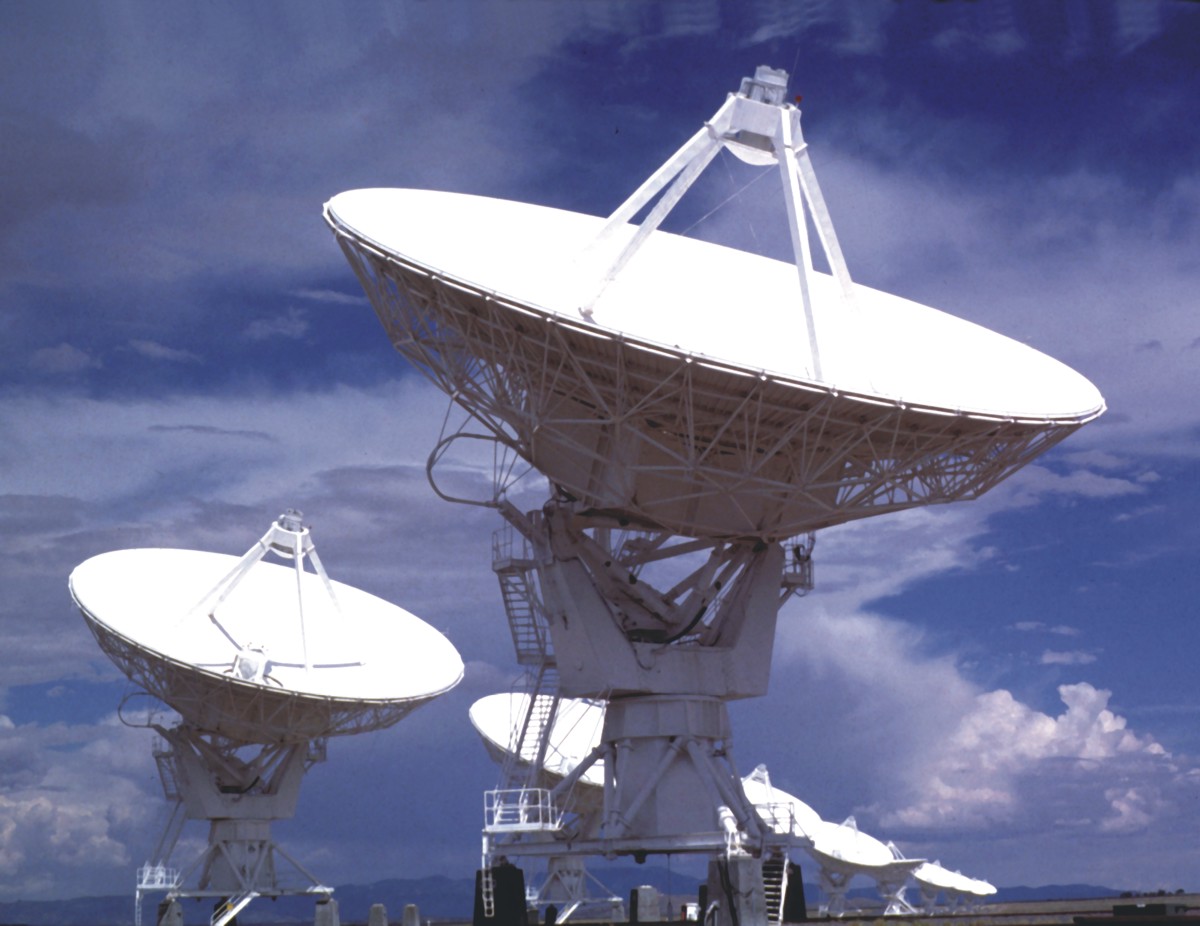
Fig. 1: The Very Large Array (VLA) is a collection of 27 radio antennas located on the plains of San Augustin near Socorro, New Mexico, each with a dish 25 meters in diameter and weighing more than 200 tons. The data from all antennas can be combined electronically so that the array effectively functions as one giant antenna. Image courtesy of NRAO/AUI

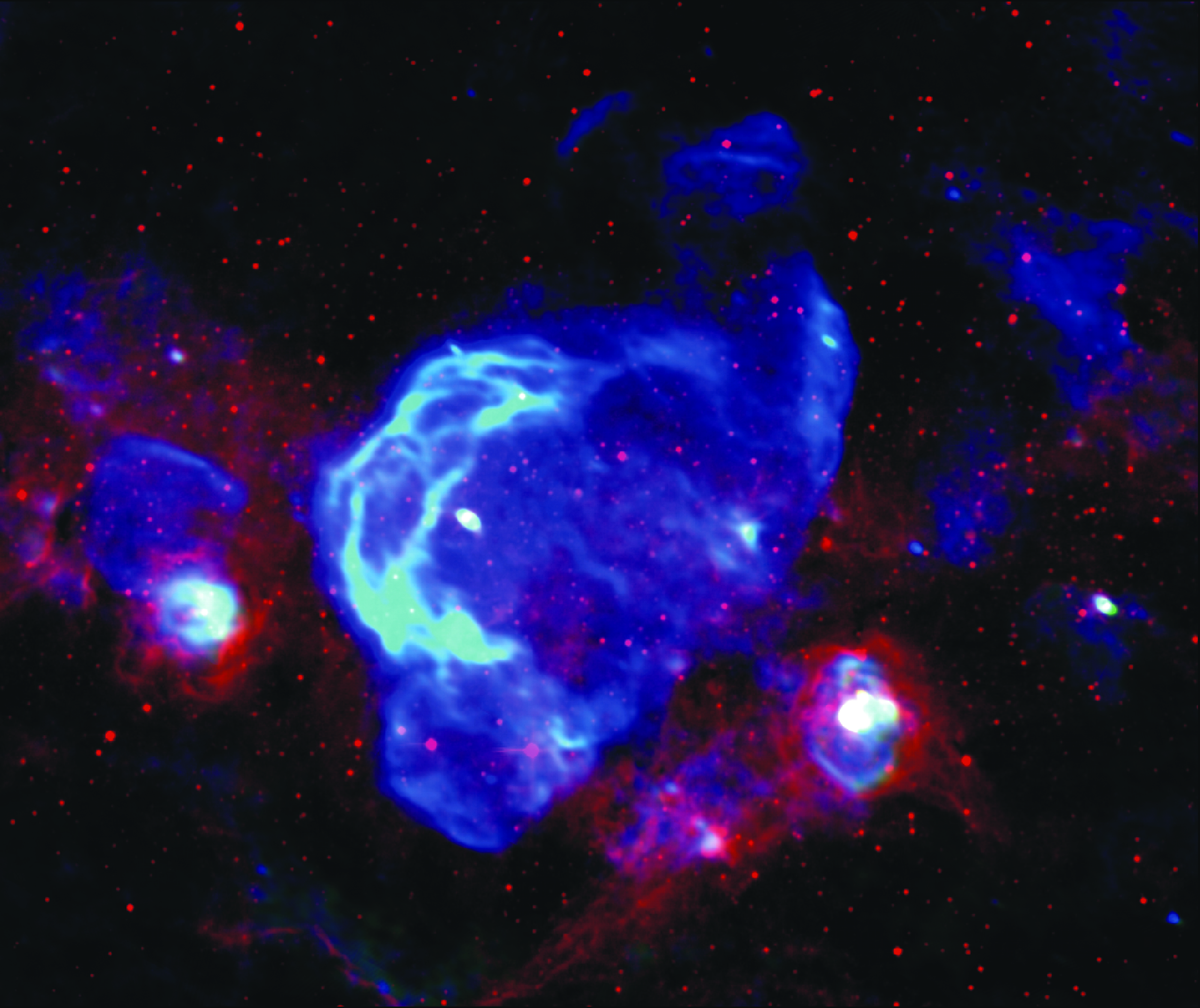
Fig. 2: This is a false colour image of the region surrounding the W28 supernova remnant with the radio emission detected with the VLA shown in blue. The more compact objects north and south of W28 are regions of ionized hydrogen not directly related to the remnant. The new image reconstruction method will make it much easier to reconstruct interferometry images of such extended sources.  Credit: NRAO/AUI/NSF and Brogan et al. 

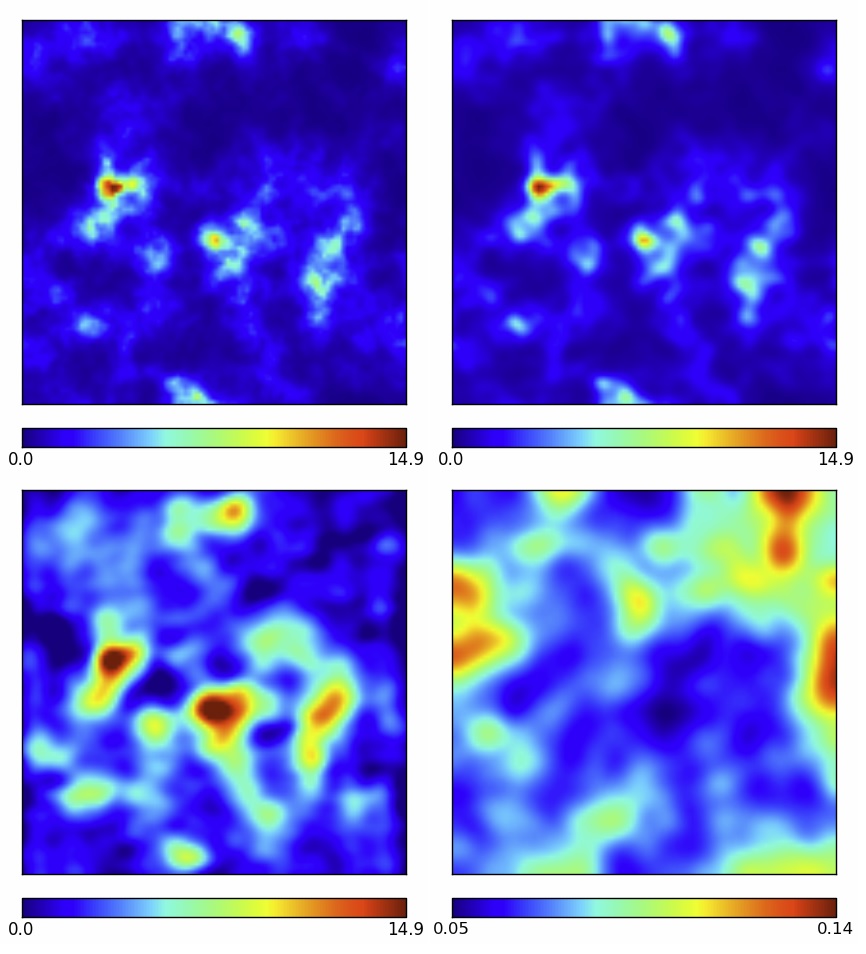
Fig. 3: A simulated observation of a galaxy cluster with the VLA. The image on the top left shows the (real) input signal. The top right image shows the reconstruction using the RESOLVE algorithm. The image on the bottom left shows a reconstruction with a standard algorigthm (CLEAN) while the image on the bottom right gives the relative uncertainty of the reconstruction, note the different scale on this map. 

Radio astronomers obtain extremely high resolution sky images by using interferometers, instruments where several single radio telescopes are linked together. However, optimal data analysis procedures for such an instrument are significantly more involved than for a single telescope. Scientists from the Max Planck Institute for Astrophysics have now developed the algorithm RESOLVE which solves a number of outstanding problems in radio imaging. 

Using radio interferometers, scientists look into the deepest depths of the Universe. These instruments deliver high-resolution images of many different celestial objects, ranging from the Sun, over pulsars, and the interstellar gas in the Milky Way, to distant sources such as radio galaxies or quasars. The high-resolution radio images of such objects often reveal their complex and extended structure. 

Indeed, most of the radio emission from celestial sources originates in extended cosmic plasma clouds, glowing only faintly to the observer on Earth. In consequence, such extended regions of emission are difficult to detect, since they have to be separated from unwanted interferences as e.g. electronic noise from terrestrial technical equipment or atmospheric effects. 

Furthermore, imaging in radio interferometry is inherently more complicated as for a single telescope. This is because an interferometer does not detect the celestial sources directly, instead the signals from different detectors are electronically superimposed. To reconstruct the original signal from the data, a so called Fourier transformation needs to be applied, usually implying complex calculations on the computer. Unfortunately, standard imaging methods have the drawback that they often only produce unreliable results for weak and extended emission. Moreover, due to the complex nature of the interferometric observation, in general an estimation of the measurement uncertainty was unreliable so far as well. 

In two recent publications, the new imaging algorithm RESOLVE ("Radio Extended Sources Lognormal Deconvolution Estimator") is presented to solve exactly these problems of current methods. RESOLVE employs a statistical approach, estimating the most probable image reconstruction compatible with the measured data. In this process, the algorithm uses the vague prior knowledge of the observer on the source — namely that it is an extended object — to differentiate between likely and unlikely reconstructions. To this end, RESOLVE assumes that the radio intensity does not change abruptly from one place to the next, but instead that the source is comprised of statistically similar structures, connected over several pixels, and not necessarily exactly known prior to an observation. Mathematically, this is expressed by a so-called spatial correlation function, unknown at the beginning of the reconstruction process. 

RESOLVE can roughly be divided into two major steps. In the first part, the statistically most probable image reconstruction, compatible with an extended source, is estimated. In this step, the spatial correlation function is assumed to be known by the algorithm and thus influences the reconstruction process. In the second part, the correlation function is estimated using the intermediate image reconstruction obtained in the first step. RESOLVE iterates this two-step process until a statistically optimal reconstruction has been obtained. Finally, from the last reconstruction, a map of the measurement uncertainty is calculated. 

This procedure can be extended to observations at different wavelengths. For this, in addition, the spectral dependence of the radio emission in every pixel is estimated using a very similar method as just described. 

Simulated reconstructions using RESOLVE show that from high quality interferometric data, it is indeed possible to computationally reverse the complicated measurement process of the interferometer with high precision and to estimate the structure of an extended radio source with high precision. In addition, the noise is removed from the measured signal and a measurement uncertainty is estimated during this process. Possible areas of application in observational radio astronomy range from single objects in the Milky Way like e.g. remnants of exploding stars, to distant radio galaxies and large galaxy clusters. The new image reconstructions will allow for a deeper and better resolved view into the radio sky.

Henrik Junklewitz, Michael Bell and Torsten Enßlin


REFERENCES

Henrik Junklewitz, Michael Bell, Marco Selig and Torsten Enßlin, "RESOLVE: A new algorithm for aperture synthesis imaging in radio astronomy", submitted to A&A

Henrik Junklewitz, Michael Bell and Torsten Enßlin, "A new approach to multi-frequency imaging in radio interferometry", submitted to A&A