Wednesday, October 27, 2021

Neutron star collisions are a “goldmine” of heavy elements, study finds


New research suggests binary neutron stars are a likely cosmic source for the gold, platinum, and other heavy metals we see today. Credits: National Science Foundation/LIGO/Sonoma State University/A. Simonnet, edited by MIT News 

Mergers between two neutron stars have produced more heavy elements in last 2.5 billion years than mergers between neutron stars and black holes.

Most elements lighter than iron are forged in the cores of stars. A star’s white-hot center fuels the fusion of protons, squeezing them together to build progressively heavier elements. But beyond iron, scientists have puzzled over what could give rise to gold, platinum, and the rest of the universe’s heavy elements, whose formation requires more energy than a star can muster.

A new study by researchers at MIT and the University of New Hampshire finds that of two long-suspected sources of heavy metals, one is more of a goldmine than the other.

The study, published today in Astrophysical Journal Letters, reports that in the last 2.5 billion years, more heavy metals were produced in binary neutron star mergers, or collisions between two neutron stars, than in mergers between a neutron star and a black hole.

The study is the first to compare the two merger types in terms of their heavy metal output, and suggests that binary neutron stars are a likely cosmic source for the gold, platinum, and other heavy metals we see today. The findings could also help scientists determine the rate at which heavy metals are produced across the universe.

“What we find exciting about our result is that to some level of confidence we can say binary neutron stars are probably more of a goldmine than neutron star-black hole mergers,” says lead author Hsin-Yu Chen, a postdoc in MIT’s Kavli Institute for Astrophysics and Space Research.

Chen’s co-authors are Salvatore Vitale, assistant professor of physics at MIT, and Francois Foucart of UNH.

An efficient flash

As stars undergo nuclear fusion, they require energy to fuse protons to form heavier elements. Stars are efficient in churning out lighter elements, from hydrogen to iron. Fusing more than the 26 protons in iron, however, becomes energetically inefficient.

“If you want to go past iron and build heavier elements like gold and platinum, you need some other way to throw protons together,” Vitale says.

Scientists have suspected supernovae might be an answer. When a massive star collapses in a supernova, the iron at its center could conceivably combine with lighter elements in the extreme fallout to generate heavier elements.

In 2017, however, a promising candidate was confirmed, in the form a binary neutron star merger, detected for the first time by LIGO and Virgo, the gravitational-wave observatories in the United States and in Italy, respectively. The detectors picked up gravitational waves, or ripples through space-time, that originated 130 million light years from Earth, from a collision between two neutron stars — collapsed cores of massive stars, that are packed with neutrons and are among the densest objects in the universe.

The cosmic merger emitted a flash of light, which contained signatures of heavy metals.

“The magnitude of gold produced in the merger was equivalent to several times the mass of the Earth,” Chen says. “That entirely changed the picture. The math showed that binary neutron stars were a more efficient way to create heavy elements, compared to supernovae.”

A binary goldmine

Chen and her colleagues wondered: How might neutron star mergers compare to collisions between a neutron star and a black hole? This is another merger type that has been detected by LIGO and Virgo and could potentially be a heavy metal factory. Under certain conditions, scientists suspect, a black hole could disrupt a neutron star such that it would spark and spew heavy metals before the black hole completely swallowed the star.

The team set out to determine the amount of gold and other heavy metals each type of merger could typically produce. For their analysis, they focused on LIGO and Virgo’s detections to date of two binary neutron star mergers and two neutron star – black hole mergers.

The researchers first estimated the mass of each object in each merger, as well as the rotational speed of each black hole, reasoning that if a black hole is too massive or slow, it would swallow a neutron star before it had a chance to produce heavy elements. They also determined each neutron star’s resistance to being disrupted. The more resistant a star, the less likely it is to churn out heavy elements. They also estimated how often one merger occurs compared to the other, based on observations by LIGO, Virgo, and other observatories.

Finally, the team used numerical simulations developed by Foucart, to calculate the average amount of gold and other heavy metals each merger would produce, given varying combinations of the objects’ mass, rotation, degree of disruption, and rate of occurrence.

On average, the researchers found that binary neutron star mergers could generate two to 100 times more heavy metals than mergers between neutron stars and black holes. The four mergers on which they based their analysis are estimated to have occurred within the last 2.5 billion years. They conclude then, that during this period, at least, more heavy elements were produced by binary neutron star mergers than by collisions between neutron stars and black holes.

The scales could tip in favor of neutron star-black hole mergers if the black holes had high spins, and low masses. However, scientists have not yet observed these kinds of black holes in the two mergers detected to date.

Chen and her colleagues hope that, as LIGO and Virgo resume observations next year, more detections will improve the team’s estimates for the rate at which each merger produces heavy elements. These rates, in turn, may help scientists determine the age of distant galaxies, based on the abundance of their various elements.

“You can use heavy metals the same way we use carbon to date dinosaur remains,” Vitale says. “Because all these phenomena have different intrinsic rates and yields of heavy elements, that will affect how you attach a time stamp to a galaxy. So, this kind of study can improve those analyses.”

This research was funded, in part, by NASA, the National Science Foundation, and the LIGO Laboratory.

Jennifer Chu | MIT News Office

Source: MIT/News


Tuesday, October 26, 2021

Chandra Sees Evidence for Possible Planet in Another Galaxy


M51/Whirpool Galaxy
Credit X-ray: NASA/CXC/SAO/R. DiStefano, et al.; 
Optical: NASA/ESA/STScI/Grendler; 
Illustration: NASA/CXC/M.Weiss


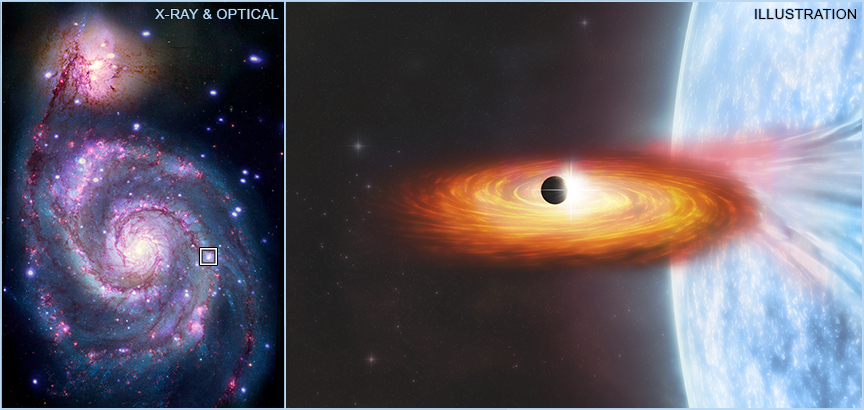
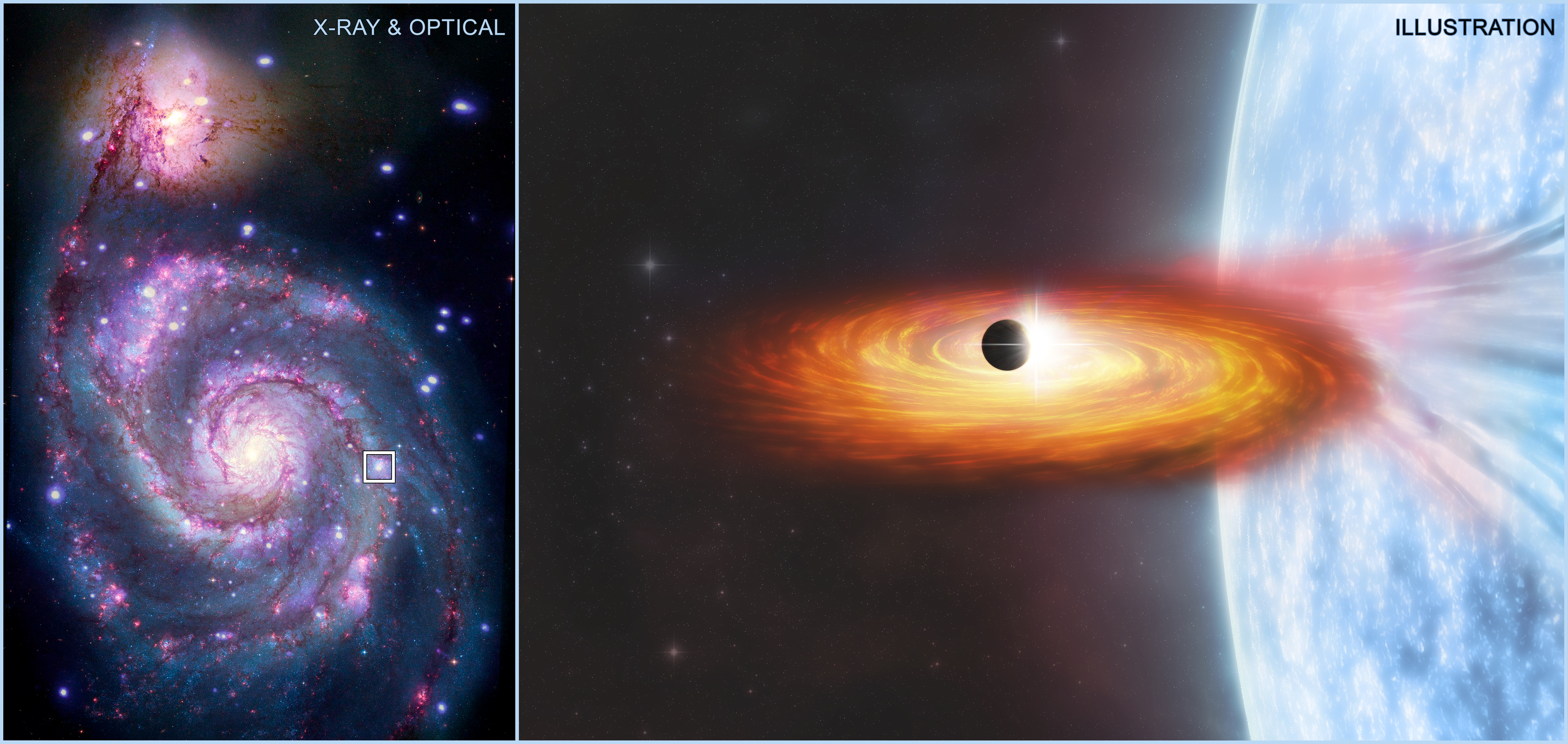
Astronomers have found evidence for a possible planet candidate in the M51 ("Whirlpool") galaxy, potentially representing what would be the first planet seen to transit a star outside of the Milky Way. As reported in our latest press release, researchers used NASA's Chandra X-ray Observatory to detect the dimming of X-rays from an "X-ray binary", a system where a Sun-like star is in orbit around a neutron star or black hole. The authors interpret this dimming as being a planet passing in front of the neutron star or black hole.

The left panel of this graphic shows M51 in X-rays from Chandra (purple and blue) and optical light from NASA's Hubble Space Telescope (red, green, and blue). A box marks the location of the possible planet candidate, an X-ray binary known as M51-ULS-1. An artist's illustration in the right panel depicts the X-ray binary and possible planet. Material from the companion star (white and blue in illustration) is pulled onto the neutron star or black hole, forming a disk around the dense object (illustrated as red and orange). The material near the dense object becomes superheated, causing it to glow in X-ray light (white). The planet is shown beginning to pass in front of this source of X-rays.

Looking for the dimming of a star's light as something passes in front of it is called the transit technique. For years, scientists have discovered exoplanets using transits with optical light telescopes, which detect the range of light humans can see with their eyes and more. This includes both ground-based telescopes and space-based ones like NASA's Kepler mission. These optical light transit detections require very high levels of sensitivity because the planet is much smaller than the star it passes in front of, and, therefore, only a tiny fraction of the light is blocked.


M51-ULS-1 Transit Only
Animation Credit: NASA/CXC/A.Jubett

The scenario of a transit in an X-ray binary is different. Because a potential planet is close in size to the X-ray source around the neutron star or black hole, a transiting planet passing along Earth's line of sight could temporarily block most or all of the X-rays. This makes it possible to spot transits at greater distances — including beyond the Milky Way — than current optical light studies using transits. A separate graphic shows how X-rays from M51-ULS-1 temporarily decrease to zero during the Chandra observations.

While this is a tantalizing study, the case of an exoplanet in M51 is not ironclad. One challenge is that the planet candidate's large orbit in M51-ULS-1 means it would not cross in front of its binary partner again for about 70 years, thwarting any attempts for a confirming observation for decades. There is also the possibility that the dimming of X-rays is due to a passing cloud of gas near the M51-ULS-1, though the researchers think the data strongly favor the planet explanation.

Illustration Credit: NASA/CXC/M. Weiss

The paper describing these results appears in the latest issue of Nature Astronomy and is available online. The authors are Rosanne DiStefano (CfA), Julia Berndtsson (Princeton), Ryan Urquhart (Michigan State University), Roberto Soria (University of the Chinese Science Academy), Vinay Kashap (CfA), Theron Carmichael (CfA), and Nia Imara (now at the University of California at Santa Cruz). NASA's Marshall Space Flight Center manages the Chandra program. The Smithsonian Astrophysical Observatory's Chandra X-ray Center controls science from Cambridge Massachusetts and flight operations from Burlington, Massachusetts.


Fast Facts for M51/Whirlpool Galaxy:

Scale: Image is about 6 arcmin (49,000 light years) across.
Category:
Normal Galaxies & Starburst Galaxies
Constellation: Canes Venatici
Observation Date: 11 pointings between March 2000 and October 2012
Observation Time: 232 hours 10 minutes (9 days 16 hours 10 min)
Obs. ID: 353, 354, 1622, 3932, 13812-13816, 15496, 15553
Instrument:
ACIS
Also Known As: NGC 5194, NGC 5195
References: DiStefano, R., et al., 2021, Nature Astronomy (Published);
PDF Document
Color Code: X-ray: purple and blue; Optical: red, green, and blue
Distance Estimate: About 28 million light years


Monday, October 25, 2021

Astronomers Provide 'Field Guide' to Exoplanets Known as Hot Jupiters By Daniel Stolte, University Communications


This artist’s impression shows a hot Jupiter planet orbiting close to one of the stars in the rich old star cluster Messier 67, located between 2,500 and 3,000 light-years from Earth in the constellation of Cancer (The Crab).ESO/L. Calçada


The turbulent atmosphere of a hot, gaseous planet known as HD 80606b is shown in this simulation based on data from NASA's Spitzer Space Telescope. The planet spends most of its time far away from its star, but every 111 days, it swings extremely close to the star, experiencing a massive burst of heat.NASA/JPL-CalTech

By combining Hubble Space Telescope observations with theoretical models, a team of astronomers has gained insights into the chemical and physical makeup of a variety of exoplanets known as hot Jupiters. The findings provide a new and improved "field guide" for this group of planets and inform ideas about planet formation in general.

Hot Jupiters – giant gas planets that race around their host stars in extremely tight orbits – have become a little bit less mysterious thanks to a new study combining theoretical modeling with observations by the Hubble Space Telescope.

While previous studies mostly focused on individual worlds classified as "hot Jupiters" due to their superficial similarity to the gas giant in our own solar system, the new study is the first to look at a broader population of the strange worlds. Published in Nature Astronomy, the study, led by a University of Arizona researcher, provides astronomers with an unprecedented "field guide" to hot Jupiters and offers insight into planet formation in general.

Although astronomers think that only about 1 in 10 stars host an exoplanet in the hot Jupiter class, the peculiar planets make up a sizeable portion of exoplanets discovered to date, due to the fact that they are bigger and brighter than other types of exoplanets, such as rocky, more Earthlike planets or smaller, cooler gas planets. Ranging in size from about one-third the size of Jupiter to 10 Jupiter masses, all hot Jupiters orbit their host stars at an extremely close range, usually much closer than Mercury – the innermost planet in our solar system – is to the sun. A "year" on a typical hot Jupiter lasts hours, or at most a few days. For comparison, Mercury takes almost three months to complete a trip around the sun.

Because of their close orbits, most, if not all, hot Jupiters are thought to be locked in a high-speed embrace with their host stars, with one side eternally exposed to the star's radiation and the other shrouded in perpetual darkness. The surface of a typical hot Jupiter can get as hot as almost 5,000 degrees Fahrenheit, with "cooler" specimens reaching 1,400 degrees – hot enough to melt aluminum.

The research, which was led by Megan Mansfield, a NASA Sagan Fellow at the University of Arizona's Steward Observatory, used observations made with the Hubble Space Telescope that allowed the team to directly measure emission spectra from hot Jupiters, despite the fact that Hubble can't image any of these planets directly.

"These systems, these stars and their hot Jupiters, are too far away to resolve the individual star and its planet," Mansfield said. "All we can see is a point – the combined light source of the two."

Mansfield and her team used a method known as secondary eclipsing to tease out information from the observations that allowed them to peer deep into the planets' atmospheres and gain insights into their structure and chemical makeup. The technique involves repeated observations of the same system, catching the planet at various places in its orbit, including when it dips behind the star.

"We basically measure the combined light coming from the star and its planet and compare that measurement with what we see when the planet is hidden behind its star," Mansfield said. "This allows us to subtract the star's contribution and isolate the light emitted by the planet, even though we can't see it directly."

The eclipse data provided the researchers with insight into the thermal structure of the atmospheres of hot Jupiters and allowed them to construct individual profiles of temperatures and pressures for each one. The team then analyzed near-infrared light, which is a band of wavelengths just beyond the range humans can see, coming from each hot Jupiter system for so-called absorption features. Because each molecule or atom has its own specific absorption profile, like a fingerprint, looking at different wavelengths allows researchers to obtain information about the chemical makeup of hot Jupiters. For example, if water is present in the planet's atmosphere, it will absorb light at 1.4 microns, which falls into the range of wavelengths that Hubble can see very well.

"In a way, we use molecules to scan through the atmospheres on these hot Jupiters," Mansfield said. "We can use the spectrum we observe to get information on what the atmosphere is made of, and we can also get information on what the structure of the atmosphere looks like."

The team went a step further by quantifying the observational data and comparing it to models of the physical processes believed to be at work in the atmospheres of hot Jupiters. The two sets matched very well, confirming that many predictions about the planets' nature – based on theoretical work – appear to be correct, according to Mansfield, who said the findings are "exciting because they were anything but guaranteed."

The results suggest that all hot Jupiters, not just the 19 included in the study, are likely to contain similar sets of molecules, like water and carbon monoxide, along with smaller amounts of other molecules. The differences among individual planets should mostly amount to varying relative amounts of these molecules. The findings also revealed that the observed water absorption features varied slightly from one hot Jupiter to the next.

"Taken together, our results tell us there is a good chance we have the big picture items figured out that are happening in the chemistry of these planets," Mansfield said. "At the same time, each planet has its own chemical makeup, and that also influences what we see in our observations."

According to the authors, the results can be used to guide expectations of what astronomers might be able to see when looking at a hot Jupiter that hasn't been studied before. The launch of NASA's news flagship telescope, the James Webb Space Telescope, slated for Dec. 18, has exoplanet hunters excited because Webb can see in a much broader range of infrared light, and will allow a much more detailed look at exoplanets, including hot Jupiters.

"There is a lot that we still don't know about how planets form in general, and one of the ways we try to understand how that could happen is by looking at the atmospheres of these hot Jupiters and figuring out how they got to be where they are," Mansfield said. "With the Hubble data, we can look at trends by studying the water absorption, but when we are talking about the composition of the atmosphere as a whole, there are many other important molecules you want to look at, such as carbon monoxide and carbon dioxide, and JWST will give us a chance to actually observe those as well."

Resources for the Media 

Media contact:

Daniel Stolte
Science Writer, University Communications
stolte@arizona.edu
520-626-4402

Researcher contact:


Megan Mansfield
NASA Sagan Fellow, Steward Observatory
meganmansfield@arizona.edu


Saturday, October 23, 2021

Hubble Watches an Intergalactic Dance

mage credit: ESA/Hubble & NASA, Dark Energy Survey, J. Dalcanton
Text credit: European Space Agency (ESA)

This observation from the NASA/ESA Hubble Space Telescope showcases Arp 86, a peculiar pair of interacting galaxies which lies roughly 220 million light-years from Earth in the constellation Pegasus. Arp 86 is composed of the two galaxies NGC 7752 and NGC 7753 – NGC 7753 is the large spiral galaxy dominating this image, and NGC 7752 is its smaller companion. The diminutive companion galaxy almost appears attached to NGC 7753, and it is this peculiarity that has earned the designation “Arp 86” – signifying that the galaxy pair appears in the Atlas of Peculiar Galaxies compiled by the astronomer Halton Arp in 1966. The gravitational dance between the two galaxies will eventually result in NGC 7752 being tossed out into intergalactic space or entirely engulfed by its much larger neighbor.

Hubble observed Arp 86 as part of a larger effort to understand the connections between young stars and the clouds of cold gas in which they form. Hubble gazed into star clusters and clouds of gas and dust in a variety of environments dotted throughout nearby galaxies. Combined with measurements from ALMA, a gigantic radio telescope perched high in the Chilean Andes, these Hubble observations provide a treasure trove of data for astronomers working to understand how stars are born.

These observations also helped sow the seeds of future research using the NASA/ESA James Webb Space Telescope. Due to launch later this year, Webb will study star formation in dusty regions like those in the galaxies of Arp 86.


Media Contact:

Claire Andreoli
NASA's Goddard Space Flight Center
301-286-1940

Editor: Lynn Jenner

Source: NASA/Hubble


Friday, October 22, 2021

Hubble gives unprecedented, early view of a doomed star's destruction


Astronomers recently witnessed supernova SN 2020fqv explode inside the interacting Butterfly galaxies, located about 60 million light-years away in the constellation Virgo. Researchers quickly trained NASA's Hubble Space Telescope on the aftermath. Along with other space- and ground-based telescopes, Hubble delivered a ringside seat to the first moments of the ill-fated star's demise, giving a comprehensive view of a supernova in the very earliest stage of exploding. Hubble probed the material very close to the supernova that was ejected by the star in the last year of its life. These observations allowed researchers to understand what was happening to the star just before it died, and may provide astronomers with an early warning system for other stars on the brink of death. Credits: Author: NASA, ESA, Ryan Foley (UC Santa Cruz)-Image processingM: Joseph DePasquale (STScI).
Release images

Like a witness to a violent death, NASA's Hubble Space Telescope recently gave astronomers an unprecedented, comprehensive view of the first moments of a star's cataclysmic demise. Hubble's data, combined with other observations of the doomed star from space- and ground-based telescopes, may give astronomers an early warning system for other stars on the verge of blowing up.

"We used to talk about supernova work like we were crime scene investigators, where we would show up after the fact and try to figure out what happened to that star," explained Ryan Foley of the University of California, Santa Cruz, the leader of the team that made this discovery. "This is a different situation, because we really know what's going on and we actually see the death in real time."

Telescope Teamwork

The supernova, called SN 2020fqv, is in the interacting Butterfly Galaxies, which are located about 60 million light-years away in the constellation Virgo. It was discovered in April 2020 by the Zwicky Transient Facility at the Palomar Observatory in San Diego, California. Astronomers realized that the supernova was simultaneously being observed by the Transiting Exoplanet Survey Satellite (TESS), a NASA satellite designed primarily to discover exoplanets, with the ability to detect an assortment of other phenomena. They quickly trained Hubble and a suite of ground-based telescopes on it.

Together, these observatories gave the first holistic view of a star in the very earliest stage of destruction. Hubble probed the material very close to the star, called circumstellar material, mere hours after the explosion. This material was blown off the star in the last year of its life. These observations allowed astronomers to understand what was happening to the star just before it died.

"We rarely get to examine this very close-in circumstellar material since it is only visible for a very short time, and we usually don't start observing a supernova until at least a few days after the explosion," explained Samaporn Tinyanont, lead author on the study's paper to be published in the Monthly Notices of the Royal Astronomical Society. "For this supernova, we were able to make ultra-rapid observations with Hubble, giving unprecedented coverage of the region right next to the star that exploded."

Telling the Star's Story

The team looked at Hubble observations of the star going back to the 1990s. TESS provided an image of the system every 30 minutes starting several days before the explosion, through the explosion itself, and continuing for several weeks. Hubble was used again starting only hours after astronomers first detected the explosion. And from studying the circumstellar material with Hubble, the scientists gained an understanding of what was happening around the star in the previous decade. By combining all of this information, the team was able to create a multi-decade look at the star's final years.

"Now we have this whole story about what's happening to the star in the years before it died, through the time of death, and then the aftermath of that," said Foley. "This is really the most detailed view of stars like this in their last moments and how they explode."

The Rosetta Stone of Supernovas

Tinyanont and Foley called SN 2020fqv "the Rosetta Stone of supernovas." The ancient Rosetta Stone, which has the same text inscribed in three different scripts, helped experts learn to read Egyptian hieroglyphs.

In the case of this supernova, the science team used three different methods to determine the mass of the exploding star. These included comparing the properties and the evolution of the supernova with theoretical models; using information from a 1997 archival Hubble image of the star to rule out higher-mass stars; and using observations to directly measure the amount of oxygen in the supernova, which probes the mass of the star. The results are all consistent: around 14 to 15 times the mass of the Sun. Accurately determining the mass of the star that explodes in a supernova is crucial to understanding how massive stars live and die.

"People use the term 'Rosetta Stone' a lot. But this is the first time we've been able to verify the mass with these three different methods for one supernova, and all of them are consistent," said Tinyanont. "Now we can push forward using these different methods and combining them, because there are a lot of other supernovas where we have masses from one method but not another."

An Early Warning System?

In the years before stars explode, they tend to become more active. Some astronomers point to the red supergiant Betelgeuse, which has recently been belching significant amounts of material, and they wonder if this star will soon go supernova. While Foley doubts Betelgeuse will imminently explode, he does think we should take such stellar outbursts seriously.

"This could be a warning system," said Foley. "So if you see a star start to shake around a bit, start acting up, then maybe we should pay more attention and really try to understand what's going on there before it explodes. As we find more and more of these supernovas with this sort of excellent data set, we'll be able to understand better what's happening in the last few years of a star's life."

The Hubble Space Telescope is a project of international cooperation between NASA and ESA (European Space Agency). NASA's Goddard Space Flight Center in Greenbelt, Maryland, manages the telescope. The Space Telescope Science Institute (STScI) in Baltimore, Maryland, conducts Hubble science operations. STScI is operated for NASA by the Association of Universities for Research in Astronomy, in Washington, D.C. 

 Credits: Release: NASA, ESA

Media Contact:

Ann Jenkins
Space Telescope Science Institute, Baltimore, Maryland

Ray Villard
Space Telescope Science Institute, Baltimore, Maryland

Science Contact:

Ryan Foley
University of California, Santa Cruz, Santa Cruz, California

Samaporn Tinyanont
University of California, Santa Cruz, Santa Cruz, California

Contact us:
Direct inquiries to the
News Team.

Related links and documents:

Science Paper: The science paper by S. Tinyanont, PDF (8.83 MB)
NASA's Hubble Portal


Thursday, October 21, 2021

Astronomers see white dwarf switch on and off


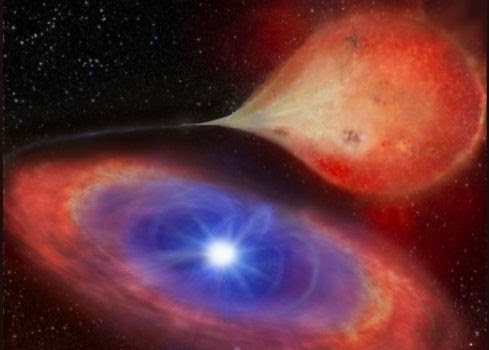
An artist’s impression example of a white dwarf – in this image the white dwarf MV Lyrae – accreting as it draws in material from a companion star. Credit: Helena Uthas

White dwarfs are what most stars become after burning off the hydrogen that fuels them. Now our astronomers have seen one of these galactic objects switching on and off for the first time.

Researchers used a planet-hunting satellite to observe the unique phenomenon in a white dwarf about 1,400 light years from Earth.

This particular white dwarf is known to be accreting, or feeding, from an orbiting companion star.

Our astronomers saw it lose brightness in 30 minutes, a process only previously seen in accreting white dwarfs over a period of several days to months.

Accreting white dwarf

The brightness of an accreting white dwarf is affected by the amount of surrounding material it feeds on so the researchers say something is interfering with its food supply.

They believe what they’re witnessing could be changes to the white dwarf’s surface magnetic field.

During the “on” mode, when the brightness is high, the white dwarf feeds off the accretion disc as it normally would.

Suddenly and abruptly the system turns “off” and its brightness plummets.

Magnetic gating

The researchers say that when this happens the magnetic field is spinning so rapidly it creates a barrier disrupting the amount of food the white dwarf can receive – a process called magnetic gating.

This leads to semi-regular small increases in brightness seen by the astronomers. After some time, the system sporadically turns “on” again, and the brightness increases back to its original level.

They hope their discovery will teach us more about the physics behind accretion – where objects like black holes, white dwarfs and neutron stars feed on surrounding material from neighbouring stars.

Find out more


Wednesday, October 20, 2021

Studying the Edge of the Sun’s Magnetic Bubble


The heliosphere within the Milky Way galaxy.
Credits: NASA's Goddard Space Flight Center/Conceptual Image Lab/Walt Feimer

Our corner of the universe, the solar system, is nestled inside the Milky Way galaxy, home to more than 100 billion stars. The solar system is encased in a bubble called the heliosphere, which separates us from the vast galaxy beyond – and some of its harsh space radiation.

We’re protected from that radiation by the heliosphere, which itself is created by another source of radiation: the Sun. The Sun constantly spews charged particles, called the solar wind, from its surface. The solar wind flings out to about four times the distance of Neptune, carrying with it the magnetic field from the Sun.

“Magnetic fields tend to push up against each other, but not mix,” said Eric Christian, a lead heliosphere research scientist at NASA’s Goddard Space Flight Center in Greenbelt, Maryland. “Inside the bubble of the heliosphere are pretty much all particles and magnetic fields from the Sun. Outside are those from the galaxy.”

To understand the heliosphere, start by breaking apart the word, suggests David McComas, professor of astrophysical sciences at Princeton University in New Jersey. "Heliosphere" is the combination of two words: "Helios," the Greek word for the Sun, and "sphere," a broad region of influence (though, to be clear, scientists aren’t sure of the heliosphere’s exact shape).

The heliosphere was discovered in the late 1950s, and many questions about it remain. As scientists study the heliosphere, they learn more about how it reduces astronauts’ and spacecrafts' exposure to radiation and more generally, how stars can influence their nearby planets.


The heliosphere changes in size throughout the solar cycle.
Credits: NASA's Goddard Space Flight Center/Scientific Visualization Studio/Tom Bridgman

A balloon in space

Some radiation surrounds us every day. When we sunbathe, we’re basking in radiation from the Sun. We use radiation to warm leftovers in our kitchen microwaves and rely on it for medical imaging.

Space radiation, however, is more similar to the radiation released by radioactive elements like uranium. The space radiation that comes at us from other stars is called galactic cosmic radiation (GCR). Active areas in the galaxy – like supernovae, black holes, and neutron stars – can strip the electrons from atoms and accelerate the nuclei to almost the speed of light, producing GCR.

On Earth, we have three layers of protection from space radiation. The first is the heliosphere, which helps block GCR from reaching the major planets in the solar system. Additionally, Earth’s magnetic field produces a shield called the magnetosphere, which keeps GCR out away from Earth and low-orbiting satellites like the International Space Station. Finally, the gases of Earth’s atmosphere absorb radiation.

When astronauts head to the Moon or to Mars, they won’t have the same protection we have on Earth. They’ll only have the protection of the heliosphere, which fluctuates in size throughout the Sun’s 11-year cycle.

In each solar cycle, the Sun goes through periods of intense activity and powerful solar winds, and quieter periods. Like a balloon, when the wind calms down, the heliosphere deflates. When it picks up, the heliosphere expands.

“The effect the heliosphere has on cosmic rays allows for human exploration missions with longer duration. In a way, it allows humans to reach Mars,” said Arik Posner, a heliophysicist at NASA Headquarters in Washington, D.C. “The challenge for us is to better understand the interaction of cosmic rays with the heliosphere and its boundaries.”

Anatomy of the heliosphere

There is some debate about the precise shape of the heliosphere. However, scientists agree that it has several layers. Let’s look at the layers from inside outward:


This illustration shows the position of NASA’s Voyager 1 and Voyager 2 probes, outside of the heliosphere, a protective bubble created by the Sun that extends well past the orbit of Pluto. Credits: NASA/JPL-Caltech
  • Termination shock: All of the major planets in our solar system are located in the heliosphere’s innermost layer. Here, the solar wind emanates out from the Sun at full speed, about a million miles per hour, for billions of miles, unaffected by the pressure from the galaxy. The outer boundary of this core layer is called the termination shock.
  • Heliosheath: Beyond the termination shock is the heliosheath. Here, the solar wind moves more slowly and deflects as it faces the pressure of the interstellar medium outside.
  • Heliopause: The heliopause marks the sharp, final plasma boundary between the Sun and the rest of the galaxy. Here, the magnetic fields of the solar and interstellar winds push up against each other, and the inside and outside pressures are in balance.
  • Outer Heliosheath: The region just beyond the heliopause, which is still influenced by the presence of the heliosphere, is called the outer heliosheath.

How we study the heliosphere’s outer reaches

Many NASA missions study the Sun and the innermost parts of the heliosphere. But only two human-made objects have crossed the boundary of the solar system and entered interstellar space.

In 1977, NASA launched Voyager 1 and Voyager 2. Each spacecraft is equipped with tools to measure the magnetic fields and the particles it is directly passing through. After swinging past the outer planets on a grand tour, they exited the heliopause in 2012 and 2018 respectively and are currently in the outer heliosheath. They discovered that cosmic rays are about three times more intense outside the heliopause than deep inside the heliosphere.

However, the picture the Voyagers paint is incomplete.

“Trying to figure out the entire heliosphere from two points, Voyager 1 and 2, is like trying to determine the weather in the entire Pacific Ocean using two weather stations,” Christian said.

The Voyagers work with the Interstellar Boundary Explorer (IBEX) to study the heliosphere. IBEX is a 176-pound, suitcase-sized satellite launched by NASA in 2008. Since then, IBEX has orbited Earth, equipped with telescopes observing the outer boundary of the heliosphere. IBEX captures and analyzes a class of particle called energetic neutral atoms, or ENAs, that cross its path. ENAs form where the interstellar medium and the solar wind meet. Some ENAs stream back toward the center of the solar system – and IBEX.

“Every time you collect one of those ENAs, you know what direction it came from,” said McComas, IBEX’s principal investigator. “By collecting a lot of those individual atoms, you're able to make this inside out image of our heliosphere.”

In 2025, NASA will launch the Interstellar Mapping and Acceleration Probe (IMAP). IMAP’s ENA cameras are higher resolution and more sensitive than IBEX’s.

Mysteries abound

In 2009, IBEX returned a finding so shocking that researchers initially wondered if the instrument may have malfunctioned. That discovery became known as the IBEX Ribbon – a band across the sky where ENA emissions are two or three times brighter than the rest of the sky.

“The Ribbon was totally unexpected and not anticipated by any theories before we flew the mission,” McComas said. It’s still not entirely clear what causes it, but it is a clear example of the mysteries of the heliosphere that remain to be discovered.


NASA’s Interstellar Boundary Explorer, or IBEX, studies the heliosphere from its orbit around Earth. IBEX’s first-ever skymap showed a surprising feature dubbed the “IBEX ribbon.” Credits: NASA/IBEX

“Our Sun is a star like billions of other stars in the universe. Some of those stars also have astrospheres, like the heliosphere, but this is the only astrosphere we are actually inside of and can study closely,” said Justyna Sokol, a research scientist at Southwest Research Institute in San Antonio, Texas. “We need to start from our neighborhood to learn so much more about the rest of the universe.”

By Alison Gold

NASA's Goddard Space Flight Center, Greenbelt, Md.

Editor: Miles Hatfield

Source: NASA/Sun


Tuesday, October 19, 2021

Dwarf galaxy catches globular cluster


Composite image of NGC 2005 (left) and the Large Magellanic Cloud (right). The chemical composition of the stars in the globular cluster NGC 2005 differs from other stars in the Large Magellanic Cloud. It is the first evidence of merging dwarf galaxies outside our Milky Way. (c) HLA/Fabian RR/ESO/VMC Survey/Astronomie.nl [CC BY-SA 3.0]

Astronomers already knew that our own Milky Way grew by taking in smaller galaxies. But now a team of Italian-Dutch researchers have shown that a small galaxy neighbouring the Milky Way has in turn absorbed an even smaller galaxy from its vicinity. The researchers will publish their findings on Monday in the journal Nature Astronomy.

According to the prevailing theory, large galaxies such as our Milky Way were formed by mergers with smaller galaxies. In recent years, evidence for this has indeed been found for our Milky Way thanks to the Gaia satellite. An Italian-Dutch team of researchers wanted to prove the hypothesis that small galaxies are in turn made up of even smaller ones.

Globular clusters

To test their hypothesis, the researchers studied the Large Magellanic Cloud, a neighbouring galaxy to our Milky Way. They focused in particular at globular clusters. Globular clusters are groups of thousands to millions of stars. The idea is that the core of such a globular cluster can hold out even after billions of years of pushing and pulling in a galaxy.

The researchers analysed the chemical composition of eleven globular clusters collected by the Very Large Telescope and the Magellan telescopes in Chile.

Of the eleven globular clusters studied in the Large Magellanic Cloud, one was found to have a distinctly different chemical composition. It is globular cluster NGC 2005. This cluster contains about 200,000 stars and is located 750 light years away from the centre of the Large Magellanic Cloud. Among other things, it contains less zinc, copper, silicon and calcium than the ten other clusters. 
 
Relic of earlier merger

Based on the chemical composition of NGC 2005, the researchers deduced that the cluster must be a relic of a small galaxy in which the stars formed rather slowly. Billions of years ago, this small galaxy would have merged with the then not so large Large Magellanic Cloud. Over time, most of the small galaxy was pulled apart and most of the stars were scattered, but the central globular cluster NGC 2005, remained.

Researcher Davide Massari, who works in Italy and at the University of Groningen, is delighted: "We are actually seeing a relic of an earlier merger. And we have now convincingly demonstrated for the first time that small galaxies neighboring our Milky Way have in turn built up from even smaller galaxies."

Scientific paper

A relic from a past merger event in the Large Magellanic Cloud. By: A. Mucciarelli, D. Massari, A. Minelli, D. Romano, M. Bellazzini, F.R. Ferraro, F. Matteucci, L. Origlia. In: Nature Astronomy. (preprint, pdf)


Monday, October 18, 2021

How do ice giants maintain their magnetic fields?

Illustration of Neptune's interior purchased from Shutterstock


Figure illustrating how the experiments were performed, revealing two forms of superionic ice
Courtesy of Vitali Prakapenka.


Washington, DC—A layer of “hot,” electrically conductive ice could be responsible for generating the magnetic fields of ice giant planets like Uranus and Neptune. New work from Carnegie and the University of Chicago’s Center for Advanced Radiation Sources reveals the conditions under which two such superionic ices form. Their findings are published in Nature Physics.

As all school children learn, water molecules are made up of two hydrogen atoms and one oxygen atom—H20. As the conditions in which water exists change, the organization and properties of these molecules are affected. We can see this in our everyday lives when liquid water is boiled into steam or frozen into ice.

The molecules that comprise ordinary ice that you might find in your drinking glass or on your driveway in winter arranged in a crystalline lattice held together by hydrogen bonds between the hydrogen and oxygen atoms. Hydrogen bonds are highly versatile. This means that ice can exist in a striking diversity of different structures—at least 18 known forms—which emerge under increasingly extreme environmental conditions.

Of particular interest is so-called superionic ice, formed at very high pressures and temperatures, in which the traditional water molecule bonds are shifted, allowing the hydrogen molecules to float freely in an oxygen lattice. This mobility makes the ice capable of conducting electricity almost as well as a metallic material.

Observations of hot, superionic ice created in the lab have led to contradictory results and there has been a great deal of disagreement about the exact conditions under which the new properties emerge.

“So, our research team, led by the University of Chicago’s Vitali Prakapenka, set out to use multiple spectroscopic tools to map changes in ice’s structure and properties under conditions ranging up to 1.5 million times normal atmospheric pressure and about 11,200 degrees Fahrenheit,” explained Carnegie’s Alexander Goncharov.

By doing this, the scientists—also including Nicholas Holtgrewe formerly of Carnegie, now at the Food and Drug Administration in St Louis, and Sergey Lobanov, formerly of Carnegie, now at the GFZ German Research Center for Geosciences—were able to pinpoint the emergence of two forms of superionic ice, one of which they suggest could be found in the interiors of ice giant planets Uranus and Neptune.

“In order to probe the structure of this unique state of matter under very extreme conditions—heated by a laser and compressed between two diamonds—we used the Advanced Photon Source’s brilliant high-energy synchrotron x-ray beam, which was focused down to about 3 micrometers, 30 times smaller than a single human hair,” said Prakapenka, explaining the work done using the facility’s GSECARS beamline. “These experiments are so challenging that we had to run a few thousand of them over a decade to get enough high-quality data to solve the long-standing mystery of high-pressure, high-temperature behavior of ice under conditions relevant to giant planet interiors.”

“Simulations have indicated that the magnetic fields of these two planets are generated in thin, fluid layers found at relatively shallow depths,” Goncharov added. “The conductivity of superionic ice would be able to accomplish this type of field generation and one of the two structures we revealed could exist under the conditions found in these magnetic field-generating zones.”

Further study is needed to understand the conductive properties and viscosity of these ice phases under ice giant-interior conditions.


This work was supported by the U.S. National Science Foundation, the Army Research Office, the Deep Carbon Observatory, the Helmholtz Young Investigators Group, and the Carnegie Institution for Science. This work was performed at GeoSoilEnviroCARS, Advanced Photon Source, Argonne National Laboratory.


Scientific Area:
Earth & Planetary Science

Reference to Person:
Alexander Goncharov

Reference to Department:
Earth and Planets Laborator


Saturday, October 16, 2021

Hubble Finds Evidence of Persistent Water Vapour Atmosphere on Europa

Hubble's View of Jupiter and Europa in August 2020 
 
Artist’s Impression of Jupiter and Europa 
 
Artist’s Impression of Jupiter and Europa 
 
Artist’s Impression of a Water Atmosphere on Europa 
 
Galileo Spacecraft’s Image of Europa


Videos

Space Sparks Episode 7


Observations by the NASA/ESA Hubble Space Telescope recently revealed water vapour in the atmosphere of Ganymede, one of Jupiter’s moons. A new analysis of archival images and spectra has now revealed that water vapour is also present in the atmosphere of Jupiter’s icy moon Europa. The analysis found that a water vapour atmosphere is present only on one hemisphere of the moon. This result advances our understanding of the atmospheric structure of icy moons, and helps lay the groundwork for upcoming science missions which will explore Jupiter’s icy moons.

Europa — one of Jupiter’s 79 moons — is both the sixth closest moon to Jupiter and the sixth largest moon in the Solar System. It is an icy orb larger than the dwarf planet Pluto with a smooth, icy surface scarred by cracks and fissures. The surface of the moon is a bleak environment with an average temperature of −170 °C and only a tenuous atmosphere. However, astronomers suspect that Europa harbours a vast ocean underneath its icy surface, which some scientists speculate could host extraterrestrial life [1]. Now, for the first time, an astronomer has discovered evidence for persistent water vapour in the atmosphere of Europa.

Using a technique that recently resulted in the discovery of water vapour in the atmosphere of Jupiter’s moon Ganymede, an astronomer has found evidence of water in Europa’s trailing hemisphere — the portion of the moon that is always opposite to its direction of motion [2]. The asymmetric distribution of water vapour was predicted by previous studies based on computer simulations, but had not previously been detected observationally.

“The observation of water vapour on Ganymede and on the trailing side of Europa advances our understanding of the atmospheres of icy moons,” commented Lorenz Roth of the KTH Royal Institute of Technology in Stockholm, Sweden, the author of this study. “The detection of a stable H2O abundance on Europa is surprising because the surface temperatures are so low.”

To make this discovery, Roth delved into archival Hubble datasets, selecting ultraviolet observations of Europa from 1999, 2012, 2014 and 2015 while the moon was at various orbital positions. These observations were all taken with one of Hubble’s most versatile instruments — the Space Telescope Imaging Spectrograph (STIS). These ultraviolet STIS observations allowed Roth to determine the abundance of oxygen — one of the constituents of water — in Europa’s atmosphere, and by interpreting the strength of emission at different wavelengths he was able to infer the presence of water vapour. 

Previous observations of water vapour on Europa have been associated with transient plumes erupting through the ice, analogous to geysers here on Earth but more than 100 kilometres high. The phenomena seen in these plume studies were apparently transient inhomogeneities or blobs in the atmosphere. The new results, however, show similar amounts of water vapour to be present spread over a larger area in observations spanning from 1999 to 2015. This suggests the long-term presence of a water vapour atmosphere on Europa’s trailing hemisphere. Despite the presence of water vapour on Europa’s trailing hemisphere there is no indication of H2O on the leading hemisphere of Europa.

Space scientists working to understand these icy moons will soon be able to benefit from a close-up view. ESA’s  JUpiter ICy moons Explorer (JUICE) mission is being prepared for a tour of Ganymede, Callisto and Europa, Jupiter’s three largest icy moons. JUICE is the first large-class mission in ESA's Cosmic Vision 2015–2025 programme and is expected to launch in 2022 and arrive at Jupiter in 2031. The probe will carry an advanced suite of instruments — the most powerful remote sensing payload ever flown to the outer Solar System — and will spend at least three years making detailed observations of the Jovian system. Europa will also be visited by a NASA mission, Europa Clipper, which will perform a series of flybys of the moon and investigate its habitability, as well as selecting a landing site for a future mission.

“This result lays the groundwork for future science based on upcoming missions to the Jovian moons,” concluded Roth. “The more we can understand about these icy moons before spacecraft like JUICE and Europa Clipper arrive, the better use we can make of our limited observing time within the Jovian system.”

This discovery and the insights from upcoming missions such as JUICE will improve our understanding of potentially habitable environments in the Solar System. Understanding the formation and evolution of Jupiter and its moons also helps astronomers gain insights into Jupiter-like exoplanets around other stars. Combined with observations from space telescopes such as the upcoming NASA/ESA/CSA James Webb Space Telescope, this could help astronomers determine if life could emerge in Jupiter-like exoplanetary systems elsewhere in the universe.


Notes

[1] Liquid water is a crucial ingredient in the complex chemistry that underpins all known forms of life. Europa’s subsurface ocean is warmed not by sunlight, but rather by the subtle flexing of the moon caused by Jupiter’s immense gravitational field. The presence of liquid water and a source of energy make Europa one of the most likely locations in the Solar System for potential habitability.

[2] Europa is tidally locked, which means that it takes the same amount of time to revolve on its own axis as it does to orbit Jupiter. This means that the same hemisphere of Europa always faces Jupiter, and that the same hemisphere of the moon is always facing away from the direction that Europa is travelling along its orbit. Earth’s Moon is also tidally locked, which is why we always see the same face of the Moon in the night sky.


More Information

The Hubble Space Telescope is a project of international cooperation between ESA and NASA.

The astronomer who carried out this study was Lorenz Roth of the Royal Institute of Technology, Space and Plasma Physics, Sweden.

These results have been published in the journal Geophysical Research Letters.

Image credit: NASA, ESA, A. Simon (Goddard Space Flight Center), and M. H. Wong (University of California, Berkeley) and the OPAL team.


Links

Lorenz Roth
KTH Royal Institute of Technology
Stockholm, Sweden
Email:
lorenzr@kth.se

Bethany Downer
ESA/Hubble Chief Science Communications Officer
Email:
Bethany.Downer@esahubble.org

Source: ESA/Hubble/News


Friday, October 15, 2021

Hubble Uncovers a Burst of Star Formation

NGC 4666
Text credit: European Space Agency (ESA)
Image credit: ESA/Hubble & NASA, O. Graur; Acknowledgment: L. Shatz


NGC 4666 takes center stage in this image from the NASA/ESA Hubble Space Telescope. This majestic spiral galaxy lies about 80 million light-years away in the constellation Virgo and is undergoing a particularly intense episode of star formation. Astronomers refer to galaxies that rapidly form stars as starburst galaxies. NGC 4666’s starburst is likely due to gravitational interactions with its unruly neighbors – including the nearby galaxy NGC 4668 and a dwarf galaxy, which is a small galaxy made up of a few billion stars.

NGC 4666’s burst of star formation is driving an unusual form of extreme galactic weather known as a superwind – a gigantic transfer of gas from the bright central heart of the galaxy out into space. This superwind is the result of driving winds from short-lived massive stars formed during NGC 4666’s starburst as well as spectacularly energetic supernova explosions. Two supernovae occurred in NGC 4666 within the last decade – one in 2014 and the other in 2019. The star that led to the 2019 supernova was 19 times as massive as our Sun!

Though the torrent of superheated gas emanating from NGC 4666 is truly vast in scale – extending for tens of thousands of light-years – it is invisible in this image. The superwind’s extremely high temperature makes it stand out as a luminous plume in X-ray or radio observations, but it doesn’t show up at the visible wavelengths imaged by Hubble’s Wide Field Camera 3.

Media Contact:

Claire Andreoli
NASA's Goddard Space Flight Center
301-286-1940

Editor: Lynn Jenner


Source: NASA's/Hubble


Thursday, October 14, 2021

G344.7-0.1: When a Stable Star Explodes Quick Look: When a Stable Star Explodes


G344.7-0.1
Credit: X-ray: NASA/CXC/Tokyo Univ. of Science/K. Fukushima, et al.;
IR: NASA/JPL/Spitzer; Radio: CSIRO/ATNF/ATCA

 JPEG (225.7 kb) - Large JPEG (1.1 MB) - Tiff (37.5 MB) - More Images

Tour: Abell 1775 - More Animations


White dwarfs are among the most stable of stars. Left on their own, these stars that have exhausted most of their nuclear fuel — while still typically as massive as the Sun — and shrunk to a relatively small size can last for billions or even trillions of years.

However, a white dwarf with a nearby companion star can become a cosmic powder keg. If the companion's orbit brings it too close, the white dwarf can pull material from it until the white dwarf grows so much that it becomes unstable and explodes. This kind of stellar blast is called a Type Ia supernova.

While it is generally accepted by astronomers that such encounters between white dwarfs and "normal" companion stars are one likely source of Type Ia supernova explosions, many details of the process are not well understood. One way to investigate the explosion mechanism is to look at the elements left behind by the supernova in its debris or ejecta.

This new composite image shows G344.7-0.1, a supernova remnant created by a Type Ia supernova, through the eyes of different telescopes. X-rays from NASA's Chandra X-ray Observatory (blue) have been combined with infrared data from NASA's Spitzer Space Telescope (yellow and green) as well as radio data from the NSF's Very Large Array and the Commonwealth Scientific and Industrial Research Organisation's Australia Telescope Compact Array (red).

Chandra is one of the best tools available for scientists to study supernova remnants and measure the composition and distribution of "heavy" elements — that is, anything other than hydrogen and helium — they contain.

Astronomers estimate that G344.7-0.1 is about 3,000 to 6,000 years old in Earth's time frame. On the other hand, the most well-known and widely-observed Type Ia remnants, including Kepler, Tycho, and SN 1006, have all exploded within the last millennium or so as seen from Earth. Therefore, this deep look at G344.7-0.1 with Chandra gives astronomers a window into an important phase later in the evolution of a Type Ia supernova remnant.

Both the expanding blast wave and the stellar debris produce X-rays in supernova remnants. As the debris moves outward from the initial explosion, it encounters resistance from surrounding gas and slows down, creating a reverse shock wave that travels back toward the center of the explosion. This process is analogous to a traffic jam on a highway, where as times passes an increasing number of cars will stop or slow down behind the accident, causing the traffic jam to travel backwards. The reverse shock heats the debris to millions of degrees, causing it to glow in X-rays.

Type Ia remnants like Kepler, Tycho and SN 1006 are too young for the reverse shock to have time to plausibly travel backwards to heat all of the debris in the remnant's center. However, the relatively advanced age of G344.7-0.1 means that the reverse shock has moved back through the entire debris field.

A separate color version of only the Chandra data shows X-ray emission from iron (blue) and silicon (red) respectively, and X-rays produced by the acceleration of electrons as they are deflected by the nuclei of atoms that are positively charged (green). The region with the highest density of iron and the arc-like structures of silicon are labeled.


G344.7-0.13
3 Color X-Ray Composite (Labeled)

The Chandra image of G344.7-0.1 shows that the region with the highest density of iron (blue) is surrounded by arc-like structures (green) containing silicon. Similar arc-like structures are found for sulfur, argon, and calcium. The Chandra data also suggests that the region with the highest density iron has been heated by the reverse shock more recently than the elements in the arc-like structures, implying that it is located near the true center of the stellar explosion. These results support the predictions of models for Type Ia supernova explosions, which show that heavier elements are produced in the interior of an exploding white dwarf.

This three-color Chandra image also shows that the densest iron is located to the right of the supernova remnant's geometric center. This asymmetry is likely caused by gas surrounding the remnant being denser on the right than it is on the left.

A paper describing these results was published in the July 1st, 2020 issue of The Astrophysical Journal and is available online. The authors of the study are Kotaro Fukushima (Tokyo University of Science, Japan), Hiroya Yamaguchi (JAXA), Patrick Slane (Center for Astrophysics | Harvard & Smithsonian), Sangwook Park (University of Texas, Austin), Satoru Katsuda (Saitama University, Japan), Hidetoshi Sano (Nagoya University, Japan), Laura Lopez (The Ohio State University, Columbus), Paul Plucinsky (Center for Astrophysics), Shogo Kobayashi (Tokyo University of Science), and Kyoko Matsushita (Tokyo University of Science). The radio data were provided by Elsa Giacani from the Institute of Astronomy and Space Physics, who led a study of G344.7-0.1 published in 2011 in the journal Astronomy and Astrophysics.

NASA's Marshall Space Flight Center manages the Chandra program. The Smithsonian Astrophysical Observatory's Chandra X-ray Center controls science from Cambridge Massachusetts and flight operations from Burlington, Massachusetts.

Quick Look: When a Stable Star Explodes


Fast Facts for G344.7-0.1:

Scale: Image is about 17.6 arcmin (100 light years) across.
Category:
Supernovas & Supernova Remnants
Coordinates (J2000): RA 17h 03m 56s | Dec -41° 42´ 59"
Constellation:
Scorpius
Observation Date: 7 observations between May 12 and July 05, 2018
Observation Time: 33 hours 8.4 minutes (2 days, 9 hours, 8.4 minutes)
Obs. ID: 20308, 20309, 21093, 21094, 21095, 21096, 21117
Instrument:
ACIS
References: Fukushima, K., et al., 2020, ApJ, 897, 62. arXiv:2005.09664
Color Code: Multiwavelength Image: Radio (red), Infrared (green & yellow), X-ray (blue); X-ray 3 Color Image: Si (red), 3-6 keV (green), Fe (blue)
Distance Estimate: About 19,600 light years