Showing posts with label SN 1006. Show all posts

Sunday, October 29, 2023

IXPE Untangles Theories Surrounding Historic Supernova Remnant


This new image of supernova remnant SN 1006 combines data from NASA’s Imaging X-ray Polarimetry Explorer and NASA’s Chandra X-ray Observatory. The red, green, and blue elements reflect low, medium, and high energy X-rays, respectively, as detected by Chandra. The IXPE data, which measure the polarization of the X-ray light, is show in purple in the upper left corner, with the addition of lines representing the outward movement of the remnant’s magnetic field. X-ray: NASA/CXC/SAO (Chandra); NASA/MSFC/Nanjing Univ./P. Zhou et al. (IXPE); IR: NASA/JPL/CalTech/Spitzer; Image Processing: NASA/CXC/SAO/J.Schmidt

NASA’s IXPE (Imaging X-ray Polarimetry Explorer) telescope has captured the first polarized X-ray imagery of the supernova remnant SN 1006. The new results expand scientists’ understanding of the relationship between magnetic fields and the flow of high-energy particles from exploding stars.

“Magnetic fields are extremely difficult to measure, but IXPE provides an efficient way for us to probe them,” said Dr. Ping Zhou, an astrophysicist at Nanjing University in Jiangsu, China, and lead author of a new paper on the findings, published in The Astrophysical Journal. “Now we can see that SN 1006’s magnetic fields are turbulent, but also present an organized direction.”

Situated some 6,500 light-years from Earth in the Lupus constellation, SN 1006 is all that remains after a titanic explosion, which occurred either when two white dwarfs merged or when a white dwarf pulled too much mass from a companion star. Initially spotted in spring of 1006 CE by observers across China, Japan, Europe, and the Arab world, its light was visible to the naked eye for at least three years. Modern astronomers still consider it the brightest stellar event in recorded history.

Since modern observation began, researchers have identified the remnant’s strange double structure, markedly different from other, rounded supernova remnants. It also has bright “limbs” or edges identifiable in the X-ray and gamma-ray bands.

“Close-proximity, X-ray-bright supernova remnants such as SN 1006 are ideally suited to IXPE measurements, given IXPE’s combination of X-ray polarization sensitivity with the capability to resolve the emission regions spatially,” said Douglas Swartz, a Universities Space Research Association researcher at NASA’s Marshall Space Flight Center in Huntsville, Alabama. “This integrated capability is essential to localizing cosmic-ray acceleration sites.”

Previous X-ray observations of SN 1006 offered the first evidence that supernova remnants can radically accelerate electrons, and helped identify rapidly expanding nebulae around exploded stars as a birthplace for highly energetic cosmic rays, which can travel at nearly the speed of the light.

Scientists surmised that SN 1006’s unique structure is tied to the orientation of its magnetic field, and theorized that supernova blast waves in the northeast and southwest move in the direction aligned with the magnetic field, and more efficiently accelerate high-energy particles.

IXPE’s new findings helped validate and clarify those theories, said Dr. Yi-Jung Yang, a high-energy astrophysicist at the University of Hong Kong and coauthor of the paper.

“The polarization properties obtained from our spectral-polarimetric analysis align remarkably well with outcomes from other methods and X-ray observatories, underscoring IXPE’s reliability and strong capabilities”, Yang said.

“For the first time, we can map the magnetic field structures of supernova remnants at higher energies with enhanced detail and accuracy – enabling us to better understand the processes driving the acceleration of these particles.” Dr. Yi-Jung Yang (High-energy astrophysicist at the University of Hong Kong)

Researchers say the results demonstrate a connection between the magnetic fields and the remnant’s high-energy particle outflow. The magnetic fields in SN 1006’s shell are somewhat disorganized, per IXPE’s findings, yet still have a preferred orientation. As the shock wave from the original explosion passes through the surrounding gas, the magnetic fields become aligned with the shock wave’s motion. Charged particles are trapped by the magnetic fields around the original point of the blast, where they quickly receive bursts of acceleration. Those speeding high-energy particles, in turn, transfer energy to keep the magnetic fields strong and turbulent.

IXPE has observed three supernova remnants – Cassiopeia A, Tycho, and now SN 1006 – since launching in December 2021, helping scientists develop a more comprehensive understanding of the origin and processes of the magnetic fields surrounding these phenomena.

Scientists were surprised to find that SN 1006 is more polarized than the other two supernova remnants, but that all three show magnetic fields oriented such that they point outward from the center of the explosion. As researchers continue to explore IXPE data, they are re-orienting their understanding of how particles get accelerated in extreme objects like these.

IXPE is a collaboration between NASA and the Italian Space Agency with partners and science collaborators in 12 countries. IXPE is led by NASA’s Marshall Space Flight Center in Huntsville, Alabama. Ball Aerospace, headquartered in Broomfield, Colorado, manages spacecraft operations together with the University of Colorado’s Laboratory for Atmospheric and Space Physics in Boulder.

By Beth Ridgeway

Learn more about IXPE’s ongoing mission here:
https://www.nasa.gov/ixpe

Elizabeth Landau
NASA Headquarters

elizabeth.r.landau@nasa.gov
202-358-0845

Jonathan Deal
NASA’s Marshall Space Flight Center

jonathan.e.deal@nasa.gov
256-544-0034

Source: NASA/IXPE


Thursday, October 14, 2021

G344.7-0.1: When a Stable Star Explodes Quick Look: When a Stable Star Explodes


G344.7-0.1
Credit: X-ray: NASA/CXC/Tokyo Univ. of Science/K. Fukushima, et al.;
IR: NASA/JPL/Spitzer; Radio: CSIRO/ATNF/ATCA

 JPEG (225.7 kb) - Large JPEG (1.1 MB) - Tiff (37.5 MB) - More Images

Tour: Abell 1775 - More Animations


White dwarfs are among the most stable of stars. Left on their own, these stars that have exhausted most of their nuclear fuel — while still typically as massive as the Sun — and shrunk to a relatively small size can last for billions or even trillions of years.

However, a white dwarf with a nearby companion star can become a cosmic powder keg. If the companion's orbit brings it too close, the white dwarf can pull material from it until the white dwarf grows so much that it becomes unstable and explodes. This kind of stellar blast is called a Type Ia supernova.

While it is generally accepted by astronomers that such encounters between white dwarfs and "normal" companion stars are one likely source of Type Ia supernova explosions, many details of the process are not well understood. One way to investigate the explosion mechanism is to look at the elements left behind by the supernova in its debris or ejecta.

This new composite image shows G344.7-0.1, a supernova remnant created by a Type Ia supernova, through the eyes of different telescopes. X-rays from NASA's Chandra X-ray Observatory (blue) have been combined with infrared data from NASA's Spitzer Space Telescope (yellow and green) as well as radio data from the NSF's Very Large Array and the Commonwealth Scientific and Industrial Research Organisation's Australia Telescope Compact Array (red).

Chandra is one of the best tools available for scientists to study supernova remnants and measure the composition and distribution of "heavy" elements — that is, anything other than hydrogen and helium — they contain.

Astronomers estimate that G344.7-0.1 is about 3,000 to 6,000 years old in Earth's time frame. On the other hand, the most well-known and widely-observed Type Ia remnants, including Kepler, Tycho, and SN 1006, have all exploded within the last millennium or so as seen from Earth. Therefore, this deep look at G344.7-0.1 with Chandra gives astronomers a window into an important phase later in the evolution of a Type Ia supernova remnant.

Both the expanding blast wave and the stellar debris produce X-rays in supernova remnants. As the debris moves outward from the initial explosion, it encounters resistance from surrounding gas and slows down, creating a reverse shock wave that travels back toward the center of the explosion. This process is analogous to a traffic jam on a highway, where as times passes an increasing number of cars will stop or slow down behind the accident, causing the traffic jam to travel backwards. The reverse shock heats the debris to millions of degrees, causing it to glow in X-rays.

Type Ia remnants like Kepler, Tycho and SN 1006 are too young for the reverse shock to have time to plausibly travel backwards to heat all of the debris in the remnant's center. However, the relatively advanced age of G344.7-0.1 means that the reverse shock has moved back through the entire debris field.

A separate color version of only the Chandra data shows X-ray emission from iron (blue) and silicon (red) respectively, and X-rays produced by the acceleration of electrons as they are deflected by the nuclei of atoms that are positively charged (green). The region with the highest density of iron and the arc-like structures of silicon are labeled.


G344.7-0.13
3 Color X-Ray Composite (Labeled)

The Chandra image of G344.7-0.1 shows that the region with the highest density of iron (blue) is surrounded by arc-like structures (green) containing silicon. Similar arc-like structures are found for sulfur, argon, and calcium. The Chandra data also suggests that the region with the highest density iron has been heated by the reverse shock more recently than the elements in the arc-like structures, implying that it is located near the true center of the stellar explosion. These results support the predictions of models for Type Ia supernova explosions, which show that heavier elements are produced in the interior of an exploding white dwarf.

This three-color Chandra image also shows that the densest iron is located to the right of the supernova remnant's geometric center. This asymmetry is likely caused by gas surrounding the remnant being denser on the right than it is on the left.

A paper describing these results was published in the July 1st, 2020 issue of The Astrophysical Journal and is available online. The authors of the study are Kotaro Fukushima (Tokyo University of Science, Japan), Hiroya Yamaguchi (JAXA), Patrick Slane (Center for Astrophysics | Harvard & Smithsonian), Sangwook Park (University of Texas, Austin), Satoru Katsuda (Saitama University, Japan), Hidetoshi Sano (Nagoya University, Japan), Laura Lopez (The Ohio State University, Columbus), Paul Plucinsky (Center for Astrophysics), Shogo Kobayashi (Tokyo University of Science), and Kyoko Matsushita (Tokyo University of Science). The radio data were provided by Elsa Giacani from the Institute of Astronomy and Space Physics, who led a study of G344.7-0.1 published in 2011 in the journal Astronomy and Astrophysics.

NASA's Marshall Space Flight Center manages the Chandra program. The Smithsonian Astrophysical Observatory's Chandra X-ray Center controls science from Cambridge Massachusetts and flight operations from Burlington, Massachusetts.

Quick Look: When a Stable Star Explodes


Fast Facts for G344.7-0.1:

Scale: Image is about 17.6 arcmin (100 light years) across.
Category:
Supernovas & Supernova Remnants
Coordinates (J2000): RA 17h 03m 56s | Dec -41° 42´ 59"
Constellation:
Scorpius
Observation Date: 7 observations between May 12 and July 05, 2018
Observation Time: 33 hours 8.4 minutes (2 days, 9 hours, 8.4 minutes)
Obs. ID: 20308, 20309, 21093, 21094, 21095, 21096, 21117
Instrument:
ACIS
References: Fukushima, K., et al., 2020, ApJ, 897, 62. arXiv:2005.09664
Color Code: Multiwavelength Image: Radio (red), Infrared (green & yellow), X-ray (blue); X-ray 3 Color Image: Si (red), 3-6 keV (green), Fe (blue)
Distance Estimate: About 19,600 light years

Friday, April 19, 2013

SN 1006: X-Ray View of a Thousand-Year-Old Cosmic Tapestry

SN 1006
 Credit : NASA/CXC/Middlebury College/F.Winkler

This year, astronomers around the world have been celebrating the 50th anniversary of X-ray astronomy. Few objects better illustrate the progress of the field in the past half-century than the supernova remnant known as SN 1006.

When the object we now call SN 1006 first appeared on May 1, 1006 A.D., it was far brighter than Venus and visible during the daytime for weeks. Astronomers in China, Japan, Europe, and the Arab world all documented this spectacular sight. With the advent of the Space Age in the 1960s, scientists were able to launch instruments and detectors above Earth's atmosphere to observe the Universe in wavelengths that are blocked from the ground, including X-rays. SN 1006 was one of the faintest X-ray sources detected by the first generation of X-ray satellites.

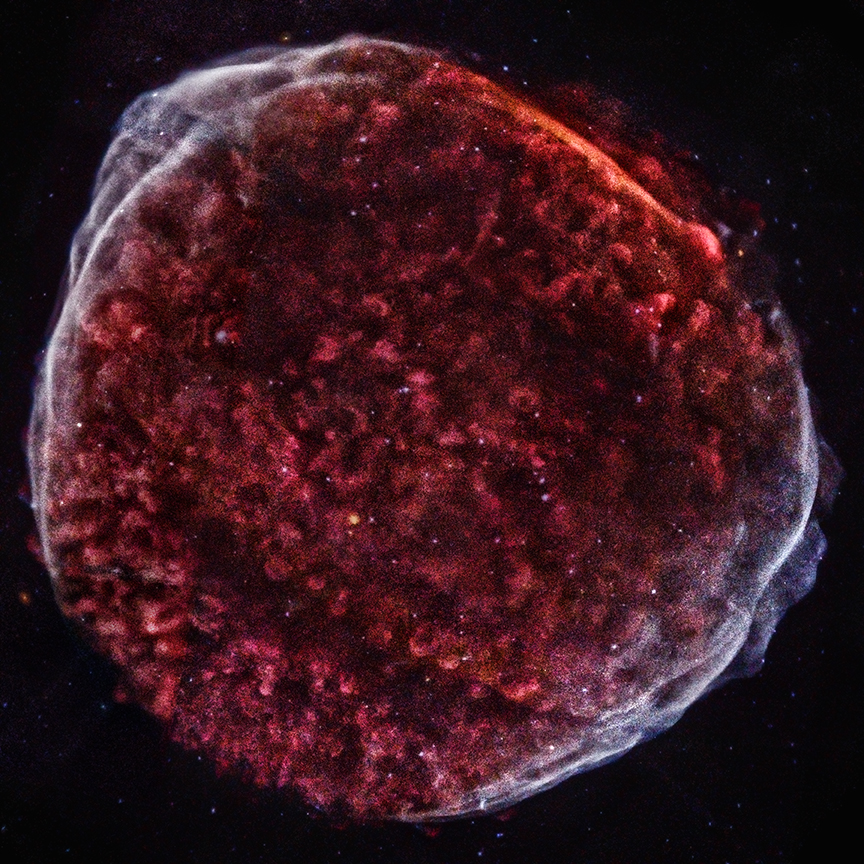
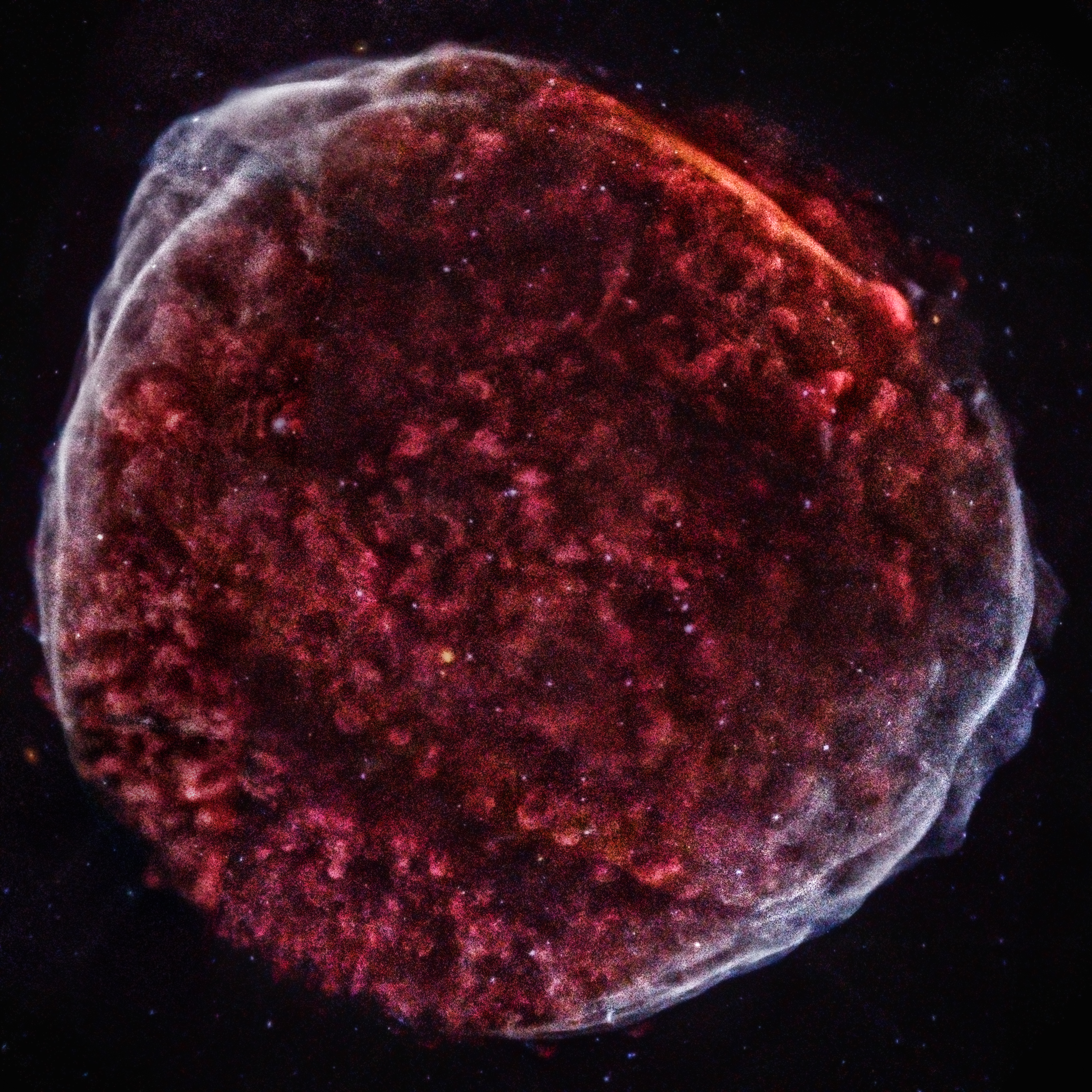
A new image of SN 1006 from NASA's Chandra X-ray Observatory reveals this supernova remnant in exquisite detail. By overlapping ten different pointings of Chandra's field-of-view, astronomers have stitched together a cosmic tapestry of the debris field that was created when a white dwarf star exploded, sending its material hurtling into space. In this new Chandra image, low, medium, and higher-energy X-rays are colored red, green, and blue respectively.

The Chandra image provides new insight into the nature of SN1006, which is the remnant of a so-called Type Ia supernova . This class of supernova is caused when a white dwarf pulls too much mass from a companion star and explodes, or when two white dwarfs merge and explode. Understanding Type Ia supernovas is especially important because astronomers use observations of these explosions in distant galaxies as mileposts to mark the expansion of the Universe.

The new SN 1006 image represents the most spatially detailed map yet of the material ejected during a Type Ia supernova. By examining the different elements in the debris field -- such as silicon, oxygen, and magnesium -- the researchers may be able to piece together how the star looked before it exploded and the order that the layers of the star were ejected, and constrain theoretical models for the explosion.

Scientists are also able to study just how fast specific knots of material are moving away from the original explosion. The fastest knots are moving outward at almost eleven million miles per hour, while those in other areas are moving at a more leisurely seven million miles per hour. SN 1006 is located about 7,000 light years from Earth. The new Chandra image of SN 1006 contains over 8 days worth of observing time by the telescope. These results were presented at a meeting of High Energy Astrophysics Division of the American Astronomical Society in Monterey, CA.

This work involved Frank Winkler, from Middlebury College in Middlebury, VT; Satoru Katsuda from The Institute of Physical and Chemical Research (RIKEN) in Saitama, Japan; Knox Long from Space Telescope Science Institute in Baltimore, MD; Robert Petre from NASA -Goddard Space Flight Center (GSFC) in Greenbelt, MD; Stephen Reynolds from North Carolina State University in Raleigh, NC; and Brian Williams from NASA -GSFC in Greenbelt, MD.

NASA's Marshall Space Flight Center in Huntsville, Ala., manages the Chandra program for NASA's Science Mission Directorate in Washington. The Smithsonian Astrophysical Observatory controls Chandra's science and flight operations from Cambridge, Mass.

 
Fast Facts for SN 1006:

Scale : Image is 34 arcmin across (about 70 light years)
Category : Supernovas & Supernova Remnants
Coordinates (J2000) : RA 15h 04m 10.01s | Dec -41º 53' 44.88"
Constellation : Lupus
Observation Date : 24 pointings between July 10, 2000 and June 15, 2012
Observation Time : 248 hours (10 days, 8 hours).
Obs. ID : 732, 1959, 3838, 4385-4394, 9107, 13737-13743, 14423, 14424, 14435
Instrument : ACIS
Also Known As : SNR 327.6+14.6
Color Code : X-ray (Red, Green, Blue)


Friday, February 15, 2013

Clues to the Mysterious Origin of Cosmic Rays

VLT/VIMOS observations of the shock front in the remnant of the supernova SN 1006

The remnant of the supernova SN 1006 seen at many different wavelengths

Part of the supernova remnant SN 1006 
seen with the NASA/ESA Hubble Space Telescope

VLT probes remains of medieval supernova

Very detailed new observations with ESO’s Very Large Telescope (VLT) of the remains of a thousand-year-old supernova have revealed clues to the origins of cosmic rays. For the first time the observations suggest the presence of fast-moving particles in the supernova remnant that could be the precursors of such cosmic rays. The results are appearing in the 14 February 2013 issue of the journal Science.

In the year 1006 a new star was seen in the southern skies and widely recorded around the world. It was many times brighter than the planet Venus and may even have rivaled the brightness of the Moon. It was so bright at maximum that it cast shadows and it was visible during the day. More recently astronomers have identified the site of this supernova and named it SN 1006. They have also found a glowing and expanding ring of material in the southern constellation of Lupus (The Wolf) that constitutes the remains of the vast explosion.

It has long been suspected that such supernova remnants may also be where some cosmic rays — very high energy particles originating outside the Solar System and travelling at close to the speed of light — are formed. But until now the details of how this might happen have been a long-standing mystery.

A team of astronomers led by Sladjana Nikolić (Max Planck Institute for Astronomy, Heidelberg, Germany [1]) has now used the VIMOS instrument on the VLT to look at the one-thousand-year-old SN 1006 remnant in more detail than ever before. They wanted to study what is happening where high-speed material ejected by the supernova is ploughing into the stationary interstellar matter — the shock front. This expanding high-velocity shock front is similar to the sonic boom produced by an aircraft going supersonic and is a natural candidate for a cosmic particle accelerator.

For the first time the team has not just obtained information about the shock material at one point, but also built up a map of the properties of the gas, and how these properties change across the shock front. This has provided vital clues to the mystery.

The results were a surprise — they suggest that there were many very rapidly moving protons in the gas in the shock region [2]. While these are not the sought-for high-energy cosmic rays themselves, they could be the necessary “seed particles”, which then go on to interact with the shock front material to reach the extremely high energies required and fly off into space as cosmic rays.

Nikolić explains: “This is the first time we were able to take a detailed look at what is happening in and around a supernova shock front. We found evidence that there is a region that is being heated in just the way one would expect if there were protons carrying away energy from directly behind the shock front.

The study was the first to use an integral field spectrograph [3] to probe the properties of the shock fronts of supernova remnants in such detail. The team now is keen to apply this method to other remnants.
Co-author Glenn van de Ven of the Max Planck Institute for Astronomy, concludes: “This kind of novel observational approach could well be the key to solving the puzzle of how cosmic rays are produced in supernova remnants.

Notes

[1] The new evidence emerged during analysis of the data by Sladjana Nikolić (Max Planck Institute for Astronomy) as part of work towards her doctoral degree at the University of Heidelberg.

[2] These protons are called suprathermal as they are moving much quicker than expected simply from the temperature of the material.

[3] This is achieved using a feature of VIMOS called an integral field unit, where the light recorded in each pixel is separately spread out into its component colours and each of these spectra recorded. The spectra can then be subsequently analysed individually and maps of the velocities and chemical properties of each part of the object created.

More information

This research was presented in a paper “An Integral View of Fast Shocks around Supernova 1006” to appear in the journal Science on 14 February 2013.


The team is composed of Sladjana Nikolić (Max Planck Institute for Astronomy [MPIA], Heidelberg, Germany), Glenn van de Ven (MPIA), Kevin Heng (University of Bern, Switzerland), Daniel Kupko (Leibniz Institute for Astrophysics Potsdam [AIP], Potsdam, Germany), Bernd Husemann (AIP), John C. Raymond (Harvard-Smithsonian Center for Astrophysics, Cambridge, USA), John P. Hughes (Rutgers University, Piscataway, USA), Jesús Falcon-Barroso (Instituto de Astrofísica de Canarias, La Laguna, Spain).


ESO is the foremost intergovernmental astronomy organisation in Europe and the world’s most productive ground-based astronomical observatory by far. It is supported by 15 countries: Austria, Belgium, Brazil, the Czech Republic, Denmark, France, Finland, Germany, Italy, the Netherlands, Portugal, Spain, Sweden, Switzerland and the United Kingdom. ESO carries out an ambitious programme focused on the design, construction and operation of powerful ground-based observing facilities enabling astronomers to make important scientific discoveries. ESO also plays a leading role in promoting and organising cooperation in astronomical research. ESO operates three unique world-class observing sites in Chile: La Silla, Paranal and Chajnantor. At Paranal, ESO operates the Very Large Telescope, the world’s most advanced visible-light astronomical observatory and two survey telescopes. VISTA works in the infrared and is the world’s largest survey telescope and the VLT Survey Telescope is the largest telescope designed to exclusively survey the skies in visible light. ESO is the European partner of a revolutionary astronomical telescope ALMA, the largest astronomical project in existence. ESO is currently planning the 39-metre European Extremely Large optical/near-infrared Telescope, the E-ELT, which will become “the world’s biggest eye on the sky”.

Links

Contacts

Sladjana Nikolić
Max Planck Institute for Astronomy
Heidelberg, Germany
Tel: +49 6221 528 438
Email:
nikolic@mpia.de

Glenn van de Ven
Max Planck Institute for Astronomy
Heidelberg, Germany
Tel: +49 6221 528 275
Email:
glenn@mpia.de

Richard Hook
ESO, La Silla, Paranal, E-ELT & Survey Telescopes Press Officer
Garching bei München, Germany
Tel: +49 89 3200 6655
Cell: +49 151 1537 3591
Email:
rhook@eso.org