Showing posts with label NGC 4567. Show all posts

Wednesday, August 10, 2022

Colliding Galaxies Dazzle in Gemini North Image

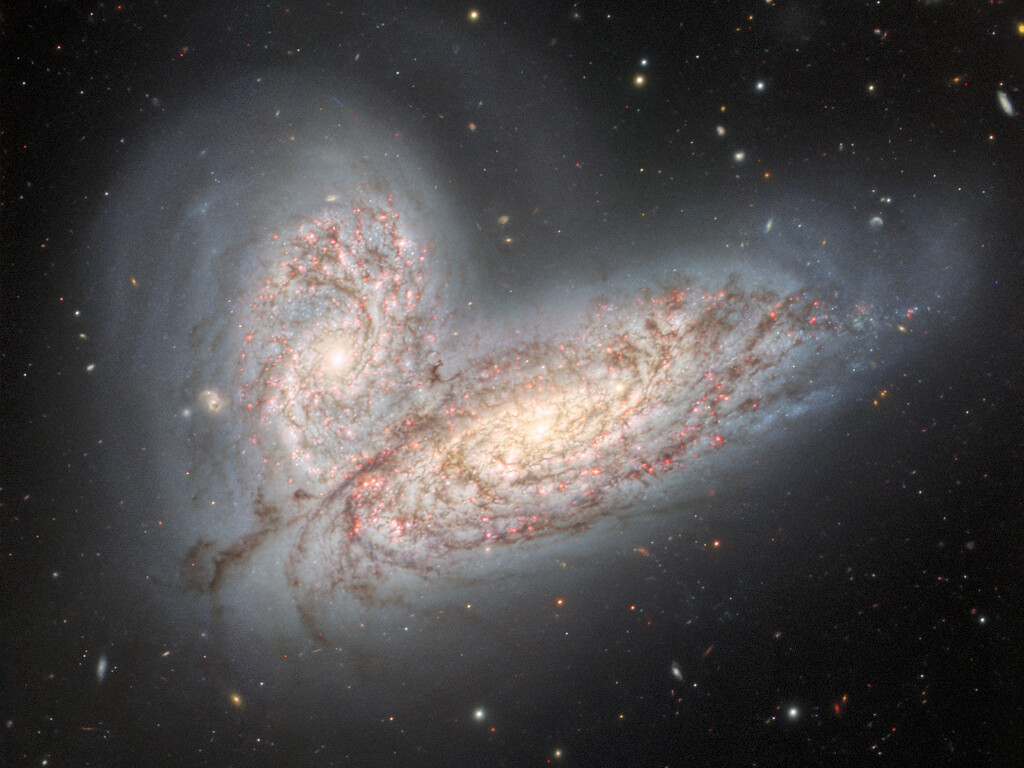
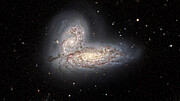
The merging galaxy pair NGC 4568 and NGC 4567

The merging galaxy pair NGC 4568 and NGC 4567 and supernova SN 2020fqv (callout box)


Videos

Cosmoview Episode 50: The Merging Galaxy Pair NGC 4568 and NGC 4567
 
Zooming in on Merging Spiral Galaxies
 
CosmoView Episodio 50: Detectan titánica colisión galáctica
CosmoView Episodio 50: Detectan titánica colisión galáctica in English only


NSF’s NOIRLab unveils stunning image of merging spiral galaxies

An evocative new image captured by the Gemini North telescope in Hawai‘i reveals a pair of interacting spiral galaxies — NGC 4568 and NGC 4567 — as they begin to clash and merge. These galaxies are entangled by their mutual gravitational field and will eventually combine to form a single elliptical galaxy in around 500 million years. Also visible in the image is the glowing remains of a supernova that was detected in 2020.

Gemini North, one of the twin telescopes of the International Gemini Observatory, operated by NSF’s NOIRLab, has observed the initial stages of a cosmic collision approximately 60 million light-years away in the direction of the constellation Virgo. The two stately spiral galaxies, NGC 4568 (bottom) and NGC 4567 (top), are poised to undergo one of the most spectacular events in the Universe, a galactic merger. At present, the centers of these galaxies are still 20,000 light-years apart (about the distance from Earth to the center of the Milky Way) and each galaxy still retains its original, pinwheel shape. Those placid conditions, however, will change.

As NGC 4568 and NGC 4567 draw together and coalesce, their dueling gravitational forces will trigger bursts of intense stellar formation and wildly distort their once-majestic structures. Over millions of years, the galaxies will repeatedly swing past each other in ever-tightening loops, drawing out long streamers of stars and gas until their individual structures are so thoroughly mixed that a single, essentially spherical, galaxy emerges from the chaos. By that point, much of the gas and dust (the fuel for star formation) in this system will have been used up or blown away.

This merger is also a preview of what will happen when the Milky Way and its closest large galactic neighbor the Andromeda Galaxy collide in about 5 billion years. 

A bright region in the center of one of NGC 4568’s sweeping spiral arms is the fading afterglow of a supernova — known as SN 2020fqv — that was detected in 2020. The new Gemini image was produced from data taken in 2020. 

By combining decades of observations and computer modeling, astronomers now have compelling evidence that merging spiral galaxies like these go on to become elliptical galaxies. It is likely that NGC 4568 and NGC 4567 will eventually resemble their more-mature neighbor Messier 89, an elliptical galaxy that also resides in the Virgo Cluster. With its dearth of star-forming gas, Messier 89 now exhibits minimal star formation and is made up primarily of older, low-mass stars and ancient globular clusters.

Advanced technology on the Gemini North telescope, including the Gemini Multi-Object Spectrograph North (GMOS-N) and the dry air above the summit of Maunakea, allowed astronomers to capture this spectacular image. 

The image was obtained by NOIRLab’s Communication, Education & Engagement team, as part of the NOIRLab Legacy Imaging Program.


More Information

NSF’s NOIRLab (National Optical-Infrared Astronomy Research Laboratory), the US center for ground-based optical-infrared astronomy, operates the international Gemini Observatory (a facility of NSF, NRC–Canada, ANID–Chile, MCTIC–Brazil, MINCyT–Argentina, and KASI–Republic of Korea, Kitt Peak National Observatory (KPNO), Cerro Tololo Inter-American Observatory (CTIO), the Community Science and Data Center (CSDC), and Vera C. Rubin Observatory (operated in cooperation with the Department of Energy’s SLAC National Accelerator Laboratory). It is managed by the Association of Universities for Research in Astronomy (AURA) under a cooperative agreement with NSF and is headquartered in Tucson, Arizona. The astronomical community is honored to have the opportunity to conduct astronomical research on Iolkam Du’ag (Kitt Peak) in Arizona, on Maunakea in Hawai‘i, and on Cerro Tololo and Cerro Pachón in Chile. We recognize and acknowledge the very significant cultural role and reverence that these sites have to the Tohono O'odham Nation, to the Native Hawaiian community, and to the local communities in Chile, respectively.


Links

Travis Rector
NSF's NOIRLab & University of Alaska
Tel: +1 907 786 1242
Email:
tarector@alaska.edu

Charles Blue
Public Information Officer
NSF's NOIRLab
Tel: +1 202 236 6324
Email:
charles.blue@noirlab.edu

Wednesday, November 03, 2021

A Cosmic Whodunit: ALMA Study Confirms What’s Robbing Galaxies of Their Star-Forming Gas


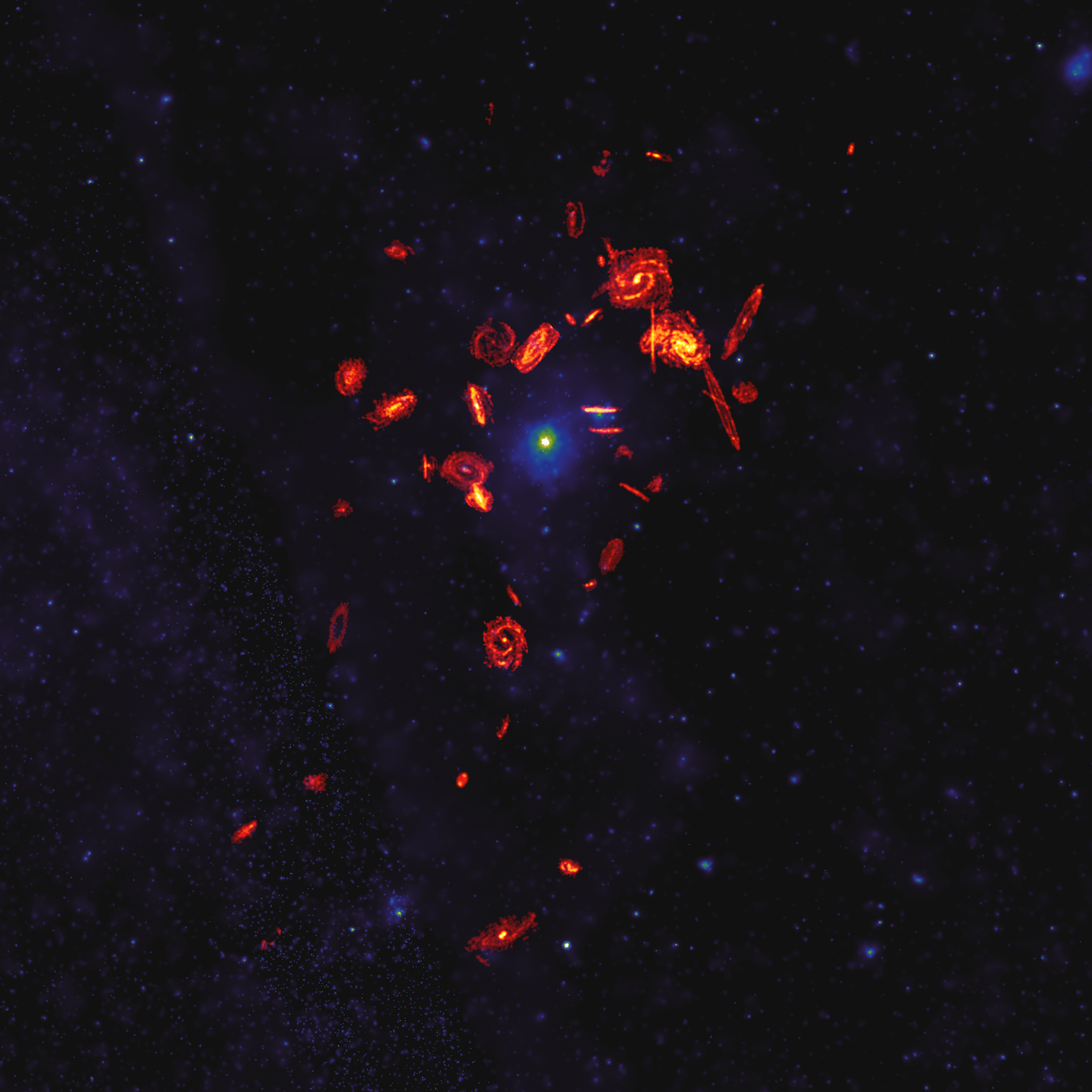
The VERTICO—Virgo Environment Traced in Carbon Monoxide—Survey observed the gas reservoirs in 51 galaxies in the nearby Virgo Cluster and found that the extreme environment in the cluster was killing galaxies by robbing them of their star-forming fuel. In this composite image, ALMA’s radio wavelength observations of the VERTICO galaxies’ molecular gas disks are magnified by a factor of 20. They are overlaid on the X-ray image of the hot plasma within the Virgo Cluster.
Hi-Res File



NGC 4567 and NGC 4568 are two of the thousands of galaxies in the Virgo Cluster, located roughly 65 million light-years from Earth. Observed by the VERTICO—Virgo Environment Traced in Carbon Monoxide—Survey, the two galaxies are among those in the galaxy cluster impacted by extreme physical processes that can lead to the death of galaxies. The galaxies are shown here in composite radio data from ALMA with molecular gas in red/orange and optical data from Hubble Space Telescope with stars in white/blue. Credit: ALMA (ESO/NAOJ/NRAO)/S. Dagnello (NRAO).
Hi-Res File


Spiral galaxy NGC 4254 is among the thousands of galaxies living and dying by the extreme physical processes in the Virgo Cluster. The galaxy is seen here in radio from ALMA with molecular gas in red/orange and optical from Hubble Space Telescope with stars in white/blue. Credit: ALMA (ESO/NAOJ/NRAO)/S. Dagnello (NRAO).
Hi-Res File


VERTICO Survey unmasks violent environments as culprit in mass galaxy quenching mystery


Astronomers examining the nearby Universe with the help of the Atacama Large Millimeter/submillimeter Array (ALMA) have just completed the largest high-resolution survey of star-forming fuel ever conducted in galaxy clusters. But more importantly, they’re tackling a long-standing mystery in astrophysics: what’s killing galaxies? The research, which provides the clearest evidence to date that extreme environments in space have severe impacts on the galaxies within them, will be published in an upcoming edition of The Astrophysical Journal Supplement Series.

The Virgo Environment Traced in Carbon Monoxide Survey—VERTICO—set out to better understand star formation and the role of galaxies in the Universe. “We know that galaxies are being killed by their environments, and we want to know why,” said Toby Brown, Plaskett Fellow at the National Research Council of Canada and lead author on the paper. “What VERTICO reveals better than ever before is which physical processes affect molecular gas and how they dictate the life and death of the galaxy.”

Galaxies are large collections of stars, and their births, evolutions, and deaths are influenced by where they live in the Universe and how they interact with their surroundings. Galaxy clusters, in particular, are some of the most extreme environments in the Universe, making them of particular interest to scientists studying the evolution of galaxies.

Home to thousands of galaxies the Virgo Cluster is the nearest massive cluster of galaxies to the Local Group, where the Milky Way resides. The extreme size and proximity make the cluster easy to study, but it also has other features that make it ripe for observation. “The Virgo Cluster is a bit unusual in that it has a relatively large population of galaxies that are still forming stars,” said Christine Wilson, Distinguished University Professor at McMaster University and co-principal investigator on the VERTICO project. “Many galaxy clusters in the Universe are dominated by red galaxies with little gas and star formation.”

The VERTICO project observed the gas reservoirs of 51 galaxies in the Virgo Cluster in high-resolution, revealing an environment so extreme and inhospitable that it can stop entire galaxies from forming stars in a process known as galaxy quenching. “The Virgo Cluster is the most extreme region of the local Universe, filled with million-degree plasma, extreme galaxy speeds, violent interactions between galaxies and their surroundings, a galaxy retirement village, and accordingly, a galaxy graveyard,” said Brown, adding that the project revealed how gas stripping can stunt, or shut down, one of the most important physical processes in the Universe: star formation. “Gas stripping is one of the most spectacular and violent external mechanisms that can shut down star formation in galaxies,” said Brown. “Gas stripping occurs when galaxies are moving so fast through hot plasma in the cluster that vast quantities of cold molecular gas are stripped away from the galaxy, as though the gas is being swept away by a huge cosmic broom. The exquisite quality of VERTICO’s observations allows us to better see and understand such mechanisms.”

The project was aided by ALMA’s Band 6 receiver—developed at the National Radio Astronomy Observatory’s Central Development Laboratory (CDL)—which provides high sensitivity and high resolution while minimizing required observing time. That, in turn, led to the collection of a significant amount of data, which may contain the clues needed to solve the remaining mysteries of how environments impact galaxies, and accordingly, how galaxies die. Wilson said, “There have been a lot of questions over the years on whether and how the cluster environment affects the molecular gas in galaxies, and how exactly those environments may contribute to their deaths. We still have work to do, but I’m confident VERTICO will allow us to answer these questions once and for all.”


The new paper is the first from VERTICO, with additional research expected to publish in the near future.


Resources 

“VERTICO: The Virgo Environment Traced In CO Survey,” Brown et. al. (2021), The Astrophysical Journal Supplement Series, preprint: https://arxiv.org/abs/2111.00937

About ALMA

The Atacama Large Millimeter/submillimeter Array (ALMA), an international astronomy facility, is a partnership of the European Organisation for Astronomical Research in the Southern Hemisphere (ESO), the U.S. National Science Foundation (NSF) and the National Institutes of Natural Sciences (NINS) of Japan in cooperation with the Republic of Chile. ALMA is funded by ESO on behalf of its Member States, by NSF in cooperation with the National Research Council of Canada (NRC) and the Ministry of Science and Technology (MOST) and by NINS in cooperation with the Academia Sinica (AS) in Taiwan and the Korea Astronomy and Space Science Institute (KASI).

ALMA construction and operations are led by ESO on behalf of its Member States; by the National Radio Astronomy Observatory (NRAO), managed by Associated Universities, Inc. (AUI), on behalf of North America; and by the National Astronomical Observatory of Japan (NAOJ) on behalf of East Asia. The Joint ALMA Observatory (JAO) provides the unified leadership and management of the construction, commissioning and operation of ALMA.


Media Contact: 

Amy C. Oliver
Public Information Officer, ALMA
Public Information & News Manager, NRAO
+1 434 242 9584

aoliver@nrao.edu


Friday, October 22, 2021

Hubble gives unprecedented, early view of a doomed star's destruction


Astronomers recently witnessed supernova SN 2020fqv explode inside the interacting Butterfly galaxies, located about 60 million light-years away in the constellation Virgo. Researchers quickly trained NASA's Hubble Space Telescope on the aftermath. Along with other space- and ground-based telescopes, Hubble delivered a ringside seat to the first moments of the ill-fated star's demise, giving a comprehensive view of a supernova in the very earliest stage of exploding. Hubble probed the material very close to the supernova that was ejected by the star in the last year of its life. These observations allowed researchers to understand what was happening to the star just before it died, and may provide astronomers with an early warning system for other stars on the brink of death. Credits: Author: NASA, ESA, Ryan Foley (UC Santa Cruz)-Image processingM: Joseph DePasquale (STScI).
Release images

Like a witness to a violent death, NASA's Hubble Space Telescope recently gave astronomers an unprecedented, comprehensive view of the first moments of a star's cataclysmic demise. Hubble's data, combined with other observations of the doomed star from space- and ground-based telescopes, may give astronomers an early warning system for other stars on the verge of blowing up.

"We used to talk about supernova work like we were crime scene investigators, where we would show up after the fact and try to figure out what happened to that star," explained Ryan Foley of the University of California, Santa Cruz, the leader of the team that made this discovery. "This is a different situation, because we really know what's going on and we actually see the death in real time."

Telescope Teamwork

The supernova, called SN 2020fqv, is in the interacting Butterfly Galaxies, which are located about 60 million light-years away in the constellation Virgo. It was discovered in April 2020 by the Zwicky Transient Facility at the Palomar Observatory in San Diego, California. Astronomers realized that the supernova was simultaneously being observed by the Transiting Exoplanet Survey Satellite (TESS), a NASA satellite designed primarily to discover exoplanets, with the ability to detect an assortment of other phenomena. They quickly trained Hubble and a suite of ground-based telescopes on it.

Together, these observatories gave the first holistic view of a star in the very earliest stage of destruction. Hubble probed the material very close to the star, called circumstellar material, mere hours after the explosion. This material was blown off the star in the last year of its life. These observations allowed astronomers to understand what was happening to the star just before it died.

"We rarely get to examine this very close-in circumstellar material since it is only visible for a very short time, and we usually don't start observing a supernova until at least a few days after the explosion," explained Samaporn Tinyanont, lead author on the study's paper to be published in the Monthly Notices of the Royal Astronomical Society. "For this supernova, we were able to make ultra-rapid observations with Hubble, giving unprecedented coverage of the region right next to the star that exploded."

Telling the Star's Story

The team looked at Hubble observations of the star going back to the 1990s. TESS provided an image of the system every 30 minutes starting several days before the explosion, through the explosion itself, and continuing for several weeks. Hubble was used again starting only hours after astronomers first detected the explosion. And from studying the circumstellar material with Hubble, the scientists gained an understanding of what was happening around the star in the previous decade. By combining all of this information, the team was able to create a multi-decade look at the star's final years.

"Now we have this whole story about what's happening to the star in the years before it died, through the time of death, and then the aftermath of that," said Foley. "This is really the most detailed view of stars like this in their last moments and how they explode."

The Rosetta Stone of Supernovas

Tinyanont and Foley called SN 2020fqv "the Rosetta Stone of supernovas." The ancient Rosetta Stone, which has the same text inscribed in three different scripts, helped experts learn to read Egyptian hieroglyphs.

In the case of this supernova, the science team used three different methods to determine the mass of the exploding star. These included comparing the properties and the evolution of the supernova with theoretical models; using information from a 1997 archival Hubble image of the star to rule out higher-mass stars; and using observations to directly measure the amount of oxygen in the supernova, which probes the mass of the star. The results are all consistent: around 14 to 15 times the mass of the Sun. Accurately determining the mass of the star that explodes in a supernova is crucial to understanding how massive stars live and die.

"People use the term 'Rosetta Stone' a lot. But this is the first time we've been able to verify the mass with these three different methods for one supernova, and all of them are consistent," said Tinyanont. "Now we can push forward using these different methods and combining them, because there are a lot of other supernovas where we have masses from one method but not another."

An Early Warning System?

In the years before stars explode, they tend to become more active. Some astronomers point to the red supergiant Betelgeuse, which has recently been belching significant amounts of material, and they wonder if this star will soon go supernova. While Foley doubts Betelgeuse will imminently explode, he does think we should take such stellar outbursts seriously.

"This could be a warning system," said Foley. "So if you see a star start to shake around a bit, start acting up, then maybe we should pay more attention and really try to understand what's going on there before it explodes. As we find more and more of these supernovas with this sort of excellent data set, we'll be able to understand better what's happening in the last few years of a star's life."

The Hubble Space Telescope is a project of international cooperation between NASA and ESA (European Space Agency). NASA's Goddard Space Flight Center in Greenbelt, Maryland, manages the telescope. The Space Telescope Science Institute (STScI) in Baltimore, Maryland, conducts Hubble science operations. STScI is operated for NASA by the Association of Universities for Research in Astronomy, in Washington, D.C. 

 Credits: Release: NASA, ESA

Media Contact:

Ann Jenkins
Space Telescope Science Institute, Baltimore, Maryland

Ray Villard
Space Telescope Science Institute, Baltimore, Maryland

Science Contact:

Ryan Foley
University of California, Santa Cruz, Santa Cruz, California

Samaporn Tinyanont
University of California, Santa Cruz, Santa Cruz, California

Contact us:
Direct inquiries to the
News Team.

Related links and documents:

Science Paper: The science paper by S. Tinyanont, PDF (8.83 MB)
NASA's Hubble Portal