Showing posts with label Abell 1775. Show all posts

Thursday, October 14, 2021

G344.7-0.1: When a Stable Star Explodes Quick Look: When a Stable Star Explodes


G344.7-0.1
Credit: X-ray: NASA/CXC/Tokyo Univ. of Science/K. Fukushima, et al.;
IR: NASA/JPL/Spitzer; Radio: CSIRO/ATNF/ATCA

 JPEG (225.7 kb) - Large JPEG (1.1 MB) - Tiff (37.5 MB) - More Images

Tour: Abell 1775 - More Animations


White dwarfs are among the most stable of stars. Left on their own, these stars that have exhausted most of their nuclear fuel — while still typically as massive as the Sun — and shrunk to a relatively small size can last for billions or even trillions of years.

However, a white dwarf with a nearby companion star can become a cosmic powder keg. If the companion's orbit brings it too close, the white dwarf can pull material from it until the white dwarf grows so much that it becomes unstable and explodes. This kind of stellar blast is called a Type Ia supernova.

While it is generally accepted by astronomers that such encounters between white dwarfs and "normal" companion stars are one likely source of Type Ia supernova explosions, many details of the process are not well understood. One way to investigate the explosion mechanism is to look at the elements left behind by the supernova in its debris or ejecta.

This new composite image shows G344.7-0.1, a supernova remnant created by a Type Ia supernova, through the eyes of different telescopes. X-rays from NASA's Chandra X-ray Observatory (blue) have been combined with infrared data from NASA's Spitzer Space Telescope (yellow and green) as well as radio data from the NSF's Very Large Array and the Commonwealth Scientific and Industrial Research Organisation's Australia Telescope Compact Array (red).

Chandra is one of the best tools available for scientists to study supernova remnants and measure the composition and distribution of "heavy" elements — that is, anything other than hydrogen and helium — they contain.

Astronomers estimate that G344.7-0.1 is about 3,000 to 6,000 years old in Earth's time frame. On the other hand, the most well-known and widely-observed Type Ia remnants, including Kepler, Tycho, and SN 1006, have all exploded within the last millennium or so as seen from Earth. Therefore, this deep look at G344.7-0.1 with Chandra gives astronomers a window into an important phase later in the evolution of a Type Ia supernova remnant.

Both the expanding blast wave and the stellar debris produce X-rays in supernova remnants. As the debris moves outward from the initial explosion, it encounters resistance from surrounding gas and slows down, creating a reverse shock wave that travels back toward the center of the explosion. This process is analogous to a traffic jam on a highway, where as times passes an increasing number of cars will stop or slow down behind the accident, causing the traffic jam to travel backwards. The reverse shock heats the debris to millions of degrees, causing it to glow in X-rays.

Type Ia remnants like Kepler, Tycho and SN 1006 are too young for the reverse shock to have time to plausibly travel backwards to heat all of the debris in the remnant's center. However, the relatively advanced age of G344.7-0.1 means that the reverse shock has moved back through the entire debris field.

A separate color version of only the Chandra data shows X-ray emission from iron (blue) and silicon (red) respectively, and X-rays produced by the acceleration of electrons as they are deflected by the nuclei of atoms that are positively charged (green). The region with the highest density of iron and the arc-like structures of silicon are labeled.


G344.7-0.13
3 Color X-Ray Composite (Labeled)

The Chandra image of G344.7-0.1 shows that the region with the highest density of iron (blue) is surrounded by arc-like structures (green) containing silicon. Similar arc-like structures are found for sulfur, argon, and calcium. The Chandra data also suggests that the region with the highest density iron has been heated by the reverse shock more recently than the elements in the arc-like structures, implying that it is located near the true center of the stellar explosion. These results support the predictions of models for Type Ia supernova explosions, which show that heavier elements are produced in the interior of an exploding white dwarf.

This three-color Chandra image also shows that the densest iron is located to the right of the supernova remnant's geometric center. This asymmetry is likely caused by gas surrounding the remnant being denser on the right than it is on the left.

A paper describing these results was published in the July 1st, 2020 issue of The Astrophysical Journal and is available online. The authors of the study are Kotaro Fukushima (Tokyo University of Science, Japan), Hiroya Yamaguchi (JAXA), Patrick Slane (Center for Astrophysics | Harvard & Smithsonian), Sangwook Park (University of Texas, Austin), Satoru Katsuda (Saitama University, Japan), Hidetoshi Sano (Nagoya University, Japan), Laura Lopez (The Ohio State University, Columbus), Paul Plucinsky (Center for Astrophysics), Shogo Kobayashi (Tokyo University of Science), and Kyoko Matsushita (Tokyo University of Science). The radio data were provided by Elsa Giacani from the Institute of Astronomy and Space Physics, who led a study of G344.7-0.1 published in 2011 in the journal Astronomy and Astrophysics.

NASA's Marshall Space Flight Center manages the Chandra program. The Smithsonian Astrophysical Observatory's Chandra X-ray Center controls science from Cambridge Massachusetts and flight operations from Burlington, Massachusetts.

Quick Look: When a Stable Star Explodes


Fast Facts for G344.7-0.1:

Scale: Image is about 17.6 arcmin (100 light years) across.
Category:
Supernovas & Supernova Remnants
Coordinates (J2000): RA 17h 03m 56s | Dec -41° 42´ 59"
Constellation:
Scorpius
Observation Date: 7 observations between May 12 and July 05, 2018
Observation Time: 33 hours 8.4 minutes (2 days, 9 hours, 8.4 minutes)
Obs. ID: 20308, 20309, 21093, 21094, 21095, 21096, 21117
Instrument:
ACIS
References: Fukushima, K., et al., 2020, ApJ, 897, 62. arXiv:2005.09664
Color Code: Multiwavelength Image: Radio (red), Infrared (green & yellow), X-ray (blue); X-ray 3 Color Image: Si (red), 3-6 keV (green), Fe (blue)
Distance Estimate: About 19,600 light years

Friday, July 16, 2021

Abell 1775: Chandra Catches Slingshot During Collision

Abell 1775
X-ray: NASA/CXC/Leiden Univ./A. Botteon et al.; Radio: LOFAR/ASTRON; Optical/IR:PanSTARRS


 JPEG (378.6 kb) - JPEG (2.1 MB) - Tiff (74.1 MB) - More Images

Tour: Abell 1775 - More Animations


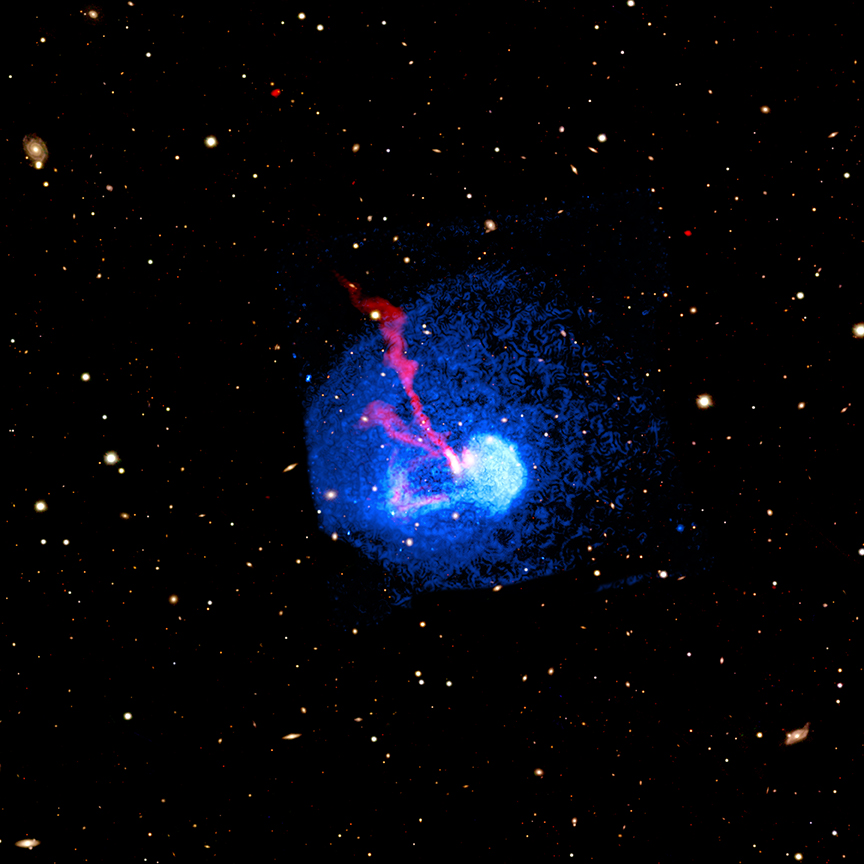
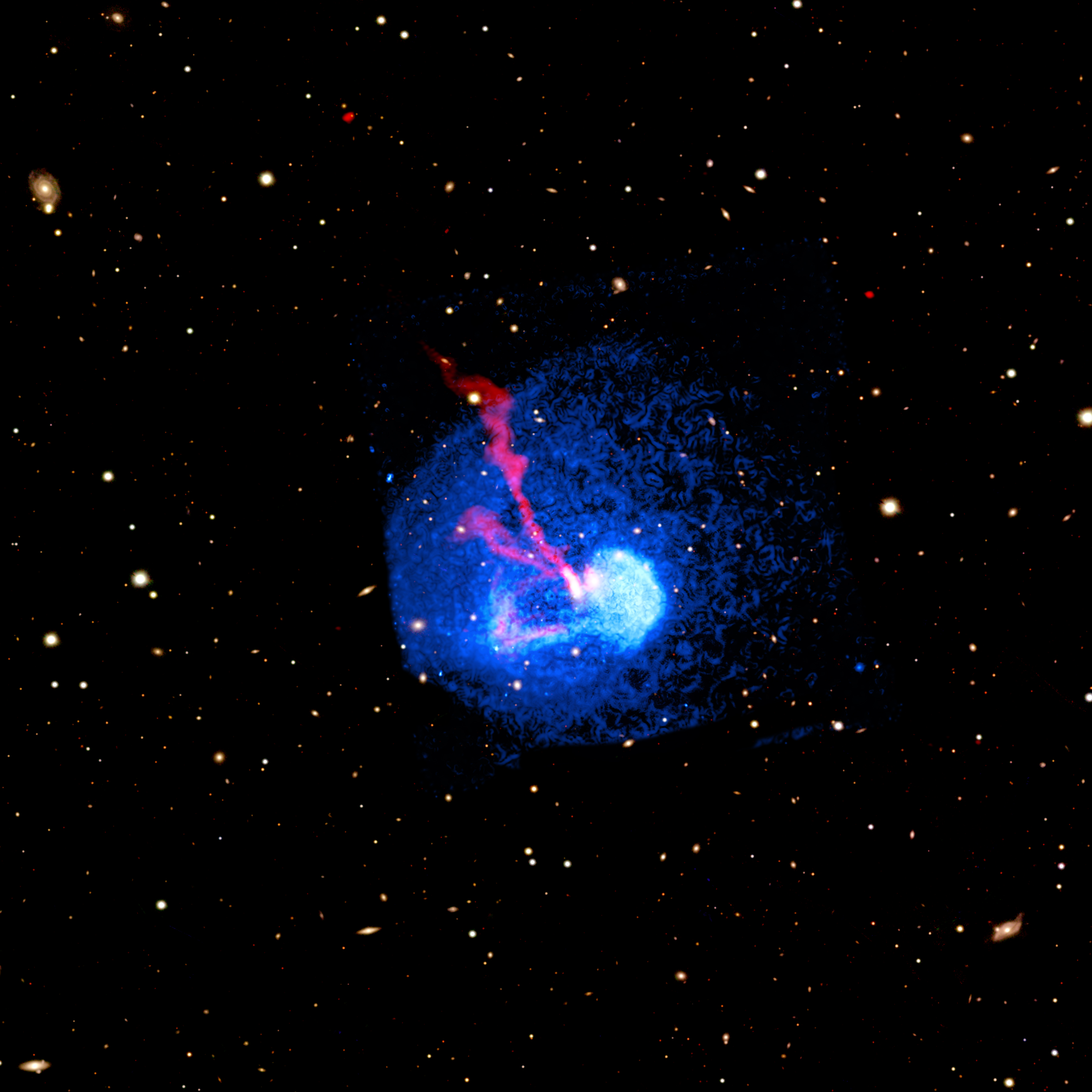
When the titans of space — galaxy clusters — collide, extraordinary things can happen. A new study using NASA's Chandra X-ray Observatory examines the repercussions after two galaxy clusters clashed.

Galaxy clusters are the largest structures in the Universe held together by gravity, containing hundreds or even thousands of individual galaxies immersed in giant oceans of superheated gas. In galaxy clusters, the normal matter — like the atoms that make up the stars, planets, and everything on Earth — is primarily in the form of hot gas and stars. The mass of the hot gas between the galaxies is far greater than the mass of the stars in all of the galaxies. This normal matter is bound in the cluster by the gravity of an even greater mass of dark matter.

Because of the huge masses
and speeds involved, collisions and mergers between galaxy clusters are among the most energetic events in the Universe.

In a new study of the galaxy cluster Abell 1775, located about 960 million light years from Earth, a team of astronomers led by Andrea Botteon from Leiden University in the Netherlands announced that they found a spiral-shaped pattern in Chandra's X-ray data. These results imply a turbulent past for the cluster.

When two galaxy clusters of different sizes have a grazing collision, the smaller cluster will begin to plow through the larger one. (Because of its superior mass, the bigger cluster has the upper hand when it comes to gravitational pull.) As the smaller cluster moves through, its hot gas is stripped off due to friction. This leaves behind a wake, or tail, that trails behind the cluster. After the center of the smaller cluster passes by the center of the larger one, the gas in the tail starts to encounter less resistance and overshoots the center of its cluster. This can cause the tail to "slingshot" as it flies to the side, curving as it extends away from the cluster's center.

The newest Chandra data contains evidence — including the brightness of the X-rays and the temperatures they represent — for one of these curving "slingshot" tails. Previous studies of Abell 1775 with Chandra and other telescopes hinted, but did not confirm, that there was an ongoing collision in this system.

A new image of Abell 1775 contains X-rays from Chandra (blue), optical data from the Pan-STARRS telescope in Hawaii (blue, yellow, and white), and radio data from the LOw Frequency ARray (LOFAR) in the Netherlands (red). The tail is labeled in this image along with a region of gas with a curved edge, called a "cold front," that is denser and cooler than the gas it is plowing into. The tail and the cold front all curve in the same direction, creating a spiral appearance. A separate labeled image shows the field of view of the Chandra data. 

Labeled Multiwavelength Image of Abell 1775

Astronomers previously found that Abell 1775 contains an enormous jet and radio source, which is also seen in this new composite image. This jet is powered by a supermassive black hole in a large elliptical galaxy in the cluster's center. New data from LOFAR and the Giant Metrewave Radio Telescope (GMRT) in India reveals that the radio jet is actually 2.6 million light years long. This is about twice as long as astronomers thought it was before and makes it one of the longest ever observed in a galaxy cluster. The structure of the jet changes abruptly as it crosses into the lower density gas in the upper part of the image, across the edge of the cold front, implying that the collision has affected it.

According to the new study, the gas motions inside the cluster could be responsible for other structures detected by observing Abell 1775 in radio waves, such as two filaments located near the origin of the jet (one of these is labeled). The LOFAR and Chandra data have also enabled the researchers to study in great detail the phenomena that contribute to accelerating electrons both in this galaxy's jet and in the radio emission near the center of the larger cluster.

There is an alternate explanation for the appearance of the cluster. As a small cluster approaches a larger one, the dense hot gas of the larger cluster will be attracted to it by gravity. After the smaller cluster passes the center of the other cluster, the direction of motion of the cluster gas reverses, and it travels back towards the cluster center. The cluster gas moves through the center again and "sloshes" back and forth, similar to wine sloshing in a glass that was jerked sideways. The sloshing gas ends up in a spiral pattern because the collision between the two clusters was off-center.

The Botteon team favors the slingshot tail scenario, but a separate group of astronomers led by Dan Hu of Shanghai Jiao Tong University in China favors the sloshing explanation based on data from Chandra and ESA's XMM-Newton. Both the slingshot and sloshing scenarios involve a collision between two galaxy clusters. Eventually the two clusters will fully merge with each other to form a single, larger galaxy cluster.

Further observations and modeling of Abell 1775 are required to help decide between these two scenarios.

A paper describing the results by Botteon's team has been published in the journal Astronomy and Astrophysics and is available online. The separate work on the "sloshing" theory led by Dan Hu has been accepted for publication in The Astrophysical Journal and is also available online.

NASA's Marshall Space Flight Center manages the Chandra program. The Smithsonian Astrophysical Observatory's Chandra X-ray Center controls science from Cambridge, Massachusetts, and flight operations from Burlington, Massachusetts.


Source: NASA's Chandra X-Ray Observatory


Fast Facts for Abell 1775:

Scale: Image is about 19.4 arcmin (5.3 million light years) across.
Category:
Groups & Clusters of Galaxies
Coordinates (J2000): RA 13h 41m 55.6s | Dec +26° 21´ 53"
Constellation: Boötes
Observation  Time:  27 hours 26 minutes (1 day 3 hours 26 minutes)
Obs. ID: 12891, 13510
Instrument:
ACIS
References: Botteon, A., et. al, 2021, A&A, 649, A37; arXiv:2103.01989
Color Code: X-ray: blue; Radio: red; Optical/IR: red, green, blue
Distance Estimate: About 960 million light years (z=0.072)