Tuesday, September 14, 2021

Rerun of Supernova Blast Is Expected to Appear in 2037

MACS J0138.0-2155
Credits: Lead Author: Steve A. Rodney (University of South Carolina), Gabriel Brammer (Cosmic Dawn Center/Niels Bohr Institute/University of Copenhagen). Iimage Processing: Joseph DePasquale (STScI). Release Images | Release Videos

It's challenging to make predictions, especially in astronomy. There are however, a few forecasts astronomers can depend on, such as the timing of upcoming lunar and solar eclipses and the clockwork return of some comets.

Now, looking far beyond the solar system, astronomers have added a solid prediction of an event happening deep in intergalactic space: an image of an exploding star, dubbed Supernova Requiem, which will appear around the year 2037. Although this rebroadcast will not be visible to the naked eye, some future telescopes should be able to spot it.

It turns out that this future appearance will be the fourth-known view of the same supernova, magnified, brightened, and split into separate images by a massive foreground cluster of galaxies acting like a cosmic zoom lens. Three images of the supernova were first found from archival data taken in 2016 by NASA's Hubble Space Telescope.

The multiple images are produced by the monster galaxy cluster's powerful gravity, which distorts and magnifies the light from the supernova far behind it, an effect called gravitational lensing. First predicted by Albert Einstein, this effect is similar to a glass lens bending light to magnify the image of a distant object.

The three lensed supernova images, seen as tiny dots captured in a single Hubble snapshot, represent light from the explosive aftermath. The dots vary in brightness and color, which signify three different phases of the fading blast as it cooled over time.

"This new discovery is the third example of a multiply imaged supernova for which we can actually measure the delay in arrival times," explained lead researcher Steve Rodney of the University of South Carolina in Columbia. "It is the most distant of the three, and the predicted delay is extraordinarily long. We will be able to come back and see the final arrival, which we predict will be in 2037, plus or minus a couple of years." 

The light that Hubble captured from the cluster, MACS J0138.0-2155, took about 4 billion years to reach Earth. The light from Supernova Requiem needed an estimated 10 billion years for its journey, based on the distance of its host galaxy.

The team's prediction of the supernova's return appearance is based on computer models of the cluster, which describe the various paths the supernova light is taking through the maze of clumpy dark matter in the galactic grouping. Dark matter is an invisible material that comprises the bulk of the universe's matter and is the scaffolding upon which galaxies and galaxy clusters are built.

Each magnified image takes a different route through the cluster and arrives at Earth at a different time, due, in part, to differences in the length of the pathways the supernova light followed.

"Whenever some light passes near a very massive object, like a galaxy or galaxy cluster, the warping of space-time that Einstein's theory of general relativity tells us is present for any mass, delays the travel of light around that mass," Rodney said.

He compares the supernova's various light paths to several trains that leave a station at the same time, all traveling at the same speed and bound for the same location. Each train, however, takes a different route, and the distance for each route is not the same. Because the trains travel over different track lengths across different terrain, they do not arrive at their destination at the same time.

In addition, the lensed supernova image predicted to appear in 2037 lags behind the other images of the same supernova because its light travels directly through the middle of the cluster, where the densest amount of dark matter resides. The immense mass of the cluster bends the light, producing the longer time delay. "This is the last one to arrive because it's like the train that has to go deep down into a valley and climb back out again. That's the slowest kind of trip for light," Rodney explained.

The lensed supernova images were discovered in 2019 by Gabe Brammer, a study co-author at the Cosmic Dawn Center (DAWN) at the Niels Bohr Institute, University of Copenhagen, in Denmark. Brammer spotted the mirrored supernova images while analyzing distant galaxies magnified by massive foreground galaxy clusters as part of an ongoing Hubble program called REsolved QUIEscent Magnified Galaxies (REQUIEM).

He was comparing new REQUIEM data from 2019 with archival images taken in 2016 from a different Hubble science program. A tiny red object in the 2016 data caught his eye, which he initially thought was a far-flung galaxy. But it had disappeared in the 2019 images.

"But then, on further inspection of the 2016 data, I noticed there were actually three magnified objects, two red and a purple," he explained. "Each of the three objects was paired with a lensed image of a distant massive galaxy. Immediately it suggested to me that it was not a distant galaxy but actually a transient source in this system that had faded from view in the 2019 images like a light bulb that had been flicked off."

Brammer teamed up with Rodney to conduct a further analysis of the system. The lensed supernova images are arranged in an arc around the cluster's core. They appear as small dots near the smeared orange features that are thought to be the magnified snapshots of the supernova's host galaxy.

Study co-author Johan Richard of the University of Lyon in France produced a map of the amount of dark matter in the cluster, inferred from the lensing it produces. The map shows the predicted locations of lensed objects. This supernova is predicted to appear again in 2042, but it will be so faint that the research team thinks it will not be visible.

Catching the rerun of the explosive event will help astronomers measure the time delays between all four supernova images, which will offer clues to the type of warped-space terrain the exploded star's light had to cover. Armed with those measurements, researchers can fine-tune the models that map out the cluster's mass. Developing precise dark-matter maps of massive galaxy clusters is another way for astronomers to measure the universe's expansion rate and investigate the nature of dark energy, a mysterious form of energy that works against gravity and causes the cosmos to expand at a faster rate.

This time-delay method is valuable because it's a more direct way of measuring the universe's expansion rate, Rodney explained. "These long time delays are particularly valuable because you can get a good, precise measurement of that time delay if you are just patient and wait years, in this case more than a decade, for the final image to return," he said. "It is a completely independent path to calculate the universe's expansion rate. The real value in the future will be using a larger sample of these to improve the precision."

Spotting lensed images of supernovae will become increasingly common in the next 20 years with the launch of NASA's Nancy Grace Roman Space Telescope and the start of operations at the Vera C. Rubin Observatory. Both telescopes will observe large swaths of the sky, which will allow them to spot dozens more multiply imaged supernovae.

Future telescopes such as NASA's James Webb Space Telescope also could detect light from supernova Requiem at other epochs of the blast.

The team's results will appear on September 13 in the journal Nature Astronomy

The Hubble Space Telescope is a project of international cooperation between NASA and ESA (European Space Agency). NASA's Goddard Space Flight Center in Greenbelt, Maryland, manages the telescope. The Space Telescope Science Institute (STScI) in Baltimore, Maryland, conducts Hubble science operations. STScI is operated for NASA by the Association of Universities for Research in Astronomy in Washington, D.C.
 
Credits:

Media Contact:

Donna Weaver
Space Telescope Science Institute, Baltimore, Maryland

Ray Villard
Space Telescope Science Institute, Baltimore, Maryland

Science Contact:

Steven A. Rodney
University of South Carolina, Columbia, South Carolina

Gabriel Brammer
Cosmic Dawn Center/Niels Bohr Institute/University of Copenhagen, Copenhagen, Denmark

Release: NASA, ESA, University of South Carolina, Cosmic Dawn Center/Niels Bohr Institute/University of Copenhagen

Contact Us: Direct inquiries to the News Team

Related Links and Documents:

Source: HubbleSite/News


Monday, September 13, 2021

A Closer Look at Hubble’s 31st Anniversary Snapshot

AG Carinae - Comparison
Credit: ESA/Hubble and NASA, A. Nota, C. Britt

A Closer Look at Hubble’s 31st Anniversary Snapshot

A Closer Look at Hubble’s 31st Anniversary Snapshot

This comparison view shows puffing dust bubbles and an erupting gas shell — the final acts of a monster star.You can explore the detail of the nebula surrounding the star AG Carinae by using the slider tool on the image above.

This comparison view shows puffing dust bubbles and an erupting gas shell — the final acts of a monster star.You can explore the detail of the nebula surrounding the star AG Carinae by using the slider tool on the image above.

This Picture of the Week showcases new views of the dual nature of the star AG Carinae, which was the target of the NASA/ESA Hubble Space Telescope’s 31st anniversary image in April 2021. This new perspective was developed thanks to Hubble’s observations of the star in 2020 and 2014, along with others captured by the telescope’s WFPC2 instrument in 1994.

The first image showcases the details of the ionised hydrogen and ionised nitrogen emissions from the nebula (seen here in red). In the second image, the blue demonstrates the contrasting appearance of the distribution of the dust that shines of reflected stellar light. Astronomers believe that the dust bubbles and filaments formed within and were shaped by powerful stellar wind .

This giant star is waging a tug-of-war between gravity and radiation to avoid self-destruction. The star is surrounded by an expanding shell of gas and dust — a nebula — that is shaped by the powerful winds emanating from the star. The nebula is about five light-years wide, equal to the distance from here to our nearest star, Alpha Centauri

AG Carinae is formally classified as a Luminous Blue Variable because it is hot (blue), very luminous, and variable. Such stars are quite rare because there are not many stars that are so massive. Luminous Blue Variable stars continuously lose mass in the final stages of their life, during which a significant amount of stellar material is ejected into the surrounding interstellar space, until enough mass has been lost that the star has reached a stable state.

AG Carinae is surrounded by a spectacular nebula, formed by material ejected by the star during several of its past outbursts. The nebula is approximately 10 000 years old, and the observed velocity of the gas is approximately 70 kilometres per second. While this nebula looks like a ring, it is in fact a hollow shell rich in gas and dust, the centre of which has been cleared by the powerful stellar wind travelling at roughly 200 kilometres per second. The gas (composed mostly of ionised hydrogen and nitrogen) is visible to us in these images as a thick bright red ring, which appears doubled in places — possibly the result of several outbursts colliding into each other. The dust, here visible in blue, has formed in clumps, bubbles and filaments that are shaped by the stellar wind.

Scientists who observed the star and its surrounding nebula note that the ring is not perfectly spherical; it appears to have a bipolar symmetry, indicating that the mechanism producing the outburst may have been caused by the presence of a disc in the centre, or that the star is not alone but might have a companion (known as a binary star). An alternative and simpler theory is that the star rotates very fast (as many massive stars have been found to do).


Friday, September 10, 2021

Astronomers nail down the origins of rare loner dwarf galaxies


Caption:In this image, the fall of a blue ultra-diffuse galaxy into a galaxy system and its subsequent ejection as a red ultra-diffuse galaxy, is depicted. Credits:Image: Vanina Rodriguez

By definition, dwarf galaxies are small and dim, with just a fraction of the stars found in the Milky Way and other galaxies. There are, however, giants among the dwarfs: Ultra-diffuse galaxies, or UDGs, are dwarf systems that contain relatively few stars but are scattered over vast regions. Because they are so diffuse, these systems are difficult to detect, though most have been found tucked within clusters of larger, brighter galaxies.

Now astronomers from MIT, the University of California at Riverside, and elsewhere have used detailed simulations to detect “quenched” UDGs — a rare type of dwarf galaxy that has stopped generating stars. They identified several such systems in their simulations and found the galaxies were not in clusters, but rather exiled in voids — quiet, nearly empty regions of the universe.

This isolation goes against astronomers’ predictions of how quenched UDGs should form. So, the team used the same simulations to rewind the dwarf systems’ evolution and see exactly how they came to be.

The researchers found that quenched UDGs likely coalesced within halos of dark matter with unusually high angular momentum. Like a cotton candy machine, this extreme environment may have spun out dwarf galaxies that were anomalously stretched out.

These UDGs then evolved within galaxy clusters, like most UDGs. But interactions within the cluster likely ejected the dwarfs into the void, giving them wide, boomerang-like trajectories known as “backsplash” orbits. In the process, the galaxies’ gas was stripped away, leaving the galaxies “quenched” and unable to produce new stars.

The simulations showed that such UDGs should be more common than what has been observed. The researchers say their results, published today in Nature Astronomy, provide a blueprint for astronomers to go looking for these dwarfish giants in the universe’s voids.

“We always strive to get a complete consensus of the galaxies that we have in the universe,” says Mark Vogelsberger, associate professor of physics at MIT. “This study is adding a new population of galaxies that the simulation actually predicts. And we now have to look for them in the real universe.”

Vogelsberger co-led the study with Laura Sales of UC Riverside and José A. Benavides of the Institute of Theoretical and Experimental Astronomy in Argentina.

Red v blue

The team’s search for quenched UDGs began with a simple survey for UDG satellites — ultra-diffuse systems that reside outside galaxy clusters. Astronomers predict that UDGs within clusters should be quenched, as they would be surrounded by other galaxies that would essentially rub out the UDG’s already-diffuse gas and shut off star production. Quenched UDGs in clusters should then consist mainly of old stars and appear red in color.

If UDGs exist outside clusters, in the void, they are expected to continue churning out stars, as there would be no competing gas from other galaxies to quench them. UDGs in the void, therefore, are predicted to be rich with new stars, and to appear blue.

When the team surveyed previous detections of UDG satellites, outside clusters, they found most were blue as expected — but a few were red.

“That’s what caught our attention,” Sales says. “And we thought, ‘What are they doing there? How did they form?’ There was no good explanation.”

Galactic cube

To find one, the researchers looked to TNG50, a detailed cosmological simulation of galaxy formation developed by Vogelsberger and others at MIT and elsewhere. The simulation runs on some of the most powerful supercomputers in the world and is designed to evolve a large volume of the universe, from conditions resembling those shortly after the Big Bang to the present day. The simulation is based on fundamental principles of physics and the complex interactions between matter and gas, and its results have been shown in many scenarios to agree with what astronomers have observed in the actual universe. TNG50 has therefore been used as an accurate model for how and where many types of galaxies evolve through time. In their new study, Vogelsberger, Sales, and Benavides used TNG50 to first see if they could spot quenched UDGs outside galaxy clusters. They started with a cube of the early universe measuring about 150 million light years wide, and ran the simulation forward, up through the present day. Then they searched the simulation specifically for UDGs in voids, and found most of the ones they detected were blue, as expected. But a surprising number — about 25 percent — were red, or quenched.

They zeroed in on these red satellite dwarfs and used the same simulation, this time as a sort of time machine to see how, when, and where these galaxies originated. They found that the systems were initially part of clusters but were somehow thrown out into the void, on a more elliptical, “backsplash” orbit.

“These orbits are almost like those of comets in our solar system,” Sales says. “Some go out and orbit back around, and others may come in once and then never again. For quenched UDGs, because their orbits are so elliptical, they haven’t had time to come back, even over the entire age of the universe. They are still out there in the field.”

The simulations also showed that the quenched UDGs’ red color arose from their ejection — a violent process that stripped away the galaxies’ star-forming gas, leaving it quenched and red. Running the simulations further back in time, the team observed that the tiny systems, like all galaxies, originated in halos of dark matter, where gas coalesces into galactic disks. But for quenched UDGs, the halos appeared to spin faster than normal, generating stretched out, ultra-diffuse galaxies.

Now that the researchers have a better understanding of where and how quenched UDGs arose, they hope astronomers can use their results to tune telescopes, to identify more such isolated red dwarfs — which the simulations suggest must be lurking in larger numbers than what astronomers have so far detected.

“It’s quite surprising that the simulations can really produce all these very small objects,” Vogelsberger says. “We predict there should be more of this kind of galaxy out there. This makes our work quite exciting.”

Jennifer Chu | MIT News Office

Source: MIT/News


Thursday, September 09, 2021

ESO captures best images yet of peculiar “dog-bone” asteroid

Asteroid Kleopatra from different angles
 
Asteroid Kleopatra from different angles (annotated)
 
Size comparison of asteroid Kleopatra with northern Italy
 
Size comparison of asteroid Kleopatra with Chile
 
Processed SPHERE image showing the moons of Kleopatra


Videos

Location of Kleopatra in the Solar System


Using the European Southern Observatory’s Very Large Telescope (ESO’s VLT), a team of astronomers have obtained the sharpest and most detailed images yet of the asteroid Kleopatra. The observations have allowed the team to constrain the 3D shape and mass of this peculiar asteroid, which resembles a dog bone, to a higher accuracy than ever before. Their research provides clues as to how this asteroid and the two moons that orbit it formed.

“Kleopatra is truly a unique body in our Solar System,” says Franck Marchis, an astronomer at the SETI Institute in Mountain View, USA and at the Laboratoire d'Astrophysique de Marseille, France, who led a study on the asteroid — which has moons and an unusual shape — published today in Astronomy & Astrophysics. “Science makes a lot of progress thanks to the study of weird outliers. I think Kleopatra is one of those and understanding this complex, multiple asteroid system can help us learn more about our Solar System.”

Kleopatra orbits the Sun in the Asteroid Belt between Mars and Jupiter. Astronomers have called it a “dog-bone asteroid” ever since radar observations around 20 years ago revealed it has two lobes connected by a thick “neck”. In 2008, Marchis and his colleagues discovered that Kleopatra is orbited by two moons, named AlexHelios and CleoSelene, after the Egyptian queen’s children.

To find out more about Kleopatra, Marchis and his team used snapshots of the asteroid taken at different times between 2017 and 2019 with the Spectro-Polarimetric High-contrast Exoplanet REsearch (SPHERE) instrument on ESO’s VLT. As the asteroid was rotating, they were able to view it from different angles and to create the most accurate 3D models of its shape to date. They constrained the asteroid’s dog-bone shape and its volume, finding one of the lobes to be larger than the other, and determined the length of the asteroid to be about 270 kilometres or about half the length of the English Channel.

In a second study, also published in Astronomy & Astrophysics and led by Miroslav Brož of Charles University in Prague, Czech Republic, the team reported how they used the SPHERE observations to find the correct orbits of Kleopatra’s two moons. Previous studies had estimated the orbits, but the new observations with ESO’s VLT showed that the moons were not where the older data predicted them to be.

“This had to be resolved,” says Brož. “Because if the moons’ orbits were wrong, everything was wrong, including the mass of Kleopatra.” Thanks to the new observations and sophisticated modelling, the team managed to precisely describe how Kleopatra’s gravity influences the moons’ movements and to determine the complex orbits of AlexHelios and CleoSelene. This allowed them to calculate the asteroid’s mass, finding it to be 35% lower than previous estimates.

Combining the new estimates for volume and mass, astronomers were able to calculate a new value for the density of the asteroid, which, at less than half the density of iron, turned out to be lower than previously thought [1]. The low density of Kleopatra, which is believed to have a metallic composition, suggests that it has a porous structure and could be little more than a “pile of rubble”. This means it likely formed when material reaccumulated following a giant impact.

Kleopatra’s rubble-pile structure and the way it rotates also give indications as to how its two moons could have formed. The asteroid rotates almost at a critical speed, the speed above which it would start to fall apart, and even small impacts may lift pebbles off its surface. Marchis and his team believe that those pebbles could subsequently have formed AlexHelios and CleoSelene, meaning that Kleopatra has truly birthed its own moons.

The new images of Kleopatra and the insights they provide are only possible thanks to one of the advanced adaptive optics systems in use on ESO’s VLT, which is located in the Atacama Desert in Chile. Adaptive optics help to correct for distortions caused by the Earth’s atmosphere which cause objects to appear blurred — the same effect that causes stars viewed from Earth to twinkle. Thanks to such corrections, SPHERE was able to image Kleopatra — located 200 million kilometres away from Earth at its closest — even though its apparent size on the sky is equivalent to that of a golf ball about 40 kilometres away.

ESO’s upcoming Extremely Large Telescope (ELT), with its advanced adaptive optics systems, will be ideal for imaging distant asteroids such as Kleopatra. “I can’t wait to point the ELT at Kleopatra, to see if there are more moons and refine their orbits to detect small changes,” adds Marchis.


Notes 

[1] The newly calculated density is 3.4 grams per cubic centimetre, while previously Kleopatra was believed to have a mean density of about 4.5 grams per cubic centimetre.


More Information

This research, based on observations with SPHERE on ESO’s VLT (Principal Investigator: Pierre Vernazza), was presented in two papers to appear in Astronomy & Astrophysics.

The team of the paper entitled “(216) Kleopatra, a low density critically rotating M-type asteroid” (https://www.aanda.org/10.1051/0004-6361/202140874) is composed of F. Marchis (SETI Institute, Carl Sagan Center, Mountain View, USA and Aix Marseille University, CNRS, Laboratoire d’Astrophysique de Marseille, France [LAM]), L. Jorda (LAM), P. Vernazza (LAM), M. Brož (Institute of Astronomy, Faculty of Mathematics and Physics, Charles University, Prague, Czech Republic [CU]), J. Hanuš (CU), M. Ferrais (LAM), F. Vachier (Institut de mécanique céleste et de calcul des éphémérides, Observatoire de Paris, PSL Research University, CNRS, Sorbonne Universités, UPMC University Paris 06 and Université de Lille, France [IMCCE]), N. Rambaux (IMCCE), M. Marsset (Department of Earth, Atmospheric and Planetary Sciences, MIT, Cambridge, USA [MIT]), M. Viikinkoski (Mathematics & Statistics, Tampere University, Finland [TAU]), E. Jehin (Space sciences, Technologies and Astrophysics Research Institute, Université de Liège, Belgium [STAR]), S. Benseguane (LAM), E. Podlewska-Gaca (Faculty of Physics, Astronomical Observatory Institute, Adam Mickiewicz University, Poznan, Poland [UAM]), B. Carry (Université Côte d’Azur, Observatoire de la Côte d’Azur, CNRS, Laboratoire Lagrange, France [OCA]), A. Drouard (LAM), S. Fauvaud (Observatoire du Bois de Bardon, Taponnat, France [OBB]), M. Birlan (IMCCE and Astronomical Institute of Romanian Academy, Bucharest, Romania [AIRA]), J. Berthier (IMCCE), P. Bartczak (UAM), C. Dumas (Thirty Meter Telescope, Pasadena, USA [TMT]), G. Dudziński (UAM), J. Ďurech (CU), J. Castillo-Rogez (Jet Propulsion Laboratory, California Institute of Technology, Pasadena,USA [JPL]), F. Cipriani (European Space Agency, ESTEC - Scientific Support Office, Noordwijk, The Netherlands [ESTEC]​​), F. Colas (IMCCE), R. Fetick (LAM), T. Fusco (LAM and The French Aerospace Lab BP72, Chatillon Cedex, France [ONERA]​​), J. Grice (OCA and School of Physical Sciences, The Open University, Milton Keynes, UK [OU]), A. Kryszczynska (UAM), P. Lamy (Laboratoire Atmosphères, Milieux et Observations Spatiales, CNRS [CRNS] and Université de Versailles Saint-Quentin-en-Yvelines, Guyancourt, France [UVSQ]), A. Marciniak (UAM), T. Michalowski (UAM), P. Michel (OCA), M. Pajuelo (IMCCE and Sección Física, Departamento de Ciencias, Pontificia Universidad Católica del Perú, Lima, Perú [PUCP]), T. Santana-Ros (Departamento de Física, Ingeniería de Sistemas y Teoría de la Señal, Universidad de Alicante, Spain [UA] and Institut de Ciéncies del Cosmos, Universitat de Barcelona, Spain [UB]), P. Tanga (OCA), A. Vigan (LAM), O. Witasse (ESTEC), and B. Yang (European Southern Observatory, Santiago, Chile [ESO]).

The team of the paper entitled “An advanced multipole model for (216) Kleopatra triple system” (https://www.aanda.org/10.1051/0004-6361/202140901) is composed of M. Brož (CU), F. Marchis (SETI and LAM), L. Jorda (LAM), J. Hanuš (CU), P. Vernazza (LAM), M. Ferrais (LAM), F. Vachier (IMCCE), N. Rambaux (IMCCE), M. Marsset (MIT), M. Viikinkoski (TAU), E. Jehin (STAR), S. Benseguane (LAM), E. Podlewska-Gaca (UAM), B. Carry (OCA), A. Drouard (LAM), S. Fauvaud (OBB), M. Birlan (IMCCE and AIRA), J. Berthier (IMCCE), P. Bartczak (UAM), C. Dumas (TMT), G. Dudziński (UAM), J. Ďurech (CU), J. Castillo-Rogez (JPL), F. Cipriani (ESTEC​​), F. Colas (IMCCE), R. Fetick (LAM), T. Fusco (LAM and ONERA), J. Grice (OCA and OU), A. Kryszczynska (UAM), P. Lamy (CNRS and UVSQ), A. Marciniak (UAM), T. Michalowski (UAM), P. Michel (OCA), M. Pajuelo (IMCCE and PUCP), T. Santana-Ros (UA and UB), P. Tanga (OCA), A. Vigan (LAM), O. Witasse (ESTEC), and B. Yang (ESO).

ESO is the foremost intergovernmental astronomy organisation in Europe and the world’s most productive ground-based astronomical observatory by far. It has 16 Member States: Austria, Belgium, the Czech Republic, Denmark, France, Finland, Germany, Ireland, Italy, the Netherlands, Poland, Portugal, Spain, Sweden, Switzerland and the United Kingdom, along with the host state of Chile and with Australia as a Strategic Partner. ESO carries out an ambitious programme focused on the design, construction and operation of powerful ground-based observing facilities enabling astronomers to make important scientific discoveries. ESO also plays a leading role in promoting and organising cooperation in astronomical research. ESO operates three unique world-class observing sites in Chile: La Silla, Paranal and Chajnantor. At Paranal, ESO operates the Very Large Telescope and its world-leading Very Large Telescope Interferometer as well as two survey telescopes, VISTA working in the infrared and the visible-light VLT Survey Telescope. Also at Paranal ESO will host and operate the Cherenkov Telescope Array South, the world’s largest and most sensitive gamma-ray observatory. ESO is also a major partner in two facilities on Chajnantor, APEX and ALMA, the largest astronomical project in existence. And on Cerro Armazones, close to Paranal, ESO is building the 39-metre Extremely Large Telescope, the ELT, which will become “the world’s biggest eye on the sky”.


Link


Contacts:

Franck Marchis
SETI Institute and Laboratoire d’Astrophysique de Marseille
Mountain View and Marseille, France and USA
Cell: +1-510-599-0604
Email:
fmarchis@seti.org

Miroslav Brož
Charles University
Prague, Czech Republic
Email:
mira@sirrah.troja.mff.cuni.cz

Pierre Vernazza
Laboratoire d’Astrophysique de Marseille
Marseille, France
Tel: +33 4 91 05 59 11
Email:
pierre.vernazza@lam.fr

Bárbara Ferreira
ESO Media Manager
Garching bei München, Germany
Tel: +49 89 3200 6670
Cell: +49 151 241 664 00
Email:
press@eso.org

 Source: ESO/News


Wednesday, September 08, 2021

Stellar Collision Triggers Supernova Explosion


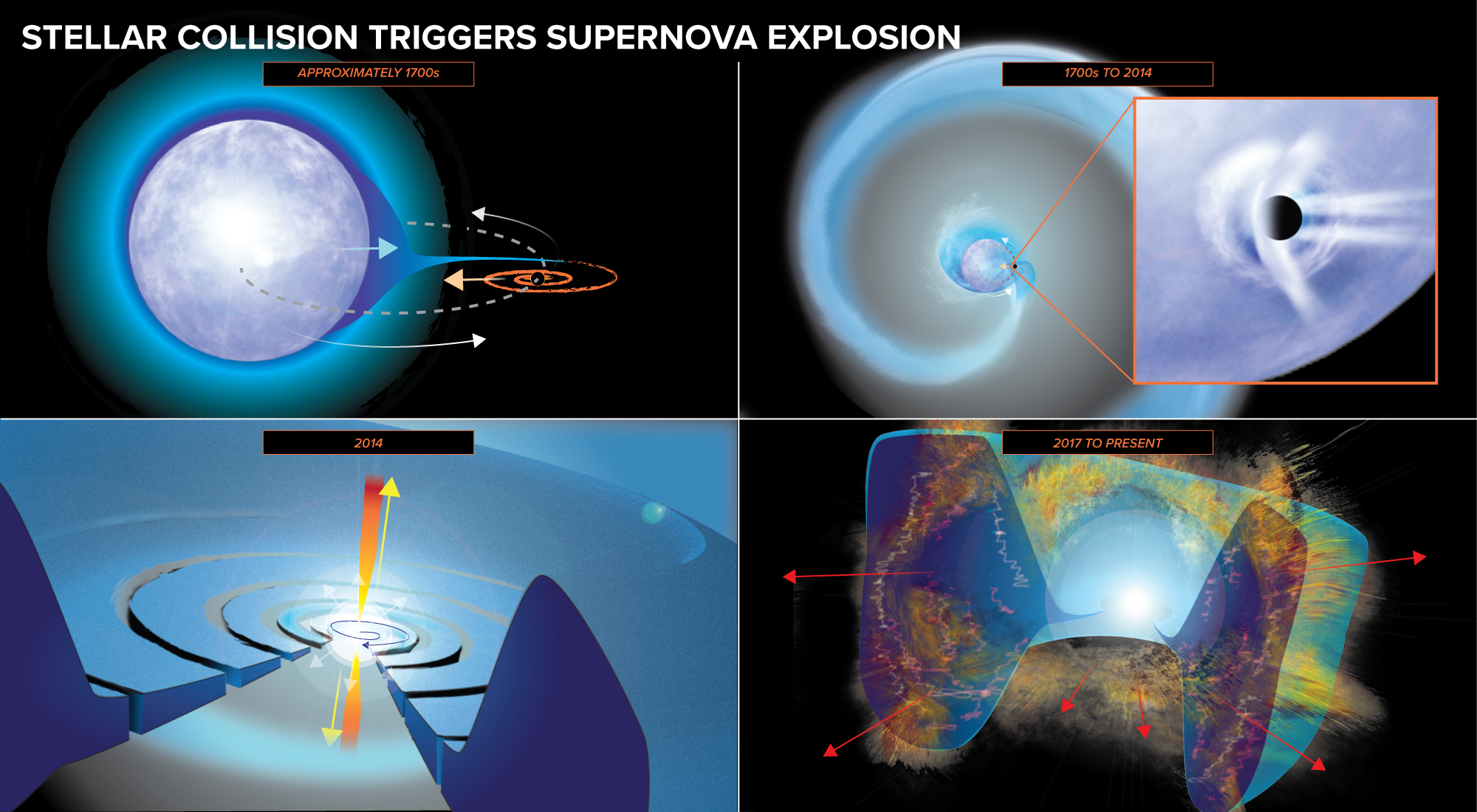
The Sequence of Events -- Clockwise, from top left: (1.) A neutron star or black hole orbits a "normal" companion star (light blue), growing closer over thousands of years. (2.) The neutron star or black hole enters its companion's atmosphere, throwing gas outward in an expanding spiral. (3.) When the intruder reaches the companion's core, material briefly forms a disk that propels a superfast jet outward, poking its way out of the star. The nuclear fusion that held the companion's core up against its own gravity is disrupted, triggering a collapse and subsequent supernova explosion. (4.) The material blasted out by the supernova explosion catches up to the material thrown out by the earlier interaction, causing strong shock waves that produce the radio waves observed with the VLA. Credit: Bill Saxton, NRAO/AUI/NSF.Hi-res File


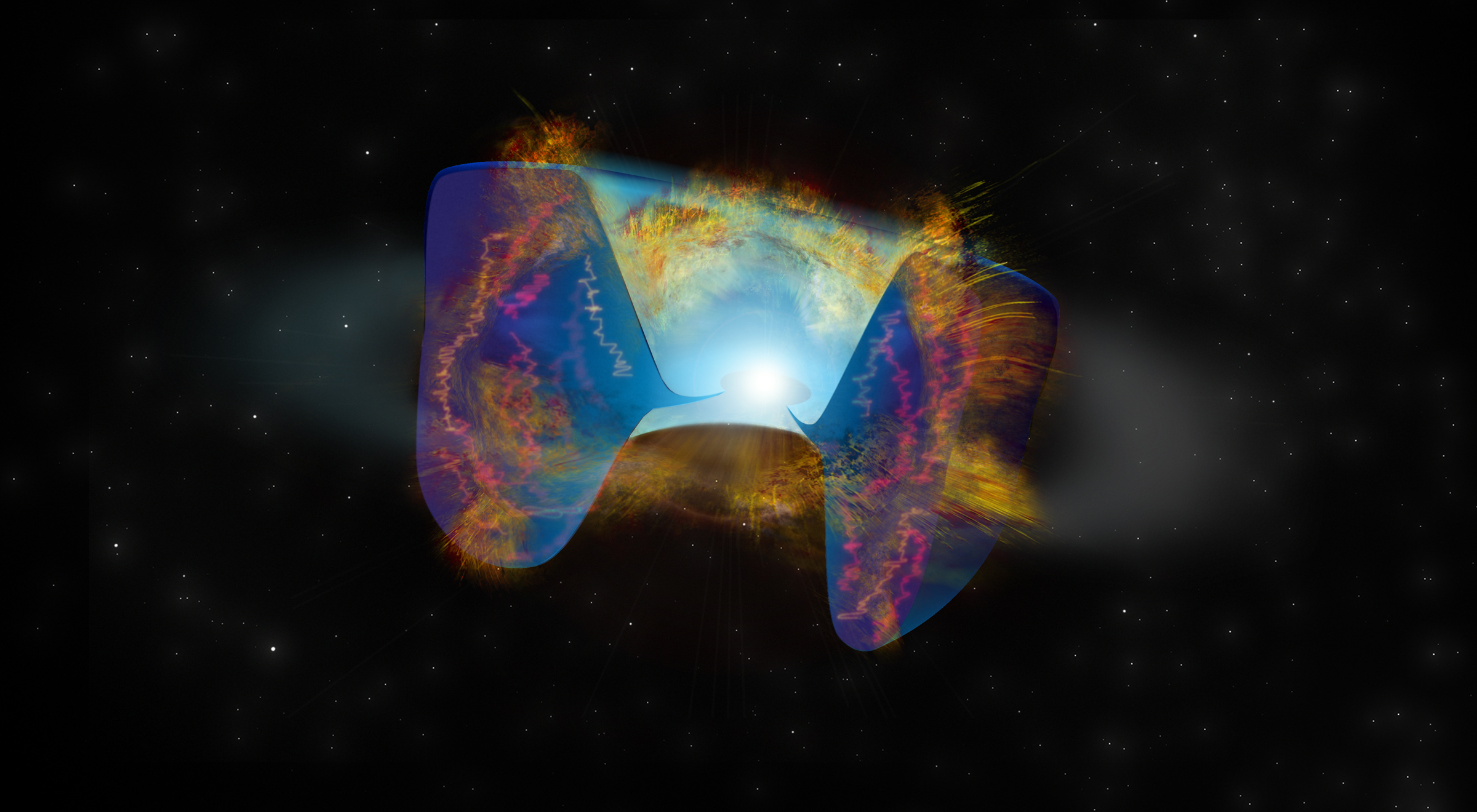
Fast-moving debris from a supernova explosion triggered by a stellar collision crashes into gas thrown out earlier, and the shocks cause bright radio emission seen by the VLA. Credit: Bill Saxton, NRAO/AUI/NSF.Hi-res File

Astronomers have found dramatic evidence that a black hole or neutron star spiraled its way into the core of a companion star and caused that companion to explode as a supernova. The astronomers were tipped off by data from the Very Large Array Sky Survey (VLASS), a multi-year project using the National Science Foundation’s Karl G. Jansky Very Large Array (VLA).

“Theorists had predicted that this could happen, but this is the first time we’ve actually seen such an event,” said Dillon Dong, a graduate student at Caltech and lead author on a paper reporting the discovery in the journal Science.

The first clue came when the scientists examined images from VLASS, which began observations in 2017, and found an object brightly emitting radio waves but which had not appeared in an earlier VLA sky survey, called Faint Images of the Radio Sky at Twenty centimeters (FIRST). They made subsequent observations of the object, designated VT 1210+4956, using the VLA and the Keck telescope in Hawaii. They determined that the bright radio emission was coming from the outskirts of a dwarf, star-forming galaxy some 480 million light-years from Earth. They later found that an instrument aboard the International Space Station had detected a burst of X-rays coming from the object in 2014.

The data from all these observations allowed the astronomers to piece together the fascinating history of a centuries-long death dance between two massive stars. Like most stars that are much more massive than our Sun, these two were born as a binary pair, closely orbiting each other. One of them was more massive than the other and evolved through its normal, nuclear fusion-powered lifetime more quickly and exploded as a supernova, leaving behind either a black hole or a superdense neutron star.

The black hole or neutron star’s orbit grew steadily closer to its companion, and about 300 years ago it entered the companion’s atmosphere, starting the death dance. At this point, the interaction began spraying gas away from the companion into space. The ejected gas, spiraling outward, formed an expanding, donut-shaped ring, called a torus, around the pair.

Eventually, the black hole or neutron star made its way inward to the companion star’s core, disrupting the nuclear fusion producing the energy that kept the core from collapsing of its own gravity. As the core collapsed, it briefly formed a disk of material closely orbiting the intruder and propelled a jet of material outward from the disk at speeds approaching that of light, drilling its way through the star.

“That jet is what produced the X-rays seen by the MAXI instrument aboard the International Space Station, and this confirms the date of this event in 2014,” Dong said.

The collapse of the star’s core caused it to explode as a supernova, following its sibling’s earlier explosion.

“The companion star was going to explode eventually, but this merger accelerated the process,” Dong said.

The material ejected by the 2014 supernova explosion moved much faster than the material thrown off earlier from the companion star, and by the time VLASS observed the object, the supernova blast was colliding with that material, causing powerful shocks that produced the bright radio emission seen by the VLA.

“All the pieces of this puzzle fit together to tell this amazing story,” said Gregg Hallinan of Caltech. “The remnant of a star that exploded a long time ago plunged into its companion, causing it, too, to explode,” he added.

The key to the discovery, Hallinan said, was VLASS, which is imaging the entire sky visible at the VLA’s latitude — about 80 percent of the sky — three times over seven years. One of the objectives of doing VLASS that way is to discover transient objects, such as supernova explosions, that emit brightly at radio wavelengths. This supernova, caused by a stellar merger, however, was a surprise.

“Of all the things we thought we would discover with VLASS, this was not one of them,” Hallinan said.

The National Radio Astronomy Observatory is a facility of the National Science Foundation, operated under cooperative agreement by Associated Universities, Inc.

Media Contact:

Dave Finley, Public Information Officer
(505) 241-9210

dfinley@nrao.edu

Link to Scientific Paper


Source: National Radio Astronomy Observatory (NRAO)/News


Tuesday, September 07, 2021

Galaxies Pump Out Contaminated Exhausts

Galaxies pump out contaminated exhausts

Credit: James Josephides, Swinburne Astronomical Productions

AUSTIN — Galaxies pollute the environment they exist in, researchers have found.

A team of astronomers including The University of Texas at Austin’s Danielle Berg and John Chisholm used a new imaging system at the WM Keck Observatory in Hawaii to confirm that what flows into a galaxy is a lot cleaner than what flows out. The research is published today in The Astrophysical Journal.

“Enormous clouds of gas are pulled into galaxies and used in the process of making stars,” said co-lead author Deanne Fisher, associate professor at the Centre for Astrophysics and Supercomputing at Swinburne University in Australia.

“On its way in it is made of hydrogen and helium. By using a new piece of equipment called the Keck Cosmic Web Imager, we were able to confirm that stars made from this fresh gas eventually drive a huge amount of material back out of the system, mainly through supernovas.

“But this stuff is no longer nice and clean — it contains lots of other elements, including oxygen, carbon, and iron.”

The process of atoms flooding into galaxies — known as ‘accretion’ – and their eventual expulsion — known as ‘outflows’ — is an important mechanism governing the growth, mass and size of galaxies.

Until now, however, the composition of the inward and outward flows could only be guessed at.

"These are some of the first observations to reveal the long-sought cycle of gas in and out of galaxies," UT Austin's Chisholm said. "This work uses the chemical composition of the gas to tag whether the gas is freshly coming into the galaxy or is being ejected out of the galaxy. This cycle of gas regulates the buildup stars and the evolution of galaxies in general. These observations provide concrete benchmarks to test our theory of galaxy evolution."

This research is the first time the full cycle has been confirmed in a galaxy other than the Milky Way.

To make their findings, the researchers focused on a galaxy called Mrk 1486, which lies about 500 light years from the Sun and is going through a period of very rapid star formation.

“We found there is a very clear structure to how the gases enter and exit,” explained study co-leader Alex Cameron of the UK’s University of Oxford.

“Imagine the galaxy is a spinning frisbee. The gas enters relatively unpolluted from the cosmos outside, around the perimeter, and then condenses to form new stars. When those stars later explode, they push out other gas – now containing these other elements – through the top and bottom.”

The elements — comprising more than half the Periodic Table — are forged deep inside the cores of the stars through nuclear fusion. When the stars collapse or go nova the results are catapulted into the universe – where they form part of the matrix from which newer stars, planets, asteroids and, in at least one instance, life emerges.

Mrk 1486 was the perfect candidate for observation because it lies “edge-on” to Earth, meaning that the outflowing gas could be easily viewed, and its composition measured. Most galaxies sit at awkward angles for this type of research.

“This work is important for astronomers because for the first time we’ve been able to put limits on the forces that strongly influence how galaxies make stars,” added Professor Fisher. “It takes us one step closer to understanding how and why galaxies look the way they do — and how long they will last.”

Other scientists contributing to the work are based at the University of Maryland at College Park, the University of California at San Diego, and the Universidad de Concepcion in Chile.


Media Contact:

Rebecca Johnson, Communications Mgr.
McDonald Observatory
The University of Texas at Austin
512-475-6763

Science Contact:

Dr. John Chisholm, Asst. Professor
Department of Astronomy
The University of Texas at Austin

Source:  McDonald Observatory/News


Monday, September 06, 2021

Hubble discovers hydrogen-burning White Dwarfs enjoying slow aging-


To investigate the physics underpinning white dwarf evolution, astronomers compared cooling white dwarfs in two massive collections of stars: the globular clusters M13 and M3. These two clusters share many physical properties such as age and metallicity, but the populations of stars which will eventually give rise to white dwarfs are different. This makes M13 and M3 together a perfect natural laboratory in which to test how different populations of white dwarfs cool. Credits: Science: ESA, NASA, Giampaolo Piotto.
Release Images

Could dying stars hold the secret to looking younger? New evidence from NASA's Hubble Space Telescope suggests that white dwarf stars could continue to burn hydrogen in the final stages of their lives, causing them to appear more youthful than they actually are. This discovery could have consequences for how astronomers measure the ages of star clusters, which contain the oldest known stars in the universe.

These results challenge the prevalent view of white dwarfs as inert, slowly cooling burned-out stars where nuclear fusion has stopped. Now, an international group of astronomers has discovered the first evidence that white dwarfs can slow down their rate of aging by burning hydrogen on their surfaces.

"We have found the first observational evidence that white dwarfs can still undergo stable thermonuclear activity," explained Jianxing Chen of the Alma Mater Studiorum Università di Bologna and the Italian National Institute for Astrophysics, who led this research. "This was quite a surprise, as it is at odds with what is commonly believed."

White dwarfs have cast off their outer layers during the last stages of their lives. They are common objects in the cosmos; roughly 98% of all the stars in the universe will ultimately end up as white dwarfs, including our own Sun. Studying these cooling stages helps astronomers understand not only white dwarfs, but also their earlier stages as well.

To investigate the physics underpinning white dwarf evolution, astronomers compared cooling white dwarfs in two massive collections of stars: the globular clusters M3 and M13. These two clusters share many physical properties such as age and metallicity (the abundance of heavier elements), but the populations of stars which will eventually give rise to white dwarfs are different. This makes M3 and M13 together a perfect natural laboratory in which to test how different populations of white dwarfs cool.

"The superb quality of our Hubble observations provided us with a full view of the stellar populations of the two globular clusters," continued Chen. "This allowed us to really contrast how stars evolve in M3 and M13."

Using Hubble's Wide Field Camera 3 the team observed M3 and M13 at near-ultraviolet wavelengths, allowing them to compare more than 700 white dwarfs in the two clusters. They found that M3 contains standard white dwarfs, which are simply cooling stellar cores. M13, on the other hand, contains two populations of white dwarfs: standard white dwarfs and those which have managed to hold on to an outer envelope of hydrogen, allowing them to burn for longer and hence cool more slowly.

Comparing their results with computer simulations of stellar evolution in M13, the researchers were able to show that roughly 70% of the white dwarfs in M13 are burning hydrogen on their surfaces, slowing down the rate at which they are cooling.

This discovery could have consequences for how astronomers measure the ages of stars in the Milky Way galaxy. The evolution of white dwarfs has previously been modeled as a predictable cooling process. This relatively straightforward relationship between age and temperature has led astronomers to use the white dwarf cooling rate as a natural clock to determine the ages of star clusters, particularly globular and open clusters. However, white dwarfs burning hydrogen could cause these age estimates to be inaccurate by as much as 1 billion years.

"Our discovery challenges the definition of white dwarfs as we consider a new perspective on the way in which stars get old," added Francesco Ferraro of the Alma Mater Studiorum Università di Bologna and the Italian National Institute for Astrophysics, who coordinated the study. "We are now investigating other clusters similar to M13 to further constrain the conditions which drive stars to maintain the thin hydrogen envelope which allows them to age slowly."

The Hubble Space Telescope is a project of international cooperation between NASA and ESA (European Space Agency). NASA's Goddard Space Flight Center in Greenbelt, Maryland, manages the telescope. The Space Telescope Science Institute (STScI) in Baltimore, Maryland, conducts Hubble science operations. STScI is operated for NASA by the Association of Universities for Research in Astronomy in Washington, D.C.

Media Contact:

Bethany Downer

ESA/Hubble.org

Ray Villard
Space Telescope Science Institute, Baltimore, Maryland

Science Contact:

Jianxing Chen
University of Bologna, Bologna, Italy

Francesco R. Ferraro
University of Bologna, Bologna, Italy


Contact us:
Direct inquiries to the News Team

Related links and documents: 

Saturday, September 04, 2021


Young star HD 142527

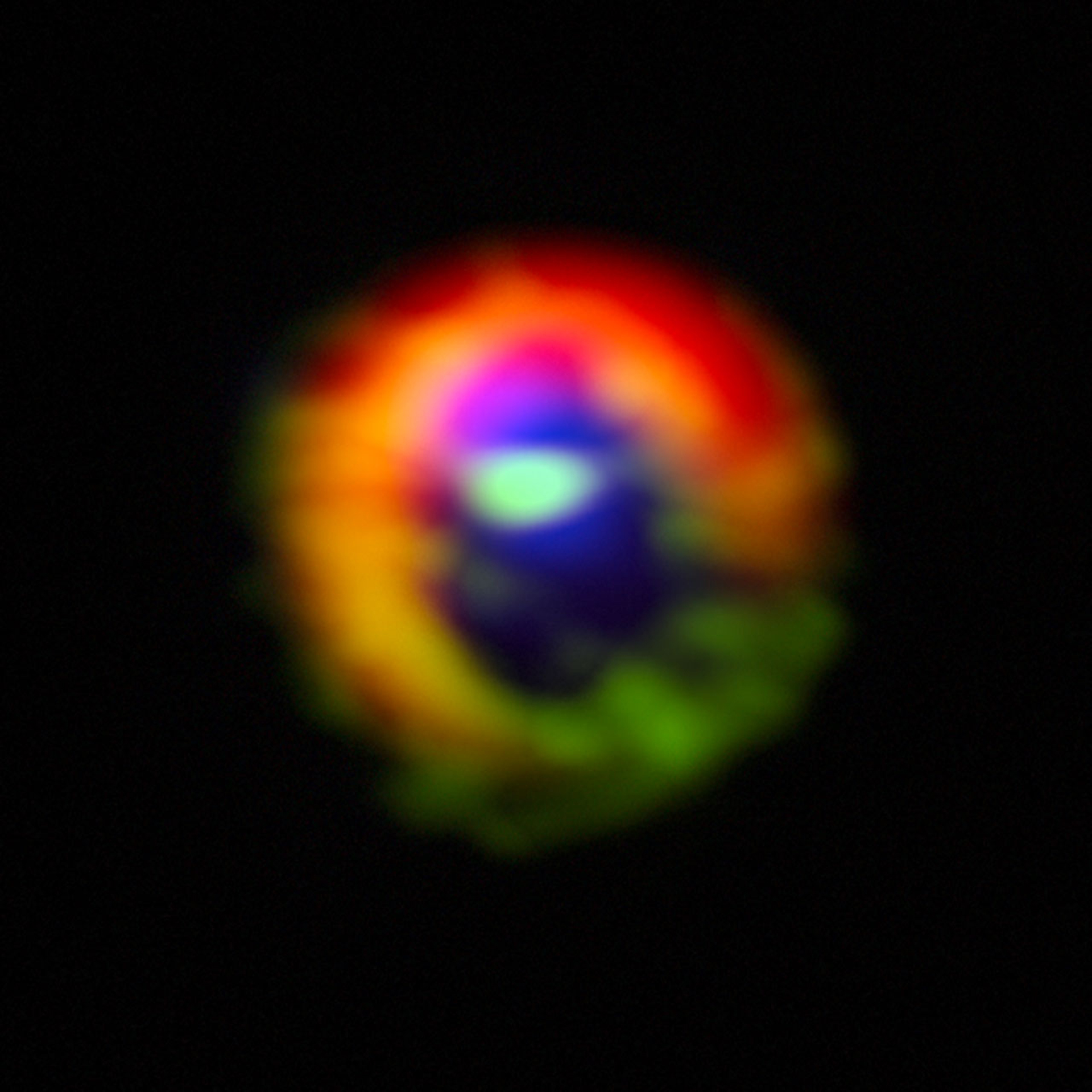
Observations made with the Atacama Large Millimeter/submillimeter Array (ALMA) telescope of the disc of gas and cosmic dust around the young star HD 142527 show vast streams of gas flowing across the gap in the disc. These are created by giant planets guzzling gas as they grow. The dust in the outer disc is shown in red. Dense gas in the streams flowing across the gap, as well as in the outer disc, is shown in green. Diffuse gas in the central gap is shown in blue. The gas filaments can be seen at the three o’clock and ten o’clock positions, flowing from the outer disc towards the center. Credit: ALMA (ESO/NAOJ/NRAO), S. Casassus et al. Hi-res image


Friday, September 03, 2021

Chemical clues to the death of massive stars


Multi-wavelength images of Arp 299 and its X-ray spectra

Upper left panel: XMM-Newton soft X-ray (0.3-2 keV) image with the RGS (rectangles) and EPIC/pn (circle) source regions. The three new observations in Cycle 19 have similar RGS roll angles so that one rectangular box appears thick. Upper right panel: A true color image of Arp 299 with soft X-ray in purple, optical (Hubble, F814W) in green, and infrared (Spitzer, 3.6 micron) in red. The bottom panel shows the XMM-Newton spectra of Arp 299. The RGS grating spectrum is shown in red, while the EPIC/pn spectrum is shown in purple. Vertical dashed lines in blue mark emission lines from various elements. Image credit: Junjie Mao

The Universe has countless stars, which come in different masses. The most common ones are the low-mass stars, including our Sun. Massive stars refer to those whose mass is more than eight times the mass of the Sun. The life of low-mass stars is quite long. For instance, our Sun can live for 10 billion years. However, massive stars can only live up to tens of millions of years. Some of these massive stars will have a splendid death. They can explode as core-collapse supernovae, which can outshine their entire galaxy. More than 2000 years ago (in the Han Dynasty), ancient Chinese astronomers kept records of the earliest supernovae observed with naked eyes by humankind.

Supernova events are rare in our galaxy due to the low star formation rate of the Milky Way. That is to say, there are not many baby stars born every year.

However, in starburst galaxies, the star formation rate can be boosted by a factor of 10 or 100! Accordingly, starburst galaxies can put on a “fireworks show” of supernovae when massive stars die. Arp 299 is a pair of colliding galaxies where numerous supernovae have exploded. In fact, it puts on at least a few “fireworks shows” of supernovae per decade.

Supernovae release not only a massive amount of photons (energy) but also a large number of elements (matter), such as oxygen, neon, magnesium, and iron. The relative amount of different elements is quite sensitive to the population of massive stars that die as core-collapse supernovae. 

Using ESA’s XMM-Newton space observatory, an international group of astronomers measured the chemical composition of the X-ray emitting “confetti” in Arp 299.

It is often assumed that massive stars from 10 to 40 times the mass of the Sun can explode successfully as core-collapse supernovae. However, the observed chemical composition in Arp 299 does not match the existing theoretical models unless we remove supernovae from massive stars heavier than 23 to 27 times the mass of the Sun. This is in accordance with the fact that astronomers have not clearly observed supernovae from stars heavier than 18 times the mass of the Sun.

What happens to those massive stars, then? They might end their life as black holes with no matter escaping from it or less energetic supernovae that release a little matter. The research team also points out that it is also possible that current theoretical predictions of the elements released through core-collapse supernovae are underestimated.

About the study

Journal:The Astrophysical Journal Letters
Title: Elemental Abundances of the Hot Atmosphere of Luminous Infrared Galaxy Arp 299
Authors: Junjie Mao, Ping Zhou, Aurora Simionescu, Yuanyuan Su, Yasushi Fukazawa, Liyi Gu, Hiroki Akamatsu, Zhenlin Zhu, Jelle de Plaa, François Mernier & Jelle S. Kaastra
 
 
Media Contact

Inquiries on the study

Junjie Mao 
E-mail:
jmao2018@hiroshima-u.ac.jp
Graduate School of Advanced Science and Engineering, Hiroshima University

Yasushi Fukazawa
Graduate School of Advanced Science and Engineering, Hiroshima University
E-mail:
fukazawa@astro.hiroshima-u.ac.jp

Inquiries on the story

Hiroshima University Department of Public Relations
TEL: 082-424-3701
E-mail:
koho@office.hiroshima-u.ac.jp

Source: Hiroshima University/News


Thursday, September 02, 2021

MG B2016+112: "X-ray Magnifying Glass" Enhances View of Distant Black Holes

MG B2016+112
Credit: Illustration: NASA/CXC/M. Weiss; X-ray Image (inset): NASA/CXC/SAO/D. Schwartz et al.


A new technique using NASA's Chandra X-ray Observatory has allowed astronomers to obtain an unprecedented look at a black hole system in the early Universe, as reported in our latest press release. This is providing a way for astronomers to look at faint and distant X-ray objects in more detail than had previously been possible.

Astronomers used an alignment in space that shows "gravitational lensing" of light from two objects that are nearly 12 billion light years away. An artist's illustration in the main part of this graphic shows how the paths of light from these distant objects are bent and amplified by a galaxy along the line of sight between Earth and the objects. 

The objects in this latest Chandra study are part of a system called MG B2016+112. The X-rays detected by Chandra were emitted by this system when the Universe was only 2 billion years old compared to its current age of nearly 14 billion years.

Previous studies of radio emission from MG B2016+112 suggested that the system consisted of two separate supermassive black holes, each of which may also be producing a jet. Using a gravitational lensing model based on the radio data, Schwartz and his colleagues concluded that the three X-ray sources they detected from the MG B2016+112 system must have resulted from the lensing of two distinct objects.

The X-ray light from one of the objects on the left (purple) has been warped by the gravity of the intervening galaxy to produce two beams and X-ray sources ("A" and "B" in a labeled version) detected in the Chandra image, which is represented by the dashed square on the right. The X-ray light from the fainter object (blue) produces an X-ray source ("C") that has been amplified by the galaxy to be as much as 300 times brighter than it would have been without the lensing. The Chandra image is shown in the inset.

These two X-ray-emitting objects are likely a pair of growing supermassive black holes or a growing supermassive black hole and a jet. Previous Chandra measurements of pairs or trios of growing supermassive black holes have generally involved objects much closer to Earth, or with much larger separations between the objects.

A paper describing these results appears in The Astrophysical Journal and a pre-publication version is available at https://arxiv.org/abs/2103.08537. The authors of the study are Dan Schwartz (Center for Astrophysics | Harvard and Smithsonian), Cristiana Spignola (INAF), and Anna Barnacka (CfA).

NASA's Marshall Space Flight Center manages the Chandra program. The Smithsonian Astrophysical Observatory's Chandra X-ray Center controls science from Cambridge, Massachusetts, and flight operations from Burlington, Massachusetts.


Fast Facts for MG B2016+112:

Scale: X-ray image (inset) is about 10 arcsec (250,000 light years) across.
Category:
Quasars & Active Galaxies, Black Holes
Constellation: Delphinus
Observation Date: Apr 12, 2000
Observation Time: 2 hours 9 minutes
Obs. ID: 429
Instrument:
ACIS
References: Schwartz, D., Spingola, C., and Barnacka, A., 2021, ApJ, 917, 26; arXiv:2103:08537
Color Code: X-ray: Pink
Distance Estimate: About 11.8 billion light years (z=3.273)


Wednesday, September 01, 2021

Spectacular Portrait of Centaurus A Dark Energy Camera captures detailed view of striking peculiar galaxy

Centaurus A captured by the Dark Energy Camera


Videos

CosmoView Episode 32: Spectacular Portrait of Centaurus A
CosmoView Episode 32: Spectacular Portrait of Centaurus A 
 
Zooming into Centaurus A
Zooming into Centaurus A 
 
CosmoView Episode 32: Cerro Tololo consigue espectacular retrato galáctico


Dark Energy Camera captures detailed view of striking peculiar galaxy

A spectacular portrait of the galaxy Centaurus A has been captured by astronomers using the Dark Energy Camera mounted on the Víctor M. Blanco 4-meter Telescope at Cerro Tololo Inter-American Observatory in Chile. This galaxy’s peculiar appearance — cloaked in dark tendrils of dust — stems from a past interaction with another galaxy, and its size and proximity to Earth make it one of the best-studied giant galaxies in the night sky.

The galaxy Centaurus A, which lies over 12 million light-years away in the direction of the southern-hemisphere constellation Centaurus (The Centaur), is the leading light of this striking image. This image provides a spectacular view of the luminous glow of stars and the dark tendrils of dust that hide the bright center of the galaxy. This dust is the result of a past galactic collision, in which a giant elliptical galaxy merged with a smaller spiral galaxy. As well as large amounts of gas and dust, Centaurus A’s dust lane contains widespread star formation, as indicated by the red clouds of hydrogen and by the large number of faint blue stars visible at each end of the dust lane. 

The proximity and brightness of Centaurus A — it is one of the closest giant galaxies to Earth — make it one of the best-studied objects in the southern hemisphere night sky. Since its discovery in 1826 scientists have studied the galaxy exhaustively with many different kinds of telescopes, revealing a variety of intriguing features. Radio telescopes reveal a colossal jet of matter spewing outward from the heart of the galaxy. This jet is accelerated to almost half the speed of light by a supermassive black hole at the center of Centaurus A, and its bright emissions at radio wavelengths make this galaxy one of the most prominent radio sources in the night sky. In fact, in July 2021, the Event Horizon Telescope produced an image of a jet launching from the black hole in Centaurus A, which weighs in at 55 million times the mass of the Sun.

Centaurus A is a reliable target for southern-hemisphere amateur astronomers, with its bright bulge and dark dust lane visible with binoculars or small telescopes. This image, however, shows a 10-megapixel subsection of the full 570-megapixel Dark Energy Camera (DECam), which is mounted on the Víctor M. Blanco 4-meter Telescope at Cerro Tololo Inter-American Observatory (CTIO) in Chile. One of the highest-performance, wide-field CCD imagers in the world, DECam was designed specifically for the Dark Energy Survey and was operated by the Department of Energy (DOE) and the National Science Foundation (NSF) between 2013 and 2019. DECam was funded by the DOE and was built and tested at DOE's Fermilab. At present the Dark Energy Camera is used for programs covering a huge range of science.

This image was obtained by astronomer Monika Soraisam (now at University of Illinois at Urbana-Champaign) as part of a long-term monitoring campaign (between 2018 and 2021) to identify variable objects on timescales from hours to years (novae, long-period variables) in prominent galaxies in the southern hemisphere. The campaign has been conducted as a pathfinder to Vera C. Rubin Observatory's Legacy Survey of Space and Time. 

The analysis of data from the Dark Energy Survey is supported by DOE and the NSF, and the DECam science archive is curated by the Community Science and Data Center (CSDC) at NSF’s NOIRLab. CTIO and CSDC are Programs of NOIRLab.


More Information

NSF’s NOIRLab (National Optical-Infrared Astronomy Research Laboratory), the US center for ground-based optical-infrared astronomy, operates the international Gemini Observatory (a facility of NSF, NRC–Canada, ANID–Chile, MCTIC–Brazil, MINCyT–Argentina, and KASI–Republic of Korea), Kitt Peak National Observatory (KPNO), Cerro Tololo Inter-American Observatory (CTIO), the Community Science and Data Center (CSDC), and Vera C. Rubin Observatory (operated in cooperation with the Department of Energy’s SLAC National Accelerator Laboratory). It is managed by the Association of Universities for Research in Astronomy (AURA) under a cooperative agreement with NSF and is headquartered in Tucson, Arizona. The astronomical community is honored to have the opportunity to conduct astronomical research on Iolkam Du’ag (Kitt Peak) in Arizona, on Maunakea in Hawai‘i, and on Cerro Tololo and Cerro Pachón in Chile. We recognize and acknowledge the very significant cultural role and reverence that these sites have to the Tohono O'odham Nation, to the Native Hawaiian community, and to the local communities in Chile, respectively.

This work is supported in part by the US Department of Energy Office of Science. The Dark Energy Survey is a collaboration of more than 400 scientists from 26 institutions in seven countries. Funding for the DES Projects has been provided by the US Department of Energy Office of Science, US National Science Foundation, Ministry of Science and Education of Spain, Science and Technology Facilities Council of the United Kingdom, Higher Education Funding Council for England, ETH Zurich for Switzerland, National Center for Supercomputing Applications at the University of Illinois at Urbana-Champaign, Kavli Institute of Cosmological Physics at the University of Chicago, Center for Cosmology and AstroParticle Physics at Ohio State University, Mitchell Institute for Fundamental Physics and Astronomy at Texas A&M University, Financiadora de Estudos e Projetos, Fundação Carlos Chagas Filho de Amparo à Pesquisa do Estado do Rio de Janeiro, Conselho Nacional de Desenvolvimento Científico e Tecnológico and Ministério da Ciência e Tecnologia, Deutsche Forschungsgemeinschaft, and the collaborating institutions in the Dark Energy Survey.

NCSA at the University of Illinois at Urbana-Champaign provides supercomputing and advanced digital resources for the nation’s science enterprise. At NCSA, University of Illinois faculty, staff, students, and collaborators from around the globe use advanced digital resources to address research grand challenges for the benefit of science and society. NCSA has been advancing one third of the Fortune 50® for more than 30 years by bringing industry, researchers, and students together to solve grand challenges at rapid speed and scale. 

Fermilab is America’s premier national laboratory for particle physics and accelerator research. A US Department of Energy Office of Science laboratory, Fermilab is located near Chicago, Illinois, and operated under contract by the Fermi Research Alliance LLC, a joint partnership between the University of Chicago and the Universities Research Association, Inc.

The DOE Office of Science is the single largest supporter of basic research in the physical sciences in the United States and is working to address some of the most pressing challenges of our time.


Links


Contact:

Amanda Kocz
Press and Internal Communications Officer
NSF’s NOIRLab
Cell: +1 626 524 5884
Email:
amanda.kocz@noirlab.edu

Source: NOIRLab/News


Tuesday, August 31, 2021

How disorderly young galaxies grow up and mature

Using a supercomputer, the researchers created a high-resolution simulation

Using a supercomputer simulation, a research team at Lund University in Sweden has succeeded in following the development of a galaxy over a span of 13.8 billion years. The study shows how, due to interstellar frontal collisions, young and chaotic galaxies over time mature into spiral galaxies such as the Milky Way.

Soon after the Big Bang 13.8 billion years ago, the Universe was an unruly place. Galaxies constantly collided. Stars formed at an enormous rate inside gigantic gas clouds. However, after a few billion years of intergalactic chaos, the unruly, embryonic galaxies became more stable and over time matured into well-ordered spiral galaxies. The exact course of these developments has long been a mystery to the world’s astronomers. However, in a new study published in Monthly Notices of the Royal Astronomical Society, researchers have been able to provide some clarity on the matter.

“Using a supercomputer, we have created a high-resolution simulation that provides a detailed picture of a galaxy’s development since the Big Bang, and how young chaotic galaxies transition into well-ordered spirals” says Oscar Agertz, astronomy researcher at Lund University.

In the study, the astronomers, led by Oscar Agertz and Florent Renaud, use the Milky Way’s stars as a starting point. The stars act as time capsules that divulge secrets about distant epochs and the environment in which they were formed. Their positions, speeds and amounts of various chemical elements can therefore, with the assistance of computer simulations, help us understand how our own galaxy was formed.

“We have discovered that when two large galaxies collide, a new disc can be created around the old one due to the enormous inflows of star-forming gas. Our simulation shows that the old and new discs slowly merged over a period of several billion years. This is something that not only resulted in a stable spiral galaxy, but also in populations of stars that are similar to those in the Milky Way”, says Florent Renaud, astronomy researcher at Lund University.

A compact group of interacting galaxies, similar to the chaos of the early days of the Universe
Credit: NASA/ESA, and the HUBBLE SM4 ERO Team. Hi-res image

The new findings will help astronomers to interpret current and future mappings of the Milky Way. The study points to a new direction for research in which the main focus will be on the interaction between large galaxy collisions and how spiral galaxies’ discs are formed. The research team in Lund has already started new super computer simulations in cooperation with the research infrastructure PRACE (Partnership for Advanced Computing in Europe).

“With the current study and our new computer simulations we will generate a lot of information which means we can better understand the Milky Way’s fascinating life since the beginning of the Universe”, concludes Oscar Agertz.

The University of Surrey participated in the research together with Lund University.

Contact:


Oscar Agertz, associate senior lecturer
Department of Astronomy and Theoretical Physics, Lund University
+46 700 45 22 20

oscar.agertz@astro.lu.se