Showing posts with label Centaurus A. Show all posts

Saturday, November 14, 2026

Centaurus A in the spotlight: Plasma simulations reproduce black hole jets' mysterious bright edges

Connecting plasma physics to observations of Centaurus A. Left: Three-dimensional visualization of the plasma simulation of Centaurus A. The hot accretion flow surrounding the supermassive black hole is shown in red, the relativistic jets in blue and the magnetic field structure by gray helical field lines. Colored particles and arrows illustrate the motion of accelerated particles along the jet. Top right: Event Horizon Telescope image of the inner jet of Centaurus A at a wavelength of 1.3 mm. Bottom right: Synthetic EHT observation generated from the new plasma-informed model. Credit: Christian M. Fromm, Janssen et al. 2021 and Glaser et al. 2026


Around 12 million light-years away, the supermassive black hole of the galaxy Centaurus A is hurling two enormous plasma jets into space at nearly the speed of light. These so-called jets are brighter at their edges than at their center. The reason for this was previously unclear but has now been explained by a team from the Chair of Astronomy at the University of Würzburg. The research is published in the journal Astronomy & Astrophysics.

Centaurus A is the closest active galaxy to Earth, and its black hole is about 60 million times as massive as our sun. Precisely because it is so close, astrophysicists can observe its jets in exceptional detail. The galaxy thus serves as a unique laboratory for studying the most extreme conditions in the universe.

Why do the edges of Centaurus A glow?

In principle, a jet should be brightest at its center. However, observations with the Event Horizon Telescope (EHT) show the opposite: in Centaurus A, it is mainly the edges that glow. This phenomenon has occupied researchers for decades.

The Würzburg team has now found an explanation in the behavior of the plasma—the ionized gas—from which the jets are made. In the jet's extremely strong magnetic fields, fast electrons move along the field lines. This changes the way in which they emit light: their brightness depends on the orientation of the magnetic field. Because the magnetic field in the jet has a complex structure, bright edges and a comparatively dark core are created—exactly the pattern observed with the EHT.

"Cen A is our closest window into the physics of relativistic jets," said Felix Glaser, a master's student at the Chair of Astronomy and lead author of the study. "The fact that our plasma-informed model reproduces the observed edge brightening suggests that we are capturing an important piece of the underlying physics. These processes may not be unique to Cen A, but could be common in relativistic jets throughout the universe."

Tiny particles, enormous impact

What is particularly exciting is that the simulations connect processes on the tiny scale of particles with structures extending across several light-days. They not only reproduce the bright edge structure, but also agree exceptionally well with the EHT images taken at a wavelength of 1.3 millimeters.

"What is truly amazing is that microscopic plasma effects can shape structures on vastly larger scales," said Dr. Christian Fromm, leader of the Computational Astrophysics Group. "Future observations will reveal even more of these plasma signatures, making it increasingly important to include realistic plasma physics in our models already today and to further investigate the highly nonlinear effects of relativistic plasma.".

The study therefore helps us understand how black holes accelerate particles to enormous energies and what radiation is produced in the process. It is also an example of the work of the DFG Research Unit "Relativistic Jets in Active Galaxies" (FOR 5195), which combines observations, simulations and plasma physics.

"This result illustrates exactly what we aim to achieve within our DFG Research Unit 'Relativistic Jets in Active Galaxies' (FOR 5195)," said professor Matthias Kadler, spokesperson of the research unit. "By bringing together expertise in high-resolution observations, numerical simulations and plasma physics, we are making progress toward understanding how black holes launch powerful jets and how these jets produce the radiation we observe. The new study is an excellent example of this approach."

Better telescopes for the future.

Research into black hole jets is entering a new era. New millimeter telescopes—including the planned Wetterstein Millimeter Telescope on the Zugspitze—will make observations significantly sharper. Major projects such as the next-generation Very Large Array and the Square Kilometre Array will also provide even more detailed insights in the future.

"A black hole and a fusion reactor may sound like completely different worlds—but both are governed by the physics of plasma," says professor Karl Mannheim, holder of the Chair of Astronomy at the University of Würzburg. "At Centaurus A, we can study plasma under conditions that cannot be created on Earth. These insights not only help us understand the universe, but may also contribute to the development of future fusion energy.".

The work paves the way for a new generation of models that will improve our understanding of the universe's most powerful particle accelerators.

by Theresa Kunzelmann, Julius Maximilian University of Würzburg

Source: Phys.org


Publication details:

Felix Glaser et al., Probing anisotropic particle acceleration and limb brightening in Centaurus A's jet, Astronomy & Astrophysics (2026). DOI: 10.1051/0004-6361/202660093

Journal information: Astronomy & Astrophysics


Who's behind this story? :

Gaby Clark - Scientific Editor

Gaby has an MA in English and has been copy editing since 2021. Her early copy editing career involved working with higher education and health content. The pandemic showed her the power of reliable and trustworthy science news, and she now enjoys how she contributes in her copy editing role at Science X.

Robert Egan - Senior Editor

Robert had to live in 11 cities and three countries before finding a place that felt like home. In addition to a bachelor's degree in mathematical biology and a master's degree in creative writing, Robert possesses a small street dog with a large overbite who likes to hunt crabs on the beach.


Monday, December 16, 2024

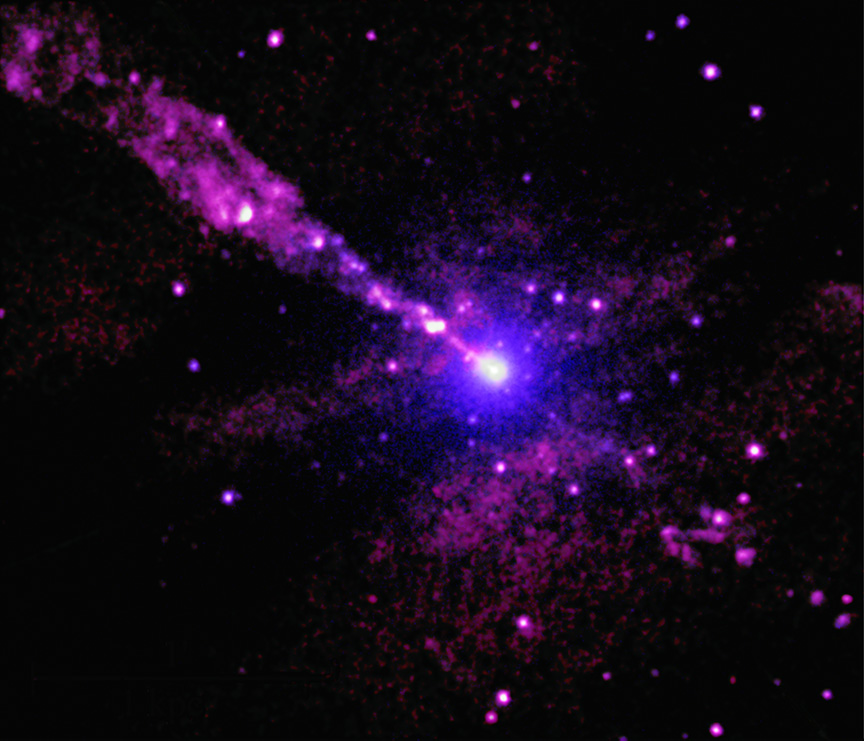
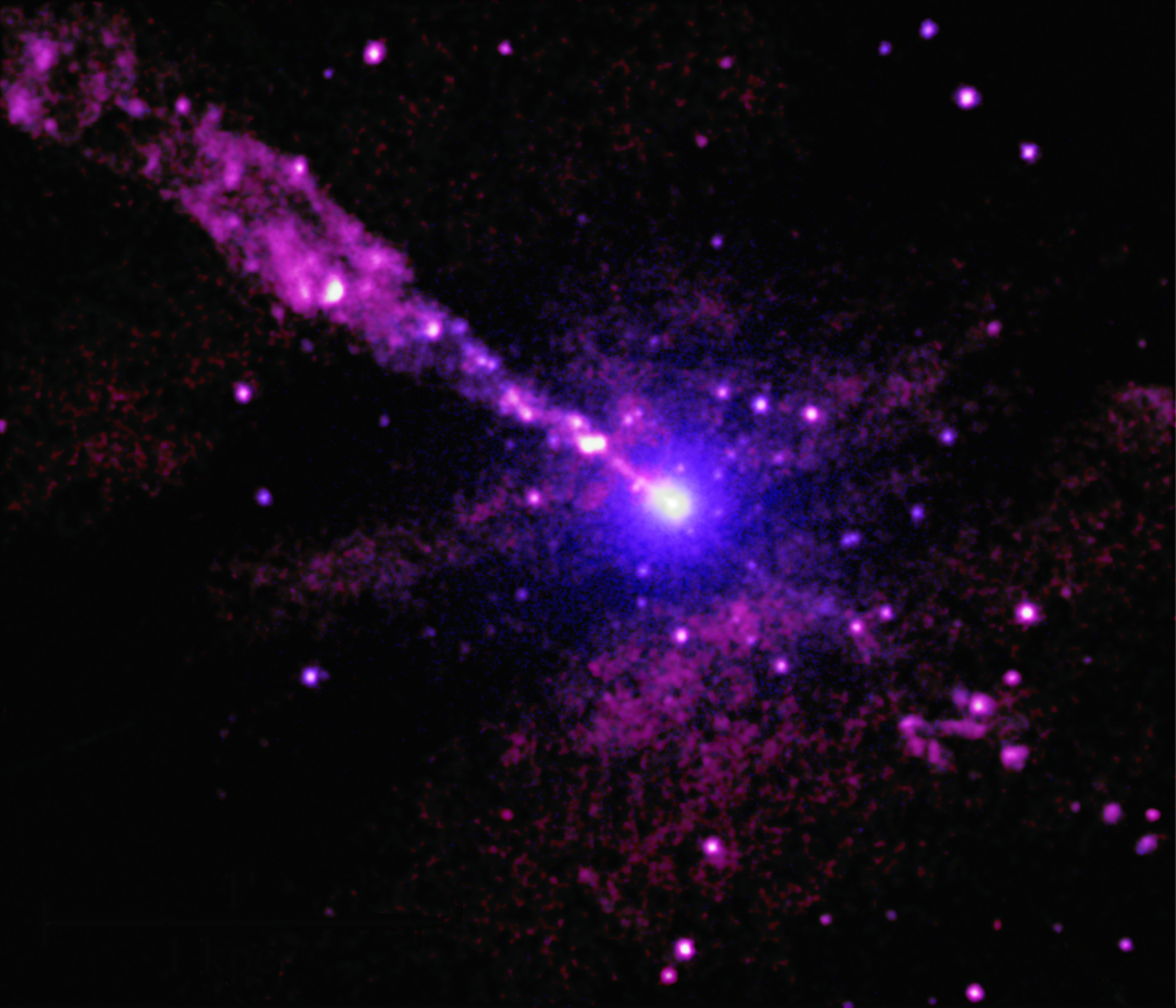
NASA's Chandra Sees Black Hole Jet Stumble Into Something in the Dark

Centaurus A
Credit: NASA/CXC/SAO/D. Bogensberger et al.; Image Processing: NASA/CXC/SAO/N. Wolk


Even matter ejected by black holes can run into objects in the dark. Using NASA’s Chandra X-ray Observatory, astronomers have found an unusual mark from a giant black hole’s powerful jet striking an unidentified object in its path.

The discovery was made in a galaxy called Centaurus A (Cen A), located about 12 million light-years from Earth. Astronomers have long studied Cen A because it has a supermassive black hole in its center sending out spectacular jets that stretch out across the entire galaxy. The black hole launches this jet of high-energy particles not from inside the black hole, but from intense gravitational and magnetic fields around it.

The image shows low-energy X-rays seen by Chandra represented in pink, medium-energy X-rays in purple, and the highest-energy X-rays in blue.
In this latest study, researchers determined that the jet is — at least in certain spots — moving at close to the speed of light. Using the deepest X-ray image ever made of Cen A, they also found a patch of V-shaped emission connected to a bright source of X-rays, something that had not been seen before in this galaxy.

Called C4, this source is located close to the path of the jet from the supermassive black hole and is highlighted in the inset. The arms of the “V” are at least about 700 light-years long. For context, the nearest star to Earth is about 4 light-years away.

Source C4 in the Centaurus A Galaxy
Credit: NASA/CXC/SAO/D. Bogensberger et al.; Image Processing: NASA/CXC/SAO/N. Wolk)

While the researchers have ideas about what is happening, the identity of the object being blasted is a mystery because it is too distant for its details to be seen, even in images from the current most powerful telescopes.

The incognito object being rammed may be a massive star, either by itself or with a companion star. The X-rays from C4 could be caused by the collision between the particles in the jet and the gas in a wind blowing away from the star. This collision can generate turbulence, causing a rise in the density of the gas in the jet. This, in turn, ignites the X-ray emission seen with Chandra.

The shape of the “V,” however, is not completely understood. The stream of X-rays trailing behind the source in the bottom arm of the “V” is roughly parallel to the jet, matching the picture of turbulence causing enhanced X-ray emission behind an obstacle in the path of the jet. The other arm of the “V” is harder to explain because it has a large angle to the jet, and astronomers are unsure what could explain that.

This is not the first time astronomers have seen a black hole jet running into other objects in Cen A. There are several other examples where a jet appears to be striking objects — possibly massive stars or gas clouds. However, C4 stands out from these by having the V-shape in X-rays, while other obstacles in the jet’s path produce elliptical blobs in the X-ray image. Chandra is the only X-ray observatory capable of seeing this feature. Astronomers are trying to determine why C4 has this different post-contact appearance, but it could be related to the type of object that the jet is striking or how directly the jet is striking it.

A paper describing these results appears in a recent issue of The Astrophysical Journal. The authors of the study are David Bogensberger (University of Michigan), Jon M. Miller (University of Michigan), Richard Mushotsky (University of Maryland), Niel Brandt (Penn State University), Elias Kammoun (University of Toulouse, France), Abderahmen Zogbhi (University of Maryland), and Ehud Behar (Israel Institute of Technology).

NASA's Marshall Space Flight Center in Huntsville, Alabama, manages the Chandra program. The Smithsonian Astrophysical Observatory's Chandra X-ray Center controls science operations from Cambridge, Massachusetts, and flight operations from Burlington, Massachusetts.


Visual Description:

This release features a series of images focusing on a collision between a jet of matter blasting out of a distant black hole, and a mysterious, incognito object.

At the center of the primary image is a bright white dot, encircled by a hazy purple blue ring tinged with neon blue. This is the black hole at the heart of the galaxy called Centaurus A. Shooting out of the black hole is a stream of ejected matter. This stream, or jet, shoots in two opposite directions. It shoots toward us, widening as it reaches our upper left, and away from us, growing thinner and more faint as it recedes toward the lower right. In the primary image, the jet resembles a trail of hot pink smoke. Other pockets of granular, hot pink gas can be found throughout the image. Here, pink represents low energy X-rays observed by Chandra, purple represents medium energy X-rays, and blue represents high energy X-rays.

Near our lower right, where the jet is at its thinnest, is a distinct pink "V", its arms opening toward our lower right. This mark is understood to be the result of the jet striking an unidentified object that lay in its path. A labeled version of the image highlights this region, and names the point of the V-shape, the incognito object, C4. A wide view version of the image is composited with optical data.

At the distance of Cen A, the arms of the V-shape appear rather small. In fact, each arm is at least 700 light-years long. The jet itself is 30,000 light-years long. For context, the nearest star to the Sun is about 4 light-years away.


Fast Facts for Centaurus A Knots:

Scale: Image is about 3 arcmin (11,000 light-years) across.
Category: Quasars & Active Galaxies
Coordinates (J2000): RA 13h 25m 27.62s | Dec -43° 01´ 08.80"
Constellation: Centaurus
Observation Dates: 34 observations between 17 May 2000 and 9 Sept 2022
Observation Time: 233 hours 18 minutes (9 days 17 hours 18 minutes)
Obs. ID: 962, 2978, 3965, 8489, 8490, 10722, 10725, 11846, 12156, 13303, 15294, 16276, 17890, 17891, 18461, 19747, 19521, 20794, 21698, 22714, 23823, 24318-24326, 26405, 26453, 27344, 27345
Instrument: ACIS
References: Bogensberger, D. et al., 2024, ApJ, 974, 307; arXiv:2408.14078
Color Code: X-ray (Chandra): magenta, purple, blue


Wednesday, September 01, 2021

Spectacular Portrait of Centaurus A Dark Energy Camera captures detailed view of striking peculiar galaxy

Centaurus A captured by the Dark Energy Camera


Videos

CosmoView Episode 32: Spectacular Portrait of Centaurus A
CosmoView Episode 32: Spectacular Portrait of Centaurus A 
 
Zooming into Centaurus A
Zooming into Centaurus A 
 
CosmoView Episode 32: Cerro Tololo consigue espectacular retrato galáctico


Dark Energy Camera captures detailed view of striking peculiar galaxy

A spectacular portrait of the galaxy Centaurus A has been captured by astronomers using the Dark Energy Camera mounted on the Víctor M. Blanco 4-meter Telescope at Cerro Tololo Inter-American Observatory in Chile. This galaxy’s peculiar appearance — cloaked in dark tendrils of dust — stems from a past interaction with another galaxy, and its size and proximity to Earth make it one of the best-studied giant galaxies in the night sky.

The galaxy Centaurus A, which lies over 12 million light-years away in the direction of the southern-hemisphere constellation Centaurus (The Centaur), is the leading light of this striking image. This image provides a spectacular view of the luminous glow of stars and the dark tendrils of dust that hide the bright center of the galaxy. This dust is the result of a past galactic collision, in which a giant elliptical galaxy merged with a smaller spiral galaxy. As well as large amounts of gas and dust, Centaurus A’s dust lane contains widespread star formation, as indicated by the red clouds of hydrogen and by the large number of faint blue stars visible at each end of the dust lane. 

The proximity and brightness of Centaurus A — it is one of the closest giant galaxies to Earth — make it one of the best-studied objects in the southern hemisphere night sky. Since its discovery in 1826 scientists have studied the galaxy exhaustively with many different kinds of telescopes, revealing a variety of intriguing features. Radio telescopes reveal a colossal jet of matter spewing outward from the heart of the galaxy. This jet is accelerated to almost half the speed of light by a supermassive black hole at the center of Centaurus A, and its bright emissions at radio wavelengths make this galaxy one of the most prominent radio sources in the night sky. In fact, in July 2021, the Event Horizon Telescope produced an image of a jet launching from the black hole in Centaurus A, which weighs in at 55 million times the mass of the Sun.

Centaurus A is a reliable target for southern-hemisphere amateur astronomers, with its bright bulge and dark dust lane visible with binoculars or small telescopes. This image, however, shows a 10-megapixel subsection of the full 570-megapixel Dark Energy Camera (DECam), which is mounted on the Víctor M. Blanco 4-meter Telescope at Cerro Tololo Inter-American Observatory (CTIO) in Chile. One of the highest-performance, wide-field CCD imagers in the world, DECam was designed specifically for the Dark Energy Survey and was operated by the Department of Energy (DOE) and the National Science Foundation (NSF) between 2013 and 2019. DECam was funded by the DOE and was built and tested at DOE's Fermilab. At present the Dark Energy Camera is used for programs covering a huge range of science.

This image was obtained by astronomer Monika Soraisam (now at University of Illinois at Urbana-Champaign) as part of a long-term monitoring campaign (between 2018 and 2021) to identify variable objects on timescales from hours to years (novae, long-period variables) in prominent galaxies in the southern hemisphere. The campaign has been conducted as a pathfinder to Vera C. Rubin Observatory's Legacy Survey of Space and Time. 

The analysis of data from the Dark Energy Survey is supported by DOE and the NSF, and the DECam science archive is curated by the Community Science and Data Center (CSDC) at NSF’s NOIRLab. CTIO and CSDC are Programs of NOIRLab.


More Information

NSF’s NOIRLab (National Optical-Infrared Astronomy Research Laboratory), the US center for ground-based optical-infrared astronomy, operates the international Gemini Observatory (a facility of NSF, NRC–Canada, ANID–Chile, MCTIC–Brazil, MINCyT–Argentina, and KASI–Republic of Korea), Kitt Peak National Observatory (KPNO), Cerro Tololo Inter-American Observatory (CTIO), the Community Science and Data Center (CSDC), and Vera C. Rubin Observatory (operated in cooperation with the Department of Energy’s SLAC National Accelerator Laboratory). It is managed by the Association of Universities for Research in Astronomy (AURA) under a cooperative agreement with NSF and is headquartered in Tucson, Arizona. The astronomical community is honored to have the opportunity to conduct astronomical research on Iolkam Du’ag (Kitt Peak) in Arizona, on Maunakea in Hawai‘i, and on Cerro Tololo and Cerro Pachón in Chile. We recognize and acknowledge the very significant cultural role and reverence that these sites have to the Tohono O'odham Nation, to the Native Hawaiian community, and to the local communities in Chile, respectively.

This work is supported in part by the US Department of Energy Office of Science. The Dark Energy Survey is a collaboration of more than 400 scientists from 26 institutions in seven countries. Funding for the DES Projects has been provided by the US Department of Energy Office of Science, US National Science Foundation, Ministry of Science and Education of Spain, Science and Technology Facilities Council of the United Kingdom, Higher Education Funding Council for England, ETH Zurich for Switzerland, National Center for Supercomputing Applications at the University of Illinois at Urbana-Champaign, Kavli Institute of Cosmological Physics at the University of Chicago, Center for Cosmology and AstroParticle Physics at Ohio State University, Mitchell Institute for Fundamental Physics and Astronomy at Texas A&M University, Financiadora de Estudos e Projetos, Fundação Carlos Chagas Filho de Amparo à Pesquisa do Estado do Rio de Janeiro, Conselho Nacional de Desenvolvimento Científico e Tecnológico and Ministério da Ciência e Tecnologia, Deutsche Forschungsgemeinschaft, and the collaborating institutions in the Dark Energy Survey.

NCSA at the University of Illinois at Urbana-Champaign provides supercomputing and advanced digital resources for the nation’s science enterprise. At NCSA, University of Illinois faculty, staff, students, and collaborators from around the globe use advanced digital resources to address research grand challenges for the benefit of science and society. NCSA has been advancing one third of the Fortune 50® for more than 30 years by bringing industry, researchers, and students together to solve grand challenges at rapid speed and scale. 

Fermilab is America’s premier national laboratory for particle physics and accelerator research. A US Department of Energy Office of Science laboratory, Fermilab is located near Chicago, Illinois, and operated under contract by the Fermi Research Alliance LLC, a joint partnership between the University of Chicago and the Universities Research Association, Inc.

The DOE Office of Science is the single largest supporter of basic research in the physical sciences in the United States and is working to address some of the most pressing challenges of our time.


Links


Contact:

Amanda Kocz
Press and Internal Communications Officer
NSF’s NOIRLab
Cell: +1 626 524 5884
Email:
amanda.kocz@noirlab.edu

Source: NOIRLab/News


Monday, July 26, 2021

EHT pinpoints dark heart of the nearest radio galaxy


Distance scales uncovered in the Centaurus A jet. The top left image shows how the jet disperses into gas clouds that emit radio waves, captured by the ATCA and Parkes observatories. The top right panel displays a color composite image, with a 40x zoom compared to the first panel to match the size of the galaxy itself. Submillimeter emission from the jet and dust in the galaxy measured by the LABOCA/APEX instrument is shown in orange. X-ray emission from the jet measured by the Chandra spacecraft is shown in blue. Visible white light from the stars in the galaxy has been captured by the MPG/ESO 2.2-metre telescope. The next panel below shows a 165000x zoom image of the inner radio jet obtained with the TANAMI telescopes. The bottom panel depicts the new highest resolution image of the jet launching region obtained with the EHT at millimeter wavelengths with a 60000000x zoom in telescope resolution. Indicated scale bars are shown in light years and light days. One light year is equal to the distance that light travels within one year: about nine trillion kilometers. In comparison, the distance to the nearest-known star from our Sun is approximately four light years. One light day is equal to the distance that light travels within one day: about six times the distance between the Sun and Neptune. Credit: Radboud University; CSIRO/ATNF/I.Feain et al., R.Morganti et al., N.Junkes et al.; ESO/WFI; MPIfR/ESO/APEX/A. Weiss et al.; NASA/CXC/CfA/R. Kraft et al.; TANAMI/C. Mueller et al.; EHT/M. Janssen et al.
Hi-res image


Highest resolution image of Centaurus A obtained with the Event Horizon Telescope on top of a color composite image of the entire galaxy. Credit: Radboud University; ESO/WFI; MPIfR/ESO/APEX/A. Weiss et al.; NASA/CXC/CfA/R. Kraft et al.; EHT/M. Janssen et al
. Hi-res image

An international team anchored by the Event Horizon Telescope (EHT) Collaboration, which is known for capturing the first image of a black hole in the galaxy Messier 87, has now imaged the heart of the nearby radio galaxy Centaurus A in unprecedented detail. The astronomers pinpoint the location of the central supermassive black hole and reveal how a gigantic jet is being born. Most remarkably, only the outer edges of the jet seem to emit radiation, which challenges our theoretical models of jets. This work, led by Michael Janssen from the Max Planck Institute for Radio Astronomy in Bonn and Radboud University Nijmegen is published in Nature Astronomy on July 19th.

At radio wavelengths, Centaurus A emerges as one of the largest and brightest objects in the night sky. After it was identified as one of the first known extragalactic radio sources in 1949, Centaurus A has been studied extensively across the entire electromagnetic spectrum by a variety of radio, infrared, optical, X-ray, and gamma-ray observatories. At the center of Centaurus A lies a black hole with the mass of 55 million suns, which is right between the mass scales of the Messier 87 black hole (six and a half billion suns) and the one in the center of our own galaxy (about four million suns).

In a new paper in Nature Astronomy, data from the 2017 EHT observations have been analyzed to image Centaurus A in unprecedented detail. “This allows us for the first time to see and study an extragalactic radio jet on scales smaller than the distance light travels in one day. We see up close and personally how a monstrously gigantic jet launched by a supermassive black hole is being born”, says astronomer Michael Janssen.

Compared to all previous high-resolution observations, the jet launched in Centaurus A is imaged at a tenfold higher frequency and sixteen times sharper resolution. With the resolving power of the EHT, we can now link the vast scales of the source, which are as big as 16 times the angular diameter of the Moon on the sky, to their origin near the black hole in a region of merely the width of an apple on the Moon when projected on the sky. That is a magnification factor of one billion.

Understanding jets

Supermassive black holes residing in the center of galaxies like Centaurus A are feeding off gas and dust that is attracted by their enormous gravitational pull. This process releases massive amounts of energy and the galaxy is said to become ‘active’. Most matter lying close to the edge of the black hole falls in. However, some of the surrounding particles escape moments before capture and are blown far out into space: Jets – one of the most mysterious and energetic features of galaxies – are born.

Astronomers have relied on different models of how matter behaves near the black hole to better understand this process. But they still do not know exactly how jets are launched from its central region and how they can extend over scales that are larger than their host galaxies without dispersing out. The EHT aims to resolve this mystery.

The new image shows that the jet launched by Centaurus A is brighter at the edges compared to the center. This phenomenon is known from other jets, but has never been seen so pronouncedly before. “Now we are able to rule out theoretical jet models that are unable to reproduce this edge-brightening. It’s a striking feature that will help us better understand jets produced by black holes”, says Matthias Kadler, TANAMI leader and professor for astrophysics at the University of Würzburg in Germany.

Future observations

With the new EHT observations of the CentaurusA jet, the likely location of the black hole has been identified at the launching point of the jet. Based on this location, the researchers predict that future observations at an even shorter wavelength and higher resolution would be able to photograph the central black hole of Centaurus A. This will require the use of space-based satellite observatories.

“These data are from the same observing campaign that delivered the famous image of the black hole in M87. The new results show that the EHT provides a treasure trove of data on the rich variety of black holes and there is still more to come”, says Heino Falcke, EHT board member and professor for Astrophysics at Radboud University.

Additional Information

To observe the Centaurus A galaxy with this unprecedentedly sharp resolution at a wavelength of 1.3 mm, the EHT collaboration used Very Long Baseline Interferometry (VLBI), the same technique with which the famous image of the black hole in M87 was made. An alliance of eight telescopes around the world, of which ALMA is the most sensitive element, joined together to create the virtual Earth-sized Event Horizon Telescope. The EHT collaboration involves more than 300 researchers from Africa, Asia, Europe, North and South America.

The EHT consortium consists of 13 stakeholder institutes: the Academia Sinica Institute of Astronomy and Astrophysics, the University of Arizona, the University of Chicago, the East Asian Observatory, Goethe University Frankfurt, Institut de Radioastronomie Millimétrique (MPG/CNRS/IGN), Large Millimeter Telescope, Max Planck Institute for Radio Astronomy, MIT Haystack Observatory, National Astronomical Observatory of Japan, Perimeter Institute for Theoretical Physics, Radboud University and the Center for Astrophysics | Harvard & Smithsonian.

TANAMI (Tracking Active Galactic Nuclei with Austral Milliarcsecond Interferometry) is a multiwavelength program to monitor relativistic jets in active galactic nuclei of the Southern Sky. This program has been monitoring Centaurus A with VLBI at centimeter-wavelengths since the mid 2000s. The TANAMI array consists of nine radio telescopes located on four continents observing at wavelengths of 4 cm and 1.3 cm.

The Atacama Large Millimeter/submillimeter Array (ALMA), an international astronomy facility, is a partnership of the European Organisation for Astronomical Research in the Southern Hemisphere (ESO), the U.S. National Science Foundation (NSF) and the National Institutes of Natural Sciences (NINS) of Japan in cooperation with the Republic of Chile. ALMA is funded by ESO on behalf of its Member States, by NSF in cooperation with the National Research Council of Canada (NRC) and the Ministry of Science and Technology (MOST) and by NINS in cooperation with the Academia Sinica (AS) in Taiwan and the Korea Astronomy and Space Science Institute (KASI).

ALMA construction and operations are led by ESO on behalf of its Member States; by the National Radio Astronomy Observatory (NRAO), managed by Associated Universities, Inc. (AUI), on behalf of North America; and by the National Astronomical Observatory of Japan (NAOJ) on behalf of East Asia. The Joint ALMA Observatory (JAO) provides the unified leadership and management of the construction, commissioning and operation of ALMA.

Scientific Paper 

Source:   Atacama Large Millimeter/submillimeter Array (ALMA)/Press Releases


Contacts

Valeria Foncea
Education and Public Outreach Manager
Joint ALMA Observatory Santiago - Chile
Phone: +56 2 2467 6258
Cell phone: +56 9 7587 1963

Masaaki Hiramatsu
Education and Public Outreach Officer, NAOJ Chile
Observatory, Tokyo - Japan
Phone: +81 422 34 3630

Bárbara Ferreira
ESO Public Information Officer
Garching bei München, Germany
Phone: +49 89 3200 6670

Amy C. Oliver
Public Information & News Manager
National Radio Astronomical Observatory (NRAO), USA
Phone: +1 434 242 9584


Sunday, April 11, 2021

Galactic Merger Warps Magnetic Fields


Composite image of Centaurus A. Magnetic fields observed by SOFIA are shown as streamlines over an image of the galaxy taken at visible and submillimeter wavelengths by the European Southern Observatory and Atacama Pathfinder Experiment (orange), X-ray wavelengths from the Chandra X-Ray observatory (blue) and infrared from the Spitzer Space Telescope (dark red). The large-scale magnetic fields, across 1,600 light-years, are parallel to the dust lanes seen in visible light and other wavelengths. However, the fields appear twisted and distorted near the middle. The twisting is a remnant of the spiral-shaped magnetic field from one of the original galaxies, while the active, supermassive black hole at its core adds to the distortions.  Credits: Optical: European Southern Observatory (ESO) Wide Field Imager; Submillimeter: Max Planck Institute for Radio Astronomy/ESO/Atacama Pathfinder Experiment (APEX)/A.Weiss et al.; X-ray and Infrared: NASA/Chandra/R. Kraft; JPL-Caltech/J. Keene; SOFIA/L. Proudfit.
Hi-res image
 

Composite image of Centaurus A without the streamlines observed by SOFIA. The image was taken at visible and submillimeter wavelengths by the European Southern Observatory and Atacama Pathfinder Experiment (orange), X-ray wavelengths from the Chandra X-Ray observatory (blue) and infrared from the Spitzer Space Telescope (dark red). Credits: Optical: European Southern Observatory (ESO) Wide Field Imager; Submillimeter: Max Planck Institute for Radio Astronomy/ESO/Atacama Pathfinder Experiment (APEX)/A.Weiss et al; X-ray and Infrared: NASA/Chandra/R. Kraft; JPL-Caltech/J. Keene.
Hi-res image

What happens when two galaxies collide?

One of the brightest galaxies in the night sky, Centaurus A, is well known for its distinct “S” shape. This shape is believed to be the result of a clash between a spiral and an elliptical galaxy about 100 million years ago.

Now, for the first time, scientists have mapped out the invisible magnetic fields pulsing through Centaurus A using infrared light. The results show how the merging of the two original galaxies created a new, reshaped, and contorted galaxy that not only combined the two galaxies’ magnetic fields but amplified their forces.

The new observations, made with NASA’s airborne Stratospheric Observatory for Infrared Astronomy, SOFIA, provide new insights into how the early universe may have been shaped by galactic mergers under the influence of their supercharged magnetic fields. The results were recently published in Nature Astronomy.

“Magnetic fields were key to shaping the early universe, but they did not start out as the forces we know today; somehow they grew stronger over time,” said Dr. Enrique Lopez-Rodriguez a research scientist at Stanford Kavli Institute for Particle Astrophysics and Cosmology in Stanford, California. “Galactic mergers appear to be one of the strengthening mechanisms.”

Since it is relatively close by intergalactic standards, at 13 million light-years away, Centaurus A makes a good candidate to study galactic mergers. The new view of the large-scale magnetic fields, which span  1,600 light-years, found they run parallel to the dust lanes that are remnants of the original spiral galaxy.

However, closer to the middle of the galactic disk is a different story.

As the galactic collision triggered a burst of star formation and reshaped the original spiral galaxy, those effects, combined with gravitational forces, distorted the smaller-scale magnetic fields, twisting them and amplifying them. Similar merging processes in the early universe may have transformed relatively weak primordial magnetic fields into the powerful forces observed today that affect how galaxies and stars are created.

Scientists using SOFIA, a joint project of NASA and the German Aerospace Center previously discovered that magnetic fields are closely aligned with the structure of a spiral galaxy, and can also be disrupted by interactions with a neighboring galaxy. But researchers weren’t sure what would happen to the magnetic fields after a merger in a galaxy with an active black hole at its core.

Centaurus A’s active supermassive black hole appears to be adding to the disorder. Further analysis is needed to learn about the magnetic field around it.

“The magnetic fields around the central black hole are very complex, but we know that they can affect material flowing into active black holes in other galaxies,” said Lopez-Rodriquez. “We plan to spend more time focusing our analysis only on the magnetic fields around the central black hole.”

This analysis of magnetic fields will add to upcoming observations by NASA’s James Webb Space Telescope, which will study what's happening deep inside the galaxy’s core, including the black hole’s activity.  Scientists previously discovered that magnetic fields can help feed active black holes, so learning if that phenomenon is occurring in Centaurus A, while also having a detailed view of the material falling toward the black hole from Webb, will give scientists a more comprehensive understanding of this unusual galaxy.

SOFIA is a joint project of NASA and the German Aerospace Center. NASA’s Ames Research Center in California’s Silicon Valley manages the SOFIA program, science, and mission operations in cooperation with the Universities Space Research Association, headquartered in Columbia, Maryland, and the German SOFIA Institute at the University of Stuttgart. The aircraft is maintained and operated by NASA’s Armstrong Flight Research Center Building 703, in Palmdale, California.

Media Contact: 

Elizabeth Landau 
NASA Headquarters, Washington 
202-358-0845 

elizabeth.r.landau@nasa.gov 

Rachel Hoover
Ames Research Center, Silicon Valley, Calif.
650-604-4789

Rachel.Hoover@nasa.gov


Editor: Kassandra Bell

Source:  NASA/Galaxies


Friday, March 19, 2021

Peering into a Galaxy's Dusty Core to Study an Active Supermassive Black Hole

Centaurus A sports a warped central disk of gas and dust, which is evidence of a past collision and merger with another galaxy. It also has an active galactic nucleus that periodically emits jets. It is the fifth brightest galaxy in the sky and only about 13 million light-years away from Earth, making it an ideal target to study an active galactic nucleus – a supermassive black hole emitting jets and winds – with NASA's upcoming James Webb Space Telescope. Credits: X-ray: NASA / CXC/SAO; Optical: Rolf Olsen; Infrared: NASA  / CXC/SAO; Optical: Rolf Olsen; Infrared: NASA

Release images / Release Videos

Centaurus A is a giant of a galaxy, but its appearances in telescope observations can be deceiving. Dark dust lanes and young blue star clusters, which crisscross its central region, are apparent in ultraviolet, visible, and near-infrared light, painting a fairly subdued landscape. But by switching to X-ray and radio light views, a far more raucous scene begins to unfold: From the core of the misshapen elliptical galaxy, spectacular jets of material have erupted from its active supermassive black hole – known as an active galactic nucleus – sending material into space well beyond the galaxy's limits.

What, precisely, is happening at its core to cause all this activity? Upcoming observations led by Nora Lützgendorf and Macarena García Marín of the European Space Agency using NASA's James Webb Space Telescope will allow researchers to peer through its dusty core in high resolution for the first time to begin to answer these questions.

"There's so much going on in Centaurus A," explains Lützgendorf. "The galaxy's gas, disk, and stars all move under the influence of its central supermassive black hole. Since the galaxy is so close to us, we'll be able to use Webb to create two-dimensional maps to see how the gas and stars move in its central region, how they are influenced by the jets from its active galactic nucleus, and ultimately better characterize the mass of its black hole."

A Quick Look Back

Let's hit "rewind" to review a bit of what is already known about Centaurus A. It's well studied because it's relatively nearby – about 13 million light-years away – which means we can clearly resolve the full galaxy. The first record of it was logged in the mid-1800s, but astronomers lost interest until the 1950s because the galaxy appeared to be a quiet, if misshapen, elliptical galaxy. Once researchers were able to begin observing with radio telescopes in the 1940s and '50s, Centaurus A became radically more interesting – and its jets came into view. In 1954, researchers found that Centaurus A is the result of two galaxies that merged, which was later estimated to have occurred 100 million years ago.

With more observations in the early 2000s, researchers estimated that about 10 million years ago, its active galactic nucleus shot out twin jets in opposite directions. When examined across the electromagnetic spectrum, from X-ray to radio light, it's clear there is far more to this story that we still have to learn.

"Multi-wavelength studies of any galaxy are like the layers of an onion. Each wavelength shows you something different," said Marín. "With Webb's near- and mid-infrared instruments, we'll see far colder gas and dust than in previous observations, and learn much more about the environment at the center of the galaxy."

Visualizing Webb's Data

The team led by Lützgendorf and Marín will observe Centaurus A not only by taking images with Webb, but by gathering data known as spectra, which spread out light into its component wavelengths like a rainbow. Webb's spectra will reveal high-resolution information about the temperatures, speeds, and compositions of the material at the center of the galaxy.

In particular, Webb's Near Infrared Spectrograph (NIRSpec) and Mid-Infrared Instrument (MIRI) will provide the research team with a combination of data: an image plus a spectrum from within each pixel of that image. This will allow the researchers to build intricate 2D maps from the spectra that will help them identify what's happening behind the veil of dust at the center – and analyze it from many angles in depth.

Compare this style of modeling to the analysis of a garden. In the same way botanists classify plants based on specific sets of features, these researchers will classify spectra from Webb's MIRI to construct "gardens" or models. "If you take a snapshot of a garden from a great distance away," Marín explained, "You will see something green, but with Webb, we will be able to see individual leaves and flowers, their stems, and maybe the soil underneath."

As the research team digs into the spectra, they'll build maps from individual parts of the garden, comparing one spectrum to another nearby spectrum. This is analogous to determining which parts contain which plant species based on comparisons of "stems," "leaves," and "flowers" as they go.

"When it comes to spectral analysis, we conduct many comparisons," Marín continued. "If I compare two spectra in this region, maybe I will find that what was observed contains a prominent population of young stars. Or confirm which areas are both dusty and heated. Or maybe we will identify emission coming from the active galactic nucleus."

In other words, the "ecosystem" of spectra has many levels, which will allow the team to better define precisely what is present and where it is – which is made possible by Webb's specialized infrared instruments. And, since these studies will build on many that came before, the researchers will be able to confirm, refine, or break new ground by identifying new features.

Weighing the Black Hole in Centaurus A

The combination of images and spectra provided by NIRSpec and MIRI will allow the team to create very high-resolution maps of the speeds of the gas and stars at the center of Centaurus A. "We plan to use these maps to model how the entire disk at the center of the galaxy moves to more precisely determine the black hole's mass," Lützgendorf explains.

Since researchers understand how the gravity of a black hole governs the rotation of nearby gas, they can use the Webb data to weigh the black hole in Centaurus A. With a more complete set of infrared data, they will also determine if different parts of the gas are all behaving as anticipated. "I'm looking forward to fully filling out our data," Lützgendorf said. "I hope to see how the ionized gas behaves and twirls, and where we see the jets."

The researchers are also hoping to break new ground. "It's possible we'll find things we haven't considered yet," Lützgendorf explains. "In some aspects, we'll be covering completely new territory with Webb." Marín wholeheartedly agrees, and adds that building on a wealth of existing data is invaluable. "The most exciting aspects about these observations is the potential for new discoveries," she said. "I think we might find something that makes us look back to other data and reinterpret what was seen earlier."

These studies of Centaurus A will be conducted as part of Gillian Wright and Pierre Ferruit's joint MIRI and NIRSpec Guaranteed Time Observations programs. All of Webb's data will ultimately be stored in the publicly accessible Barbara A. Mikulski Archive for Space Telescopes (MAST) at the Space Telescope Science Institute in Baltimore.

The James Webb Space Telescope will be the world's premier space science observatory when it launches in 2021. Webb will solve mysteries in our solar system, look beyond to distant worlds around other stars, and probe the mysterious structures and origins of our universe and our place in it. Webb is an international program led by NASA with its partners, ESA (European Space Agency) and the Canadian Space Agency. 
 

Contact:  

Claire Blome / Christine Pulliam
Space Telescope Science Institute, Baltimore, Maryland
667-218-6426 / 410-338-4366

cblome@stsci.edu / cpulliam@stsci.edu

Related Links

NASA's Webb Portal

Source:  NASA's James Webb Space Telescope/News


Tuesday, July 14, 2015

New Tool for Astronomers – Second Planck Catalogue of Compact Sources Released

ESA's Planck mission is the source for a new catalogue, eagerly awaited by the scientific community, and available online from today. The Second Planck Catalogue of Compact Sources uses data from the entire mission to identify tens of thousands of compact sources, as well as providing polarisation data for several hundred of them. The new catalogue surpasses its predecessors not only in the quantity of sources but also in the quality of data. It will be an asset to astronomers working in a wide range of fields. 


ESA's Planck telescope set out to measure tiny fluctuations in the Cosmic Microwave Background (CMB) – the thermal footprint left by the Big Bang. To achieve this, it continuously scanned the sky between 2009 and 2013, detecting the CMB as well as the foreground emissions arising from cosmic structures lying between the CMB and ourselves. The study of these foreground structures, which had to be carefully mapped and characterised in order to be separated from the CMB, has resulted in a valuable by-product: an extensive catalogue of tens of thousands of individual compact sources, released today. These sources appear to Planck as bright point-like spots superposed on wide expanses of more diffuse emission and consist mainly of galaxies located at great distances from the Milky Way, though compact objects within our Galaxy also appear in the catalogue.

Map of selection of compact sources from the Second Planck Catalogue of Compact Sources
Credit: ESA and the Planck Collaboration

Hi-res Image 


ESA has released compact source catalogues from Planck in the past but in this instance the diverse and extensive catalogue includes data from the full Planck mission. The mission involved surveying the entire sky in nine different wavelengths spanning the far-infrared to radio, covering the spectral range 30 GHz to 857 GHz. The result is a catalogue with datasets from five surveys using the telescope's High Frequency Instrument (HFI) channels and a remarkable eight surveys using the Low Frequency Instrument (LFI) channels. This is a significant leap forward from the one and a half surveys used for the Early Release Compact Source Catalogue, released in 2011, and the 2.5 used in the 2013 catalogue that followed.
 
"There are a number of ways in which the data in this catalogue surpass those of its predecessors in more than just quantity," explains Marcos López-Caniego from ESA, responsible for the LFI portion of the survey. "For example, for the LFI channels, which cover the frequency range 30 to 70 GHz, averaging data over eight surveys has dramatically increased the sensitivity."

"Another major advance is in the better understanding of the contents of the catalogue," adds Diana Harrison from the Institute of Astronomy, University of Cambridge, UK, who was responsible for the HFI section of the catalogue. "One of the major complications at the wavelengths that Planck observes is to distinguish truly compact individual sources from variations in the diffuse emission which arises from gas and dust in our own Galaxy. In this catalogue there has been a totally new treatment of the reliability of the sources, especially in the HFI channels, which has resulted in much higher confidence in its contents."

The improvements to the reliability and sensitivity of the data are just part of the reason that this extensive database differs from those that came before. Planck has polarisation sensitive instruments in seven of the nine frequencies it observes in and this catalogue, unlike its predecessors, offers polarisation data for several hundred compact sources.

"For those sources that have been significantly detected in polarisation maps we have used the latest calibration of Planck data, and improved pipelines, to measure the polarised flux densities of the sources," explains Marcos. "In other words, we have measured and included the amount of polarised light we have collected radiating from these sources, which means that they can be studied in both total intensity and polarised light."

Data from the Second Planck Catalogue of Compact Sources are used to map polarised compact sources across the sky, in this example from the 30 GHz channel. Credit: ESA and the Planck Collaboration. Hi-res Image


Catalogue use and applications 

The catalogue can be accessed from the ESA Planck Legacy Archive hosted at ESA's European Space Astronomy Centre (ESAC) and is available to all researchers. Data are provided in standard fits format tables that can be used with a variety of astronomical tools. A search tool allows users to search by coordinate or common name.

"The catalogue is built with flexibility in mind due to the wide variety of astronomical objects that are contained within it," explains Jan Tauber, Planck Project Scientist at ESA. "The menagerie of sources in the catalogue includes radio galaxies, blazars, infrared-luminous galaxies, galaxy clusters, supernova remnants, cold molecular cloud cores, stars with dust shells, as well as many other unidentified objects, and the list of fields within astronomy which could benefit from the catalogue is just as long!"

The availability of a much larger catalogue of compact sources than has previously been available is of great value to researchers working on other CMB experiments. These sources sorely contaminate CMB data and with the aid of the new catalogue they can now be quickly identified, and removed from, observation data.

As well as the use in CMB research the catalogue will be of use to radio astronomers as it extends the range of frequencies currently available from ground-based telescopes, widening the scope of their research and potentially allowing them to study the emission from their chosen galaxy at nine frequencies with polarisation data in seven channels. 

Detailed view of Centaurus A as seen by Planck
Credit: ESA and the Planck Collaboration


Researchers from across astronomy – including optical, infrared, radio, X-ray and gamma ray astronomers – will benefit from the catalogue, which can be used to build spectral energy distribution plots of individual objects or whole classes of objects. In other words, plotting the brightness of objects, over a range of frequencies, giving valuable clues to their properties. For others, a key benefit of the catalogue will be the ability to combine its full mission maps and single survey maps with the new tools in the Planck Legacy Archive to produce maps from specific periods of time. This will allow for long-term and short-term studies of how the objects vary over time.

Astronomers looking at far-infrared wavelengths will find the catalogue of particular use, on account of Planck having two channels in common with ESA's Herschel telescope, which provides maps of many of these sources with much higher resolution.

In order to serve the needs of this hugely varied community of users the catalogue includes four different measures of the amount of polarised light, and total intensity, for each source – each measure determined using a different photometry method – so that the user can choose the one most suitable for their needs.

A hint at the potential of the catalogue is evidenced by some results that have already emerged from earlier targeted searches for specific compact sources. Researchers using the 2013 catalogue found in the Planck maps the location of potential precursors of the vast galaxy clusters that we see in our local Universe, and used Herschel to map those sources in detail, confirming a subset of them.

These are just some of the applications that the new catalogue might have and even more are expected to emerge.

"What we are releasing here is an important product of the Planck mission," Tauber comments. "This suite of compact sources represents a lasting legacy that we are confident will produce new and exciting findings across the breadth of astronomy research."


Background Information

Launched in 2009, Planck was designed to map the sky in nine frequencies using two state-of-the-art instruments: the Low Frequency Instrument, which includes three frequency bands in the range 30–70 GHz, and the High Frequency Instrument, which includes six frequency bands in the range 100–857 GHz. HFI completed its survey in January 2012, while LFI continued to make science observations until 3 October 2013, before being switched off on 19 October 2013.

The Planck Scientific Collaboration consists of all the scientists who have contributed to the development of the mission, and who participate in the scientific exploitation of the data during the proprietary period. These scientists are members of one or more of four consortia: the LFI Consortium, the HFI Consortium, the DK-Planck Consortium and ESA's Planck Science Office. The two European-led Planck Data Processing Centres are located in Paris, France and Trieste, Italy. The LFI consortium is led by N. Mandolesi, ASI, Italy (deputy PI: M. Bersanelli, Universita' degli Studi di Milano, Italy), and was responsible for the development and operation of LFI. The HFI consortium is led by J.L. Puget, Institut d'Astrophysique Spatiale in Orsay, France (deputy PI: F. Bouchet, Institut d'Astrophysique de Paris, France), and was responsible for the development and operation of HFI.


Contact Information

Diana Harrison
Institute of Astronomy, University of Cambridge, UK
Tel: +44 1223 766 660
Email: dlh@ast.cam.ac.uk

Marcos López-Caniego
ESA European Space Astronomy Centre (ESAC), Madrid, Spainv
Tel: +34 91 813 1481
Email: Marcos.Lopez.Caniego@sciops.esa.int

Jan Tauber
ESA Planck Project Scientist
Scientific Support Office
Directorate of Science and Robotic Exploration
ESA, The Netherlands
Tel: +31 71 565 5342
Email: jtauber@cosmos.esa.int

Source: ESA/Planck

Wednesday, May 13, 2015

The Dark Side of Star Clusters

The giant elliptical galaxy Centaurus A (NGC 5128) and its strange globular clusters

The strange galaxy Centaurus A in the constellation of Centaurus 

Wide-field view of the giant galaxy Centaurus A


 Videos

Panning across the giant elliptical galaxy Centaurus A (NGC 5128) and its strange globular clusters
Panning across the giant elliptical galaxy Centaurus A (NGC 5128) and its strange globular clusters 


VLT discovers new kind of globular star cluster


Observations with ESO’s Very Large Telescope in Chile have discovered a new class of “dark” globular star clusters around the giant galaxy Centaurus A. These mysterious objects look similar to normal clusters, but contain much more mass and may either harbour unexpected amounts of dark matter, or contain massive black holes — neither of which was expected nor is understood.

Globular star clusters are huge balls of thousands of stars that orbit most galaxies. They are among the oldest known stellar systems in the Universe and have survived through almost the entire span of galaxy growth and evolution.

Matt Taylor, a PhD student at the Pontificia Universidad Catolica de Chile, Santiago, Chile, and holder of an ESO Studentship, is lead author of the new study. He sets the scene: “Globular clusters and their constituent stars are keys to understanding the formation and evolution of galaxies. For decades, astronomers thought that the stars that made up a given globular cluster all shared the same ages and chemical compositions — but we now know that they are stranger and more complicated creatures.”

The elliptical galaxy Centaurus A (also known as NGC 5128) is the closest giant galaxy to the Milky Way and is suspected to harbour as many as 2000 globular clusters. Many of these globulars are brighter and more massive than the 150 or so orbiting the Milky Way.

Matt Taylor and his team have now made the most detailed studies so far of a sample of 125 globular star clusters around Centaurus A using the FLAMES instrument on ESO’s Very Large Telescope at the Paranal Observatory in northern Chile [1].

They used these observations to deduce the mass of the clusters [2] and compare this result with how brightly each of the clusters shines.

For most of the clusters in the new survey, the brighter ones had more mass in the way that was expected — if a cluster contains more stars it has greater total brightness and more total mass. But for some of the globulars something strange showed up: they were many times more massive than they looked. And even more strangely, the more massive these unusual clusters were, the greater the fraction of their material was dark. Something in these clusters was dark, hidden and massive. But what?

There were several possibilities. Perhaps the dark clusters contain black holes, or other dark stellar remnants in their cores? This may be a factor that explains some of the hidden mass, but the team concludes that it cannot be the whole story. What about dark matter? Globular clusters are normally considered to be almost devoid of this mysterious substance, but perhaps, for some unknown reason, some clusters have retained significant dark matter clumps in their cores. This would explain the observations but does not fit into conventional theory.

Co-author Thomas Puzia adds: “Our discovery of star clusters with unexpectedly high masses for the amount of stars they contain hints that there might be multiple families of globular clusters, with differing formation histories. Apparently some star clusters look like, walk like, and smell like run-of-the-mill globulars, but there may quite literally be more to them than meets the eye.”

These objects remain a mystery. The team is also engaged in a wider survey of other globular clusters in other galaxies and there are some intriguing hints that such dark clusters may also be found elsewhere.
Matt Taylor sums up the situation: “We have stumbled on a new and mysterious class of star cluster! This shows that we still have much to learn about all aspects of globular cluster formation. It’s an important result and we now need to find further examples of dark clusters around other galaxies.”


Notes

[1] Up to now astronomers have studied star clusters to this detail only in the Local Group. The relatively small distances make direct measurements of their masses possible. Looking at NGC 5128, which is an isolated, massive elliptical galaxy just outside the Local Group about 12 million light-years away, they were able to estimate masses of globular clusters in a completely different environment by pushing VLT/FLAMES to its limits.

[2] The FLAMES observations provide information about the motions of the stars in the clusters. This orbital information depends on the strength of the gravitational field and can hence be used to deduce the mass of the cluster — astronomers call such estimates dynamical masses. The light gathering power of a 8.2-metre VLT Unit Telescope mirror and FLAMES’s ability to observe more than 100 clusters simultaneously was the key to collecting the data necessary for the study.


More Information

This research was presented in a paper entitled “Observational evidence for a dark side to NGC 5128’s globular cluster system”, by M. Taylor et al., to appear in the Astrophysical Journal.

The team is composed of Matthew A. Taylor (Pontificia Universidad Catolica de Chile, Santiago, Chile; ESO, Santiago, Chile), Thomas H. Puzia (Pontificia Universidad Catolica de Chile), Matias Gomez (Universidad Andres Bello, Santiago, Chile) and Kristin A. Woodley (University of California, Santa Cruz, California, USA).

ESO is the foremost intergovernmental astronomy organisation in Europe and the world’s most productive ground-based astronomical observatory by far. It is supported by 16 countries: Austria, Belgium, Brazil, the Czech Republic, Denmark, France, Finland, Germany, Italy, the Netherlands, Poland, Portugal, Spain, Sweden, Switzerland and the United Kingdom, along with the host state of Chile. ESO carries out an ambitious programme focused on the design, construction and operation of powerful ground-based observing facilities enabling astronomers to make important scientific discoveries. ESO also plays a leading role in promoting and organising cooperation in astronomical research. ESO operates three unique world-class observing sites in Chile: La Silla, Paranal and Chajnantor. At Paranal, ESO operates the Very Large Telescope, the world’s most advanced visible-light astronomical observatory and two survey telescopes. VISTA works in the infrared and is the world’s largest survey telescope and the VLT Survey Telescope is the largest telescope designed to exclusively survey the skies in visible light. ESO is a major partner in ALMA, the largest astronomical project in existence. And on Cerro Armazones, close to Paranal, ESO is building the 39-metre European Extremely Large Telescope, the E-ELT, which will become “the world’s biggest eye on the sky”.


Links

Contact

Matthew A. Taylor
Pontificia Universidad Catolica de Chile
Santiago, Chile
Tel: +56-9-91912386
Email:
mataylor5128@gmail.com

Thomas H. Puzia
Pontificia Universidad Catolica de Chile
Santiago, Chile
Tel: +56-9-89010007
Email:
tpuzia@gmail.com

Richard Hook
ESO, Public Information Officer
Garching bei München, Germany
Tel: +49 89 3200 6655
Cell: +49 151 1537 3591
Email:
rhook@eso.org

Source: ESO