Showing posts with label ultra-diffuse galaxies (UDGs). Show all posts

Tuesday, December 07, 2021

Tails Tell the Tale of Galaxy Evolution


Figure: Conceptual image of the evolutionary path from a normal dwarf galaxy to an UDG/dE in a cluster. (a) An unperturbed galaxy falls near, but not directly through, the cluster. (b) Collision with intercluster gas triggers star formation and gas stripping, creating a “jellyfish” galaxy. (c) Star formation and stripping remove all of the gas, quenching further star formation. (d) The galaxy evolves into an UDG or dwarf elliptical (dE). (Credit: Kirill Grishin, Legacy Surveys / D. Lang (Perimeter Institute), NAOJ, CFHT, ESO )


An international team of astronomers has found tails of gas and/or stars trailing behind a sample of young galaxies without current star formation. Based on this result, the team concludes that about half of the ultra-diffuse galaxies in the Coma cluster are likely to have evolved through collisions with external gas. Ultra-diffuse galaxies together with similar dwarf elliptical galaxies account for about 80% of the members of galaxy clusters, so understanding their evolution is an important part of modeling the evolution of the Universe.

Extended galaxies sparely populated by stars and exhibiting little current star formation are commonly found in galaxy clusters. It is thought that these ultra-diffuse galaxies (UDG) started as more normal dwarf galaxies, but some event removed most of the gas from the galaxies, preventing them from forming new stars, and causing them to puff up in size. But precisely because these ultra-diffuse galaxies are faint and diffuse, they are difficult to study, so their evolution remains poorly understood.

To work around this problem, an international team of astronomers from Russia, the USA, Japan, France, and the UAE, used archive data from the 8.2 m Subaru Telescope and new observations with the 6.5 m MMT to study galaxies which are currently bright, but expected to evolve into UDGs. The sample includes 9 galaxies in the Coma cluster (320 million light-years away in the direction of the constellation Coma Berenices) and 2 galaxies in the Abell 2147 cluster (510 million light-years away in the direction of the constellation Hercules). The team found that every galaxy in the sample exhibits a tail of gas and/or stars, indicating that they have recently collided with outside gas.

The space between galaxies in a cluster is not a perfect vacuum; there is very hot, thin intracluster gas. When a small galaxy passes through it, the gas inside the galaxy collides with this intracluster gas. This triggers a burst of rapid star formation, and the pressure from the intracluster gas pushes the original gas out of the galaxy. During this phase, the galaxy exhibits a bright tail or tails of gas streaming behind it, earning it the nickname “jellyfish galaxy.” The loss of gas prevents further star formation and changes the dynamics of the galaxy, causing it to puff up in size. In this way, collision with intracluster gas provides an all-in-one explanation for the evolution of UDGs. From the number of galaxies studied in this sample, the team estimates that approximately half of the UDGs in the Coma cluster have experienced this kind of gas stripping.

These results appeared as Grishin et al. "Transforming gas-rich low-mass disky galaxies into ultra-diffuse galaxies by ram pressure" in Nature Astronomy on November 1, 2021.


About the Subaru Telescope

The Subaru Telescope is a large optical-infrared telescope operated by the National Astronomical Observatory of Japan, National Institutes of Natural Sciences with the support of the MEXT Project to Promote Large Scientific Frontiers. We are honored and grateful for the opportunity of observing the Universe from Maunakea, which has cultural, historical, and natural significance in Hawai`i.

Relevant Links


Friday, September 10, 2021

Astronomers nail down the origins of rare loner dwarf galaxies


Caption:In this image, the fall of a blue ultra-diffuse galaxy into a galaxy system and its subsequent ejection as a red ultra-diffuse galaxy, is depicted. Credits:Image: Vanina Rodriguez

By definition, dwarf galaxies are small and dim, with just a fraction of the stars found in the Milky Way and other galaxies. There are, however, giants among the dwarfs: Ultra-diffuse galaxies, or UDGs, are dwarf systems that contain relatively few stars but are scattered over vast regions. Because they are so diffuse, these systems are difficult to detect, though most have been found tucked within clusters of larger, brighter galaxies.

Now astronomers from MIT, the University of California at Riverside, and elsewhere have used detailed simulations to detect “quenched” UDGs — a rare type of dwarf galaxy that has stopped generating stars. They identified several such systems in their simulations and found the galaxies were not in clusters, but rather exiled in voids — quiet, nearly empty regions of the universe.

This isolation goes against astronomers’ predictions of how quenched UDGs should form. So, the team used the same simulations to rewind the dwarf systems’ evolution and see exactly how they came to be.

The researchers found that quenched UDGs likely coalesced within halos of dark matter with unusually high angular momentum. Like a cotton candy machine, this extreme environment may have spun out dwarf galaxies that were anomalously stretched out.

These UDGs then evolved within galaxy clusters, like most UDGs. But interactions within the cluster likely ejected the dwarfs into the void, giving them wide, boomerang-like trajectories known as “backsplash” orbits. In the process, the galaxies’ gas was stripped away, leaving the galaxies “quenched” and unable to produce new stars.

The simulations showed that such UDGs should be more common than what has been observed. The researchers say their results, published today in Nature Astronomy, provide a blueprint for astronomers to go looking for these dwarfish giants in the universe’s voids.

“We always strive to get a complete consensus of the galaxies that we have in the universe,” says Mark Vogelsberger, associate professor of physics at MIT. “This study is adding a new population of galaxies that the simulation actually predicts. And we now have to look for them in the real universe.”

Vogelsberger co-led the study with Laura Sales of UC Riverside and José A. Benavides of the Institute of Theoretical and Experimental Astronomy in Argentina.

Red v blue

The team’s search for quenched UDGs began with a simple survey for UDG satellites — ultra-diffuse systems that reside outside galaxy clusters. Astronomers predict that UDGs within clusters should be quenched, as they would be surrounded by other galaxies that would essentially rub out the UDG’s already-diffuse gas and shut off star production. Quenched UDGs in clusters should then consist mainly of old stars and appear red in color.

If UDGs exist outside clusters, in the void, they are expected to continue churning out stars, as there would be no competing gas from other galaxies to quench them. UDGs in the void, therefore, are predicted to be rich with new stars, and to appear blue.

When the team surveyed previous detections of UDG satellites, outside clusters, they found most were blue as expected — but a few were red.

“That’s what caught our attention,” Sales says. “And we thought, ‘What are they doing there? How did they form?’ There was no good explanation.”

Galactic cube

To find one, the researchers looked to TNG50, a detailed cosmological simulation of galaxy formation developed by Vogelsberger and others at MIT and elsewhere. The simulation runs on some of the most powerful supercomputers in the world and is designed to evolve a large volume of the universe, from conditions resembling those shortly after the Big Bang to the present day. The simulation is based on fundamental principles of physics and the complex interactions between matter and gas, and its results have been shown in many scenarios to agree with what astronomers have observed in the actual universe. TNG50 has therefore been used as an accurate model for how and where many types of galaxies evolve through time. In their new study, Vogelsberger, Sales, and Benavides used TNG50 to first see if they could spot quenched UDGs outside galaxy clusters. They started with a cube of the early universe measuring about 150 million light years wide, and ran the simulation forward, up through the present day. Then they searched the simulation specifically for UDGs in voids, and found most of the ones they detected were blue, as expected. But a surprising number — about 25 percent — were red, or quenched.

They zeroed in on these red satellite dwarfs and used the same simulation, this time as a sort of time machine to see how, when, and where these galaxies originated. They found that the systems were initially part of clusters but were somehow thrown out into the void, on a more elliptical, “backsplash” orbit.

“These orbits are almost like those of comets in our solar system,” Sales says. “Some go out and orbit back around, and others may come in once and then never again. For quenched UDGs, because their orbits are so elliptical, they haven’t had time to come back, even over the entire age of the universe. They are still out there in the field.”

The simulations also showed that the quenched UDGs’ red color arose from their ejection — a violent process that stripped away the galaxies’ star-forming gas, leaving it quenched and red. Running the simulations further back in time, the team observed that the tiny systems, like all galaxies, originated in halos of dark matter, where gas coalesces into galactic disks. But for quenched UDGs, the halos appeared to spin faster than normal, generating stretched out, ultra-diffuse galaxies.

Now that the researchers have a better understanding of where and how quenched UDGs arose, they hope astronomers can use their results to tune telescopes, to identify more such isolated red dwarfs — which the simulations suggest must be lurking in larger numbers than what astronomers have so far detected.

“It’s quite surprising that the simulations can really produce all these very small objects,” Vogelsberger says. “We predict there should be more of this kind of galaxy out there. This makes our work quite exciting.”

Jennifer Chu | MIT News Office

Source: MIT/News


Monday, March 04, 2019

Discovery of Many New Ultra-Diffuse Galaxies in Galaxy Clusters

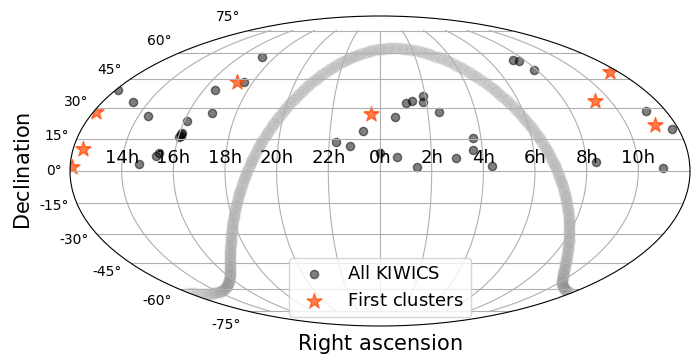
Figure 1. Map of the sky showing the clusters surveyed in KIWICS, and the eight clusters that have been already analysed.
Credit: Pavel Mancera Piña. Large format: [PNG]

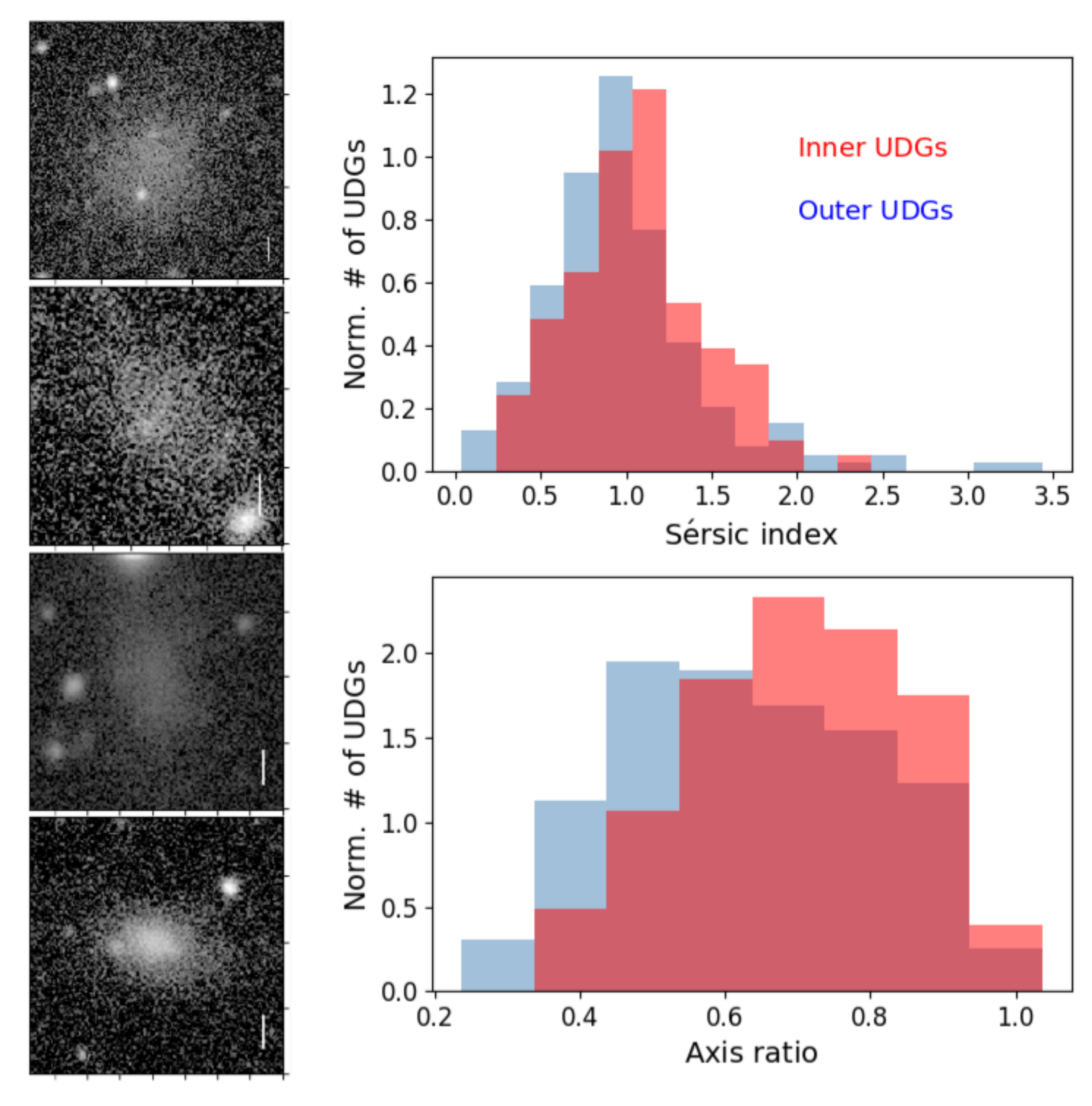
Figure 2. Left panel: Example of UDGs found in different clusters, the white lines show a scale of 5 arcsec. Upper right panel: The Sérsic index distribution (a measure of the light concentration of a galaxy) for central (red) and outer (blue) UDGs, showing that the galaxies in the central regions are more concentrated. Lower right panel: Axis ratio distribution of the two samples, showing that galaxies in the central regions are rounder. Credit: Pavel Mancera Piña. Large format: [PNG].

In preparation for the new multi-object survey spectrograph, WEAVE, on the 4.2m William Herschel Telescope, the astronomical community is working on deep imaging surveys to identify the astronomical objects which will be studied later in more detail with WEAVE. 

WEAVE will allow astronomers to take optical spectra of up to ~1000 targets at the same time in a single exposure, or to carry out integral-field spectroscopy using 20 deployable mini integral-field units or one large integral-field unit. 

Galaxies, like our Milky Way, can live in large groups with many others, the so-called galaxy clusters. Such associations contain a potpourri of galaxies with many different properties such as colours, ages, morphologies and brightness. Among this broad diversity there exists a bewildering population of large but extremely faint galaxies, called "ultra diffuse galaxies" (see e.g., news release "The Puzzle of Ultra-Diffuse Galaxies"), and understanding their properties is important to understand how the environment of galaxies affects their evolution. Since they are so faint, they are easily perturbed by the cluster environment, and therefore are ideal probes to study what happens with galaxies in the dense cluster environment. 

Using the capabilities of the WFC at the Isaac Newton Telescope (INT) to explore large areas of the sky and detect faint ultra-diffuse galaxies (UDGs), a collaboration of astronomers in the Netherlands and Spain performed a study to investigate these galaxies in detail, the Kapteyn IAC WEAVE INT Clusters Survey (KIWICS). 

When finished, the KIWICS survey will contain 48 X-ray selected clusters. The results for 8 clusters have recently been published in the journal Monthly Notices of the Royal Astronomical Society.

By analysing the general properties of about 500 newly-found UDGs at different distances from the centres of the clusters the researchers found several signs of environmental effects. The first result was that the larger clusters show a lack of UDGs in their centres. This is proof that the enormous gravitational forces present there are tearing these fluffy galaxies apart.

Moreover they also found that UDGs away from the cluster centre are generally younger and have less concentrated stellar distributions, showing that the gravitational potential of the cluster, which is stronger close to the cluster centre, is changing the structure of galaxies, and is removing the interstellar gas, so that no new stars are being formed in the centres of clusters.

In addition, they see that, as UDGs approach the centres of their host clusters, their morphologies are transformed from irregular discs to more spheroidal systems. In fact, for dwarf galaxies, which are similar to UDGs, but much smaller, observations in the literature give the same results.

It is expected that the whole KIWICS survey will be finished at the end of 2019, just before WEAVE will be installed on the William Herschel Telescope.

More information:


Pavel E. Mancera Piña, Reynier F. Peletier, J. Alfonso López Aguerri, Aku Venhola, Scott C. Trager and Nelvy Choque Challapa, 2018, "Reviewing the frequency and central depletion of ultra-diffuse galaxies in galaxy clusters from the KIWICS survey", MNRAS, 481, 4381 [ ADS ]

Pavel E. Mancera Piña, J. Alfonso López Aguerri, Reynier F. Peletier, Aku Venhola, Scott C. Trager and Nelvy Choque Challapa, 2019, "The evolution of ultra-diffuse galaxies in nearby galaxy clusters from the Kapteyn IAC WEAVE INT Clusters Survey (KIWICS)", arXiv:1901.07577 [ ADS ]

Contact:

Javier Méndez  (Public Relations Officer)