Showing posts with label AG Carinae. Show all posts

Monday, September 13, 2021

A Closer Look at Hubble’s 31st Anniversary Snapshot

AG Carinae - Comparison
Credit: ESA/Hubble and NASA, A. Nota, C. Britt

A Closer Look at Hubble’s 31st Anniversary Snapshot

A Closer Look at Hubble’s 31st Anniversary Snapshot

This comparison view shows puffing dust bubbles and an erupting gas shell — the final acts of a monster star.You can explore the detail of the nebula surrounding the star AG Carinae by using the slider tool on the image above.

This comparison view shows puffing dust bubbles and an erupting gas shell — the final acts of a monster star.You can explore the detail of the nebula surrounding the star AG Carinae by using the slider tool on the image above.

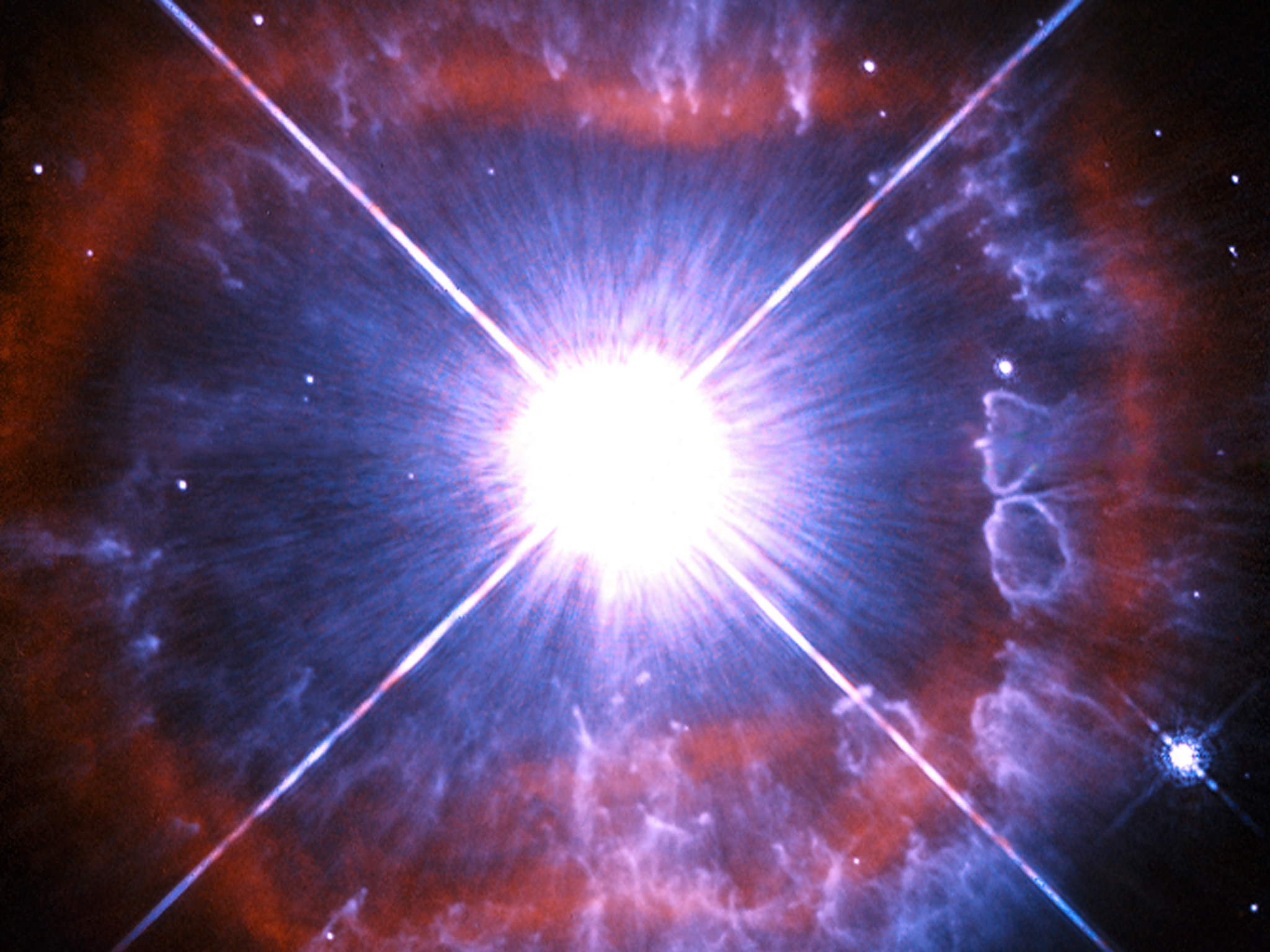
This Picture of the Week showcases new views of the dual nature of the star AG Carinae, which was the target of the NASA/ESA Hubble Space Telescope’s 31st anniversary image in April 2021. This new perspective was developed thanks to Hubble’s observations of the star in 2020 and 2014, along with others captured by the telescope’s WFPC2 instrument in 1994.

The first image showcases the details of the ionised hydrogen and ionised nitrogen emissions from the nebula (seen here in red). In the second image, the blue demonstrates the contrasting appearance of the distribution of the dust that shines of reflected stellar light. Astronomers believe that the dust bubbles and filaments formed within and were shaped by powerful stellar wind .

This giant star is waging a tug-of-war between gravity and radiation to avoid self-destruction. The star is surrounded by an expanding shell of gas and dust — a nebula — that is shaped by the powerful winds emanating from the star. The nebula is about five light-years wide, equal to the distance from here to our nearest star, Alpha Centauri

AG Carinae is formally classified as a Luminous Blue Variable because it is hot (blue), very luminous, and variable. Such stars are quite rare because there are not many stars that are so massive. Luminous Blue Variable stars continuously lose mass in the final stages of their life, during which a significant amount of stellar material is ejected into the surrounding interstellar space, until enough mass has been lost that the star has reached a stable state.

AG Carinae is surrounded by a spectacular nebula, formed by material ejected by the star during several of its past outbursts. The nebula is approximately 10 000 years old, and the observed velocity of the gas is approximately 70 kilometres per second. While this nebula looks like a ring, it is in fact a hollow shell rich in gas and dust, the centre of which has been cleared by the powerful stellar wind travelling at roughly 200 kilometres per second. The gas (composed mostly of ionised hydrogen and nitrogen) is visible to us in these images as a thick bright red ring, which appears doubled in places — possibly the result of several outbursts colliding into each other. The dust, here visible in blue, has formed in clumps, bubbles and filaments that are shaped by the stellar wind.

Scientists who observed the star and its surrounding nebula note that the ring is not perfectly spherical; it appears to have a bipolar symmetry, indicating that the mechanism producing the outburst may have been caused by the presence of a disc in the centre, or that the star is not alone but might have a companion (known as a binary star). An alternative and simpler theory is that the star rotates very fast (as many massive stars have been found to do).


Monday, April 26, 2021

AG Carinae: A Luminous Blue Variable Star Read News Release View All Videos

AG Carinae
Credits: IMAGE: NASA, ESA, STScI

Release Image | Release Videos

In celebration of the 31st anniversary of the launching of NASA's Hubble Space Telescope, astronomers aimed the renowned observatory at a brilliant "celebrity star," one of the brightest stars seen in our galaxy, surrounded by a glowing halo of gas and dust.

The price for the monster star's opulence is "living on the edge." The star, called AG Carinae, is waging a tug-of-war between gravity and radiation to avoid self-destruction.

The expanding shell of gas and dust that surrounds the star is about five light-years wide, which equals the distance from here to the nearest star beyond the Sun, Proxima Centauri.

The huge structure was created from one or more giant eruptions about 10,000 years ago. The star's outer layers were blown into space—like a boiling teapot popping off its lid. The expelled material amounts to roughly 10 times our Sun's mass.

These outbursts are the typical life of a rare breed of star called a luminous blue variable, a brief convulsive phase in the short life of an ultra-bright, glamorous star that lives fast and dies young. These stars are among the most massive and brightest stars known. They live for only a few million years, compared to the roughly 10-billion-year lifetime of our Sun. AG Carinae is a few million years old and resides 20,000 light-years away inside our Milky Way galaxy.

Luminous blue variables exhibit a dual personality: They appear to spend years in quiescent bliss and then they erupt in a petulant outburst. These behemoths are stars in the extreme, far different from normal stars like our Sun. In fact, AG Carinae is estimated to be up to 70 times more massive than our Sun and shines with the blinding brilliance of 1 million suns.

"I like studying these kinds of stars because I am fascinated by their instability. They are doing something weird," said Kerstin Weis, a luminous blue variable expert at Ruhr University in Bochum, Germany.

Major outbursts such as the one that produced the nebula occur once or twice during a luminous blue variable's lifetime. A luminous blue variable star only casts off material when it is in danger of self-destruction as a supernova. Because of their massive forms and super-hot temperatures, luminous blue variable stars like AG Carinae are in a constant battle to maintain stability.

It's an arm wrestling contest between radiation pressure from within the star pushing outward and gravity pressing inward. This cosmic match results in the star expanding and contracting. The outward pressure occasionally wins the battle, and the star expands to such an immense size that it blows off its outer layers, like a volcano erupting. But this outburst only happens when the star is on the verge of coming apart. After the star ejects the material, it contracts to its normal size, settles back down, and becomes quiescent for a while.

Like many other luminous blue variables, AG Carinae remains unstable. It has experienced lesser outbursts that have not been as powerful as the one that created the present nebula.

Although AG Carinae is quiescent now, as a super-hot star it continues pouring out searing radiation and powerful stellar wind (streams of charged particles). This outflow continues shaping the ancient nebula, sculpting intricate structures as outflowing gas slams into the slower-moving outer nebula. The wind is traveling at up to 670,000 miles per hour (1 million km/hr), about 10 times faster than the expanding nebula. Over time, the hot wind catches up with the cooler expelled material, plows into it, and pushes it farther away from the star. This "snowplow" effect has cleared a cavity around the star.

The red material is glowing hydrogen gas laced with nitrogen gas. The diffuse red material at upper left pinpoints where the wind has broken through a tenuous region of material and swept it into space.

The most prominent features, highlighted in blue, are filamentary structures shaped like tadpoles and lopsided bubbles. These structures are dust clumps illuminated by the star's reflected light. The tadpole-shaped features, most prominent at left and bottom, are denser dust clumps that have been sculpted by the stellar wind. Hubble's sharp vision reveals these delicate-looking structures in great detail.

The image was taken in visible and ultraviolet light. Ultraviolet light offers a slightly clearer view of the filamentary dust structures that extend all the way down toward the star. Hubble is ideally suited for ultraviolet-light observations because this wavelength range can only be viewed from space.

Massive stars, like AG Carinae, are important to astronomers because of their far-reaching effects on their environment. The largest program in Hubble's history—the Ultraviolet Legacy Library of Young Stars as Essential Standards (ULLYSES)—is studying the ultraviolet light of young stars and the way they shape their surroundings.

Luminous blue variable stars are rare: less than 50 are known among the galaxies in our local group of neighboring galaxies. These stars spend tens of thousands of years in this phase, a blink of an eye in cosmic time. Many are expected to end their lives in titanic supernova blasts, which enrich the universe with heavier elements beyond iron.

Hubble Trivia

  • Launched on April 24, 1990, NASA's Hubble Space Telescope has made more than 1.5 million observations of about 48,000 celestial objects.
  • In its 31-year lifetime, the telescope has racked up more than 181,000 orbits around our planet, totaling over 4.5 billion miles.
  • Hubble observations have produced more than 169 terabytes of data, which are available for present and future generations of researchers.
  • Astronomers using Hubble data have published more than 18,000 scientific papers, with more than 900 of those papers published in 2020.

The Hubble Space Telescope is a project of international cooperation between NASA and ESA (European Space Agency). NASA's Goddard Space Flight Center in Greenbelt, Maryland, manages the telescope. The Space Telescope Science Institute (STScI) in Baltimore, Maryland, conducts Hubble science operations. STScI is operated for NASA by the Association of Universities for Research in Astronomy in Washington, D.C.

Credits:

Media Contact:

Donna Weaver
Space Telescope Science Institute, Baltimore, Maryland

Ray Villard
Space Telescope Science Institute, Baltimore, Maryland
Publication Partners: NASA, ESA, STScI 

Contact Us: Direct inquiries to the News Team.

Related Links and Documents:

NASA's Hubble Portal
ULLYSES Project
ESA/Hubble's Release
Illuminated Universe Blog
Goddard's Narrated Video (YouTube)

Source: HubbleSite/News


Friday, October 03, 2014

Snapshot of a shedding star

Credit: ESA/Hubble & NASA

In this new Hubble image, the strikingly luminous star AG Carinae — otherwise known as HD 94910 — takes centre stage. Found within the constellation of Carina in the southern sky, AG Carinae lies 20 000 light-years away, nestled in the Milky Way. 

AG Carinae is classified as a Luminous Blue Variable. These rare objects are massive evolved stars that will one day become Wolf-Rayet Stars — a class of stars that are tens of thousands to several million times as luminous as the Sun. They have evolved from main sequence stars that were twenty times the mass of the Sun.

Stars like AG Carinae lose their mass at a phenomenal rate. This loss of mass is due to powerful stellar winds with speeds of up to 7 million km/hour. These powerful winds are also responsible for the shroud of material visible in this image. The winds exert enormous pressure on the clouds of interstellar material expelled by the star and force them into this shape.

Despite HD 94910’s intense luminosity, it is not visible with the naked eye as much of its output is in the ultraviolet.

This image was taken with the Wide Field and Planetary Camera 2 (WFPC2), that was installed on Hubble during the Shuttle mission STS-61 and was Hubble’s workhorse for many years. It is worth noting that the bright glare at the centre of the image is not the star itself. The star is tiny at this scale and hidden within the saturated region. The white cross is also not an astronomical phenomenon but rather an effect of the telescope.

Source: ESA/Hubble - Space Telescope