Friday, November 15, 2019

Two Cosmic Peacocks Show Violent History of the Magellanic Clouds

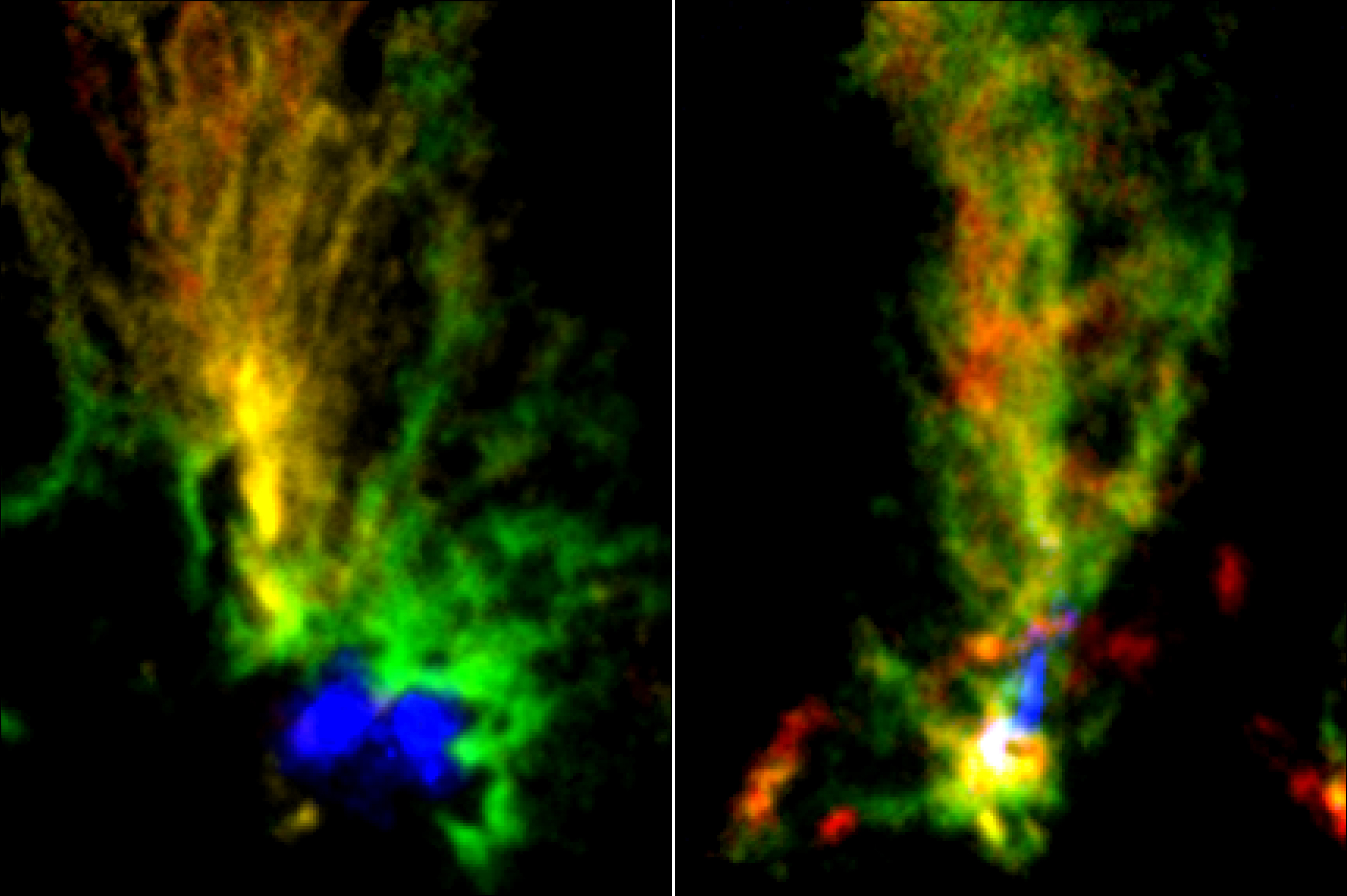
ALMA images of two molecular clouds N159E-Papillon Nebula (left) and N159W South (right). Red and green show the distribution of molecular gas in different velocities seen in the emission from 13CO. Blue region in N159E-Papillon Nebula shows the ionized hydrogen gas observed with the Hubble Space Telescope. Blue part in N159W South shows the emission from dust particles obtained with ALMA. Credit: ALMA (ESO/NAOJ/NRAO)/Fukui et al./Tokuda et al./NASA-ESA Hubble Space Telescope. Hi-res image

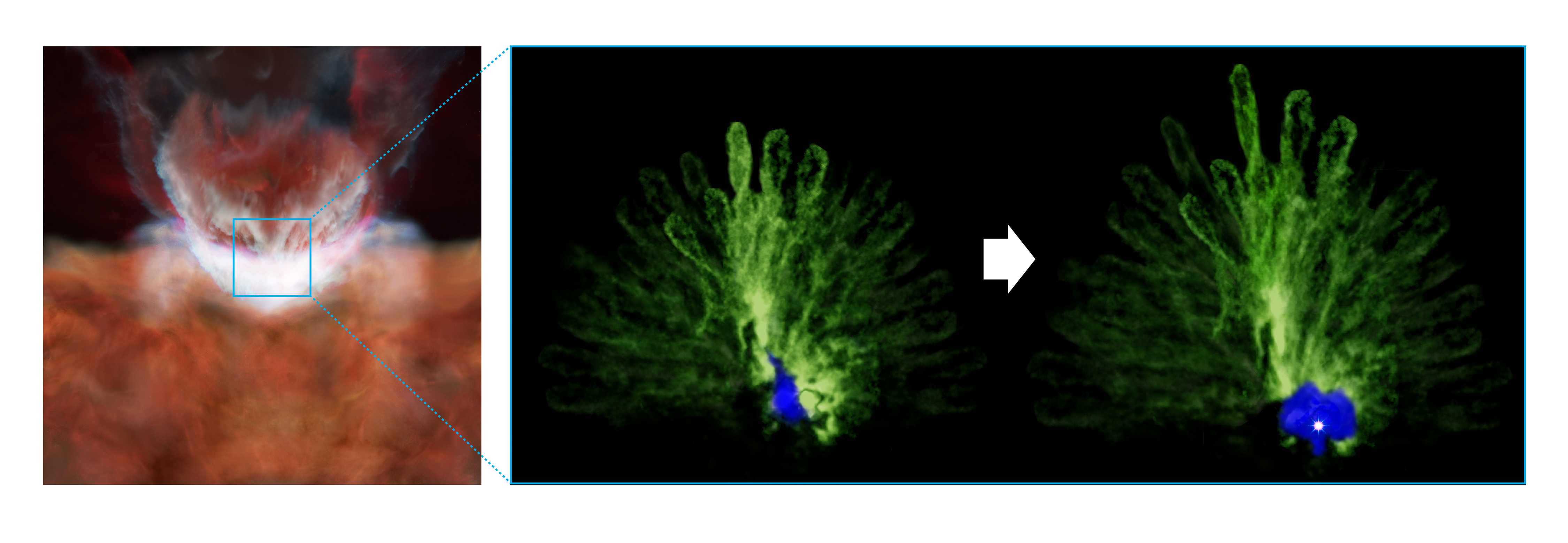
Artist’s impression of the formation process of peacock-shaped clouds. After collision of two clouds (left), complicated filamentary structures with a pivot in the bottom are formed in the boundary region (center), and a massive star is formed in the dense part with ionized region shown in blue (right). Credit: NAOJ. Hi-res image

Computer simulation movie of collision of two gaseous clouds by Tsuyoshi Inoue (Nagoya University). A number of filamentary structures are formed at the same time after the collision. This simulation was performed by a supercomputer “ATERUI” operated by National Astronomical Observatory of Japan. Credit: NAOJ/Inoue et al.

Two peacock-shaped gas clouds were revealed in the Large Magellanic Cloud (LMC) by observations with the Atacama Large Millimeter/submillimeter Array (ALMA). A team of astronomers found several massive baby stars in the complex filamentary clouds, which agrees well with computer simulations of giant collisions of gas clouds. The researchers interpret this to mean that the filaments and young stars are telltale evidence of violent interactions between the LMC and the Small Magellanic Cloud (SMC) 200 million years ago.

Astronomers know that stars are formed in collapsing clouds in space. However, the formation processes of giant stars, 10 times or more massive than the Sun, are not well understood because it is difficult to pack such a large amount of material into a small region. Some researchers suggest that interactions between galaxies provide a perfect environment for massive star formation. Due to the colossal gravity, clouds in the galaxies are stirred, stretched, and often collide with each other. A huge amount of gas is compressed in an unusually small area, which could form the seeds of massive stars.

A research team used ALMA to study the structure of dense gas in N159, a bustling star formation region in the LMC. Thanks to ALMA’s high resolution, the team obtained a very detailed map of the clouds in two sub-regions, N159E-Papillon Nebula and N159W South.

Interestingly, the cloud structures in the two regions look very similar: fan-shaped filaments of gas extending to the north with the pivots in the southernmost points. The ALMA observations also found several massive baby stars in the filaments in the two regions.

“It is unnatural that in two regions separated by 150 light-years, clouds with such similar shapes were formed and that the ages of the baby stars are similar in two regions separated 150 light years,” says Kazuki Tokuda, a researcher at Osaka Prefecture University and the National Astronomical Observatory of Japan. “There must be a common cause of these features. Interaction between the LMC and SMC is a good candidate.”

In 2017, Yasuo Fukui, a professor at Nagoya University and his team revealed the motion of hydrogen gas in the LMC and found that a gaseous component right next to N159 has a different velocity than the rest of the clouds. They suggested a hypothesis that the starburst is caused by a massive flow of gas from the SMC to the LMC, and that this flow originated from a close encounter between the two galaxies 200 million years ago.

The pair of the peacock-shaped clouds in the two regions revealed by ALMA fits nicely with this hypothesis. Computer simulations show that many filamentary structures are formed in a short time scale after a collision of two clouds, which also backs this idea.

“For the first time, we uncovered the link between massive star formation and galaxy interactions in very sharp detail,” says Fukui, the lead author of one of the research papers. “This is an important step in understanding the formation process of massive star clusters in which galaxy interactions have a big impact.”


Additional Information

This research was presented in the following two papers on 14 November 2019 in the Astrophysical Journal.

1.Fukui et al. “An ALMA view of molecular filaments in the Large Magellanic Cloud I: The formation of high-mass stars and pillars in the N159E-Papillon Nebula triggered by a cloud-cloud collision”

2.Tokuda et al. “An ALMA view of molecular filaments in the Large Magellanic Cloud II: An early stage of high-mass star formation embedded at colliding clouds in N159W-South”


Research team members are:

Yasuo Fukui (Nagoya University), Kazuki Tokuda (Osaka Prefecture University/National Astronomical Observatory of Japan), Kazuya Saigo (National Astronomical Observatory of Japan), Ryohei Harada (Osaka Prefecture University), Kengo Tachihara (Nagoya University), Kisetsu Tsuge (Nagoya University), Tsuyoshi Inoue (Nagoya University), Kazufumi Torii (National Astronomical Observatory of Japan), Atsushi Nishimura (Nagoya University), Sarolta Zahorecz (Osaka Prefecture University/National Astronomical Observatory of Japan), Omnarayani Nayak (Space Telescope Science Institute), Margaret Meixner (Johns Hopkins University/Space Telescope Science Institute), Tetsuhiro Minamidani (National Astronomical Observatory of Japan), Akiko Kawamura (National Astronomical Observatory of Japan), Norikazu Mizuno (National Astronomical Observatory of Japan/Joint ALMA Observatory), Remy Indebetouw (University of Virginia/National Radio Astronomy Observatory), Marta Sewiło (NASA Goddard Space Flight Center/University of Maryland), Suzanne Madden (Université Paris-Saclay), Maud Galametz(Université Paris-Saclay), Vianney Lebouteiller (Université Paris-Saclay), C.-H. Rosie Chen (Max Planck Institute for Radio Astronomy), and Toshikazu Onishi (Osaka Prefecture University)

This research was supported by JSPS KAKENHI (No. 22244014, 23403001, 26247026, 18K13582, 18K13580,18H05440), NAOJ ALMA Scientific Research Grant (No. 2016-03B), and NASA (No.80GSFC17M0002).

The Atacama Large Millimeter/submillimeter Array (ALMA), an international astronomy facility, is a partnership of the European Organisation for Astronomical Research in the Southern Hemisphere (ESO), the U.S. National Science Foundation (NSF) and the National Institutes of Natural Sciences (NINS) of Japan in cooperation with the Republic of Chile. ALMA is funded by ESO on behalf of its Member States, by NSF in cooperation with the National Research Council of Canada (NRC) and the Ministry of Science and Technology (MOST) and by NINS in cooperation with the Academia Sinica (AS) in Taiwan and the Korea Astronomy and Space Science Institute (KASI).

ALMA construction and operations are led by ESO on behalf of its Member States; by the National Radio Astronomy Observatory (NRAO), managed by Associated Universities, Inc. (AUI), on behalf of North America; and by the National Astronomical Observatory of Japan (NAOJ) on behalf of East Asia. The Joint ALMA Observatory (JAO) provides the unified leadership and management of the construction, commissioning, and operation of ALMA.


Contacts

Nicolás Lira
Education and Public Outreach Coordinator
Joint ALMA Observatory, Santiago - Chile
Phone: +56 2 2467 6519
Cell phone: +56 9 9445 7726
Email: nicolas.lira@alma.cl

Masaaki Hiramatsu
Education and Public Outreach Officer, NAOJ Chile
Observatory
, Tokyo - Japan
Phone: +81 422 34 3630
Email: hiramatsu.masaaki@nao.ac.jp

Iris Nijman
Public Information Officer
National Radio Astronomy Observatory Charlottesville, Virginia - USA
Cell phone: +1 (434) 249 3423
Email: alma-pr@nrao.edu

Bárbara Ferreira
ESO Public Information Officer
Garching bei München, Germany
Phone: +49 89 3200 6670
Email: pio@eso.org


Saturday, November 09, 2019

Champions League

Credit: ESA/Hubble & NASA, K. Stapelfeldt

Within a galaxy hosting around 300 billion stars, here the NASA/ESA Hubble Space Telescope has captured a mere handful or two — just about enough to form a single football team. These stellar “teammates” play under the banner of NGC 1333, the cloud of gas and dust which formed them and that they continue to call home.

NGC 1333 is located about 1000 light-years away in the constellation of Perseus (The Hero). The cool gas and dust concentrated in this region is generating new stars whose light is then reflecting off the surrounding material, lighting it up and making this object’s lingering presence known to us. NGC 1333 is accordingly classified as a reflection nebula.

This image shows just a single region of NGC 1333. Hubble has imaged NGC 1333 more widely before, revealing that the smattering of stars seen here has ample company. Seen in a broader context, this team of stars is but one gathering amongst many in NGC 1333’s celestial Champions League.


Friday, November 08, 2019

Hubble Captures a Dozen Sunburst Arc Doppelgangers

The Sunburst Arc

Sunburst Arc 1

Sunburst Arc 2

Sunburst Arc 3

Area surrounding the Sunburst Arc (ground-based image)


Videos

Pan of the Sunburst Arc

Animation of gravitational lensing (artist’s impression)


Astronomers using the NASA/ESA Hubble Space Telescope have observed a galaxy in the distant regions of the Universe which appears duplicated at least 12 times on the night sky. This unique sight, created by strong gravitational lensing, helps astronomers get a better understanding of the cosmic era known as the epoch of reionisation.

This new image from the NASA/ESA Hubble Space Telescope shows an astronomical object whose image is multiplied by the effect of strong gravitational lensing. The galaxy, nicknamed the Sunburst Arc, is almost 11 billion light-years away from Earth and has been lensed into multiple images by a massive cluster of galaxies 4.6 billion light-years away [1].

The mass of the galaxy cluster is large enough to bend and magnify the light from the more distant galaxy behind it. This process leads not only to a deformation of the light from the object, but also to a multiplication of the image of the lensed galaxy.

In the case of the Sunburst Arc the lensing effect led to at least 12 images of the galaxy, distributed over four major arcs. Three of these arcs are visible in the top right of the image, while one counterarc is visible in the lower left — partially obscured by a bright foreground star within the Milky Way.

Hubble uses these cosmic magnifying glasses to study objects otherwise too faint and too small for even its extraordinarily sensitive instruments. The Sunburst Arc is no exception, despite being one of the brightest gravitationally lensed galaxies known.

The lens makes various images of the Sunburst Arc between 10 and 30 times brighter. This allows Hubble to view structures as small as 520 light-years across — a rare detailed observation for an object that distant. This compares reasonably well with star forming regions in galaxies in the local Universe, allowing astronomers to study the galaxy and its environment in great detail.

Hubble’s observations showed that the Sunburst Arc is an analogue of galaxies which existed at a much earlier time in the history of the Universe: a period known as the epoch of reionisation — an era which began only 150 million years after the Big Bang [2].

The epoch of reionisation was a key era in the early Universe, one which ended the “dark ages”, the epoch before the first stars were created when the Universe was dark and filled with neutral hydrogen [3]. Once the first stars formed, they started to radiate light, producing the high-energy photons required to ionise the neutral hydrogen [4].

This converted the intergalactic matter into the mostly ionised form in which it exists today. However, to ionise intergalactic hydrogen, high-energy radiation from these early stars would have had to escape their host galaxies without first being absorbed by interstellar matter. So far only a small number of galaxies have been found to “leak” high-energy photons into deep space. How this light escaped from the early galaxies remains a mystery.

The analysis of the Sunburst Arc helps astronomers to add another piece to the puzzle — it seems that at least some photons can leave the galaxy through narrow channels in a gas rich neutral medium. This is the first observation of a long-theorised process [5]. While this process is unlikely to be the main mechanism that led the Universe to become reionised, it may very well have provided a decisive push.


Notes

[1] The official designation of the Sunburst Arc galaxy is PSZ1 G311.65-18.48.

[2] The further we look into space, the further back we look in time. This allows astronomers to study different epochs of the Universe, by studying objects at different distances.

[3] Ionisation is the process of gaining or losing electrons to leave electrically charged particles. The era is known as reionisation because, after the Big Bang, matter formed first into protons and electrons. Then, during the era of recombination — about 380 000 years after the Big Bang — neutral hydrogen formed from these particles for the first time.

[4] While an ionised hydrogen atom consists of only the core of the atom (one proton) a neutral hydrogen atom contains a nucleus of one proton which is orbited by one electron.

[5] The paper outlining these observations will appear in Science on 8 November 2019.


More Information

The Hubble Space Telescope is a project of international cooperation between ESA and NASA.

The international team of astronomers in this study consists of T. Emil Rivera-Thorsen (University of Oslo, Norway), Håkon Dahle (University of Oslo, Norway), John Chisholm (Université de Genève, Switzerland; University of California Santa Cruz, USA), Michael K. Florian (NASA Goddard Space Flight Center, USA), Max Gronke (University of California Santa Barbara, USA), Michael D. Gladders (University of Chicago, USA), Jane R. Rigby (NASA Goddard Space Flight Center, USA), Guillaume Mahler (University of Michigan, USA), Keren Sharon (University of Michigan, USA), Matthew Bayliss (MIT-Kavli Center for Astrophysics and Space Research, USA) and included data from Hubble programs 15418 and 15101.

Image credit: ESA, NASA, E. Rivera-Thorsen et al.


Links


Contacts:

Emil Rivera-Thorsen
Department of Astronomy, Stockholm University
Stockholm, Sweden
Tel: +46 737 703 603
Email: trive@astro.su.se

Håkon Dahle
Institute of Theoretical Astrophysics
Oslo, Norway
Tel: +47 93266331
Email: hakon.dahle@astro.uio.no

Bethany Downer
ESA/Hubble, Public Information Officer
Garching, Germany
Email: bethany.downer@partner.eso.org

Thursday, November 07, 2019

Galactic fountains and carousels

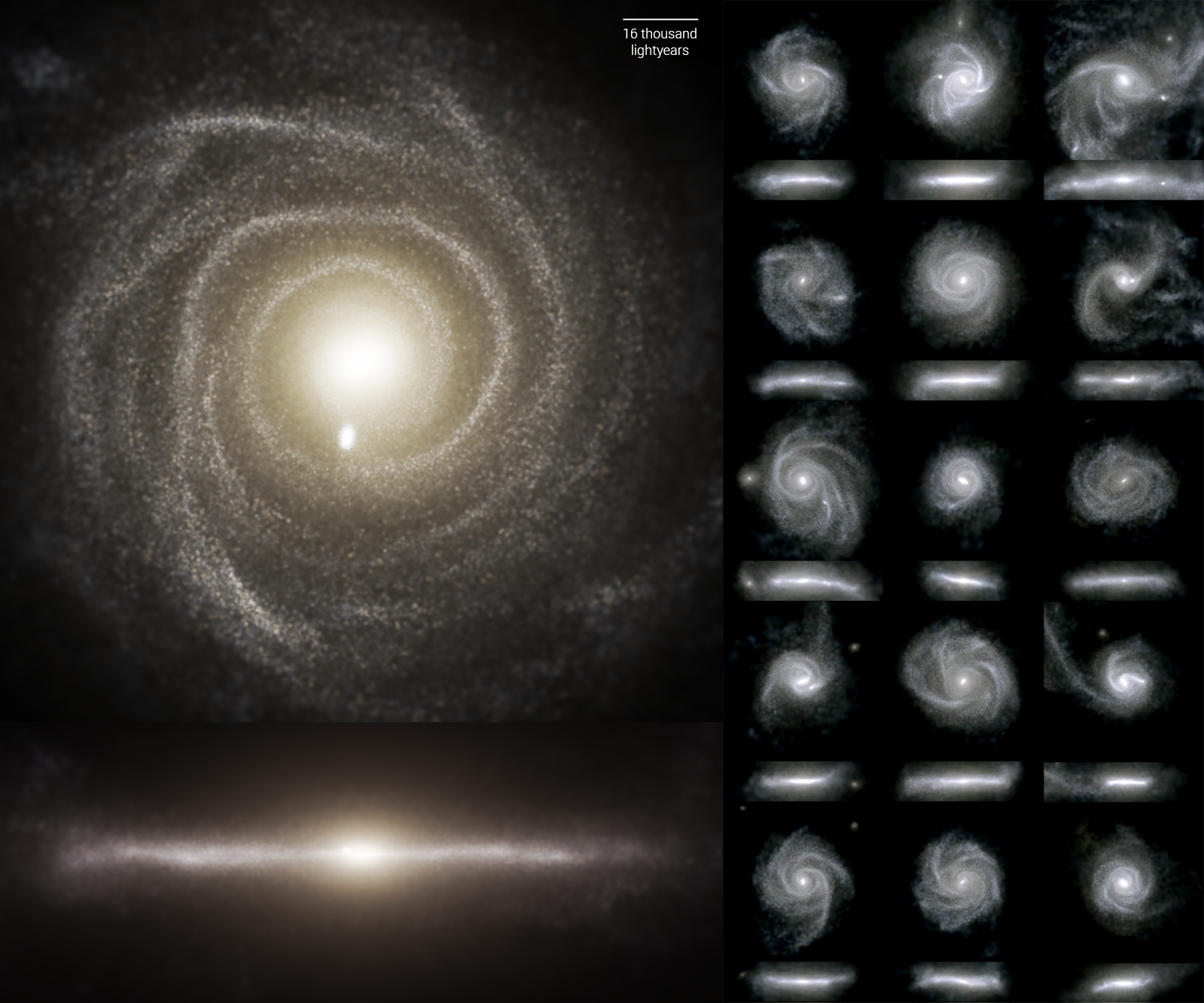
Fig 1: Images of disk galaxies from the TNG50 simulation in visible light. For each galaxy, there is a face-on view (top) and an edge-on view. TNG50 has thrown new light on how disk galaxies like this form. Credit: D. Nelson (MPA) and the Illustris TNG team

Order emerging from chaos 

Scientists from Germany and the United States have unveiled the results of a newly-completed, state of the art simulation of the evolution of galaxies. TNG50 is the most detailed large-scale cosmological simulation yet. It allows researchers to study in detail how galaxies form, and how they have evolved since shortly after the Big Bang. For the first time, it reveals that the geometry of the cosmic gas flows around galaxies determines galaxy structure, and vice versa.

Astronomers running cosmological simulations face a fundamental trade-off: with finite computing power, typical simulations so far have been either very detailed or have spanned a large volume of virtual space, but not both. Detailed simulations with limited volumes can model no more than a few galaxies, making statistical deductions difficult. Large-volume simulations, in turn, typically lack fine details on smaller scales, which are important for describing individual galaxies. The TNG50 simulation, which has just been published, manages to avoid this trade-off. For the first time, it combines the idea of a large-scale cosmological simulation – a Universe in a box – with the computational resolution of “zoom” simulations, at a level of detail that had previously only been possible for studies of individual galaxies.

In a simulated cube of space that is more than 230 million light-years across, TNG50 can discern physical phenomena that occur on scales one million times smaller, tracing the simultaneous evolution of thousands of galaxies over 13.8 billion years of cosmic history. It does so with more than 20 billion particles representing dark matter, stars, cosmic gas, magnetic fields, and supermassive black holes. The calculation itself required 16,000 cores on the Hazel Hen supercomputer in Stuttgart working together, 24/7, for more than a year – the equivalent of fifteen thousand years on a single processor, making it one of the most demanding astrophysical computations to date.


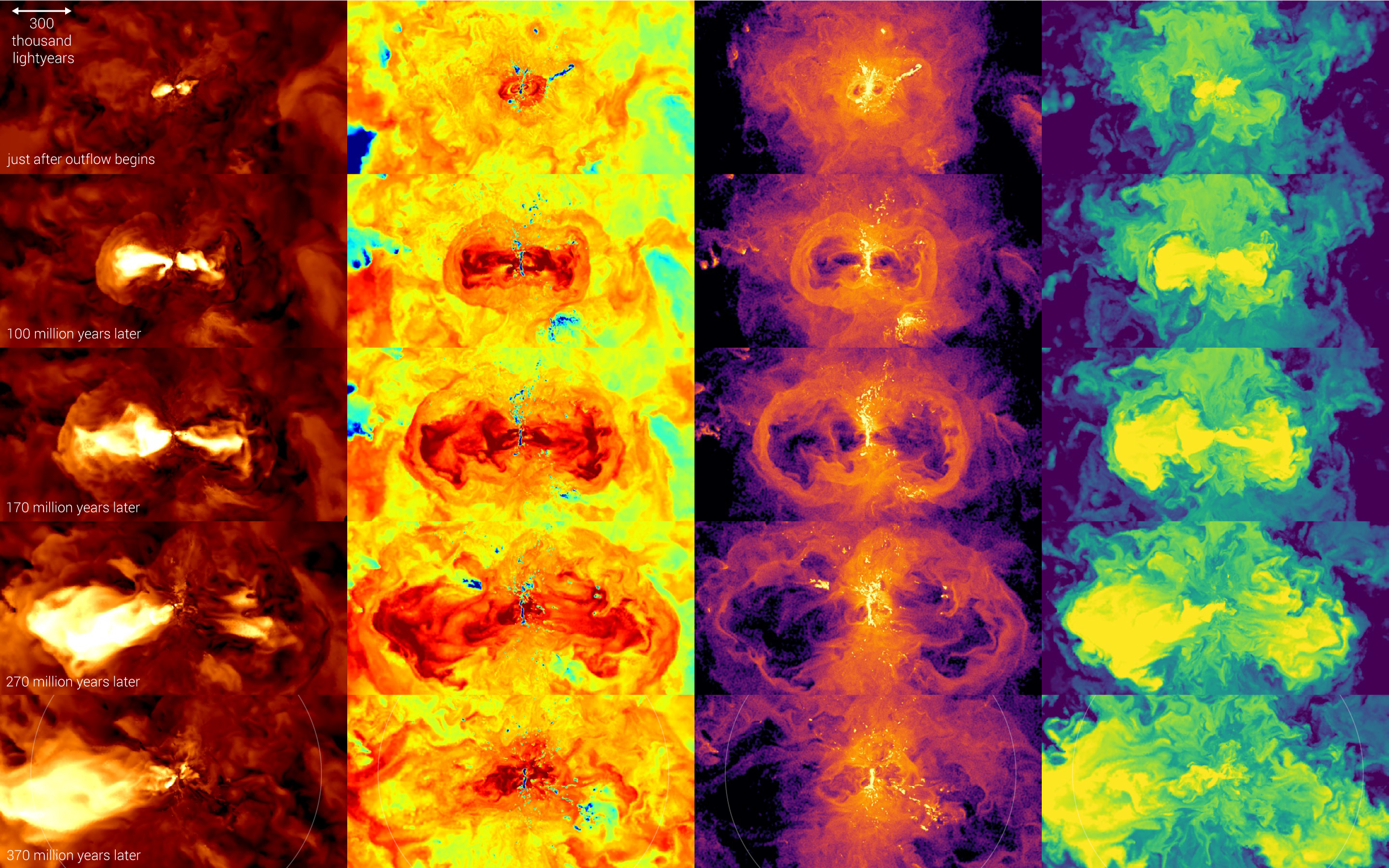
Fig 2: Outflow of gas from a galaxy. From top to bottom, each row represents a different snapshot, spanning 370 million years of cosmic evolution. The outflow is driven by energy set free near the active supermassive black hole in the galaxy’s center. From left to right, the columns show false-color representations of the velocity, temperature, density and heavy element content of the galaxy. The galaxy itself is the cold (blue, second column from left) and dense (yellow, third column) disk of star-forming gas visible as a small, vertical structure in the center of each image. Credit: D. Nelson (MPA) and the Illustris TNG team

The first scientific results from TNG50, presented in two articles that have just been published in the Monthly Notices of the Royal Astronomical Society, by a team led by Dr. Annalisa Pillepich (Max Planck Institute for Astronomy, Heidelberg) and Dr. Dylan Nelson (Max Planck Institute for Astrophysics, Garching), have revealed unforeseen physical phenomena. According to Nelson: “Numerical experiments of this kind are particularly successful when you get out more than you put in. In our simulation, we see phenomena that had not been programmed explicitly into the simulation code. These phenomena emerge in a natural fashion, from the complex interplay of the basic physical ingredients of our model universe.”

TNG50 features two prominent examples for this kind of emergent behavior. The first concerns the formation of “disk” galaxies like our own Milky Way. Using TNG50 as a time machine to rewind the evolution of cosmic structure, researchers have seen how the well-ordered, rapidly rotating disk galaxies (which are common in our nearby Universe) emerge from chaotic, disorganized, and highly turbulent clouds of gas at earlier epochs.

As the gas settles down, newborn stars are typically found on more and more circular orbits, eventually forming large spiral galaxies – galactic carousels. Annalisa Pillepich explains: “In practice, TNG50 shows that our own Milky Way galaxy with its thin disk is at the height of galaxy fashion: over the past 10 billion years, at least those galaxies that are still forming new stars have become more and more disk-like, and their chaotic internal motions have decreased considerably. The Universe was much more messy when it was just a few billion years old!”

Interplay of gas flows and galaxies

As these galaxies flatten out, researchers found another emergent phenomenon, concerning high-speed outflows and winds of gas flowing out of galaxies. Such outflows and winds are launched as a result of supernovae explosions and supermassive black hole activity. Galactic gaseous outflows are initially also chaotic and flow away in all directions, but over time, they begin to become more focused along a path of least resistance. In the late universe, outflows are oriented within two conical volumes, emerging from the galaxy in opposite directions – like two ice cream cones placed tip to tip, with the galaxy swirling at the center.

These winds slow down as they attempt to leave the gravitational well of the dark matter halo, and can eventually stall and fall back onto the galaxies, forming a galactic fountain of recycled gas. This process redistributes gas from the center of a galaxy to its outskirts, further accelerating the transformation of the galaxy itself into a thin disk: galactic structure shapes galactic fountains, and vice versa.

Just as for the other simulations of the TNG family, the team of scientists creating TNG50 (based at Max Planck Institutes in Heidelberg and Garching, Harvard University, MIT, and the CCA) will eventually release all simulation data to the astronomy community at large and to the public. Then, astronomers all over the world will be able to make their own discoveries in the TNG50 universe – and possibly find additional examples of emergent cosmic phenomena, of order emerging from chaos.

Formation and evolution of a massive galaxy in the TNG50 simulation. Main image: cosmic gas density. Insets, from left to right: large-scale dark matter density, large-scale gas density, then zoomed-in images of stellar distribution (luminosity) and gas density in the central region of the galaxy. The resulting TNG50 galaxy is similar in mass and shape to the Andromeda galaxy (M31). After a turbulent beginning, the galaxy experiences no major disturbances and can settled down into an equilibrium state. Credit: D. Nelson (MPA) and the illustris TNG team. More

Background information

The first scientific results from the TNG50 simulation were published as D. Nelson et al. 2019, “First Results from the TNG50 Simulation: Galactic outflows driven by supernovae and black hole feedback” and A. Pillepich et al. 2019, “First Results from the TNG50 Simulation: The evolution of stellar and gaseous disks across cosmic time,” both in the Monthly Notices of the Royal Astronomical Society. Both manuscripts have been online as “Accepted manuscripts,” and are now being published in the current volume of MNRAS.

The researchers involved in TNG50 are Annalisa Pillepich (Max Planck Institute for Astronomy) and Dylan Nelson (Max Planck Institute for Astrophysics), in collaboration with Volker Springel and Rüdiger Pakmor (both Max Planck Institute for Astrophysics), Paul Torrey (University of Florida), Rainer Weinberger (Harvard-Smithsonian Center for Astrophysics), Mark Vogelsberger (Kavli Institute for Astrophysics and Space Research, MIT), Federico Marinacci (University of Bologna), Shy Genel (Flatiron Institute) and Lars Hernquist (Harvard-Smithsonian Center for Astrophysics).


Contact:

Dr. Dylan Nelson
Postdoc
Tel.:2251
email: dnelson@mpa-garching.mpg.de

Dr. Annalisa Pillepich
+49 6221 528-395
email: pillepich@mpia-hd.mpg.de
Max Planck Institute for Astronomy, Heidelberg

Dr. Hannelore Hämmerle
Press officer
Tel:3980
email: hanne@mpa-garching.mpg.de

Dr. Markus Pössel
Press & Public Relations
+49 6221 528-261
email: pr@mpia.de
Max Planck Institute for Astronomy, Heidelberg


Wednesday, November 06, 2019

Cool dense hydrogen gas around the first quasars

Figure 1: An atlas of the extended Ly-Alpha halos detected at around z~6 quasars (i.e., when the Universe is only 1/15th of its current age). The black dot at the center marks the quasar location. See also an animated 3D-version for P308-21 at the end of the page. © MPA

Quasars are amongst the brightest non-transient sources in the sky. Thanks to their high luminosity, they can be observed even at early cosmic times, where – surprisingly – these first quasars appear as already evolved systems: with black holes with masses exceeding one billion solar masses hosted by massive and heavily star forming galaxies. To explain such rapid growth, theorists believe these systems must reside in peculiarly dense environments, where huge gas reservoirs favour efficient inflow of material onto seed super-massive black holes. An international team of astronomers has recently found the first clear observational evidence that this is indeed the case. The new “panoramic” spectrograph called MUSE unveiled, for the first time, the almost ubiquitous presence of large amounts of cool gas in close proximity to the first quasars. This pristine fuel will fall on the primordial galaxies and sustain their growth in both stellar and black hole mass.

A prime objective of observational astrophysics is to peer deep into the young Universe and study how the first stars, galaxies, and black holes formed. For decades, astronomers exploited the brightness of quasars to study galaxy formation and evolution at all cosmic times, both as silhouettes against the luminous quasars, and in emission around them. Despite significant progress, we still do not understand the detailed processes whereby super-massive black holes with masses a billion times larger than the Sun assemble their mass in less than one billion years after the Big Bang, a small fraction of the current Universe age (13.7 billion years).

Hydro-dynamical cosmological simulations and analytical arguments suggest that to grow such massive systems in such a short time scale, the host galaxies of the first quasars need a continuous replenishment of fresh fuel. This gas has to be provided by cold filamentary streams from the so-called intergalactic medium down to the quasar's host galaxy and/or by mergers with other gas rich galaxies. While a merger is a violent short episode, the aforementioned filaments should be present around each quasar.

Emission from this large-scale gas is, however, typically too faint to be detected unless it is illuminated by the intense radiation from the quasar. In this case, the hydrogen in the gas reprocesses the incident radiation and shines as an extended "fuzz" of Ly-Alpha emission, now detectable with top-notch facilities. Recently, a team of astronomers from Garching, Heidelberg, and Santa Barbara took advantage of this boosted emission and embarked on a large survey aimed at uncovering the presence of this fuzz around more than 30 luminous quasars in the young Universe.

Figure 2: In the past years, several studies showed that quasars at the so-called cosmic noon (2-3 billion years after the Big Bang) are embedded in large Ly-Alpha nebulae. This plot illustrates how the average Ly-Alpha emission becomes fainter with increasing distance from the center of the dark matter halo where these quasars reside. The three different colors correspond to studies at different cosmic times. Surprisingly, while the shape of this drop remains similar, the earliest supermassive black holes (this study, red) appears to be surrounded by larger gas masses. © MPA

An investment of more than 50 hours with the panoramic integral-field spectrograph MUSE on the Very Large Telescope revealed that around 40% of first quasars are embedded in Ly-Alpha halos (see Figure 1) with a total extent of up to a hundred thousand light years. These halos are directly tracing the presence of cool dense hydrogen gas around the first quasars. In particular, the researchers discovered that this gas is bound within the dark matter halo of the quasar host galaxies and that it is abundant enough to maintain both the observed high-rate of gas consumption of the central supermassive black holes and their highly star forming host galaxies.

The presence of these extended nebulae is an important piece of the puzzle that astronomers are building to picture the formation of large cosmic structures more than 12 billion years ago. By providing detailed constraints on the fuel supply, these new observations can be used to test current theories and models for the growth of massive galaxies and black holes from the Big Bang to the present (see Figure 2). While additional observations are already planned to fully capture the physical status of the gas, current data already pose new challenges to theoretical models. They indicate that, rather than being smooth, "Lyman-alpha" nebulae take on the consistency of a mist comprising an enormous number of tiny droplets. Reproducing the structure of these clouds may prove to be a key challenge for the next generation of theoretical models of galaxy evolution.

3D visualization of the extended Ly-Alpha halo around the quasar P308-21 at z=6.23. The “hole” at the center represents the quasar location, which has been removed so as not to contaminate the measurement with light coming from the central black hole. The gas appears to be in a relatively quiescent motion, suggesting that it is moving within the dark matter halo where the central quasar resides.


Authors

Emanuele Paolo Farina
MPIA, Heidelberg, and MPA, Garching

Thales Gutcke, Dr.
Postdoc
Tel.: 2205
email: thales@mpa-garching.mpg.de

Tiago Costa, Dr.
Postdoc
Tel.: 2033
email: tcosta@mpa-garching.mpg.de

Dr. Fabrizio Arrigoni Battaia
Postdoc 
Tel.: 2288
email: arrigoni@mpa-garching.mpg.de


More Information:

The Requiem Survey


Tuesday, November 05, 2019

Astronomers Catch Wind Rushing Out of Galaxy


A volume rendering of the KCWI data cube revealing the structure of Makani. Credit: David Tree & Peter Richardson, Games and Visual Effects Research Lab, University of Hertfordshire


Researchers Directly Observe for the First Time a Huge Outflow of Gas Extending Far Beyond a Galaxy

Maunakea, Hawaii – Exploring the influence of galactic winds from a distant galaxy called Makani, University of California, San Diego’s Alison Coil, Rhodes College’s David Rupke and a group of collaborators from around the world made a novel discovery using W. M. Keck Observatory on Hawaii Island.

Published online today in the journal Nature, their study’s findings provide direct evidence for the first time of the role of galactic winds—ejections of gas from galaxies—in creating the circumgalactic medium (CGM). It exists in the regions around galaxies, and it plays an active role in their cosmic evolution. The unique composition of Makani—meaning ‘wind’ in Hawaiian—uniquely lent itself to the breakthrough findings.

“Makani is not a typical galaxy,” noted Coil, a physics professor at UC San Diego. “It’s what’s known as a late-stage major merger—two recently combined similarly massive galaxies, which came together because of the gravitational pull each felt from the other as they drew nearer. Galaxy mergers often lead to starburst events, when a substantial amount of gas present in the merging galaxies is compressed, resulting in a burst of new star births. Those new stars, in the case of Makani, likely caused the huge outflows—either in stellar winds or at the end of their lives when they exploded as supernovae.”

Coil explained that most of the gas in the universe inexplicably appears in the regions surrounding galaxies—not in the galaxies. Typically, when astronomers observe a galaxy, they are not witnessing it undergoing dramatic events—big mergers, the rearrangement of stars, the creation of multiple stars or driving huge, fast winds.

“While these events may occur at some point in a galaxy’s life, they’d be relatively brief,” noted Coil. “Here, we’re actually catching it all right as it’s happening through these huge outflows of gas and dust.”

Coil and Rupke, the paper’s first author, used data collected from one of Keck Observatory’s newest instruments – the Keck Cosmic Web Imager (KCWI) – combined with images from the Hubble Space Telescope and the Atacama Large Millimeter Array (ALMA), to draw their conclusions.

The KCWI data provided what the researchers call the “stunning detection” of the ionized oxygen gas to extremely large scales, well beyond the stars in the galaxy. It allowed them to distinguish a fast gaseous outflow launched from the galaxy a few million years ago, from a gas outflow launched hundreds of millions of years earlier that has since slowed significantly.

“The earlier outflow has flowed to large distances from the galaxy, while the fast, recent outflow has not had time to do so,” summarized Rupke, associate professor of physics at Rhodes College.

Figure 1: The giant galactic wind surrounding the massive, compact galaxy Makani. The colors and white contour lines show the amount of light emitted by the ionized gas from different parts of the oxygen nebula, from brightest (white) to faintest (purple). The middle part of the image (black) shows the full extent of the galaxy, though most of the galaxy is concentrated at the center (the tiny green circle). The axes show distance from the center of the galaxy in kiloparsecs. Figure by: Gene Leung (UC San Diego) 

From Hubble, the researchers procured images of Makani’s stars, showing it to be a massive, compact galaxy that resulted from a merger of two once separate galaxies. From ALMA, they could see that the outflow contains molecules as well as atoms. The data sets indicated that with a mixed population of old, middle-age and young stars, the galaxy might also contain a dust-obscured accreting supermassive black hole. This suggests to the scientists that Makani’s properties and timescales are consistent with theoretical models of galactic winds.

“In terms of both their size and speed of travel, the two outflows are consistent with their creation by these past starburst events; they’re also consistent with theoretical models of how large and fast winds should be if created by starbursts. So observations and theory are agreeing well here,” noted Coil.

Rupke noticed that the hourglass shape of Makani’s nebula is strongly reminiscent of similar galactic winds in other galaxies, but that Makani’s wind is much larger than in other observed galaxies.

“This means that we can confirm it’s actually moving gas from the galaxy into the circumgalactic regions around it, as well as sweeping up more gas from its surroundings as it moves out,” Rupke explained. “And it’s moving a lot of it—at least one to 10 percent of the visible mass of the entire galaxy—at very high speeds, thousands of kilometers per second.” 

Rupke also noted that while astronomers are converging on the idea that galactic winds are important for feeding the CGM, most of the evidence has come from theoretical models or observations that don’t encompass the entire galaxy. 

“Here we have the whole spatial picture for one galaxy, which is a remarkable illustration of what people expected,” he said. “Makani’s existence provides one of the first direct windows into how a galaxy contributes to the ongoing formation and chemical enrichment of its CGM.”

Figure 2: The multiphase galactic wind: comparison of the ionized, neutral atomic and molecular gas. In the zoomed-in view of the inner 40 kiloparsecs at the upper right, molecular gas emission from carbon monoxide (green contours) is plotted on emission from magnesium atoms that trace neutral atomic gas (color, with white contours) in the same velocity range (-500 to +500 kilometers per second, where negative velocities are blueshifted and positive velocities redshifted with respect to the galaxy). The zoomed-in view at the lower left compares the emission from low-velocity molecules and ionized oxygen atoms, and the high-velocity molecular and ionized gas are shown at lower right. The molecules, neutral atoms and ionized gas all correspond well spatially, though the ionized gas extends far beyond the other two gas phases. Figure by: David Rupke (Rhodes College)

This study was supported by the National Science Foundation (collaborative grant AST-1814233, 1813365, 1814159 and 1813702), NASA (award SOF-06-0191, issued by USRA), Rhodes College and the Royal Society.


About KCWI

The Keck Cosmic Web Imager (KCWI) is designed to provide visible band, integral field spectroscopy with moderate to high spectral resolution formats and excellent sky-subtraction. The astronomical seeing and large aperture of the telescope enables studies of the connection between galaxies and the gas in their dark matter halos, stellar relics, star clusters, and lensed galaxies. Support for this project was provided by the Heising-Simons Foundation. Learn more at www.heisingsimons.org.


About W.M. Keck Observatory

The W. M. Keck Observatory telescopes are among the most scientifically productive on Earth. The two, 10-meter optical/infrared telescopes on the summit of Maunakea on the Island of Hawaii feature a suite of advanced instruments including imagers, multi-object spectrographs, high-resolution spectrographs, integral-field spectrometers, and world-leading laser guide star adaptive optics systems.

Some of the data presented herein were obtained at Keck Observatory, which is a private 501(c) 3 non-profit organization operated as a scientific partnership among the California Institute of Technology, the University of California, and the National Aeronautics and Space Administration. The Observatory was made possible by the generous financial support of the W. M. Keck Foundation.

The authors wish to recognize and acknowledge the very significant cultural role and reverence that the summit of Maunakea has always had within the Native Hawaiian community. We are most fortunate to have the opportunity to conduct observations from this mountain.


Monday, November 04, 2019

Ancient gas cloud shows that the first stars must have formed very quickly

Astronomers found a pristine gas cloud in the proximity of one of the most distant quasars known, seen just 850 million after the Big Bang (1/14th of the universe's current age). The gas cloud absorbs some of the light from the background quasar, leaving signatures that allow astronomers to study its chemical composition. This is the most distant gas cloud for which astronomers have been able to measure a metallicity to date. This system has one of the smallest amount of metals ever identified in a gas cloud but the ratio of its chemical elements are still similar to what observed in more evolved systems. © graphics department.

Astronomers led by Eduardo Bañados of the Max Planck Institute for Astronomy have discovered a gas cloud that contains information about an early phase of galaxy and star formation, merely 850 million years after the Big Bang. The cloud was found serendipitously during observations of a distant quasar, and it has the properties that astronomers expect from the precursors of modern-day dwarf galaxies. When it comes to relative abundances, the cloud's chemistry is surprisingly modern, showing that the first stars in the universe must have formed very quickly after the Big Bang. The results have been published in the Astrophysical Journal.

When astronomers look at distant objects, they necessarily look back in time. The gas cloud discovered by Bañados et al. is so distant that its light has taken nearly 13 billion years to reach us; conversely, the light reaching us now tells us how the gas cloud looked nearly 13 billion years ago, no more than about 850 million years after the Big Bang. For astronomers, this is an extremely interesting epoch. Within the first several hundred million years after the Big Bang, the first stars and galaxies formed, but the details of that complex evolution are still largely unknown.

This very distant gas cloud was a fortuitous discovery. Bañados, then at the Carnegie Institution for Science, and his colleagues were following up on several quasars from a survey of 15 of the most distant quasars known (z³6.5), which had been prepared by Chiara Mazzucchelli as part of her PhD research at the Max Planck Institute for Astronomy. At first, the researchers just noted that the quasar P183+05 had a rather unusual spectrum. But when Bañados analyzed a more detailed spectrum, obtained with the Magellan Telescopes at Las Campanas Observatory in Chile, he recognized that there was something else going on: The weird spectral features were the traces of a gas cloud that was very close to the distant quasar – one of the most distant gas clouds astronomers have yet been able to identify.

Lit up by a distant quasar

Quasars are the extremely bright active nuclei of distant galaxies. The driving force behind their luminosity is the galaxy’s central supermassive black hole. Matter swirling around that black hole (before falling in) heats up to temperatures reaching hundreds of thousands of degrees, giving off enormous amounts of radiation. This allows astronomers to use quasars as background sources to detect hydrogen and other chemical elements in absorption: If a gas cloud is directly between the observer and a distant quasar, some of the quasar’s light will be absorbed.

Astronomers can detect this absorption by studying the quasar’s spectrum, that is, the rainbow-like decomposition of the quasar’s light into the different wavelength regions. The absorption pattern contains information about the gas cloud’s chemical composition, temperature, density and even about the cloud’s distance from us (and from the quasar). Behind this is the fact that each chemical element has a “fingerprint” of spectral lines – narrow wavelengths region in which that element’s atoms can emit or absorb light particularly well. The presence of a characteristic fingerprint reveals the presence and abundance of a specific chemical element.

Not quite the cloud they were looking for

From the spectrum of the gas cloud, the researchers could immediately tell the distance of the cloud, and that they were looking back into the first billion years of cosmic history. They also found traces of several chemical elements including carbon, oxygen, iron, and magnesium. However, the amount of these elements was tiny, about 1/800 times the abundance in the atmosphere of our sun. Astronomers summarily call all elements heavier than helium “metals;” this measurement makes the gas cloud one of the most metal-poor (and distant) systems known in the universe. Michael Rauch from the Carnegie Institution of Science, who is co-author of the new study, says: "After we were convinced that were were looking at such pristine gas only 850 million years after the Big Bang we started wondering whether this system could still retain chemical signatures produced by the very first generation of stars."

Finding these first generation, so-called “population III” stars is one of the most important goals in reconstructing the history of the universe. In the later universe, chemical elements heavier than hydrogen play an important role in letting gas clouds collapse to form stars. But those chemical elements, notably carbon, are themselves produced in stars, and flung into space in supernova explosions. For the first stars, those chemical facilitators would simply not have been there, since directly after the Big Bang phase, there were only hydrogen and helium atoms. That is what makes the first stars fundamentally different from all later stars.

The analysis showed that the cloud’s chemical make-up was not chemically primitive, but instead the relative abundances were surprisingly similar to the chemical abundances observed in today’s intergalactic gas clouds. The ratios of the abundances of heavier elements were very close to the ratios in the modern universe. The fact that this gas cloud in the very early universe already contains metals with modern relative chemical abundances poses key challenges for the formation of the first generation of stars.

So many stars, so little time

This study implies that the formation of the first stars in this system must have begun much earlier: the chemical yields expected from the first stars had already been erased by the explosions of at least one more generation of stars. A particular time constraint comes from supernovae of type Ia, cosmic explosions that would be required to produce metals with the observed relative abundances. Such supernovae typically need about 1 billion years to happen, which puts a serious constraint on any scenarios of how the first stars formed.

Now that the astronomers have found this very early cloud, they are systematically looking for additional examples. Eduardo Bañados says: “It is exciting that we can measure metallicity and chemical abundances so early in the history of the universe, but if we want to identify the signatures of the first stars we need to probe even earlier in cosmic history. I am optimistic that we will find even more distant gas clouds, which could help us understand how the first stars were born.”

Background information

The results described here have been published in Bañados et al., “A metal–poor damped Lyαsystem at redshift 6.4,” in the Astrophysical Journal.

The MPIA researchers involved are Eduardo Bañados (also Carnegie Institution for Science), Emanuele Farina and Joe Hennawi (both also UCSB), Bram P. Venemans, and Fabian Walter (also NRAO), in collaboration with Michael Rauch (Carnegie Institution for Science), Roberto Decarli (INAF Bologna), Chiara Mazzucchelli (ESO), Robert A. Simcoe (MIT-Kavli Center for Astrophysics and Space Research), J. Xavier Prochaska (UCSC), Thomas Cooper (Carnegie Institution for Science), Frederick B. Davies (UCSB) and Shi-Fan S. Chen (MIT-Kavli Center for Astrophysics and Space Research and UC Berkeley)

e-print of the article  


Contact

Eduardo Banados Torres
Phone: +49 6221 528-461
Email: banados@mpia.de
Room: 329
Links: Personal homepage

Markus Pössel
Public Information Officer
Phone:+49 6221 528-261
Email: pr@mpia.de


Saturday, November 02, 2019

A Crisis in Cosmology

W. M. Keck Observatory's AO system was used for the first time to obtain the hubble constant by observing three gravitationally lensed systems, including HE0435-1223 (pictured). 

Maunakea, Hawaii – A group of astronomers led by University of California, Davis has obtained new data that suggest the universe is expanding more rapidly than previously thought.

The study comes on the heels of a hot debate over just how fast the universe is ballooning; measurements thus far are in disagreement.

The team’s new measurement of the Hubble Constant, or the expansion rate of the universe, involved a different method. They used NASA’s Hubble Space Telescope (HST) in combination with W. M. Keck Observatory’s Adaptive Optics (AO) system to observe three gravitationally-lensed systems. This is the first time ground-based AO technology has been used to obtain the Hubble Constant.
“When I first started working on this problem more than 20 years ago, the available instrumentation limited the amount of useful data that you could get out of the observations,” says co-author Chris Fassnacht, Professor of Physics at UC Davis. “In this project, we are using Keck Observatory’s AO for the first time in the full analysis. I have felt for many years that AO observations could contribute a lot to this effort.”

The team’s results are published in the latest online issue of the Monthly Notices of the Royal Astronomical Society.

To rule out any bias, the team conducted a blind analysis; during the processing, they kept the final answer hidden from even themselves until they were convinced that they had addressed as many possible sources of error as they could think of. This prevented them from making any adjustments to get to the “correct” value, avoiding confirmation bias. 

“When we thought that we had taken care of all possible problems with the analysis, we unblind the answer with the rule that we have to publish whatever value that we find, even if it’s crazy. It’s always a tense and exciting moment,” says lead author Geoff Chen, a graduate student at the UC Davis Physics Department.

The unblinding revealed a value that is consistent with Hubble Constant measurements taken from observations of “local” objects close to Earth, such as nearby Type Ia supernovae or gravitationally-lensed systems; Chen’s team used the latter objects in their blind analysis. 

The team’s results add to growing evidence that there is a problem with the standard model of cosmology, which shows the universe was expanding very fast early in its history, then the expansion slowed down due to the gravitational pull of dark matter, and now the expansion is speeding up again due to dark energy, a mysterious force.


An artist’s depiction of the standard model of cosmology
Credit: BICEP2 Collaboration/CERN/NASA

This model of the expansion history of the universe is assembled using traditional Hubble Constant measurements, which are taken from “distant” observations of the cosmic microwave background (CMB) – leftover radiation from the Big Bang when the universe began 13.8 billion years ago.

Recently, many groups began using varying techniques and studying different parts of the universe to obtain the Hubble Constant and found that the value obtained from “local” versus “distant” observations disagree.

“Therein lies the crisis in cosmology,” says Fassnacht. “While the Hubble Constant is constant everywhere in space at a given time, it is not constant in time. So, when we are comparing the Hubble Constants that come out of various techniques, we are comparing the early universe (using distant observations) vs. the late, more modern part of the universe (using local, nearby observations).”

This suggests that either there is a problem with the CMB measurements, which the team says is unlikely, or the standard model of cosmology needs to be changed in some way using new physics to correct the discrepancy.

Methodology

Using Keck Observatory’s AO system with the Near-Infrared Camera, second generation (NIRC2) instrument on the Keck II telescope, Chen and his team obtained local measurements of three well-known lensed quasar systems: PG1115+ 080, HE0435-1223, and RXJ1131-1231. 

Quasars are extremely bright, active galaxies, often with massive jets powered by a supermassive black hole ravenously eating material surrounding it. 

Though quasars are often extremely far way, astronomers are able to detect them through gravitational lensing, a phenomenon that acts as nature’s magnifying glass. When a  sufficiently massive galaxy closer to Earth gets in the way of light from a very distant quasar, the galaxy can act as a lens; its gravitational field warps space itself, bending the background quasar’s light into multiple images and making it look extra bright.

At times, the brightness of the quasar flickers, and since each image corresponds to a slightly different path length from quasar to telescope, the flickers appear at slightly different times for each image – they don’t all arrive on Earth at the same time. 

With HE0435-1223, PG1115+ 080, and RXJ1131-1231, the team carefully measured those time delays, which are inversely proportional to the value of the Hubble Constant. This allows astronomers to decode the light from these distant quasars and gather information about how much the universe has expanded during the time the light has been on its way to Earth.

Multiple lensed quasar images of HE0435-1223 (left), PG1115+ 080 (center), and RXJ1131-1231 (right). 
Image credit: G. Chen, C. Fassnacht, UC Davis


“One of the most important ingredients in using gravitational lensing to measure the Hubble Constant is sensitive and high-resolution imaging,” said Chen. “Up until now, the best lens-based Hubble Constant measurements all involved using data from HST. When we unblinded, we found two things. First, we had consistent values with previous measurements that were based on HST data, proving that AO data can provide a powerful alternative to HST data in the future. Secondly, we found that combining the AO and HST data gave a more precise result.”

Next Steps

Chen and his team, as well as many other groups all over the planet, are doing more research and observations to further investigate. Now that Chen’s team has proven Keck Observatory’s AO system is just as powerful as HST, astronomers can add this methodology to their bucket of techniques when measuring the Hubble Constant.

“We can now try this method with more lensed quasar systems to improve the precision of our measurement of the Hubble Constant. Perhaps this will lead us to a more complete cosmological model of the universe,” says Fassnacht.


About NIRC2

The Near-Infrared Camera, second generation (NIRC2) works in combination with the Keck II adaptive optics system to obtain very sharp images at near-infrared wavelengths, achieving spatial resolutions comparable to or better than those achieved by the Hubble Space Telescope at optical wavelengths. NIRC2 is probably best known for helping to provide definitive proof of a central massive black hole at the center of our galaxy. Astronomers also use NIRC2 to map surface features of solar system bodies, detect planets orbiting other stars, and study detailed morphology of distant galaxies.

About Adaptative Optics

W. M. Keck Observatory is a distinguished leader in the field of adaptive optics (AO), a breakthrough technology that removes the distortions caused by the turbulence in the Earth’s atmosphere. Keck Observatory pioneered the astronomical use of both natural guide star (NGS) and laser guide star adaptive optics (LGS AO) on large telescopes and current systems now deliver images three to four times sharper than the Hubble Space Telescope at near-infrared wavelengths. Keck AO has imaged the four massive planets orbiting the star HR8799, measured the mass of the giant black hole at the center of our Milky Way Galaxy, discovered new supernovae in distant galaxies, and identified the specific stars that were their progenitors. Support for this technology was generously provided by the Bob and Renee Parsons Foundation, Change Happens Foundation, Gordon and Betty Moore Foundation, Mt. Cuba Astronomical Foundation, NASA, NSF, and W. M. Keck Foundation.

About W.M. Keck Observatory

The W. M. Keck Observatory telescopes are among the most scientifically productive on Earth. The two, 10-meter optical/infrared telescopes on the summit of Maunakea on the Island of Hawaii feature a suite of advanced instruments including imagers, multi-object spectrographs, high-resolution spectrographs, integral-field spectrometers, and world-leading laser guide star adaptive optics systems.

Some of the data presented herein were obtained at Keck Observatory, which is a private 501(c) 3 non-profit organization operated as a scientific partnership among the California Institute of Technology, the University of California, and the National Aeronautics and Space Administration. The Observatory was made possible by the generous financial support of the W. M. Keck Foundation.

The authors wish to recognize and acknowledge the very significant cultural role and reverence that the summit of Maunakea has always had within the Native Hawaiian community. We are most fortunate to have the opportunity to conduct observations from this mountain.


Friday, November 01, 2019

Chandra Archive Collection: Combing Through the "X-ray Files"

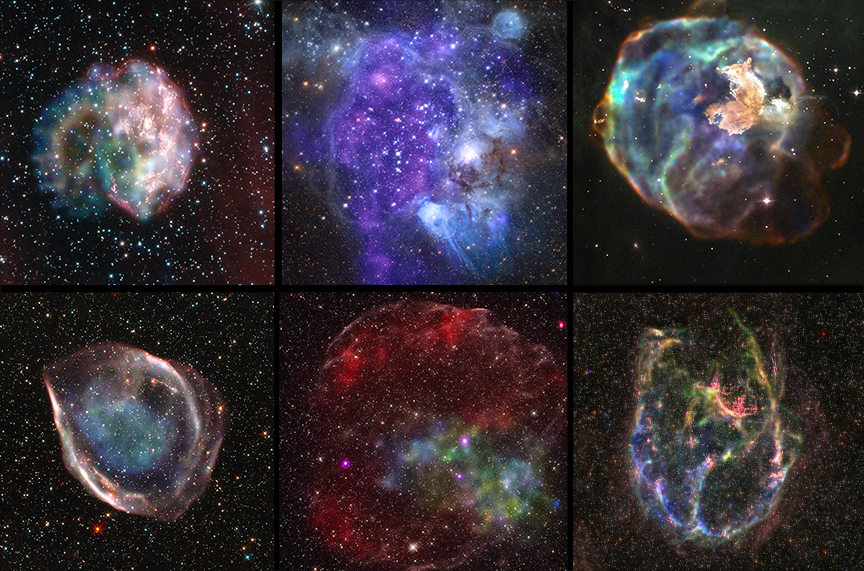
N103B, LHA 120-N 44, LMC N63A, DEM L71, SNR J0534.2-7033 (DEM L238), N132D
Credit: Enhanced Image by Judy Schmidt (CC BY-NC-SA) based on images provided courtesy of NASA/CXC/SAO & NASA/STScI (all images)


N103B
When a thermonuclear explosion destroyed a white dwarf star (the dense final stage in the evolution of a Sun-like star) in a double star system and produced a supernova, it left behind this glowing debris field, called a supernova remnant. The Chandra X-ray data (most clearly visible on the left side of the remnant in red, green and blue) shows multimillion-degree gas that has been heated by a shock wave produced by the explosion that destroyed the star. An optical light image from the Hubble Space Telescope is brightest on the right side of the image, where the overlap with X-rays is mostly in pink and white. 

LHA 120-N 44
This region of star formation features a giant bubble that is blowing out from the middle of this image due to winds flowing off young stars. Chandra data (purple and pink) show this superbubble of hot gas, while Hubble data (orange and light blue) reveals the gas and dust in the system.

LMC N63A
After a massive star exploded, it left behind this supernova remnant observed by Chandra and Hubble. The Chandra data (red, green and blue) show multimillion-degree gas and the blast wave from the supernova. The light brown region in the upper right of the remnant is a dense cloud of gas and dust that reflects optical light detected by Hubble.

DEM L71
The Chandra image of this supernova remnant (also known as SNR 0505.7-6752) reveals an inner cloud of glowing iron and silicon (green and blue) surrounded by an outer blast wave (red). The outer blast wave, created during the destruction of the white dwarf star, is also seen in optical data from Hubble (red and white).

SNR J0534.2-7033 (DEM L238)
Another supernova remnant resulting from the explosion of a white dwarf star is revealed in this image of DEM L238, also known as SNR J0534.2-7033. The Chandra image (yellow, green and bright red) shows multimillion-degree gas and the Hubble image shows cooler gas in the system, near the outer border of the remnant in red.

N132D
This is the brightest supernova remnant in either the LMC or its galactic cousin, the Small Magellanic Cloud. N132D also stands out because it belongs to a rare class of supernova remnants that have relatively high levels of oxygen. Scientists think most of the oxygen we breathe came from explosions similar to this one. Here, Chandra data are shown in purple and green and Hubble data are shown in red. 

NASA's Marshall Space Flight Center manages the Chandra program. The Smithsonian Astrophysical Observatory's Chandra X-ray Center controls science and flight operations from Cambridge, Massachusetts.


Thursday, October 31, 2019

Spitzer Telescope Spots a Ghoulish Gourd

This infrared image from NASA's Spitzer Space telescope shows a cloud of gas and dust carved out by a massive star. A drawing overlaid on the image reveals why researchers nicknamed this region the "Jack-o'-lantern Nebula." Credit: NASA/JPL-Caltech.  › Full image and caption

A carved-out cloud of gas and dust looks like a celestial jack-o'-lantern in this image from NASA's Spitzer Space Telescope.

A massive star - known as an O-type star and about 15 to 20 times heavier than the Sun - is likely responsible for sculpting this cosmic pumpkin. A recent study of the region suggests that the powerful outflow of radiation and particles from the star likely swept the surrounding dust and gas outward, creating deep gouges in this cloud, which is known as a nebula.

Spitzer, which detects infrared light, saw the star glowing like a candle at the center of a hollowed-out pumpkin. The study's authors have fittingly nicknamed the structure the "Jack-o'-lantern Nebula."

A plethora of objects in the universe emit infrared light, often as heat, so objects tend to radiate more infrared light the warmer they are.

Invisible to the human eye, three wavelengths of infrared light compose the multicolor image of the nebula seen here. Green and red represent light emitted primarily by dust radiating at different temperatures, though some stars radiate prominently in these wavelengths as well. The combination of green and red in the image creates yellow hues. Blue represents a wavelength mostly emitted, in this image, by stars and some very hot regions of the nebula, while white regions indicate where the objects are bright in all three colors. The O-type star appears as a white spot in the center of a red dust shell near the center of the scooped-out region.

A high-contrast version of the same image makes the red wavelength more pronounced. Together, the red and green wavelengths create an orange hue. The picture highlights contours in the dust as well as the densest regions of the nebula, which appear brightest.

The study that produced these observations appears in the Astrophysical Journal and examined a region in the outer region of the Milky Way galaxy. (Our Sun is halfway to the edge of the disk-shaped galaxy.) Researchers used infrared light to count the very young stars in different stages of early development in this region. They also counted protostars - infant stars still swaddled in the dense dust clouds in which they were born. When combined with tallies of adult stars in these regions, these data will help scientists determine whether the rates of star and planet formation in the galaxy's outer regions differ from the rates in middle and inner regions.

Scientists already know that conditions differ slightly in those outer areas. For example, interstellar clouds of gas and dust are colder and more sparsely distributed there than they are near the center of the galaxy (which may reduce the rate of star formation). Star-forming clouds in those outer areas also contain lower amounts of heavy chemical elements, including carbon, oxygen and other ingredients for life as we know it. Eventually, more studies like this one might also determine whether planets similar in composition to Earth are more or less common in the outer galaxy than in our local galactic neighborhood.

The data used to create this image was collected during Spitzer's "cold mission," which ran between 2004 and 2009.

For more information about Spitzer, go to: https://www.nasa.gov/mission_pages/spitzer/main/index.html

News Media Contact

Calla Cofield
Jet Propulsion Laboratory, Pasadena, Calif.
626-808-2469
calla.e.cofield@jpl.nasa.gov