Showing posts with label lensed quasar. Show all posts

Saturday, November 02, 2019

A Crisis in Cosmology

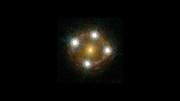
W. M. Keck Observatory's AO system was used for the first time to obtain the hubble constant by observing three gravitationally lensed systems, including HE0435-1223 (pictured). 

Maunakea, Hawaii – A group of astronomers led by University of California, Davis has obtained new data that suggest the universe is expanding more rapidly than previously thought.

The study comes on the heels of a hot debate over just how fast the universe is ballooning; measurements thus far are in disagreement.

The team’s new measurement of the Hubble Constant, or the expansion rate of the universe, involved a different method. They used NASA’s Hubble Space Telescope (HST) in combination with W. M. Keck Observatory’s Adaptive Optics (AO) system to observe three gravitationally-lensed systems. This is the first time ground-based AO technology has been used to obtain the Hubble Constant.
“When I first started working on this problem more than 20 years ago, the available instrumentation limited the amount of useful data that you could get out of the observations,” says co-author Chris Fassnacht, Professor of Physics at UC Davis. “In this project, we are using Keck Observatory’s AO for the first time in the full analysis. I have felt for many years that AO observations could contribute a lot to this effort.”

The team’s results are published in the latest online issue of the Monthly Notices of the Royal Astronomical Society.

To rule out any bias, the team conducted a blind analysis; during the processing, they kept the final answer hidden from even themselves until they were convinced that they had addressed as many possible sources of error as they could think of. This prevented them from making any adjustments to get to the “correct” value, avoiding confirmation bias. 

“When we thought that we had taken care of all possible problems with the analysis, we unblind the answer with the rule that we have to publish whatever value that we find, even if it’s crazy. It’s always a tense and exciting moment,” says lead author Geoff Chen, a graduate student at the UC Davis Physics Department.

The unblinding revealed a value that is consistent with Hubble Constant measurements taken from observations of “local” objects close to Earth, such as nearby Type Ia supernovae or gravitationally-lensed systems; Chen’s team used the latter objects in their blind analysis. 

The team’s results add to growing evidence that there is a problem with the standard model of cosmology, which shows the universe was expanding very fast early in its history, then the expansion slowed down due to the gravitational pull of dark matter, and now the expansion is speeding up again due to dark energy, a mysterious force.


An artist’s depiction of the standard model of cosmology
Credit: BICEP2 Collaboration/CERN/NASA

This model of the expansion history of the universe is assembled using traditional Hubble Constant measurements, which are taken from “distant” observations of the cosmic microwave background (CMB) – leftover radiation from the Big Bang when the universe began 13.8 billion years ago.

Recently, many groups began using varying techniques and studying different parts of the universe to obtain the Hubble Constant and found that the value obtained from “local” versus “distant” observations disagree.

“Therein lies the crisis in cosmology,” says Fassnacht. “While the Hubble Constant is constant everywhere in space at a given time, it is not constant in time. So, when we are comparing the Hubble Constants that come out of various techniques, we are comparing the early universe (using distant observations) vs. the late, more modern part of the universe (using local, nearby observations).”

This suggests that either there is a problem with the CMB measurements, which the team says is unlikely, or the standard model of cosmology needs to be changed in some way using new physics to correct the discrepancy.

Methodology

Using Keck Observatory’s AO system with the Near-Infrared Camera, second generation (NIRC2) instrument on the Keck II telescope, Chen and his team obtained local measurements of three well-known lensed quasar systems: PG1115+ 080, HE0435-1223, and RXJ1131-1231. 

Quasars are extremely bright, active galaxies, often with massive jets powered by a supermassive black hole ravenously eating material surrounding it. 

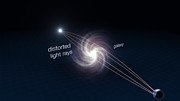
Though quasars are often extremely far way, astronomers are able to detect them through gravitational lensing, a phenomenon that acts as nature’s magnifying glass. When a  sufficiently massive galaxy closer to Earth gets in the way of light from a very distant quasar, the galaxy can act as a lens; its gravitational field warps space itself, bending the background quasar’s light into multiple images and making it look extra bright.

At times, the brightness of the quasar flickers, and since each image corresponds to a slightly different path length from quasar to telescope, the flickers appear at slightly different times for each image – they don’t all arrive on Earth at the same time. 

With HE0435-1223, PG1115+ 080, and RXJ1131-1231, the team carefully measured those time delays, which are inversely proportional to the value of the Hubble Constant. This allows astronomers to decode the light from these distant quasars and gather information about how much the universe has expanded during the time the light has been on its way to Earth.

Multiple lensed quasar images of HE0435-1223 (left), PG1115+ 080 (center), and RXJ1131-1231 (right). 
Image credit: G. Chen, C. Fassnacht, UC Davis


“One of the most important ingredients in using gravitational lensing to measure the Hubble Constant is sensitive and high-resolution imaging,” said Chen. “Up until now, the best lens-based Hubble Constant measurements all involved using data from HST. When we unblinded, we found two things. First, we had consistent values with previous measurements that were based on HST data, proving that AO data can provide a powerful alternative to HST data in the future. Secondly, we found that combining the AO and HST data gave a more precise result.”

Next Steps

Chen and his team, as well as many other groups all over the planet, are doing more research and observations to further investigate. Now that Chen’s team has proven Keck Observatory’s AO system is just as powerful as HST, astronomers can add this methodology to their bucket of techniques when measuring the Hubble Constant.

“We can now try this method with more lensed quasar systems to improve the precision of our measurement of the Hubble Constant. Perhaps this will lead us to a more complete cosmological model of the universe,” says Fassnacht.


About NIRC2

The Near-Infrared Camera, second generation (NIRC2) works in combination with the Keck II adaptive optics system to obtain very sharp images at near-infrared wavelengths, achieving spatial resolutions comparable to or better than those achieved by the Hubble Space Telescope at optical wavelengths. NIRC2 is probably best known for helping to provide definitive proof of a central massive black hole at the center of our galaxy. Astronomers also use NIRC2 to map surface features of solar system bodies, detect planets orbiting other stars, and study detailed morphology of distant galaxies.

About Adaptative Optics

W. M. Keck Observatory is a distinguished leader in the field of adaptive optics (AO), a breakthrough technology that removes the distortions caused by the turbulence in the Earth’s atmosphere. Keck Observatory pioneered the astronomical use of both natural guide star (NGS) and laser guide star adaptive optics (LGS AO) on large telescopes and current systems now deliver images three to four times sharper than the Hubble Space Telescope at near-infrared wavelengths. Keck AO has imaged the four massive planets orbiting the star HR8799, measured the mass of the giant black hole at the center of our Milky Way Galaxy, discovered new supernovae in distant galaxies, and identified the specific stars that were their progenitors. Support for this technology was generously provided by the Bob and Renee Parsons Foundation, Change Happens Foundation, Gordon and Betty Moore Foundation, Mt. Cuba Astronomical Foundation, NASA, NSF, and W. M. Keck Foundation.

About W.M. Keck Observatory

The W. M. Keck Observatory telescopes are among the most scientifically productive on Earth. The two, 10-meter optical/infrared telescopes on the summit of Maunakea on the Island of Hawaii feature a suite of advanced instruments including imagers, multi-object spectrographs, high-resolution spectrographs, integral-field spectrometers, and world-leading laser guide star adaptive optics systems.

Some of the data presented herein were obtained at Keck Observatory, which is a private 501(c) 3 non-profit organization operated as a scientific partnership among the California Institute of Technology, the University of California, and the National Aeronautics and Space Administration. The Observatory was made possible by the generous financial support of the W. M. Keck Foundation.

The authors wish to recognize and acknowledge the very significant cultural role and reverence that the summit of Maunakea has always had within the Native Hawaiian community. We are most fortunate to have the opportunity to conduct observations from this mountain.


Thursday, January 26, 2017

Cosmic lenses support finding on faster than expected expansion of the Universe


Lensed quasar and its surroundings

PR Image heic1702b
Studied lensed quasars of H0LiCOW collaboration

PR Image heic1702c
Lensed quasar

PR Image heic1702d
Lensed quasar

PR Image heic1702e
Lensed quasar

PR Image heic1702f
Lensed quasar

PR Image heic1702g
Lensed quasar


Videos

Strong Gravitational lensing

Flickering quasar images


By using galaxies as giant gravitational lenses, an international group of astronomers using the NASA/ESA Hubble Space Telescope have made an independent measurement of how fast the Universe is expanding. The newly measured expansion rate for the local Universe is consistent with earlier findings. These are, however, in intriguing disagreement with measurements of the early Universe. This hints at a fundamental problem at the very heart of our understanding of the cosmos.

The Hubble constant — the rate at which the Universe is expanding — is one of the fundamental quantities describing our Universe. A group of astronomers from the H0LiCOW collaboration, led by Sherry Suyu (associated with the Max Planck Institute for Astrophysics in Germany, the ASIAA in Taiwan and the Technical University of Munich), used the NASA/ESA Hubble Space Telescope and other telescopes [1] in space and on the ground to observe five galaxies in order to arrive at an independent measurement of the Hubble constant [2].

The new measurement is completely independent of — but in excellent agreement with — other measurements of the Hubble constant in the local Universe that used Cepheid variable stars and supernovae as points of reference [heic1611].

However, the value measured by Suyu and her team, as well as those measured using Cepheids and supernovae, are different from the measurement made by the ESA Planck satellite. But there is an important distinction — Planck measured the Hubble constant for the early Universe by observing the cosmic microwave background.

While the value for the Hubble constant determined by Planck fits with our current understanding of the cosmos, the values obtained by the different groups of astronomers for the local Universe are in disagreement with our accepted theoretical model of the Universe. “The expansion rate of the Universe is now starting to be measured in different ways with such high precision that actual discrepancies may possibly point towards new physics beyond our current knowledge of the Universe,” elaborates Suyu.

The targets of the study were massive galaxies positioned between Earth and very distant quasars — incredibly luminous galaxy cores. The light from the more distant quasars is bent around the huge masses of the galaxies as a result of strong gravitational lensing [3]. This creates multiple images of the background quasar, some smeared into extended arcs.

Because galaxies do not create perfectly spherical distortions in the fabric of space and the lensing galaxies and quasars are not perfectly aligned, the light from the different images of the background quasar follows paths which have slightly different lengths. Since the brightness of quasars changes over time, astronomers can see the different images flicker at different times, the delays between them depending on the lengths of the paths the light has taken. These delays are directly related to the value of the Hubble constant. “Our method is the most simple and direct way to measure the Hubble constant as it only uses geometry and General Relativity, no other assumptions,” explains co-lead Frédéric Courbin from EPFL, Switzerland

Using the accurate measurements of the time delays between the multiple images, as well as computer models, has allowed the team to determine the Hubble constant to an impressively high precision: 3.8% [4]. “An accurate measurement of the Hubble constant is one of the most sought-after prizes in cosmological research today,” highlights team member Vivien Bonvin, from EPFL, Switzerland. And Suyu adds: “The Hubble constant is crucial for modern astronomy as it can help to confirm or refute whether our picture of the Universe — composed of dark energy, dark matter and normal matter — is actually correct, or if we are missing something fundamental.”


Notes


[1] The study used, alongside the NASA/ESA Hubble Space Telescope, the Keck Telescope, ESO’s Very Large Telescope, the Subaru Telescope, the Gemini Telescope, the Victor M. Blanco Telescope, the Canada-France-Hawaii telescope and the NASA Spitzer Space Telescope. In addition, data from the Swiss 1.2-metre Leonhard Euler Telescope and the MPG/ESO 2.2-metre telescope were used.

[2] The gravitational lensing time-delay method that the astronomers used here to achieve a value for the Hubble constant is especially important owing to its near-independence of the three components our Universe consists of: normal matter, dark matter and dark energy. Though not completely separate, the method is only weakly dependent on these.

[3] Gravitational lensing was first predicted by Albert Einstein more than a century ago. All matter in the Universe warps the space around itself, with larger masses producing a more pronounced effect. Around very massive objects, such as galaxies, light that passes close by follows this warped space, appearing to bend away from its original path by a clearly visible amount. This is known as strong gravitational lensing.

[4] The H0LiCOW team determined a value for the Hubble constant of 71.9±2.7 kilometres per second per Megaparsec. In 2016 scientists using Hubble measured a value of 73.24±1.74 kilometres per second per Megaparsec. In 2015, the ESA Planck Satellite measured the constant with the highest precision so far and obtained a value of 66.93±0.62 kilometres per second per Megaparsec.


More Information


The Hubble Space Telescope is a project of international cooperation between ESA and NASA.

This research was presented in a series of papers to appear in the Monthly Notices of the Royal Astronomical Society.

The papers are entitled as follows: "H0LiCOW I. H0 Lenses in COSMOGRAIL’s Wellspring: Program Overview", by Suyu et al., "H0LiCOW II. Spectroscopic survey and galaxy-group identification of the strong gravitational lens system HE 0435−1223", by Sluse et al., "H0LiCOW III. Quantifying the effect of mass along the line of sight to the gravitational lens HE 0435−1223 through weighted galaxy counts", by Rusu et al., "H0LiCOW IV. Lens mass model of HE 0435−1223 and blind measurement of its time-delay distance for cosmology", by Wong et al., and "H0LiCOW V. New COSMOGRAIL time delays of HE 0435−1223: H0 to 3.8% precision from strong lensing in a flat ΛCDM model", by Bonvin et al.

The international team consists of: S. H. Suyu (Max Planck Institute for Astrophysics, Germany; Academia Sinica Institute of Astronomy and Astrophysics, Taiwan; Technical University of Munich, Germany), V. Bonvin (Laboratory of Astrophysics, EPFL, Switzerland), F. Courbin (Laboratory of Astrophysics, EPFL, Switzerland), C. D. Fassnacht (University of California, Davis, USA), C. E. Rusu (University of California, Davis, USA), D. Sluse (STAR Institute, Belgium), T. Treu (University of California, Los Angeles, USA), K. C. Wong (National Astronomical Observatory of Japan, Japan; Academia Sinica Institute of Astronomy and Astrophysics, Taiwan), M. W. Auger (University of Cambridge, UK), X. Ding (University of California, Los Angeles, USA; Beijing Normal University, China), S. Hilbert (Exzellenzcluster Universe, Germany; Ludwig-Maximilians-Universität, Munich, Germany), P. J. Marshall (Stanford University, USA), N. Rumbaugh (University of California, Davis, USA), A. Sonnenfeld (Kavli IPMU, the University of Tokyo, Japan; University of California, Los Angeles, USA; University of California, Santa Barbara, USA), M. Tewes (Argelander-Institut für Astronomie, Germany), O. Tihhonova (Laboratory of Astrophysics, EPFL, Switzerland), A. Agnello (ESO, Garching, Germany), R. D. Blandford (Stanford University, USA), G. C.-F. Chen (University of California, Davis, USA; Academia Sinica Institute of Astronomy and Astrophysics, Taiwan), T. Collett (University of Portsmouth, UK), L. V. E. Koopmans (University of Groningen, The Netherlands), K. Liao (University of California, Los Angeles, USA), G. Meylan (Laboratory of Astrophysics, EPFL, Switzerland), C. Spiniello (INAF – Osservatorio Astronomico di Capodimonte, Italy; Max Planck Institute for Astrophysics, Garching, Germany) and A. Yıldırım (Max Planck Institute for Astrophysics, Garching, Germany)

Image credit: NASA, ESA, Suyu (Max Planck Institute for Astrophysics), Auger (University of Cambridge)


Links


Contacts 

Sherry Suyu
Max Planck Institute for Astrophysics
Garching, Germany
Tel: +49 89 30000 2015
Email:
suyu@mpa-garching.mpg.de

Vivien Bonvin
Institute of Physics, Laboratory of Astrophysics, Ecole Polytechnique Fédérale de Lausanne (EPFL), Observatory of Sauverny
Versoix, Switzerland
Tel: +41 22 3792420
Email:
vivien.bonvin@epfl.ch

Frederic Courbin
Institute of Physics, Laboratory of Astrophysics, Ecole Polytechnique Fédérale de Lausanne (EPFL), Observatory of Sauverny
Versoix, Switzerland
Tel: +41 22 3792418
Email:
frederic.courbin@epfl.ch

Mathias Jäger
ESA/Hubble, Public Information Officer
Garching, Germany
Tel: +49 176 62397500
Email: hubble@eso.org


Wednesday, November 11, 2015

Time Delay in Lensed Quasar: First Fast Turnaround Result

30"x30" color composite g+r+i image using data from both Gemini and the NOT, highlighting the three brighter lensed quasar images for which time delays have now been measured. Image C leads all other images of the quasar by several years, and hence predicts the future behaviour. Lensing of quasars is achromatic, but the NOT data (r,i) and Gemini data (g) were taken at different times, and hence image C appears in this composite to be a different color than images A and B. 


A team of Norwegian and US astronomers, using data from Gemini North and the Nordic Optical Telescope (NOT), have measured the time delay in images of a quasar lensed by a foreground cluster of galaxies. The Gemini observations are the first published result obtained with the innovative Fast Turnaround (FT) mode of observing.

A distant quasar may have its light split into multiple images by a foreground galaxy cluster that acts as a gravitational lens. The light travels along different paths of differing lengths to form each of these images. Quasars themselves are intrinsically variable, so the observed fading and brightening of each image happens at different observed times. Measuring these “time delays” yields tight constraints on the mass distribution in the lensing cluster, as well as the lensing geometry, and hence cosmology.

The team monitored the redshift z=2.82 quasar SDSS J2222+2745 over the course of three years, using the NOT and Gemini+GMOS-N. They found a time delay of 48 and 722 days for two pairs of the quasar’s lensed images. The Gemini data were instrumental in refining the time delay measurements for the quasar image that leads the other image by ~ 2 years and hence predicts the behavior of other images of the quasar; continuing monitoring of the system will now allow further observations that take advantage of that 2 year peek into the future.

Under Gemini’s FT mode, users can submit proposals every month and (if accepted) receive data 1-4 months after their initial proposal idea. The mode can be used for any kind of scientifically valuable project that needs just a few hours of observing time. Since the program’s launch in January, it has been used to follow up discoveries of new solar system objects, obtain data sets needed to complete projects, and also for short, self-contained programs. For more information, see the FT web pages: http://www.gemini.edu/sciops/observing-gemini/observing-modes/fast-turnaround.

This work is available on Astro-ph at: http://arxiv.org/abs/1505.06187.

Paper Abstract:

We report first results from an ongoing monitoring campaign to measure time delays between the six images of the quasar SDSS J2222+2745, gravitationally lensed by a galaxy cluster. The time delay between A and B, the two most highly magnified images, is measured to be τAB=47.7±6.0 days (95% confidence interval), consistent with previous model predictions for this lens system. The strong intrinsic variability of the quasar also allows us to derive a time delay value of τCA=722±24 days between image C and A, in spite of modest overlap between their light curves in the current data set. Image C, which is predicted to lead all the other lensed quasar images, has undergone a sharp, monotonic flux increase of 60-75% during 2014. A corresponding brightening is firmly predicted to occur in images A and B during 2016. The amplitude of this rise indicates that time delays involving all six known images in this system, including those of the demagnified central images D-F, will be obtainable from further ground-based monitoring of this system during the next few years.


Wednesday, February 20, 2013

3-D Observations of the Outflow from an Active Galactic Nucleus

A Japanese team of astronomers, led by Toru Misawa (Shinshu University), has used the Subaru Telescope to observe a distant gravitationally-lensed quasar (Note 1) and probed an active galactic nucleus in its central region. Looking through multiple sight lines, the astronomers obtained a 3-D view of the quasar and discovered complex small structures inside outflows from the galactic nucleus. These outflows will spread widely and eventually affect the evolution of the host galaxy.

Figure 1: An artist's rendition of the central region of the quasar. A gaseous disk surrounds a central black hole. The outflow is gas streaming from the disk outward along the curved mesh, which indicates the distortion of space/time, and is distinguished from a jet that is blowing vertically. The arrows A, B, and C indicate the light paths observed, which probably pass near the surface of an outflow. (Credit: Shinshu University and the National Astronomical Observatory of Japan)

Quasars are bright central regions of some distant galaxies. Their luminosities are often hundreds of times greater than those of their host galaxies (Note 2). Scientists believe that their light source is a very bright gaseous disk surrounding a supermassive black hole at the center of the galaxy. Gas streams called "outflows" move outward from the disk (Figure 1) and have a substantial influence on surrounding interstellar/intergalactic regions. However, because quasars at large distances look like mere stars, their internal structures are not easy to investigate.

Figure 2: Left: Schematic drawing of the gravitational lensing, showing SDSS J1029+2623 (at ~10 billion light years), a cluster of galaxies (at ~5 billion light years), and Earth. An outflow is a very small domain surrounded by a large ring of dust.  

Right: An Earthly analogy of gravitational lensing. The diagram shows how scenery looks from different directions (without considering the image distortion by the lensing) and serves as a comparison to the lensed images of the quasar. (Credit: Shinshu University and the National Astronomical Observatory of Japan)
 
The current team used the large light-gathering power of the 8.2 m Subaru Telescope mounted with its high-resolution spectrograph HDS (High Dispersion Spectrograph) to observe the quasar SDSS J1029+2623 (from now on referred to as "J 1029") and examine its structure. This quasar is ~10 billion light years distant from Earth (Note 1) toward the constellation Leo, and a massive cluster of galaxies, ~5 billion light years away, lies between the quasar and Earth (Figure 2). Because astronomical objects are usually very distant, they are difficult to study from different angles. Nevertheless, gravitational lensing opens up this possibility. If a cluster of galaxies lies along the line of sight to a distant quasar, then part of the light from the distant quasar (the "lensed quasar") bends around the intervening cluster (the "lensing cluster"), and observers will see more highly resolved and brighter images of the now magnified background quasar. Due to the gravitational lensing by the cluster intervening between J 1029 and Earth, there is significant distortion in the light path from the quasar, and it splits into three images: A, B, and C (Figure 3, Note 3). The maximum separation angle, ~22".5 (Note 4), between images A and B is a current record; it is larger than the typical separation of quasar images lensed by a single galaxy. The team hypothesized that each lensed image could contain information on the outflow from the quasar when viewed from different angles (Figures 1 and 2).

Figure 3: Color image of the region around SDSS J1029+2623, taken with Hubble Space Telescope. Quasar images (marked with A, B, and C) are gravitationally lensed by a foreground cluster of galaxies. Three galaxies of the lensing cluster (marked as G1a, b and G2) are visible. (Credit: Shinshu University, the National Astronomical Observatory of Japan, and Kavli Institute for the Physics and Mathematics of the Universe)

The team used Subaru Telescope's HDS to perform spectroscopic observations of the brightest two images A and B (Note 5), and their results supported their hypothesis. Any absorber between the quasar and Earth provides absorption features in the spectra of the quasar images. While most absorption features originate from foreground objects that are physically unrelated to the quasar, some show clear evidence of origins from the outflow, such as partial coverage by clouds (Note 6). Those features show a clear difference between the images A and B, although they are generally similar (Figure 4). This result supports the idea that the sight lines are going through different areas of the outflow from different directions. When viewed through one eye alone, an object appears to be two-dimensional, but viewing with both eyes yields a 3-D image that provides multi-directional information. This process is analogous to what occurred in the observations (Figure 2, Note 7).

Figure 4: Comparison of absorption features of three elements, carbon, nitrogen, and hydrogen (from top to bottom), seen in spectra of the lensed images A (red line) and B (blue line). All of them arise at the outflow. A horizontal axis is an outflow velocity from the light source, defined as negative if it heads to Earth. The shaded area shows a clear difference between the images A and B. (Credit: Shinshu University and the National Astronomical Observatory of Japan)

It is surprising that the absorption profiles arising in the outflow show clear differences between them, despite the small separation angle of ~22".5. Misawa commented on this discovery saying, "The outflow may not necessarily be homogeneous, but could instead have a complex internal structure with a number of clumpy gas clouds like cirrocumulus clouds in Earth's atmosphere. The team plans to observe the area in image C in more detail." Direct observation of a clumpy structure in tandem with theoretical analysis will contribute to revealing the mysterious formation history of these outflows.

The team has also explored other explanations for the outflows. Because the light paths of the images A and B are different, they have a substantial time difference between them when they reach Earth (Note 8). If the internal structure of the outflow varies with time, the two images deliver information about different epochs even if they pass through the same region of the outflow. The astronomers intend to conduct observations with the Subaru Telescope in March, 2013 to test the "time-variation" scenario.

References:
The research paper on which this release is based was published on-line in the January 15, 2013 edition of The Astronomical Journal: T. Misawa et al., "Spectroscopy along Multiple, Lensed Sight Lines through Outflowing Winds in the Quasar SDSS J1029+2623", vol. 145, issue 2, article id. 48 (2013). The authors of the paper are:
  • T. Misawa, Shinshu University, Japan
  • N. Inada, Nara National College of Technology, Japan
  • K. Ohsuga, National Astronomical Observatory of Japan, Japan
  • P. Gandhi, Institute of Space and Astronautical Science, Japan
  • R. Takahashi, Tomakomai National College of Technology, Japan
  • M. Oguri, Kavli Institute for the Physics and Mathematics of the Universe, Japan
Acknowledgements:
This research was supported by the following:
  • Special Postdoctoral Research Program of RIKEN, the Japan Society for the Promotion of Science (23740148, 23740161)
  • Shinshu University Research Grant for Exploratory Research by Young Scientists
  • The FIRST program "Subaru Measurements of Images and Redshifts (SuMIRe)"
  • World Premier International Research Center Initiative (WPI Initiative), MEXT, Japan
Notes:
  1. It corresponds to a redshift of z~2.197. A "z" or redshift value measures how much the expansion of space has stretched the light from an object. Generally, the greater the observed z value for a galaxy, the more distant it is in time and space from Earth.
  2. Because their appearance is star-like, they are called "quasi-stellar objects" and abbreviated as quasars.
  3. An international team led by Naohisa Inada and Masamune Oguri (both are members of the current research team) discovered the first quasar (SDSS J1004+4112) that is lensed by a cluster of galaxies (http://www.sdss.org/news/releases/20031217.lensing.html). Only three quasars that are lensed by a cluster of galaxies have been discovered so far (SDSS J1004+4112, SDSS J1029+2623, and SDSS J2222+2745). Among them, SDSS J1029+2623 has the largest separation angle.
  4. 1 arcsec (1") is a unit of angle, defined as 1/3600 of 1 degree. Human eyes cannot distinguish such a small angle.
  5. The observed flux ratio of the three lensed images is A:B:C ~ 0.95:1.00:0.24.
  6. This means that an absorber only partially covers the background light source toward the sight line. Because foreground interstellar or intergalactic media are larger than the light source of the quasar by more than several orders, only small gas clouds in the vicinity of the quasar can reproduce a partial coverage.
  7. Similar observation has been also performed for the other lensed quasar DSS J1004+4112 (Green, P. 2006, the Astrophysical Journal, vol. 644, pp.733-741).
  8. The image A leads the image B by 744 days (Fohlmeister, J. et al., 2013, The Astrophysical Journal, vol. 764, 186).