Showing posts with label ESA/HUBLLE. Show all posts

Wednesday, May 07, 2025

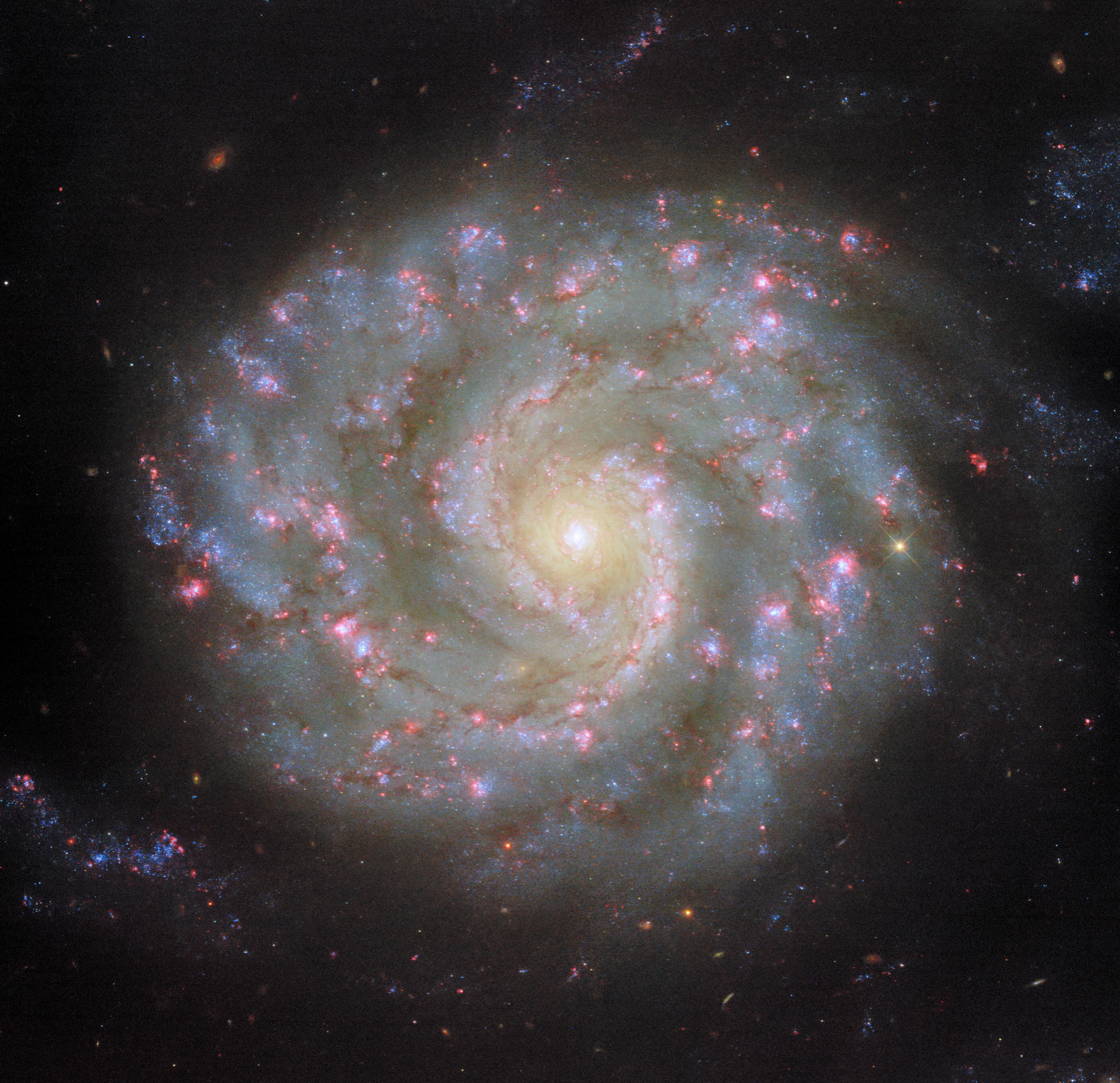
Face to face with a spiral’s arms

A spiral galaxy viewed face-on, with a slightly oval-shaped disc. The centre is a bright white spot surrounded by a golden glow. Two spiral arms extend out from the centre, wrapping around the galaxy and broadening out to form the thick outer edge of the disc. Thin reddish strands of dust and bright pink spots follow the arms through the disc.

The spiral galaxy NGC 3596 is on display in this NASA/ESA Hubble Space Telescope Picture of the Week, which incorporates six different wavelengths of light. NGC 3596 is situated 90 million light-years from Earth in the constellation Leo. The galaxy was discovered in 1784 by astronomer William Herschel, the namesake of ESA’s Herschel Space Observatory.

NGC 3596 appears almost perfectly face-on when viewed from Earth, showcasing the galaxy’s neatly wound spiral arms. The bright arms mark where the galaxy’s stars, gas and dust are concentrated. Star formation is also most active in a galaxy’s spiral arms, as shown by the brilliant pink star-forming regions and young blue stars tracing NGC 3596’s arms in this image.

What causes these spiral arms to form? It’s a surprisingly difficult question to answer, partly because of the remarkable diversity of spiral galaxies. Some have clear spiral arms, while others have patchy, feathery arms. Some have prominent bars across their centres, while others have compact, circular nuclei. Some have close neighbours, while others are isolated.NGC 3596

Early ideas of how spiral arms formed were stumped by what’s called the ‘winding problem’. If a galaxy’s spiral arms are coherent structures, the arms would be wound tighter and tighter as the galaxy spins, until the arms are no longer visible. Now, researchers believe that spiral arms represent a pattern of high-density and low-density areas rather than a physical structure. As stars, gas and dust orbit within a galaxy’s disc, they pass in and out of the spiral arms. Much like cars moving through a traffic jam, these materials slow down and bunch up as they enter a spiral arm, before emerging and continuing their journey through the galaxy.


Wednesday, April 22, 2020

Hubble Observes Aftermath of Massive Collision

Visualisation of Fomalhaut and Fomalhaut b (Artist’s Impression)

Illustration of Hubble’s Observation of Fomalhaut b’s Expanding Dust Cloud

DSS image of Fomalhaut (ground-based image)

Fomalhaut and Piscis Austrinus (ground-based image)


Videos

Hubblecast 127 Light: The Mysteries of Fomalhaut b


The Hubble Space Telescope offers insight into the nature of exoplanet Fomalhaut b

What astronomers thought was a planet beyond our solar system, has now seemingly vanished from sight. Astronomers now suggest that a full-grown planet never existed in the first place. The NASA/ESA Hubble Space Telescope had instead observed an expanding cloud of very fine dust particles caused by a titanic collision between two icy asteroid-sized bodies orbiting the bright star Fomalhaut, about 25 light-years from Earth.

“The Fomalhaut system is the ultimate test lab for all of our ideas about how exoplanets and star systems evolve,” said George Rieke of the University of Arizona’s Steward Observatory. “We do have evidence of such collisions in other systems, but none of this magnitude has ever been observed. This is a blueprint for how planets destroy each other.”

The object was previously believed to be a planet, called Fomalhaut b, and was first announced in 2008 based on data taken in 2004 and 2006. It was clearly visible in several years of Hubble observations that revealed it as a moving dot. Unlike other directly imaged exoplanets, nagging puzzles with Fomalhaut b arose early on. The object was unusually bright in visible light, but did not have any detectable infrared heat signature. Astronomers proposed that the added brightness came from a huge shell or ring of dust encircling the object that may have been collision-related. Also, early Hubble observations suggested the object might not be following an elliptical orbit, as planets usually do.

“These collisions are exceedingly rare and so this is a big deal that we actually get to see one,” said András Gáspár of the University of Arizona. “We believe that we were at the right place at the right time to have witnessed such an unlikely event with the Hubble Space Telescope.”

“Our study, which analysed all available archival Hubble data on Fomalhaut b, including the most recent images taken by Hubble, revealed several characteristics that together paint a picture that the planet-sized object may never have existed in the first place,” [1] said Gáspár.

Hubble images from 2014 showed the object had vanished, to the disbelief of the astronomers. Adding to the mystery, earlier images showed the object to continuously fade over time. “Clearly, Fomalhaut b was doing things a bona fide planet should not be doing,” said Gáspár.

The resulting interpretation is that Fomalhaut b is not a planet, but a slowly expanding cloud blasted into space as a result of a collision between two large bodies. Researchers believe the collision occurred not too long prior to the first observations taken in 2004. By now the debris cloud, consisting of dust particles around 1 micron (1/50th the diameter of a human hair), is below Hubble’s detection limit. The dust cloud is estimated to have expanded by now to a size larger than the orbit of Earth around our Sun.

Equally confounding is that the object is not on an elliptical orbit, as expected for planets, but on an escape trajectory, or hyperbolic path. “A recently created massive dust cloud, experiencing considerable radiative forces from the central star Fomalhaut, would be placed on such a trajectory” Gáspár said, “Our model is naturally able to explain all independant observable paramters of the system: its expansion rate, its fading and its trajectory.”

Because Fomalhaut b is presently inside a vast ring of icy debris encircling the star, the colliding bodies were likely a mixture of ice and dust, like the cometary bodies that exist in the Kuiper belt on the outer fringe of our solar system. Gáspár and Rieke estimate that each of these comet-like bodies measured about 200 kilometers across. The also suggest that the Fomalhaut system may experience one of these collision events only every 200 000 years.

Gáspár, Rieke, and other astronomers will also be observing the Fomalhaut system with the upcoming NASA/ESA/CSA James Webb Space Telescope, which is scheduled to launch in 2021.


Notes

[1] The team’s paper “New HST data and modeling reveal a massive planetesimal collision around Fomalhaut” is being published in the Proceedings of the National Academy of Sciences on 20 April 2020.


More information

The Hubble Space Telescope is a project of international cooperation between ESA and NASA.

The team of astronomers in this study consists of A. Gáspár and G. Rieke of the University of Arizona, USA.

Image credit: ESA/NASA, M. Kornmesser


Links


Contact

András Gáspár
University of Arizona
Tucson, Arizona, USA

Bethany Downer
ESA/Hubble, Public Information Officer
Garching, Germany

Source: ESA/Hubble/News


Friday, December 13, 2019

Galactic Diversity

Credit: ESA/Hubble & NASA, D. Rosario et al.

NGC 3175 is located around 50 million light-years away in the constellation of Antlia (The Air Pump). The galaxy can be seen slicing across the frame in this image from the NASA/ESA Hubble Space Telescope, with its mix of bright patches of glowing gas, dark lanes of dust, bright core, and whirling, pinwheeling arms coming together to paint a beautiful celestial scene.

The galaxy is the eponymous member of the NGC 3175 group, which has been called a nearby analogue for the Local Group. The Local Group contains our very own home galaxy, the Milky Way, and around 50 others — a mix of spiral, irregular, and dwarf galaxies. The NGC 3175 group contains a couple of large spiral galaxies — the subject of this image, and NGC 3137 — and numerous lower-mass spiral and satellite galaxies. Galaxy groups are some of the most common galactic gatherings in the cosmos, and they comprise 50 or so galaxies all bound together by

This image comprises observations from Hubble’s Wide Field Camera 3.


Saturday, November 09, 2019

Champions League

Credit: ESA/Hubble & NASA, K. Stapelfeldt

Within a galaxy hosting around 300 billion stars, here the NASA/ESA Hubble Space Telescope has captured a mere handful or two — just about enough to form a single football team. These stellar “teammates” play under the banner of NGC 1333, the cloud of gas and dust which formed them and that they continue to call home.

NGC 1333 is located about 1000 light-years away in the constellation of Perseus (The Hero). The cool gas and dust concentrated in this region is generating new stars whose light is then reflecting off the surrounding material, lighting it up and making this object’s lingering presence known to us. NGC 1333 is accordingly classified as a reflection nebula.

This image shows just a single region of NGC 1333. Hubble has imaged NGC 1333 more widely before, revealing that the smattering of stars seen here has ample company. Seen in a broader context, this team of stars is but one gathering amongst many in NGC 1333’s celestial Champions League.


Sunday, August 05, 2018

Probing the distant past

Credit: ESA/Hubble & NASA
Acknowledgement: Judy Schmidt (
Geckzilla)


Obtained for a research programme on star formation in old and distant galaxies, this NASA/ESA Hubble Space Telescope image obtained with its Wide Field Camera 3 (WFC3) demonstrates the immense effects of gravity; more specifically, it shows the effects of gravitational lensing caused by an object called SDSS J1152+3313.

Gravitational lenses — such as this galaxy cluster SDSS J1152+3313 — possess immense masses that wrap their surroundings and bend the light from faraway objects into rings, arcs, streaks, blurs, and other odd shapes. This lens, however, is not only wrapping the appearance of a distant galaxy — it is also amplifying its light, making it appear much brighter than it would be without the lens. Combined with the high image quality obtainable with Hubble, this gives valuable clues into how stars formed in the early Universe.

Star formation is a key process in astronomy. Everything that emits light is somehow connected to stars, so understanding how stars form is key to understanding countless objects lying across the cosmos. Astronomers can probe these early star-forming regions to learn about the sizes, luminosities, formation rates, and generations of different types of stars.


Friday, May 15, 2015

Galactic onion

Credit: ESA/Hubble & NASA
Acknowledgement: Judy Schmidt


The glowing object in this image is an elliptical galaxy called NGC 3923. It is located over 90 million light-years away in the constellation of Hydra.

NGC 3923 is an example of a shell galaxy where the stars in its halo are arranged in layers.

Finding concentric shells of stars enclosing a galaxy is quite common and is observed in many elliptical galaxies. In fact, every tenth elliptical galaxy exhibits this onion-like structure, which has never been observed in spiral galaxies. The shell-like structures are thought to develop as a consequence of galactic cannibalism, when a larger galaxy ingests a smaller companion. As the two centres approach, they initially oscillate about a common centre, and this oscillation ripples outwards forming the shells of stars just as ripples on a pond spread when the surface is disturbed.

NGC 3923 has over twenty shells, with only a few of the outer ones visible in this image and its shells are much more subtle than those of other shell galaxies. The shells of this galaxy are also interestingly symmetrical, while other shell galaxies are more skewed.

A version of this image was entered into the Hubble’s Hidden Treasures image processing competition by contestant Judy Schmidt.


Monday, December 26, 2011

Faint Galaxy with Popping Pink Features


IC 2574
Credit: ESA/Hubble & NASA

The NASA/ESA Hubble Space Telescope has imaged a region of space containing the intriguing object IC 2574. Pink bubbles blown by supernova explosions abound in this faint galaxy. The colour of these shells comes from hydrogen gas irradiated by newborn stars. The formation of the stars was triggered by shock waves from earlier supernova detonations that compressed material together.

IC 2574 is commonly known as Coddington's Nebula after the American astronomer Edwin Coddington, who discovered it in 1898. Astronomers classify IC 2574 as a dwarf irregular galaxy due to its relatively small size and lack of organisation or structure. These galaxies are thought to resemble some of the earliest that formed in the Universe. Dwarf irregular galaxies thus serve as useful "living fossils" for studying the evolution of more complex galaxy types such as our home, the Milky Way, with its central bar and spiral arms. The expanding shells in IC 2574 are of particular interest to astronomers as they reveal how supernova-driven explosions ignite round after round of star formation.

The constellation containing IC 2574 is Ursa Major (The Great Bear). IC 2574 is located about 12 million light-years away, belonging to the Messier 81 group of galaxies. This group is named after the most prominent galaxy in its midst, the big, bright and accordingly well-studied spiral galaxy Messier 81.

This picture was produced with Hubble’s Advanced Camera for Surveys, and covers a field of view of around 3.3 by 3.3 arcminutes.

Friday, December 23, 2011

Hubble Captures a “Lucky” Galaxy Alignment

LRG 3-757
Credit: ESA/Hubble & NASA

An interesting galaxy has been circled in this NASA/ESA Hubble Space Telescope image. The galaxy — one of a group of galaxies called Luminous Red Galaxies — has an unusually large mass, containing about ten times the mass of the Milky Way. However, it’s actually the blue horseshoe shape that circumscribes the red galaxy that is the real prize in this image.

This blue horseshoe is a distant galaxy that has been magnified and warped into a nearly complete ring by the strong gravitational pull of the massive foreground Luminous Red Galaxy. To see such a so-called Einstein Ring required the fortunate alignment of the foreground and background galaxies, making this object’s nickname “the Cosmic Horseshoe” particularly apt.

The Cosmic Horseshoe is one of the best examples of an Einstein Ring. It also gives us a tantalising view of the early Universe: the blue galaxy’s redshift — a measure of how the wavelength of its light has been stretched by the expansion of the cosmos — is approximately 2.4. This means we see it as it was about 3 billion years after the Big Bang. The Universe is now 13.7 billion years old.

Astronomers first discovered the Cosmic Horseshoe in 2007 using data from the Sloan Digital Sky Survey. But this Hubble image, taken with the Wide Field Camera 3, offers a much more detailed view of this fascinating object.

This picture was created from images taken in visible and infrared light on Hubble’s Wide Field Camera 3. The field of view is approximately 2.6 arcminutes wide.

Saturday, December 17, 2011

Standing out from the Crowd

NGC 6642
Credit: ESA/Hubble & NASA

The compact nature of globular clusters is a double-edged sword. On the one hand, having so many stars of a similar age in one bundle gives astronomers insights into the chemical makeup of our galaxy in its early history. But, at the same time, the high density of stars in the cores of globulars also makes it difficult for astronomers to resolve individual stars.

The core of NGC 6642, shown here in this Hubble Space Telescope image, is particularly dense, making this globular a difficult observational target for most telescopes. Furthermore, it occupies a very central position in our galaxy, which means that images inadvertently capture many stars that don’t belong to the cluster — these “field stars” just get in the way.

However, using Hubble’s powerful Advanced Camera for Surveys (ACS), astronomers can identify and remove such distracting field stars, and resolve the cluster’s dense core in unprecedented detail. Using Hubble’s ACS, astronomers have already made many interesting finds about NGC 6642. For example, many “blue stragglers” (stars which seemingly lag behind in their rate of aging) have been spotted in this globular, and it is known to be lacking in low-mass stars.

This picture was created from visible and infrared images taken with the Wide Field Channel of the Advanced Camera for Surveys. The field of view is approximately 1.6 by 1.6 arcminutes.

Thursday, December 15, 2011

Young star rebels against its parent cloud

PR Image heic1118a
Hubble view of star-forming region S106

PR Image heic1118b
Hubble/Subaru composite of star-forming region S 106

PR Image heic1118c
Ground-based view of the area around star-forming region S 106

Videos

PR Video heic1118a
Hubblecast 51: Star-forming region S 106

PR Video heic1118b
Animation of S 106

PR Video heic1118c
Zooming in on S 106

PR Video heic1118d
Pan over S 106

PR Video heic1118e
Artist’s impression of S 106

Hubble’s Wide Field Camera 3 has captured this image of a giant cloud of hydrogen gas illuminated by a bright young star. The image shows how violent the end stages of the star-formation process can be, with the young object shaking up its stellar nursery.

Despite the celestial colours of this picture, there is nothing peaceful about star forming region Sh 2-106, or S106 for short. A devilish young star, named S106 IR, lies in it and ejects material at high speed, which disrupts the gas and dust around it. The star has a mass about 15 times that of the Sun and is in the final stages of its formation. It will soon quieten down by entering the main sequence, the adult stage of stellar life.

For now, S106 IR remains embedded in its parent cloud, but it is rebelling against it. The material spewing off the star not only gives the cloud its hourglass shape but also makes the hydrogen gas in it very hot and turbulent. The resulting intricate patterns are clearly visible in this Hubble image.

The young star also heats up the surrounding gas, making it reach temperatures of 10 000 degrees Celsius. The star’s radiation ionises the hydrogen lobes, making them glow. The light from this glowing gas is coloured blue in this image.

Separating these regions of glowing gas is a cooler, thick lane of dust, appearing red in the image. This dark material almost completely hides the ionising star from view, but the young object can still be seen peeking through the widest part of the dust lane.

S106 was the 106th object to be catalogued by the astronomer Stewart Sharpless in the 1950s. It is a few thousand light-years distant in the direction of Cygnus (The Swan). The cloud itself is relatively small by the standards of star-forming regions, around 2 light-years along its longest axis. This is about half the distance between the Sun and Proxima Centauri, our nearest stellar neighbour.

This composite picture was obtained with the Wide Field Camera 3 on the NASA/ESA Hubble Space Telescope. It results from the combination of two images taken in infrared light and one which is tuned to a specific wavelength of visible light emitted by excited hydrogen gas, known as H-alpha. This choice of wavelengths is ideal for targetting star-forming regions. The H-alpha filter isolates the light emitted from hydrogen in gas clouds while the infrared light can shine through the dust that often obscures these regions.

Notes

The Hubble Space Telescope is a project of international cooperation between ESA and NASA.
Image credit: NASA, ESA and the Hubble Heritage Team (STScI/AURA)

Links
Images of Hubble
NASA press release

Contacts

Oli Usher
Hubble/ESA
Garching, Germany
Tel: +49-89-3200-6855
Email: ousher@eso.org

Friday, December 09, 2011

The Frosty Leo Nebula

IRAS 09371+1212
Credit: ESA/Hubble & NASA

Three thousand light-years from Earth lies the strange protoplanetary nebula IRAS 09371+1212, nicknamed the Frosty Leo Nebula. Despite their name, protoplanetary nebulae have nothing to do with planets: they are formed from material shed from their aging central star. The Frosty Leo Nebula has acquired its curious name as it has been found to be rich in water in the form of ice grains, and because it lies in the constellation of Leo.

This nebula is particularly noteworthy because it has formed far from the galactic plane, away from interstellar clouds that may block our view. The intricate shape comprises a spherical halo, a disc around the central star, lobes and gigantic loops. This complex structure strongly suggests that the formation processes are complex and it has been suggested that there could be a second star, currently unseen, contributing to the shaping of the nebula.

Protoplanetary nebulae like the Frosty Leo Nebula have brief lifespans by astronomical standards and are precursors to the planetary nebula phase, in which radiation from the star will make the nebula’s gas light up brightly. Their rarity makes studying them a priority for astronomers who seek to understand better the evolution of stars.

This picture was created from images taken with the High Resolution Channel of Hubble’s Advanced Camera for Surveys, which images a small area of sky (only 26 by 29 arcseconds) in high detail.

Monday, November 21, 2011

Probing a super-giant shell of gas and stars

Large Magellanic Cloud
Credit: ESA/Hubble, NASA and D. A. Gouliermis

In one of the largest known star formation regions in the Large Magellanic Cloud (LMC), a small satellite galaxy of the Milky Way, lie young and bright stellar groupings known as OB associations. One of these associations, called LH 72, was captured in this dramatic NASA/ESA Hubble Space Telescope image. It consists of a few high-mass, young stars embedded in a beautiful and dense nebula of hydrogen gas.

Much of the star formation in the LMC occurs in super-giant shells. These regions of interstellar gas are thought to have formed due to strong stellar winds and supernova explosions that cleared away much of the material around the stars creating wind-blown shells. The swept-up gas eventually cools down and fragments into smaller clouds that dot the edges of these regions and eventually collapse to form new stars.

The biggest of these shells, home to LH 72, is designated LMC4. With a diameter of about 6000 light-years, it is the largest in the Local Group of galaxies that is home to both the Milky Way and LMC. Studying gas-embedded young associations of stars like LH 72 is a way of probing the super-giant shells to understand how they formed and evolved.

This image was taken with Hubble’s Wide Field Planetary Camera 2 using five different filters in ultraviolet, visible and infrared light. The field of view is approximately 1.8 by 1.8 arcminutes.

Monday, October 31, 2011

Looking to the Heavens

IRAS 10082-5647
Credit: ESA/Hubble & NASA

The pearly wisps surrounding the central star IRAS 10082-5647 in this Hubble image certainly draw the eye towards the heavens. The divine-looking cloud is a reflection nebula, made up of gas and dust glowing softly by the reflected light of nearby stars, in this case a young Herbig Ae/Be star.

The star, like others of this type, is still a relative youngster, only a few million years old. It has not yet reached the so-called main sequence phase, where it will spend around 80% of its life creating energy by burning hydrogen in its core. Until then the star heats itself by gravitational collapse, as the material in the star falls in on itself, becoming ever denser and creating immense pressure which in turn gives off copious amounts of heat.

Stars only spend around 1% of their lives in this pre-main sequence phase. Eventually, gravitational collapse will heat the star’s core enough for hydrogen fusion to begin, propelling the star into the main sequence phase, and adulthood.

The Advanced Camera for Surveys aboard the Hubble Space Telescope captured the whorls and arcs of this nebula, lit up with the light from IRAS 10082-5647. Visible (555 nm) and near-infrared (814 nm) filters were used, coloured blue and red respectively. The field of view is around 1.3 by 1.3 arcminutes.

Monday, October 24, 2011

Hubble Sizes up a Dwarf Galaxy

Phoenix Dwarf Galaxy
Credit: ESA/Hubble & NASA
Fullsize Original 1,2 mb

The NASA/ESA Hubble Space Telescope has taken this image of the Phoenix Dwarf Galaxy, which is located 1.4 million light-years away from Earth. It is located in the constellation of Phoenix in the southern sky. The object, a dwarf irregular galaxy, features younger stars in its inner regions and older ones at its outskirts.

Dwarf galaxies are small galaxies composed of a few billion stars, compared to fully-fledged galaxies which can contain hundreds of billions of stars. In the Local Group, there are a number of such dwarf galaxies orbiting the larger galaxies such as the Milky Way or the Andromeda Galaxy. They are thought to have been created by tidal forces in the early stages of the creation of these galaxies, or as a result of collisions between galaxies, forming from ejected streams of material and dark matter from the parent galaxies. The Milky Way galaxy features at least 14 satellite dwarf galaxies orbiting it.

Because of their shape, dwarf irregulars have often been mistaken for globular clusters: they do not feature a bulge or spiral arms like larger galaxies. However, their importance in terms of cosmology is in stark contrast to their unspectacular shapes, as their chemical makeup and high levels of gas are believed to be similar to those of the earliest galaxies that populated the Universe. They are thought to be contemporary versions of some of the remote galaxies observed in deep field galaxy surveys, and can thus help to understand the early stages of galaxy and star formation in the young Universe.

The galaxy was discovered in 1976 by Hans-Emil Schuster and Richard Martin West. Hans-Emil Schuster was acting director of ESO’s La Silla Observatory in Chile and was involved in the selection and testing of the sites for the observatories of both La Silla and Paranal. His great contribution to astronomy and to ESO was recognised by the Chilean government last week when he was awarded the medal of the Order of Bernardo O’Higgins.

Friday, October 07, 2011

Spot the Difference — Hubble spies another globular cluster, but with a secret

NGC 5024 - Messier 53
Credit: ESA/Hubble & NASA


Thousands and thousands of brilliant stars make up this globular cluster, Messier 53, captured with crystal clarity in this image from the NASA/ESA Hubble Space Telescope. Bound tightly by gravity, the cluster is roughly spherical and becomes denser towards its heart.

These enormous sparkling spheres are by no means rare, and over 150 exist in the Milky Way alone, including Messier 53. It lies on the outer edges of the galaxy, where many other globular clusters are found, almost equally distant from both the centre of our galaxy and the Sun. Although they are relatively common, the famous astronomer William Herschel, not at all known for his poetic nature, once described a globular cluster as “one of the most beautiful objects I remember to have seen in the heavens”, and it is clear to see why.

Globular clusters are much older and larger than open clusters, meaning they are generally expected to contain more old red stars and fewer massive blue stars. But Messier 53 has surprised astronomers with its unusual number of a type of star called blue stragglers.

These youngsters are rebelling against the theory of stellar evolution. All the stars in a globular cluster are expected to form around the same time, so they are expected follow a specific trend set by the age of the cluster and based on their mass. But blue stragglers don’t follow that rule; they appear to be brighter and more youthful than they have any right to be. Although their precise nature remains mysterious these unusual objects are probably formed by close encounters, possibly collisions, between stars in the crowded centres of globular clusters.

This picture was put together from visible and infrared exposures taken with the Wide Field Channel of Hubble's Advanced Camera for Surveys.The field of view is approximately 3.4 arcminutes across.

Friday, September 23, 2011

Galaxies in a Swarm of Star Clusters

NGC 4874
Credit: ESA/Hubble & NASA

In the centre of a rich cluster of galaxies located in the direction of the constellation of Coma Berenices, lies a galaxy surrounded by a swarm of star clusters. NGC 4874 is a giant elliptical galaxy, about ten times larger than the Milky Way, at the centre of the Coma Galaxy Cluster. With its strong gravitational pull, it is able to hold onto more than 30 000 globular clusters of stars, more than any other galaxy that we know of, and even has a few dwarf galaxies in its grasp.

In this NASA/ESA Hubble Space Telescope image, NGC 4874 is the brightest object, located to the right of the frame and seen as a bright star-like core surrounded by a hazy halo. A few of the other galaxies of the cluster are also visible, looking like flying saucers dancing around NGC 4874. But the really remarkable feature of this image is the point-like objects around NGC 4874, revealed on a closer look: almost all of them are clusters of stars that belong to the galaxy. Each of these globular star clusters contains many hundreds of thousands of stars.

Recently, astronomers discovered that a few of these point-like objects are not star clusters but ultra-compact dwarf galaxies, also under the gravitational influence of NGC 4874. Being only about 200 light-years across and mostly made up of old stars, these galaxies resemble brighter and larger versions of globular clusters. They are thought to be the cores of small elliptical galaxies that, due to the violent interactions with other galaxies in the cluster, lost their gas and surrounding stars.

This Hubble image also shows many more distant galaxies that do not belong to the cluster, seen as small smudges in the background. While the galaxies in the Coma Cluster are located about 350 million light-years away, these other objects are much further out. Their light took several hundred million to billions of years to reach us.

Most unusually, the image also shows a very faint blue satellite trail, extending across the whole image, from the upper left corner of the frame to the lower right. Because Hubble’s cameras can only see a tiny part of the sky at one time, such trails are very rare.

This picture was created from optical and near-infrared exposures taken with the Wide Field Channel of Hubble’s Advanced Camera for Surveys. The field of view is 3.3 arcminutes across.

Tuesday, August 30, 2011

Astronomical Vision Test

ESO 540-030
Credit: ESA/Hubble & NASA


Peering into the depths of space, the sharp-eyed NASA/ESA Hubble Space Telescope has imaged the nearby but faint dwarf galaxy ESO 540-030. This object itself appears as a huge swarm of dim stars, but ESO 540-030 is actually just one point of interest in the picture.

ESO 540-030 is just over 11 million light-years distant, and is part of the Sculptor group of galaxies. This collection is the closest neighbour to our own Local Group of galaxies that includes the Milky Way. Due to its proximity the Sculptor group contains some of the brightest galaxies in the southern skies, although ESO 540-030 is not one of these; dwarf galaxies generally have low surface brightness, which make observations difficult.

Hubble has captured a snapshot of galaxy types in the background, with spirals, barred spirals, ellipticals and irregulars on display. Careful examination of this picture should allow examples of each galaxy type to be found. Some galaxies lie directly behind ESO 540-030, increasing the challenge. As well as the galaxies there are also five bright stars, which are much closer to us than the galaxies. The telltale diffraction spikes — four sharp lines of light emanating at 90 degree angles, caused by light diffracting in the telescope — are unmistakable signs of the stars in the picture.

Cataloguing galaxy types is an important task for scientists attempting to understand more about how our Universe evolved. Our own eyes are excellent tools for this, as participants of the Galaxy Zoo Hubble project will confirm [1].

This picture was created from images taken with the Wide Field Channel of Hubble’s Advanced Camera for Surveys. Images through a yellow-orange filter (F606W, coloured blue) were combined with images taken in the near-infrared (F814W, coloured red). The total exposure times were 4480 s and 3360 s, respectively and the field of view is about 3.1 arcminutes across.

Links

[1] http://www.galaxyzoo.org/

Monday, August 22, 2011

Feeling the Strain

NGC 2146
Credit: ESA/Hubble & NASA

A galaxy being stretched out of shape has been imaged by the NASA/ESA Hubble Space Telescope. Known as NGC 2146, it has been severely warped and deformed so that an immense dusty arm of glittering material now lies directly in front of the centre of the galaxy, as seen in the image.

NGC 2146 is classified as a barred spiral due to its shape, but the most distinctive feature is the dusty spiral arm that has looped in front of the galaxy's core as seen from our perspective. The forces required to pull this structure out of its natural shape and twist it up to 45 degrees are colossal. The most likely explanation is that a neighbouring galaxy is gravitationally perturbing it and distorting the orbits of many of NGC 2146’s stars. It is probable that we are currently witnessing the end stages of a process which has been occurring for tens of millions of years.

NCG 2146 is undergoing intense bouts of star formation, to such an extent that it is referred to as a starburst galaxy. This is a common state for barred spirals, but the extra gravitational disruption that NGC 2146 is enduring no doubt exacerbates the situation, compressing hydrogen-rich nebulae and triggering stellar birth.

Measuring about 80 000 light-years from end to end, NGC 2146 is slightly smaller than the Milky Way. It lies approximately 70 million light-years distant in the faint northern constellation of Camelopardalis (The Giraffe). Although it is fairly easy to see with a moderate-sized telescope as a faint elongated blur of light it was not spotted until 1876 when the German astronomer Friedrich Winnecke found it visually using just a 16 cm telescope.

This picture was created from images taken with the Wide Field Channel of Hubble’s Advanced Camera for Surveys. Images through a near-infrared filter (F814W, coloured blue and orange/brown) were combined with images taken in a filter that isolates the glow from hydrogen gas (F658N, coloured red). An additional green colour channel was also created by combining the two to help to create a realistic colour rendition for the final picture from this unusual filter combination. The total exposure times were 120 s and 700 s respectively and the field of view is covers 2.6 x 1.6 arcminutes.

Monday, August 08, 2011

Crowded, but Suspiciously Quiet?

Hickson Compact Group 7
Credit: ESA/Hubble & NASA

The NASA/ESA Hubble Space Telescope has imaged part of the Hickson Compact Group 7, or HCG 7 for short. This grouping is composed of one lenticular (lens-shaped) and three spiral galaxies in close proximity. In this image, one of the spirals dominates the foreground, with many more distant galaxies peppering the background. Observing tightly-knit galaxy groups like HCG 7 is important because they evolve in a different way from their more spaced-out counterparts in less crowded regions of the Universe.

A recent study using Hubble data analysed the star clusters in HCG 7. Three hundred young clusters and 150 globular clusters were charted, and their ages and distributions measured. The results suggest that the rate of star formation has been fairly steady through time, although quite high in the central regions. Additional studies, including searches for material between the galaxies, hint that the stars in the HCG 7 galaxies formed by converting their gas without any gravitational influences caused by merging with other galaxies. This is puzzling, as the galaxies are depleting their supplies of gas at a rate that suggests that they have merged in the past.

This raises the question of whether the group really has evolved serenely, or if there are mysterious processes at work that are yet to be understood. The currently known information is contradictory and an encouragement for further studies to discover the real story behind HCG 7.

This picture was created from images taken with the Wide Field Channel of the Advanced Camera for Surveys. Images through a blue filter (F435W, coloured blue), yellow-orange (F606W, coloured green) and near-infrared (F814W, coloured red) filters were combined. The total exposure times were 1710 s, 1230 s and 1065 s per filter, respectively, and the field of view is 3.3 x 3.0 arcminutes.

Tuesday, August 02, 2011

Enigmatic Cluster Targeted by Hubble

NGC 6401
Credit: ESA/Hubble & NASA

The NASA/ESA Hubble Space Telescope has used its powerful optics to separate the globular cluster NGC 6401 into its constituent stars. What was once only visible as a ghostly mist in the eyepieces of astronomical instruments has been transformed into a stunning stellar landscape.

NGC 6401 can be found within the constellation of Ophiuchus (The Serpent Bearer). The globular cluster itself is relatively faint, so a telescope and some observational experience are required to see it. Globular clusters are very rich, and generally spherical, collections of stars, hence the name. They orbit the cores of galaxies, with the force of gravity also keeping the stars bound as a group. There are around 160 globular clusters associated with our Milky Way, of which NGC 6401 is one. These objects are very old, containing some of the most ancient stars known. However, there are many mysteries surrounding them, with the origin of globular clusters and their role within galaxy evolution not being completely understood.

The famous astronomer William Herschel discovered this cluster in 1784 with his 47 cm telescope, but mistakenly believed it to be a bright nebula. Later his son, John Herschel, was to make the same error — evidently the technology of the day was insufficient to allow the individual stars to be resolved visually.

NGC 6401 has confused more modern astronomers as well. In 1977 it was thought that a low-mass star in the cluster had been discovered venting its outer layers (known as a planetary nebula). However, a further study in 1990 concluded that the object is in fact a symbiotic star: a binary composed of a red giant and a small hot star such as a white dwarf, with surrounding nebulosity. It could be that the study in 1977 was simply a few thousand years ahead of its time, as symbiotic stars are thought to become a type of planetary nebula.

This picture was created from images taken with the Wide Field Channel of Hubble’s Advanced Camera for Surveys. Images through a yellow-orange filter (F606W, coloured blue) were combined with images taken in the near-infrared (F814W, coloured red). The total exposure times were 680 s and 580 s, respectively and the field of view is 3.3 x 1.5 arcminutes.