Showing posts with label TNG Simulations. Show all posts

Friday, June 11, 2021

Black holes help with star birth


Virtual milky way: Gas density around a massive central galaxy in a group in the virtual universe of the TNG50 simulation. Gas inside the galaxy corresponds to the bright vertical structure: a gaseous disk. To the left and right of that structure are bubbles – regions that look like circles in this image, with markedly reduced gas density inside. This geometry of the gas is due to the action of the super massive black hole that hides at the center of the galaxy and that pushes out gas preferably in directions perpendicular to the galaxy gaseous disk, carving regions of lower density. © TNG Collaboration/Dylan Nelson

The cosmic mass monsters clear the way for the formation of new suns in satellite galaxies

Research combining systematic observations with cosmological simulations has found that, surprisingly, black holes can help certain galaxies form new stars. On scales of galaxies, the role of supermassive black holes for star formation had previously been seen as destructive – active black holes can strip galaxies of the gas that galaxies need to form new stars. The new results, published in the journal Nature, showcase situations where active black holes can, instead, "clear the way" for galaxies that orbit inside galaxy groups or clusters, keeping those galaxies from having their star formation disrupted as they fly through the surrounding intergalactic gas.

Active black holes are primarily thought to have a destructive influence on their surroundings. As they blast energy into their host galaxy, they heat up and eject that galaxy's gas, making it more difficult for the galaxy to produce new stars. But now, researchers have found that the same activity can actually help with star formation – at least for the satellite galaxies that orbit the host galaxy.

The counter-intuitive result came out of a collaboration sparked by a lunchtime conversation between astronomers specializing in large-scale computer simulations and observers. As such, it is a good example for the kind of informal interaction that has become more difficult under pandemic conditions.

Astronomical observations that include taking a distant galaxy's spectrum – the rainbow-like separation of a galaxy's light into different wavelengths – allow for fairly direct measurements of the rate at which that galaxy is forming new stars.

Going by such measurements, some galaxies are forming stars at rather sedate rates. In our own Milky Way galaxy, only one or two new stars are born each year. Others undergo brief bursts of excessive star formation activity, called "star bursts", with hundreds of stars born per year. In yet other galaxies, star formation appears to be suppressed, or "quenched," as astronomers say: Such galaxies have virtually stopped forming new stars.

A special kind of galaxy, specimens of which are frequently – almost half of the time – found to be in such a quenched state, are so-called satellite galaxies. These are part of a group or cluster of galaxies, their mass is comparatively low, and they orbit a much more massive central galaxy similar to the way satellites orbit the Earth.

Such galaxies typically form very few new stars, if at all, and since the 1970s, astronomers have suspected that something very much akin to headwind might be to blame: Groups and clusters of galaxies not only contain galaxies, but also rather hot thin gas filling the intergalactic space.

As a satellite galaxy orbits through the cluster at a speed of hundreds of kilometers per second, the thin gas would make it feel the same kind of "headwind" that someone riding a fast bike, or motor-bike, will feel. The satellite galaxy's stars are much too compact to be affected by the steady stream of oncoming intergalactic gas.

But the satellite galaxy's own gas is not: It would be stripped away by the oncoming hot gas in a process known as "ram pressure stripping". On the other hand, a fast-moving galaxy has no chance of pulling in a sufficient amount of intergalactic gas, to replenish its gas reservoir. The upshot is that such satellite galaxies lose their gas almost completely – and with it the raw material needed for star formation. As a result, star-formation activity would be quenched.

The processes in question take place over millions or even billions of years, so we cannot watch them happening directly. But even so, there are ways for astronomers to learn more. They can utilize computer simulations of virtual universes, programmed so as to follow the relevant laws of physics – and compare the results with what we actually observe. And they can look for tell-tale clues in the comprehensive "snapshot" of cosmic evolution that is provided by astronomical observations.

Annalisa Pillepich, a group leader at the Max Planck Institute for Astronomy (MPIA), specializes in simulations of this kind. The IllustrisTNG suite of simulations, which Pillepich has co-led, provides the most detailed virtual universes to date – universes in which researchers can follow the movement of gas around on comparatively small scales.

IllustrisTNG provides some extreme examples of satellite galaxies that have freshly been stripped by ram pressure: so-called "jellyfish galaxies," that are trailing the remnants of their gas like jellyfish are trailing their tentacles. In fact, identifying all the jellyfish in the simulations is a recently launched citizen science project on the Zooniverse platform, where volunteers can help with the research into that kind of freshly quenched galaxy. But, while jellyfish galaxies are relevant, they are not where the present research project started. Over lunch in November 2019, Pillepich recounted a different one of her IllustrisTNG results to Ignacio Martín-Navarro, an astronomer specializing in observations, who was at MPIA on a Marie Curie fellowship. A result about the influence of supermassive black holes that reached beyond the host galaxy, into intergalactic space.

Such supermassive black holes can be found in the center of all galaxies. Matter falling onto such a black hole typically becomes part of a rotating so-called accretion disk surrounding the black hole, before falling into the black hole itself. This fall onto the accretion disk liberates an enormous amount of energy in the form of radiation, and oftentimes also in the form of two jets of quickly moving particles, which accelerate away from the black hole at right angles to the accretion disk. A supermassive black hole that is emitting energy in this way is called an Active Galactic Nucleus, AGN for short.

While IllustrisTNG is not detailed enough to include black hole jets, it does contain physical terms that simulate how an AGN is adding energy to the surrounding gas. And as the simulation showed, that energy injection will lead to gas outflows, which in turn will orient themselves along a path of least resistance: in the case of disk galaxies similar to our own Milky Way, perpendicular to the stellar disk; for so-called elliptical galaxies, perpendicular to a suitable preferred plane defined by the arrangement of the galaxy's stars.

Over time, the bipolar gas outflows, perpendicular to the disk or preferred plane, will go so far as to affect the intergalactic environment – the thin gas surrounding the galaxy. They will push the intergalactic gas away, each outflow creating a gigantic bubble. It was this account that got Pillepich and Martín-Navarro thinking: If a satellite galaxy were to pass through that bubble – would it be affected by the outflow, and would its star formation activity be quenched even further?

Martín-Navarro took up this question within his own domain. He had extensive experience in working with data from one of the largest systematic surveys to date: the Sloan Digital Sky Survey (SDSS), which provides high-quality images of a large part of the Northern hemisphere. In the publicly available data from that survey's 10th data, he examined 30,000 galaxy groups and clusters, each containing a central galaxy and on average 4 satellite galaxies.

In a statistical analysis of those thousands of systems, he found a small, but marked difference between satellite galaxies that were close to the central galaxy's preferred plane and satellites that were markedly above and below. But the difference was in the opposite direction the researchers had expected: Satellites above and below the plane, within the thinner bubbles, were on average not more likely, but about 5% less likely to have had their star formation activity quenched.

With that surprising result, Martín-Navarro went back to Annalisa Pillepich, and the two performed the same kind of statistical analysis in the virtual universe of the IllustrisTNG simulations. In simulations of that kind, after all, cosmic evolution is not put in "by hand" by the researchers. Instead, the software includes rules that model the rules of physics for that virtual universe as naturally as possible, and which also include suitable initial conditions that correspond to the state of our own universe shortly after the Big Bang.

That is why simulations like that leave room for the unexpected – in this particular case, for re-discovering the on-plane, off-plane distribution of quenched satellite galaxies: The virtual universe showed the same 5% deviation for the quenching of satellite galaxies! Evidently, the researchers were on to something.

In time, Pillepich, Martín-Navarro and their colleagues came up with a hypothesis for the physical mechanism behind the quenching variation. Consider a satellite galaxy travelling through one of the thinned-out bubbles the central black hole has blown into the surrounding intergalactic medium. Due to the lower density, that satellite galaxy experiences less headwind, less ram pressure, and is thus less likely to have its gas stripped away.

Then, it is down to statistics. For satellite galaxies that have orbited the same central galaxies several times already, traversing bubbles but also the higher-density regions in between, the effect will not be noticeable. Such galaxies will have lost their gas long ago.

But for satellite galaxies that have joined the group, or cluster, rather recently, location will make a difference: If those satellites happen to land in a bubble first, they are less likely to lose their gas then if they happen to land outside a bubble. This effect could account for the statistical difference for the quenched satellite galaxies.

With the excellent agreement between the statistical analyses of both the SDSS observations and the IllustrisTNG simulations, and with a plausible hypothesis for a mechanism, this is a highly promising result. In the context of galaxy evolution, it is particularly interesting because it confirms, indirectly, the role of active galactic nuclei not only heating intergalactic gas up, but actively "pushing it away", to create lower-density regions. And as with all promising results, there are now a number of natural directions that either Martín-Navarro, Pillepich and their colleagues or other scientists can take in order to explore further.

Contact

Markus Pössel
Head of press and public relations
Max Planck Institute for Astronomy, Heidelberg
+49 6221 528-261

pr@mpia.de

Annalisa Pillepich
Max Planck Institute for Astronomy, Heidelberg
+49 6221 528-395

pillepich@mpia.de

Original publication

I. Martín-Navarro et al
Anisotropic satellite galaxy quenching modulated by supermassive black hole activity

Nature, June 10, 221


DOI


Thursday, November 07, 2019

Galactic fountains and carousels

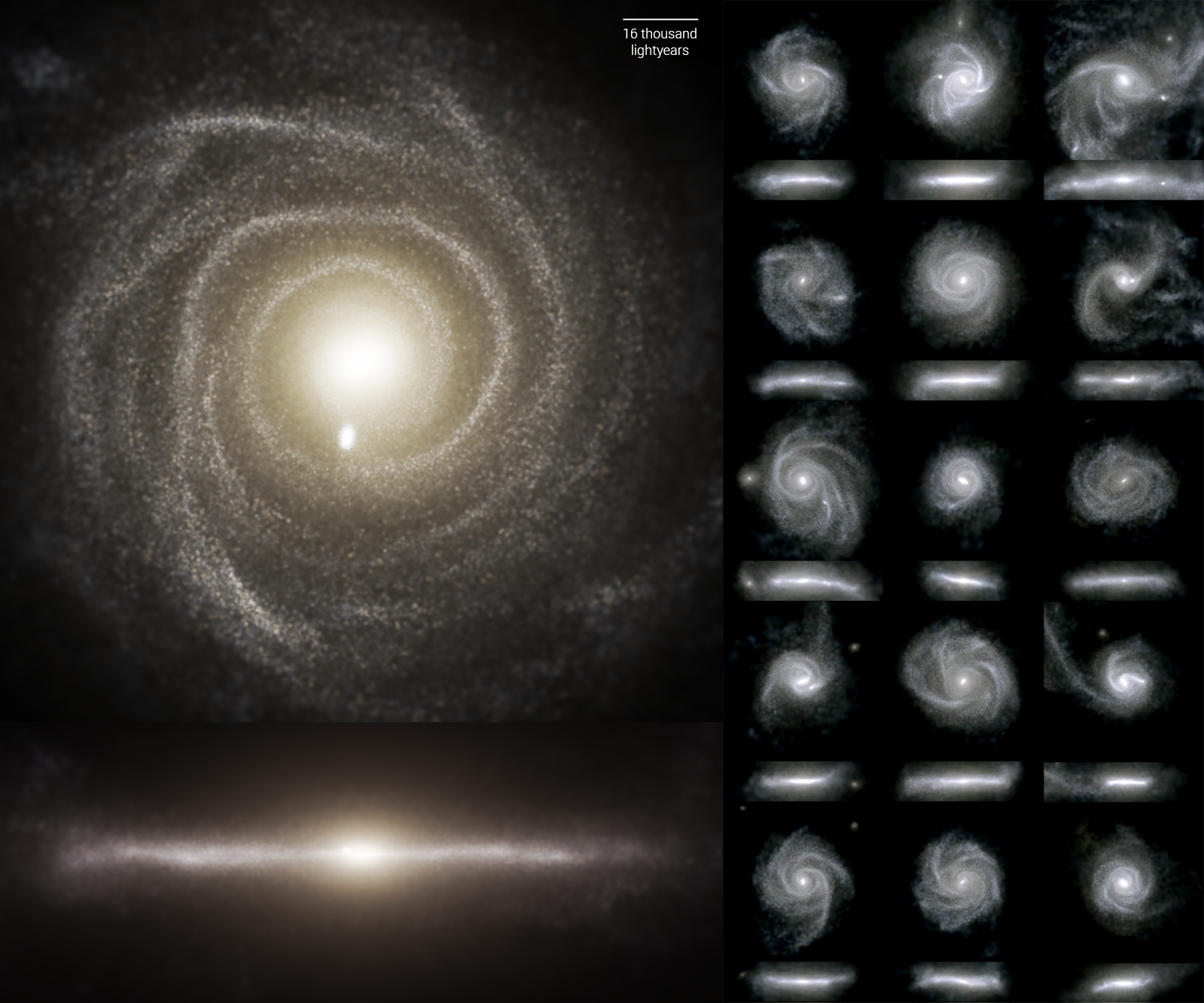
Fig 1: Images of disk galaxies from the TNG50 simulation in visible light. For each galaxy, there is a face-on view (top) and an edge-on view. TNG50 has thrown new light on how disk galaxies like this form. Credit: D. Nelson (MPA) and the Illustris TNG team

Order emerging from chaos 

Scientists from Germany and the United States have unveiled the results of a newly-completed, state of the art simulation of the evolution of galaxies. TNG50 is the most detailed large-scale cosmological simulation yet. It allows researchers to study in detail how galaxies form, and how they have evolved since shortly after the Big Bang. For the first time, it reveals that the geometry of the cosmic gas flows around galaxies determines galaxy structure, and vice versa.

Astronomers running cosmological simulations face a fundamental trade-off: with finite computing power, typical simulations so far have been either very detailed or have spanned a large volume of virtual space, but not both. Detailed simulations with limited volumes can model no more than a few galaxies, making statistical deductions difficult. Large-volume simulations, in turn, typically lack fine details on smaller scales, which are important for describing individual galaxies. The TNG50 simulation, which has just been published, manages to avoid this trade-off. For the first time, it combines the idea of a large-scale cosmological simulation – a Universe in a box – with the computational resolution of “zoom” simulations, at a level of detail that had previously only been possible for studies of individual galaxies.

In a simulated cube of space that is more than 230 million light-years across, TNG50 can discern physical phenomena that occur on scales one million times smaller, tracing the simultaneous evolution of thousands of galaxies over 13.8 billion years of cosmic history. It does so with more than 20 billion particles representing dark matter, stars, cosmic gas, magnetic fields, and supermassive black holes. The calculation itself required 16,000 cores on the Hazel Hen supercomputer in Stuttgart working together, 24/7, for more than a year – the equivalent of fifteen thousand years on a single processor, making it one of the most demanding astrophysical computations to date.


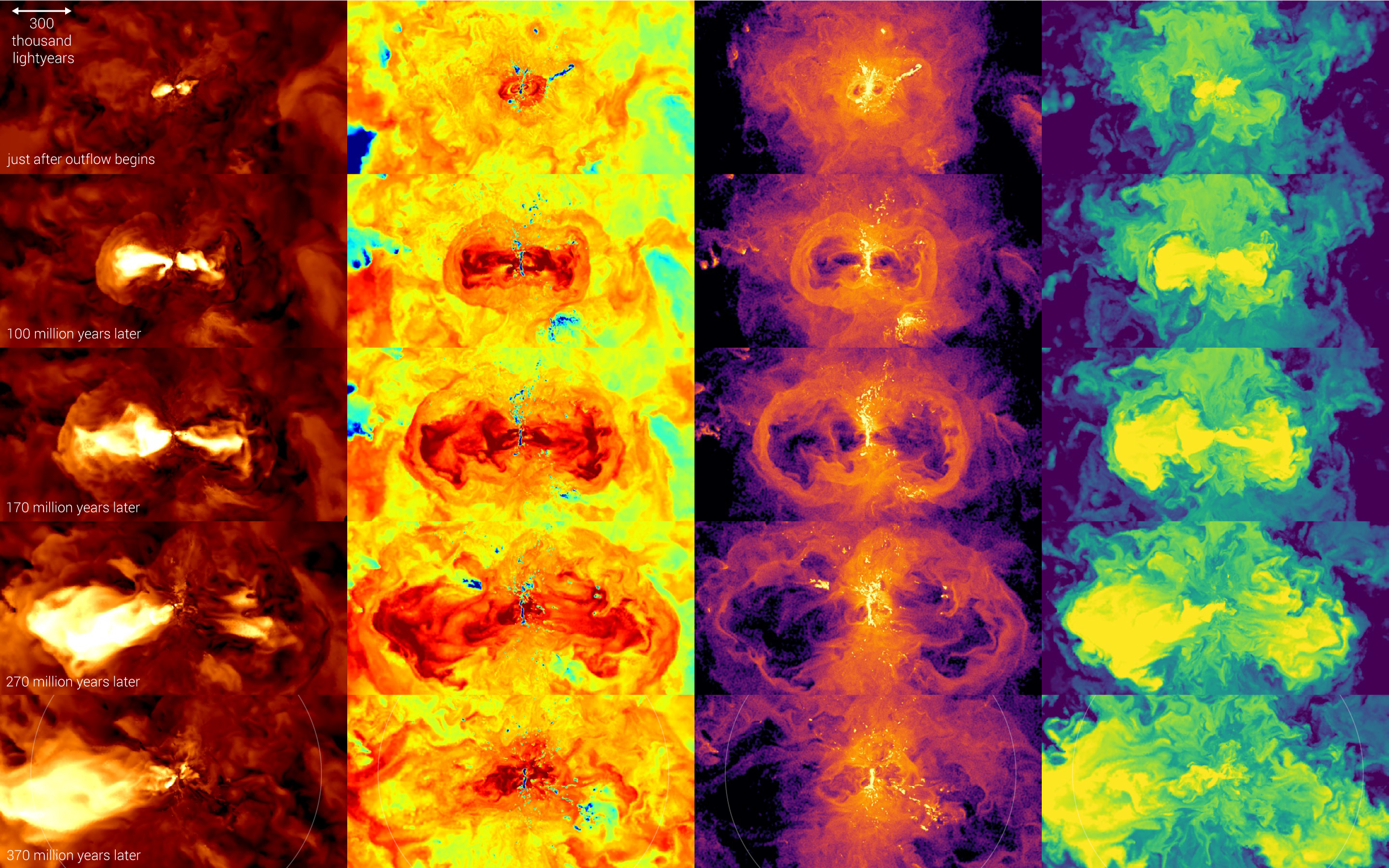
Fig 2: Outflow of gas from a galaxy. From top to bottom, each row represents a different snapshot, spanning 370 million years of cosmic evolution. The outflow is driven by energy set free near the active supermassive black hole in the galaxy’s center. From left to right, the columns show false-color representations of the velocity, temperature, density and heavy element content of the galaxy. The galaxy itself is the cold (blue, second column from left) and dense (yellow, third column) disk of star-forming gas visible as a small, vertical structure in the center of each image. Credit: D. Nelson (MPA) and the Illustris TNG team

The first scientific results from TNG50, presented in two articles that have just been published in the Monthly Notices of the Royal Astronomical Society, by a team led by Dr. Annalisa Pillepich (Max Planck Institute for Astronomy, Heidelberg) and Dr. Dylan Nelson (Max Planck Institute for Astrophysics, Garching), have revealed unforeseen physical phenomena. According to Nelson: “Numerical experiments of this kind are particularly successful when you get out more than you put in. In our simulation, we see phenomena that had not been programmed explicitly into the simulation code. These phenomena emerge in a natural fashion, from the complex interplay of the basic physical ingredients of our model universe.”

TNG50 features two prominent examples for this kind of emergent behavior. The first concerns the formation of “disk” galaxies like our own Milky Way. Using TNG50 as a time machine to rewind the evolution of cosmic structure, researchers have seen how the well-ordered, rapidly rotating disk galaxies (which are common in our nearby Universe) emerge from chaotic, disorganized, and highly turbulent clouds of gas at earlier epochs.

As the gas settles down, newborn stars are typically found on more and more circular orbits, eventually forming large spiral galaxies – galactic carousels. Annalisa Pillepich explains: “In practice, TNG50 shows that our own Milky Way galaxy with its thin disk is at the height of galaxy fashion: over the past 10 billion years, at least those galaxies that are still forming new stars have become more and more disk-like, and their chaotic internal motions have decreased considerably. The Universe was much more messy when it was just a few billion years old!”

Interplay of gas flows and galaxies

As these galaxies flatten out, researchers found another emergent phenomenon, concerning high-speed outflows and winds of gas flowing out of galaxies. Such outflows and winds are launched as a result of supernovae explosions and supermassive black hole activity. Galactic gaseous outflows are initially also chaotic and flow away in all directions, but over time, they begin to become more focused along a path of least resistance. In the late universe, outflows are oriented within two conical volumes, emerging from the galaxy in opposite directions – like two ice cream cones placed tip to tip, with the galaxy swirling at the center.

These winds slow down as they attempt to leave the gravitational well of the dark matter halo, and can eventually stall and fall back onto the galaxies, forming a galactic fountain of recycled gas. This process redistributes gas from the center of a galaxy to its outskirts, further accelerating the transformation of the galaxy itself into a thin disk: galactic structure shapes galactic fountains, and vice versa.

Just as for the other simulations of the TNG family, the team of scientists creating TNG50 (based at Max Planck Institutes in Heidelberg and Garching, Harvard University, MIT, and the CCA) will eventually release all simulation data to the astronomy community at large and to the public. Then, astronomers all over the world will be able to make their own discoveries in the TNG50 universe – and possibly find additional examples of emergent cosmic phenomena, of order emerging from chaos.

Formation and evolution of a massive galaxy in the TNG50 simulation. Main image: cosmic gas density. Insets, from left to right: large-scale dark matter density, large-scale gas density, then zoomed-in images of stellar distribution (luminosity) and gas density in the central region of the galaxy. The resulting TNG50 galaxy is similar in mass and shape to the Andromeda galaxy (M31). After a turbulent beginning, the galaxy experiences no major disturbances and can settled down into an equilibrium state. Credit: D. Nelson (MPA) and the illustris TNG team. More

Background information

The first scientific results from the TNG50 simulation were published as D. Nelson et al. 2019, “First Results from the TNG50 Simulation: Galactic outflows driven by supernovae and black hole feedback” and A. Pillepich et al. 2019, “First Results from the TNG50 Simulation: The evolution of stellar and gaseous disks across cosmic time,” both in the Monthly Notices of the Royal Astronomical Society. Both manuscripts have been online as “Accepted manuscripts,” and are now being published in the current volume of MNRAS.

The researchers involved in TNG50 are Annalisa Pillepich (Max Planck Institute for Astronomy) and Dylan Nelson (Max Planck Institute for Astrophysics), in collaboration with Volker Springel and Rüdiger Pakmor (both Max Planck Institute for Astrophysics), Paul Torrey (University of Florida), Rainer Weinberger (Harvard-Smithsonian Center for Astrophysics), Mark Vogelsberger (Kavli Institute for Astrophysics and Space Research, MIT), Federico Marinacci (University of Bologna), Shy Genel (Flatiron Institute) and Lars Hernquist (Harvard-Smithsonian Center for Astrophysics).


Contact:

Dr. Dylan Nelson
Postdoc
Tel.:2251
email: dnelson@mpa-garching.mpg.de

Dr. Annalisa Pillepich
+49 6221 528-395
email: pillepich@mpia-hd.mpg.de
Max Planck Institute for Astronomy, Heidelberg

Dr. Hannelore Hämmerle
Press officer
Tel:3980
email: hanne@mpa-garching.mpg.de

Dr. Markus Pössel
Press & Public Relations
+49 6221 528-261
email: pr@mpia.de
Max Planck Institute for Astronomy, Heidelberg


Saturday, December 22, 2018

Fossil from the Big Bang Discovered with W. M. Keck Observatory

Simulation of galaxies and gas in the universe. Within the gas in the (blue) filaments connecting the (orange) galaxies lurk rare pockets of pristine gas – vestiges of the Big Bang that have somehow been orphaned from the explosive, polluting deaths of stars, seen here as circular shock waves around some orange points. Credit: TNG Collaboration


Rare Relic is One of Only Three Fossil Clouds Known in the Universe


Maunakea, Hawaii – A relic cloud of gas, orphaned after the Big Bang, has been discovered in the distant universe by astronomers using the world’s most powerful optical telescope, the W. M. Keck Observatory on Maunakea, Hawaii.

The discovery of such a rare fossil, led by PhD student Fred Robert and Professor Michael Murphy at Swinburne University of Technology, offers new information about how the first galaxies in the universe formed.

“Everywhere we look, the gas in the universe is polluted by waste heavy elements from exploding stars,” says Robert. “But this particular cloud seems pristine, unpolluted by stars even 1.5 billion years after the Big Bang.”

“If it has any heavy elements at all, it must be less than 1/10,000th of the proportion we see in our Sun. This is extremely low; the most compelling explanation is that it’s a true relic of the Big Bang.”

The results will be published in the journal Monthly Notices of the Royal Astronomical Society. A preprint of the paper, “Exploring the origins of a new, apparently metal-free gas cloud at z = 4.4,” is available online at http://arxiv.org/abs/1812.05098.

Robert and his team used two of Keck Observatory’s instruments – the Echellette Spectrograph and Imager (ESI) and the High-Resolution Echelle Spectrometer (HIRES) – to observe the spectrum of a quasar behind the gas cloud.

The quasar, which emits a bright glow of material falling into a supermassive black hole, provides a light source against which the spectral shadows of the hydrogen in the gas cloud can be seen.

“We targeted quasars where previous researchers had only seen shadows from hydrogen and not from heavy elements in lower-quality spectra,” says Robert. “This allowed us to discover such a rare fossil quickly with the precious time on Keck Observatory’s twin telescopes.”

The only two other fossil clouds known were discovered in 2011 by Professor Michele Fumagalli of Durham University, John O’Meara, formerly a professor at St. Michael’s College and now the new Chief Scientist at Keck Observatory, and Professor J. Xavier Prochaska of the University of California, Santa Cruz; both Fumagalli and O’Meara are co-authors of this new research on the third fossil cloud.

“The first two were serendipitous discoveries, and we thought they were the tip of the iceberg. But no one has discovered anything similar – they are clearly very rare and difficult to see. It’s fantastic to finally discover one systematically,” says O’Meara.

“It’s now possible to survey for these fossil relics of the Big Bang,” says Murphy. “That will tell us exactly how rare they are and help us understand how some gas formed stars and galaxies in the early universe, and why some didn’t.”

This research was funded by an Australian Research Council Discovery Project grant and Professor Fumagalli’s contribution was partially funded by a European Research Council grant.


About ESI

The Echellette Spectrograph and Imager (ESI) is a medium-resolution visible-light spectrograph that records spectra from 0.39 to 1.1 microns in each exposure. Built at UCO/Lick Observatory by a team led by Prof. Joe Miller, ESI also has a low-resolution mode and can image in a 2 x 8 arc min field of view. An upgrade provided an integral field unit that can provide spectra everywhere across a small, 5.7 x4.0 arc sec field. Astronomers have found a number of uses for ESI, from observing the cosmological effects of weak gravitational lensing to searching for the most metal-poor stars in our galaxy.

About HIRES

The High-Resolution Echelle Spectrometer (HIRES) produces spectra of single objects at very high spectral resolution, yet covering a wide wavelength range. It does this by separating the light into many “stripes” of spectra stacked across a mosaic of three large CCD detectors. HIRES is famous for finding exoplanets. Astronomers also use HIRES to study important astrophysical phenomena like distant galaxies and quasars, and find cosmological clues about the structure of the early universe, just after the Big Bang.

About W. M. Keck Observatory

The W. M. Keck Observatory telescopes are the most scientifically productive on Earth. The two, 10-meter optical/infrared telescopes atop Maunakea on the Island of Hawaii feature a suite of advanced instruments including imagers, multi-object spectrographs, high-resolution spectrographs, integral-field spectrometers, and world-leading laser guide star adaptive optics systems. The data presented herein were obtained at Keck Observatory, which is a private 501(c) 3 non-profit organization operated as a scientific partnership among the California Institute of Technology, the University of California, and the National Aeronautics and Space Administration. The Observatory was made possible by the generous financial support of the W. M. Keck Foundation. The authors recognize and acknowledge the very significant cultural role and reverence that the summit of Maunakea has always had within the Native Hawaiian community. We are most fortunate to have the opportunity to conduct observations from this mountain.