Wednesday, September 14, 2016

Astronomers observe star reborn in a flash

 PR Image heic1618a
Stingray Nebula and SAO 244567 

SAO 244567


Videos 

Evolution of SAO 244567


An international team of astronomers using Hubble have been able to study stellar evolution in real time. Over a period of 30 years dramatic increases in the temperature of the star SAO 244567 have been observed. Now the star is cooling again, having been reborn into an earlier phase of stellar evolution. This makes it the first reborn star to have been observed during both the heating and cooling stages of rebirth.

Even though the Universe is constantly changing, most processes are too slow to be observed within a human lifespan. But now an international team of astronomers have observed an exception to this rule. “SAO 244567 is one of the rare examples of a star that allows us to witness stellar evolution in real time”, explains Nicole Reindl from the University of Leicester, UK, lead author of the study. “Over only twenty years the star has doubled its temperature and it was possible to watch the star ionising its previously ejected envelope, which is now known as the Stingray Nebula.”

SAO 244567, 2700 light-years from Earth, is the central star of the Stingray Nebula and has been visibly evolving between observations made over the last 45 years. Between 1971 and 2002 the surface temperature of the star skyrocketed by almost 40 000 degrees Celsius. Now new observations made with the Cosmic Origins Spectrograph (COS) on the NASA/ESA Hubble Space Telescope have revealed that SAO 244567 has started to cool and expand.

This is unusual, though not unheard-of [1], and the rapid heating could easily be explained if one assumed that SAO 244567 had an initial mass of 3 to 4 times the mass of the Sun. However, the data show that SAO 244567 must have had an original mass similar to that of our Sun. Such low-mass stars usually evolve on much longer timescales, so the rapid heating has been a mystery for decades.

Back in 2014 Reindl and her team proposed a theory that resolved the issue of both SAO 244567’s rapid increase in temperature as well as the low mass of the star. They suggested that the heating was due to what is known as a helium-shell flash event: a brief ignition of helium outside the stellar core [2].

This theory has very clear implications for SAO 244567’s future: if it has indeed experienced such a flash, then this would force the central star to begin to expand and cool again — it would return back to the previous phase of its evolution. This is exactly what the new observations confirmed. As Reindl explains: “The release of nuclear energy by the flash forces the already very compact star to expand back to giant dimensions — the born-again scenario.”

It is not the only example of such a star, but it is the first time ever that a star has been observed during both the heating and cooling stages of such a transformation.

Yet no current stellar evolutionary models can fully explain SAO 244567’s behaviour. As Reindl elaborates: “We need refined calculations to explain some still mysterious details in the behaviour of SAO 244567. These could not only help us to better understand the star itself but could also provide a deeper insight in the evolution of central stars of planetary nebulae.”

Until astronomers develop more refined models for the life cycles of stars, aspects of SAO 244567’s evolution will remain a mystery.


Notes

[1] The other star thought to have experienced the same type of helium flash event (see [2]) is FG Sagittae, located in the constellation Sagitta, making SAO 244567 the second of its kind. However, other objects undergoing similar “born-again” scenarios are known, including Sakurai’s Object, located in Sagittarius.

[2] Helium flash events, also known as late thermal pulses, occur late in the evolution of about 25% of low- to medium-mass stars. After evolving off the main sequence, these stars enter the red giant phase, where the star expands dramatically. Various changes occur in the star’s chemical and physical composition during this phase, until it has burnt most of the helium available in its core, which is by then composed of carbon and oxygen. Helium fusion continues in a thin shell around the core, but then turns off as the helium becomes depleted. This allows hydrogen fusion to start in a layer above the helium layer. After enough additional helium accumulates, helium fusion is reignited, leading to a thermal pulse which eventually causes the star to expand, cool and brighten temporarily.


More Information

The Hubble Space Telescope is a project of international cooperation between ESA and NASA.


The results will be presented in the paper “Breaking news from the HST: The central star of the Stingray Nebula is now returning towards the AGB”, published in the Monthly Notices of the Royal Astronomical Society (MNRAS).


The international team of astronomers in this study consists of Nicole Reindl (University of Leicester, UK; Eberhard Karls University, Germany), T. Rauch (Eberhard Karls University, Germany), M. M. Miller Bertolami (UNLP-CONICET, Argentina), H. Todt (University of Potsdam, Germany), K. Werner (Eberhard Karls University, Germany)

Image credit: NASA, ESA/Hubble


Links


Contacts 

Nicole Reindl
University of Leicester
Leicester, United Kingdom
Tel: +44 116 223 1385
Email:
nr152@leicester.ac.uk

Mathias Jäger
ESA/Hubble, Public Information Officer
Garching bei München, Germany
Tel: +49 176 62397500
Email:
mjaeger@partner.eso.org


Tuesday, September 13, 2016

A Riddle for Our Time

A schematic of cosmic history. Astronomers have called attention to a neglected riddle of the expansion: although the outward flaring seen in the graphic (representing cosmic acceleration) might have started at any time, curiously it has happened in our own time. Credit: NASA/WMAP


One of the most remarkable successes of astrophysics in the last century was its discovery that the age of the universe as measured by its oldest stars was about the same as the age estimated in an entirely different way, from the recession of galaxies. Both came up with surprisingly long times - billions of years - providing reassuring confirmation that both were probably on the right track. But the two values were not identical and scientists very quickly realized a major discrepancy: the oldest stars were older than the universe itself. Refinements to the measurements and the models to resolve this contradiction were underway until 1998 when cosmic acceleration was discovered. It proved, in a single sweep, that the universe was actually much older than had been thought, and in particular was older than the oldest stars.

But there was a riddle in the discovery: The motion of the universe is governed by matter, whose gravity tends to slow the expansion down, and by acceleration which speeds it up. Since the average density of matter in the universe steadily drops as the universe swells, in time it has a smaller and smaller value. Curiously, today it just happens to have almost exactly the same value (when expressed in the same units) as the acceleration parameter. Why? There was a second riddle too: The theoretical size of the acceleration parameter could be almost anything; indeed, basic quantum mechanical calculations suggest it should be vastly larger than it is. Why it is as small as we measure is a mystery.

CfA astronomers Arturo Avelino and Bob Kirshner have just published a paper calling attention to yet another riddle. The universe did not expand at a constant rate that was just the blend of these two factors. For the first nine billion years of cosmic evolution, contraction dominated and the universe gradually slowed its expansion. Since the relative importance of cosmic acceleration grows with time, however, for the past five billion years acceleration has dominated and the universe has sped up its expansion. Curiously, though, today the universe looks the same way it would have if it had always been expanding steadily at a constant rate (the rate required to prevent ultimate re-collapse). 

Although it sounds slightly similar to the original riddle, the authors describe why this new puzzle is actually different: We are living (apparently) in a privileged epoch; the other puzzles do not have this implication. The explanation(s) for these riddles is not yet known. If some specific new kinds of elementary particles exist, the scientists suggest, they could provide the answer, but for now the only thing that is certain is that more observational research is needed.

Reference(s):

"The Dimensionless Age of the Universe: a Riddle for Our Time," A. Avelino and R. Kirshner, ApJ 828, 35, 2016.


Monday, September 12, 2016

RCW 103: Young Magnetar Likely the Slowest Pulsar Ever Detected


RCW 103
Credit  X-ray: NASA/CXC/University of Amsterdam/N.Rea et al; Optical: DSS


Using NASA's Chandra X-ray Observatory and other X-ray observatories, astronomers have found evidence for what is likely one of the most extreme pulsars, or rotating neutron stars, ever detected. The source exhibits properties of a highly magnetized neutron star, or magnetar, yet its deduced spin period is thousands of times longer than any pulsar ever observed.

For decades, astronomers have known there is a dense, compact source at the center of RCW 103, the remains of a supernova explosion located about 9,000 light years from Earth. This composite image shows RCW 103 and its central source, known officially as 1E 161348-5055 (1E 1613, for short), in three bands of X-ray light detected by Chandra. In this image, the lowest energy X-rays from Chandra are red, the medium band is green, and the highest energy X-rays are blue. The bright blue X-ray source in the middle of RCW 103 is 1E 1613. The X-ray data have been combined with an optical image from the Digitized Sky Survey.

Observers had previously agreed that 1E 1613 is a neutron star, an extremely dense star created by the supernova that produced RCW 103. However, the regular variation in the X-ray brightness of the source, with a period of about six and a half hours, presented a puzzle. All proposed models had problems explaining this slow periodicity, but the main ideas were of either a spinning neutron star that is rotating extremely slowly because of an unexplained slow-down mechanism, or a faster-spinning neutron star that is in orbit with a normal star in a binary system.

On June 22, 2016, an instrument aboard NASA's Swift telescope captured the release of a short burst of X-rays from 1E 1613. The Swift detection caught astronomers' attention because the source exhibited intense, extremely rapid fluctuations on a time scale of milliseconds, similar to other known magnetars. These exotic objects possess the most powerful magnetic fields in the Universe -trillions of times that observed on the Sun - and can erupt with enormous amounts of energy.

Seeking to investigate further, a team of astronomers led by Nanda Rea of the University of Amsterdam quickly asked two other orbiting telescopes - NASA's Chandra X-ray Observatory and Nuclear Spectroscopic Telescope Array, or NuSTAR - to follow up with observations.

New data from this trio of high-energy telescopes, and archival data from Chandra, Swift and ESA's XMM-Newton confirmed that 1E 1613 has the properties of a magnetar, making it only the 30th known. These properties include the relative amounts of X-rays produced at different energies and the way the neutron star cooled after the 2016 burst and another burst seen in 1999. The binary explanation is considered unlikely because the new data show that the strength of the periodic variation in X-rays changes dramatically both with the energy of the X-rays and with time. However, this behavior is typical for magnetars.

But the mystery of the slow spin remained. The source is rotating once every 24,000 seconds (6.67 hours), much slower than the slowest magnetars known until now, which spin around once every 10 seconds. This would make it the slowest spinning neutron star ever detected.

Astronomers expect that a single neutron star will be spinning quickly after its birth in the supernova explosion and will then slow down over time as it loses energy. However, the researchers estimate that the magnetar within RCW 103 is about 2,000 years old, which is not enough time for the pulsar to slow down to a period of 24,000 seconds by conventional means.

While it is still unclear why 1E 1613 is spinning so slowly, scientists do have some ideas. One leading scenario is that debris from the exploded star has fallen back onto magnetic field lines around the spinning neutron star, causing it to spin more slowly with time. Searches are currently being made for other very slowly spinning magnetars to study this idea in more detail.

Another group, led by Antonino D'Aì at the National Institute of Astrophysics (INAF) in Palermo, Italy, monitored 1E 1613 in X-rays using Swift and in the near-infrared and visible light using the 2.2-meter telescope at the European Southern Observatory at La Silla, Chile, to search for any low-energy counterpart to the X-ray burst. They also conclude that 1E 1613 is a magnetar with a very slow spin period.

A paper describing the findings of Rea's team appears in the September 2, 2016, issue of The Astrophysical Journal Letters and is available online. The authors of that paper are Nanda Rea (University of Amsterdam and IEEC-CSIC, Spain), A. Borghese (Univ. of Amsterdam), P. Esposito (Univ. of Amsterdam), F. Coti Zelati (Univ. of Amsterdam, INAF, Insubria), M. Bachetti (INAF), G. L. Israel (INAF), A. De Luca (INAF).

A paper describing the findings of D'Aì's team has been accepted for publication by Monthly Notices of the Royal Astronomical Society and is also available online.

NuSTAR is a Small Explorer mission led by the California Institute of Technology in Pasadena and managed by NASA's Jet Propulsion Laboratory, also in Pasadena, for NASA's Science Mission Directorate in Washington.

NASA's Swift satellite was launched in November 2004 and is managed by NASA's Goddard Space Flight Center in Greenbelt, Maryland.

NASA's Marshall Space Flight Center in Huntsville, Alabama, manages the Chandra program for NASA's Science Mission Directorate in Washington. The Smithsonian Astrophysical Observatory in Cambridge, Massachusetts, controls Chandra's science and flight operations.

Fast Facts for RCW 103:

Scale: Image is 24 arcmin across (about 75 light years)
Category: Supernovas & Supernova Remnants, Neutron Stars/X-ray Binaries
Coordinates (J2000): RA 16h 17m 28.80s | Dec -51° 01' 48.00"
Constellation: Norma
Observation Date:
22 pointings between Feb 2000 and June 2006

Observation Time: 99 hours 43 min (4 days 3 hours 43 min).
Obs. ID: 123, 970, 1040, 2314-2318, 2759, 3514-3517, 4596-4599, 5592-5595, 11823, 12224, 17460, 18878
Instrument: ACIS
References: Rea, N. et al, 2016, ApJL (accepted); arXiv:1607.04107
Color Code: X-ray (Red, Green, Blue); Optical (Red, Green, Blue)
Distance Estimate: About 10,700 light years


Friday, September 09, 2016

'Enterprise' Nebulae Seen by Spitzer

Credit: NASA/JPL-Caltech


Just in time for the 50th anniversary of the TV series "Star Trek," which first aired September 8th,1966, a new infrared image from NASA's Spitzer Space Telescope may remind fans of the historic show. 

Since ancient times, people have imagined familiar objects when gazing at the heavens. There are many examples of this phenomenon, known as pareidolia, including the constellations and the well-known nebulae named Ant, Stingray and Hourglass. 

On the right of the image, with a little scrutiny, you may see hints of the saucer and hull of the original USS Enterprise, captained by James T. Kirk, as if it were emerging from a dark nebula. To the left, its "Next Generation" successor, Jean-Luc Picard's Enterprise-D, flies off in the opposite direction.

Astronomically speaking, the region pictured in the image falls within the disk of our Milky Way galaxy and displays two regions of star formation hidden behind a haze of dust when viewed in visible light. Spitzer's ability to peer deeper into dust clouds has revealed a myriad of stellar birthplaces like these, which are officially known only by their catalog numbers, IRAS 19340+2016 and IRAS19343+2026. 

Trekkies, however, may prefer using the more familiar designations NCC-1701 and NCC-1701-D. Fifty years after its inception, Star Trek still inspires fans and astronomers alike to boldly explore where no one has gone before.

This image was assembled using data from Spitzer's biggest surveys of the Milky Way, called GLIMPSE and MIPSGAL. Light with a wavelength of 3.5 microns is shown in blue, 8.0 microns in green, and 24 microns in red. The green colors highlight organic molecules in the dust clouds, illuminated by starlight. Red colors are related to thermal radiation emitted from the very hottest areas of dust.

JPL manages the Spitzer Space Telescope mission for NASA's Science Mission Directorate, Washington. Science operations are conducted at the Spitzer Science Center at Caltech in Pasadena, California. Spacecraft operations are based at Lockheed Martin Space Systems Company, Littleton, Colorado. Data are archived at the Infrared Science Archive housed at the Infrared Processing and Analysis Center at Caltech. Caltech manages JPL for NASA. 


Into the storm

Credit: ESA/Hubble & NASA


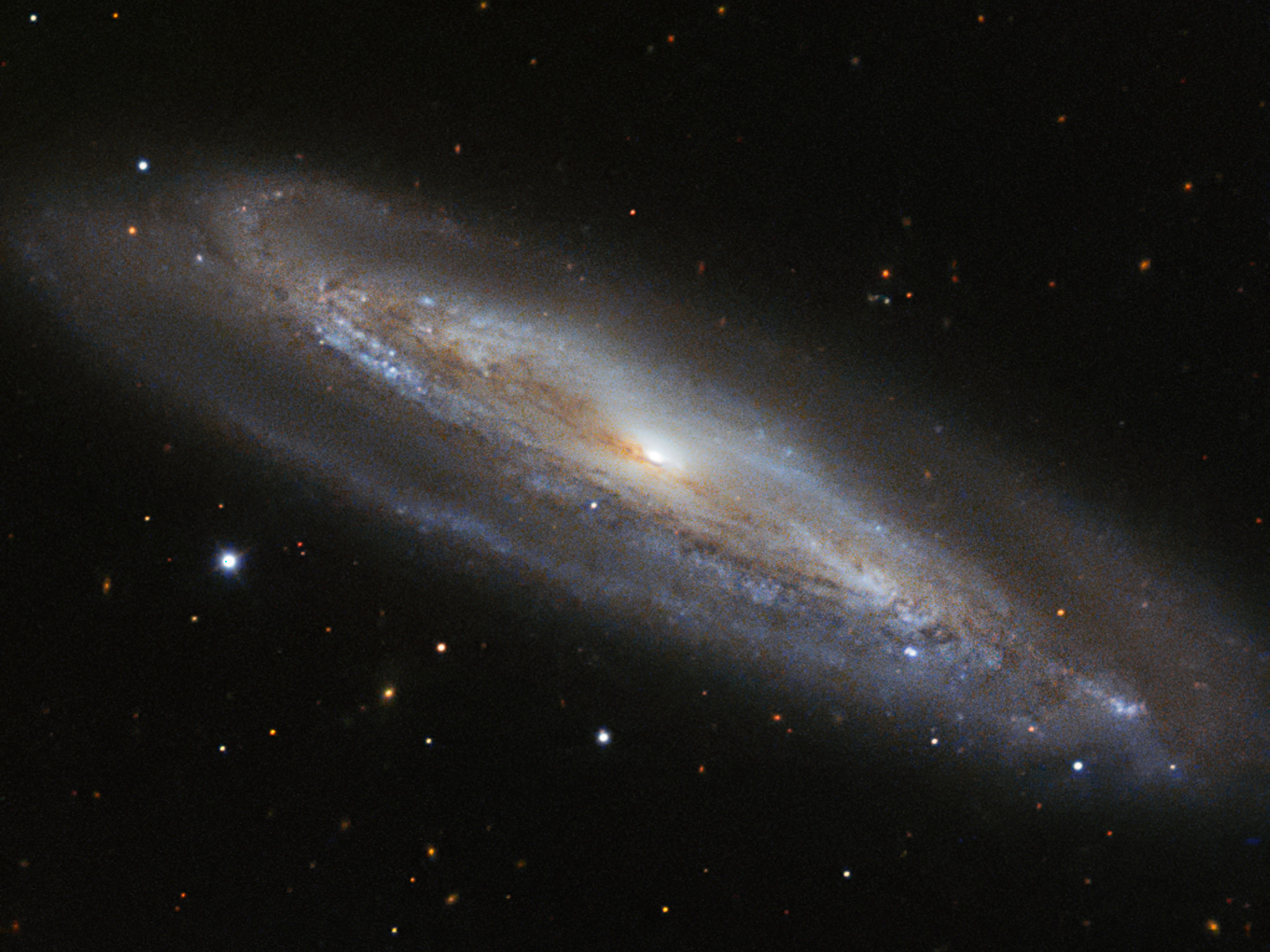
This shot from the NASA/ESA Hubble Space Telescope shows a maelstrom of glowing gas and dark dust within one of the Milky Way’s satellite galaxies, the Large Magellanic Cloud (LMC).

This stormy scene shows a stellar nursery known as N159, an HII region over 150 light-years across. N159 contains many hot young stars. These stars are emitting intense ultraviolet light, which causes nearby hydrogen gas to glow, and torrential stellar winds, which are carving out ridges, arcs, and filaments from the surrounding material.

At the heart of this cosmic cloud lies the Papillon Nebula, a butterfly-shaped region of nebulosity. This small, dense object is classified as a High-Excitation Blob, and is thought to be tightly linked to the early stages of massive star formation.

N159 is located over 160 000 light-years away. It resides just south of the Tarantula Nebula (heic1402), another massive star-forming complex within the LMC. It was previously imaged by Hubble’s Wide Field Planetary Camera 2, which also resolved the Papillon Nebula for the first time.


Thursday, September 08, 2016

Astronomers Discover Rare Fossil Relic of Early Milky Way

The unusual cluster Terzan 5

The location of the star cluster Terzan 5
Around the star cluster Terzan 5


Videos 

Zooming on the star cluster Terzan 5


Using ESO’s Very Large Telescope and other telescopes a fossilised remnant of the early Milky Way harbouring stars of hugely different ages has been revealed by an international team of astronomers. This stellar system resembles a globular cluster, but is like no other cluster known. It contains stars remarkably similar to the most ancient stars in the Milky Way and bridges the gap in understanding between our galaxy’s past and its present.

Terzan 5, 19 000 light-years from Earth in the constellation of Sagittarius (the Archer) and in the direction of the galactic centre, has been classified as a globular cluster for the forty-odd years since its detection. Now, an Italian-led team of astronomers have discovered that Terzan 5 is like no other globular cluster known.

The team scoured data from the Multi-conjugate Adaptive Optics Demonstrator [1], installed at the Very Large Telescope, as well as from a suite of other ground-based and space telescopes [2]. They found compelling evidence that there are two distinct kinds of stars in Terzan 5 which not only differ in the elements they contain, but have an age-gap of roughly 7 billion years [3].

The ages of the two populations indicate that the star formation process in Terzan 5 was not continuous, but was dominated by two distinct bursts of star formation. “This requires the Terzan 5 ancestor to have large amounts of gas for a second generation of stars and to be quite massive. At least 100 million times the mass of the Sun,” explains Davide Massari, co-author of the study, from INAF, Italy, and the University of Groningen, Netherlands.

Its unusual properties make Terzan 5 the ideal candidate for a living fossil from the early days of the Milky Way. Current theories on galaxy formation assume that vast clumps of gas and stars interacted to form the primordial bulge of the Milky Way, merging and dissolving in the process.

“We think that some remnants of these gaseous clumps could remain relatively undisrupted and keep existing embedded within the galaxy,” explains Francesco Ferraro from the University of Bologna, Italy, and lead author of the study. “Such galactic fossils allow astronomers to reconstruct an important piece of the history of our Milky Way.”

While the properties of Terzan 5 are uncommon for a globular cluster, they are very similar to the stellar population which can be found in the galactic bulge, the tightly packed central region of the Milky Way. These similarities could make Terzan 5 a fossilised relic of galaxy formation, representing one of the earliest building blocks of the Milky Way.

This assumption is strengthened by the original mass of Terzan 5 necessary to create two stellar populations: a mass similar to the huge clumps which are assumed to have formed the bulge during galaxy assembly around 12 billion years ago. Somehow Terzan 5 has managed to survive being disrupted for billions of years, and has been preserved as a remnant of the distant past of the Milky Way.

“Some characteristics of Terzan 5 resemble those detected in the giant clumps we see in star-forming galaxies at high-redshift, suggesting that similar assembling processes occurred in the local and in the distant Universe at the epoch of galaxy formation,“ continues Ferraro.

Hence, this discovery paves the way for a better and more complete understanding of galaxy assembly. “Terzan 5 could represent an intriguing link between the local and the distant Universe, a surviving witness of the Galactic bulge assembly process,” explains Ferraro while commenting on the importance of the discovery. The research presents a possible route for astronomers to unravel the mysteries of galaxy formation, and offers an unrivaled view into the complicated history of the Milky Way.


Notes

[1] The Multi-Conjugate Adaptive Optics Demonstrator (MAD) is a prototype multi-conjugate adaptive optics system which aims to demonstrate the feasibility of different MCAO reconstruction techniques in the framework of the E-ELT concept and the second generation VLT Instruments.

[2] The researchers also used data from the Wide Field Camera 3 on board the NASA/ESA Hubble Space Telescope and NIRC2 (the Near-Infrared Camera, second generation) at the W. M. Keck Observatory.

[3] The two detected stellar populations have ages of 12 billion years and 4.5 billion years respectively.


More Information

This research was presented in a paper entitled “The age of the young bulge-like population in the stellar system Terzan 5: linking the Galactic bulge to the high-z Universe”, by F. R. Ferraro et al., which will be published in the Astrophysical Journal.

The team is composed of F. R. Ferraro (Dipartimento di Fisica e Astronomia, Università degli Studi di Bologna, Italy) , D. Massari (INAF - Osservatorio Astronomico di Bologna, Italy & Kapteyn Astronomical Institute, University of Groningen, Netherlands), E. Dalessandro (Dipartimento di Fisica e Astronomia, Università degli Studi di Bologna, Italy; INAF - Osservatorio Astronomico di Bologna, Italy) , B. Lanzoni (Dipartimento di Fisica e Astronomia, Università degli Studi di Bologna, Italy), L. Origlia (INAF - Osservatorio Astronomico di Bologna, Italy), R. M. Rich (Department of Physics and Astronomy, University of California, Los Angeles, USA) and A. Mucciarelli (Dipartimento di Fisica e Astronomia, Università degli Studi di Bologna, Italy).

ESO is the foremost intergovernmental astronomy organisation in Europe and the world’s most productive ground-based astronomical observatory by far. It is supported by 16 countries: Austria, Belgium, Brazil, the Czech Republic, Denmark, France, Finland, Germany, Italy, the Netherlands, Poland, Portugal, Spain, Sweden, Switzerland and the United Kingdom, along with the host state of Chile. ESO carries out an ambitious programme focused on the design, construction and operation of powerful ground-based observing facilities enabling astronomers to make important scientific discoveries. ESO also plays a leading role in promoting and organising cooperation in astronomical research. ESO operates three unique world-class observing sites in Chile: La Silla, Paranal and Chajnantor. At Paranal, ESO operates the Very Large Telescope, the world’s most advanced visible-light astronomical observatory and two survey telescopes. VISTA works in the infrared and is the world’s largest survey telescope and the VLT Survey Telescope is the largest telescope designed to exclusively survey the skies in visible light. ESO is a major partner in ALMA, the largest astronomical project in existence. And on Cerro Armazones, close to Paranal, ESO is building the 39-metre European Extremely Large Telescope, the E-ELT, which will become “the world’s biggest eye on the sky”.


Links 


Contacts:

Francesco Ferraro
Università degli Studi di Bologna
Bologna, Italy
Tel: +39 051 20 9 5774
Email:
francesco.ferraro3@unibo.it

Davide Massari
INAF - Osservatorio Astronomico di Bologna
Bologna, Italy
Tel: +51 2095318
Email:
davide.massari@oabo.inaf.it

Richard Hook
ESO Public Information Officer
Garching bei München, Germany
Tel: +49 89 3200 6655
Cell: +49 151 1537 3591
Email:
rhook@eso.org


Source: ESO

Wednesday, September 07, 2016

Hubble views a cosmic oyster and pearl in NGC 1501

Hubble views a cosmic oyster and pearl in NGC 1501
Copyright: ESA/Hubble & NASA; acknowledgement: M. Canale 


This image was captured using Hubble’s Wide Field Planetary Camera 2, the camera responsible for many of the telescope’s most beautiful images. It shows the appropriately nicknamed Oyster Nebula (more formally known as NGC 1501), a candescent cloud some 5000 light-years away from Earth in the constellation of Camelopardalis.

The Oyster Nebula is a type of cosmic object that is essentially a giant cloud of dust and electrically charged gases. Nebulas are often made to glow, as seen here, by the radiation from a nearby star. In the case of the Oyster Nebula, that star can be seen as a yellow–orange dot at the centre of the turquoise cloud, resembling the oyster’s precious pearl.

This is a planetary nebula, meaning that it was created when its progenitor star – the ‘pearl’ – threw its outer layers of gas into space. This star is just as notable as the beautiful structure surrounding it. It is a pulsating star, meaning that its brightness varies regularly and periodically. In the case of NGC 1501’s progenitor star, this is incredibly fast, with the star’s brightness changing significantly in just half an hour.

The complexity of the Oyster Nebula’s internal structure is clearly evident in this detailed image, appearing almost webbed or bubbly. Astronomers have modelled this object in 3D and found it to be an irregularly shaped cloud filled with lumpy and bumpy structures, such as knots and bubbles of gas and clumps of dust, all knitted together.

These visible-light observations capture the glow of gases including hydrogen and nitrogen. The bright colours shown here are arbitrary. A version of this image was entered into the 2012 Hubble’s Hidden Treasures image processing competition by contestant Marc Canale.


Tuesday, September 06, 2016

Why So Blue?

Credit:ESO
Acknowledgements: Flickr user
jbarring


The colour blue has many associations — coldness, sadness, serenity. However, the colour holds a completely different meaning for astronomers, as demonstrated by the edge-on spiral galaxy Messier 98.

Messier 98, also known as NGC 4192, is located approximately 50 million light-years away in the constellation of Coma Berenices (Berenice's Hair). In this spectacular image from ESO’s New Technology Telescope (NTT), the galaxy’s perimeter, rippled with gas and dust, is dotted with pockets of blueish light. These are regions filled with very young stars, which are so hot that they glow with a bright blue hue. These young stars are burning at such high temperatures that they are emitting fierce radiation, burning away some of the dense material that surrounds them. In total, Messier 98 is thought to contain one trillion stars!

The NTT is a 3.58-metre telescope at the La Silla Observatory, which pioneered the use of active optics and was the first in the world to have a computer-controlled main mirror.


Source: ESO/Images
 

Monday, September 05, 2016

At the edge of galaxy clusters: splashback and accretion shock

Left: dark matter halo of a simulated galaxy cluster. The density steepening at the splashback is highlighted with a special image enhancement technique. Right: gas temperature of a simulated cluster. The accretion shock is clearly visible where the temperature steepens at the outskirts of the cluster. Credits: More, Diemer & Kravtsov 2015 (left); Vazza et al. 2010 (right)


Observations are beginning to be sensitive enough to see the outskirts of galaxy clusters, where theory predicts interesting features in the dark matter and gas profiles: the so-called splashback and the accretion shock. Scientists at MPA use an analytical model to compute the locations of these features, and shed new light on the underlying physics.

Providing a simple model for complex cosmic phenomena is one of the goals of theoretical astrophysics. When successful, such a model yields a deeper understanding of the underlying physics. Recently scientists at MPA have done just this for better understanding what happens at the outskirts of galaxy clusters.

The observation of galaxy clusters has played an important role in convincing astronomers of the existence of dark matter: Galaxies inside galaxy clusters move with high velocities; hot, X-ray emitting gas fills the galaxy cluster region; often galaxy clusters show a gravitational lensing effect on background galaxies. All these measurements have consistently shown that visible matter is embedded in dark matter halos which make up about 85% of the total gravitating mass of a galaxy cluster.

Unlike a star, which is a 'halo' of gas with a clear boundary and a finite mass, these dark matter halos are fuzzy, extended structures. Their densities typically drop like ρ ∝ r-3 with radius in the outer regions without a clear cutoff, which has prevented astronomers to assign a definite boundary and mass to them. When you talk to an astronomer about a galaxy cluster with a certain mass, he or she will likely ask 'Within which radius is this mass defined?'

However, scientists recently realized that a particular feature at the outskirts of galaxy clusters can serve as a natural boundary for their dark matter halo. This feature - the so-called 'splashback' - marks the position of a sudden steepening in the density profile. Physically, this 'splashback' is caused by recently accreted dark matter that is piling up near the first apocenter of its orbit through the dark matter halo.

Hydrodynamical numerical simulations have found that the splashback radius closely tracks the position of the accretion shock. The accretion shock is located, where intergalactic plasma gets shock-heated when accreting onto a galaxy cluster. Also the accretion shock associated with a sudden steepening feature – this time in gas density and temperature. Since the physics underlying the splashback and the accretion shock is quite different, it is rather intriguing that they seem to track each other.

While simulations are a powerful tool for studying complex astrophysical systems, analytical models are also needed to simplify the picture and to understand the underlying physics. Using an analytical model called the 'self-similar spherical collapse model', scientists at MPA computed the growth of galaxy clusters in an expanding universe. The profile of a galaxy cluster and the history of its mass growth are treated in a consistent manner.

The analytical model captures the steepening features in the density profiles of dark matter (dashed line) and gas (solid line) in galaxy clusters, which correspond to the splashback radius and the accretion shock, respectively. The different colours show results for different cluster mass growth rates. In all cases, the locations of the splashback and accretion shock closely track each other. © MPA


This model can predict the radial locations of the splashback and the accretion shock as a function of the rate of cluster mass growth. Although both radii depend sensitively on the mass growth rate, they are found to indeed track each other. For typical mass growth rates for observed galaxy clusters, both quantities shrink at a higher mass growth rates, caused by different physics: For the gas, the inflowing material is associated with higher energy and momentum for a higher mass growth rate. Whereas for the dark matter, a significantly increased mass adds gravitational attraction to the splashback material. 

A more intricate finding is that the locations of the splashback and the accretion shock track each other best if the adiabatic index of the gas is close to 5/3. Coincidentally, the intergalactic plasma, which is dominated by single atoms, has approximately this adiabatic index. In this sense, this tracking behaviour is not universal.

Improvements in the quality and quantity of observational data are bringing the outskirts of galaxy clusters into our view. Potential observational evidence for the splashback radius has already been found, and we may expect a direct detection of the accretion shock from X-ray and millimetre observations in the near future. Then, combining analytical predictions with those observations may lead to a deeper understanding and new discoveries of galaxy clusters and the structure assembly in our Universe.


Original:

X. Shi
The outer profile of dark matter haloes: an analytical approach

Friday, September 02, 2016

ALMA Finds Unexpected Trove of Gas Around Larger Stars

Artist impression of a debris disk surrounding a star in the Scorpius-Centaurus Association. ALMA discovered that -- contrary to expectations -- the more massive stars in this region retain considerable stores of carbon monoxide gas. This finding could offer new insights into the timeline for giant planet formation around young stars. Credit: NRAO/AUI/NSF; D. Berry / SkyWorks

ALMA image of the debris disk surrounding a star in the Scorpius-Centaurus Association known as HIP 73145. The green region maps the carbon monoxide gas that suffuses the debris disk. The red is the millimeter-wavelength light emitted by the dust surrounding the central star. The star HIP 73145 is estimated to be approximately twice the mass of the Sun. The disk in this system extends well past what would be the orbit of Neptune in our solar system, drawn in for scale. The location of the central star is also highlighted for reference. Credit: J. Lieman-Sifry, et al., ALMA (ESO/NAOJ/NRAO); B. Saxton (NRAO/AUI/NSF)

ALMA image of the debris disk surrounding a star in the Scorpius-Centaurus Association known as HIP 73145. The green region maps the carbon monoxide gas that suffuses the debris disk. The red is the millimeter-wavelength light emitted by the dust surrounding the central star. The star HIP 73145 is estimated to be approximately twice the mass of the Sun. The disk in this system extends well past what would be the orbit of Neptune in our solar system. Credit: J. Lieman-Sifry, et al., ALMA (ESO/NAOJ/NRAO); B. Saxton (NRAO/AUI/NSF)

Four out of 24 debris disks observed by ALMA in the Scorpius-Centaurus Association. Researchers were surprised to discover that the larger, more energetic stars retained much more gas in their debris disks than smaller, Sun-like stars. Credit: Lieman-Sifry et al. ALMA (ESO/NAOJ/NRAO); B. Saxton (NRAO/AUI/NSF)

Podcast on discovery of debris disks surrounding young stars in the Scorpius-Centaurus Association. ALMA discovered that -- contrary to expectations -- the more massive stars in this region retain considerable stores of carbon monoxide gas. This finding could offer new insights into the timeline for giant planet formation around young stars.


Astronomers using the Atacama Large Millimeter/submillimeter Array (ALMA) surveyed dozens of young stars – some Sun-like and others approximately double that size – and discovered that the larger variety have surprisingly rich reservoirs of carbon monoxide gas in their debris disks. In contrast, the lower-mass, Sun-like stars have debris disks that are virtually gas-free.

This finding runs counter to astronomers’ expectations, which hold that stronger radiation from larger stars should strip away gas from their debris disks faster than the comparatively mild radiation from smaller stars. It may also offer new insights into the timeline for giant planet formation around young stars.

Debris disks are found around stars that have shed their dusty, gas-filled protoplanetary disks and gone on to form planets, asteroids, comets, and other planetesimals. Around younger stars, however, many of these newly formed objects have yet to settle into stately orbits and routinely collide, producing enough rubble to spawn a "second-generation" disk of debris.

"Previous spectroscopic measurements of debris disks revealed that certain ones had an unexpected chemical signature suggesting they had an overabundance of carbon monoxide gas," said Jesse Lieman-Sifry, lead author on a paper published in Astrophysical Journal. At the time of the observations, Lieman-Sifry was an undergraduate astronomy major at Wesleyan University in Middletown, Connecticut. "This discovery was puzzling since astronomers believe that this gas should be long gone by the time we see evidence of a debris disk," he said.

In search of clues as to why certain stars harbor gas-rich disks, Lieman-Sifry and his team surveyed 24 star systems in the Scorpius-Centaurus Association. This loose stellar agglomeration, which lies a few hundred light-years from Earth, contains hundreds of low- and intermediate-mass stars. For reference, astronomers consider our Sun to be a low-mass star.

The astronomers narrowed their search to stars between five and ten million years old -- old enough to host full-fledged planetary systems and debris disks -- and used ALMA to examine the millimeter-wavelength "glow" from the carbon monoxide in the stars’ debris disks.

The team carried out their survey over a total of six nights between December 2013 and December 2014, observing for a mere ten minutes each night. At the time it was conducted, this study constituted the most extensive millimeter-wavelength interferometric survey of stellar debris disks ever achieved.

Armed with an incredibly rich set of observations, the astronomers found the most gas-rich disks ever recorded in a single study. Among their sample of two dozen disks, the researchers spotted three that exhibited strong carbon monoxide emission. Much to their surprise, all three gas-rich disks surrounded stars about twice as massive as the Sun. None of the 16 smaller, Sun-like stars in the sample appeared to have disks with large stores of carbon monoxide.

This finding is counterintuitive because higher-mass stars flood their planetary systems with energetic ultraviolet radiation that should destroy the carbon monoxide gas lingering in their debris disks. This new research reveals, however, that the larger stars are somehow able to either preserve or replenish their carbon monoxide stockpiles.

"We’re not sure whether these stars are holding onto reservoirs of gas much longer than expected, or whether there's a sort of 'last gasp' of second-generation gas produced by collisions of comets or evaporation from the icy mantles of dust grains," said Meredith Hughes, an astronomer at Wesleyan University and coauthor of the study.

The existence of this gas may have important implications for planet formation, says Hughes. Carbon monoxide is a major constituent of the atmospheres of giant planets. Its presence in debris disks could mean that other gases, including hydrogen, are present, but perhaps in much lower concentrations. If certain debris disks are able to hold onto appreciable amounts of gas, it might push back astronomers’ expected deadline for giant planet formation around young stars, the astronomers speculate.

"Future high-resolution observations of these gas-rich systems may allow astronomers to infer the location of the gas within the disk, which may shed light on the origin of the gas," says co-author Antonio Hales, an astronomer with the Joint ALMA Observatory in Santiago, Chile, and the National Radio Astronomy Observatory in Charlottesville, Virginia. "For instance, if the gas was produced by planetesimal collisions, it should be more highly concentrated in regions of the disk where those impacts occurred. ALMA is the only instrument capable of making these kind of high-resolution images."
According to Lieman-Sifry, these dusty disks are just as diverse as the planetary systems they accompany. The discovery that the debris disks around some larger stars retain carbon monoxide longer than their Sun-like counterparts may provide insights into the role this gas plays in the development of planetary systems.

The National Radio Astronomy Observatory is a facility of the National Science Foundation, operated under cooperative agreement by Associated Universities, Inc.


Reference:

This research is presented in the paper titled “Debris disks in the Scorpius-Centaurus OB association resolved by ALMA,” by J. Lieman-Sifry et al., published in Astrophysical Journal on 25 August 2016. [Preprint: http://arxiv.org/abs/1606.07068


Contact:

Charles Blue
NRAO Public Information Officer
+1 434.296.0314; cblue@nrao.edu


The team is composed of Jesse Lieman-Sifry (Wesleyan Univ., Middletown, Connecticut), A. Meredith Hughes (Wesleyan Univ., Middletown, Connecticut), John M. Carpenter (California Institute of Technology, Pasadena), Uma Gorti (SETI Institute, Mountain View, California), Antonio Hales (Joint ALMA Observatory, Santiago, Chile, and National Radio Astronomy Observatory, Charlottesville, Virginia), and Kevin M. Flaherty (Wesleyan Univ., Middletown, Connecticut).

The Atacama Large Millimeter/submillimeter Array (ALMA), an international astronomy facility, is a partnership of the European Organisation for Astronomical Research in the Southern Hemisphere (ESO), the U.S. National Science Foundation (NSF) and the National Institutes of Natural Sciences (NINS) of Japan in cooperation with the Republic of Chile. ALMA is funded by ESO on behalf of its Member States, by NSF in cooperation with the National Research Council of Canada (NRC) and the National Science Council of Taiwan (NSC) and by NINS in cooperation with the Academia Sinica (AS) in Taiwan and the Korea Astronomy and Space Science Institute (KASI).

ALMA construction and operations are led by ESO on behalf of its Member States; by the National Radio Astronomy Observatory (NRAO), managed by Associated Universities, Inc. (AUI), on behalf of North America; and by the National Astronomical Observatory of Japan (NAOJ) on behalf of East Asia. The Joint ALMA Observatory (JAO) provides the unified leadership and management of the construction, commissioning and operation of ALMA.


Thursday, September 01, 2016

First stars formed even later than previously thought

ESA's Planck satellite has revealed that the first stars in the Universe started forming later than previous observations of the Cosmic Microwave Background indicated. This new analysis also shows that these stars were the only sources needed to account for reionising atoms in the cosmos, having completed half of this process when the Universe had reached an age of 700 million years. 

Credit: ESA – C. Carreau


With the multitude of stars and galaxies that populate the present Universe, it's hard to imagine how different our 13.8 billion year cosmos was when it was only a few seconds old. At that early phase, it was a hot, dense primordial soup of particles, mostly electrons, protons, neutrinos, and photons – the particles of light.

 In such a dense environment the Universe appeared like an 'opaque' fog, as light particles could not travel any significant distance before colliding with electrons.

As the cosmos expanded, the Universe grew cooler and more rarefied and, after about 380 000 years, finally became 'transparent'. By then, particle collisions were extremely sporadic and photons could travel freely across the cosmos.

Credit: ESA


Today, telescopes like Planck can observe this fossil light across the entire sky as the Cosmic Microwave Background, or CMB. Its distribution on the sky reveals tiny fluctuations that contain a wealth of information about the history, composition and geometry of the Universe.

The release of the CMB happened at the time when electrons and protons joined to form hydrogen atoms. This is the first moment in the history of the cosmos when matter was in an electrically neutral state.

After that, a few hundred million years passed before these atoms could assemble and eventually give rise to the Universe's first generation of stars.

As these first stars came to life, they filled their surroundings with light, which subsequently split neutral atoms apart, turning them back into their constituent particles: electrons and protons.

Scientists refer to this as the 'epoch of reionisation'. It did not take long for most material in the Universe to become completely ionised, and – except in a very few, isolated places – it has been like that ever since.

Observations of very distant galaxies hosting supermassive black holes indicate that the Universe had been completely reionised by the time it was about 900 million years old. The starting point of this process, however, is much harder to determine and has been a hotly debated topic in recent years.

"The CMB can tell us when the epoch of reionisation started and, in turn, when the first stars formed in the Universe," explains Jan Tauber, Planck project scientist at ESA.

To make this measurement, scientists exploit the fact that a fraction of the CMB is polarised: part of the light vibrates in a preferred direction. This results from CMB photons bouncing off electrons – something that happened very frequently in the primordial soup, before the CMB was released, and then again later, after reionisation, when light from the first stars brought free electrons back onto the cosmic stage.

"It is in the tiny fluctuations of the CMB polarisation that we can see the influence of the reionisation process and deduce when it began," adds Tauber.

Credit: ESA and the Planck Collaboration


A first estimate of the epoch of reionisation came in 2003 from NASA's Wilkinson Microwave Anisotropy Probe (WMAP), suggesting that this process might have started early in cosmic history, when the Universe was only a couple of hundred million years old. This result was problematic, because there is no evidence that any stars had formed by then, which would mean postulating the existence of other, exotic sources that could have caused the reionisation at that time.

This first estimate was soon to be corrected, as subsequent data from WMAP pushed the starting time to later epochs, indicating that the Universe had not been significantly reionised until at least some 450 million years into its history.

This eased, but did not completely solve the puzzle: although the earliest of the first stars have been observed to be present already when the Universe was 300 to 400 million years old, it remained unclear whether these stars were the main culprits for reionising fully the cosmos or whether additional, more exotic sources must have played a role too.

In 2015, the Planck Collaboration provided new data to tackle the problem, moving the reionisation epoch even later in cosmic history and revealing that this process was about half-way through when the Universe was around 550 million years old. The result was based on Planck's first all-sky maps of the CMB polarisation, obtained with its Low-Frequency Instrument (LFI).

Now, a new analysis of data from Planck's other detector, the High-Frequency Instrument (HFI), which is more sensitive to this phenomenon than any other so far, shows that reionisation started even later – much later than any previous data have suggested.

"The highly sensitive measurements from HFI have clearly demonstrated that reionisation was a very quick process, starting fairly late in cosmic history and having half-reionised the Universe by the time it was about 700 million years old," says Jean-Loup Puget from Institut d'Astrophysique Spatiale in Orsay, France, principal investigator of Planck's HFI.

"These results are now helping us to model the beginning of the reionisation phase."

"We have also confirmed that no other agents are needed, besides the first stars, to reionise the Universe," adds Matthieu Tristram, a Planck Collaboration scientist at Laboratoire de l'Accélérateur Linéaire in Orsay, France.

The new study locates the formation of the first stars much later than previously thought on the cosmic timeline, suggesting that the first generation of galaxies are well within the observational reach of future astronomical facilities, and possibly even some current ones.

In fact, it is likely that some of the very first galaxies have already been detected with long exposures, such as the Hubble Ultra Deep Field observed with the NASA/ESA Hubble Space Telescope, and it will be easier than expected to catch many more with future observatories such as the NASA/ESA/CSA James Webb Space Telescope.

Notes for Editors


Launched in 2009, Planck was designed to map the sky in nine frequencies using two state-of-the-art instruments: the Low Frequency Instrument (LFI), which includes three frequency bands in the range 30-70 GHz, and the High Frequency Instrument (HFI), which includes six frequency bands in the range 100-857 GHz.

HFI completed its survey in January 2012, while LFI continued to make science observations until 3 October 2013, before being switched off on 19 October 2013. Seven of Planck's nine frequency channels were equipped with polarisation-sensitive detectors.

The Planck Scientific Collaboration consists of all the scientists who have contributed to the development of the mission, and who participate in the scientific exploitation of the data during the proprietary period.

These scientists are members of one or more of four consortia: the LFI Consortium, the HFI Consortium, the DK-Planck Consortium, and ESA's Planck Science Office. The two European-led Planck Data Processing Centres are located in Paris, France and Trieste, Italy.

The LFI consortium is led by N. Mandolesi, Università degli Studi di Ferrara, Italy (deputy PI: M. Bersanelli, Università degli Studi di Milano, Italy), and was responsible for the development and operation of LFI. The HFI consortium is led by J.L. Puget, Institut d'Astrophysique Spatiale in Orsay (CNRS/Université Paris-Sud), France (deputy PI: F. Bouchet, Institut d'Astrophysique de Paris (CNRS/UPMC), France), and was responsible for the development and operation of HFI.


For further informatin, please contact:

Jan Tauber
ESA Planck Project Scientist
Scientific Support Office
Directorate of Science
European Space Agency
Email:
jan.tauber@esa.int
Phone: +31-71-565-5342

Jean-Loup Puget
Principal Investigator, High Frequency Instrument
Institut d'Astrophysique Spatiale
Orsay, France
Email:
jean-loup.puget@ias.u-psud.fr
Phone: +33-169858665

Matthieu Tristram
CNRS - IN2P3
Laboratoire de l'Accélérateur Linéaire
Université Paris-Sud 11
Orsay, France
Email:
tristram@lal.in2p3.fr
Phone: +33-164468388


Source: ESA/PLANCK

Wednesday, August 31, 2016

NASA Team Probes Peculiar Age-Defying Star

An age-defying star designated as IRAS 19312+1950 (arrow) exhibits features characteristic of a very young star and a very old star. The object stands out as extremely bright inside a large, chemically rich cloud of material, as shown in this image from NASA’s Spitzer Space Telescope. A NASA-led team of scientists thinks the star – which is about 10 times as massive as our sun and emits about 20,000 times as much energy – is a newly forming protostar. That was a big surprise because the region had not been known as a stellar nursery before. But the presence of a nearby interstellar bubble, which indicates the presence of a recently formed massive star, also supports this idea. Credits: NASA/JPL-Caltech. For an unannotated version of this image, click here.