Showing posts with label red supergiant. Show all posts

Friday, July 25, 2025

Gemini North Discovers Long-Predicted Stellar Companion of Betelgeuse

PR Image noirlab2523a
Betelgeuse and Its Stellar Companion (annotated)

PR Image noirlab2523b
Betelgeuse and Its Stellar Companion in Orion

PR Image noirlab2523c
Betelgeuse and Its Stellar Companion (non-annotated)

PR Image noirlab2523d
Eclipse near Moonrise

PR Image noirlab2523e
Orion (Annotated)

PR Image noirlab2523f
Betelgeuse in Orion


Videos

Cosmoview Episode 101: Gemini North Discovers Long-Predicted Stellar Companion of Betelgeuse (horizontal)
PR Video noirlab2523a
Cosmoview Episode 101: Gemini North Discovers Long-Predicted Stellar Companion of Betelgeuse (horizontal)

Cosmoview Episode 101: Gemini North Discovers Long-predicted Stellar Companion of Betelgeuse (vertical)
PR Video noirlab2523b
Cosmoview Episode 101: Gemini North Discovers Long-predicted Stellar Companion of Betelgeuse (vertical)

Cosmoview Episodio 101: El telescopio de Gemini Norte descubre compañera estelar de Betelgeuse (horizontal)
PR Video noirlab2523c
Cosmoview Episodio 101: El telescopio de Gemini Norte descubre compañera estelar de Betelgeuse (horizontal)

Cosmoview Episodio 101: El telescopio de Gemini Norte descubre compañera estelar de Betelgeuse (vertical)
PR Video noirlab2523d
Cosmoview Episodio 101: El telescopio de Gemini Norte descubre compañera estelar de Betelgeuse (vertical)


Gemini North telescope in Hawai‘i reveals never-before-seen companion to Betelgeuse, solving millennia-old mystery

Astronomers have discovered a companion star in an incredibly tight orbit around Betelgeuse using the NASA and U.S. National Science Foundation-funded ‘Alopeke instrument on Gemini North, one half of the International Gemini Observatory, partly funded by the NSF and operated by NSF NOIRLab. This discovery answers the longstanding mystery of the star’s varying brightness and provides insight into the physical mechanisms behind other variable red supergiants.

Betelgeuse is one of the brightest stars in the night sky, and the closest red supergiant to Earth. It has an enormous volume, spanning a radius around 700 times that of the Sun. Despite only being ten million years old, which is considered young by astronomy standards, it’s late in its life. Located in the shoulder of the constellation Orion, people have observed Betelgeuse with the naked eye for millennia, noticing that the star changes in brightness over time. Astronomers established that Betelgeuse has a main period of variability of around 400 days and a more extended secondary period of around six years.

In 2019 and 2020, there was a steep decrease in Betelgeuse’s brightness — an event referred to as the ‘Great Dimming.’ The event led some to believe that a supernova death was quickly approaching, but scientists were able to determine the dimming was actually caused by a large cloud of dust ejected from Betelgeuse.

The Great Dimming mystery was solved, but the event sparked a renewed interest in studying Betelgeuse, which brought about new analyses of archival data on the star. One analysis led scientists to propose that the cause of Betelgeuse’s six-year variability is the presence of a companion star [1]. But when the Hubble Space Telescope and the Chandra X-Ray Observatory searched for this companion, no detections were made.

The companion star has now been detected for the first time by a team of astrophysicists led by Steve Howell, a senior research scientist at NASA Ames Research Center. They observed Betelgeuse using a speckle imager called ‘Alopeke. ‘Alopeke, which means ‘fox’ in Hawaiian, is funded by the NASA–NSF Exoplanet Observational Research Program (NN-EXPLORE) and is mounted on the Gemini North telescope, one half of the International Gemini Observatory, funded in part by the U.S. National Science Foundation and operated by NSF NOIRLab.

Speckle imaging is an astronomical imaging technique that uses very short exposure times to freeze out the distortions in images caused by Earth’s atmosphere. This technique enables high resolution, which, when combined with the light collecting power of Gemini North’s 8.1-meter mirror, allowed for Betelgeuse’s faint companion to be directly detected.

Analysis of the companion star’s light allowed Howell and his team to determine the companion star’s characteristics. They found that it is six magnitudes fainter than Betelgeuse in the optical wavelength range, it has an estimated mass of around 1.5 times that of the Sun, and it appears to be an A- or B-type pre-main-sequence star — a hot, young, blue-white star that has not yet initiated hydrogen burning in its core.

The companion is at a relatively close distance away from the surface of Betelgeuse — about four times the distance between the Earth and the Sun. This discovery is the first time a close-in stellar companion has been detected orbiting a supergiant star. Even more impressive — the companion orbits well within Betelgeuse’s outer extended atmosphere, proving the incredible resolving abilities of ‘Alopeke.

“Gemini North’s ability to obtain high angular resolutions and sharp contrasts allowed the companion of Betelgeuse to be directly detected,” says Howell. Furthermore, he explains that ‘Alopeke did what no other telescope has done before: “Papers that predicted Betelgeuse’s companion believed that no one would likely ever be able to image it.”

This discovery provides a clearer picture of this red supergiant’s life and future death. Betelgeuse and its companion star were likely born at the same time. However, the companion star will have a shortened lifespan as strong tidal forces will cause it to spiral into Betelgeuse and meet its demise, which scientists estimate will occur within the next 10,000 years.

The discovery also helps to explain why similar red supergiant stars might undergo periodic changes in their brightness on the scale of many years. Howell shares his hope for further studies in this area: “This detection was at the very extremes of what can be accomplished with Gemini in terms of high-angular resolution imaging, and it worked. This now opens the door for other observational pursuits of a similar nature.”

Martin Still, NSF program director for the International Gemini Observatory adds: “The speckle capabilities provided by the International Gemini Observatory continue to be a spectacular tool, open to all astronomers for a wide range of astronomy applications. Delivering the solution to the Betelgeuse problem that has stood for hundreds of years will stand as an evocative highlight achievement.”

Another opportunity to study Betelgeuse’s stellar companion will occur in November 2027 when it returns to its furthest separation from Betelgeuse, and thus easiest to detect. Howell and his team look forward to observations of Betelgeuse before and during this event to better constrain the nature of the companion.


Notes

[1] Two papers released in 2024 used decades of observations of Betelgeuse from many observers around the world to predict the orbit and location of the companion star (see DOI: 10.3847/1538-4357/ad93c8 and DOI: 10.3847/1538-4357/ad87f4).


More information

This research is presented in a paper titled “Probable Direct Imaging Discovery of the Stellar Companion to Betelgeuse” to appear in The Astrophysical Journal Letters on 24 July. DOI: 10.3847/2041-8213/adeaaf

The team is composed of Steve B. Howell (NASA Ames Research Center), David R. Ciardi (NASA Exoplanet Science Institute-Caltech/IPAC), Catherine A. Clark (NASA Exoplanet Science Institute-Caltech/IPAC), Douglas A. Hope (Georgia Tech Research Institute, Georgia State University), Colin Littlefield (NASA Ames Research Center, Bay Area Environmental Research Institute), Elise Furlan (NASA Exoplanet Science Institute-Caltech/IPAC).


NSF NOIRLab, the U.S. National Science Foundation center for ground-based optical-infrared astronomy, operates the International Gemini Observatory (a facility of NSF, NRC–Canada, ANID–Chile, MCTIC–Brazil, MINCyT–Argentina, and KASI–Republic of Korea), NSF Kitt Peak National Observatory (KPNO), NSF Cerro Tololo Inter-American Observatory (CTIO), the Community Science and Data Center (CSDC), and NSF–DOE Vera C. Rubin Observatory (in cooperation with DOE’s SLAC National Accelerator Laboratory). It is managed by the Association of Universities for Research in Astronomy (AURA) under a cooperative agreement with NSF and is headquartered in Tucson, Arizona.

The scientific community is honored to have the opportunity to conduct astronomical research on I’oligam Du’ag (Kitt Peak) in Arizona, on Maunakea in Hawai‘i, and on Cerro Tololo and Cerro Pachón in Chile. We recognize and acknowledge the very significant cultural role and reverence of I’oligam Du’ag to the Tohono O’odham Nation, and Maunakea to the Kanaka Maoli (Native Hawaiians) community.

The NASA–NSF Exoplanet Observational Research Program (NN-EXPLORE) is a joint initiative to advance U.S. exoplanet science by providing the community with access to cutting-edge, ground-based observational facilities. Managed by NASA’s Exoplanet Exploration Program (ExEP), NN-EXPLORE supports and enhances the scientific return of space missions such as Kepler, TESS, HST, and JWST by enabling essential follow-up observations from the ground—creating strong synergies between space-based discoveries and ground-based characterization. ExEP is located at the Jet Propulsion Laboratory. More information at
https://exoplanets.nasa.gov/exep/NNExplore/overview/.


Links


Contacts:

Steve Howell
Senior Research Scientist
NASA Ames Research Center
Email:
steve.b.howell@nasa.gov

Josie Fenske
Public Information Officer
NSF NOIRLab
Email:
josie.fenske@noirlab.edu


Friday, February 14, 2020

ESO Telescope Sees Surface of Dim Betelgeuse

SPHERE’s view of Betelgeuse in December 2019

SPHERE’s view of Betelgeuse in January 2019

Betelgeuse before and after dimming

Betelgeuse’s dust plumes seen by VISIR image

A plume on Betelgeuse (artist’s impression with annotations)

The star Betelgeuse in the constellation of Orion


Videos

ESOcast 217 Light: ESO Telescope Sees Surface of Dim Betelgeuse

Zooming in on Betelgeuse

Betelgeuse before and after dimming (animated)

From Betelgeuse’s surroundings to its surface
PR Video eso2003d
From Betelgeuse’s surroundings to its surface


Using ESO’s Very Large Telescope (VLT), astronomers have captured the unprecedented dimming of Betelgeuse, a red supergiant star in the constellation of Orion. The stunning new images of the star’s surface show not only the fading red supergiant but also how its apparent shape is changing.

Betelgeuse has been a beacon in the night sky for stellar observers but it began to dim late last year. At the time of writing Betelgeuse is at about 36% of its normal brightness, a change noticeable even to the naked eye. Astronomy enthusiasts and scientists alike were excitedly hoping to find out more about this unprecedented dimming.

A team led by Miguel Montargès, an astronomer at KU Leuven in Belgium, has been observing the star with ESO's Very Large Telescope since December, aiming to understand why it’s becoming fainter. Among the first observations to come out of their campaign is a stunning new image of Betelgeuse’s surface, taken late last year with the SPHERE instrument.

The team also happened to observe the star with SPHERE in January 2019, before it began to dim, giving us a before-and-after picture of Betelgeuse. Taken in visible light, the images highlight the changes occurring to the star both in brightness and in apparent shape.

Many astronomy enthusiasts wondered if Betelgeuse’s dimming meant it was about to explode. Like all red supergiants, Betelgeuse will one day go supernova, but astronomers don’t think this is happening now. They have other hypotheses to explain what exactly is causing the shift in shape and brightness seen in the SPHERE images. “The two scenarios we are working on are a cooling of the surface due to exceptional stellar activity or dust ejection towards us,” says Montargès [1]. “Of course, our knowledge of red supergiants remains incomplete, and this is still a work in progress, so a surprise can still happen.”

Montargès and his team needed the VLT at Cerro Paranal in Chile to study the star, which is over 700 light-years away, and gather clues on its dimming. “ESO's Paranal Observatory is one of few facilities capable of imaging the surface of Betelgeuse,” he says. Instruments on ESO’s VLT allow observations from the visible to the mid-infrared, meaning astronomers can see both the surface of Betelgeuse and the material around it. “This is the only way we can understand what is happening to the star.”

Another new image, obtained with the VISIR instrument on the VLT, shows the infrared light being emitted by the dust surrounding Betelgeuse in December 2019. These observations were made by a team led by Pierre Kervella from the Observatory of Paris in France who explained that the wavelength of the image is similar to that detected by heat cameras. The clouds of dust, which resemble flames in the VISIR image, are formed when the star sheds its material back into space.

“The phrase ‘we are all made of stardust’ is one we hear a lot in popular astronomy, but where exactly does this dust come from?” says Emily Cannon, a PhD student at KU Leuven working with SPHERE images of red supergiants. “Over their lifetimes, red supergiants like Betelgeuse create and eject vast amounts of material even before they explode as supernovae. Modern technology has enabled us to study these objects, hundreds of light-years away, in unprecedented detail giving us the opportunity to unravel the mystery of what triggers their mass loss.”

Souce: ESO/News


Notes

[1] Betelgeuse's irregular surface is made up of giant convective cells that move, shrink and swell. The star also pulsates, like a beating heart, periodically changing in brightness. These convection and pulsation changes in Betelgeuse are referred to as stellar activity. 


More Information

The team is composed of Miguel Montargès (Institute of Astronomy, KU Leuven, Belgium), Emily Cannon (Institute of Astronomy, KU Leuven, Belgium), Pierre Kervella (LESIA, Observatoire de Paris - PSL, France), Eric Lagadec (Laboratoire Lagrange, Observatoire de la Côte d'Azur, France), Faustine Cantalloube (Max-Planck-Institut für Astronomie, Heidelberg, Germany), Joel Sánchez Bermúdez (Instituto de Astronomía, Universidad Nacional Autónoma de México, Mexico City, Mexico and Max-Planck-Institut für Astronomie, Heidelberg, Germany), Andrea Dupree (Center for Astrophysics | Harvard & Smithsonian, USA), Elsa Huby (LESIA, Observatoire de Paris - PSL, France), Ryan Norris (Georgia State University, USA), Benjamin Tessore (IPAG, France), Andrea Chiavassa (Laboratoire Lagrange, Observatoire de la Côte d'Azur, France), Claudia Paladini (ESO, Chile), Agnès Lèbre (Université de Montpellier, France), Leen Decin (Institute of Astronomy, KU Leuven, Belgium), Markus Wittkowski (ESO, Germany), Gioia Rau (NASA/GSFC, USA), Arturo López Ariste (IRAP, France), Stephen Ridgway (NSF’s National Optical-Infrared Astronomy Research Laboratory, USA), Guy Perrin (LESIA, Observatoire de Paris - PSL, France), Alex de Koter (Astronomical Institute Anton Pannekoek, Amsterdam University, The Netherlands & Institute of Astronomy, KU Leuven, Belgium), Xavier Haubois (ESO, Chile), Eric Pantin (CEA, France), Ralf Siebenmorgen (ESO, Germany).

The VISIR image was obtained as part of the NEAR science demonstration observations. NEAR (Near Earths in the AlphaCen Region) is an upgrade of VISIR, which was implemented as a time-limited experiment.

ESO is the foremost intergovernmental astronomy organisation in Europe and the world’s most productive ground-based astronomical observatory by far. It has 16 Member States: Austria, Belgium, the Czech Republic, Denmark, France, Finland, Germany, Ireland, Italy, the Netherlands, Poland, Portugal, Spain, Sweden, Switzerland and the United Kingdom, along with the host state of Chile and with Australia as a Strategic Partner. ESO carries out an ambitious programme focused on the design, construction and operation of powerful ground-based observing facilities enabling astronomers to make important scientific discoveries. ESO also plays a leading role in promoting and organising cooperation in astronomical research. ESO operates three unique world-class observing sites in Chile: La Silla, Paranal and Chajnantor. At Paranal, ESO operates the Very Large Telescope and its world-leading Very Large Telescope Interferometer as well as two survey telescopes, VISTA working in the infrared and the visible-light VLT Survey Telescope. Also at Paranal ESO will host and operate the Cherenkov Telescope Array South, the world’s largest and most sensitive gamma-ray observatory. ESO is also a major partner in two facilities on Chajnantor, APEX and ALMA, the largest astronomical project in existence. And on Cerro Armazones, close to Paranal, ESO is building the 39-metre Extremely Large Telescope, the ELT, which will become “the world’s biggest eye on the sky”.</ div>


Links


Contacts

Miguel Montargès
FWO [PEGASUS]² Marie Skłodowska-Curie Fellow / Institute of Astronomy, KU Leuven
Leuven, Belgium
Tel: +32 16 32 74 67
Email: miguel.montarges@kuleuven.be

Emily Cannon
Institute of Astronomy, KU Leuven
Leuven, Belgium
Tel: +32 16 32 88 92
Email: emily.cannon@kuleuven.be

Pierre Kervella
LESIA, Observatoire de Paris - PSL
Paris, France
Tel: +33 0145077966
Email: pierre.kervella@observatoiredeparis.psl.eu

Bárbara Ferreira
ESO Public Information Officer
Garching bei München, Germany
Tel: +49 89 3200 6670
Cell: +49 151 241 664 00
Email: pio@eso.org


Thursday, August 24, 2017

Best Ever Image of a Star’s Surface and Atmosphere

 PR Image eso1726a
VLTI reconstructed view of the surface of Antares 

PR Image eso1726b
Artist’s impression of the red supergiant star Antares

PR Image eso1726c
VLTI velocity map of the surface of Antares

PR Image eso1726d
The bright red star Antares in the constellation of Scorpius 


Videos
 
ESOcast 123 Light: Best Ever Image of a Star’s Surface and Atmosphere (4K UHD)

Zooming in on the red supergiant star Antares

3D animation of Antares

Approaching Antares (artist's impression)


First map of motion of material on a star other than the Sun

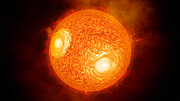
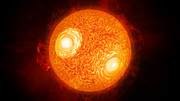
Using ESO’s Very Large Telescope Interferometer astronomers have constructed the most detailed image ever of a star — the red supergiant star Antares. They have also made the first map of the velocities of material in the atmosphere of a star other than the Sun, revealing unexpected turbulence in Antares’s huge extended atmosphere. The results were published in the journal Nature.

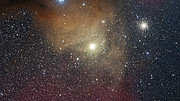
To the unaided eye the famous, bright star Antares shines with a strong red tint in the heart of the constellation of Scorpius (The Scorpion). It is a huge and comparatively cool red supergiant star in the late stages of its life, on the way to becoming a supernova [1].

A team of astronomers, led by Keiichi Ohnaka, of the Universidad Católica del Norte in Chile, has now used ESO’s Very Large Telescope Interferometer (VLTI) at the Paranal Observatory in Chile to map Antares’s surface and to measure the motions of the surface material. This is the best image of the surface and atmosphere of any star other than the Sun.

The VLTI is a unique facility that can combine the light from up to four telescopes, either the 8.2-metre Unit Telescopes, or the smaller Auxiliary Telescopes, to create a virtual telescope equivalent to a single mirror up to 200 metres across. This allows it to resolve fine details far beyond what can be seen with a single telescope alone.

How stars like Antares lose mass so quickly in the final phase of their evolution has been a problem for over half a century,” said Keiichi Ohnaka, who is also the lead author of the paper. “The VLTI is the only facility that can directly measure the gas motions in the extended atmosphere of Antares — a crucial step towards clarifying this problem. The next challenge is to identify what’s driving the turbulent motions.”

Using the new results the team has created the first two-dimensional velocity map of the atmosphere of a star other than the Sun. They did this using the VLTI with three of the Auxiliary Telescopes and an instrument called AMBER to make separate images of the surface of Antares over a small range of infrared wavelengths. The team then used these data to calculate the difference between the speed of the atmospheric gas at different positions on the star and the average speed over the entire star [2]. This resulted in a map of the relative speed of the atmospheric gas across the entire disc of Antares — the first ever created for a star other than the Sun..

The astronomers found turbulent, low-density gas much further from the star than predicted, and concluded that the movement could not result from convection [3], that is, from large-scale movement of matter which transfers energy from the core to the outer atmosphere of many stars. They reason that a new, currently unknown, process may be needed to explain these movements in the extended atmospheres of red supergiants like Antares.

In the future, this observing technique can be applied to different types of stars to study their surfaces and atmospheres in unprecedented detail. This has been limited to just the Sun up to now,” concludes Ohnaka. “Our work brings stellar astrophysics to a new dimension and opens an entirely new window to observe stars.


Notes

[1] Antares is considered by astronomers to be a typical red supergiant. These huge dying stars are formed with between nine and 40 times the mass of the Sun. When a star becomes a red supergiant, its atmosphere extends outward so it becomes large and luminous, but low-density. Antares now has a mass about 12 times that of the Sun and a diameter about 700 times larger than the Sun’s. It is thought that it started life with a mass more like 15 times that of the Sun, and has shed three solar-masses of material during its life.

[2] The velocity of material towards or away from Earth can be measured by the Doppler Effect, which shifts spectral lines either towards the red or blue ends of the spectrum, depending on whether the material emitting or absorbing light is receding from or approaching the observer.

[3] Convection is the process whereby cold material moves downwards and hot material moves upwards in a circular pattern. The process occurs on Earth in the atmosphere and ocean currents, but it also moves gas around within stars.


More Information

This research was presented in a paper entitled “Vigorous atmospheric motion in the red supergiant star Antares”, by K. Ohnaka et al., published in the journal Nature.

The team is composed of K. Ohnaka (Universidad Católica del Norte, Antofagasta, Chile), G. Weigelt (Max- Planck-Institut für Radioastronomie, Bonn, Germany) and K. -H. Hofmann (Max- Planck-Institut für Radioastronomie, Bonn, Germany).

ESO is the foremost intergovernmental astronomy organisation in Europe and the world’s most productive ground-based astronomical observatory by far. It is supported by 16 countries: Austria, Belgium, Brazil, the Czech Republic, Denmark, France, Finland, Germany, Italy, the Netherlands, Poland, Portugal, Spain, Sweden, Switzerland and the United Kingdom, along with the host state of Chile. ESO carries out an ambitious programme focused on the design, construction and operation of powerful ground-based observing facilities enabling astronomers to make important scientific discoveries. ESO also plays a leading role in promoting and organising cooperation in astronomical research. ESO operates three unique world-class observing sites in Chile: La Silla, Paranal and Chajnantor. At Paranal, ESO operates the Very Large Telescope and its world-leading Very Large Telescope Interferometer as well as two survey telescopes, VISTA working in the infrared and the visible-light VLT Survey Telescope. ESO is also a major partner in two facilities on Chajnantor, APEX and ALMA, the largest astronomical project in existence. And on Cerro Armazones, close to Paranal, ESO is building the 39-metre Extremely Large Telescope, the ELT, which will become “the world’s biggest eye on the sky”.


Links


Contacts

Keiichi Ohnaka
Instituto de Astronomía — Universidad Católica del Norte
Antofagasta, Chile
Tel: +56 55 235 5493
Email: k1.ohnaka@gmail.com

Richard Hook
ESO Public Information Officer
Garching bei München, Germany
Tel: +49 89 3200 6655
Cell: +49 151 1537 3591
Email: rhook@eso.org

Source: ESO/News

Saturday, July 01, 2017

Betelgeuse captured by ALMA

 Betelgeuse
Credit: ALMA (ESO/NAOJ/NRAO)/E. O’Gorman/P. Kervella


This orange blob shows the nearby star Betelgeuse, as seen by the Atacama Large Millimeter/submillimeter Array (ALMA). This is the first time that ALMA has ever observed the surface of a star and this first attempt has resulted in the highest-resolution image of Betelgeuse available.

Betelgeuse is one of the largest stars currently known — with a radius around 1400 times larger than the Sun’s in the millimeter continuum. About 600 light-years away in the constellation of Orion (The Hunter), the red supergiant burns brightly, causing it to have only a short life expectancy. The star is just about eight million years old, but is already on the verge of becoming a supernova. When that happens, the resulting explosion will be visible from Earth, even in broad daylight.

The star has been observed in many other wavelengths, particularly in the visible, infrared, and ultraviolet. Using ESO’s Very Large Telescope astronomers discovered a vast plume of gas almost as large as our Solar System. Astronomers have also found a gigantic bubble that boils away on Betelgeuse’s surface. These features help to explain how the star is shedding gas and dust at tremendous rates (eso0927, eso1121). In this picture, ALMA observes the hot gas of the lower chromosphere of Betelgeuse at sub-millimeter wavelengths — where localised increased temperatures explain why it is not symmetric. Scientifically, ALMA can help us to understand the extended atmospheres of these hot, blazing stars.

Links

Source: ESO/Potw

Saturday, March 11, 2017

Home to a hypergiant

Credit: ESA/Hubble & NASA 

Light travels through space at just under 300 000 kilometres per second! This staggering speed is used to calculate astronomical distances; although often misinterpreted as a unit of time (due to its misleading name), a light-year is actually a unit of astronomical distance, and is defined as the distance that light travels in a year. For reference, this is around nine trillion kilometres… but it’s a little tricky to visualise!

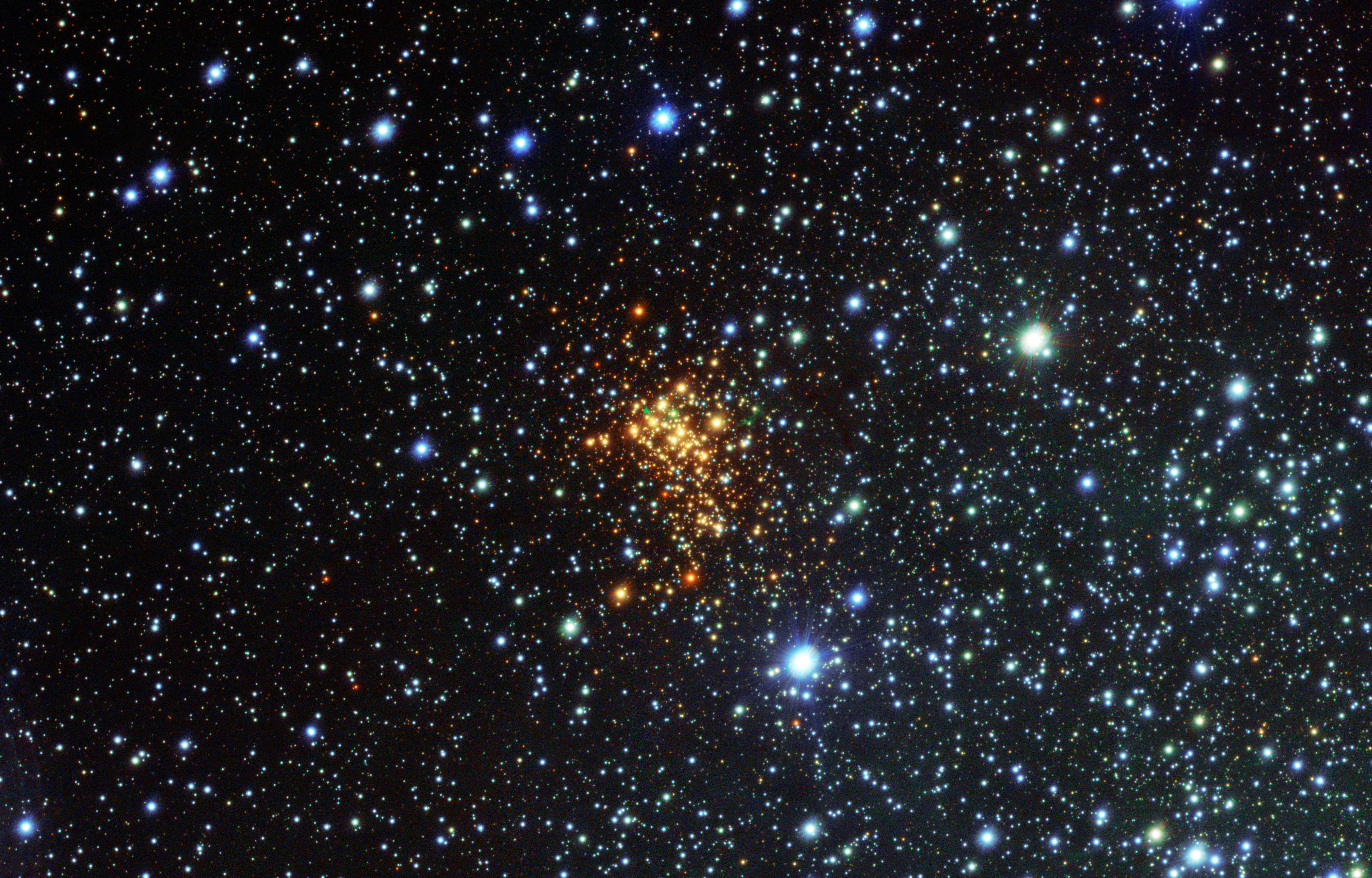
With this in mind, 15 000 light-years may sound like a truly huge distance, but compared to the vastness of the cosmos, it’s really quite nearby. In fact, an object sitting 15 000 light-years away would not even be outside our home galaxy, the Milky Way. This is roughly the distance between us and a young super star cluster known as Westerlund 1, home to one of the largest stars ever discovered. 

Stars are classified according to their spectral type, surface temperature, and luminosity. While studying and classifying the cluster’s constituent stars, astronomers discovered that Westerlund 1 is home to one of the largest stars ever discovered, originally named Westerlund 1-26. It is a red supergiant (although sometimes classified as a hypergiant) with a radius over 1500 times that of our Sun. If Westerlund 1-26 were placed where our Sun is in our Solar System, it would extend out beyond the orbit of Jupiter
 
Most of Westerlund 1’s stars are thought to have formed in the same burst of activity, meaning that they have similar ages and compositions. The cluster is relatively young in astronomical terms —at around three million years old it is a baby compared to our own Sun, which is some 4.6 billion years old.


Wednesday, August 31, 2016

NASA Team Probes Peculiar Age-Defying Star

An age-defying star designated as IRAS 19312+1950 (arrow) exhibits features characteristic of a very young star and a very old star. The object stands out as extremely bright inside a large, chemically rich cloud of material, as shown in this image from NASA’s Spitzer Space Telescope. A NASA-led team of scientists thinks the star – which is about 10 times as massive as our sun and emits about 20,000 times as much energy – is a newly forming protostar. That was a big surprise because the region had not been known as a stellar nursery before. But the presence of a nearby interstellar bubble, which indicates the presence of a recently formed massive star, also supports this idea. Credits: NASA/JPL-Caltech. For an unannotated version of this image, click here.

Saturday, August 06, 2016

Faintest hisses from space reveal famous star's past life

Artist’s impression of the supernova flare seen in the Large Magellanic Cloud on 23 February 1987. Credit: CAASTRO / Mats Björklund (Magipics). Click for a full size image

Artist’s impression of the star in its multi-million year long and previously unobservable phase as a large, red supergiant. 
Credit: CAASTRO / Mats Björklund (Magipics). Click for a full size image


Astronomers have managed to peer into the past of a nearby star millions of years before its famous explosion, using a telescope in remote outback Australia at a site free from FM radio interference.

Research led by a student at the University of Sydney, and including an international team of astronomers observing the region at the lowest-ever radio frequencies, has helped fine-tune our understanding of stellar explosions. The findings are published today in the journal Monthly Notices of the Royal Astronomical Society.

The research paints a picture of the star's life long before its death in what was the closest and brightest supernova seen from Earth, now known as supernova remnant 1987A (SN 1987A), which collapsed spectacularly almost 30 years ago.

Much had been known about the immediate past of this star through studying the cosmic ruins resulting from the star's collapse in 1987, which occurred in a neighbouring galaxy, the Large Magellanic Cloud. However it was the detection of the very faintest of hisses through low-frequency radio astronomy that has provided the latest insights. Previously, only the final fraction of the dead star's multi-million-year-long life, about 0.1%, or 20,000 years had been observable.

This latest research – which has enabled astrophysicists to probe the supernova's past life millions of years further back than was previously possible – was led by Joseph Callingham, a PhD candidate with the University of Sydney and the ARC Centre of Excellence for All-Sky Astrophysics (CAASTRO), under supervision from former Young Australian of the Year and former CAASTRO Director Prof Bryan Gaensler, now at the University of Toronto.

Operating the Murchison Widefield Array in the West Australian desert, the radio astronomers were able to 'see' right back to when the star was in its long-lasting red supergiant phase.

Mr Callingham explained previous studies focused on material that was ejected into space when the star was in its final blue supergiant phase. "Just like excavating and studying ancient ruins that teach us about the life of a past civilisation, my colleagues and I have used low-frequency radio observations as a window into the star's life," he said.

Researchers found the red supergiant lost its matter at a slower rate and generated slower winds that pushed into its surrounding environment than was previously assumed. 

"Our new data improves our knowledge of the composition of space in the region of SN 1987A; we can now go back to our simulations and tweak them, to better reconstruct the physics of supernova explosions," said Mr Callingham.

Professor Gaensler explained that key to gaining these new insights was the quiet environment in which the radio telescope is located. "Nobody knew what was happening at low radio frequencies, because the signals from our own earthbound FM radio drown out the faint signals from space. Now, by studying the strength of the radio signal, astronomers for the first time can calculate how dense the surrounding gas is, and thus understand the environment of the star before it died."


Media contact

Dr Wiebke Ebeling
ARC Centre of Excellence for All-sky Astrophysics (CAASTRO)
Curtin Institute of Radio Astronomy | Curtin University
Australia
Tel: +61 8 9266 9174
Mob: +61 423 933 444
wiebke.ebeling@curtin.edu.au


Science contact

Joseph Callingham
University of Sydney
j.callingham@physics.usyd.edu.au


Images e videos


The team describe the result, and show an animation of how the older material from the star's red supergiant phase is being pushed along by younger material and by the shock from the supernova. Credit: CAASTRO


Notes for Editors

CAASTRO is a collaboration of The University of Sydney, The Australian National University, The University of Melbourne, Swinburne University of Technology, The University of Queensland, The University of Western Australia and Curtin University, the latter two participating together as the International Centre for Radio Astronomy Research (ICRAR). CAASTRO is funded under the Australian Research Council (ARC) Centre of Excellence program, with additional funding from the seven participating universities and from the NSW State Government's Science Leveraging Fund.

The Royal Astronomical Society (RAS), founded in 1820, encourages and promotes the study of astronomy, solar-system science, geophysics and closely related branches of science. The RAS organizes scientific meetings, publishes international research and review journals, recognizes outstanding achievements by the award of medals and prizes, maintains an extensive library, supports education through grants and outreach activities and represents UK astronomy nationally and internationally. Its more than 4000 members (Fellows), a third based overseas, include scientific researchers in universities, observatories and laboratories as well as historians of astronomy and others.

The RAS accepts papers for its journals based on the principle of peer review, in which fellow experts on the editorial boards accept the paper as worth considering. The Society issues press releases based on a similar principle, but the organisations and scientists concerned have overall responsibility for their content.
 
Follow the RAS on Twitter


Tuesday, October 15, 2013

Surprise Cloud Around Vast Star

Credit: ESO/VPHAS+ Survey/N. Wright

This new picture from the VLT Survey Telescope (VST) at ESO's Paranal Observatory shows the remarkable super star cluster Westerlund 1 (eso1034). This exceptionally bright cluster lies about 16 000 light-years from Earth in the southern constellation of Ara (The Altar). It contains hundreds of very massive and brilliant stars, all of which are just a few million years old — babies by stellar standards. But our view of this cluster is hampered by gas and dust that prevents most of the visible light from the cluster's stars from getting to Earth.

Now, astronomers studying images of Westerlund 1 from a new survey of the southern skies [1] have spotted something unexpected in this cluster. Around one of the stars — known as W26, a red supergiant and possibly the biggest star known— they have discovered clouds of glowing hydrogen gas, shown as green features in this new image.

Such glowing clouds around massive stars are very rare, and are even rarer around a red supergiant— this is the first ionised nebula discovered around such a star. W26 itself would be too cool to make the gas glow; the astronomers speculate that the source of the ionising radiation may be either hot blue stars elsewhere in the cluster, or possibly a fainter, but much hotter, companion star to W26.

W26 will eventually explode as a supernova. The nebula that surrounds it is very similar to the nebula surrounding SN1987A, the remnants of a star that went supernova in 1987 [2]. SN1987A was the closest observed supernova to Earth since 1604, and as such it gave astronomers a chance to explore the properties of these explosions. Studying objects like this new nebula around W26 will help astronomers to understand the mass loss processes around these massive stars, which eventually lead to their explosive demise.

Notes

[1] This picture forms part of a detailed public survey of a large part of the Milky Way called VPHAS+ that is using the power of the VST to search for new objects such as young stars and planetary nebulae. A spectacular recent picture of the Prawn Nebula was made using observations from the same survey.

[2] This nebula is thought to have surrounded SN1987A’s progenitor star since before it went supernova.

Links

Source:  ESO