Wednesday, March 14, 2012

Abell 383: Getting a Full Picture of an Elusive Subject

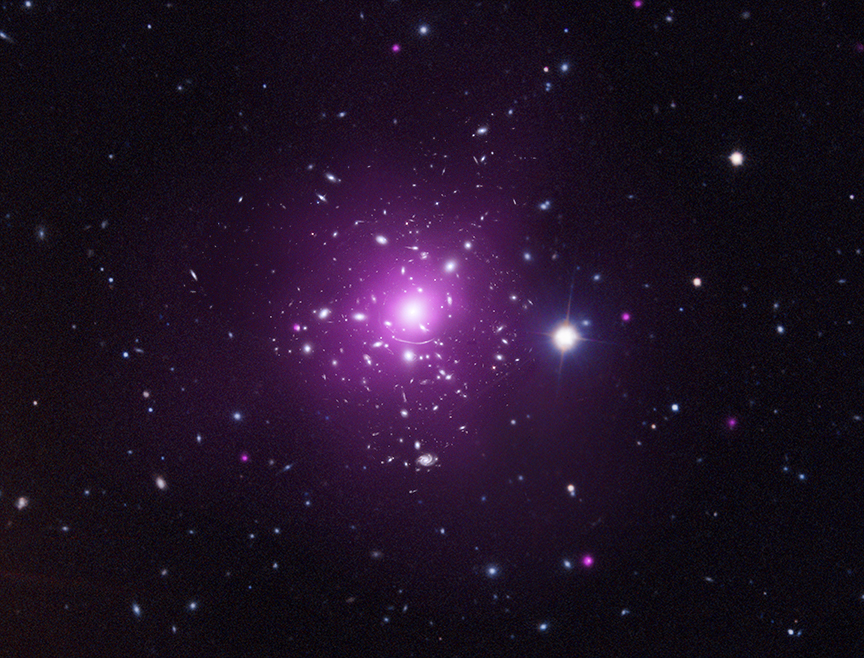
Abell 383
Credit: X-ray: NASA/CXC/Caltech/A.Newman et al/Tel Aviv/A.Morandi & M.Limousin; Optical: NASA/STScI, ESO/VLT, SDSS

Two teams of astronomers have used data from NASA's Chandra X-ray Observatory and other telescopes to map the distribution of dark matter in a galaxy cluster known as Abell 383, which is located about 2.3 billion light years from Earth. Not only were the researchers able to find where the dark matter lies in the two dimensions across the sky, they were also able to determine how the dark matter is distributed along the line of sight.

Dark matter is invisible material that does not emit or absorb any type of light, but is detectable through its gravitational effects. Several lines of evidence indicate that there is about six times as much dark matter as "normal", or baryonic, matter in the Universe. Understanding the nature of this mysterious matter is one of the outstanding problems in astrophysics.

Galaxy clusters are the largest gravitationally-bound structures in the universe, and play an important role in research on dark matter and cosmology, the study of the structure and evolution of the universe. The use of clusters as dark matter and cosmological probes hinges on scientists' ability to use objects such as Abell 383 to accurately determine the three-dimensional structures and masses of clusters.

The recent work on Abell 383 provides one of the most detailed 3-D pictures yet taken of dark matter in a galaxy cluster. Both teams have found that the dark matter is stretched out like a gigantic football, rather than being spherical like a basketball, and that the point of the football is aligned close to the line of sight.

The X-ray data (purple) from Chandra in the composite image show the hot gas, which is by far the dominant type of normal matter in the cluster. Galaxies are shown with the optical data from the Hubble Space Telescope (HST), the Very Large Telescope, and the Sloan Digital Sky Survey, colored in blue and white.

Both teams combined the X-ray observations of the "normal matter" in the cluster with gravitational lensing information determined from optical data. Gravitational lensing - an effect predicted by Albert Einstein - causes the material in the galaxy cluster, both normal and dark matter, to bend and distort the optical light from background galaxies. The distortion is severe in some parts of the image, producing an arc-like appearance for some of the galaxies. In other parts of the image the distortion is subtle and statistical analysis is used to study the distortion effects and probe the dark matter.

A considerable amount of effort has gone into studying the center of galaxy clusters, where the dark matter has the highest concentration and important clues about its behavior might be revealed. Both of the Abell 383 studies reported here continue that effort.

The team of Andrea Morandi from Tel Aviv University in Israel and Marceau Limousin from Université de Provence in France and University of Copenhagen in Denmark concluded that the increased concentration of the dark matter toward the center of the cluster is in agreement with most theoretical simulations. Their lensing data came from HST images.

The team led by Andrew Newman of the California Institute of Technology and Tommaso Treu of University of California, Santa Barbara (UCSB) used lensing data from HST and the Japanese telescope Subaru, but added Keck observations to measure the velocities of stars in the galaxy in the center of the cluster, allowing for a direct estimate of the amount of matter there. They found evidence that the amount of dark matter is not peaked as dramatically toward the center as the standard cold dark matter model predicts. Their paper describes this as being the "most robust case yet" made for such a discrepancy with the theory.

The contrasting conclusions reached by the two teams most likely stem from differences in the data sets and the detailed mathematical modeling used. One important difference is that because the Newman et al. team used velocity information in the central galaxy, they were able to estimate the density of dark matter at distances that approached as close as only 6,500 light years from the center of the cluster. Morandi and Limousin did not use velocity data and their density estimates were unable to approach as close to the cluster's center, reaching to within 80,000 light years.

Another important difference is that Morandi and Limousin used a more detailed model for the 3-D map of dark matter in the cluster. For example, they were able to estimate the orientation of the dark matter "football" in space and show that it is mostly edge-on, although slightly tilted with respect to the line of sight.

As is often the case with cutting-edge and complex results, further work will be needed to resolve the discrepancy between the two teams. In view of the importance of resolving the dark matter mystery, there will undoubtedly be much more research into Abell 383 and other objects like it in the months and years to come.

If the relative lack of dark matter in the center of Abell 383 is confirmed, it may show that improvements need to be made in our understanding of how normal matter behaves in the center of galaxy clusters, or it may show that dark matter particles can interact with each other, contrary to the prevailing model.

The Newman et al. paper was published in the February 20, 2011 issue of the Astrophysical Journal Letter and the Morandi and Limousin paper has been accepted for publication in the Monthly Notices of the Royal Astronomical Society. Other members of the Newman et al. team were Richard Ellis from Caltech, and David Sand from Las Cumbres Global Telescope Network and UCSB.

Fast Facts for Abell 383:

Scale: 7.26 arcmin across (4.84 million light years)
Category: Groups & Clusters of Galaxies
Coordinates: (J2000) RA 02h 48m 06.96s | Dec -03º 29' 31.81"
Constellation: Eridanus
Observation Date: 3 pointings between Sep and Nov 2000
Observation Time: 13 hours 43 min.
Obs. ID: 524, 2320, 2321
Color Code: X-ray (Purple), Optical (White & Blue)
Instrument: ACIS
References: Newman,A. et al. 2011 ApJ 728:L39; arXiv:1101.3553; Morandi, A., Limousin, M. 2011 MNRAS (in press);arXiv:1108.0769
Distance Estimate: 2.3 billion light years (z=0.189)

The Feeding Habits of Teenage Galaxies

PR Image eso1212a
Teenage galaxies in the distant Universe

PR Image eso1212b
Teenage galaxies in the distant Universe (unannotated)

PR Image eso1212c
Teenage galaxies in the distant Universe and the motions of their gas

PR Image eso1212d
A Wide-field view of the sky around a field studied in the MASSIV survey

Videos

PR Video eso1212a
Zooming in on teenage galaxies in the distant Universe

New observations made with ESO’s Very Large Telescope are making a major contribution to understanding the growth of adolescent galaxies. In the biggest survey of its kind astronomers have found that galaxies changed their eating habits during their teenage years - the period from about 3 to 5 billion years after the Big Bang. At the start of this phase smooth gas flow was the preferred snack, but later, galaxies mostly grew by cannibalising other smaller galaxies.

Astronomers have known for some time that the earliest galaxies were much smaller than the impressive spiral and elliptical galaxies that now fill the Universe. Over the lifetime of the cosmos galaxies have put on a great deal of weight but their food, and eating habits, are still mysterious. A new survey of carefully selected galaxies has focussed on their teenage years — roughly the period from about 3 to 5 billion years after the Big Bang.

By employing the state-of-the-art instruments on ESO’s Very Large Telescope an international team is unravelling what really happened. In more than one hundred hours of observations the team has collected the biggest ever set of detailed observations of gas-rich galaxies at this early stage of their development [1].

“Two different ways of growing galaxies are competing: violent merging events when larger galaxies eat smaller ones, or a smoother and continuous flow of gas onto galaxies. Both can lead to lots of new stars being created,” explains Thierry Contini (IRAP, Toulouse, France), who leads the work.

The new results point toward a big change in the cosmic evolution of galaxies, when the Universe was between 3 and 5 billion years old. Smooth gas flow (eso1040) seems to have been a big factor in the building of galaxies in the very young Universe, whereas mergers became more important later.

“To understand how galaxies grew and evolved we need to look at them in the greatest possible detail. The SINFONI instrument on ESO’s VLT is one of the most powerful tools in the world to dissect young and distant galaxies. It plays the same role that a microscope does for a biologist,” adds Thierry Contini.

Distant galaxies like the ones in the survey are just tiny faint blobs in the sky, but the high image quality from the VLT used with the SINFONI instrument [2] means that the astronomers can make maps of how different parts of the galaxies are moving and what they are made of. There were some surprises.

“For me, the biggest surprise was the discovery of many galaxies with no rotation of their gas. Such galaxies are not observed in the nearby Universe. None of the current theories predict these objects,” says Benoît Epinat, another member of the team.

“We also didn’t expect that so many of the young galaxies in the survey would have heavier elements concentrated in their outer parts — this is the exact opposite of what we see in galaxies today,” adds Thierry Contini.

The team are only just starting to explore their rich set of observations. They plan to also observe the galaxies with future instruments on the VLT as well as using ALMA to study the cold gas in these galaxies. Looking further into the future the European Extremely Large Telescope will be ideally equipped to extend this type of study deeper into the early Universe.
Notes

[1] The name of the survey is MASSIV: Mass Assembly Survey with SINFONI in VVDS. The VVDS is the VIMOS-VLT Deep Survey. VIMOS is the VIsible imaging Multi-Object Spectrograph, a powerful camera and spectrograph on the VLT that was used to find the galaxies used in the MASSIV work, and measure their distances and other properties.

[2] SINFONI is the Spectrograph for INtegral Field Observations in the Near Infrared. It is the instrument on the VLT that was used for the MASSIV survey. SINFONI is a near-infrared (1.1-2.45 µm) integral field spectrograph using adaptive optics to improve the image quality.

More information

This research was presented in four papers describing the MASSIV survey that will appear in the journal Astronomy & Astrophysics.

The team is composed of T. Contini (Institut de Recherche en Astrophysique et Planétologie [IRAP], CNRS & Université de Toulouse, France), B. Epinat (Laboratoire d'Astrophysique de Marseille, CNRS & Université d'Aix-Marseille, France [LAM]), D. Vergani (Istituto di Astrofisica Spaziale e Fisica Cosmica-INAF, Bologna, Italy [IASF BO-INAF]), J. Queyrel (IRAP), L. Tasca (LAM), B. Garilli (Istituto di Astrofisica Spaziale e Fisica Cosmica-INAF, Milan, Italy [IASF MI-INAF]), O. Le Fevre (LAM), M. Kissler-Patig (ESO), P. Amram (LAM), J. Moultaka (IRAP), L. Paioro (IASF MI-INAF), L. Tresse (LAM), C. López-Sanjuan (LAM), E. Perez-Montero (Instituto de Astrofísica de Andalucía, Granada, Spain), C. Divoy (IRAP) and V. Perret (LAM).

The year 2012 marks the 50th anniversary of the founding of the European Southern Observatory (ESO). ESO is the foremost intergovernmental astronomy organisation in Europe and the world’s most productive astronomical observatory. It is supported by 15 countries: Austria, Belgium, Brazil, the Czech Republic, Denmark, France, Finland, Germany, Italy, the Netherlands, Portugal, Spain, Sweden, Switzerland and the United Kingdom. ESO carries out an ambitious programme focused on the design, construction and operation of powerful ground-based observing facilities enabling astronomers to make important scientific discoveries. ESO also plays a leading role in promoting and organising cooperation in astronomical research. ESO operates three unique world-class observing sites in Chile: La Silla, Paranal and Chajnantor. At Paranal, ESO operates the Very Large Telescope, the world’s most advanced visible-light astronomical observatory and two survey telescopes. VISTA works in the infrared and is the world’s largest survey telescope and the VLT Survey Telescope is the largest telescope designed to exclusively survey the skies in visible light. ESO is the European partner of a revolutionary astronomical telescope ALMA, the largest astronomical project in existence. ESO is currently planning a 40-metre-class European Extremely Large optical/near-infrared Telescope, the E-ELT, which will become “the world’s biggest eye on the sky”.

Links

Research papers in A&A: Paper I, Paper II, Paper III, Paper IV
MASSIV website
Photos of the VLT
Article about MASSIV in ESO Messenger

Contacts

Thierry Contini
Institut de Recherche en Astrophysique et Planétologie, CNRS & Université de Toulouse
Toulouse, France
Tel: +33 561 332 814
Cell: +33 662 641 268
Email: Thierry.Contini@irap.omp.eu

Richard Hook
ESO, La Silla, Paranal, E-ELT and Survey Telescopes Public Information Officer
Garching bei München, Germany
Tel: +49 89 3200 6655
Cell: +49 151 1537 3591
Email: rhook@eso.org

Tuesday, March 13, 2012

The Origins of a Torus in a Galactic Nucleus

An artist's conception of a quasar, with a Chandra X-ray Observatory image of the quasar GB1508+5714 inset. The data reveal a jet of high-energy particles that extends more than 100,000 light years from the supermassive black hole powering the quasar. A new study shows for the first time that a torus of gas and dust will naturally form around the nuclear black hole as material falls in toward the nucleus. Credit: NASA/Chandra. Low Resolution Image (jpg)

Quasars are among the most energetic objects in the universe, with some of them as luminous as ten thousand Milky Way galaxies. Quasars are thought to have massive black holes at their cores, and astronomers also think that the regions around the black holes actively accrete matter, a process that releases vast amounts of energy and often ejects a powerful, narrow jet of material. Because they are so bright, quasars can be seen even when they are very far away, and this combination of being both highly energetic and located at cosmological distances makes them appealing to astronomers trying to figure out the nature of galactic center black holes (our own Milky Way has one) and the conditions in the early universe that prompt these monsters to form.

Quasars, and other galaxies with less dramatic but still active nuclei, come in a variety of subgroups. Some, for example, contain hot gas moving at huge velocities, while others do not; some are seen with strong dust absorption features, but others are not. One problem in unraveling the mystery of quasars is that many (perhaps most) quasar nuclei seem to be surrounded by a torus of obscuring dust that makes them difficult to study. In fact, the standard model of these objects proposes that the various subgroups result from viewing the active nuclei at different angles with respect to its dusty torus. If the nucleus happens to be seen face-on, and if there is a jet present, the gas velocities are large and the dust is not apparent; if seen edge-on through the torus, the observed velocities are much smaller and the dust absorption features are dominant. But so far no one knows for sure how quasars form, how they develop in time, or how (or what) physical processes generate their stupendous energies.

The situation may be about to change. The violent activity around a black hole is very difficult to analyze with just pen and paper, and so for years researchers have tried to use computer simulations to identify what happens. But these simulations have faced a major challenge: tracing the detailed flow of material from galaxy-wide scales of hundreds of thousands of light-years down into the central tenth of a light-year around the black hole. It has just been too hard to keep track of everything at such a fine scale across such a large one.

CfA astronomers Chris Hayward and Lars Hernquist, together with ex-CfA member Phil Hopkins and a fourth colleague, have figured out a way to deal with the computational dilemma. They use a clever scheme of multi-scale "zoom-ins" which allows them to track and model, in a physically consistent way, selected parcels of gas as they move inward towards the torus. Their simulations lead them to reach two very significant conclusions. First, they show that a dusty torus is likely to be produced around the black hole - in the past it had been postulated in order to explain the various morphologies but had never been demonstrated, even in a simulation. Secondly, the scientists show that the torus is not just a passive screen: it plays an active role in feeding gas and dust into the accretion disk around the black hole itself.

Monday, March 12, 2012

Stellar Voyage of a Butterfly-like Planetary Nebula


The breathtaking butterfly-like planetary nebula NGC 6881 is visible here in an image taken by the NASA/ESA Hubble Space Telescope. Located in the constellation of Cygnus, it is formed of an inner nebula, estimated to be about one fifth of a light-year across, and symmetrical “wings” that spread out about one light-year from one tip to the other. The symmetry could be due to a binary star at the nebula’s centre.

NGC 6881 has a dying star at its core which is about 60% of the mass of the Sun. It is an example of a quadrupolar planetary nebula, made from two pairs of bipolar lobes pointing in different directions, and consisting of four pairs of flat rings. There are also three rings in the centre.

A planetary nebula is a cloud of ionised gas, emitting light of various colours. It typically forms when a dying star — a red giant — throws off its outer layers, because of pulsations and strong stellar winds.

The star’s exposed hot, luminous core starts emitting ultraviolet radiation, exciting the outer layers of the star, which then become a newly born planetary nebula. At some point, the nebula is bound to dissolve in space, leaving the central star as a white dwarf — the final evolutionary state of stars.

The name “planetary” dates back to the 18th century, when such nebulae were first discovered — and when viewed through small optical telescopes, they looked a lot like giant planets.

Planetary nebulae usually live for a few tens of thousands of years, a short phase in the lifetime of a star.

The image was taken through three filters which isolate the specific wavelength of light emitted by nitrogen (shown in red), hydrogen (shown in green) and oxygen (shown in blue).

Source: ESA/Hubble - Space Telescope 

Sunday, March 11, 2012

Riding the Wake of a Merging Galaxy Cluster

Observations using the OASIS integral field spectrograph on the William Herschel Telescope (WHT) have revealed a long, thin plume of ionised gas stretching out from the brightest cluster galaxy (BCG) of Abell 2146 (z=0.243) (Canning et al. 2012). Extended optical emission-line nebulae are not uncommon in the cores of clusters, but the discovery of this particular structure is unexpected, as the host cluster is in the throes of a major merger event (Russell et al. 2010).

How can a >15kpc long plume survive in the environment of such a turbulent intracluster medium? Chandra X-ray observations of the system show that a merging subcluster has created large shock fronts, each several hundred kiloparsecs across. These surround a dense, relatively cool X-ray core which is being stripped of its material in the collision.

An optical image of the merging cluster Abell 2146 taken with the Subaru telescope. The morphology of the hot X-ray gas is shown as blue contours with the dense X-ray cool core unusually leading the brightest cluster galaxy. The majority of cluster galaxies are ahead of the X-ray gas, as expected in a galaxy cluster merger. The positions of the X-ray shock fronts are shown by the red lines. [ PNG | TIFF ]

A peak of cool, dense X-ray gas is usually observed to coincide with the position of the dominant central galaxy in relaxed galaxy clusters. As it has a short radiative cooling time, material condensing out of the hot atmosphere is in a position to contribute to the growth of the dominant galaxy. In a merging cluster core, however, the situation is very different. During a collision between two clusters, individual galaxies can be regarded as effectively collisionless particles. Along with the dark matter component of the clusters, the galaxies thus lead the baryonic gas, which is slowed by friction after the main collision event. The centroids of the dark matter distribution (observationally traced by the galaxies) thus separates from the main baryonic mass component traced by the hot X-ray gas. Observations of this offset in the 'Bullet' cluster merger have provided some of the strongest evidence for dark matter.

The situation in A2146 is unusual. While many of the member galaxies of the merging subcluster are located ahead of the X-ray peak, the dominant cluster galaxy lags behind. A large offset of 36 kpc is observed between the brightest cluster galaxy and the X-ray cool core. The new OASIS observations reveal a thin plume of ionised gas stretching out from the brightest cluster galaxy to bridge the gap to the X-ray cool core. The shape of the plume is tracked by a tail of cooler X-ray gas, linking the dense X-ray peak to the brightest cluster galaxy. This also means that the optical plume could trace an intermediate stage of gas cooling directly from the hot phase and on to the BCG from the X-ray cool core. Whether or not such a process results in significant star formation - thus contributing to the growth of the massive central galaxy - awaits further observation.

A smoothed Chandra X-ray image of Abell 2146 showing the full gas structure. The insert shows the zoomed in image of the X-ray cool core and the brighest cluster galaxy. Low temperature X-ray gas is stripped from the core and coincides with a thin plume of ionised gas extending onto the galaxy. The plume is likely longer than observed and is truncated by the OASIS field-of-view. The colour of the ionised gas shows it's line-of-sight velocity in km per second; smooth low-velocities are observed in the plume while significant rotaion appears to be ongoing in the core of the galaxy. [ PNG | TIFF ]


References:
R. E. A. Canning, H. R. Russell, N. A. Hatch, A. C. Fabian, A. I. Zabludoff, C. S. Crawford, L. J. King, B. R. McNamara, S. Okamoto and S. I. Raimundo, 2012, "Riding the wake of a merging galaxy cluster", MNRAS, 420, DOI : 10.1111/j.1365-2966.2011.20116.x.
Russell H. R., Sanders J. S., Fabian A. C., Baum S. A., Donahue M., Edge A. C., McNamara B. R., O’Dea C. P., 2010, MNRAS, 406, 1721.

Javier Méndez
Public Relations Officer

Friday, March 09, 2012

ESO Images in a Universal Context

PR Image ann12018a
Screenshot of an ESO image of the Orion Nebula shown in Microsoft’s WWT

Astronomical metadata to provide better access to space images

The European Southern Observatory has launched an initiative to attach extra information about context (metadata) to the images in its huge collection. The Astronomy Visualization Metadata standard that is now implemented has been developed in collaboration with many other major observatories, including partners from NASA, ESA, the California Academy of Sciences and the University of Arizona.

It is now easier than ever to learn more about the fantastic imagery of the Universe, including the archives of ESO. The Astronomy Visualization Metadata (AVM) standard was created to make access to astronomical images easier by collecting extra information in a standard way [1]. This extra information — known as metadata — includes details similar to those included with every digital snapshot picture coming from cameras today — who took the picture, when was it taken, where in the sky was the camera pointed and so on. It is, however, specifically designed for public-friendly astronomical images [2], making it much easier to find an image and much easier to put it into context. ESO has been helping to develop this tool and has been working on implementing it for all its astronomical images, culminating in its launch today.

“Tagging our images with metadata means we can now classify astronomical images using one common universal ‘language’, making them more easily accessible to all,” explains Lars Holm Nielsen, Advanced Projects Coordinator at ESO, who led the efforts to implement the standard at ESO.

AVM tags, some of which are based on research-based standards used by scientists, have been specifically tailored to address the needs and interests of the general public and outreach community. For example coordinate tags (World Coordinate System or WCS tags) can be used to describe the position, orientation, and scale of an image, so that images can be easily used in virtual atlases of the sky and other such applications where coordinates are essential. Images now have links that take the visitor to Microsoft’s WorldWide Telescope. Or, for instance, all images taken with the MPG/ESO 2.2-metre Telescope can be displayed with one click. Also images of this telescope are available in one swift overview. Or all press releases with results from the Very Large Telescope are available in one list.

The ESO image gallery has AVM tagging running "under the hood" such that most of the information you see on the webpage is also embedded in the highest quality versions of the images. This kind of integration allows all of the information to be carried along and used by other applications.

Many applications already make use of these metadata. The NASA-led AstroPix database of astronomical images, an outreach project to which ESO contributes, already makes use of the AVM tags. AstroPix, which is currently in a beta version, offers access to the collected image libraries of a many of the leading astronomical observatories under a single unified interface. These include the Spitzer Space Telescope, the Chandra X-ray Observatory, the NASA/ESA Hubble Space Telescope, Galex, WISE and ESO. The tags are used to characterise the object types, captions, the facilities that took the images, the position in the sky and much more.

“ESO has one of the biggest and best collections of astronomical images and now they have AVM tags they can be immediately searched and viewed in a very natural way, with AstroPix” adds Robert Hurt, leader of the AVM project as well as AstroPix. “It’s a big step forward.”

Other applications and organisations using the AVM standard, which will now benefit from the newly tagged ESO images, include Microsoft’s WorldWide Telescope, Stellarium and Google Sky. And planetarium system producers such as Skyskan, Uniview/Skiss and Evans & Sutherland are actively building AVM support into future versions of their software.

“This is a significant achievement for everyone involved in astronomy outreach. The wide response from our partners also means we will be able to better reach out to the public and share the incredible images coming from ESO’s many operating telescopes. We are grateful to everyone involved in this effort", [3] adds Lars Lindberg Christensen, Head of ESO Outreach and one of the initiators of the project.

Notes

[1] Metadata — additional information about data — describes the contents and context of data files using tags that can be used to classify files. It is used to describe digital data such as images using standards specially-tailored to the needs of a particular field.

[2] AVM, developed in the framework of Virtual Astronomy Multimedia Project (VAMP), is also relevant for artist‘s concepts and diagrams, simulations, and photography, and is only the first step in a future effort to encompass all multimedia products related to astronomy, including videos, podcasts, etc. VAMP is a collaborative project between individuals representing Spitzer Science Center, ESA/Hubble, California Academy of Sciences, IPAC/IRSA, and the University of Arizona. Key personnel at major observatories and end-application development organisations have endorsed the project and are committed to seeing success.

[3] ESO would like to thank the people without whose support this could not have been possible. They include Lars Holm Nielsen, Robert Hurt, Adrienne Gauthier, Amit Kapadia, Sarah Roberts and many others. Lars Holm Nielsen, who concludes a distinguished career at ESO with this release, is a specialist in development of information systems and software for cutting-edge science communication with a life long passion for astronomy. He has been working for the ESO-Hubble outreach group since 2002 and has been responsible for managing the implementation of advanced projects as well as the ESO’s outreach web infrastructure. In this capacity, he has been instrumental in developing the AVM system.

More Information

The year 2012 marks the 50th anniversary of the founding of the European Southern Observatory (ESO). ESO is the foremost intergovernmental astronomy organisation in Europe and the world’s most productive astronomical observatory. It is supported by 15 countries: Austria, Belgium, Brazil, the Czech Republic, Denmark, France, Finland, Germany, Italy, the Netherlands, Portugal, Spain, Sweden, Switzerland and the United Kingdom. ESO carries out an ambitious programme focused on the design, construction and operation of powerful ground-based observing facilities enabling astronomers to make important scientific discoveries. ESO also plays a leading role in promoting and organising cooperation in astronomical research. ESO operates three unique world-class observing sites in Chile: La Silla, Paranal and Chajnantor. At Paranal, ESO operates the Very Large Telescope, the world’s most advanced visible-light astronomical observatory and two survey telescopes. VISTA works in the infrared and is the world’s largest survey telescope and the VLT Survey Telescope is the largest telescope designed to exclusively survey the skies in visible light. ESO is the European partner of a revolutionary astronomical telescope ALMA, the largest astronomical project in existence. ESO is currently planning a 40-metre-class European Extremely Large optical/near-infrared Telescope, the E-ELT, which will become “the world’s biggest eye on the sky”.

Links


The Astropix database
Website of VAMP, the Virtual Astronomy Multimedia Project

Contacts

Lars Holm Nielsen
ESO, Garching, Germany
Cell: +49-151 22 652 416
Email: lars@hankat.dk

Lars Lindberg Christensen
Head, ESO education and Public Outreach Department
Garching, Germany
Tel: +49-89-3200-6761
Cell: +49-173-3872-621
Email: lars@eso.org

Antlia Dwarf Galaxy Peppers the Sky with Stars

Antlia Dwarf galaxy
Credit: ESA/Hubble & NASA

The myriad faint stars that comprise the Antlia Dwarf galaxy are more than four million light-years from Earth, but this NASA/ESA Hubble Space Telescope image offers such clarity that they could be mistaken for much closer stars in our own Milky Way. This very faint and sparsely populated small galaxy was only discovered in 1997.

Although small, the Antlia Dwarf is a dynamic site featuring stars at many different stages of evolution, from young to old. The freshest stars are only found in the central regions where there is significant ongoing star formation. Older stars and globular clusters are found in the outer areas.

It is not entirely clear whether the Antlia Dwarf is a member our galactic neighbourhood, called the Local Group. It probably lies just beyond the normally accepted outer limits of the group. Although it is fairly isolated, some believe it has interacted with other star groups. Evidence comes from galaxy NGC 3109, close to the Antlia Dwarf (but not visible in this image). Both galaxies feature rifts of stars moving at comparable velocities; a telltale sign that they were gravitationally linked at some point in the past.

This picture was created from observations in visible and infrared light taken with the Wide Field Channel of Hubble’s Advanced Camera for Surveys. The field of view is approximately 3.2 by 1.5 arcminutes.

Source: ESA/Hubble - Space Telescope

Thursday, March 08, 2012

Citizen Scientists Reveal a Bubbly Milky Way

A team of volunteers from the general public has pored over observations from NASA's Spitzer Space Telescope and discovered more than 5,000 "bubbles" in the disk of our Milky Way galaxy. Image credit: NASA/JPL-Caltech/Oxford University. Full image and caption

If astronomy had its own Academy Awards, then this part of the Milky Way would have been the "Favorite Nebula" pick for 2011. Competing against 12,263 other slices of the sky, this got more votes from the 35,000 volunteers searching for cosmic bubbles than any other location. Image credit: NASA/JPL-Caltech/University of Wisconsin. Full image and caption - enlarge image

A team of volunteers has pored over observations from NASA's Spitzer Space Telescope and discovered more than 5,000 "bubbles" in the disk of our Milky Way galaxy. Young, hot stars blow these bubbles into surrounding gas and dust, indicating areas of brand new star formation.

Upwards of 35,000 "citizen scientists" sifted through the Spitzer infrared data as part of the online Milky Way Project to find these telltale bubbles. The volunteers have turned up 10 times as many bubbles as previous surveys so far.

"These findings make us suspect that the Milky Way is a much more active star-forming galaxy than previously thought," said Eli Bressert, an astrophysics doctoral student at the European Southern Observatory, based in Germany, and the University of Exeter, England, and co-author of a paper submitted to the Monthly Notices of the Royal Astronomical Society.

"The Milky Way's disk is like champagne with bubbles all over the place," he said.

Computer programs struggle at identifying the cosmic bubbles. But human eyes and minds do an excellent job of noticing the wispy arcs of partially broken rings and the circles-within-circles of overlapping bubbles. The Milky Way Project taps into the "wisdom of crowds" by requiring that at least five users flag a potential bubble before its inclusion in the new catalog. Volunteers mark any candidate bubbles in the infrared Spitzer images with a sophisticated drawing tool before proceeding to scour another image.

"The Milky Way Project is an attempt to take the vast and beautiful data from Spitzer and make extracting the information a fun, online, public endeavor," said Robert Simpson, a postdoctoral researcher in astronomy at Oxford University, England, principal investigator of the Milky Way Project and lead author of the paper.

The data come from the Spitzer Galactic Legacy Infrared Mid-Plane Survey Extraordinaire (GLIMPSE) and Multiband Imaging Photometer for Spitzer Galactic (MIPSGAL) surveys. These datasets cover a narrow, wide strip of the sky measuring 130 degrees wide and just two degrees tall. From a stargazer's perspective, a two-degree strip is about the width of your index finger held at arm's length, and your arms opened to the sky span about 130 degrees. The surveys peer through the Milky Way's disk and right into the galaxy's heart.

The bubbles tagged by the volunteers vary in size and shape, both with distance and due to local gas cloud variations. The results will help astronomers better identify star formation across the galaxy. One topic under investigation is triggered star formation, in which the bubble-blowing birth of massive stars compresses nearby gas that then collapses to create further fresh stars.

"The Milky Way Project has shown that nearly a third of the bubbles are part of 'hierarchies,' where smaller bubbles are found on or near the rims of larger bubbles," said Matthew Povich, a National Science Foundation Astronomy and Astrophysics Postdoctoral Fellow at Penn State, University Park, and co-author of the paper. "This suggests new generations of star formation are being spawned by the expanding bubbles."

Variations in the distribution pattern of the bubbles intriguingly hint at structure in the Milky Way. For example, a rise in the number of bubbles around a gap at one end of the survey could correlate with a spiral arm. Perhaps the biggest surprise is a drop-off in the bubble census on either side of the galactic center. "We would expect star formation to be peaking in the galactic center because that's where most of the dense gas is," said Bressert. "This project is bringing us way more questions than answers."

In addition, the Milky Way Project users have pinpointed many other phenomena, such as star clusters and dark nebulae, as well as gaseous "green knots" and "fuzzy red objects." Meanwhile, the work with the bubbles continues, with each drawing helping to refine and improve the catalog.

For those interested in counting bubbles and contributing to the Milky Way Project, visit the following link: www.milkywayproject.org . To learn of other citizen science-based efforts, check out the Zooniverse: https://www.zooniverse.org/ .

Other authors of the paper include Sarah Kendrew of the Max Planck Institute, Heidelberg, Germany; Chris Lintott and Arfon Smith, also of the University of Oxford and the Adler Planetarium in Chicago, Ill.; Kim Arvidsson, also of the Adler Planetarium; Grace Wolf-Chase, also of the Adler Planetarium and the University of Chicago; Reid Sherman, also of the University of Chicago; Claudia Cyganowski of the Harvard-Smithsonian Center for Astronomy, Cambridge, Mass. and a National Science Foundation Astronomy and Astrophysics Postdoctoral Fellow; Sarah Maddison of Swinburne University, Hawthorn, Australia; and Kevin Schawinski of Yale University, New Haven, Conn. and an Einstein Fellow.

NASA's Jet Propulsion Laboratory, Pasadena, Calif., manages the Spitzer Space Telescope mission for NASA's Science Mission Directorate, Washington. Science operations are conducted at the Spitzer Science Center at the California Institute of Technology in Pasadena. Caltech manages JPL for NASA. For more information about Spitzer, visit http://spitzer.caltech.edu and http://www.nasa.gov/spitzer .


Written by Adam Hadhazy

***

Whitney Clavin 818-354-4673
Jet Propulsion Laboratory, Pasadena, Calif.
whitney.clavin@jpl.nasa.gov

Wednesday, March 07, 2012

Second Biggest Flare Of the Solar Cycle

This movie of the March 6, 2012 X5.4 flare was captured by the Solar Dynamics Observatory (SDO) in the 171 Angstrom wavelength. One of the most dramatic features is the way the entire surface of the sun seems to ripple with the force of the eruption. This movement comes from something called EIT waves – because they were first discovered with the Extreme ultraviolet Imaging Telescope (EIT) on the Solar Heliospheric Observatory. Since SDO captures images every 12 seconds, it has been able to map the full evolution of these waves and confirm that they can travel across the full breadth of the sun. The waves move at over a million miles per hour, zipping from one side of the sun to the other in about an hour. The movie shows two distinct waves. The first seems to spread in all directions; the second is narrower, moving toward the southeast. Such waves are associated with, and perhaps trigger, fast coronal mass ejections, so it is likely that each one is connected to one of the two CMEs that erupted on March 6. Credit: NASA/SDO/AIA. Download video - Download still - Download multi-colored still

The sun erupted with one of the largest solar flares of this solar cycle on March 6, 2012 at 7PM EST. This flare was categorized as an X5.4, making it the second largest flare -- after an X6.9 on August 9, 2011 -- since the sun’s activity segued into a period of relatively low activity called solar minimum in early 2007. The current increase in the number of X-class flares is part of the sun’s normal 11-year solar cycle, during which activity on the sun ramps up to solar maximum, which is expected to peak in late 2013.

About an hour later, at 8:14 PM ET, March 6, the same region let loose an X1.3 class flare. An X1 is 5 times smaller than an X5 flare.

These X-class flares erupted from an active region named AR 1429 that rotated into view on March 2. Prior to this, the region had already produced numerous M-class and one X-class flare. The region continues to rotate across the front of the sun, so the March 6 flare was more Earthward facing than the previous ones. It triggered a temporary radio blackout on the sunlit side of Earth that interfered with radio navigation and short wave radio.

In association with these flares, the sun also expelled two significant coronal mass ejections (CMEs), which are travelling faster than 600 miles a second and may arrive at Earth in the next few days. In the meantime, the CME associated with the X-class flare from March 4 has dumped solar particles and magnetic fields into Earth’s atmosphere and distorted Earth's magnetic fields, causing a moderate geomagnetic storm, rated a G2 on a scale from G1 to G5. Such storms happen when the magnetic fields around Earth rapidly change strength and shape. A moderate storm usually causes aurora and may interfere with high frequency radio transmission near the poles. This storm is already dwindling, but the Earth may experience another enhancement if the most recent CMEs are directed toward and impact Earth.


The Solar Heliospheric Observatory (SOHO) captured this movie of the sun's coronal mass ejection (CME) on the evening of March 6, 2012. The extremely fast and energetic solar particles associated with the solar flare caused the "noise" at the end of the movie. Credit: SOHO/ESA&NASA. Download video

In addition, last night’s flares have sent solar particles into Earth’s atmosphere, producing a moderate solar energetic particle event, also called a solar radiation storm. These particles have been detected by NASA’s SOHO and STEREO spacecraft, and NOAA’s GOES spacecraft. At the time of writing, this storm is rated an S3 on a scale that goes up to S5. Such storms can interfere with high frequency radio communication.

Besides the August 2011 X-class flare, the last time the sun sent out flares of this magnitude was in 2006. There was an X6.5 on December 6, 2006 and an X9.0 on December 5, 2006. Like the most recent events, those two flares erupted from the same region on the sun, which is a common occurrence.

What is a solar flare? What is a coronal mass ejection?

For answers to these and other space weather questions, please visit the Spaceweather Frequently Asked Questions page


Karen C. Fox
NASA Goddard Space Flight Center, Greenbelt, MD

Galaxies Get Up Close and Personal

PR Image eso1211a
VST image of the Hercules galaxy cluster

PR Image eso1211b
Highlights of the VST image of the Hercules galaxy cluster

PR Image eso1211c
The location of the Hercules galaxy cluster

PR Image eso1211d
Wide-field view of the Hercules galaxy cluster

Videos

PR Video eso1211a
Zooming in on the Hercules galaxy cluster

PR Video eso1211b
Panning across on the Hercules galaxy cluster

VST captures collisions in young galaxy cluster

The VLT Survey Telescope (VST) at ESO’s Paranal Observatory in Chile has imaged a fascinating collection of interacting galaxies in the Hercules galaxy cluster. The sharpness of the new picture, and the hundreds of galaxies captured in great detail in less than three hours of observations, attest to the great power of the VST and its huge camera OmegaCAM to explore the nearby Universe.

The Hercules galaxy cluster (also known as Abell 2151) lies about 500 million light-years away in the constellation of Hercules. It is unlike other nearby galactic assemblies in many ways. As well as being rather irregular in shape, it contains a wide variety of galaxy types, particularly young, star-forming spiral galaxies, and there are no giant elliptical galaxies in sight.

The new image was taken with the VST, the most recent addition to ESO’s Paranal Observatory in Chile (eso1119). The VST is a survey telescope equipped with OmegaCAM, a 268-megapixel camera that provides images covering very large areas on the sky. Normally only small telescopes can image large objects such as this in a single shot, but the 2.6-metre VST not only has a wide field, but can also exploit the superb conditions on Paranal to simultaneously obtain very sharp and deep images quickly.

Galaxy pairs getting up close and personal and on their way to merging into single, larger galaxies can be seen all over this image. The numerous interactions, and the large number of gas-rich, star-forming spiral galaxies in the cluster, make the members of the Hercules cluster look like the young galaxies of the more distant Universe [1]. Because of this similarity, astronomers believe that the Hercules galaxy cluster is a relatively young cluster. It is a vibrant and dynamic swarm of galaxies that will one day mature into one more similar to the older galaxy clusters that are more typical of our galactic neighbourhood.

Galaxy clusters are formed when smaller groups of galaxies come together due to the pull of their gravity. As these groups get closer to each other, the cluster becomes more compact and more spherical in shape. At the same time, the galaxies themselves get closer together and many start to interact. Even if spiral galaxies are dominant in the initial groups, the galactic collisions eventually distort their spiral structure and strip off their gas and dust, quenching most star formation. For this reason, most of the galaxies in a mature cluster are elliptical or irregular in shape. One or two large elliptical galaxies, formed from the merger of smaller galaxies and permeated by old stars, usually reside at the centres of these old clusters.

The Hercules galaxy cluster is believed to be a collection of at least three small clusters and groups of galaxies that are currently being assembled into a larger structure. Furthermore, the cluster itself is merging with other large clusters to form a galaxy supercluster. These giant collections of clusters are some of the largest structures in the Universe. The wide field of view and image quality of OmegaCAM on the VST make it ideal for studying the outskirts of galaxy clusters where the poorly-understood interactions between clusters are taking place.

This beautiful image shows not only the galaxies of the Hercules galaxy cluster, but also many faint and fuzzy objects in the background, which are galaxies that are much further away from us. Closer to home, several brilliant Milky Way stars are also visible in the foreground and there are even a few asteroids that have left short trails as they moved slowly across the image during the exposures.

Notes

[1] Objects in the very distant Universe are seen as they were when much younger, because it takes several billion years for their light to reach us.

More information

The VST programme is a joint venture between the INAF–Osservatorio Astronomico di Capodimonte, Naples, Italy and ESO. INAF designed and built the telescope with the collaboration of leading Italian industries and ESO was responsible for the enclosure and the civil engineering works at the site. OmegaCAM, the VST’s camera, was designed and built by a consortium including institutes in the Netherlands, Germany and Italy with major contributions from ESO. The facility is operated by ESO, which also archives and distributes data from the telescope.

The year 2012 marks the 50th anniversary of the founding of the European Southern Observatory (ESO). ESO is the foremost intergovernmental astronomy organisation in Europe and the world’s most productive astronomical observatory. It is supported by 15 countries: Austria, Belgium, Brazil, the Czech Republic, Denmark, France, Finland, Germany, Italy, the Netherlands, Portugal, Spain, Sweden, Switzerland and the United Kingdom. ESO carries out an ambitious programme focused on the design, construction and operation of powerful ground-based observing facilities enabling astronomers to make important scientific discoveries. ESO also plays a leading role in promoting and organising cooperation in astronomical research. ESO operates three unique world-class observing sites in Chile: La Silla, Paranal and Chajnantor. At Paranal, ESO operates the Very Large Telescope, the world’s most advanced visible-light astronomical observatory and two survey telescopes. VISTA works in the infrared and is the world’s largest survey telescope and the VLT Survey Telescope is the largest telescope designed to exclusively survey the skies in visible light. ESO is the European partner of a revolutionary astronomical telescope ALMA, the largest astronomical project in existence. ESO is currently planning a 40-metre-class European Extremely Large optical/near-infrared Telescope, the E-ELT, which will become “the world’s biggest eye on the sky”.

Links
Photos of VST
Photos of OmegaCAM

Contacts

Richard Hook
ESO, La Silla, Paranal, E-ELT and Survey Telescopes Public Information Officer
Garching bei München, Germany
Tel: +49 89 3200 6655
Email: rhook@eso.org

Tuesday, March 06, 2012

Galaxy Cluster Hidden in Plain View

An infared image of the cluster. Three narrow slices of the infrared spectrum are represented in this color composite. The colors have been balanced to accentuate the red galaxies at a distance of 10.5 billion light years. For an animated gif of this image, see: http://bit.ly/wp4aFv

Pasadena, CA--A team of astronomers has discovered the most distant cluster of red galaxies ever observed using FourStar, a new and powerful near-infrared camera on the 6.5m Magellan Baade Telescope. The galaxy cluster is located 10.5 billion light years away in the direction of the constellation Leo. It is made up of 30 galaxies packed closely together, forming the earliest known “galaxy city” in the universe. The findings will be published in the Astrophysical Journal Letters.

Remarkably, the cluster was completely missed by previous surveys, which searched this region of the sky for thousands of hours and were conducted by all the major ground- and space-based observing facilities, including the Hubble Space Telescope. Despite these intense observations, accurate distances for such faint and distant galaxies were missing until the advent of FourStar.
Eric Persson of the Carnegie Observatories* led the development of the new camera that enabled these observations. Persson and his team--which includes Carnegie’s David Murphy, Andy Monson, Dan Kelson, Pat McCarthy, and Ryan Quadri--equipped FourStar with five special filters to collect images that are sensitive to narrow slices of the near-infrared spectrum. This powerful approach allows them to measure accurate distances between Earth and thousands of distant galaxies at one time, providing a 3-D map of the early universe.

The 3-D map revealed the conspicuous concentration of galaxies that existed when the universe was only three billion years old.

“This means the galaxy cluster is still young and should continue to grow into an extremely dense structure possibly containing thousands of galaxies,” explained lead author Lee Spitler of Australia’s Swinburne University of Technology.

Studying this system will help astronomers understand how galaxies are influenced by their environment, evolve, and assemble into larger structures.

The finding is part of a larger survey, the FourStar Galaxy Evolution Survey ("Z-FOURGE"), led by Dr. Ivo Labbé, a former Carnegie postdoctoral fellow, now at Leiden Observatory in the Netherlands. The focus of the survey is to address a classical problem in observational astronomy: determining distances. Only then do you know if a point of light is a star in our Milky Way, a small nearby galaxy, or a large one very far away.

The Z-FOURGE observations are being conducted using the Magellan 6.5- meter telescope at Carnegie’s Las Campanas Observatory in Chile. From the first six months of the survey, the team obtained accurate distances for faint galaxies over a region roughly one-fifth the apparent size of the Moon. Though the area is relatively small, they found about a thousand galaxies at even greater distances than the new cluster.

“The excellent image quality and sensitivity of Magellan and FourStar really make the difference,”Labbé said. “We look forward to many more exciting and unexpected discoveries!”
For more information about this project, visit: http://z-fourge.obs.carnegiescience.edu/.

*****

*The full list of the research team is: Karl Glazebrook, Glenn G. Kacprzak, Ivo Labbé (PI), Daniel D. Kelson, Patrick J. McCarthy, Andy Monson, David Murphy, Casey Papovich, S. Eric Persson, Ryan Quadri, Lee R. Spitler, Caroline M. S. Straatman, Vithal Tilvi, Kim-Vy H. Tran, and Pieter van Dokkum.

Funding for this project came from the Carnegie Institution for Science; Swinburne University; Sterrewacht Leiden, Leiden University; Department of Physics and Astronomy, Texas A&M University; Department of Astronomy, Yale University; the Australian Research Council, Discovery Program; the Commonwealth of Australia; University of New South Wales; and the National Collaborative Research Infrastructure Strategy of the Australian Federal Government. The funding sources for FourStar are the Carnegie Institution for Science, the National Science Foundation, the Monell Foundation, Yale University, and Texas A&M University.

Monday, March 05, 2012

Galaxies' El Dorado

NGC 1483
Credit: ESA/Hubble & NASA

The NASA/ESA Hubble Space Telescope has produced this beautiful image of the galaxy NGC 1483. NGC 1483 is a barred spiral galaxy located in the southern constellation of Dorado — the dolphinfish in Spanish. The nebulous galaxy features a bright central bulge and diffuse arms with distinct star-forming regions. In the background, many other distant galaxies can be seen.

The constellation Dorado is home to the Dorado Group of galaxies, a loose group comprising an estimated 70 galaxies and located some 62 million light-years away. The Dorado group is much larger than the Local Group that includes the Milky Way (and which contains around 30 galaxies) and approaches the size of a galaxy cluster. Galaxy clusters are the largest groupings of galaxies (and indeed the largest structures of any type) in the Universe to be held together by their gravity.

Barred spiral galaxies are so named because of the prominent bar-shaped structures found in their centre. They form about two thirds of all spiral galaxies, including the Milky Way. Recent studies suggest that bars may be a common stage in the formation of spiral galaxies, and may indicate that a galaxy has reached full maturity.

 Source: ESA/Hubble - Space Telescope


Saturday, March 03, 2012

Cassini Detects Hint of Fresh Air at Dione

This view highlights tectonic faults and craters on Dione, an icy world that has undoubtedly experienced geologic activity since its formation. Image credit: NASA/JPL/Space Science Institute. Full image and caption

NASA's Cassini spacecraft has "sniffed" molecular oxygen ions around Saturn's icy moon Dione for the first time, confirming the presence of a very tenuous atmosphere. The oxygen ions are quite sparse - one for every 0.67 cubic inches of space (one for every 11 cubic centimeters of space) or about 2,550 per cubic foot (90,000 per cubic meter) - show that Dione has an extremely thin neutral atmosphere.

At the Dione surface, this atmosphere would only be as dense as Earth's atmosphere 300 miles (480 kilometers) above the surface. The detection of this faint atmosphere, known as an exosphere, is described in a recent issue of the journal Geophysical Research Letters.

"We now know that Dione, in addition to Saturn's rings and the moon Rhea, is a source of oxygen molecules," said Robert Tokar, a Cassini team member based at Los Alamos National Laboratory, Los Alamos, N.M., and the lead author of the paper. "This shows that molecular oxygen is actually common in the Saturn system and reinforces that it can come from a process that doesn't involve life."

Dione's oxygen appears to derive from either solar photons or energetic particles from space bombarding the moon's water ice surface and liberating oxygen molecules, Tokar said. But scientists will be looking for other processes, including geological ones, that could also explain the oxygen.

"Scientists weren't even sure Dione would be big enough to hang on to an exosphere, but this new research shows that Dione is even more interesting than we previously thought," said Amanda Hendrix, Cassini deputy project scientist at NASA's Jet Propulsion Laboratory, Pasadena, Calif., who was not directly involved in the study. "Scientists are now digging through Cassini data on Dione to look at this moon in more detail."

Several solid solar system bodies - including Earth, Venus, Mars and Saturn's largest moon Titan - have atmospheres. But they tend to be typically much denser than what has been found around Dione. However, Cassini scientists did detect a thin exosphere around Saturn's moon Rhea in 2010, very similar to Dione. The density of oxygen at the surfaces of Dione and Rhea is around 5 trillion times less dense than that at Earth's surface.

Tokar said scientists suspected molecular oxygen would exist at Dione because NASA's Hubble Space Telescope detected ozone. But they didn't know for sure until Cassini was able to measure ionized molecular oxygen on its second flyby of Dione on April 7, 2010 with the Cassini plasma spectrometer. On that flyby, the spacecraft flew within about 313 miles (503 kilometers) of the moon's surface.

Cassini scientists are also analyzing data from Cassini's ion and neutral mass spectrometer from a very close flyby on Dec. 12, 2011. The ion and neutral mass spectrometer made the detection of Rhea's thin atmosphere, so scientists will be able to compare Cassini data from the two moons and see if there are other molecules in Dione's exosphere.

The Cassini-Huygens mission is a cooperative project of NASA, the European Space Agency, and the Italian Space Agency. NASA's Jet Propulsion Laboratory, Pasadena, CLinkalif., a division of the California Institute of Technology in Pasadena, manages the mission for NASA's Science Mission Directorate, Washington, D.C. The Cassini orbiter was designed, developed and assembled at JPL. The Cassini plasma spectrometer team and the ion and neutral mass spectrometer team are based at Southwest Research Institute, San Antonio.

For more information about the Cassini mission, visit: http://www.nasa.gov/cassini and http://saturn.jpl.nasa.gov .

Jia-Rui C. Cook 818-354-0850
Jet Propulsion Laboratory, Pasadena, Calif.
jia-rui.c.cook@jpl.nasa.gov

Friday, March 02, 2012

Dark Matter Core Defies Explanation in Hubble Image

Merging Galaxy Cluster Abell 520
Credit: NASA, ESA, CFHT, CXO, M.J. Jee (University of California, Davis),
and A. Mahdavi (San Francisco State University)
News Realease Images - Zoomable image

It was the result no one wanted to believe. Astronomers observed what appeared to be a clump of dark matter left behind during a bizarre wreck between massive clusters of galaxies.

The dark matter collected into a "dark core" containing far fewer galaxies than would be expected if the dark matter and galaxies hung together. Most of the galaxies apparently have sailed far away from the collision. This result could present a challenge to basic theories of dark matter, which predict that galaxies should be anchored to the invisible substance, even during the shock of a collision.

The initial observations, made in 2007, were so unusual that astronomers shrugged them off as unreal, due to poor data. However, new results from NASA's Hubble Space Telescope confirm that dark matter and galaxies parted ways in the gigantic merging galaxy cluster called Abell 520, located 2.4 billion light-years away.

Now, astronomers are left with the challenge of trying to explain dark matter's seemingly oddball behavior in this cluster.

"This result is a puzzle," said astronomer James Jee of the University of California, Davis, leader of the Hubble study. "Dark matter is not behaving as predicted, and it's not obviously clear what is going on. Theories of galaxy formation and dark matter must explain what we are seeing."

A paper reporting the team's results has been accepted for publication in The Astrophysical Journal and is available online.

First detected about 80 years ago, dark matter is thought to be the gravitational "glue" that holds galaxies together. The mysterious invisible substance is not made of the same kind of matter that makes up stars, planets, and people. Astronomers know little about dark matter, yet it accounts for most of the universe's mass.

They have deduced dark matter's existence by observing its ghostly gravitational influence on normal matter. It's like hearing the music but not seeing the band.

One way to study dark matter is by analyzing smashups between galaxy clusters, the largest structures in the universe. When galaxy clusters collide, astronomers expect galaxies to tag along with the dark matter, like a dog on a leash. Clouds of intergalactic gas, however, plow into one another, slow down, and lag behind the impact.

That theory was supported by visible-light and X-ray observations of a colossal collision between two galaxy clusters called the Bullet Cluster. The galactic grouping has become a textbook example of how dark matter should behave.

But studies of Abell 520 showed that dark matter's behavior may not be so simple. The original observations found that the system's core was rich in dark matter and hot gas but contained no luminous galaxies, which normally would be seen in the same location as the dark matter. NASA's Chandra X-ray Observatory detected the hot gas. Astronomers used the Canada-France-Hawaii and Subaru telescopes atop Mauna Kea to infer the location of dark matter by measuring how the mysterious substance bends light from more distant background galaxies, an effect called gravitational lensing.

The astronomers then turned Hubble's Wide Field Planetary Camera 2 to help bail them out of this cosmic conundrum. Instead, to their chagrin, the Hubble observations helped confirm the earlier findings. Astronomers used Hubble to map the dark matter in the cluster through the gravitational lensing technique.

"Observations like those of Abell 520 are humbling in the sense that in spite of all the leaps and bounds in our understanding, every now and then, we are stopped cold," explained Arif Babul of the University of Victoria in British Columbia, the team's senior theorist.

Is Abell 520 an oddball, or is the prevailing picture of dark matter flawed? Jee thinks it's too soon to tell.

"We know of maybe six examples of high-speed galaxy cluster collisions where the dark matter has been mapped," Jee said. "But the Bullet Cluster and Abell 520 are the two that show the clearest evidence of recent mergers, and they are inconsistent with each other. No single theory explains the different behavior of dark matter in those two collisions. We need more examples."

The team has proposed a half-dozen explanations for the findings, but each is unsettling for astronomers. "It's pick your poison," said team member Andisheh Mahdavi of San Francisco State University in California, who led the original Abell 520 observations in 2007. One possible explanation for the discrepancy is that Abell 520 was a more complicated interaction than the Bullet Cluster encounter. Abell 520 may have formed from a collision between three galaxy clusters, instead of just two colliding systems in the case of the Bullet Cluster.

Another scenario is that some dark matter may be what astronomers call "sticky." Like two snowballs smashing together, normal matter slams into each other during a collision and slows down. But dark matter blobs are thought to pass through each other during an encounter without slowing down. This scenario proposes that some dark matter interacts with itself and stays behind when galaxy clusters collide.

A third possibility is that the core contained many galaxies, but they were too dim to be seen, even by Hubble. Those galaxies would have to have formed dramatically fewer stars than other normal galaxies. Armed with the Hubble data, the group hopes to create a computer simulation to try to reconstruct the collision, hoping that it yields some answers to dark matter's weird behavior.

CONTACT

Ray Villard
Space Telescope Science Institute, Baltimore, Md.
410-338-4514
villard@stsci.edu

Wednesday, February 29, 2012

Young Stars Flicker Amidst Clouds of Gas and Dust

This new view of the Orion nebula highlights fledging stars hidden in the gas and clouds. Image credit: NASA/ESA/JPL-Caltech/IRAM. Full image and caption

PASADENA, Calif. - Astronomers have spotted young stars in the Orion nebula changing right before their eyes, thanks to the European Space Agency's Herschel Space Observatory and NASA's Spitzer Space Telescope. The colorful specks -- developing stars strung across the image -- are rapidly heating up and cooling down, speaking to the turbulent, rough-and-tumble process of reaching full stellar adulthood.

The image can be viewed at: http://www.nasa.gov/mission_pages/herschel/multimedia/pia13959.html

The rainbow of colors represents different wavelengths of infrared light captured by both Spitzer and Herschel. Spitzer is designed to see shorter infrared wavelengths than Herschel. By combining their observations, astronomers get a more complete picture of star formation. NASA's Jet Propulsion Laboratory in Pasadena, Calif., manages the Spitzer mission for NASA, and also plays an important role in the European Space Agency-led Herschel mission.

In the portion of the Orion nebula pictured, the telescopes' infrared vision reveals a host of embryonic stars hidden in gas and dust clouds. These stars are at the very earliest stages of evolution.

A star forms as a clump of this gas and dust collapses, creating a warm glob of material fed by an encircling disk. In several hundred thousand years, some of the forming stars will accrete enough material to trigger nuclear fusion at their cores, and then blaze into stardom.

Herschel mapped this region of the sky once a week for six weeks in the late winter and spring of 2011. To monitor for activity in protostars, Herschel's Photodetector Array Camera and Spectrometer probed long infrared wavelengths of light that trace cold dust particles, while Spitzer gauged the warmer dust emitting shorter infrared wavelengths. In this data, astronomers noticed that several of the young stars varied in their brightness by more than 20 percent over just a few weeks. As this twinkling comes from cool material emitting infrared light, the material must be far from the hot center of the young star, likely in the outer disk or surrounding gas envelope. At that distance, it should take years or centuries for material to spiral closer in to the growing starlet, rather than mere weeks.

A couple of scenarios under investigation could account for this short span. One possibility is that lumpy filaments of gas funnel from the outer to the central regions of the star, temporarily warming the object as the clumps hit its inner disk. Or, it could be that material occasionally piles up at the inner edge of the disk and casts a shadow on the outer disk.

"Herschel's exquisite sensitivity opens up new possibilities for astronomers to study star formation, and we are very excited to have witnessed short-term variability in Orion protostars," said Nicolas Billot, an astronomer at the Institut de Radioastronomie Millimétrique (IRAM) in Grenada, Spain who is preparing a paper on the findings along with his colleagues. "Follow-up observations with Herschel will help us identify the physical processes responsible for the variability."

Herschel is a European Space Agency cornerstone mission, with science instruments provided by consortia of European institutes and with important participation by NASA. NASA's Herschel Project Office is based at JPL. JPL contributed mission-enabling technology for two of Herschel's three science instruments. The NASA Herschel Science Center, part of the Infrared Processing and Analysis Center at the California Institute of Technology in Pasadena, supports the United States astronomical community. Caltech manages JPL for NASA.

More information is online at http://www.herschel.caltech.edu , http://www.nasa.gov/herschel and http://www.esa.int/SPECIALS/Herschel .

Whitney Clavin 818-354-4673
Jet Propulsion Laboratory, Pasadena, Calif.
whitney.clavin@jpl.nasa.gov