Showing posts with label Cassini. Show all posts

Monday, April 29, 2013

NASA Probe Gets Close Views of Large Saturn Hurricane


Narrated video about a hurricane-like storm seen at Saturn's north pole by NASA's Cassini spacecraft.  › Download video       › Related video

The spinning vortex of Saturn's north polar storm resembles a deep red rose of giant proportions surrounded by green foliage in this false-color image from NASA's Cassini spacecraft. Image credit: NASA/JPL-Caltech/SSI.  › Full image and caption

The north pole of Saturn, in the fresh light of spring, is revealed in this color image from NASA's Cassini spacecraft. Image credit: NASA/JPL-Caltech/SSI.  › Full image and caption

This spectacular, vertigo inducing, false-color image from NASA's Cassini mission highlights the storms at Saturn's north pole. Image credit: NASA/JPL-Caltech/SSI. › Full image and caption 

PASADENA, Calif. - NASA's Cassini spacecraft has provided scientists the first close-up, visible-light views of a behemoth hurricane swirling around Saturn's north pole. 

In high-resolution pictures and video, scientists see the hurricane's eye is about 1,250 miles (2,000 kilometers) wide, 20 times larger than the average hurricane eye on Earth. Thin, bright clouds at the outer edge of the hurricane are traveling 330 mph(150 meters per second). The hurricane swirls inside a large, mysterious, six-sided weather pattern known as the hexagon. 

"We did a double take when we saw this vortex because it looks so much like a hurricane on Earth," said Andrew Ingersoll, a Cassini imaging team member at the California Institute of Technology in Pasadena. "But there it is at Saturn, on a much larger scale, and it is somehow getting by on the small amounts of water vapor in Saturn's hydrogen atmosphere."
Scientists will be studying the hurricane to g
ain insight into hurricanes on Earth, which feed off warm ocean water. Although there is no body of water close to these clouds high in Saturn's atmosphere, learning how these Saturnian storms use water vapor could tell scientists more about how terrestrial hurricanes are generated and sustained. 

Both a terrestrial hurricane and Saturn's north polar vortex have a central eye with no clouds or very low clouds. Other similar features include high clouds forming an eye wall, other high clouds spiraling around the eye, and a counter-clockwise spin in the northern hemisphere. 

A major difference between the hurricanes is that the one on Saturn is much bigger than its counterparts on Earth and spins surprisingly fast. At Saturn, the wind in the eye wall blows more than four times faster than hurricane-force winds on Earth. Unlike terrestrial hurricanes, which tend to move, the Saturnian hurricane is locked onto the planet's north pole. On Earth, hurricanes tend to drift northward because of the forces acting on the fast swirls of wind as the planet rotates. The one on Saturn does not drift and is already as far north as it can be. 

"The polar hurricane has nowhere else to go, and that's likely why it's stuck at the pole," said Kunio Sayanagi, a Cassini imaging team associate at Hampton University in Hampton, Va. 

Scientists believe the massive storm has been churning for years. When Cassini arrived in the Saturn system in 2004, Saturn's north pole was dark because the planet was in the middle of its north polar winter. During that time, the Cassini spacecraft's composite infrared spectrometer and visual and infrared mapping spectrometer detected a great vortex, but a visible-light view had to wait for the passing of the equinox in August 2009. Only then did sunlight begin flooding Saturn's northern hemisphere. The view required a change in the angle of Cassini's orbits around Saturn so the spacecraft could see the poles. 

"Such a stunning and mesmerizing view of the hurricane-like storm at the north pole is only possible because Cassini is on a sportier course, with orbits tilted to loop the spacecraft above and below Saturn's equatorial plane," said Scott Edgington, Cassini deputy project scientist at NASA's Jet Propulsion Laboratory in Pasadena, Calif. "You cannot see the polar regions very well from an equatorial orbit. Observing the planet from different vantage points reveals more about the cloud layers that cover the entirety of the planet." 

Cassini changes its orbital inclination for such an observing campaign only once every few years. Because the spacecraft uses flybys of Saturn's moon Titan to change the angle of its orbit, the inclined trajectories require attentive oversight from navigators. The path requires careful planning years in advance and sticking very precisely to the planned itinerary to ensure enough propellant is available for the spacecraft to reach future planned orbits and encounters. 

The Cassini-Huygens mission is a cooperative project of NASA, the European Space Agency and the Italian Space Agency. JPL, a division of the California Institute of Technology, Pasadena, manages the Cassini-Huygens mission for NASA's Science Mission Directorate in Washington. The Cassini orbiter and its two onboard cameras were designed, developed and assembled at JPL. The imaging team consists of scientists from the United States, the United Kingdom, France and Germany. The imaging operations center is based at the Space Science Institute in Boulder, Colo. 

For more information about Cassini and its mission, visit: http://www.nasa.gov/cassini and http://saturn.jpl.nasa.gov .


Jia-Rui Cook 818-354-0850
Jet Propulsion Laboratory, Pasadena, Calif.

jccook@jpl.nasa.gov

Dwayne Brown 202-358-1726
NASA Headquarters, Washington

dwayne.c.brown@nasa.gov


Tuesday, February 19, 2013

Cassini sheds Light on Cosmic Particle Accelerators

The international Cassini spacecraft exploring the magnetic environment of Saturn. The image is not to scale. Saturn’s magnetosphere is depicted in grey, while the complex bow shock region – the shock wave in the solar wind that surrounds the magnetosphere – is shown in blue.

While crossing the bow shock on 3 February 2007, Cassini recorded a particularly strong shock (an Alfvén Mach number of approximately 100) under a ‘quasi-parallel’ magnetic field configuration, during which significant particle acceleration was detected for the first time. The findings provide insight into particle acceleration at the shocks surrounding the remnants of supernova explosions.Copyright ESA

During a chance encounter with an unusually strong blast of solar wind arriving at Saturn, the international Cassini spacecraft detected particles being accelerated to ultra-high energies, similar to the acceleration that takes place around supernova explosions. 

Shock waves are commonplace in the Universe, for example in the aftermath of a stellar explosion as debris accelerates outwards in a supernova remnant, or when the flow of particles from the Sun – the solar wind – impinges on the magnetic field of a planet to form a bow shock. 

Under certain magnetic field orientations and depending on the strength of the shock, particles can be accelerated to close to the speed of light at these boundaries. Indeed, very strong shocks at young supernova remnants are known to boost electrons to ultra-relativistic energies, and may be the dominant source of cosmic rays, high-energy particles that pervade our Galaxy. 

Space telescopes reveal evidence for accelerated electrons at supernova remnant shocks as X-ray emission, but these observations are made at great distances and thus the orientation of the local magnetic field can only be poorly measured at best. Without this crucial information, it is difficult to gain a full understanding of the shock acceleration process. 

Scientists want to understand how the acceleration of electrons in very strong shocks with large ‘Mach numbers’ depends on the angle between the magnetic field and a vector at right angles to the shock front. In particular, they are interested in what happens in a ‘quasi-parallel’ shock, where the field and vector are almost aligned, as may be found in supernova remnants. 

Illustration of quasi-parallel (top) and quasi-perpendicular (bottom) magnetic field conditions at a planetary bow shock. Under quasi-parallel conditions, the magnetic field is roughly pointing toward the shock surface, almost parallel to a vector at right angles to the shock front (red arrow). Under quasi-perpendicular conditions, the magnetic field is close to aligned with the shock surface, that is, almost perpendicular to the shock vector. Copyright ESA

Shocks in the solar wind in the Solar System are much more accessible and can be studied in greater detail. To date, however, particle acceleration has only been seen in ‘quasi-perpendicular’ shocks, where the magnetic field and shock vector are almost perpendicular. 

But this new study by Cassini describes the first detection of significant acceleration of electrons in a quasi-parallel shock at Saturn, coinciding with what may be the strongest shock ever encountered at the ringed planet. 

“Cassini has crossed Saturn’s bow shock hundreds of times, recording typical Alfvén Mach numbers of around 12. But during one particular crossing in early 2007, we measured a value of ~100, during which time the shock was quasi-parallel,” describes Adam Masters of the Institute of Space and Astronautical Science, Japan, and lead author of the paper reporting the results in Nature Physics.  

The findings confirm that, at high Mach numbers like those of the shocks surrounding supernova remnants, quasi-parallel shocks can become considerably more effective electron accelerators than previously thought. This result sheds new light on the complex process of cosmic particle acceleration. 

“Cassini has essentially given us the capability of studying the nature of a supernova shock in situ in our own Solar System, bridging the gap to distant high-energy astrophysical phenomena that are usually only studied remotely,” adds Dr Masters. 

“The Cassini observations have given us a glimpse of a process never before seen directly, providing new information on how high-energy particles, like cosmic rays, are accelerated to such high velocities by magnetic fields throughout the Universe,” says Nicolas Altobelli, ESA’s Cassini project scientist. 

Notes for Editors

“Electron acceleration to relativistic energies at a strong quasi-parallel shock wave” by A. Masters et al. is published in Nature Physics, 17 February 2013.

The electron observations were carried out using the Electron Spectrometer of the Cassini Plasma Spectrometer, and the Low-Energy Magnetospheric Measurements System of the Cassini Magnetospheric Imaging Instrument. The high Alfvén Mach number of MA ~ 100 was measured on 3 February 2007.

The Cassini–Huygens mission is a cooperative project of NASA, ESA and ASI, the Italian space agency. NASA’s Jet Propulsion Laboratory, a division of the California Institute of Technology in Pasadena, manages the mission for NASA’s Science Mission Directorate, Washington.

Source: ESA


Tuesday, February 05, 2013

Cassini Sees Titan Cooking up Smog

This image shows the first flash of sunlight reflected off a lake on Saturn's moon Titan. The glint off a mirror-like surface is known as a specular reflection. This kind of glint was detected by the visual and infrared mapping spectrometer (VIMS) on NASA's Cassini spacecraft on July 8, 2009. It confirmed the presence of liquid in the moon's northern hemisphere, where lakes are more numerous and larger than those in the southern hemisphere. Scientists using VIMS had confirmed the presence of liquid in Ontario Lacus, the largest lake in the southern hemisphere, in 2008. Image Credit: NASA/JPL/University of Arizona/DLR. › Full image and caption

A paper published this week using data from NASA's Cassini mission describes in more detail than ever before how aerosols in the highest part of the atmosphere are kick-started at Saturn's moon Titan. Scientists want to understand aerosol formation at Titan because it could help predict the behavior of smoggy aerosol layers on Earth.

According to the new paper, published this week in the Proceedings of the National Academy of Sciences, Titan's trademark reddish-brown smog appears to begin with solar radiation on molecules of nitrogen and methane in the ionosphere, which creates a soup of negative and positive ions. Collisions among the organic molecules and the ions help the molecules grow into bigger and more complex aerosols. Lower down in the atmosphere, these aerosols bump into each other and coagulate, and at the same time interact with other, neutral particles. Eventually, they form the heart of the physical processes that rain hydrocarbons on Titan's surface and form lakes, channels and dunes.

The paper was led by Panayotis Lavvas, a Cassini participating scientist based at the University of Reims, Champagne-Ardenne, France. The team analyzed data from three Cassini instruments -- the plasma spectrometer, the ion and neutral mass spectrometer, and the radio and plasma wave science experiment. They compared their results to those obtained by ESA's Huygens probe on its descent through the Titan atmosphere in 2005 and found they were compatible.

The Cassini-Huygens mission is a cooperative project of NASA, the European Space Agency and the Italian Space Agency. NASA's Jet Propulsion Laboratory manages the mission for NASA's Science Mission Directorate, Washington, D.C. JPL is a division of Caltech. For more information on Cassini, visit http://www.nasa.gov/cassini and http://saturn.jpl.nasa.gov .

Jia-Rui C. Cook 818-354-0850
Jet Propulsion Laboratory, Pasadena, Calif.

jccook@jpl.nasa.gov

Monday, February 04, 2013

NASA's Cassini Watches Storm Choke on Its Own Tail


This set of images from NASA's Cassini mission shows the evolution of a massive thunder-and-lightning storm that circled all the way around Saturn and fizzled when it ran into its own tail. The storm was first detected on Dec. 5, 2010. Image credit: NASA/JPL-Caltech/SSI/Hampton University. › Full image and caption

This mosaic of false-color images from NASA's Cassini spacecraft shows what a giant storm in Saturn's northern hemisphere looked like about a month after it began. Image credit: NASA/JPL-Caltech/SSI/Hampton University.  › Full image and caption

A vortex that was part of a giant storm on Saturn slowly dissipates over time in this set of false color images from NASA's Cassini spacecraft. Image credit: NASA/JPL-Caltech/SSI/Hampton University. › Full image and caption

This image from NASA's Cassini spacecraft reveals the wind patterns within a large vortex that was spawned by a giant northern storm on Saturn. Image credit: NASA/JPL-Caltech/SSI/Hampton University. › Full image and caption

This three-frame animation from NASA's Cassini spacecraft shows the swirling clouds in a vortex spawned by a great northern storm on Saturn. Image credit: NASA/JPL-Caltech/SSI/Hampton University. › See animation

Call it a Saturnian version of the Ouroboros, the mythical serpent that bites its own tail. In a new paper that provides the most detail yet about the life and death of a monstrous thunder-and-lightning storm on Saturn, scientists from NASA's Cassini mission describe how the massive storm churned around the planet until it encountered its own tail and sputtered out. It is the first time scientists have observed a storm consume itself in this way anywhere in the solar system. 

"This Saturn storm behaved like a terrestrial hurricane - but with a twist unique to Saturn," said Andrew Ingersoll, a Cassini imaging team member based at the California Institute of Technology, Pasadena, who is a co-author on the new paper in the journal Icarus. "Even the giant storms at Jupiter don't consume themselves like this, which goes to show that nature can play many awe-inspiring variations on a theme and surprise us again and again." 

Earth's hurricanes feed off the energy of warm water and leave a cold-water wake. This storm in Saturn's northern hemisphere also feasted off warm "air" in the gas giant's atmosphere. The storm, first detected on Dec. 5, 2010, and tracked by Cassini's radio and plasma wave subsystem and imaging cameras, erupted around 33 degrees north latitude. Shortly after the bright, turbulent head of the storm emerged and started moving west, it spawned a clockwise-spinning vortex that drifted much more slowly. Within months, the storm wrapped around the planet at that latitude, stretching about 190,000 miles (300,000 kilometers) in circumference, thundering and throwing lightning along the way. 

Terrestrial storms have never run into their own wakes - they encounter topographic features like mountains first and expend themselves. But Saturn has no land to stop its hurricanes. The bright, turbulent storm head was able to chomp all the way around the planet. It was only when the head of the storm ran into the vortex in June 2011 that the massive, convective storm faded away. Why the encounter would shut down the storm is still a mystery. 

By Aug. 28, after 267 days, the Saturn storm stopped thundering for good. While Cassini's infrared detectors continue to track some lingering effects in higher layers of Saturn's atmosphere, the troposphere -- which is the weather-producing layer, lower in the atmosphere - has been quiet at that latitude. 

"This thunder-and-lightning storm on Saturn was a beast," said Kunio Sayanagi, the paper's lead author and a Cassini imaging team associate at Hampton University in Virginia. "The storm maintained its intensity for an unusually long time. The storm head itself thrashed for 201 days, and its updraft erupted with an intensity that would have sucked out the entire volume of Earth's atmosphere in 150 days. And it also created the largest vortex ever observed in the troposphere of Saturn, expanding up to 7,500 miles [12,000 kilometers] across." 

The vortex grew to be as large as the giant storm known as Oval BA on Jupiter. But Oval BA and Jupiter's more famous storm - the Great Red Spot - are not thunder-and-lightning storms. Jupiter's storms also have a quiet center, unlike the violence at the center of Saturn's storms. 

"Cassini's stay in the Saturn system has enabled us to marvel at the power of this storm," said Scott Edgington, Cassini's deputy project scientist at NASA's Jet Propulsion Laboratory in Pasadena, Calif. "We had front-row seats to a wonderful adventure movie and got to watch the whole plot from start to finish. These kinds of data help scientists compare weather patterns around our solar system and learn what sustains and extinguishes them." 

This storm was the longest running of the massive storms that appear to break out in Saturn's northern hemisphere once every Saturn year (30 Earth years). The longest storm of any size ever detected on Saturn actually unfolded over 334 days in 2009 in an area known as "Storm Alley" in the southern hemisphere, but it was about 100 times smaller in area than the latest northern storm. 

The Cassini-Huygens mission is a cooperative project of NASA, the European Space Agency and the Italian Space Agency. JPL manages the mission for NASA's Science Mission Directorate, Washington. The Cassini orbiter and its two onboard cameras were designed, developed and assembled at JPL. The imaging team consists of scientists from the U.S., England, France and Germany. The imaging operations center is based at the Space Science Institute in Boulder, Colo. 

For more information, visit: http://www.nasa.gov/cassini and http://saturn.jpl.nasa.gov .
Jia-Rui Cook 818-354-0850
Jet Propulsion Laboratory, Pasadena, Calif.

jccook@jpl.nasa.gov 


Thursday, January 10, 2013

Cassini Suggests Icing on a Lake

This artist's concept envisions what hydrocarbon ice forming on a liquid hydrocarbon sea of Saturn's moon Titan might look like. Image credit: NASA/JPL-Caltech/USGS . › Full image and caption

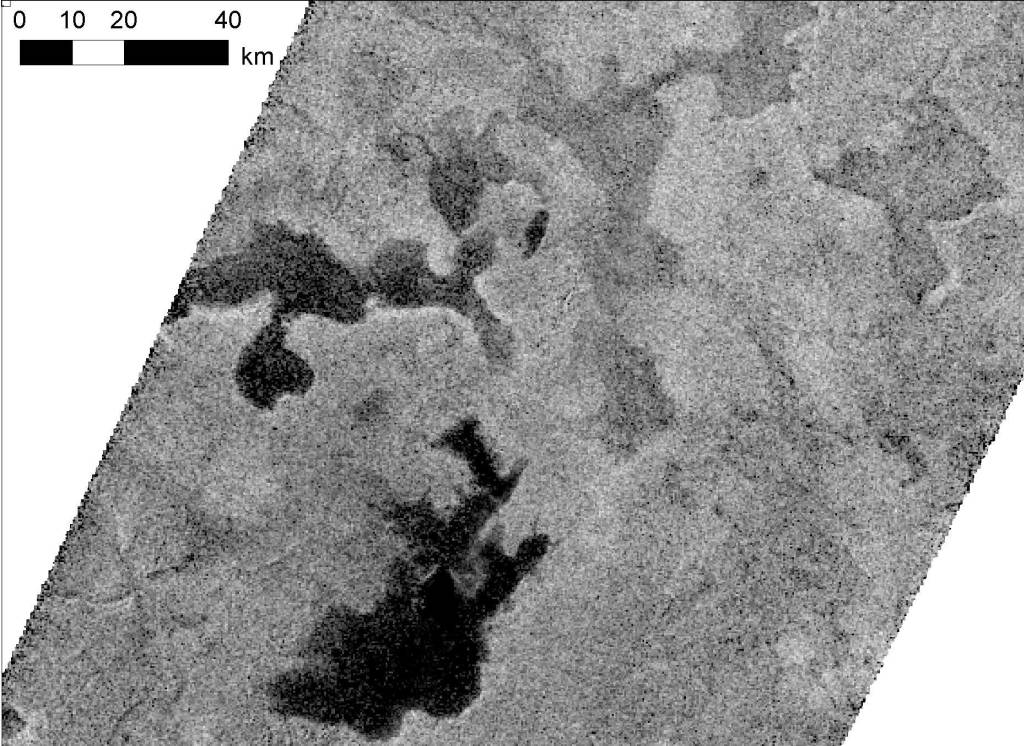
Lakes on Saturn's moon Titan reflect radio waves in varying ways in this image from NASA's Cassini spacecraft. Scientists think the variations in reflectivity, or brightness, have to do with the smoothness or texture of the surface. If a lake is fully liquid, it looks dark, but if it is only partially liquid, it looks brighter. Image credit: NASA/JPL-Caltech/ASI/Cornell . › Full image and caption  -  enlarge image

It's not exactly icing on a cake, but it could be icing on a lake. A new paper by scientists on NASA's Cassini mission finds that blocks of hydrocarbon ice might decorate the surface of existing lakes and seas of liquid hydrocarbon on Saturn's moon Titan. The presence of ice floes might explain some of the mixed readings Cassini has seen in the reflectivity of the surfaces of lakes on Titan.

"One of the most intriguing questions about these lakes and seas is whether they might host an exotic form of life," said Jonathan Lunine, a paper co-author and Cassini interdisciplinary Titan scientist at Cornell University, Ithaca, N.Y. "And the formation of floating hydrocarbon ice will provide an opportunity for interesting chemistry along the boundary between liquid and solid, a boundary that may have been important in the origin of terrestrial life."

Titan is the only other body besides Earth in our solar system with stable bodies of liquid on its surface. But while our planet's cycle of precipitation and evaporation involves water, Titan's cycle involves hydrocarbons like ethane and methane. Ethane and methane are organic molecules, which scientists think can be building blocks for the more complex chemistry from which life arose. Cassini has seen a vast network of these hydrocarbon seas cover Titan's northern hemisphere, while a more sporadic set of lakes bejewels the southern hemisphere.

Up to this point, Cassini scientists assumed that Titan lakes would not have floating ice, because solid methane is denser than liquid methane and would sink. But the new model considers the interaction between the lakes and the atmosphere, resulting in different mixtures of compositions, pockets of nitrogen gas, and changes in temperature. The result, scientists found, is that winter ice will float in Titan's methane-and-ethane-rich lakes and seas if the temperature is below the freezing point of methane -- minus 297 degrees Fahrenheit (90.4 kelvins). The scientists realized all the varieties of ice they considered would float if they were composed of at least 5 percent "air," which is an average composition for young sea ice on Earth. ("Air" on Titan has significantly more nitrogen than Earth air and almost no oxygen.)

If the temperature drops by just a few degrees, the ice will sink because of the relative proportions of nitrogen gas in the liquid versus the solid. Temperatures close to the freezing point of methane could lead to both floating and sinking ice - that is, a hydrocarbon ice crust above the liquid and blocks of hydrocarbon ice on the bottom of the lake bed. Scientists haven't entirely figured out what color the ice would be, though they suspect it would be colorless, as it is on Earth, perhaps tinted reddish-brown from Titan's atmosphere.

"We now know it's possible to get methane-and-ethane-rich ice freezing over on Titan in thin blocks that congeal together as it gets colder -- similar to what we see with Arctic sea ice at the onset of winter," said Jason Hofgartner, first author on the paper and a Natural Sciences and Engineering Research Council of Canada scholar at Cornell. "We'll want to take these conditions into consideration if we ever decide to explore the Titan surface some day."

Cassini's radar instrument will be able to test this model by watching what happens to the reflectivity of the surface of these lakes and seas. A hydrocarbon lake warming in the early spring thaw, as the northern lakes of Titan have begun to do, may become more reflective as ice rises to the surface. This would provide a rougher surface quality that reflects more radio energy back to Cassini, making it look brighter. As the weather turns warmer and the ice melts, the lake surface will be pure liquid, and will appear to the Cassini radar to darken.

"Cassini's extended stay in the Saturn system gives us an unprecedented opportunity to watch the effects of seasonal change at Titan," said Linda Spilker, Cassini project scientist at NASA's Jet Propulsion Laboratory, Pasadena, Calif. "We'll have an opportunity to see if the theories are right." The Cassini-Huygens mission is a cooperative project of NASA, the European Space Agency and ASI, the Italian Space Agency. NASA's Jet Propulsion Laboratory, a division of the California Institute of Technology in Pasadena, manages the mission for NASA's Science Mission Directorate, Washington.

Jia-Rui Cook 818-354-0850
Jet Propulsion Laboratory, Pasadena, Calif.

Tuesday, December 18, 2012

From Cassini for the Holidays: A Splendor Seldom Seen

NASA's Cassini spacecraft has delivered a glorious view of Saturn, taken while the spacecraft was in Saturn's shadow. The cameras were turned toward Saturn and the sun so that the planet and rings are backlit. Image Credit: NASA/JPL-Caltech/Space Science Institute . › Full image and caption

PASADENA, Calif -- Just in time for the holidays, NASA's Cassini spacecraft, in orbit around Saturn for morethan eight years now, has delivered another glorious, backlit view of the planet Saturn and its rings.

On Oct. 17, 2012, during its 174th orbit around the gas giant, Cassini was deliberately positioned within Saturn's shadow, a perfect location from which to look in the direction of the sun and take a backlit view of the rings and the dark side of the planet. Looking back towards the sun is a geometry referred to by planetary scientists as "high solar phase;" near the center of your target's shadow is the highest phase possible. This is a very scientifically advantageous and coveted viewing position, as it can reveal details about both the rings and atmosphere that cannot be seen in lower solar phase.

The last time Cassini had such an unusual perspective on Saturn and its rings, at sufficient distance and with sufficient time to make a full system mosaic, occurred in September 2006, when it captured a mosaic, processed to look like natural color, entitled "In Saturn's Shadow" (http://www.jpl.nasa.gov/spaceimages/details.php?id=PIA08329 ). In that mosaic, planet Earth put in a special appearance, making "In Saturn's Shadow" one of the most popular Cassini images to date.

The mosaic being released today by the mission and the imaging team, in celebration of the 2012 holiday season, does not contain Earth; along with the sun, our planet is hidden behind Saturn. However, it was taken when Cassini was closer to Saturn and therefore shows more detail in the rings than the one taken in 2006.

The new processed mosaic, composed of 60 images taken in the violet, visible and near infrared part of the spectrum, can be found at http://www.nasa.gov/cassini , http://saturn.jpl.nasa.gov and http://ciclops.org .

"Of all the many glorious images we have received from Saturn, none are more strikingly unusual than those taken from Saturn's shadow," said Carolyn Porco, Cassini's imaging team lead based at the Space Science Institute in Boulder, Colo.

The Cassini-Huygens mission is a cooperative project of NASA, the European Space Agency and the Italian Space Agency. NASA's Jet Propulsion Laboratory, a division of the California Institute of Technology in Pasadena, manages the Cassini-Huygens mission for NASA's Science Mission Directorate, Washington. The Cassini orbiter and its two onboard cameras were designed, developed and assembled at JPL. The imaging team consists of scientists from the U.S., England, France and Germany. The imaging operations center is based at the Space Science Institute in Boulder, Colo.

Jia-Rui C. Cook 818-354-0850
Jet Propulsion Laboratory, Pasadena, Calif.
jccook@jpl.nasa.gov

Steve Mullins 720-974-5859
Space Science Institute, Boulder, Colo.
media@ciclops.org


Thursday, December 13, 2012

Cassini Spots Mini Nile River on Saturn Moon


This image from NASA's Cassini spacecraft shows a vast river system on Saturn's moon Titan. It is the first time images from space have revealed a river system so vast and in such high resolution anywhere other than Earth. Image Credit: NASA/JPL-Caltech/ASI.  Full image and caption


These two gray-scale images from NASA's Space Shuttle show part of the Nile River, near the Fourth Cataract in Sudan. The top photograph was originally taken with color infrared film from Space Shuttle Columbia in November 1995. The radar image at the bottom was acquired by Spaceborne Imaging Radar C/X-Band Synthetic Aperture Radar (SIR-C/X-SAR) aboard Space Shuttle Endeavour in April 1994. The radar image shows clearly the current channel of the Nile as well as an older channel buried in drifting sands. Image credit: NASA/JPL-Caltech.  Full image and caption -  enlarge image

PASADENA, Calif. - Scientists with NASA's Cassini mission have spotted what appears to be a miniature, extraterrestrial likeness of Earth's Nile River: a river valley on Saturn's moon Titan that stretches more than 200 miles (400 kilometers) from its "headwaters" to a large sea. It is the first time images have revealed a river system this vast and in such high resolution anywhere other than Earth.

 Scientists deduce that the river, which is in Titan's north polar region, is filled with liquid hydrocarbons because it appears dark along its entire length in the high-resolution radar image, indicating a smooth surface.

 "Though there are some short, local meanders, the relative straightness of the river valley suggests it follows the trace of at least one fault, similar to other large rivers running into the southern margin of this same Titan sea," said Jani Radebaugh, a Cassini radar team associate at Brigham Young University, Provo, Utah. "Such faults - fractures in Titan's bedrock -- may not imply plate tectonics, like on Earth, but still lead to the opening of basins and perhaps to the formation of the giant seas themselves."

 The new image is available online at: http://www.nasa.gov/mission_pages/cassini/multimedia/pia16197.html .

 Titan is the only other world we know of that has stable liquid on its surface. While Earth's hydrologic cycle relies on water, Titan's equivalent cycle involves hydrocarbons such as ethane and methane. In Titan's equatorial regions, images from Cassini's visible-light cameras in late 2010 revealed regions that darkened due to recent rainfall. Cassini's visual and infrared mapping spectrometer confirmed liquid ethane at a lake in Titan's southern hemisphere known as Ontario Lacus in 2008.

 "Titan is the only place we've found besides Earth that has a liquid in continuous movement on its surface," said Steve Wall, the radar deputy team lead, based at NASA's Jet Propulsion Laboratory, Pasadena, Calif. "This picture gives us a snapshot of a world in motion. Rain falls, and rivers move that rain to lakes and seas, where evaporation starts the cycle all over again. On Earth, the liquid is water; on Titan, it's methane; but on both it affects most everything that happens."

 The radar image here was taken on Sept. 26, 2012. It shows Titan's north polar region, where the river valley flows into Kraken Mare, a sea that is, in terms of size, between the Caspian Sea and the Mediterranean Sea on Earth. The real Nile River stretches about 4,100 miles (6,700 kilometers). The processes that led to the formation of Earth's Nile are complex, but involve faulting in some regions.

 The Cassini-Huygens mission is a cooperative project of NASA, the European Space Agency and ASI, the Italian Space Agency. NASA's Jet Propulsion Laboratory, a division of the California Institute of Technology in Pasadena, manages the mission for NASA's Science Mission Directorate, Washington. The Cassini orbiter was designed, developed and assembled at JPL. The radar instrument was built by JPL and the Italian Space Agency, working with team members from the US and several European countries. JPL is a division of the California Institute of Technology in Pasadena.

Jia-Rui Cook 818-354-0850
Jet Propulsion Laboratory, Pasadena, Calif.
jccook@jpl.nasa.gov

Thursday, November 29, 2012

NASA's Cassini Sees Abrupt Turn in Titan's Atmosphere

This artist's impression of Saturn's moon Titan shows the change in observed atmospheric effects before, during and after equinox in 2009. The Titan globes also provide an impression of the detached haze layer that extends all around the moon (blue). This image was inspired by data from NASA's Cassini mission. Image Credit: ESA .  Full image and caption

This true color image captured by NASA'S Cassini spacecraft before a distant flyby of Saturn's moon Titan on June 27, 2012, shows a south polar vortex, or a swirling mass of gas around the pole in the atmosphere. Image Credit: NASA/JPL-Caltech/Space Science Institute . Full image and caption  -  enlarge image

PASADENA, Calif. -Data from NASA's Cassini spacecraft tie a shift in seasonal sunlight to a wholesale reversal, at unexpected altitudes, in the circulation of the atmosphere of Saturn's moon Titan. At the south pole, the data show definitive evidence for sinking air where it was upwelling earlier in the mission. So the key to circulation in the atmosphere of Saturn's moon Titan turned out to be a certain slant of light. The paper was published today in the journal Nature.
 
"Cassini's up-close observations are likely the only ones we'll have in our lifetime of a transition like this in action," said Nick Teanby, the study's lead author who is based at the University of Bristol, England, and is a Cassini team associate. "It's extremely exciting to see such rapid changes on a body that usually changes so slowly and has a 'year' that is the equivalent of nearly 30 Earth years."
 
In our solar system, only Earth, Venus, Mars and Titan have both a solid surface and a substantial atmosphere - providing natural laboratories for exploring climate processes. "Understanding Titan's atmosphere gives us clues for understanding our own complex atmosphere," said Scott Edgington, Cassini deputy project scientist at NASA's Jet Propulsion Laboratory, Pasadena, Calif. "Some of the complexity in both places arises from the interplay of atmospheric circulation and chemistry."
 
The pole on Titan that is experiencing winter is typically pointed away from Earth due to orbital geometry. Because Cassini has been in orbit around Saturn since 2004, it has been able to study the moon from angles impossible from Earth and watch changes develop over time. Models have predicted circulation changes for nearly 20 years, but Cassini has finally directly observed them happening - marking a major milestone in the mission.
 
Other Cassini instruments recently obtained images of the formation of haze and a vortex over Titan's south pole, but the data from the composite infrared spectrometer (CIRS) is sensitive to much higher altitudes, provides more quantitative information and more directly probes the circulation and chemistry. The CIRS data, which enable scientists to track changes in atmospheric temperature and the distribution of gases like benzene and hydrogen cyanide, also revealed changes in hard-to-detect vertical winds and global circulation.
 
Besides the evidence for sinking air, Cassini also detected complex chemical production in the atmosphere at up to 400 miles (600 kilometers) above the surface, revealing the atmospheric circulation extends about 60 miles (100 kilometers) higher than previously expected. Compression of this sinking air as it moved to lower altitudes produced a hot spot hovering high above the south pole, the first indication of big changes to come. The scientists were also able to see very rapid changes in the atmosphere and pinpoint the circulation reversal to about six months around the August 2009 equinox, when the sun shone directly over Titan's equator. The circulation change meant that within two years of equinox, some gases had increased in abundance 100-fold - much more extreme than anything seen so far on Titan.
 
The results also suggest that a detached layer of haze (first detected by NASA's Voyager spacecraft) may not be so detached after all, since complex chemistry and vertical atmospheric movement is occurring above this layer. This layer may instead be the region where small haze particles combine into larger, but more transparent, clumped aggregates that eventually descend deeper into the atmosphere and give Titan its characteristic orange appearance.
 
"Next, we would expect to see the vortex over the south pole build up," said Mike Flasar, the CIRS principal investigator at NASA's Goddard Space Flight Center in Greenbelt, Md. "As that happens, one question is whether the south winter pole will be the identical twin of the north winter pole, or will it have a distinct personality? The most important thing is to be able to keep watching as these changes happen."
 
The Cassini-Huygens mission is a cooperative project of NASA, the European Space Agency and the Italian Space Agency. NASA's Jet Propulsion Laboratory manages the mission for NASA's Science Mission Directorate, Washington, D.C. The visual and infrared mapping spectrometer team is based at the University of Arizona, Tucson. The composite infrared spectrometer team is based at NASA's Goddard Space Flight Center in Greenbelt, Md., where the instrument was built. JPL is a division of Caltech.
 
For more information on Cassini, visit http://www.nasa.gov/cassini and http://saturn.jpl.nasa.gov .

Jia-Rui C. Cook 818-354-0850
Jet Propulsion Laboratory, Pasadena, Calif.
jccook@jpl.nasa.gov

 Elizabeth Zubritsky/Nancy Neal-Jones 301-614-5438/301-286-0039
 Goddard Space Flight, Center, Greenbelt, Md.

 elizabeth.a.zubritsky@nasa.gov / nancy.n.jones@nasa.gov

Monday, November 26, 2012

Cassini Finds a Video Gamers' Paradise at Saturn

 
Scientists with NASA's Cassini mission have spotted two features shaped like the 1980s video game icon "Pac-Man" on moons of Saturn. One was observed on the moon Mimas in 2010 and the latest was observed on the moon Tethys. Image credit: NASA/JPL-Caltech/GSFC/SWRI . Full image and caption

You could call this "Pac-Man, the Sequel." Scientists with NASA's Cassini mission have spotted a second feature shaped like the 1980s video game icon in the Saturn system, this time on the moon Tethys. (The first was found on Mimas in 2010). The pattern appears in thermal data obtained by Cassini's composite infrared spectrometer, with warmer areas making up the Pac-Man shape.

"Finding a second Pac-Man in the Saturn system tells us that the processes creating these Pac-Men are more widespread than previously thought," said Carly Howett, the lead author of a paper recently released online in the journal Icarus. "The Saturn system - and even the Jupiter system - could turn out to be a veritable arcade of these characters."

Scientists theorize that the Pac-Man thermal shape on the Saturnian moons occurs because of the way high-energy electrons bombard low latitudes on the side of the moon that faces forward as it orbits around Saturn. The bombardment turns that part of the fluffy surface into hard-packed ice. As a result, the altered surface does not heat as rapidly in the sunshine or cool down as quickly at night as the rest of the surface, similar to how a boardwalk at the beach feels cooler during the day but warmer at night than the nearby sand. Finding another Pac-Man on Tethys confirms that high-energy electrons can dramatically alter the surface of an icy moon. Also, because the altered region on Tethys, unlike on Mimas, is also bombarded by icy particles from Enceladus' plumes, it implies the surface alteration is occurring more quickly than its recoating by plume particles.

"Studies at infrared wavelengths give us a tremendous amount of information about the processes that shape planets and moons," said Mike Flasar, the spectrometer's principal investigator at NASA's Goddard Space Flight Center in Greenbelt, Md. "A result like this underscores just how powerful these observations are."

Scientists saw the new Pac-Man on Tethys in data obtained on Sept. 14, 2011, where daytime temperatures inside the mouth of Pac-Man were seen to be cooler than their surroundings by 29 degrees Fahrenheit (15 kelvins). The warmest temperature recorded was a chilly minus 300 degrees Fahrenheit (90 kelvins), which is actually slightly cooler than the warmest temperature at Mimas (about minus 290 degrees Fahrenheit, or 95 kelvins). At Tethys, unlike Mimas, the Pac-Man pattern can also be seen subtly in visible-light images of the surface, as a dark lens-shaped region. This brightness variation was first noticed by NASA's Voyager spacecraft in 1980.

"Finding a new Pac-Man demonstrates the diversity of processes at work in the Saturn system," said Linda Spilker, Cassini project scientist at NASA's Jet Propulsion Laboratory, Pasadena, Calif. "Future Cassini observations may reveal other new phenomena that will surprise us and help us better understand the evolution of moons in the Saturn system and beyond."

The Cassini-Huygens mission is a cooperative project of NASA, the European Space Agency and the Italian Space Agency. NASA's Jet Propulsion Laboratory, Pasadena, Calif., a division of the California Institute of Technology in Pasadena, manages the mission for NASA's Science Mission Directorate, Washington, D.C. The Cassini orbiter was designed, developed and assembled at JPL. The composite infrared spectrometer team is based at NASA's Goddard Space Flight Center in Greenbelt, Md., where the instrument was built.

More information about the Cassini-Huygens mission is at: http://www.nasa.gov/cassini and http://saturn.jpl.nasa.gov.

Jia-Rui Cook 818-354-0850
Jet Propulsion Laboratory, Pasadena, Calif.
jccook@jpl.nasa.gov

Elizabeth Zubritsky 301-614-5438
Goddard Space Flight Center, Greenbelt, Md.
elizabeth.a.zubritsky@nasa.gov

Wednesday, July 11, 2012

The Titanian Seasons Turn, Turn, Turn

This true color image captured by NASA'S Cassini spacecraft before a distant flyby of Saturn's moon Titan on June 27, 2012, shows a south polar vortex, or a mass of swirling gas around the pole in the atmosphere of the moon. Image credit: NASA/JPL-Caltech/Space Science Institute. Full image and caption


Titan's South Polar Vortex in Motion

This movie captured by NASA'S Cassini spacecraft shows a south polar vortex, or a swirling mass of gas around the pole in the atmosphere, at Saturn’s moon Titan. The swirling mass appears to execute one full rotation in about nine hours – much faster than the moon's 16-day rotation period. The images were taken before and after a distant flyby of Titan on June 27, 2012.

False-color images from NASA's Cassini spacecraft show the development of a hood of high-altitude haze - which appears orange in this image -- forming over the south pole of Saturn's moon Titan. Image credit: NASA/JPL-Caltech/University of Arizona/LPGNantes. Full image and caption-enlarge image

PASADENA, Calif. - Images from NASA's Cassini spacecraft show a concentration of high-altitude haze and a vortex materializing at the south pole of Saturn's moon Titan, signs that the seasons are turning on Saturn's largest moon. "The structure inside the vortex is reminiscent of the open cellular convection that is often seen over Earth's oceans," said Tony Del Genio, a Cassini team member at NASA's Goddard Institute for Space Studies, N.Y. "But unlike on Earth, where such layers are just above the surface, this one is at very high altitude, maybe a response of Titan's stratosphere to seasonal cooling as southern winter approaches. But so soon in the game, we're not sure."

Cassini first saw a "hood" of high-altitude haze and a vortex, which is a mass of swirling gas around the pole in the moon's atmosphere, at Titan's north pole when the spacecraft first arrived in the Saturn system in 2004. At the time, it was northern winter. Multiple instruments have been keeping an eye on the Titan atmosphere above the south pole for signs of the coming southern winter.

While the northern hood has remained, the circulation in the upper atmosphere has been moving from the illuminated north pole to the cooling south pole. This movement appears to be causing downwellings over the south pole and the formation of high-altitude haze and a vortex.

Cassini's visible light cameras saw the first signs of hazes starting to concentrate over Titan's south pole in March, and the spacecraft's visual and infrared mapping spectrometer (VIMS) obtained false-color images on May 22 and June 7.

"VIMS has seen a concentration of aerosols forming about 200 miles [300 kilometers] above the surface of Titan's south pole," said Christophe Sotin, a VIMS team member at NASA's Jet Propulsion Laboratory, Pasadena, Calif. "We've never seen aerosols here at this level before, so we know this is something new."

During a June 27 distant flyby, Cassini's imaging cameras captured a crow's-eye view of the south polar vortex in visible light. These new images show this detached, high-altitude haze layer in stunning new detail.

"Future observations of this feature will provide good tests of dynamical models of the Titan circulation, chemistry, cloud and aerosol processes in the upper atmosphere," said Bob West, deputy imaging team lead at JPL. The Cassini-Huygens mission is a cooperative project of NASA, the European Space Agency and the Italian Space Agency. The Jet Propulsion Laboratory, a division of the California Institute of Technology in Pasadena, manages the Cassini-Huygens mission for NASA's Science Mission Directorate, Washington. The Cassini orbiter and its two onboard cameras were designed, developed and assembled at JPL. The imaging team is based at the Space Science Institute in Boulder, Colo.

For more information about the mission visit http://www.nasa.gov/cassini and http://saturn.jpl.nasa.gov . The Cassini imaging team homepage is at http://ciclops.org


Jia-Rui C. Cook 818-354-0850
Jet Propulsion Laboratory, Pasadena, Calif.
jccook@jpl.nasa.gov

Saturday, June 30, 2012

Cassini Finds Likely Subsurface Ocean on Saturn Moon

This artist's concept shows a possible scenario for the internal structure of Titan, as suggested by data from NASA's Cassini spacecraft. Scientists have been trying to determine what is under Titan's organic-rich atmosphere and icy crust. Image credit: A. Tavani. Full image and caption

Squeezing and Stretching Titan
Play video

PASADENA, Calif. -- Data from NASA's Cassini spacecraft have revealed Saturn's moon Titan likely harbors a layer of liquid water under its ice shell.

Researchers saw a large amount of squeezing and stretching as the moon orbited Saturn. They deduced that if Titan were composed entirely of stiff rock, the gravitational attraction of Saturn would cause bulges, or solid "tides," on the moon only 3 feet (1 meter) in height. Spacecraft data show Saturn creates solid tides approximately 30 feet (10 meters) in height, which suggests Titan is not made entirely of solid rocky material. The finding appears in today's edition of the journal Science.

"Cassini's detection of large tides on Titan leads to the almost inescapable conclusion that there is a hidden ocean at depth," said Luciano Iess, the paper's lead author and a Cassini team member at the Sapienza University of Rome, Italy. "The search for water is an important goal in solar system exploration, and now we've spotted another place where it is abundant."

Titan takes only 16 days to orbit Saturn, and scientists were able to study the moon's shape at different parts of its orbit. Because Titan is not spherical, but slightly elongated like a football, its long axis grew when it was closer to Saturn. Eight days later, when Titan was farther from Saturn, it became less elongated and more nearly round. Cassini measured the gravitational effect of that squeeze and pull.

Scientists were not sure Cassini would be able to detect the bulges caused by Saturn's pull on Titan. By studying six close flybys of Titan from Feb. 27, 2006, to Feb. 18, 2011, researchers were able to determine the moon's internal structure by measuring variations in the gravitational pull of Titan using data returned to NASA's Deep Space Network (DSN).

"We were making ultrasensitive measurements, and thankfully Cassini and the DSN were able to maintain a very stable link," said Sami Asmar, a Cassini team member at NASA's Jet Propulsion Laboratory in Pasadena, Calif. "The tides on Titan pulled up by Saturn aren't huge compared to the pull the biggest planet, Jupiter, has on some of its moons. But, short of being able to drill on Titan's surface, the gravity measurements provide the best data we have of Titan's internal structure."

An ocean layer does not have to be huge or deep to create these tides. A liquid layer between the external, deformable shell and a solid mantle would enable Titan to bulge and compress as it orbits Saturn. Because Titan's surface is mostly made of water ice, which is abundant in moons of the outer solar system, scientists infer Titan's ocean is likely mostly liquid water.

On Earth, tides result from the gravitational attraction of the moon and sun pulling on our surface oceans. In the open oceans, those can be as high as two feet (60 centimeters). While water is easier to move, the gravitational pulling by the sun and moon also causes Earth's crust to bulge in solid tides of about 20 inches (50 centimeters).

The presence of a subsurface layer of liquid water at Titan is not itself an indicator for life. Scientists think life is more likely to arise when liquid water is in contact with rock, and these measurements cannot tell whether the ocean bottom is made up of rock or ice. The results have a bigger implication for the mystery of methane replenishment on Titan.

"The presence of a liquid water layer in Titan is important because we want to understand how methane is stored in Titan's interior and how it may outgas to the surface," said Jonathan Lunine, a Cassini team member at Cornell University, Ithaca, N.Y. "This is important because everything that is unique about Titan derives from the presence of abundant methane, yet the methane in the atmosphere is unstable and will be destroyed on geologically short timescales."

A liquid water ocean, "salted" with ammonia, could produce buoyant ammonia-water liquids that bubble up through the crust and liberate methane from the ice. Such an ocean could serve also as a deep reservoir for storing methane.

The Cassini-Huygens mission is a cooperative project of NASA, the European Space Agency and the Italian Space Agency. The mission is managed by JPL for NASA's Science Mission Directorate in Washington. DSN, also managed by JPL, is an international network of antennas that supports interplanetary spacecraft missions and radio and radar astronomy observations for the exploration of the solar system and the universe. The network also supports selected Earth-orbiting missions. Cassini's radio science team is based at Wellesley College in Massachusetts. JPL is a division of the California Institute of Technology in Pasadena.

For more information about the mission, visit: http://www.nasa.gov/cassini and http://saturn.jpl.nasa.gov .


Jia-Rui C. Cook 818-354-0850
Jet Propulsion Laboratory, Pasadena, Calif.
jccook@jpl.nasa.gov

Dwayne Brown 202-358-1726
NASA Headquarters, Washington
dwayne.c.brown@nasa.gov

Monday, June 25, 2012

Cassini Shows Why Jet Streams Cross-Cut Saturn

A particularly strong jet stream churns through Saturn's northern hemisphere in this false-color view from NASA's Cassini spacecraft. Image Credit: NASA/JPL-Caltech/SSI. Full image and caption

This figure examines a particularly strong jet stream and the eddies that drive it through the atmosphere of Saturn's northern hemisphere. Data from NASA's Cassini spacecraft were used to create this figure. Image Credit: NASA/JPL-Caltech/SSI

Turbulent jet streams, regions where winds blow faster than in other places, churn east and west across Saturn. Scientists have been trying to understand for years the mechanism that drives these wavy structures in Saturn's atmosphere and the source from which the jets derive their energy.

In a new study appearing in the June edition of the journal Icarus, scientists used images collected over several years by NASA's Cassini spacecraft to discover that the heat from within the planet powers the jet streams. Condensation of water from Saturn's internal heating led to temperature differences in the atmosphere. The temperature differences created eddies, or disturbances that move air back and forth at the same latitude, and those eddies, in turn, accelerated the jet streams like rotating gears driving a conveyor belt.

A competing theory had assumed that the energy for the temperature differences came from the sun. That is how it works in the Earth's atmosphere.

"We know the atmospheres of planets such as Saturn and Jupiter can get their energy from only two places: the sun or the internal heating. The challenge has been coming up with ways to use the data so that we can tell the difference," said Tony Del Genio of NASA's Goddard Institute for Space Studies, N.Y., the lead author of the paper and a member of the Cassini imaging team.

The new study was possible in part because Cassini has been in orbit around Saturn long enough to obtain the large number of observations required to see subtle patterns emerge from the day-to-day variations in weather. "Understanding what drives the meteorology on Saturn, and in general on gaseous planets, has been one of our cardinal goals since the inception of the Cassini mission," said Carolyn Porco, imaging team lead, based at the Space Science Institute, Boulder, Colo. "It is very gratifying to see that we're finally coming to understand those atmospheric processes that make Earth similar to, and also different from, other planets."

Rather than having a thin atmosphere and solid-and-liquid surface like Earth, Saturn is a gas giant whose deep atmosphere is layered with multiple cloud decks at high altitudes. A series of jet streams slice across the face of Saturn visible to the human eye and also at altitudes detectable to the near-infrared filters of Cassini's cameras. While most blow eastward, some blow westward. Jet streams occur on Saturn in places where the temperature varies significantly from one latitude to another.

Thanks to the filters on Cassini's cameras, which can see near-infrared light reflected to space, scientists now have observed the Saturn jet stream process for the first time at two different, low altitudes. One filtered view shows the upper part of the troposphere, a high layer of the atmosphere where Cassini sees thick, high-altitude hazes and where heating by the sun is strong. Views through another filter capture images deeper down, at the tops of ammonia ice clouds, where solar heating is weak but closer to where weather originates. This is where water condenses and makes clouds and rain.

In the new study, which is a follow-up to results published in 2007, the authors used automated cloud tracking software to analyze the movements and speeds of clouds seen in hundreds of Cassini images from 2005 through 2012.

"With our improved tracking algorithm, we've been able to extract nearly 120,000 wind vectors from 560 images, giving us an unprecedented picture of Saturn's wind flow at two independent altitudes on a global scale," said co-author and imaging team associate John Barbara, also at the Goddard Institute for Space Studies. The team's findings provide an observational test for existing models that scientists use to study the mechanisms that power the jet streams.

By seeing for the first time how these eddies accelerate the jet streams at two different altitudes, scientists found the eddies were weak at the higher altitudes where previous researchers had found that most of the sun's heating occurs. The eddies were stronger deeper in the atmosphere. Thus, the authors could discount heating from the sun and infer instead that the internal heat of the planet is ultimately driving the acceleration of the jet streams, not the sun. The mechanism that best matched the observations would involve internal heat from the planet stirring up water vapor from Saturn's interior. That water vapor condenses in some places as air rises and releases heat as it makes clouds and rain. This heat provides the energy to create the eddies that drive the jet streams.

The condensation of water was not actually observed; most of that process occurs at lower altitudes not visible to Cassini. But the condensation in mid-latitude storms does happen on both Saturn and Earth. Storms on Earth - the low- and high-pressure centers on weather maps - are driven mainly by the sun's heating and do not mainly occur because of the condensation of water, Del Genio said. On Saturn, the condensation heating is the main driver of the storms, and the sun's heating is not important.

Images of one of the strongest jet streams and a figure from the paper can be found at http://www.nasa.gov/cassini , http://saturn.jpl.nasa.gov and http://ciclops.org .

The Cassini-Huygens mission is a cooperative project of NASA, the European Space Agency and the Italian Space Agency. The Jet Propulsion Laboratory, a division of the California Institute of Technology in Pasadena, manages the Cassini-Huygens mission for NASA's Science Mission Directorate, Washington. The Cassini orbiter and its two onboard cameras were designed, developed and assembled at JPL. The imaging team is based at the Space Science Institute in Boulder, Colo.

Jia-Rui C. Cook 818-354-0850
Jet Propulsion Laboratory, Pasadena, Calif.
jccook@jpl.nasa.gov

Joe Mason 720-974-5859
Space Science Institute, Boulder, Colo.
media@ciclops.org

Bill Steigerwald/Nancy Neal Jones 301-286-5017/6-0039
Goddard Space Flight Center, Greenbelt, Md.
william.a.steigerwald@nasa.gov / nancy.n.jones@nasa.gov

Friday, April 27, 2012

Cassini Finds Saturn Moon has Planet-Like Qualities

Phoebe's true nature is revealed in startling clarity in this mosaic of two images taken during Cassini's flyby on June 11, 2004. Image Credit: NASA/JPL/Space Science Institute. Full image and caption

This panel of images shows the nearly spherical shape of Saturn's moon Phoebe, as derived from imaging obtained from NASA's Cassini spacecraft. Each image represents a 90-degree turn. Image credit: NASA/JPL-Caltech/SSI/Cornell . Full image and caption - enlarge image

PASADENA, Calif. -- Data from NASA's Cassini mission reveal Saturn's moon Phoebe has more planet-like qualities than previously thought.

Scientists had their first close-up look at Phoebe when Cassini began exploring the Saturn system in 2004. Using data from multiple spacecraft instruments and a computer model of the moon's chemistry, geophysics and geology, scientists found Phoebe was a so-called planetesimal, or remnant planetary building block. The findings appear in the April issue of the Journal Icarus.

"Unlike primitive bodies such as comets, Phoebe appears to have actively evolved for a time before it stalled out," said Julie Castillo-Rogez, a planetary scientist at NASA's Jet Propulsion Laboratory in Pasadena, Calif. "Objects like Phoebe are thought to have condensed very quickly. Hence, they represent building blocks of planets. They give scientists clues about what conditions were like around the time of the birth of planets and their moons."

Cassini images suggest Phoebe originated in the far-off Kuiper Belt, the region of ancient, icy, rocky bodies beyond Neptune's orbit. Data show Phoebe was spherical and hot early in its history, and has denser rock-rich material concentrated near its center. Its average density is about the same as Pluto, another object in the Kuiper Belt. Phoebe likely was captured by Saturn's gravity when it somehow got close to the giant planet.

Saturn is surrounded by a cloud of irregular moons that circle the planet in orbits tilted from Saturn's orbit around the sun, the so-called equatorial plane. Phoebe is the largest of these irregular moons and also has the distinction of orbiting backward in relation to the other moons. Saturn's large moons appear to have formed from gas and dust orbiting in the planet's equatorial plane. These moons currently orbit Saturn in that same plane.

"By combining Cassini data with modeling techniques previously applied to other solar system bodies, we've been able to go back in time and clarify why it is so different from the rest of the Saturn system," said Jonathan Lunine, a co-author on the study and a Cassini team member at Cornell University, Ithaca, N.Y.

Analyses suggest that Phoebe was born within the first 3 million years of the birth of the solar system, which occurred 4.5 billion years ago. The moon may originally have been porous but appears to have collapsed in on itself as it warmed up. Phoebe developed a density 40 percent higher than the average inner Saturnian moon.

Objects of Phoebe's size have long been thought to form as "potato-shaped" bodies and remained that way over their lifetimes. If such an object formed early enough in the solar system's history, it could have harbored the kinds of radioactive material that would produce substantial heat over a short timescale. This would warm the interior and reshape the moon.

"From the shape seen in Cassini images and modeling the likely cratering history, we were able to see that Phoebe started with a nearly spherical shape, rather than being an irregular shape later smoothed into a sphere by impacts," said co-author Peter Thomas, a Cassini team member at Cornell.

Phoebe likely stayed warm for tens of millions of years before freezing up. The study suggests the heat also would have enabled the moon to host liquid water at one time. This could explain the signature of water-rich material on Phoebe's surface previously detected by Cassini.

The new study also is consistent with the idea that several hundred million years after Phoebe cooled, the moon drifted toward the inner solar system in a solar-system-wide rearrangement. Phoebe was large enough to survive this turbulence.

More than 60 moons are known to orbit Saturn, varying drastically in shape, size, surface age and origin. Scientists using both ground-based observatories and Cassini's cameras continue to search for others.

The Cassini-Huygens mission is a cooperative project of NASA, the European Space Agency and the Italian Space Agency. JPL manages the mission for the agency's Science Mission Directorate in Washington. The California Institute of Technology in Pasadena manages JPL for NASA.

For more information on the Cassini mission, visit: http://www.nasa.gov/cassini and http://saturn.jpl.nasa.gov .

Jia-Rui C. Cook 818-354-0850
Jet Propulsion Laboratory, Pasadena, Calif.
jccook@jpl.nasa.gov

Dwayne Brown 202-358-1726
NASA Headquarters, Washington
dwayne.c.brown@nasa.gov