Showing posts with label Nasa. Show all posts

Thursday, April 03, 2014

NASA Hubble Team Finds Monster "El Gordo" Galaxy Cluster Bigger Than Thought

This is a Hubble image of the most massive cluster of galaxies ever seen to exist when the universe was just half its current age of 13.8 billion years. The cluster contains several hundred galaxies.  Image Credit: NASA, ESA, and J. Jee (University of California, Davis)

NASA's Hubble Space Telescope has weighed the largest known galaxy cluster in the distant universe, catalogued as ACT-CL J0102-4915, and found it definitely lives up to its nickname -- El Gordo (Spanish for "the fat one").

By measuring how much the cluster's gravity warps images of galaxies in the distant background, a team of astronomers has calculated the cluster's mass to be as much as 3 million billion times the mass of our sun. Hubble data show the galaxy cluster, which is 9.7 billion light-years away from Earth, is roughly 43 percent more massive than earlier estimates.

The team used Hubble to measure how strongly the mass of the cluster warped space. Hubble's high resolution allowed measurements of so-called "weak lensing," where the cluster's immense gravity subtly distorts space like a funhouse mirror and warps images of background galaxies. The greater the warping, the more mass is locked up in the cluster.

"What I did is basically look at the shapes of the background galaxies that are farther away than the cluster itself," explained lead author James Jee of the University of California at Davis. "It's given us an even stronger probability that this is really an amazing system very early in the universe."

A fraction of this mass is locked up in several hundred galaxies that inhabit the cluster and a larger fraction is in hot gas that fills the entire volume of the cluster. The rest is tied up in dark matter, an invisible form of matter that makes up the bulk of the mass of the universe.

Though equally massive galaxy clusters are found in the nearby part of the universe, such as the Bullet cluster, nothing like this has ever been discovered to exist so far back in time, when the universe was roughly half its current estimated age of 13.8 billion years. The team suspects such monster galaxy clusters are rare in the early universe, based on current cosmological models.

The immense size of El Gordo was first reported in January 2012. Astronomers estimated its mass based on observations made by NASA's Chandra X-ray Observatory, and galaxy velocities measured by the European Southern Observatory's Very Large Telescope array in Paranal, Chile. They were able to put together estimates of the cluster's mass based on the motions of the galaxies moving inside the cluster and the temperatures of the hot gas between those galaxies.

The challenge was that El Gordo looked as if it might have been the result of a titanic collision between a pair of galaxy clusters -- an event researchers describe as two cosmic cannonballs hitting each other.

"We wondered what happens when you catch a cluster in the midst of a major merger and how the merger process influences both the X-ray gas and the motion of the galaxies," explained John Hughes of Rutgers University. "So, the bottom line is because of the complicated merger state, it left some questions about the reliability of the mass estimates we were making."

That is where the Hubble data came in, according to Felipe Menanteau of the University of Illinois at Urbana-Champaign.

"We were in dire need for an independent and more robust mass estimate given how extreme this cluster is and how rare its existence is in the current cosmological model. There was all this kinematic energy that was unaccounted for and could potentially suggest that we were actually underestimating the mass," Menanteau said. 

The expectation of "unaccounted energy" comes from the fact the merger of galaxy clusters is occurring tangentially to the observers' line-of-sight. This means they are potentially missing a good fraction of the kinetic energy of the merger because their spectroscopic measurements only track the radial speeds of the galaxies.

The team's next step with Hubble will be to compile an image of the cluster. Because El Gordo does not fit into Hubble's field of view, the team will capture images of sections of the galaxy cluster and piece them together into a mosaic.

Researchers say it is like observing a giant from the side.

"We can tell it's a pretty big El Gordo, but we don't know what kind of legs he has, so we need to have a larger field of view to get the complete picture of the giant," said Menanteau.

The Hubble Space Telescope is a project of international cooperation between NASA and the European Space Agency. NASA's Goddard Space Flight Center in Greenbelt, Md., manages the telescope. The Space Telescope Science Institute (STScI) in Baltimore conducts Hubble science operations. STScI is operated for NASA by the Association of Universities for Research in Astronomy, Inc., in Washington.

For images and more information about Hubble, visit:  http://www.nasa.gov/hubble


J.D. Harrington
Headquarters, Washington
202-358-5241

j.d.harrington@nasa.gov

Ray Villard
Space Science Telescope Institute, Baltimore, Md.
410-338-4493 / 410-338-4514

villard@stsci.edu


Thursday, June 28, 2012

Hubble, Swift Detect First-Ever Changes in an Exoplanet Atmosphere

Exoplanet HD 189733b (Artist's Illustration)
Science Credit:NASA,ESA, A. Lecavelier des Etangs (CNRS-UMPC, France), and P. Wheatley (University of Warwick)

WASHINGTON — An international team of astronomers using data from NASA's Hubble Space Telescope has made an unparalleled observation, detecting significant changes in the atmosphere of a planet located beyond our solar system.

The scientists conclude the atmospheric variations occurred in response to a powerful eruption on the planet's host star, an event observed by NASA's Swift satellite.

"The multiwavelength coverage by Hubble and Swift has given us an unprecedented view of the interaction between a flare on an active star and the atmosphere of a giant planet," said lead researcher Alain Lecavelier des Etangs at the Paris Institute of Astrophysics (IAP), part of the French National Scientific Research Center located at Pierre and Marie Curie University in Paris.

The exoplanet is HD 189733b, a gas giant similar to Jupiter, but about 14 percent larger and more massive. The planet circles its star at a distance of only 3 million miles, or about 30 times closer than Earth's distance from the Sun, and completes an orbit every 2.2 days. Its star, named HD 189733A, is about 80 percent the size and mass of our Sun.

Astronomers classify the planet as a "hot Jupiter." Previous Hubble observations show that the planet's deep atmosphere reaches a temperature of about 1,900 degrees Fahrenheit (1,030 degrees Celsius).

HD 189733b periodically passes across, or transits, its parent star, and these events give astronomers an opportunity to probe its atmosphere and environment. In a previous study, a group led by Lecavelier des Etangs used Hubble to show that hydrogen gas was escaping from the planet's upper atmosphere. The finding made HD 189733b only the second known "evaporating" exoplanet at the time.

The system is just 63 light-years away, so close that its star can be seen with binoculars near the famous Dumbbell Nebula. This makes HD 189733b an ideal target for studying the processes that drive atmospheric escape.

"Astronomers have been debating the details of atmospheric evaporation for years, and studying HD 189733b is our best opportunity for understanding the process," said Vincent Bourrier, a doctoral student at IAP and a team member on the new study.

When HD 189733b transits its star, some of the star's light passes through the planet's atmosphere. This interaction imprints information on the composition and motion of the planet's atmosphere into the star's light.

In April 2010, the researchers observed a single transit using Hubble's Space Telescope Imaging Spectrograph (STIS), but they detected no trace of the planet's atmosphere. Follow-up STIS observations in September 2011 showed a surprising reversal, with striking evidence that a plume of gas was streaming away from the exoplanet.

The researchers determined that at least 1,000 tons of gas was leaving the planet's atmosphere every second. The hydrogen atoms were racing away at speeds greater than 300,000 miles per hour. The findings will appear in an upcoming issue of the journal Astronomy & Astrophysics.

Because X-rays and extreme ultraviolet starlight heat the planet's atmosphere and likely drive its escape, the team also monitored the star with Swift's X-ray Telescope (XRT). On Sept. 7, 2011, just eight hours before Hubble was scheduled to observe the transit, Swift was monitoring the star when it unleashed a powerful flare. It brightened by 3.6 times in X-rays, a spike occurring atop emission levels that already were greater than the Sun's.

"The planet's close proximity to the star means it was struck by a blast of X-rays tens of thousands of times stronger than the Earth suffers even during an X-class solar flare, the strongest category," said co-author Peter Wheatley, a physicist at the University of Warwick in England.

After accounting for the planet's enormous size, the team notes that HD 189733b encountered about 3 million times as many X-rays as Earth receives from a solar flare at the threshold of the X class.

Hubble is a project of international cooperation between NASA and the European Space Agency. Swift is operated in collaboration with several U.S. institutions and partners in the United Kingdom, Italy, Germany, and Japan. NASA's Goddard Space Flight Center in Greenbelt, Md., manages both missions.

For images and video related to this finding, visit: http://go.nasa.gov/Osbvfi

For more information about Swift, visit: http://www.nasa.gov/swift

For more information about Hubble, visit: http://www.nasa.gov/hubble

CONTACT

J. D. Harrington
Headquarters, Washington
202-358-5241
j.d.harrington@nasa.gov

Lynn Chandler
NASA Goddard Space Flight Center, Greenbelt, Md.
301-286-2806
lynn.chandler-1@nasa.gov

Friday, March 02, 2012

Dark Matter Core Defies Explanation in Hubble Image

Merging Galaxy Cluster Abell 520
Credit: NASA, ESA, CFHT, CXO, M.J. Jee (University of California, Davis),
and A. Mahdavi (San Francisco State University)
News Realease Images - Zoomable image

It was the result no one wanted to believe. Astronomers observed what appeared to be a clump of dark matter left behind during a bizarre wreck between massive clusters of galaxies.

The dark matter collected into a "dark core" containing far fewer galaxies than would be expected if the dark matter and galaxies hung together. Most of the galaxies apparently have sailed far away from the collision. This result could present a challenge to basic theories of dark matter, which predict that galaxies should be anchored to the invisible substance, even during the shock of a collision.

The initial observations, made in 2007, were so unusual that astronomers shrugged them off as unreal, due to poor data. However, new results from NASA's Hubble Space Telescope confirm that dark matter and galaxies parted ways in the gigantic merging galaxy cluster called Abell 520, located 2.4 billion light-years away.

Now, astronomers are left with the challenge of trying to explain dark matter's seemingly oddball behavior in this cluster.

"This result is a puzzle," said astronomer James Jee of the University of California, Davis, leader of the Hubble study. "Dark matter is not behaving as predicted, and it's not obviously clear what is going on. Theories of galaxy formation and dark matter must explain what we are seeing."

A paper reporting the team's results has been accepted for publication in The Astrophysical Journal and is available online.

First detected about 80 years ago, dark matter is thought to be the gravitational "glue" that holds galaxies together. The mysterious invisible substance is not made of the same kind of matter that makes up stars, planets, and people. Astronomers know little about dark matter, yet it accounts for most of the universe's mass.

They have deduced dark matter's existence by observing its ghostly gravitational influence on normal matter. It's like hearing the music but not seeing the band.

One way to study dark matter is by analyzing smashups between galaxy clusters, the largest structures in the universe. When galaxy clusters collide, astronomers expect galaxies to tag along with the dark matter, like a dog on a leash. Clouds of intergalactic gas, however, plow into one another, slow down, and lag behind the impact.

That theory was supported by visible-light and X-ray observations of a colossal collision between two galaxy clusters called the Bullet Cluster. The galactic grouping has become a textbook example of how dark matter should behave.

But studies of Abell 520 showed that dark matter's behavior may not be so simple. The original observations found that the system's core was rich in dark matter and hot gas but contained no luminous galaxies, which normally would be seen in the same location as the dark matter. NASA's Chandra X-ray Observatory detected the hot gas. Astronomers used the Canada-France-Hawaii and Subaru telescopes atop Mauna Kea to infer the location of dark matter by measuring how the mysterious substance bends light from more distant background galaxies, an effect called gravitational lensing.

The astronomers then turned Hubble's Wide Field Planetary Camera 2 to help bail them out of this cosmic conundrum. Instead, to their chagrin, the Hubble observations helped confirm the earlier findings. Astronomers used Hubble to map the dark matter in the cluster through the gravitational lensing technique.

"Observations like those of Abell 520 are humbling in the sense that in spite of all the leaps and bounds in our understanding, every now and then, we are stopped cold," explained Arif Babul of the University of Victoria in British Columbia, the team's senior theorist.

Is Abell 520 an oddball, or is the prevailing picture of dark matter flawed? Jee thinks it's too soon to tell.

"We know of maybe six examples of high-speed galaxy cluster collisions where the dark matter has been mapped," Jee said. "But the Bullet Cluster and Abell 520 are the two that show the clearest evidence of recent mergers, and they are inconsistent with each other. No single theory explains the different behavior of dark matter in those two collisions. We need more examples."

The team has proposed a half-dozen explanations for the findings, but each is unsettling for astronomers. "It's pick your poison," said team member Andisheh Mahdavi of San Francisco State University in California, who led the original Abell 520 observations in 2007. One possible explanation for the discrepancy is that Abell 520 was a more complicated interaction than the Bullet Cluster encounter. Abell 520 may have formed from a collision between three galaxy clusters, instead of just two colliding systems in the case of the Bullet Cluster.

Another scenario is that some dark matter may be what astronomers call "sticky." Like two snowballs smashing together, normal matter slams into each other during a collision and slows down. But dark matter blobs are thought to pass through each other during an encounter without slowing down. This scenario proposes that some dark matter interacts with itself and stays behind when galaxy clusters collide.

A third possibility is that the core contained many galaxies, but they were too dim to be seen, even by Hubble. Those galaxies would have to have formed dramatically fewer stars than other normal galaxies. Armed with the Hubble data, the group hopes to create a computer simulation to try to reconstruct the collision, hoping that it yields some answers to dark matter's weird behavior.

CONTACT

Ray Villard
Space Telescope Science Institute, Baltimore, Md.
410-338-4514
villard@stsci.edu

Tuesday, January 31, 2012

IBEX: Glimpses of the Interstellar Material Beyond our Solar System

IBEX has directly sampled multiple heavy elements from the Local Interstellar Cloud for the first time. Credit: NASA/Goddard Scientific Visualization Studio. Download video

A great magnetic bubble surrounds the solar system as it cruises through the galaxy. The sun pumps the inside of the bubble full of solar particles that stream out to the edge until they collide with the material that fills the rest of the galaxy, at a complex boundary called the heliosheath. On the other side of the boundary, electrically charged particles from the galactic wind blow by, but rebound off the heliosheath, never to enter the solar system. Neutral particles, on the other hand, are a different story. They saunter across the boundary as if it weren't there, continuing on another 7.5 billion miles for 30 years until they get caught by the sun's gravity, and sling shot around the star.

There, NASA's Interstellar Boundary Explorer lies in wait for them. Known as IBEX for short, this spacecraft methodically measures these samples of the mysterious neighborhood beyond our home. IBEX scans the entire sky once a year, and every February, its instruments point in the correct direction to intercept incoming neutral atoms. IBEX counted those atoms in 2009 and 2010 and has now captured the best and most complete glimpse of the material that lies so far outside our own system.

The results? It's an alien environment out there: the material in that galactic wind doesn't look like the same stuff our solar system is made of.

Neutral atoms from the galactic wind sweep past the solar system's magnetic boundary, the heliosheath, and travel some 30 years into our solar system toward the sun. NASA's Interstellar Boundary Explorer (IBEX) can observe those atoms and provide information about the mysterious neighborhood outside our home. Credit: NASA/Goddard Conceptual Image Lab. Download video

"We've directly measured four separate types of atoms from interstellar space and the composition just doesn't match up with what we see in the solar system," says Eric Christian, mission scientist for IBEX at NASA's Goddard Space Flight Center in Greenbelt, Md. "IBEX's observations shed a whole new light on the mysterious zone where the solar system ends and interstellar space begins."

More than just helping to determine the distribution of elements in the galactic wind, these new measurements give clues about how and where our solar system formed, the forces that physically shape our solar system, and even the history of other stars in the Milky Way.

NASA's Interstellar Boundary Explorer (IBEX) has found that there's more oxygen in our solar system than there is in the nearby interstellar material. That suggests that either the sun formed in a different part of the galaxy or that outside our solar system life-giving oxygen lies trapped in dust or ice grains unable to move freely in space. Credit: NASA/Goddard. View larger

In a series of science papers appearing in the Astrophysics Journal on January 31, 2012, scientists report that for every 20 neon atoms in the galactic wind, there are 74 oxygen atoms. In our own solar system, however, for every 20 neon atoms there are 111 oxygen atoms. That translates to more oxygen in any given slice of the solar system than in the local interstellar space.

"Our solar system is different than the space right outside it and that suggests two possibilities," says David McComas the principal investigator for IBEX at the Southwest Research Institute in San Antonio, Texas. "Either the solar system evolved in a separate, more oxygen-rich part of the galaxy than where we currently reside or a great deal of critical, life-giving oxygen lies trapped in interstellar dust grains or ices, unable to move freely throughout space." Either way, this affects scientific models of how our solar system – and life – formed.

Studying the galactic wind also provides scientists with information about how our solar system interacts with the rest of space, which is congruent with an important IBEX goal. Classified as a NASA Explorer Mission -- a class of smaller, less expensive spacecraft with highly focused research objectives -- IBEX's main job is to study the heliosheath, that outer boundary of the solar system's magnetic bubble -- or heliosphere -- where particles from the solar wind meet the galactic wind.

Previous spacecraft have already provided some information about the way the galactic wind interacts with the heliosheath. Ulysses, for one, observed incoming helium as it traveled past Jupiter and measured it traveling at 59,000 miles per hour. IBEX's new information, however, shows the galactic wind traveling not only at a slower speed -- around 52,000 miles per hour -- but from a different direction, most likely offset by some four degrees from previous measurements. Such a difference may not initially seem significant, but it amounts to a full 20% difference in how much pressure the galactic wind exerts on the heliosphere.

The galactic wind streams toward the sun from the direction of Scorpio and IBEX has found that it travels at 52,000 miles an hour. The speed of the galactic wind and its subsequent pressure on the outside of the solar system's boundary affects the shape of the heliosphere as it travels through space. Credit: NASA/Goddard Scientific Visualization Studio. View larger

"Measuring the pressure on our heliosphere from the material in the galaxy and from the magnetic fields out there," says Christian, "will help determine the size and shape of our solar system as it travels through the galaxy."

These IBEX measurements also provide information about the cloud of material in which the solar system currently resides. This cloud is called the local interstellar cloud, to differentiate it from the myriad of particle clouds throughout the Milky Way, each traveling at different speeds. The solar system and its heliosphere moved into our local cloud at some point during the last 45,000 years.

Since the older Ulysses observations of the galactic wind speed was in between the speeds expected for the local cloud and the adjacent cloud, researchers thought perhaps the solar system didn't lie smack in the middle of this cloud, but might be at the boundary, transitioning into a new region of space. IBEX's results, however, show that we remain fully in the local cloud, at least for the moment.

"Sometime in the next hundred to few thousand years, the blink of an eye on the timescales of the galaxy, our heliosphere should leave the local interstellar cloud and encounter a much different galactic environment," McComas says.

In addition to providing insight into the interaction between the solar system and its environment, these new results also hold clues about the history of material in the universe. While the big bang initially created hydrogen and helium, only the supernovae explosions at the end of a giant star's life can spread the heavier elements of oxygen and neon through the galaxy. Knowing the amounts of such elements in space can help map how the galaxy has evolved and changed over time.

NASA's Interstellar Boundary Explorer (IBEX) studies the outer boundaries of the solar system where particles from the solar wind collide with particles from the galactic wind. Credit: NASA. View larger

"This set of papers provide many of the first direct measurements of the interstellar medium around us," says McComas. "We've been trying to understand our galaxy for a long time, and with all of these observations together, we are taking a major step forward in knowing what the local part of the galaxy is like."

Voyager 1 could cross out of our solar system within the next few years. By combining the data from several sets of NASA instruments – Ulysses, Voyager, IBEX and others – we are on the precipice of stepping outside and understanding the complex environment beyond our own frontier for the first time.

The Southwest Research Institute developed and leads the IBEX mission with a team of national and international partners. The spacecraft is one of NASA's series of low-cost, rapidly developed missions in the Small Explorers Program. NASA's Goddard Space Flight Center in Greenbelt, Md., manages the program for the agency's Science Mission Directorate.

For more information about the IBEX mission, go to:

http://www.nasa.gov/ibex - Additional downloadable media

Karen C. Fox
NASA's Goddard Space Flight Center, Greenbelt, MD

Thursday, September 29, 2011

Space Telescopes Reveal Secrets of Turbulent Black Hole

Image Credit: NASA, ESA, G. Kriss (STScI), and
J. de Plaa (SRON Netherlands Institute for Space Research)
Acknowledgment: B. Peterson (Ohio State University)
Science Credit: NASA, ESA, J. Kaastra (SRON Netherlands Institute for Space Research),
and G. Kriss (STScI)

An international team of astronomers using five different telescopes has uncovered striking features around a supermassive black hole in the core of the distant galaxy Markarian 509. They found a very hot corona hovering above the black hole and cold gas "bullets" in hotter diffuse gas, speeding outward with velocities over 1 million miles per hour. This corona absorbs and reprocesses the ultraviolet light from the accretion disk encircling the black hole, energizing it and converting it into X-rays. This discovery allows astronomers to make sense of some of the observations of active galaxies that have been hard to explain so far. The heart of the campaign consisted of repeated visible, X-ray, and gamma-ray observations with ESA's XMM-Newton and INTEGRAL satellites, which monitored Markarian 509 for six weeks. This was followed by long observations with NASA's Chandra X-ray Observatory and the Hubble Space Telescope. Prior to these observations short snapshots to monitor the behavior of the source at all wavelengths were taken with NASA's Swift satellite. The combined efforts of all these instruments gave astronomers an unprecedented insight into the core of an active galaxy.

The Cosmic Origins Spectrograph aboard Hubble reveals that the coolest gas in the line of sight toward Markarian 509 has 14 different velocity components at various locations in the innermost parts of this galaxy. Hubble's data, combined with X-ray observations, show that most of the visible outflowing gas is blown off from a dusty gas disk surrounding the central region more than 15 light-years away from the black hole. This outflow consists of dense, cold blobs or gas bullets embedded in hotter diffuse gas. The international consortium responsible for this campaign consists of 26 astronomers from 21 institutes on 4 continents. The first results of this campaign will be published as a series of seven papers in the journal Astronomy and Astrophysics. More results are in preparation. For more information about this study, visit:
http://www.sron.nl/index.php?option=com_content&task=view&id=3277&Itemid=754
http://www.spacetelescope.org/announcements/ann1121/

Monday, July 25, 2011

Sunset Glow in Orion

NGC 2023
Credit: ESA/Hubble & NASA
Click to Enlarge

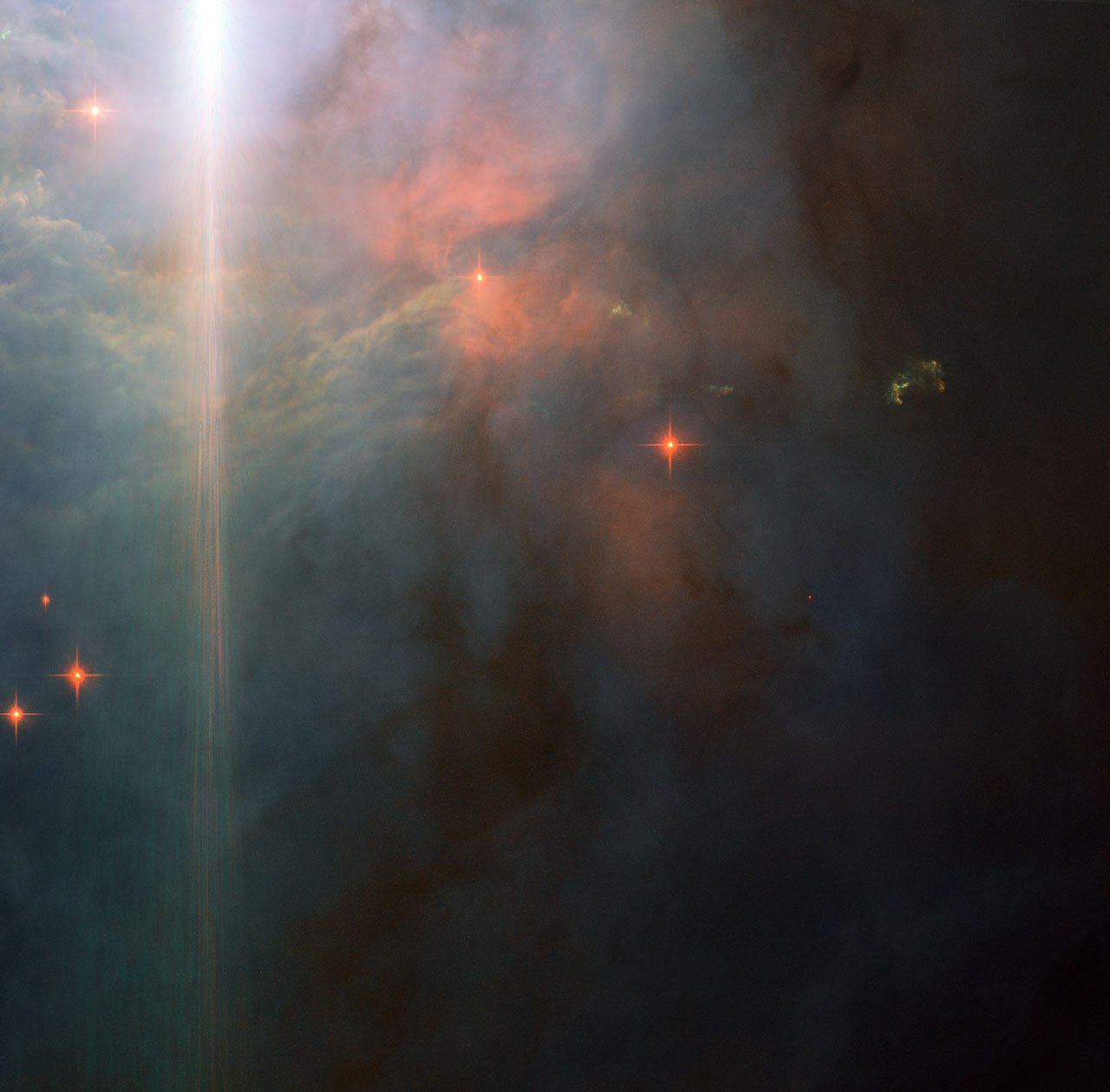
The magnificent reflection nebula NGC 2023 lies nearly 1500 light-years from Earth. It is located within the constellation of Orion (The Hunter), in a prestigious area of the sky close to the well-known Flame and Horsehead Nebulae. The entire structure of NGC 2023 is vast, at four light-years across. This NASA/ESA Hubble Space Telescope picture just takes in the southern part, with the subtle shades of colour closely resembling those of a sunset on Earth.


NGC 2023 surrounds a massive young B-type star. These stars are large, bright and blue-white in colour, and have a high surface temperature, being several times hotter than the Sun. The energy emitted from NGC2023’s B-type star illuminates the nebula, resulting in its high surface brightness: good news for astronomers who wish to study it. The star itself lies outside the field of view, at the upper left, and its brilliant light is scattered by Hubble’s optical system, creating the bright flare across the left side of the picture, which is not a real feature of the nebula.

Stars are forming from the material comprising NGC 2023. This Hubble image captures the billowing waves of gas, 5000 times denser than the interstellar medium. The unusual greenish clumps are thought to be Herbig–Haro objects. These peculiar features of star-forming regions are created when gas ejected at hundreds of kilometres per second from newly formed stars impacts the surrounding material. These shockwaves cause the gas to glow and result in the strange shapes seen here. Herbig–Haro objects typically only last for a few thousand years, which is the blink of eye in astronomical terms.

This picture was created from multiple images taken with the Wide Field Camera of Hubble’s Advanced Camera for Surveys. Exposures through a blue filter (F475W) are coloured blue, exposures through a yellow filter (F625W) are coloured green and images through a near-infrared filter (F850LP) are shown as red. The total exposure times per filter are 800 s, 800 s and 1200 s, respectively, and the field of view spans 3.2 arcminutes.

Wednesday, July 20, 2011

NASA's Hubble Discovers Another Moon Around Pluto

Pluto's Moon System
Credit: NASA, ESA, and M. Showalter (SETI Institute)
View this image

Hubble Space Telescope's keen vision has found yet another moon orbiting the distant, icy dwarf planet Pluto. This discovery expands the size of Pluto's known satellite system to four moons. The tiny, new satellite — temporarily designated P4 — was uncovered in a Hubble survey searching for rings around the frigid dwarf planet.

The new moon is the smallest moon yet discovered around Pluto. It has an estimated diameter of 8 to 21 miles (13 to 34 km). By comparison, Charon, Pluto's largest moon, is 648 miles (1,043 km) across, and the other moons, Nix and Hydra are in the range of 20 to 70 miles in diameter (32 to 113 km).

"I find it remarkable that Hubble's cameras enabled us to see such a tiny object so clearly from a distance of more than 3 billion miles (5 billion km)," said Mark Showalter of the SETI Institute in Mountain View, Calif., who led this observing program with Hubble.

The finding is a result of ongoing work to support NASA's New Horizons mission, scheduled to fly through the Pluto system in 2015. The mission is designed to provide new insights about worlds at the edge of our solar system. Hubble's mapping of Pluto's surface and discovery of its satellites have been invaluable to planning for New Horizons' close encounter.

"This is a fantastic discovery," said New Horizons' principal investigator Alan Stern of the Southwest Research Institute in Boulder, Colo. "Now that we know there's another moon in the Pluto system, we can plan close-up observations of it during our flyby." Space Telescope Science Institute director's discretionary time was allocated to make the Hubble observations.

The new moon is located between the orbits of Nix and Hydra, which Hubble discovered in 2005. Charon was discovered in 1978 at the U.S. Naval Observatory and first resolved using Hubble in 1990 as a separate body from Pluto.

The dwarf planet's entire moon system is believed to have formed by a collision between Pluto and another planet-sized body early in the history of the solar system. The smashup flung material into orbit around Pluto, which then coalesced into the family of satellites now seen.

Lunar rocks returned to Earth from the Apollo missions led to the theory that our Moon was the result of a similar collision between Earth and a Mars-sized body 4.4 billion years ago. Scientists believe material blasted off Pluto's moons by micrometeoroid impacts may form rings around the dwarf planet, but the Hubble photographs have not detected any so far.

"This surprising observation is a powerful reminder of Hubble's ability as a general purpose astronomical observatory to make astounding, unintended discoveries," said Jon Morse, astrophysics division director at NASA Headquarters in Washington.

P4 was first seen in a photo taken with Hubble's Wide Field Camera 3 on June 28, 2011. It was confirmed in subsequent Hubble pictures taken on July 3 and July 18. The moon was not seen in earlier Hubble images because the exposure times were shorter. There is a chance it appeared as a very faint smudge in 2006 images, but was overlooked because it was largely obscured by an imaging artifact, called a diffraction spike.

CONTACT

Ray Villard
Space Telescope Science Institute, Baltimore, Md.
villard@stsci.edu
410-338-4514

Karen Randall
SETI Institute, Mountain View, Calif.
krandall@seti.org
650-960-4537

Monday, July 18, 2011

Edge-on Galaxy Hosts Supernova Explosion

IC 755
Credit: ESA/Hubble & NASA


The NASA/ESA Hubble Space Telescope has imaged an elongated stream of stars, gas and dust called IC 755, which is actually a spiral galaxy that we are seeing edge-on.

In 1999 a star within IC 755 was seen to explode as a supernova and named SN 1999an. The supernova was discovered by the Beijing Astronomical Observatory Supernova Survey and three years later Hubble was used to study the environment in which the explosion took place. The inclination of the galaxy made the supernova a challenging target as many other intervening objects obscured the view. Valuable data were obtained and suggest that before detonation the star may have been around 20 times more massive than our Sun, and that it was likely to have been in the region of 14 million years old.

Supernovae like SN 1999an are classified as Type IIs and they are dramatic events that mark the end of the lives of massive stars. They have an important role to play in galaxy evolution as many elements are formed during the explosion and are ejected with such force that they are distributed far and wide. Shockwaves also help to mix material within the host galaxy and may spark new rounds of star formation. Billions of stars make up galaxies like IC 755 and many will become supernovae, using their final moments to breathe new life into the rest of the Universe.

This picture was created from multiple images taken with the Wide Field Camera of Hubble’s Advanced Camera for Surveys. Exposures through a blue filter (F435W) are coloured blue, exposures through a yellow-green filter (F555W) are coloured green and images through a near-infrared filter (F814W) are shown as red. The total exposure times per filter are 430 s and the field of view is 3.3 x 1.5 arcminutes.

Tuesday, July 12, 2011

Neptune Completes Its First Circuit Around The Sun Since Its Discovery

Neptune's Anniversary Portraits
Credit: NASA, ESA, and the Hubble Heritage Team (STScI/AURA)

Inner Moons of Neptune
Illustration Credit: NASA, ESA, and Z. Levay (STScI)
Credit: NASA, ESA, and the Hubble Heritage Team (STScI/AURA)

Today, Neptune has arrived at the same location in space where it was discovered nearly 165 years ago. To commemorate the event, NASA's Hubble Space Telescope has taken these "anniversary pictures" of the blue-green giant planet.

Neptune is the most distant major planet in our solar system. German astronomer Johann Galle discovered the planet on September 23, 1846. At the time, the discovery doubled the size of the known solar system. The planet is 2.8 billion miles (4.5 billion kilometers) from the Sun, 30 times farther than Earth. Under the Sun's weak pull at that distance, Neptune plods along in its huge orbit, slowly completing one revolution approximately every 165 years.

These four Hubble images of Neptune were taken with the Wide Field Camera 3 on June 25-26, during the planet's 16-hour rotation. The snapshots were taken at roughly four-hour intervals, offering a full view of the planet. The images reveal high-altitude clouds in the northern and southern hemispheres. The clouds are composed of methane ice crystals.

The giant planet experiences seasons just as Earth does, because it is tilted 29 degrees, similar to Earth's 23-degree-tilt. Instead of lasting a few months, each of Neptune's seasons continues for about 40 years.

The snapshots show that Neptune has more clouds than a few years ago, when most of the clouds were in the southern hemisphere. These Hubble views reveal that the cloud activity is shifting to the northern hemisphere. It is early summer in the southern hemisphere and winter in the northern hemisphere.

In the Hubble images, absorption of red light by methane in Neptune's atmosphere gives the planet its distinctive aqua color. The clouds are tinted pink because they are reflecting near-infrared light.

A faint, dark band near the bottom of the southern hemisphere is probably caused by a decrease in the hazes in the atmosphere that scatter blue light. The band was imaged by NASA's Voyager 2 spacecraft in 1989, and may be tied to circumpolar circulation created by high-velocity winds in that region.

The temperature difference between Neptune's strong internal heat source and its frigid cloud tops, about minus 260 degrees Fahrenheit, might trigger instabilities in the atmosphere that drive large-scale weather changes.

Neptune has an intriguing history. It was Uranus that led astronomers to Neptune. Uranus, the seventh planet from the Sun, is Neptune's inner neighbor. British astronomer Sir William Herschel and his sister Caroline found Uranus in 1781, 55 years before Neptune was spotted. Shortly after the discovery, Herschel noticed that the orbit of Uranus did not match the predictions of Newton's theory of gravity. Studying Uranus in 1821, French astronomer Alexis Bouvard speculated that another planet was tugging on the giant planet, altering its motion.

Twenty years later, Urbain Le Verrier of France and John Couch Adams of England, who were mathematicians and astronomers, independently predicted the location of the mystery planet by measuring how the gravity of a hypothetical unseen object could affect Uranus's path. Le Verrier sent a note describing his predicted location of the new planet to the German astronomer Johann Gottfried Galle at the Berlin Observatory. Over the course of two nights in 1846, Galle found and identified Neptune as a planet, less than a degree from Le Verrier's predicted position. The discovery was hailed as a major success for Newton's theory of gravity and the understanding of the universe.

Galle was not the first to see Neptune. In December 1612, while observing Jupiter and its moons with his handmade telescope, astronomer Galileo Galilei recorded Neptune in his notebook, but as a star. More than a month later, in January 1613, he noted that the "star" appeared to have moved relative to other stars. But Galileo never identified Neptune as a planet, and apparently did not follow up those observations, so he failed to be credited with the discovery.

Neptune is not visible to the naked eye, but may be seen in binoculars or a small telescope. It can be found in the constellation Aquarius, close to the boundary with Capricorn.

Neptune-mass planets orbiting other stars may be common in our Milky Way galaxy. NASA's Kepler mission, launched in 2009 to hunt for Earth-size planets, is finding increasingly smaller extrasolar planets, including many the size of Neptune.

For additional information, contact:

Donna Weaver / Ray Villard
Space Telescope Science Institute, Baltimore, Md.
410-338-4493 / 410-338-4514
dweaver@stsci.edu / villard@stsci.edu

Keith Noll
Space Telescope Science Institute, Baltimore, Md.
410-338-1828
noll@stsci.edu

Tuesday, July 05, 2011

NASA's Hubble Makes One Millionth Science Observation

Transiting Exoplanet HAT-P-7b
Credit: NASA, ESA, and G. Bacon (STScI)

All-Sky illustration of all Hubble observations as of June 27, 2011
Credit: NASA, ESA, and R. Thompson (CSC/STScI)

NASA's Hubble Space Telescope crossed another milestone in its space odyssey of exploration and discovery. On Monday, July 4, the Earth-orbiting observatory logged its one millionth science observation during a search for water in an exoplanet's atmosphere 1,000 light-years away.

"For 21 years Hubble has been the premier space science observatory, astounding us with deeply beautiful imagery and enabling ground-breaking science across a wide spectrum of astronomical disciplines," said NASA Administrator Charles Bolden. He piloted the space shuttle mission that carried Hubble to orbit. "The fact that Hubble met this milestone while studying a faraway planet is a remarkable reminder of its strength and legacy."

Although Hubble is best known for its stunning imagery of the cosmos, the millionth observation is a spectrocopic measurement, where light is divided its component colors. These color patterns can reveal the chemical composition of cosmic sources.

Hubble's millionth exposure is of the planet HAT-P-7b, a gas giant planet larger than Jupiter orbiting a star hotter than our Sun. HAT-P-7b, also known as Kepler 2b, has been studied by NASA's planet-hunting Kepler observatory after it was discovered by ground-based observations. Hubble now is being used to analyze the chemical composition of the planet's atmosphere.

"We are looking for the spectral signature of water vapor. This is an extremely precise observation and it will take months of analysis before we have an answer," said Drake Deming of the University of Maryland and NASA's Goddard Space Flight Center in Greenbelt, Md. "Hubble demonstrated it is ideally suited for characterizing the atmospheres of exoplanets, and we are excited to see what this latest targeted world will reveal."

"This exciting set of observations in search of water vapor on a planet orbiting another star is laying the foundation for how we plan to use the James Webb Space Telescope's more powerful vision to look for liquid water on nearby planets, the necessary precursor to extraterrestrial life," said Matt Mountain, STScI director.

Hubble was launched April 24, 1990, aboard space shuttle Discovery's STS-31 mission. Its discoveries revolutionized nearly all areas of astronomical research from planetary science to cosmology. The observatory has collected more than 50 terabytes of data to-date. The archive of that data is available to scientists and the public at: http://hla.stsci.edu/

Hubble's odometer reading includes every observation of astronomical targets since its launch and observations used to calibrate its suite of instruments. Hubble made the millionth observation using its Wide Field Camera 3, a visible- and infrared-light imager with an on-board spectrometer. It was installed by astronauts during Hubble Servicing Mission 4 in May 2009.

"The Hubble keeps amazing us with groundbreaking science," said Sen. Barbara Mikulski, the chairwoman of the Senate Commerce, Justice, Science and Related Agencies Appropriations Subcommittee that funds NASA. "I championed the mission to repair and renew Hubble not just to get one million science observations, but also to inspire millions of children across the planet to become our next generation of stargazers, scientists, astronauts and engineers."

CONTACT

Trent Perrotto
NASA Headquarters, Washington, D.C.
trent.j.perrotto@nasa.gov
202-358-0321

Ray Villard
Space Telescope Science Institute, Baltimore, Md.
410-338-4514
villard@stsci.edu

Wednesday, May 25, 2011

NASA's Hubble Finds Rare Blue Straggler Stars in the Milky Way's Hub

Blue Straggler Stars in the Galactic Bulge
Image Type: Astronomical/Illustration
Credit: NASA, ESA, W. Clarkson (Indiana University and UCLA),
and K. Sahu (STScI)

Artist's View of a Blue Straggler Star
Artwork Credit: NASA, ESA, and G. Bacon (STScI)
Science Credit: NASA, ESA,
W. Clark (Indiana University and UCLA),
and K. Sahu (STScI)

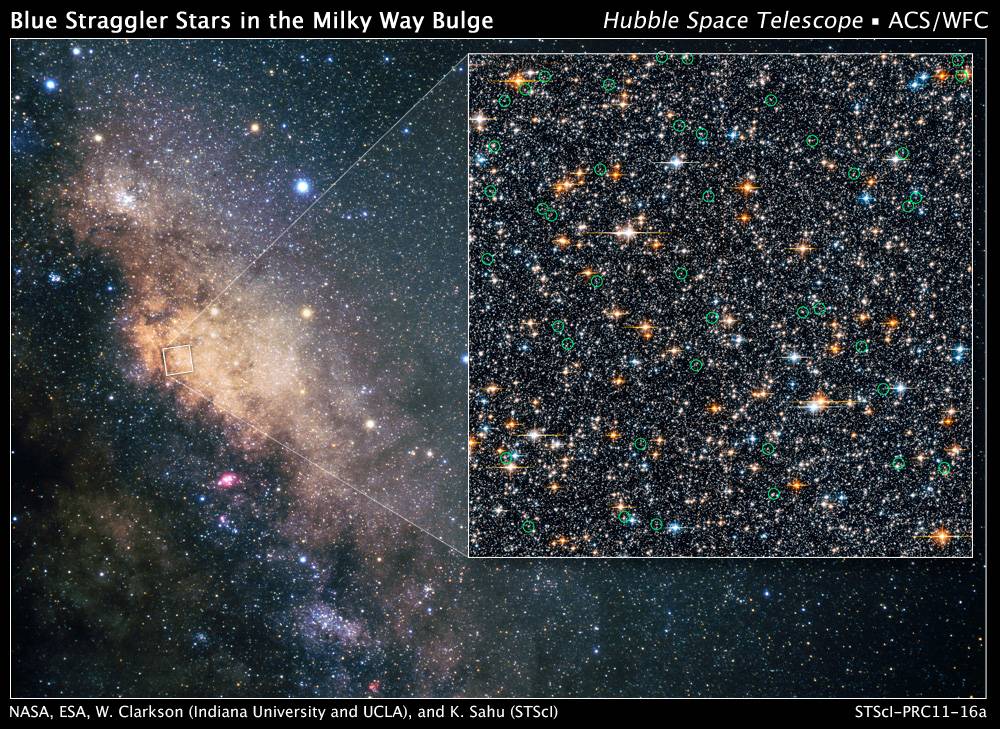
This is an artist's concept of a close binary pair of stars that are merging to form a blue-straggler-class star. Blue stragglers are so named because they seem to be lagging behind in their rate of aging compared with the population from which they formed. The merger stirs up hydrogen fuel and causes the resulting more massive star to undergo nuclear fusion at a faster rate, causing it to burn hotter and bluer. Probing the star-filled, ancient hub of our Milky Way, the Hubble Space Telescope has found blue stragglers for the first time within our galaxy's bulge.


Probing the star-filled, ancient hub of our Milky Way, NASA's Hubble Space Telescope has found a rare class of oddball stars called blue stragglers, the first time such objects have been detected within our galaxy's bulge.

The size and nature of the blue straggler population detected in the bulge will allow astronomers to better understand if the bulge is exclusively old stars, or a mixture of both young and old stars. In addition, the discovery provides a new test case for formation models of the blue stragglers themselves.

Blue stragglers — so named because they seem to be lagging behind in their rate of aging compared with the population from which they formed — were first found inside ancient globular star clusters half a century ago. They have been detected in many globular and open clusters, as well as among the stars in the solar neighborhood. But they have never been seen inside the core of our galaxy until Hubble was trained on the region.

Hubble astronomers found blue straggler stars in an extensive set of Hubble exposures of the Milky Way's crowded hub. Blue stragglers are much hotter — and hence bluer — than they should be for the aging neighborhood in which they live. Now that blue stragglers have at last been found within the bulge, the size and characteristics of this population will allow astronomers to better understand the still-controversial processes of star formation within the bulge.

The results, to be published in The Astrophysical Journal, are being reported by lead author Will Clarkson of Indiana University and the University of California, Los Angeles, at the American Astronomical Society meeting in Boston, Mass.

These results support the idea that the Milky Way's central bulge stopped making stars billions of years ago. It is now home to aging Sun-like stars and cooler red dwarfs. Giant blue stars that once lived there exploded as supernovae billions of years ago. If our galaxy were the size of a dinner plate, the central bulge would be roughly the size of a grapefruit placed in the middle of the plate.

This discovery is a spin-off from a seven-day-long survey conducted in 2006 called the Sagittarius Window Eclipsing Extrasolar Planet Search (SWEEPS). Hubble peered at and obtained variability information for 180,000 stars in the crowded central bulge of our galaxy, 26,000 light-years away. The survey was intended to find hot Jupiter-class planets that orbit very close to their stars. But the SWEEPS team also uncovered 42 oddball blue stars among the bulge population with brightness and temperatures typical for stars much younger than ordinary bulge stars.

Blue stragglers have long been suspected to be living in the bulge. Until now, it has never been proven because younger stars in the disk of our galaxy lie along the line-of-sight to the core, confusing and contaminating the view.

But Hubble's view is so sharp that astronomers could distinguish the motion of the core population from foreground stars in the Milky Way. Bulge stars orbit the galactic nucleus at a different speed than foreground stars. Plotting their motion required returning to the SWEEPS target region with Hubble two years after the first-epoch observations were made.

Hence, the blue stragglers were identified as moving along with the other stars in the bulge. It's like looking into a deep, clear pond where the fish at the bottom of the pond are swimming at a faster rate than the fish closer to the surface.

"The size of the field of view on the sky is roughly that of the thickness of a human fingernail held at arm's length, and within this region, Hubble sees about a quarter million stars towards the bulge," Clarkson says. "Only the superb image quality and stability of Hubble allowed us to make this measurement in such a crowded field."

From the 42 candidate blue stragglers, the investigators estimate 18 to 37 of them are likely to be genuine blue stragglers, with the remainder consisting of a mixture of foreground objects and at most a small population of genuinely young bulge stars.

It's not clear how blue stragglers form, or if there is more than one mechanism at work. A common idea is that blue stragglers emerge from binary pairs. As the more massive star evolves and expands, the less massive star accretes material from the companion. This stirs up hydrogen fuel and causes the accreting star to undergo nuclear fusion at a faster rate. It burns hotter and bluer.

The seven-day observation allowed the fraction of blue straggler candidates presently in close binaries to be estimated by virtue of their changing light-curve. This is caused by the change of shape induced in one star due to the tidal gravitational pull of its companion. "The SWEEPS program was designed to detect transiting planets through small light variations. Therefore the program could easily detect the variability of binary pairs, which was crucial in confirming these are indeed blue stragglers," says Kailash Sahu of the Space Telescope Science Institute in Baltimore, Md., the principal investigator of the SWEEPS program.

The observations clearly indicate that if there is a young star population in the bulge, it is very small, and it was not detected in the SWEEPS program. "Although the Milky Way bulge is by far the closest galaxy bulge, several key aspects of its formation and subsequent evolution remain poorly understood," Clarkson says. "While the consensus is that the bulge largely stopped forming stars long ago, many details of its star-formation history remain controversial. The extent of the blue straggler population detected provides two new constraints for models of the star-formation history of the bulge."

CONTACT

Ray Villard
Space Telescope Science Institute, Baltimore, Md.
410-338-4514
villard@stsci.edu

Will Clarkson
Indiana University, Bloomington, Ind., and
University of California, Los Angeles, Calif.
812-855-6911
wiclarks@indiana.edu

Kailash Sahu
Space Telescope Science Institute, Baltimore, Md.
410-338-4930
ksahu@stsci.edu

Thursday, April 07, 2011

NASA Telescopes Join Forces to Observe Unprecedented Explosion

NASA's Hubble Space Telescope has pinpointed the source of one of the most puzzling blasts of high-energy radiation ever observed. It is at the very center of a small, distant galaxy, which appears to be sending a beam of radiation directly toward Earth.

The 3.8-billion-light-year-distant galaxy appears as a bright blob at the center of the Hubble picture.

This observation may support the idea that a supermassive black hole at the core of the galaxy has gravitationally torn apart and swallowed a bypassing star. As the star's gas falls onto the black hole, radiation is ejected along a narrow beam.

On March 28, 2011, NASA's Swift satellite, which looks for transient X-rays and gamma rays, detected the first of a string of powerful bursts of high-energy radiation that has lasted for a week.

More Hubble observations are planned to see if the core changes brightness. An armada of ground- and space-based telescopes is also watching the object from X-ray through radio wavelengths. The Hubble observations were taken in visible and near-infrared light on April 4, 2011, with the Wide Field Camera 3. This Hubble image was taken in visible light. Credit: NASA, ESA, and A. Fruchter (STScI)

Images from Swift's Ultraviolet/Optical (in white and purple) and X-ray telescopes (in yellow and red) were combined in this view of GRB 110328A. The blast was detected only in X-rays, which were collected over a 3.4-hour period on March 28, 2011. Credit: NASA, Swift, and S. Immler (NASA GSFC)

NASA's Chandra X-ray Observatory completed this four-hour exposure of GRB 110328A on April 4, 2011. The center of the X-ray source corresponds to the very center of the host galaxy imaged by Hubble, indicated by the red cross in the image. Credit: NASA, CXC, and A. Levan (University of Warwick)

This diagram illustrates a possible explanation for a series of intense bursts of energy seen by the NASA Swift satellite's Burst Alert Telescope on March 28, 2011. Subsequent Hubble Space Telescope observations showed that the blasts originated from the center of a dwarf spheroidal galaxy located nearly 4 billion light-years away. The unusual string of powerful outbursts likely arose when a star wandered too close to its galaxy's central black hole, weighing perhaps as much as 1 million times the mass of our Sun. Intense gravitational tidal forces tore the star apart, and the infalling gas continues to stream toward the hole. The black hole formed a jet along its spin axis. Because the jet is pointed toward Earth, astronomers see a powerful blast of X-rays and gamma rays. Credit: NASA, ESA, and A. Feild (STScI)
NASA's Swift satellite, Hubble Space Telescope, and Chandra X-ray Observatory have teamed up to study one of the most puzzling cosmic blasts ever observed. More than a week later, high-energy radiation continues to brighten and fade from its location.

Astronomers say they have never seen such a bright, variable, high-energy, long-lasting burst before. Usually, gamma-ray bursts mark the destruction of a massive star, and flaring emission from these events never lasts more than a few hours.

Although research is ongoing, astronomers feel that the unusual blast likely arose when a star wandered too close to its galaxy's central black hole. Intense tidal forces tore the star apart, and the infalling gas continues to stream toward the hole. According to this model, the spinning black hole formed an outflowing jet along its rotational axis. A powerful blast of X-rays and gamma rays is seen when this jet is pointed in our direction.

On March 28, 2011, Swift's Burst Alert Telescope discovered the source in the constellation Draco when it erupted with the first in a series of powerful blasts.

"We know of objects in our own galaxy that can produce repeated bursts, but they are thousands to millions of times less powerful than the bursts we are seeing now. This is truly extraordinary," said Andrew Fruchter at the Space Telescope Science Institute in Baltimore.

Swift determined a position for the explosion, which is now cataloged as gamma-ray burst (GRB) 110328A, and informed astronomers worldwide.

As dozens of telescopes turned to the spot, astronomers quickly noticed a small, distant galaxy very near the Swift position. A deep image taken by Hubble on Monday, April 4, pinpointed the source of the explosion at the center of this galaxy, which lies 3.8 billion light-years away from Earth. That same day, astronomers used NASA's Chandra X-ray Observatory to make a four-hour-long exposure of the puzzling source. The image, which locates the X-ray object 10 times more precisely than Swift, shows it lies at the center of the galaxy Hubble imaged.

"We have been eagerly awaiting the Hubble observation," said Neil Gehrels, the lead scientist for Swift at NASA's Goddard Space Flight Center in Greenbelt, Md. "The fact that the explosion occurred in the center of a galaxy tells us it is most likely associated with a massive black hole. This solves a key question about the mysterious event."

Most galaxies, including our own, contain central black holes with millions of times the Sun's mass; those in the largest galaxies can be a thousand times larger. The disrupted star probably succumbed to a black hole less massive than the Milky Way's, which has a mass four million times that of our Sun.

Astronomers previously have detected stars disrupted by supermassive black holes, but none have shown the X-ray brightness and variability seen in GRB 110328A. The source has undergone numerous flares. Since April 3, for example, the source has brightened by more than five times.

Scientists think that the X-rays may be coming from matter moving near the speed of light in a particle jet that forms along the rotation axis of the spinning black hole as the star's gas falls into a disk around the black hole.

"The best explanation at the moment is that we happen to be looking down the barrel of this jet," said Andrew Levan of the University of Warwick in the United Kingdom, who led the Chandra observations. "When we look straight down these jets, a brightness boost lets us view details we might otherwise miss."

This brightness increase, which is called relativistic beaming, occurs when matter moving close to the speed of light is viewed nearly head on. Astronomers plan additional Hubble observations to see if the galaxy's core changes brightness.

Goddard manages Swift and Hubble. NASA's Marshall Space Flight Center in Huntsville, Ala., manages Chandra. Hubble was built and is operated in partnership with the European Space Agency. Science operations for all three missions include contributions from many national and international partners.

CONTACT

Trent Perrotto
NASA Headquarters, Washington
202-358-0321
trent.j.perrotto@nasa.gov

Lynn Chandler
NASA Goddard Space Flight Center, Greenbelt, Md.
301-286-2806
lynn.chandler-1@nasa.gov

Ray Villard
Space Telescope Science Institute, Baltimore, Md.
410-338-4514
villard@stsci.edu

Megan Watzke
Chandra X-ray Center, Cambridge, Mass.
617-496-7998
mwatzke@cfa.harvard.edu

Thursday, February 17, 2011

Hubble Shows New Image of Spiral Galaxy NGC 2841

Spiral Galaxy NGC 2841
Credit: NASA, ESA, and the Hubble Heritage (STScI/AURA)-ESA/Hubble Collaboration

Acknowledgment: M. Crockett and S. Kaviraj (Oxford University, UK), R. O'Connell (University of Virginia), B. Whitmore (STScI), and the WFC3 Scientific Oversight Committee

NASA's Hubble Space Telescope reveals a majestic disk of stars and dust lanes in this view of the spiral galaxy NGC 2841.

A bright cusp of starlight marks the galaxy's center. Spiraling outward are dust lanes that are silhouetted against the population of whitish middle-aged stars. Much younger blue stars trace the spiral arms.

Notably missing are pinkish emission nebulae indicative of new star birth. It is likely that the radiation and supersonic winds from fiery, super-hot, young blue stars cleared out the remaining gas (which glows pink), and hence shut down further star formation in the regions in which they were born. NGC 2841 currently has a relatively low star formation rate compared to other spirals that are ablaze with emission nebulae.

NGC 2841 lies 46 million light-years away in the constellation of Ursa Major (The Great Bear). This image was taken in 2010 through four different filters on Hubble's Wide Field Camera 3. Wavelengths range from ultraviolet light through visible light to near-infrared light.

Acknowledgment: M. Crockett and S. Kaviraj (Oxford University, UK), R. O'Connell (University of Virginia), B. Whitmore (STScI), and the WFC3 Scientific Oversight Committee.

Technical facts about this news release:

Object Name: NGC 2841
Object Description: Flocculent Spiral Galaxy
Position (J2000): R.A. 9h 22m 02.64s Dec. +50° 58' 35.47"
Constellation: Ursa Major
Distance: About 46 million light-years (14 million parsecs)
Dimensions: The image is 2.6 arcminutes (34,000 light-years or 10,500 parsecs) wide.

About the Data Data Description: The image was created from Hubble data from proposal 11360: R. O'Connell (University of Virginia), B. Balick (University of Washington), H. Bond (STScI), D. Calzetti (University of Massachusetts), M. Carollo (Swiss Federal Institute of Technology, Zurich), M. Disney (University of Wales, College of Cardiff), M. Dopita (Australian National University), J. Frogel (Ohio State University Research Foundation), D. Hall (University of Hawaii), J. Holtzman (New Mexico State University), P. McCarthy (Carnegie Institution of Washington), F. Paresce (European Southern Observatory, Germany), A. Saha (NOAO/AURA), J. Silk (University of Oxford), A. Walker (NOAO/CTIO), B. Whitmore (STScI), R. Windhorst (Arizona State University), and E. Young (University of Arizona).

Instrument: WFC3/UVIS
Exposure Date(s): January 5-7, 2010
Exposure Time: 2 hours
Filters: F336W (U), F547M (y), F657N (H-alpha + [N II]), and F814W (I)

Color: This image is a composite of separate exposures acquired by the WFC3 instrument on HST. Several filters were used to sample broad and narrow wavelength ranges. The color results from assigning different hues (colors) to each monochromatic (grayscale) image associated with an individual filter. In this case, the assigned colors are:
  • F336W (U) blue
  • F547M (y) green
  • F657N (H-alpha + [N II]) red-orange
  • F814W (I) red

Wednesday, January 26, 2011

NASA's Hubble Finds Most Distant Galaxy Candidate Ever Seen in Universe

UDFj-39546284
Credit: NASA, ESA, G. Illingworth (University of California, Santa Cruz), R. Bouwens (University of California, Santa Cruz, and Leiden University), and the HUDF09 Team. View this image

Astronomers have pushed NASA's Hubble Space Telescope to its limits by finding what they believe is the most distant object ever seen in the universe. Its light traveled 13.2 billion years to reach Hubble, roughly 150 million years longer than the previous record holder. The age of the universe is 13.7 billion years.

The dim object, called UDFj-39546284, is a compact galaxy of blue stars that existed 480 million years after the Big Bang, only four percent of the universe's current age. It is tiny. Over one hundred such mini-galaxies would be needed to make up our Milky Way.

Astronomers were surprised to find evidence that the rate at which the universe was forming stars grew precipitously in about a 200-million-year time span.

"We're seeing huge changes in the rate of star birth that tell us that if we go a little further back in time we're going to see even more dramatic changes," says Garth Illingworth of the University of California at Santa Cruz. The rate of star birth increased by about a factor of ten going from 480 million years to 650 million years after the Big Bang.

"These observations provide us with our best insights yet into the earlier primeval objects that have yet to be found," adds Rychard Bouwens of the Leiden University in the Netherlands.

Astronomers don't know exactly when the first stars appeared in the universe, but every step farther from Earth takes them deeper into the early universe's "formative years" when stars and galaxies were just beginning to emerge in the aftermath of the Big Bang. "We're moving into a regime where there are big changes afoot. Another couple of hundred million years toward the Big Bang, that will be the time where the first galaxies really are starting to get built up," says Illingworth.

Bouwens and Illingworth are reporting the discovery in the January 27 issue of the British science journal Nature.

The even more distant proto-galaxies that Illingworth expects are out there will require the infrared vision of NASA's James Webb Space Telescope, which is the successor to Hubble. Planned for launch later this decade, Webb will provide confirming spectroscopic measurements of the object's tremendous distance being reported today.

After over a year of detailed analysis, the object was positively identified in the Hubble Ultra Deep Field – Infrared (HUDF-IR) data taken in the late summer of both 2009 and 2010. This observation was made with the Wide Field Camera 3 (WFC3) starting just a few months after it was installed into the Hubble Space Telescope in May of 2009, during the last NASA space shuttle servicing mission to Hubble.

The object appears as a faint dot of starlight in the Hubble exposures. It is too young and too small to have the familiar spiral shape that is characteristic of galaxies in the local universe. Though its individual stars can't be resolved by Hubble, the evidence suggests that this is a compact galaxy of hot stars that first started to form over 100-200 million years earlier, from gas trapped in a pocket of dark matter.

The proto-galaxy is only visible at the farthest infrared wavelengths observable by Hubble. This means that the expansion of the universe has stretched and thereby reddened its light more than that of any other galaxy previously identified in the HUDF-IR, to the very limit of what Hubble can detect. Webb will go deeper into infrared wavelengths and will be at least an order of magnitude more sensitive than Hubble, allowing it to more efficiently hunt for primeval galaxies at even greater distances, at earlier times, closer to the Big Bang.

Astronomers plumb the depths of the universe, and probe its history, by measuring how much the light from an object has been stretched by the expansion of space. This is called the redshift value or "z." In general, the greater the observed "z" value for a galaxy, the more distant it is in time and space as observed from our own Milky Way. Before Hubble was launched, astronomers could only see galaxies out to a z of approximately 1, corresponding to halfway across the universe.

The original Hubble Deep Field taken in 1995 leapfrogged to z=4, or roughly 90 percent of the way back to the beginning of time. The Advanced Camera for Surveys (ACS) produced the Hubble Ultra Deep Field of 2004, pushing back the limit to z~6. ACS was installed on Hubble during Servicing Mission 3B in 2002. Hubble's first infrared camera, the Near Infrared Camera and Multi-Object Spectrometer, reached out to z=7. The WFC3 first took us back to z~8, and has now plausibly penetrated for the first time to z=10. The Webb Space Telescope is expected to leapfrog to z of approximately 15, 275 million years after the Big Bang, and possibly beyond. The very first stars may have formed between z of 30 and 15.

The hypothesized hierarchical growth of galaxies — from stellar clumps to majestic spirals and ellipticals — didn't become evident until the Hubble Space Telescope deep-field exposures. The first 500 million years of the universe's existence, from z of 1000 to 10, is now the missing chapter in the hierarchical growth of galaxies. It's not clear how the universe assembled structure out of a darkening, cooling fireball of the Big Bang. As with a developing embryo, astronomers know there must have been an early period of rapid changes that would set the initial conditions to make the universe of galaxies what it is today.

CONTACT

Ray Villard
Space Telescope Science Institute, Baltimore, Md.
410-338-4514
villard@stsci.edu

Garth Illingworth
University of California, Santa Cruz
831-459-2843
gdi@ucolick.org

Rychard Bouwens
University of California, Santa Cruz, and Leiden University, Netherlands
831-459-5276
bouwens@ucolick.org