Showing posts with label Moon. Show all posts

Friday, August 16, 2019

Moon Glows Brighter Than Sun in Images From NASA's Fermi

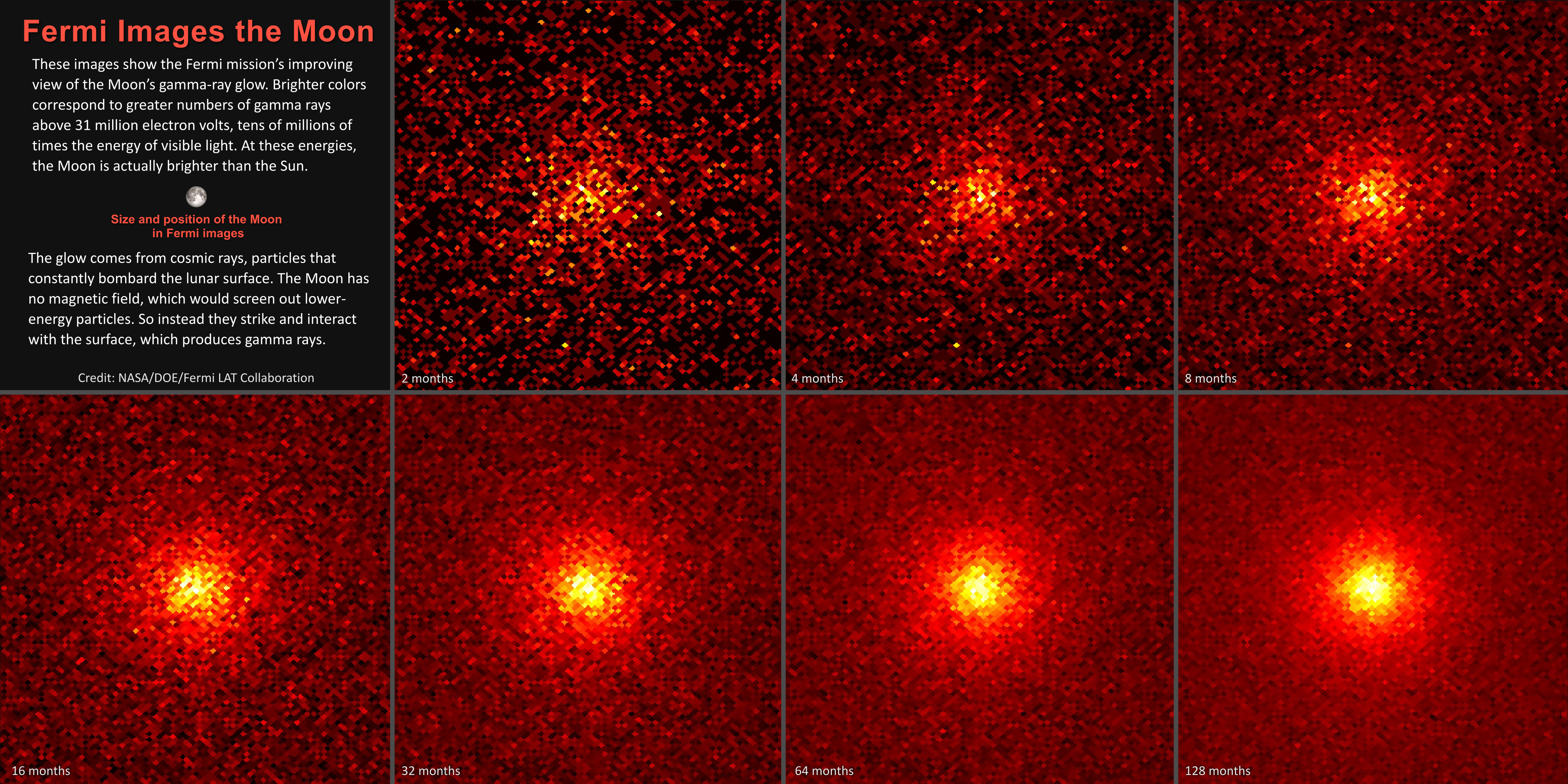
The Moon shines brightly in gamma rays as seen in this time sequence from NASA’s Fermi Gamma-ray Space Telescope. Each 5-by-5-degree image is centered on the Moon and shows gamma rays with energies above 31 million electron volts, or tens of millions of times that of visible light. At these energies, the Moon is actually brighter than the Sun. Brighter colors indicate greater numbers of gamma rays. This animation shows how longer exposure, ranging from two to 128 months (10.7 years), improved the view. Credit: NASA/DOE/Fermi LAT Collaboration. Download

If our eyes could see high-energy radiation called gamma rays, the Moon would appear brighter than the Sun! That’s how NASA’s Fermi Gamma-ray Space Telescope has seen our neighbor in space for the past decade.

Gamma-ray observations are not sensitive enough to clearly see the shape of the Moon’s disk or any surface features. Instead, Fermi’s Large Area Telescope (LAT) detects a prominent glow centered on the Moon’s position in the sky.

Mario Nicola Mazziotta and Francesco Loparco, both at Italy’s National Institute of Nuclear Physics in Bari, have been analyzing the Moon’s gamma-ray glow as a way of better understanding another type of radiation from space: fast-moving particles called cosmic rays.

“Cosmic rays are mostly protons accelerated by some of the most energetic phenomena in the universe, like the blast waves of exploding stars and jets produced when matter falls into black holes,” explained Mazziotta.

Because the particles are electrically charged, they’re strongly affected by magnetic fields, which the Moon lacks. As a result, even low-energy cosmic rays can reach the surface, turning the Moon into a handy space-based particle detector. When cosmic rays strike, they interact with the powdery surface of the Moon, called the regolith, to produce gamma-ray emission. The Moon absorbs most of these gamma rays, but some of them escape.

Mazziotta and Loparco analyzed Fermi LAT lunar observations to show how the view has improved during the mission. They rounded up data for gamma rays with energies above 31 million electron volts — more than 10 million times greater than the energy of visible light — and organized them over time, showing how longer exposures improve the view.

“Seen at these energies, the Moon would never go through its monthly cycle of phases and would always look full,” said Loparco.

These images show the steadily improving view of the Moon’s gamma-ray glow from NASA’s Fermi Gamma-ray Space Telescope. Each 5-by-5-degree image is centered on the Moon and shows gamma rays with energies above 31 million electron volts, or tens of millions of times that of visible light. At these energies, the Moon is actually brighter than the Sun. Brighter colors indicate greater numbers of gamma rays. This image sequence shows how longer exposure, ranging from two to 128 months (10.7 years), improved the view.  Credit: NASA/DOE/Fermi LAT Collaboration. Hi-res image


As NASA sets its sights on sending humans to the Moon by 2024 through the Artemis program, with the eventual goal of sending astronauts to Mars, understanding various aspects of the lunar environment take on new importance. These gamma-ray observations are a reminder that astronauts on the Moon will require protection from the same cosmic rays that produce this high-energy gamma radiation.

While the Moon’s gamma-ray glow is surprising and impressive, the Sun does shine brighter in gamma rays with energies higher than 1 billion electron volts. Cosmic rays with lower energies do not reach the Sun because its powerful magnetic field screens them out. But much more energetic cosmic rays can penetrate this magnetic shield and strike the Sun’s denser atmosphere, producing gamma rays that can reach Fermi.

Although the gamma-ray Moon doesn’t show a monthly cycle of phases, its brightness does change over time. Fermi LAT data show that the Moon’s brightness varies by about 20% over the Sun’s 11-year activity cycle. Variations in the intensity of the Sun’s magnetic field during the cycle change the rate of cosmic rays reaching the Moon, altering the production of gamma rays.

By Francis Reddy
NASA’s Goddard Space Flight Center, Greenbelt, Md.

Editor: Rob Garner


Thursday, February 04, 2016

Moon was produced by a head-on collision between Earth and a forming planet

The extremely similar chemical composition of rocks on the Earth and moon helped scientists determine that a head-on collision, not a glancing blow, took place between Earth and Theia. Copyright William K. Hartmann

Paul Warren, Edward Young (holding a sample of a rock from the moon) and Issaku Kohl
Credit: Christelle Snow/UCLA


UCLA-led research reconstructs massive crash, which took place 4.5 billion years ago


The moon was formed by a violent, head-on collision between the early Earth and a “planetary embryo” called Theia approximately 100 million years after the Earth formed, UCLA geochemists and colleagues report.

Scientists had already known about this high-speed crash, which occurred almost 4.5 billion years ago, but many thought the Earth collided with Theia (pronounced THAY-eh) at an angle of 45 degrees or more — a powerful side-swipe (simulated in this 2012 YouTube video). New evidence reported Jan. 29 in the journal Science substantially strengthens the case for a head-on assault.

The researchers analyzed seven rocks brought to the Earth from the moon by the Apollo 12, 15 and 17 missions, as well as six volcanic rocks from the Earth’s mantle — five from Hawaii and one from Arizona.

The key to reconstructing the giant impact was a chemical signature revealed in the rocks’ oxygen atoms. (Oxygen makes up 90 percent of rocks’ volume and 50 percent of their weight.) More than 99.9 percent of Earth’s oxygen is O-16, so called because each atom contains eight protons and eight neutrons. But there also are small quantities of heavier oxygen isotopes: O-17, which have one extra neutron, and O-18, which have two extra neutrons. Earth, Mars and other planetary bodies in our solar system each has a unique ratio of O-17 to O-16 — each one a distinctive “fingerprint.”

In 2014, a team of German scientists reported in Science that the moon also has its own unique ratio of oxygen isotopes, different from Earth’s. The new research finds that is not the case.

“We don’t see any difference between the Earth’s and the moon’s oxygen isotopes; they’re indistinguishable,” said Edward Young, lead author of the new study and a UCLA professor of geochemistry and cosmochemistry.

Young’s research team used state-of-the-art technology and techniques to make extraordinarily precise and careful measurements, and verified them with UCLA’s new mass spectrometer.

The fact that oxygen in rocks on the Earth and our moon share chemical signatures was very telling, Young said. Had Earth and Theia collided in a glancing side blow, the vast majority of the moon would have been made mainly of Theia, and the Earth and moon should have different oxygen isotopes. A head-on collision, however, likely would have resulted in similar chemical composition of both Earth and the moon.

“Theia was thoroughly mixed into both the Earth and the moon, and evenly dispersed between them,” Young said. “This explains why we don’t see a different signature of Theia in the moon versus the Earth.”

Theia, which did not survive the collision (except that it now makes up large parts of Earth and the moon) was growing and probably would have become a planet if the crash had not occurred, Young said. Young and some other scientists believe the planet was approximately the same size as the Earth; others believe it was smaller, perhaps more similar in size to Mars.

Another interesting question is whether the collision with Theia removed any water that the early Earth may have contained. After the collision — perhaps tens of millions of year later — small asteroids likely hit the Earth, including ones that may have been rich in water, Young said. Collisions of growing bodies occurred very frequently back then, he said, although Mars avoided large collisions.

A head-on collision was initially proposed in 2012 by Matija Ćuk, now a research scientist with the SETI Institute, and Sarah Stewart, now a professor at UC Davis; and, separately during the same year by Robin Canup of the Southwest Research Institute.

Co-authors of the Science paper are Issaku Kohl, a researcher in Young’s laboratory; Paul Warren, a researcher in the UCLA department of Earth, planetary, and space sciences; David Rubie, a research professor at Germany’s Bayerisches Geoinstitut, University of Bayreuth; and Seth Jacobson and Alessandro Morbidelli, planetary scientists at France’s Laboratoire Lagrange, Université de Nice.

The research was funded by NASA, the Deep Carbon Observatory and a European Research Council advanced grant (ACCRETE).


Media Contact

Stuart Wolpert
310-206-0511
swolpert@support.ucla.edu


Tuesday, July 23, 2013

Pale Blue Dot: Distant Spacecraft Photograph Earth

Color and black-and-white images of Earth taken by two NASA interplanetary spacecraft on July 19 show our planet and its moon as bright beacons from millions of miles away in space.

NASA's Cassini spacecraft captured the color images of Earth and the moon from its perch in the Saturn system nearly 900 million miles (1.5 billion kilometers) away. MESSENGER, the first probe to orbit Mercury, took a black-and-white image from a distance of 61 million miles (98 million kilometers) as part of a campaign to search for natural satellites of the planet.

In this rare image taken on July 19, 2013, the wide-angle camera on NASA's Cassini spacecraft has captured Saturn's rings and Earth in the same frame. Image Credit: NASA/JPL-Caltech/Space Science Institute. Larger image

Cameras on NASA's Cassini spacecraft photographed Earth and its moon from Saturn orbit on July 19, 2013. Larger image

In the Cassini images Earth and the moon appear as mere dots -- Earth a pale blue and the moon a stark white, visible between Saturn's rings. It was the first time Cassini's highest-resolution camera captured Earth and its moon as two distinct objects.

It also marked the first time people on Earth had advance notice their planet's portrait was being taken from interplanetary distances. NASA invited the public to celebrate by finding Saturn in their part of the sky, waving at the ringed planet and sharing pictures over the Internet. More than 20,000 people around the world participated. 

"We can't see individual continents or people in this portrait of Earth, but this pale blue dot is a succinct summary of who we were on July 19," said Linda Spilker, Cassini project scientist, at NASA's Jet Propulsion Laboratory in Pasadena, Calif. "Cassini's picture reminds us how tiny our home planet is in the vastness of space, and also testifies to the ingenuity of the citizens of this tiny planet to send a robotic spacecraft so far away from home to study Saturn and take a look-back photo of Earth."

Pictures of Earth from the outer solar system are rare because from that distance, Earth appears very close to our sun. A camera's sensitive detectors can be damaged by looking directly at the sun, just as a human being can damage his or her retina by doing the same. Cassini was able to take this image because the sun had temporarily moved behind Saturn from the spacecraft's point of view and most of the light was blocked. 

A wide-angle image of Earth will become part of a multi-image picture, or mosaic, of Saturn's rings, which scientists are assembling. This image is not expected to be available for several weeks because of the time-consuming challenges involved in blending images taken in changing geometry and at vastly different light levels, with faint and extraordinarily bright targets side by side. 

It thrills me to no end that people all over the world took a break from their normal activities to go outside and celebrate the interplanetary salute between robot and maker that these images represent," said Carolyn Porco, Cassini imaging team lead at the Space Science Institute in Boulder, Colo. "The whole event underscores for me our 'coming of age' as planetary explorers."

In the MESSENGER image, Earth and the moon are less than a pixel, but appear very large because they are overexposed. Long exposures are required to capture as much light as possible from potentially dim objects. Consequently, bright objects in the field of view become saturated and appear artificially large. (To view the MESSENGER images, visit: http://go.nasa.gov/16Vnt5G)

"That images of our planet have been acquired on a single day from two distant solar system outposts reminds us of this nation's stunning technical accomplishments in planetary exploration," said MESSENGER Principal Investigator Sean Solomon of Columbia University's Lamont-Doherty Earth Observatory in Palisades, N.Y. "And because Mercury and Saturn are such different outcomes of planetary formation and evolution, these two images also highlight what is special about Earth. There's no place like home."  Source: NASA - Science News


Credits:

Production editor: Dr. Tony Phillips | Credit: Science@NASA


More information:

The Cassini-Huygens mission is a cooperative project of NASA, the European Space Agency and the Italian Space Agency. JPL designed, developed and assembled the Cassini orbiter and its two onboard cameras. The Johns Hopkins University Applied Physics Laboratory in Laurel, Md., designed and built MESSENGER, a spacecraft developed under NASA's Discovery Program. NASA's Marshall Space Flight Center in Huntsville, Ala., manages the program for the agency's Science Mission Directorate in Washington. JPL and APL manage their respective missions for NASA. The California Institute of Technology in Pasadena manages JPL for NASA. 


Source: NASA - Science News  


Saturday, March 03, 2012

Cassini Detects Hint of Fresh Air at Dione

This view highlights tectonic faults and craters on Dione, an icy world that has undoubtedly experienced geologic activity since its formation. Image credit: NASA/JPL/Space Science Institute. Full image and caption

NASA's Cassini spacecraft has "sniffed" molecular oxygen ions around Saturn's icy moon Dione for the first time, confirming the presence of a very tenuous atmosphere. The oxygen ions are quite sparse - one for every 0.67 cubic inches of space (one for every 11 cubic centimeters of space) or about 2,550 per cubic foot (90,000 per cubic meter) - show that Dione has an extremely thin neutral atmosphere.

At the Dione surface, this atmosphere would only be as dense as Earth's atmosphere 300 miles (480 kilometers) above the surface. The detection of this faint atmosphere, known as an exosphere, is described in a recent issue of the journal Geophysical Research Letters.

"We now know that Dione, in addition to Saturn's rings and the moon Rhea, is a source of oxygen molecules," said Robert Tokar, a Cassini team member based at Los Alamos National Laboratory, Los Alamos, N.M., and the lead author of the paper. "This shows that molecular oxygen is actually common in the Saturn system and reinforces that it can come from a process that doesn't involve life."

Dione's oxygen appears to derive from either solar photons or energetic particles from space bombarding the moon's water ice surface and liberating oxygen molecules, Tokar said. But scientists will be looking for other processes, including geological ones, that could also explain the oxygen.

"Scientists weren't even sure Dione would be big enough to hang on to an exosphere, but this new research shows that Dione is even more interesting than we previously thought," said Amanda Hendrix, Cassini deputy project scientist at NASA's Jet Propulsion Laboratory, Pasadena, Calif., who was not directly involved in the study. "Scientists are now digging through Cassini data on Dione to look at this moon in more detail."

Several solid solar system bodies - including Earth, Venus, Mars and Saturn's largest moon Titan - have atmospheres. But they tend to be typically much denser than what has been found around Dione. However, Cassini scientists did detect a thin exosphere around Saturn's moon Rhea in 2010, very similar to Dione. The density of oxygen at the surfaces of Dione and Rhea is around 5 trillion times less dense than that at Earth's surface.

Tokar said scientists suspected molecular oxygen would exist at Dione because NASA's Hubble Space Telescope detected ozone. But they didn't know for sure until Cassini was able to measure ionized molecular oxygen on its second flyby of Dione on April 7, 2010 with the Cassini plasma spectrometer. On that flyby, the spacecraft flew within about 313 miles (503 kilometers) of the moon's surface.

Cassini scientists are also analyzing data from Cassini's ion and neutral mass spectrometer from a very close flyby on Dec. 12, 2011. The ion and neutral mass spectrometer made the detection of Rhea's thin atmosphere, so scientists will be able to compare Cassini data from the two moons and see if there are other molecules in Dione's exosphere.

The Cassini-Huygens mission is a cooperative project of NASA, the European Space Agency, and the Italian Space Agency. NASA's Jet Propulsion Laboratory, Pasadena, CLinkalif., a division of the California Institute of Technology in Pasadena, manages the mission for NASA's Science Mission Directorate, Washington, D.C. The Cassini orbiter was designed, developed and assembled at JPL. The Cassini plasma spectrometer team and the ion and neutral mass spectrometer team are based at Southwest Research Institute, San Antonio.

For more information about the Cassini mission, visit: http://www.nasa.gov/cassini and http://saturn.jpl.nasa.gov .

Jia-Rui C. Cook 818-354-0850
Jet Propulsion Laboratory, Pasadena, Calif.
jia-rui.c.cook@jpl.nasa.gov

Friday, March 18, 2011

Super Full Moon

Mark your calendar. On March 19th, a full Moon of rare size and beauty will rise in the east at sunset. It's a super "perigee moon"--the biggest in almost 20 years.

"The last full Moon so big and close to Earth occurred in March of 1993," says Geoff Chester of the US Naval Observatory in Washington DC. "I'd say it's worth a look."

Full Moons vary in size because of the oval shape of the Moon's orbit. It is an ellipse with one side (perigee) about 50,000 km closer to Earth than the other (apogee): diagram. Nearby perigee moons are about 14% bigger and 30% brighter than lesser moons that occur on the apogee side of the Moon's orbit.


Above: Perigee moons are as much as 14% wider and 30% brighter than lesser full Moons. [video]

"The full Moon of March 19th occurs less than one hour away from perigee--a near-perfect coincidence1 that happens only 18 years or so," adds Chester.

A perigee full Moon brings with it extra-high "perigean tides," but this is nothing to worry about, according to NOAA. In most places, lunar gravity at perigee pulls tide waters only a few centimeters (an inch or so) higher than usual. Local geography can amplify the effect to about 15 centimeters (six inches)--not exactly a great flood.

Indeed, contrary to some reports circulating the Internet, perigee Moons do not trigger natural disasters. The "super moon" of March 1983, for instance, passed without incident. And an almost-super Moon in Dec. 2008 also proved harmless.

Okay, the Moon is 14% bigger than usual, but can you really tell the difference? It's tricky. There are no rulers floating in the sky to measure lunar diameters. Hanging high overhead with no reference points to provide a sense of scale, one full Moon can seem much like any other.

The best time to look is when the Moon is near the horizon. That is when illusion mixes with reality to produce a truly stunning view. For reasons not fully understood by astronomers or psychologists, low-hanging Moons look unnaturally large when they beam through trees, buildings and other foreground objects. On March 19th, why not let the "Moon illusion" amplify a full Moon that's extra-big to begin with? The swollen orb rising in the east at sunset may seem so nearby, you can almost reach out and touch it.

Don't bother. Even a super perigee Moon is still 356,577 km away. That is, it turns out, a distance of rare beauty.

Author: Dr. Tony Phillips | Credit: Science@NASA

More Information

1Footnote: Less-perfect perigee moons occur more often. In 2008, for instance, there was a full Moon four hours from perigee. Many observers thought that one looked great, so the one-hour perigee moon of 2011 should be a real crowd pleaser.

Lunar Perigee and Apogee Calculator

Friday, June 19, 2009

KAGUYA (SELENE) Last shots captured by the HDTV

The Japan Aerospace Exploration Agency (JAXA) and the Japan Broadcasting Corporation (NHK) would like to release the final still images taken by the onboard High Definition Television (HDTV) of the lunar explorer "KAGUYA" just prior to its maneuvered falling to the Moon. The images are attached below. The KAGUYA was launched on September 14, 2007, and was controlled to be dropped to the Moon on June 11, 2009, as its mission was completed.

The series of continued shots was taken with an interval of about one minute by the HDTV (Teltephoto) while the KAGUYA was maneuvered to decrease its altitude toward the impact position (around GILL crater.)

We can see the approaching Moon surface as the KAGUYA went closer to it. After the final image, the KAGUYA moved into the shaded area to make its final landing, thus it was pitch dark while taking an image. This is the very final image shooting of the Moon by the KAGUYA HDTV.

You can enjoy images taken by the KAGUYA HDTV through JAXA Digital Archives, the KAGUYA Image Gallery, and the JAXA channel on YouTube.

[JAXA Website Digital Archives]
http://jda.jaxa.jp/jda/p1_e.php
(Search by selecting the following: Subject: Observation Images, Category: Moon and Planet Exploration, Mission: Moon)

[JAXA KAGUYA Image Gallery]
http://wms.selene.jaxa.jp/selene_viewer/index_e.html

[YouTube JAXA Channel]
http://www.youtube.com/jaxachannel

[NHK : Kaguya Archives]
http://www3.nhk.or.jp/kaguya/archive/index_e.html

Around Drygalski P (Diameter: about 30 km) At 3:14 a.m. on June 11, 2009 (JST) (Altitude at 20.7 km) The last clear still image taken by the KAGUYA's HDTV (Teltephoto) when it went into the shaded area from the sunshine area. You can clearly see the rough surface inside the crater as the sun shone from the back left hand side in the polar area.

An arrow shows the location of sequential photo shooting by the HDTV