Showing posts with label VST. Show all posts

Tuesday, October 15, 2013

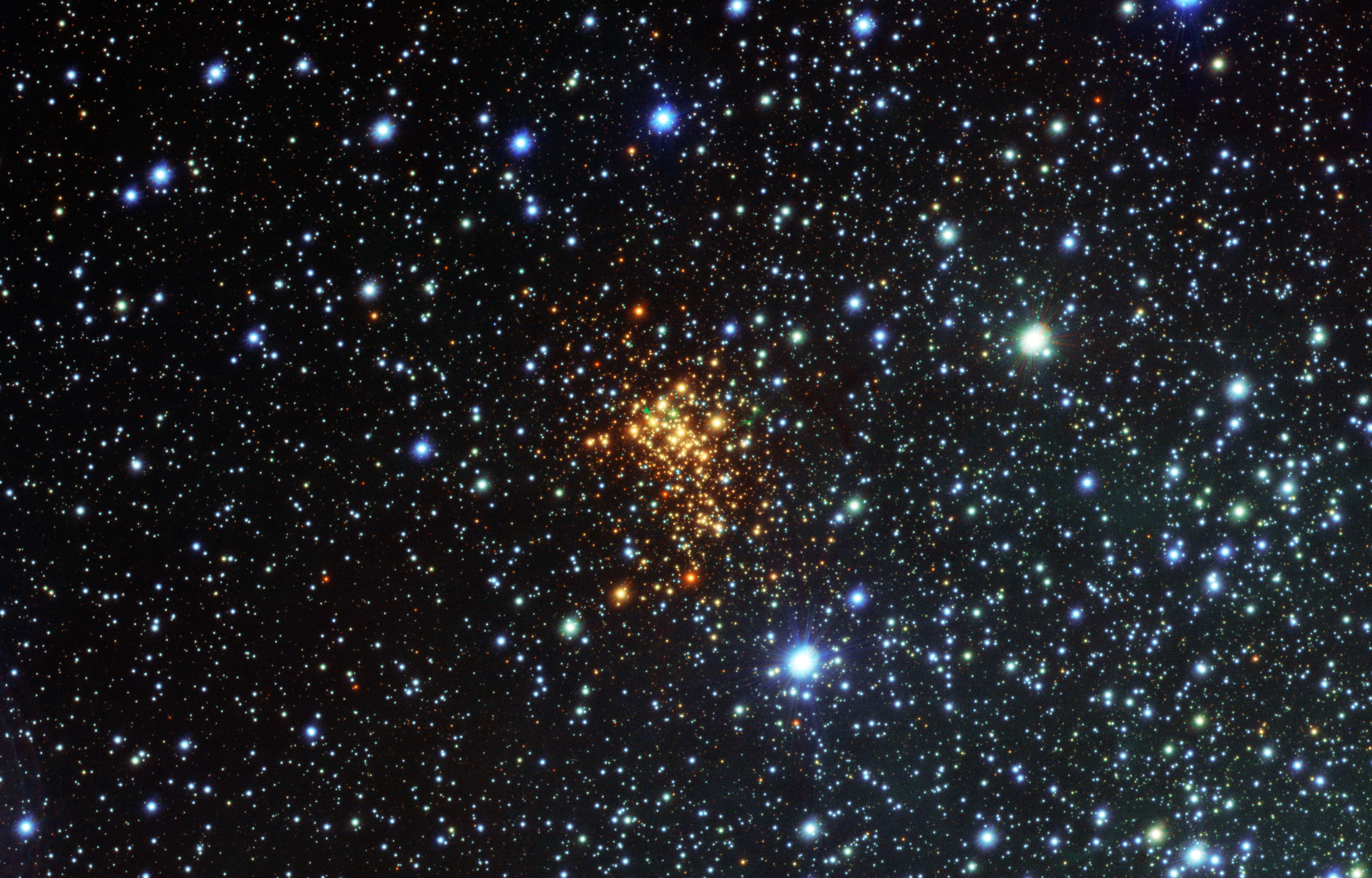
Surprise Cloud Around Vast Star

Credit: ESO/VPHAS+ Survey/N. Wright

This new picture from the VLT Survey Telescope (VST) at ESO's Paranal Observatory shows the remarkable super star cluster Westerlund 1 (eso1034). This exceptionally bright cluster lies about 16 000 light-years from Earth in the southern constellation of Ara (The Altar). It contains hundreds of very massive and brilliant stars, all of which are just a few million years old — babies by stellar standards. But our view of this cluster is hampered by gas and dust that prevents most of the visible light from the cluster's stars from getting to Earth.

Now, astronomers studying images of Westerlund 1 from a new survey of the southern skies [1] have spotted something unexpected in this cluster. Around one of the stars — known as W26, a red supergiant and possibly the biggest star known— they have discovered clouds of glowing hydrogen gas, shown as green features in this new image.

Such glowing clouds around massive stars are very rare, and are even rarer around a red supergiant— this is the first ionised nebula discovered around such a star. W26 itself would be too cool to make the gas glow; the astronomers speculate that the source of the ionising radiation may be either hot blue stars elsewhere in the cluster, or possibly a fainter, but much hotter, companion star to W26.

W26 will eventually explode as a supernova. The nebula that surrounds it is very similar to the nebula surrounding SN1987A, the remnants of a star that went supernova in 1987 [2]. SN1987A was the closest observed supernova to Earth since 1604, and as such it gave astronomers a chance to explore the properties of these explosions. Studying objects like this new nebula around W26 will help astronomers to understand the mass loss processes around these massive stars, which eventually lead to their explosive demise.

Notes

[1] This picture forms part of a detailed public survey of a large part of the Milky Way called VPHAS+ that is using the power of the VST to search for new objects such as young stars and planetary nebulae. A spectacular recent picture of the Prawn Nebula was made using observations from the same survey.

[2] This nebula is thought to have surrounded SN1987A’s progenitor star since before it went supernova.

Links

Source:  ESO


Thursday, December 06, 2012

Image of the Carina Nebula Marks Inauguration of VLT Survey Telescope

 
 PR Image eso1250a
The Carina Nebula imaged by the VLT Survey Telescope

 PR Image eso1250b
The VST inauguration

  PR Image eso1250c
President Sebastián Piñera of Chile in the Paranal Control Room

PR Image eso1250d
The Carina Nebula in the constellation of Carina

   PR Image eso1250e
Digitized Sky Survey Image of Eta Carinae Nebula

Videos

PR Video eso1250a
Zooming in on the Carina Nebula

PR Video eso1250b
Panning across a VST image of the Carina Nebula

A spectacular new image of the star-forming Carina Nebula has been captured by the VLT Survey Telescope at ESO’s Paranal Observatory and released on the occasion of the inauguration of the telescope in Naples today. This picture was taken with the help of Sebastián Piñera, President of Chile, during his visit to the observatory on 5 June 2012.

The latest telescope at ESO's Paranal Observatory in Chile — the VLT Survey Telescope (VST) — was inaugurated today at the Italian National Institute for Astrophysics (INAF) Observatory of Capodimonte, in Naples, Italy. The ceremony was attended by the Mayor of Naples, Luigi De Magistris, the INAF President, Giovanni Bignami, the ESO representatives Bruno Leibundgut and Roberto Tamai, and the main promoter of the telescope, Massimo Capaccioli of the University of Naples Federico II and INAF.

The VST is a state-of-the-art 2.6-metre telescope, with the huge 268-megapixel camera OmegaCAM at its heart. It is designed to map the sky both quickly and with very fine image quality. The VST is a joint venture between ESO and INAF and OmegaCam has been provided by the OmegaCam consortium [1]. This new telescope is the largest telescope in the world exclusively dedicated to surveying the sky at visible wavelengths (eso1119). The occasion of the inauguration has been marked by the release of a dramatic picture of the Carina Nebula taken with the new telescope.

This star formation region is one of the most prominent and frequently imaged objects of the southern sky. It has been the subject of many earlier images with ESO telescopes (eso1208, eso1145, eso1031, eso0905). However, the glowing gas cloud is huge and it is difficult for most large telescopes to study more than a tiny part of it at once. This makes it an ideal target for the VLT Survey Telescope and its big camera, OmegaCAM. The VST delivers very sharp images because of its high quality optics and the excellent site. But, as it was designed for surveys of the sky, it also has a very wide field of view that can take in almost all of the Carina Nebula in a single picture.

This object was a natural target when the President of Chile, Sebastián Piñera, accompanied by the First Lady, Cecilia Morel, were distinguished guests at the Paranal Observatory on 5 June 2012 (eso1223) and participated in observations with the VST. The picture that the President helped to take on this occasion has now been combined with other recent VST images of the Carina Nebula to produce one of the most richly detailed and colourful views of this object ever created.

The Carina Nebula is a huge stellar nursery lying about 7500 light-years from Earth in the constellation of Carina (The Keel) [2]. This cloud of glowing gas and dust is one of the closest star formation regions to the Earth and includes several of the brightest and most massive stars known. The Carina Nebula is a perfect laboratory for astronomers studying the violent births and early lives of stars.

The conspicuous red colour of the picture comes from hydrogen gas in the nebula that is glowing under the harsh ultraviolet light from many young and hot stars [3]. Other colours, originating from other elements in the gas, are also visible, as well as many dust clouds. Just above the centre of the picture lies the bright star Eta Carinae (eso0817). This huge and highly unstable star brightened dramatically in the nineteenth century and is a good candidate for a future supernova explosion.

Notes

[1] The VST programme was a joint venture between the INAF–Osservatorio Astronomico di Capodimonte, Naples, Italy and ESO. INAF designed and built the telescope with the collaboration of leading Italian industries and ESO was responsible for the enclosure and the civil engineering works at the site. OmegaCAM, the VST’s camera, was designed and built by a consortium including institutes in the Netherlands, Germany and Italy with major contributions from ESO. The new facility is operated by ESO, which also archives and distributes data from the telescope. For further details please refer to eso1119.

[2] Carina is the keel of the mythological ship Argo, of Jason and the Argonauts fame.

[3] The special filter for observing hydrogen emission was kindly made available by the VPHAS+ Consortium.

More information

The year 2012 marks the 50th anniversary of the founding of the European Southern Observatory (ESO). ESO is the foremost intergovernmental astronomy organisation in Europe and the world’s most productive astronomical observatory. It is supported by 15 countries: Austria, Belgium, Brazil, the Czech Republic, Denmark, France, Finland, Germany, Italy, the Netherlands, Portugal, Spain, Sweden, Switzerland and the United Kingdom. ESO carries out an ambitious programme focused on the design, construction and operation of powerful ground-based observing facilities enabling astronomers to make important scientific discoveries. ESO also plays a leading role in promoting and organising cooperation in astronomical research. ESO operates three unique world-class observing sites in Chile: La Silla, Paranal and Chajnantor. At Paranal, ESO operates the Very Large Telescope, the world’s most advanced visible-light astronomical observatory and two survey telescopes. VISTA works in the infrared and is the world’s largest survey telescope and the VLT Survey Telescope is the largest telescope designed to exclusively survey the skies in visible light. ESO is the European partner of a revolutionary astronomical telescope ALMA, the largest astronomical project in existence. ESO is currently planning the 39-metre European Extremely Large optical/near-infrared Telescope, the E-ELT, which will become “the world’s biggest eye on the sky”.

Links

Contacts

 Massimo Capaccioli
 University of Naples Federico II and INAF-Capodimonte Astronomical Observatory
 Naples, Italy
 Tel: +39 081 557 5601
 Cell: +39 335 677 6940
 Email:
capaccioli@na.infn.it

 Richard Hook
 ESO, La Silla, Paranal, E-ELT & Survey Telescopes Press Officer
 Garching bei München, Germany
 Tel: +49 89 3200 6655
 Cell: +49 151 1537 3591
 Email:
rhook@eso.org

Wednesday, March 07, 2012

Galaxies Get Up Close and Personal

PR Image eso1211a
VST image of the Hercules galaxy cluster

PR Image eso1211b
Highlights of the VST image of the Hercules galaxy cluster

PR Image eso1211c
The location of the Hercules galaxy cluster

PR Image eso1211d
Wide-field view of the Hercules galaxy cluster

Videos

PR Video eso1211a
Zooming in on the Hercules galaxy cluster

PR Video eso1211b
Panning across on the Hercules galaxy cluster

VST captures collisions in young galaxy cluster

The VLT Survey Telescope (VST) at ESO’s Paranal Observatory in Chile has imaged a fascinating collection of interacting galaxies in the Hercules galaxy cluster. The sharpness of the new picture, and the hundreds of galaxies captured in great detail in less than three hours of observations, attest to the great power of the VST and its huge camera OmegaCAM to explore the nearby Universe.

The Hercules galaxy cluster (also known as Abell 2151) lies about 500 million light-years away in the constellation of Hercules. It is unlike other nearby galactic assemblies in many ways. As well as being rather irregular in shape, it contains a wide variety of galaxy types, particularly young, star-forming spiral galaxies, and there are no giant elliptical galaxies in sight.

The new image was taken with the VST, the most recent addition to ESO’s Paranal Observatory in Chile (eso1119). The VST is a survey telescope equipped with OmegaCAM, a 268-megapixel camera that provides images covering very large areas on the sky. Normally only small telescopes can image large objects such as this in a single shot, but the 2.6-metre VST not only has a wide field, but can also exploit the superb conditions on Paranal to simultaneously obtain very sharp and deep images quickly.

Galaxy pairs getting up close and personal and on their way to merging into single, larger galaxies can be seen all over this image. The numerous interactions, and the large number of gas-rich, star-forming spiral galaxies in the cluster, make the members of the Hercules cluster look like the young galaxies of the more distant Universe [1]. Because of this similarity, astronomers believe that the Hercules galaxy cluster is a relatively young cluster. It is a vibrant and dynamic swarm of galaxies that will one day mature into one more similar to the older galaxy clusters that are more typical of our galactic neighbourhood.

Galaxy clusters are formed when smaller groups of galaxies come together due to the pull of their gravity. As these groups get closer to each other, the cluster becomes more compact and more spherical in shape. At the same time, the galaxies themselves get closer together and many start to interact. Even if spiral galaxies are dominant in the initial groups, the galactic collisions eventually distort their spiral structure and strip off their gas and dust, quenching most star formation. For this reason, most of the galaxies in a mature cluster are elliptical or irregular in shape. One or two large elliptical galaxies, formed from the merger of smaller galaxies and permeated by old stars, usually reside at the centres of these old clusters.

The Hercules galaxy cluster is believed to be a collection of at least three small clusters and groups of galaxies that are currently being assembled into a larger structure. Furthermore, the cluster itself is merging with other large clusters to form a galaxy supercluster. These giant collections of clusters are some of the largest structures in the Universe. The wide field of view and image quality of OmegaCAM on the VST make it ideal for studying the outskirts of galaxy clusters where the poorly-understood interactions between clusters are taking place.

This beautiful image shows not only the galaxies of the Hercules galaxy cluster, but also many faint and fuzzy objects in the background, which are galaxies that are much further away from us. Closer to home, several brilliant Milky Way stars are also visible in the foreground and there are even a few asteroids that have left short trails as they moved slowly across the image during the exposures.

Notes

[1] Objects in the very distant Universe are seen as they were when much younger, because it takes several billion years for their light to reach us.

More information

The VST programme is a joint venture between the INAF–Osservatorio Astronomico di Capodimonte, Naples, Italy and ESO. INAF designed and built the telescope with the collaboration of leading Italian industries and ESO was responsible for the enclosure and the civil engineering works at the site. OmegaCAM, the VST’s camera, was designed and built by a consortium including institutes in the Netherlands, Germany and Italy with major contributions from ESO. The facility is operated by ESO, which also archives and distributes data from the telescope.

The year 2012 marks the 50th anniversary of the founding of the European Southern Observatory (ESO). ESO is the foremost intergovernmental astronomy organisation in Europe and the world’s most productive astronomical observatory. It is supported by 15 countries: Austria, Belgium, Brazil, the Czech Republic, Denmark, France, Finland, Germany, Italy, the Netherlands, Portugal, Spain, Sweden, Switzerland and the United Kingdom. ESO carries out an ambitious programme focused on the design, construction and operation of powerful ground-based observing facilities enabling astronomers to make important scientific discoveries. ESO also plays a leading role in promoting and organising cooperation in astronomical research. ESO operates three unique world-class observing sites in Chile: La Silla, Paranal and Chajnantor. At Paranal, ESO operates the Very Large Telescope, the world’s most advanced visible-light astronomical observatory and two survey telescopes. VISTA works in the infrared and is the world’s largest survey telescope and the VLT Survey Telescope is the largest telescope designed to exclusively survey the skies in visible light. ESO is the European partner of a revolutionary astronomical telescope ALMA, the largest astronomical project in existence. ESO is currently planning a 40-metre-class European Extremely Large optical/near-infrared Telescope, the E-ELT, which will become “the world’s biggest eye on the sky”.

Links
Photos of VST
Photos of OmegaCAM

Contacts

Richard Hook
ESO, La Silla, Paranal, E-ELT and Survey Telescopes Public Information Officer
Garching bei München, Germany
Tel: +49 89 3200 6655
Email: rhook@eso.org