Showing posts with label circumstellar disks. Show all posts

Monday, December 15, 2025

Michelangelo in Space: A Planet Carving the Fomalhaut Debris Disk?

This image combines observations from the Hubble Space Telescope and the Atacama Large Millimeter/submillimeter Array to show the dusty debris disk surrounding the star Fomalhaut. Credit:
ALMA (ESO/NAOJ/NRAO). Visible light image: the NASA/ESA Hubble Space Telescope A. Fujii/Digitized Sky Survey 2. Acknowledgment: Davide De Martin (ESA/Hubble); CC BY 4.0


Title:ALMA Reveals an Eccentricity Gradient in the Fomalhaut Debris Disk
Authors: Joshua B. Lovell et al.
First Author’s Institution: Center for Astrophysics | Harvard & Smithsonian
Status: Published in ApJ

Step 1: Understanding How to Carve Your Debris Disk

Let’s start with our solar system: the Kuiper belt, a large ring of icy asteroids, is believed to have been sculpted into its current shape by Neptune. Neptune may have previously scattered objects in the Kuiper Belt through gravitational interactions, but some of them (like Pluto) remain in an orbital resonance with Neptune. In the same way that Neptune shapes the Kuiper Belt, today’s authors believe a planet could be shaping an exo-Kuiper Belt around the star Fomalhaut.
.
What on Neptune is an orbital resonance, though? A planet orbiting a star has an orbital period, and the gravitational forces between nearby (astronomically speaking) objects can push these objects into a state where their orbital periods are multiples of each other. For example, Pluto and Neptune have a 2:3 orbital resonance, meaning Pluto completes two orbits for every three that Neptune does. The same can happen for the asteroids and planetesimals in the Kuiper Belt, so the same should happen in other star systems!
.
Step 2: Make Your Observations

If we understand how debris disks carved by exoplanets look — and we think we do — then we should be able to infer the existence of exoplanets! Today’s authors have used observations from the Atacama Large Millimeter/submillimeter Array (ALMA) of the debris disk around Fomalhaut and made some very clever calculations. We’ve known about this disk for a while, which is why today’s authors have studied it with a new analysis technique they developed.

Planeteismals — basically big rocks from a few to hundreds of kilometers across — that orbit in this disk do so with a certain eccentricity, and typically things in the same orbit would have the same eccentricity. But today’s authors were clever — they checked if there was an eccentricity gradient, meaning the planetesimals’ eccentricities depend on their semi-major axis (i.e., the mean orbit radius); we would typically not expect any eccentricity gradient for bodies orbiting a star unperturbed. The authors discovered that the gradient for planetesimals around Fomalhaut is negative, which implies the presence of a planet when you look at the maths behind gravitational interactions between planets and planetesimals.

A negative eccentricity gradient means the planetesimals gather up at the point on the orbit farthest from the star (the apocenter), and since there are more planetesimals in that region, they appear brighter in the ALMA data (see Fig. 1 left); the ring also appears slightly wider. If the eccentricity gradient were positive, the same thing would happen at the point on the orbit closest to the star (the pericenter). The authors term this phenomenon the “eccentric velocity divergence.”


Figure 1: Left: The observed intensity of the Fomalhaut debris disk with ALMA. Middle: the authors’ model that fits the ALMA data the best. Right: The residual (data – model) between model and data. White means there is a close match to the data (which is better). Credit: Lovell et al. 2025


When the authors ran their eccentric velocity divergence calculations for the Fomalhaut disk model, they compared it to observations using a Markov Chain Monte Carlo algorithm.

Figure 1 shows their best-fitting model, which fits remarkably well, based on the residual (i.e., the difference between model and data) you can see on the right — including the slightly wider ring at the apocenter!

The authors tested other scenarios with different gradients and allowed for the planetesimals to oscillate their eccentricity around their orbit, but they didn’t find a better-fitting scenario.

Step 3: Find a Carving Planet

Okay, so those were the details. The authors investigated a few scenarios to see what could be causing the observed debris disk and its negative eccentricity gradient, as well as an intermediate ring sitting between the main disk and the star that recently was seen with JWST. The authors tested two scenarios: one where a planet sits between the rings and evacuates the nearby region, and another where a planet is interior to the inner ring and clears the gap through orbital resonances (kind of like Neptune!). An illustration can be seen in Figure 2.

Figure 2: Illustration of possible planet-based scenarios that could create the observed debris disk around Fomalhaut. One features a planet between the observed debris disk rings, and another is where the planet is interior to both and carves the gap with orbital resonances. Credit: J. Williams


A planet was previously thought to exist around Fomalhaut, but it is now accepted there is not one we can currently observe. The authors point out that the possible planet sculpting this debris disk could be the same planet we thought existed previously, but at a lower mass (1–16 Earth masses; almost a Neptune mass). We can’t observe a planet with these parameters yet, but maybe with future observing facilities!

Finally, the authors stress, however, that it might not be a planet causing the observed structure — it could instead be the gravity of the planetesimals in the disk. Unfortunately, existing models are not equipped to explore this scenario, which is why the authors are planning to develop tools to investigate this next.

Original astrobite edited by Sandy Chiu.


About the author, Joe Williams:

I’m a third-year PhD student at the University of Exeter in the UK, and I study protoplanetary discs — mainly the tiny dust grains and their ices! In my spare time, I’m a climber, crocheter, and reader of sci-fi and fantasy books. My favourite sci-fi series is The Expanse!


Editor’s Note: Astrobites is a graduate-student-run organization that digests astrophysical literature for undergraduate students. As part of the partnership between the AAS and astrobites, we occasionally repost astrobites content here at AAS Nova. We hope you enjoy this post from astrobites; the original can be viewed at astrobites.org.


Wednesday, June 25, 2025

New Super-resolution Imaging Reveals the First Step of Planet Formation after Star Birth

Artist’s impression of the distinctive substructure in a protoplanetary disk formed a few hundred thousand years after the birth of the central star. Credit: Y. Nakamura, A. Shoshi et al.

A scatter plot of bolometric temperatures and dust disk radii of the sources investigated in this study and those observed in the eDisk project. Purple, red, and yellow markings indicate disks with characteristic structures or potential ones with substructures. A bolometric temperature of 650 K corresponds to a disk around a central star that has evolved for about one million years since its formation, suggesting that characteristic substructures begin to emerge at even earlier stages. Credit: A. Shoshi et al.

A comparison of images of protoplanetary disks in the Ophiuchus star-forming region, created with super-resolution imaging with sparse modelling versus a conventional imaging method. The resolution is indicated by the white ellipse in the lower left corner of each panel, with a smaller ellipse denoting higher resolution. The white line in the lower right of each panel indicates a scale of 30 AU. The evolution stage of the central stars progresses from left to right, and from top to bottom in the same row. Credit: ALMA(ESO/NAOJ/NRAO), A. Shoshi et al.


A research team led by Ayumu Shoshi of Kyushu University and the Academia Sinica Institute of Astronomy and Astrophysics (ASIAA) revealed protoplanetary disks around protostars that had not been clearly observed in previous analyses, by employing a new imaging technique with sparse modeling on ALMA archival data. The targets were 78 disks in the Ophiuchus star-forming region. These disks composed of gas and dust that form around protostars immediately after their birth are, so to speak, the cradles of planets. The new technique revealed various characteristic disk substructures, including rings and spirals, that were previously undetectable with conventional methods. Notably, these distinctive substructures were found for a significant number of stars in their early formation stages, approximately several hundred thousand years after the star birth. This suggests the possible coevolution of stars and planets in a gas and dust rich environment, providing an important clue to understanding the process of planet formation.

Identifying the formation period of planetary systems, such as our Solar System, could be the beginning of the journey to discover the origin of life. The key to this is the unique substructures found in protoplanetary disks – the sites of planet formation. A protoplanetary disk is composed of low-temperature molecular gas and dust, surrounding a protostar. If a planet exists in the disk, its gravity will gather or eject materials within the disk, forming characteristic substructures such as rings or spirals. In other words, various disk substructures can be interpreted as “messages” from the forming planets. To study these substructures in detail, high-resolution radio observations with ALMA are required.

Numerous ALMA observations of protoplanetary disks (or circumstellar disks) have been conducted so far. In particular, two ALMA large programs, DSHARP and eDisk, have revealed the detailed distribution of dust in protoplanetary disks through high-resolution observations. The DSHARP project discovered that distinctive structures are common in circumstellar disks around 20 young stars, each exceeding one million years since the onset of star formation (see note below). On the other hand, fewer distinctive structures were found by the eDisk project that investigated disks around 19 protostars in the accretion phase (the stage where mass accretion onto the star and the disk is active). This phase occurs approximately 10,000 to 100,000 years after star birth. This suggests that disks have diverse characteristics depending on the age of the star.

Here, the question is when do substructures, the signs of planet formation, appear in disks. To find the answer, it is necessary to observe disks of a wide range of intermediate ages that have yet to be explored. However, limitations on the number of disks observable at high resolution, due to distance and observational time, make it challenging to conduct a statistically significant survey with a sufficiently large sample size.

To overcome these limitations, the research team turned to super-resolution imaging with sparse modeling. In radio astronomy, images are commonly restored based on a specific assumption to compensate for missing observation data. The imaging method employed this time reconstructs based on a more accurate assumption than the conventional approach, producing higher-resolution images even though the same observation data is used. PRIISM (Python module for Radio Interferometry Imaging with Sparse Modeling), the public software developed by a Japanese research team was used in this study. The research team utilized this new imaging technique on ALMA archival data, targeting 78 disks in the Ophiuchus star-forming region, located 460 light years from the Solar System.

As a result, more than half of the images produced in this study achieved a resolution over three times higher than that of the conventional method, which is comparable to that of the DSHARP and eDisk projects (Figure 1). Moreover, the total number of samples in this study is nearly four times larger than that of the previous two projects, significantly improving the robustness of our statistical analysis. Among the analyzed 78 disks, 27 disks were revealed to have ring or spiral structures, 15 of which were identified for the first time in this study.

The team combined the Ophiuchus sample with those of the eDisk project to conduct a statistical analysis. As a result, they found that the characteristic disk substructures emerge in disks with radii larger than 30 astronomical units (au) during the early stage of star formation, just a few hundred thousand years after a star was born (Figure 2). This suggests that planets begin to form at a much earlier stage than previously believed, when the disk still possesses abundant gas and dust (Figure 3). In other words, planets grow together with their very young host stars. Ayumu Shoshi says, “These findings, bridging the gap between the eDisk and DSHARP projects, were enabled by the innovative imaging that allows for both achieving high resolution and a large number of samples. While these findings only pertain to the disks in the constellation Ophiuchus, future studies of other star-forming regions will reveal whether this tendency is universal.”

Scientific Paper


Note

The evolutionary stage of a protostar is estimated using the bolometric temperature around the star. The bolometric temperature is an apparent temperature derived from the total brightness of an object across all wavelengths. A higher bolometric temperature indicates a more advanced evolutionary stage, and a temperature of 650 K suggests that approximately one million years have passed since the birth of the star.


Additional Information

This research has been published in The Publications of the Astronomical Society of Japan on April 22, 2025, as Ayumu Shoshi et al. “ALMA 2D super-resolution imaging survey of Ophiuchus Class I/flat spectrum/II disks. I. Discovery of new disk substructures” (DOI:
https://doi.org/10.1093/pasj/psaf026)

Co-researchers: Masayuki Yamaguchi (ASIAA), Takayuki Muto (Kogakuin University), Naomi Hirano (ASIAA), Ryohei Kawabe (Graduate School of Advanced Studies, SOKENDAI/National Astronomical Observatory of Japan), Takashi Tsukagoshi (Ashikaga University), and Masahiro Machida (Kyushu University)

The
original press release was published by the National Astronomical Observatory of Japan (NAOJ), an ALMA partner on behalf of East Asia.

The Atacama Large Millimeter/submillimeter Array (ALMA), an international astronomy facility, is a partnership of the European Southern Observatory (ESO), the U.S. National Science Foundation (NSF), and the National Institutes of Natural Sciences (NINS) of Japan in cooperation with the Republic of Chile. ALMA is funded by ESO on behalf of its Member States, by NSF in cooperation with the National Research Council of Canada (NRC) and the National Science and Technology Council (NSTC) in Taiwan, and by NINS in cooperation with the Academia Sinica (AS) in Taiwan and the Korea Astronomy and Space Science Institute (KASI).

ALMA construction and operations are led by ESO on behalf of its Member States; by the National Radio Astronomy Observatory (NRAO), managed by Associated Universities, Inc. (AUI), on behalf of North America; and by the National Astronomical Observatory of Japan (NAOJ) on behalf of East Asia. The Joint ALMA Observatory (JAO) provides the unified leadership and management of ALMA's construction, commissioning, and operation.


Contacts:

Nicolás Lira
Education and Public Outreach Coordinator
Joint ALMA Observatory, Santiago - Chile
Phone:
+56 2 2467 6519
Cel: +56 9 9445 7726
Email: nicolas.lira@alma.cl

Yuichi Matsuda
ALMA EA-ARC Staff Member
NAOJ
Email:
yuichi.matsuda@nao.ac.jp

Jill Malusky
Public Information Officer
NRAO
Phone: +1 304-456-2236
Email:
jmalusky@nrao.edu

Bárbara Ferreira
ESO Media Manager
Garching bei München, Germany
Phone: +49 89 3200 6670
Email:
press@eso.org


Monday, January 20, 2025

ALMA Uncover Surprising New Methods Planets May Form

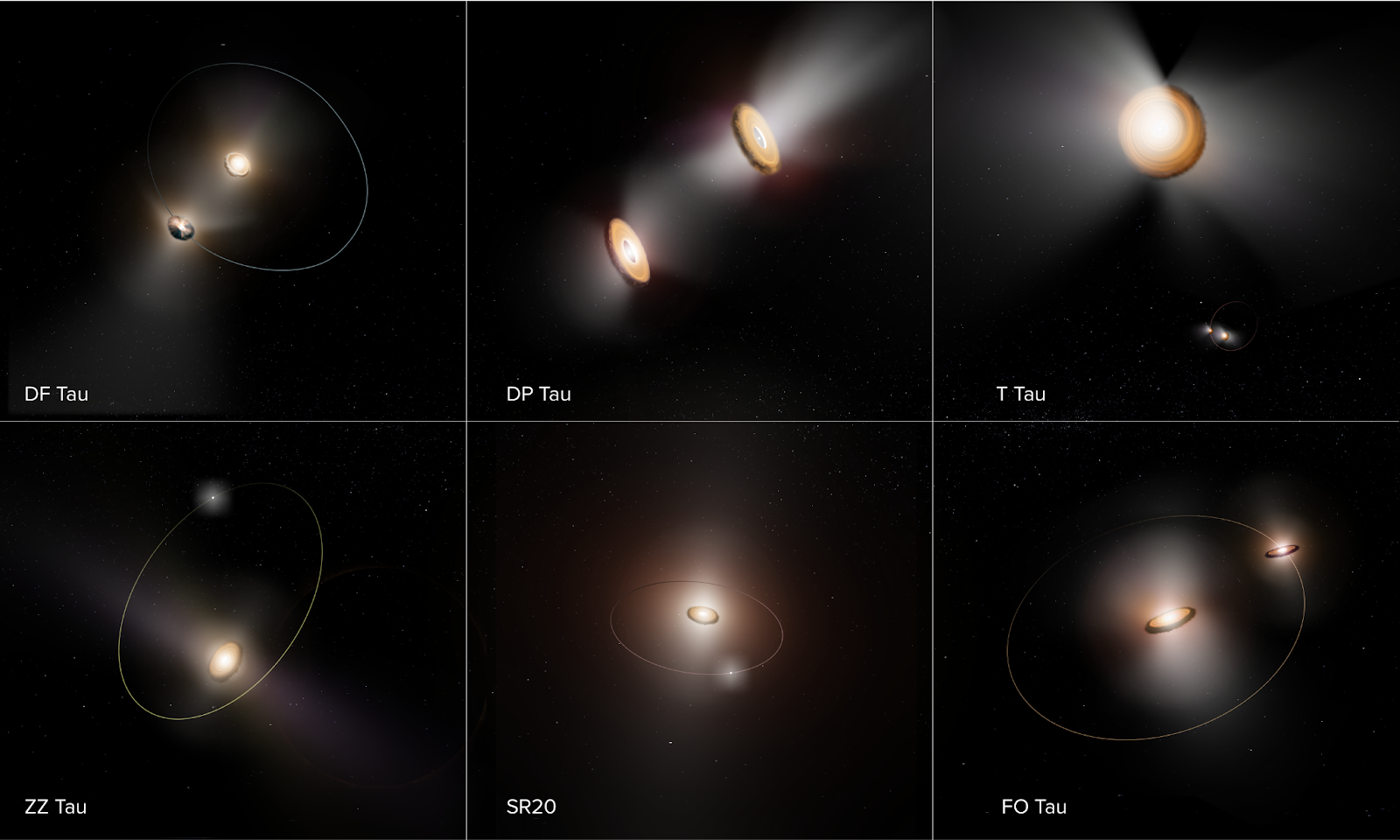
Circumstellar disks in young multiple star systems, as discovered by ALMA. Where the orbits are known, they are included with white lines. Credit: NSF/AUI/NSF NRAO/B. Saxton.
Original Image


Tucked away in a star-forming region in the Taurus constellation, a pair of circling stars display some unexpected differences in the circumstellar disks of dust and gas surrounding them. A new study led by researchers at Lowell Observatory, combining data from the Atacama Large Millimeter/submillimeter Array (ALMA) and Keck Observatory, has unveiled intriguing findings about planet formation in this binary star system, known as DF Tau, along with other systems in this region.

DF Tau consists of two young stars with nearly equal masses, orbiting each other every 48 years. Since both stars likely formed together, with the same composition in the same environment, astronomers would expect them to share different things in common, like having similar circumstellar disks. But this is not the case—while the brighter primary star has an active inner disk, the secondary star's inner disk appears to have almost completely disappeared. These unexpected differences challenge current theories of disk evolution and planet formation.

Like a potter's wheel shapes clay into various forms, a circumstellar disk provides the materials and environment for planets to form. Over time, the dust and gas in the disk will clump together, eventually forming planets, moons, and other celestial bodies. The disks won't last forever — as a star matures and planets form, the disk gradually disappears. So, what caused the unusual dissipation observed in the circumstellar disk of the secondary star?

High-resolution ALMA imaging, combined with optical and infrared data from other telescopes, allowed researchers to study, analyze, and compare the stars' properties and disks. This binary has a relatively small, tight orbit, which means gravity truncates the outer parts of the disk, but it is unlikely that the current binary orbit could alter the inner disk. Instead, other processes may be at work. "The dispersal of circumstellar disks is a complicated process with many unknowns. By looking at systems that form together, we can control one major variable: time. DF Tau and other systems in our survey tell us that disk evolution isn't strictly a function of time; other processes are at play," shares Taylor Kutra of Lowell Observatory, lead author of this research.

Binary systems like DF Tau and other sources in this ALMA survey offer a natural laboratory to study how circumstellar disks evolve. Understanding these processes is essential for refining models of planet formation because disk evolution sets the timescale on which planet formation occurs. This research highlights the diversity of disk behaviors and underscores the need for further studies to unravel the factors influencing their lifespans and structures. These findings deepen our understanding of binary star systems and shed light on the broader mechanisms shaping planetary systems across the galaxy.


Additional Information

The results of the observation are published in the following scientific article:

Kutra et.al "
Sites of Planet Formation in Binary Systems. II. Double the Disks in DF Tau".

The original press release was published by the National Radio Astronomical Observatory (NRAO) of the United States, an ALMA partner on behalf of North America.

The Atacama Large Millimeter/submillimeter Array (ALMA), an international astronomy facility, is a partnership of the European Organization for Astronomical Research in the Southern Hemisphere (ESO), the U.S. National Science Foundation (NSF) and the National Institutes of Natural Sciences (NINS) of Japan in cooperation with the Republic of Chile. ALMA is funded by ESO on behalf of its Member States, by NSF in cooperation with the National Research Council of Canada (NRC) and the National Science and Technology Council (NSTC) in Taiwan, and by NINS in cooperation with the Academia Sinica (AS) in Taiwan and the Korea Astronomy and Space Science Institute (KASI).

ALMA construction and operations are led by ESO on behalf of its Member States; by the National Radio Astronomy Observatory (NRAO), managed by Associated Universities, Inc. (AUI), on behalf of North America; and by the National Astronomical Observatory of Japan (NAOJ) on behalf of East Asia. The Joint ALMA Observatory (JAO) provides the unified leadership and management of the construction, commissioning, and operation of ALMA.


Contacts:

Nicolás Lira
Education and Public Outreach Coordinator
Joint ALMA Observatory, Santiago - Chile
Phone:
+56 2 2467 6519
Cel: +56 9 9445 7726
Email: nicolas.lira@alma.cl

Jill Malusky
Public Information Officer
NRAO
Phone:
+1 304-456-2236
Email: jmalusky@nrao.edu

Bárbara Ferreira
ESO Media Manager
Garching bei München, Germany
Phone:
+49 89 3200 6670
Email: press@eso.org

Yuichi Matsuda
ALMA EA-ARC Staff Member
NAOJ
Email:
yuichi.matsuda@nao.ac.jp


Monday, September 16, 2024

NASA's Webb Peers into the Extreme Outer Galaxy

NASA’s James Webb Space Telescope observed the outskirts of our Milky Way galaxy. Known as the Extreme Outer Galaxy, this region is located more than 58,000 light-years from the Galactic Center.

To learn more about how a local environment affects the star formation process within it, a team of scientists directed the telescope’s NIRCam (Near-Infrared Camera) and MIRI (Mid-Infrared Instrument) toward a total of four star-forming areas within Digel Clouds 1 and 2: 1A, 1B, 2N, and 2S.

In the case of Cloud 2S, shown here, Webb revealed a luminous main cluster that contains newly formed stars. Several of these young stars are emitting extended jets of material from their poles. To the main cluster’s top right is a sub-cluster of stars, a feature that scientists previously suspected to exist but has now been confirmed with Webb. Additionally, the telescope revealed a deep sea of background galaxies and red nebulous structures that are being carved away by winds and radiation from nearby stars.

Annotated image of Digel Cloud 2S captured by Webb's NIRCam (Near-Infrared Camera) and MIRI (Mid-Infrared Instrument), with compass arrows, a scale bar, color key, and graphic overlays for reference.

The north and east compass arrows show the orientation of the image on the sky. Note that the relationship between north and east on the sky (as seen from below) is flipped relative to direction arrows on a map of the ground (as seen from above).

The scale bar is labeled in light-years and arcseconds. One light-year is equal to about 5.88 trillion miles or 9.46 trillion kilometers. One arcsecond is equal to 1/3600 of one degree of arc. (The full Moon has an angular diameter of about 0.5 degrees.) The actual size of an object that covers one arcsecond on the sky depends on its distance from the telescope.

This image shows invisible near- and mid-infrared wavelengths of light that have been translated into visible-light colors. The color key shows which NIRCam and MIRI filters were used when collecting the light. The color of each filter name is the visible light color used to represent the infrared light that passes through that filter.

In the main cluster are five white arrows, which highlight the paths of five protostar jets. To learn more about how a local environment affects the star formation process within it, a team of scientists directed the telescope’s NIRCam (Near-Infrared Camera) and MIRI (Mid-Infrared Instrument) toward a total of four star-forming areas within Digel Clouds 1 and 2: 1A, 1B, 2N, and 2S.

In the case of Cloud 2S, shown here, Webb revealed a luminous main cluster that contains newly formed stars. Several of these young stars are emitting extended jets of material from their poles. To the main cluster’s top right is a sub-cluster of stars, a feature that scientists previously suspected to exist but has now been confirmed with Webb. Additionally, the telescope revealed a deep sea of background galaxies and red nebulous structures that are being carved away by winds and radiation from nearby stars. Credits: Image: NASA, ESA, CSA, STScI, Michael Ressler (NASA-JPL)


Astronomers have directed NASA’s James Webb Space Telescope to examine the outskirts of our Milky Way galaxy. Scientists call this region the Extreme Outer Galaxy due to its location more than 58,000 light-years away from the Galactic Center. (For comparison, Earth is approximately 26,000 light-years from the center.)

A team of scientists used Webb’s NIRCam (Near-Infrared Camera) and MIRI (Mid-Infrared Instrument) to image select regions within two molecular clouds known as Digel Clouds 1 and 2. With its high degree of sensitivity and sharp resolution, the Webb data resolved these areas, which are hosts to star clusters undergoing bursts of star formation, in unprecedented detail. Details of this data include components of the clusters such as very young (Class 0) protostars, outflows and jets, and distinctive nebular structures.

These Webb observations, which came from telescope time allocated to Mike Ressler of NASA’s Jet Propulsion Laboratory in California, are enabling scientists to study star formation in the outer Milky Way in the same depth of detail as observations of star formation in our own solar neighborhood.

“In the past, we knew about these star forming regions but were not able to delve into their properties,” said Natsuko Izumi of Gifu University and the National Astronomical Observatory of Japan, lead author of the study. “The Webb data builds upon what we have incrementally gathered over the years from prior observations with different telescopes and observatories. We can get very powerful and impressive images of these clouds with Webb. In the case of Digel Cloud 2, I did not expect to see such active star formation and spectacular jets.”

Stars in the Making

Although the Digel Clouds are within our galaxy, they are relatively poor in elements heavier than hydrogen and helium. This composition makes them similar to dwarf galaxies and our own Milky Way in its early history. Therefore, the team took the opportunity to use Webb to capture the activity occurring in four clusters of young stars within Digel Clouds 1 and 2: 1A, 1B, 2N, and 2S.

For Cloud 2S, Webb captured the main cluster containing young, newly formed stars. This dense area is quite active as several stars are emitting extended jets of material along their poles. Additionally, while scientists previously suspected a sub-cluster might be present within the cloud, Webb’s imaging capabilities confirmed its existence for the first time.

“We know from studying other nearby star-forming regions that as stars form during their early life phase, they start emitting jets of material at their poles,” said Ressler, second author of the study and principal investigator of the observing program. “What was fascinating and astounding to me from the Webb data is that there are multiple jets shooting out in all different directions from this cluster of stars. It’s a little bit like a firecracker, where you see things shooting this way and that.”

The Saga of Stars

The Webb imagery skims the surface of the Extreme Outer Galaxy and the Digel Clouds, and is just a starting point for the team. They intend to revisit this outpost in the Milky Way to find answers to a variety of current mysteries, including the relative abundance of stars of various masses within Extreme Outer Galaxy star clusters. This measurement can help astronomers understand how a particular environment can influence different types of stars during their formation.

“I’m interested in continuing to study how star formation is occurring in these regions. By combining data from different observatories and telescopes, we can examine each stage in the evolution process,” said Izumi. “We also plan to investigate circumstellar disks within the Extreme Outer Galaxy. We still don’t know why their lifetimes are shorter than in star-forming regions much closer to us. And of course, I’d like to understand the kinematics of the jets we detected in Cloud 2S.”

Though the story of star formation is complex and some chapters are still shrouded in mystery, Webb is gathering clues and helping astronomers unravel this intricate tale.

These findings have been published in the Astronomical Journal.

The observations were taken as part of Guaranteed Time Observation program 1237.

The James Webb Space Telescope is the world’s premier space science observatory. Webb is solving mysteries in our solar system, looking beyond to distant worlds around other stars, and probing the mysterious structures and origins of our universe and our place in it. Webb is an international program led by NASA with its partners, ESA (European Space Agency) and CSA (Canadian Space Agency).


About This Release

Credits:

Media Contact:

Abigail Major
Space Telescope Science Institute, Baltimore, Maryland

Christine Pulliam
Space Telescope Science Institute, Baltimore, Maryland

Permissions: Content Use Policy

Contact Us: Direct inquiries to the News Team.


Monday, June 17, 2024

ALMA Observations Reveal New Insights into Planet Formation in Binary Star Systems

DF Tau - FO Tau
Credit: S. Dagnello, NSF/AUI/NRAO


At the 244th meeting of the American Astronomical Society (AAS), researchers unveiled groundbreaking findings from a pioneering high-angular resolution program that sheds new light on the process of planet formation in circumstellar disks around young stars in binary systems. Leveraging the unparalleled capabilities of the Atacama Large Millimeter/submillimeter Array (ALMA) and near-infrared, component-resolved spectroscopy at the Keck II 10-meter telescope, the study offers a transformative understanding of the conditions that nurture or inhibit planet formation.

Primordial disks of gas and dust around young stars have long been recognized as the sites of planet formation. However, the conditions that ensure disk lifetimes adequate for planet formation, and the triggers that lead to their early disk dissipation, have remained elusive. Circumstellar disks in pre-main sequence binary systems provide a unique and ideal laboratory to explore these questions. By analyzing disk properties—such as size, substructure, and inclination—in relation to stellar characteristics like rotation speed and magnetic field strength, researchers are beginning to decode the complex interplay that governs these stellar environments. Binary and multiple star systems are extremely common, underscoring the significance of their study.

This innovative research combines millimeter imaging of circumstellar disks with ALMA and high-resolution spectroscopy of young stars using Keck with the NIRSPEC spectrometer. By focusing on binaries with relatively well-determined orbits, the team can control for orbital parameters and highlight critical relationships between the properties of circumstellar disks and their host stars.

The study’s detailed examination of the DF Tau binary, quasi-twin stars with an average separation of 14 astronomical units (where 1 au equals the Earth-Sun distance) in an elongated orbit, reveals cool dust in two circumstellar disks detected by ALMA. One disk is magnetically locked to its central star and is actively accreting material onto the star, while the inner region of the other disk appears to have eroded and decoupled from its rapidly rotating central star, suggesting a potential link between stellar rotation, magnetic disk locking, and early disk dissipation. Misalignments between DF Tau’s orbit, circumstellar disks, and stellar inclinations may impact the disk evolution.

In contrast, another young star twin, FO Tau, a 22 au binary in a more circular orbit, displays ALMA-detected disks well-aligned with the binary orbit. Both components exhibit modest rotation speeds and appear to be magnetically locked to their disks. These observations reveal similar behavior in both disks and stars, providing fresh insights into the dynamics of disk longevity and dissipation.

High-angular resolution observations from ALMA have shown intricate disk sub-structures, including spiral patterns, gaps, and ring formations around single stars and wide binary companions. Although disk substructures are as yet unresolved in DF Tau and FO Tau, the ability to determine bulk disk properties in close binary systems marks a significant advance in our understanding of planet formation environments.

Supported in part by NSF awards AST-1313399 and AST-2109179, this research reveals unique progress in the field of astronomy. The insights gained not only enhance our comprehension of circumstellar disk dynamics but also pave the way for future discoveries in the mechanisms of planet formation.

This work was also supported by a NASA Keck PI Data Award, administered by the NASA Exoplanet Science Institute. Data presented herein were obtained at the W. M. Keck Observatory from telescope time allocated to the National Aeronautics and Space Administration through the agency’s scientific partnership with the California Institute of Technology and the University of California. The Observatory was made possible by the generous financial support of the W. M. Keck Foundation. The authors wish to recognize and acknowledge the very significant cultural role and reverence that the summit of Maunakea has always had within the indigenous Hawaiian community. We are most fortunate to have the opportunity to conduct observations from this mountain.


About ALMA & NRAO

The Atacama Large Millimeter/submillimeter Array (ALMA), an international astronomy facility, is a partnership of the European Organisation for Astronomical Research in the Southern Hemisphere (ESO), the U.S. National Science Foundation (NSF) and the National Institutes of Natural Sciences (NINS) of Japan in cooperation with the Republic of Chile. ALMA is funded by ESO on behalf of its Member States, by NSF in cooperation with the National Research Council of Canada (NRC) and the National Science and Technology Council (NSTC) in Taiwan and by NINS in cooperation with the Academia Sinica (AS) in Taiwan and the Korea Astronomy and Space Science Institute (KASI).

ALMA construction and operations are led by ESO on behalf of its Member States; by the National Radio Astronomy Observatory (NRAO), managed by Associated Universities, Inc. (AUI), on behalf of North America; and by the National Astronomical Observatory of Japan (NAOJ) on behalf of East Asia. The Joint ALMA Observatory (JAO) provides the unified leadership and management of the construction, commissioning and operation of ALMA.

NRAO is a facility of the National Science Foundation, operated under cooperative agreement by Associated Universities, Inc.


For Press & Media Inquiries Contact:

Corrina Jaramillo Feldman
Public Information Officer – New Mexico
VLA, VLBA, ngVLA

cfeldman@nrao.edu
505-366-7267


Sunday, July 09, 2023

Baby Brown Dwarf Might be Growing: JWST Observations of TWA 27B

An image of the TWA 27 system, taken with a ground-based telescope in 2004.

Credit:ESO; CC BY 4.0

Having caught the gigantic, golden eye of JWST several times now, brown dwarfs are having a moment. A new article in The Astrophysical Journal Letters describes the latest planetary-mass companion to take the spotlight, and how our understanding of these mysterious objects is rapidly evolving.

A Popular Runt

Of all the known tiny, barely glowing “failed stars” known to astronomers as brown dwarfs, TWA 27B stands out as a particularly rich target for a number of reasons. As a member of the TW Hydrae association, the youngest group of stars within the nearest few hundred light-years of the Sun, TWA 27B is both exceptionally young and helpfully close by. Also, as a product of the earliest successful campaign to directly image small companions of larger objects, it has the longest track record of observations that can compared with new measurements. Acting on these temptations, JWST took a look at TWA 27B and its slightly larger partner, TWA 27A, in February of this year.


Images of the TWA 27 system created using three different grisms aboard the NIRSpec instrument. The top row shows both objects, while the bottom shows an enhanced view of TWA 27B created by subtracting out its brighter companion. Credit: Luhman et al. 2023


Methane-Free Zone

For about half an hour, JWST aimed at the TWA 27 system and dutifully collected photons with its onboard Near-Infrared Spectrograph (NIRSpec) instrument across three different wavelength ranges. Piecing the data together back on the ground, a team led by Kevin Luhman, Pennsylvania State University, revealed the atmosphere of a 10 million years young, 5–6-Jupiter-mass object, interestingly devoid of any methane and with only a small whiff of carbon monoxide. Both of these chemical species are common in older brown dwarfs but seem to vanish among younger ones due to non-equilibrium chemistry– a recently noted trend that these observations bolster.


The full 1–5-micron spectrum obtained of TWA 27B, compared to the best-fitting model spectrum derived from a simulation of a cloudless atmosphere. Although the model qualitatively follows the spectrum well, it overpredicts both the strength of the methane absorption and the object’s temperature. The discrepancies might be corrected with a more complex model that includes clouds. Credit: Luhman et al. 2023


Hungry Brown Dwarf?

Tantalizingly, the team also noticed that while their spectra did not indicate the smoking-gun signatures of a large circumstellar disk (an apparent “excess” of infrared emission), they did reveal that TWA 27B was emitting at specific wavelengths usually associated with accretion. This raises the possibility that the object is still growing slowly, and that it’s ringed by a tiny disk never before inferred over the long and distinguished trail of previous studies.

Thankfully, this cliffhanger provides a possible resolution: if such a disk exists, it will be obvious in observations taken at longer wavelengths. JWST, once again demonstrating its abilities to see what has never before been seen, has already taken these measurements. Data collected with its Mid-Infrared Instrument (MIRI) are being processed now, meaning the flood of unprecedented observations and accompanying discoveries about brown dwarfs is unlikely to stop soon.


Citation

“JWST/NIRSpec Observations of the Planetary Mass Companion TWA 27B,” K. L. Luhman et al 2023 ApJL 949 L36.
doi:10.3847/2041-8213/acd635


Monday, April 04, 2022

Hubble Finds a Planet Forming in an Unconventional Way

Protoplanet Around AB Aurigae (Artist's Concept)
Credits: ARTWORK: NASA, ESA, Joseph Olmsted (STScI)


AB Aurigae b Hubble Images
Credits: Science: NASA, ESA, Thayne Currie (Subaru Telescope, Eureka Scientific Inc.)
Image Processing: Thayne Currie (Subaru Telescope, Eureka Scientific Inc.), Alyssa Pagan (STScI)

Release Images

NASA's Hubble Space Telescope has directly photographed evidence of a Jupiter-like protoplanet forming through what researchers describe as an "intense and violent process." This discovery supports a long-debated theory for how planets like Jupiter form, called "disk instability."

The new world under construction is embedded in a protoplanetary disk of dust and gas with distinct spiral structure swirling around, surrounding a young star that's estimated to be around 2 million years old. That's about the age of our solar system when planet formation was underway. (The solar system's age is currently 4.6 billion years.)

"Nature is clever; it can produce planets in a range of different ways," said Thayne Currie of the Subaru Telescope and Eureka Scientific, lead researcher on the study.

All planets are made from material that originated in a circumstellar disk. The dominant theory for jovian planet formation is called "core accretion," a bottom-up approach where planets embedded in the disk grow from small objects — with sizes ranging from dust grains to boulders — colliding and sticking together as they orbit a star. This core then slowly accumulates gas from the disk. In contrast, the disk instability approach is a top-down model where as a massive disk around a star cools, gravity causes the disk to rapidly break up into one or more planet-mass fragments.

The newly forming planet, called AB Aurigae b, is probably about nine times more massive than Jupiter and orbits its host star at a whopping distance of 8.6 billion miles – over two times farther than Pluto is from our Sun. At that distance it would take a very long time, if ever, for a Jupiter-sized planet to form by core accretion. This leads researchers to conclude that the disk instability has enabled this planet to form at such a great distance. And, it is in a striking contrast to expectations of planet formation by the widely accepted core accretion model.

The new analysis combines data from two Hubble instruments: the Space Telescope Imaging Spectrograph and the Near Infrared Camera and Multi-Object Spectrograph. These data were compared to those from a state-of-the-art planet imaging instrument called SCExAO on Japan's 8.2-meter Subaru Telescope located at the summit of Mauna Kea, Hawaii. The wealth of data from space and ground-based telescopes proved critical, because distinguishing between infant planets and complex disk features unrelated to planets is very difficult.

"Interpreting this system is extremely challenging," Currie said. "This is one of the reasons why we needed Hubble for this project—a clean image to better separate the light from the disk and any planet."

Nature itself also provided a helping hand: the vast disk of dust and gas swirling around the star AB Aurigae is tilted nearly face-on to our view from Earth.

Currie emphasized that Hubble's longevity played a particular role in helping researchers measure the protoplanet's orbit. He was originally very skeptical that AB Aurigae b was a planet. The archival data from Hubble, combined with imaging from Subaru, proved to be a turning point in changing his mind.

"We could not detect this motion on the order of a year or two years," Currie said. "Hubble provided a time baseline, combined with Subaru data, of 13 years, which was sufficient to be able to detect orbital motion."

"This result leverages ground and space observations and we get to go back in time with Hubble archival observations," Olivier Guyon of the University of Arizona, Tucson, and Subaru Telescope, Hawaii added. "AB Aurigae b has now been looked at in multiple wavelengths, and a consistent picture has emerged—one that's very solid."

The team's results are published in the April 4 issue of Nature Astronomy.

"This new discovery is strong evidence that some gas giant planets can form by the disk instability mechanism," Alan Boss of the Carnegie Institution of Science in Washington, D.C. emphasized. "In the end, gravity is all that counts, as the leftovers of the star-formation process will end up being pulled together by gravity to form planets, one way or the other."

Understanding the early days of the formation of Jupiter-like planets provides astronomers with more context into the history of our own solar system. This discovery paves the way for future studies of the chemical make-up of protoplanetary disks like AB Aurigae, including with NASA's James Webb Space Telescope.

The Hubble Space Telescope is a project of international cooperation between NASA and ESA (European Space Agency). NASA's Goddard Space Flight Center in Greenbelt, Maryland, manages the telescope. The Space Telescope Science Institute (STScI) in Baltimore, Maryland, conducts Hubble science operations. STScI is operated for NASA by the Association of Universities for Research in Astronomy, in Washington, D.C.


Credits:

Media Contact:

Hannah Braun
Space Telescope Science Institute, Baltimore, Maryland

Ray Villard

Space Telescope Science Institute, Baltimore, Maryland

Science Contact:

Thayne Currie
Subaru Telescope, Hilo, Hawaii
Eureka Scientific Inc., Oakland, California

Olivier Guyon
Subaru Telescope, Hilo, Hawaii
University of Arizona, Tucson, Arizona

Kellen Lawson
University of Oklahoma, Norman, Oklahoma

Permissions:
Content Use Policy

Contact Us: Direct inquiries to the News Team. 


Thursday, August 27, 2020

How to feed a baby star


Artistic impression of the hot gas streams that help young stars grow. Magnetic fields guide matter from the surrounding circumstellar disk, the birthplace of the planets, to the surface of the star, where they produce intense bursts of radiation. Image: A. Mark Garlick

Gas reaches young stars along magnetic field lines

Astronomers have used the GRAVITY instrument to study the immediate vicinity of a young star in more detail than ever before. Their observations confirm a thirty-year-old theory about the growth of young stars: the magnetic field produced by the star itself directs material from a surrounding accretion disk of gas and dust onto its surface. The results, published today in the journal Nature, help astronomers to better understand how stars like our Sun are formed and how Earth-like planets are produced from the disks surrounding these stellar babies

When stars form, they start out comparatively small and are located deep inside a cloud of gas. Over the course of the next hundreds of thousands of years, they draw more and more of the surrounding gas onto themselves, increasing their mass in the process. Using the GRAVITY instrument, a group of researchers that includes astronomers and engineers from the Max Planck Institute for Astronomy (MPIA), has now found the most direct evidence yet for how that gas is funnelled onto young stars: it is guided by the star's magnetic field onto the surface in a narrow column.

The relevant length scales are so small that even with the best telescopes currently available no detailed images of the process are possible. Still, using the latest observation technology, astronomers can at least glean some information. For the new study, the researchers made use of the superbly high resolving power of the instrument called GRAVITY. It combines four 8-meter VLT telescopes of the European Southern Observatory (ESO) at Paranal observatory in Chile into a virtual telescope that can distinguish small details as well as a telescope with a 100-meter-mirror could.

Using GRAVITY, the researchers were able to observe the inner part of the gas disk surrounding the star TW Hydrae. “This star is special because it is very close to Earth at only 196 light years away, and the disk of matter surrounding the star is directly facing us,” says Rebeca García López (Max Planck Institute for Astronomy, Dublin Institute for Advanced Studies and University College Dublin), main author and leading scientist of this study. “This makes it an ideal candidate to probe how matter from a planet forming disk is channelled on to the stellar surface.”

The observation allowed the astronomers to show that near-infrared radiation emitted by the entire system indeed originates in the innermost region, where hydrogen gas is falling onto the star's surface. The results point clearly towards a process known as magnetospheric accretion, that is, infalling matter guided by the star's magnetic field.

Stellar birth and stellar growth

A star is born when a dense region within a cloud of molecular gas collapses under its own gravity, becomes considerably denser, heats up in the process, until eventually density and temperature in the resulting protostar are so high that nuclear fusion of hydrogen to helium starts. For protostars up to about two times the mass of the Sun, the ten or so million years directly before the ignition of proton-proton nuclear fusion constitute the so-called T Tauri phase (named after the first observed star of this kind, T Tauri in the constellation Taurus).

Stars that we see in that phase of their development, known as T Tauri stars, shine quite brightly, in particular in infrared light. These so-called “young stellar objects” (YSOs) have not yet reached their final mass: they are surrounded by the remnants of the cloud from which they were born, in particular by gas that has contracted into a circumstellar disk surrounding the star. In the outer regions of that disk, dust and gas clump together and form ever-larger bodies, which will eventually become planets. Large amounts of gas and dust from the inner disk region, on the other hand, are drawn onto the star, increasing its mass. Last but not least, the star's intense radiation drives out a considerable portion of the gas as a stellar wind.

Guidelines to the surface: the star's magnetic field

Naively, one might think that transporting gas or dust onto a massive, gravitating body is easy. Instead, it turns out to be not that simple at all. Due to what physicists call the conservation of angular momentum, it is much more natural for any object – whether planet or gas cloud – to orbit a mass than to drop straight onto its surface. One reason why some matter nonetheless manages to reach the surface is a so-called accretion disk, in which gas orbits the central mass. There is plenty of internal friction inside that continually allows some of the gas to transfer its angular momentum to other portions of gas and move further inward. Yet, at a distance from the star of less than 10 times the stellar radius, the accretion process gets more complex. Traversing that last distance is tricky.

Thirty years ago, Max Camenzind, at the Landessternwarte Königstuhl (which has since become a part of the University of Heidelberg), proposed a solution to this problem. Stars typically have magnetic fields – those of our Sun, for instance, regularly accelerate electrically charged particles in our direction, leading to the phenomenon of Northern or Southern lights. In what has become known as magnetospheric accretion, the magnetic fields of the young stellar object guide gas from the inner rim of the circumstellar disk to the surface in distinct column-like flows, helping them to shed angular momentum in a way that allows the gas to flow onto the star.

In the simplest scenario, the magnetic field looks similar to that of the Earth. Gas from the inner rim of the disk would be funneled to the magnetic North and to the magnetic South pole of the star.

Checking up on magnetospheric accretion

Having a model that explains certain physical processes is one thing. However, it is important to be able to test that model using observations. But the length scales in question are of the order of stellar radii, very small on astronomical scales. Until recently, such length scales were too small, even around the nearest young stars, for astronomers to be able to take a picture showing all relevant details.

First indication that magnetospheric accretion is indeed present came from examining the spectra of some T Tauri stars. Spectra of gas clouds contain information about the motion of the gas. For some T Tauri stars, spectra revealed disk material falling onto the stellar surface with velocities as high as several hundred kilometers per second, providing indirect evidence for the presence of accretion flows along magnetic field lines. In a few cases, the strength of the magnetic field close to a T Tauri star could be directly measured by a combining high-resolution spectra and polarimetry, which records the orientation of the electromagnetic waves we receive from an object.

More recently, instruments have become sufficiently advanced – more specifically: have reached sufficiently high resolution, a sufficiently good capability to discern small details – so as to allow direct observations that provide insights into magnetospheric accretion.

The instrument GRAVITY plays a key role here. It was developed by a consortium that includes the Max Planck Institute for Astronomy, led by the Max Planck Institute for Extraterrestrial Physics. In operation since 2016, GRAVITY links the four 8-meter-telescopes of the VLT, located at the Paranal observatory of the European Southern Observatory (ESO). The instrument uses a special technique known as interferometry. The result is that GRAVITY can distinguish details so small as if the observations were made by a single telescope with a 100-m mirror.

Catching magnetic funnels in the act

In the Summer of 2019, a team of astronomers led by Jerome Bouvier of the University of Grenobles Alpes used GRAVITY to probe the inner regions of the T Tauri Star with the designation DoAr 44. It denotes the 44th T Tauri star in a nearby star forming region in the constellation Ophiuchus, catalogued in the late 1950s by the Georgian astronomer Madona Dolidze and the Armenian astronomer Marat Arakelyan. The system in question emits considerable light at a wavelength that is characteristic for highly excited hydrogen. Energetic ultraviolet radiation from the star ionizes individual hydrogen atoms in the accretion disk orbiting the star.

The magnetic field then influences the electrically charged hydrogen nuclei (each a single proton). The details of the physical processes that heat the hydrogen gas as it moves along the accretion current towards the star are not yet understood. The observed greatly broadened spectral lines show that heating occurs.

For the GRAVITY observations, the angular resolution was sufficiently high to show that the light was not produced in the circumstellar disk, but closer to the star's surface. Moreover, the source of that particular light was shifted slightly relative to the centre of the star itself. Both properties are consistent with the light being emitted near one end of a magnetic funnel, where the infalling hydrogen gas collides with the surface of the star. Those results have been published in an article in the journal Astronomy & Astrophysics.

The new results, which have now been published in the journal Nature, go one step further. In this case, the GRAVITY observations targeted the T Tauri star TW Hydrae, a young star in the constellation Hydra. They are based on GRAVITY observations of the T Tauri star TW Hydrae, a young star in the constellation Hydra. It is probably the best-studied system of its kind.

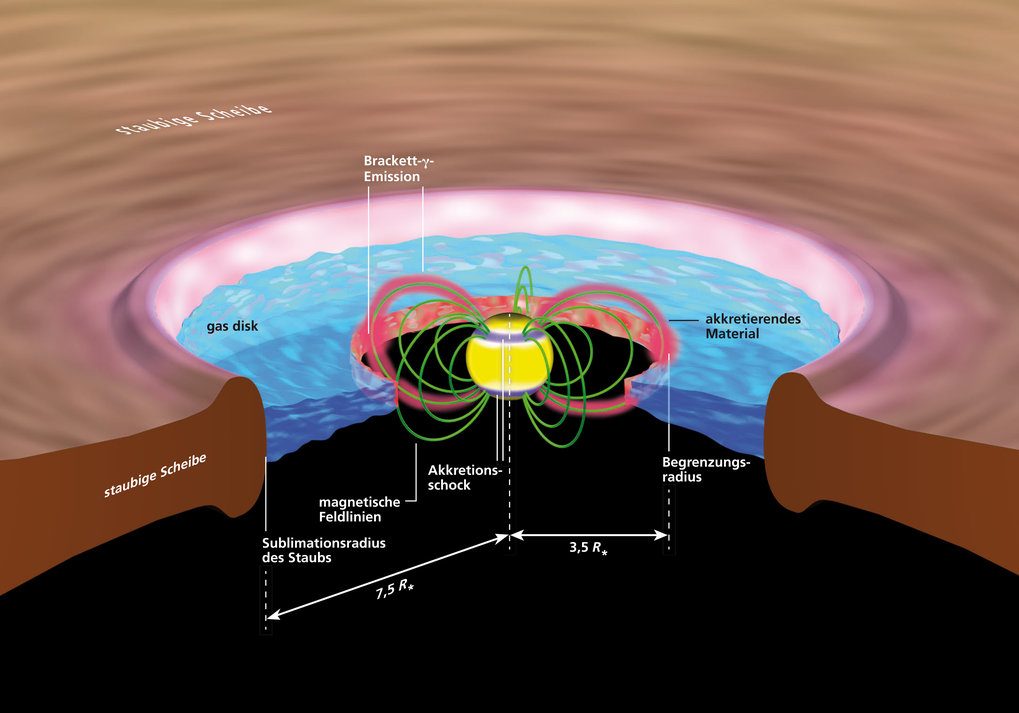
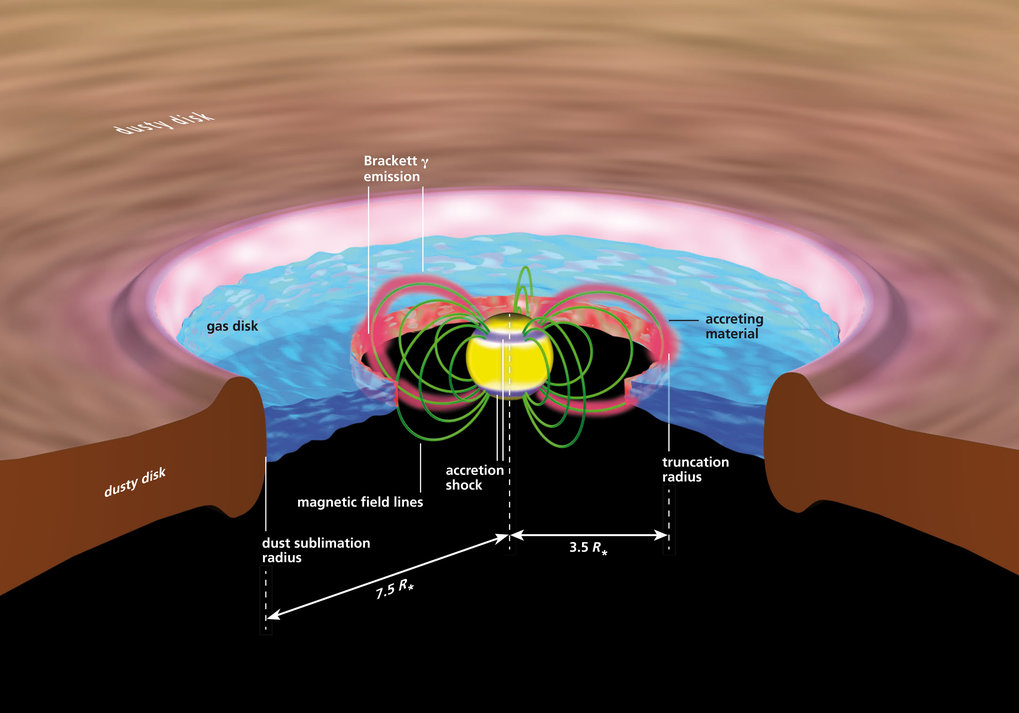
Schematic representation of the process of magnetospheric accretion of material onto a young star.


Magnetic fields produced by the young star carry gas through flow channels from the disk to the polar regions of the star. The ionized hydrogen gas emits . Image: MPIA graphics department

Too small to be part of the disk

With those observations, Rebeca García López and her colleagues have pushed the boundaries even further inwards. GRAVITY could see the emissions corresponding to the line associated with highly excited hydrogen (Brackett-γ, Brγ) and demonstrate that they stem from a region no more than 3.5 times the radius of the star across (about 3 million km, or 8 times the distance the distance between the Earth and the Moon).

This is a significant difference. According to all physics-based models, the inner rim of a circumstellar disk cannot possibly be that close to the star. If the light originates from that region, it cannot be emitted from any section of the disk. At that distance, the light also cannot be due to a stellar wind blown away by the young stellar object – the only other realistic possibility. Taken together, what is left as a plausible explanation is the magnetospheric accretion model.

What’s next?

In future observations, again using GRAVITY, the researchers will try to get data that allows them a more detailed reconstruction of physical processes close to the star. “By observing the location of the funnel's lower endpoint over time, we hope to pick up clues as to how distant the magnetic North and South poles are from the star’s axis of rotation,” explains Wolfgang Brandner, co-author and scientist at MPIA. If North and South Pole directly aligned with the rotation axis, their position over time would not change at all.

They also hope to pick up clues as to whether the star’s magnetic field is really as simple as a North Pole–South Pole configuration. “Magnetic fields can be much more complicated and have additional poles,” explains Thomas Henning, Director at MPIA. “The fields can also change over time, which is part of a presumed explanation for the brightness variations of T Tauri stars.”

All in all, this is an example of how observational techniques can drive progress in astronomy. In this case, the new observational techniques embody in GRAVITY were able to confirm ideas about the growth of young stellar objects that were proposed as long as 30 years ago. And future observations are set to help us understand even better how baby stars are being fed.

Background information

The MPIA researchers involved are Rebeca García López (also Dublin Institute for Advanced Studies [DIAS] and University College Dublin), Alessio Caratti o Garatti (also DIAS), Lucia Klarmann, Joel Sanchez-Bermudez, Wolfgang Brandner, Thomas Henning, Stefan Hippler and Silvia Scheithauer, as part of the GRAVITY Collaboration.

Source: Max Planck Institute for Astronomy


Contacts

Rebeca García López

Phone:+353 1 716-2223

Max Planck Institute for Astronomy, Heidelberg


Wolfgang Brandner

Phone:+49 6221 528-289

Max Planck Institute for Astronomy, Heidelberg


Markus Pössel

Head of press and public relations

Phone:+49 6221 528-261

Max Planck Institute for Astronomy, Heidelberg


Markus Nielbock

Press and public relations officer

Phone:+49 6221 528-134

Max Planck Institute for Astronomy, Heidelberg


Original publications

1. GRAVITY Collaboration: R. Garcia Lopez et al. A measure of the size of the magnetospheric accretion region in TW Hydrae

Nature (2020), DOI: 10.1038/s41586-020-2613-1 - Source

2. J. Bouvier et al.

Probing the magnetospheric accretion region of the young pre-transitional disk system DoAr 44 using VLTI/GRAVITY Astronomy & Astrophysics, 636, A108 (2020) .  Source / DOI 


Downloads

Images in high resolution

tw_hya-schematic-de_hires 1.21 MB

tw_hya-schematic-en_hires 1.18 MB

tw_hya-ttauristar_teaser_hires 7.0 MB


Press releases of our partners

GRAVITY observes young star feeding from its surrounding disk

Max Planck Institute for extraterrestrial Physics


Links

GRAVITY webpages at MPIA


Wednesday, June 24, 2020

Young Planets Bite the Dust

noirlab2014a/
noirlab2014b (Labeled) – GPI Circumstellar Disks
Six circumstellar disks selected from the larger sample of 26 disks obtained with the Gemini South telescope in Chile using the Gemini Planet Imager (GPI). These images highlight the diversity of shapes and sizes that these disks can take and show the outer reaches of star systems in their formative years. Credit: International Gemini Observatory/NOIRLab/NSF/AURA/T. Esposito (UC Berkeley). Image processing: Travis Rector (University of Alaska Anchorage), Mahdi Zamani & Davide de Martin. 3906 × 2642 jpg  -  3906 × 2642 jpg  (Labeled)

noirlab2014c – HD 129590
A circumstellar disk around star HD 129590 selected from the larger sample of 26 disks obtained with the Gemini South telescope in Chile using the Gemini Planet Imager (GPI).  Credit: International Gemini Observatory/NOIRLab/NSF/AURA/T. Esposito (UC Berkeley).  Image processing: Travis Rector (University of Alaska Anchorage), Mahdi Zamani & Davide de Martin. 1200 × 1200 jpg

noirlab2014d – HD 117214
A circumstellar disk around star HD 117214 selected from the larger sample of 26 disks obtained with the Gemini South telescope in Chile using the Gemini Planet Imager (GPI). Credit: International Gemini Observatory/NOIRLab/NSF/AURA/T. Esposito (UC Berkeley) Image processing: Travis Rector (University of Alaska Anchorage), Mahdi Zamani & Davide de Martin. noirlab2014e – HD 111520 A circumstellar disk around star HD 111520 selected from the larger sample of 26 disks obtained with the Gemini South telescope in Chile using the Gemini Planet Imager (GPI). Credit: International Gemini Observatory/NOIRLab/NSF/AURA/T. Esposito (UC Berkeley) Image processing: Travis Rector (University of Alaska Anchorage), Mahdi Zamani & Davide de Martin. 1200 × 1200 jpg

noirlab2014e – HD 111520
A circumstellar disk around star HD 111520 selected from the larger sample of 26 disks obtained with the Gemini South telescope in Chile using the Gemini Planet Imager (GPI). Credit: International Gemini Observatory/NOIRLab/NSF/AURA/T. Esposito (UC Berkeley) Image processing: Travis Rector (University of Alaska Anchorage), Mahdi Zamani & Davide de Martin.  1200 × 1200 jpg

noirlab2014f – HR 4796 A
A circumstellar disk around star HR 4796 A selected from the larger sample of 26 disks obtained with the Gemini South telescope in Chile using the Gemini Planet Imager (GPI). Credit: International Gemini Observatory/NOIRLab/NSF/AURA/T. Esposito (UC Berkeley) Image processing: Travis Rector (University of Alaska Anchorage), Mahdi Zamani & Davide de Martin.  1200 × 1200 jpg

noirlab2014g – TWA 7
A circumstellar disk around star TWA 7 selected from the larger sample of 26 disks obtained with the Gemini South telescope in Chile using the Gemini Planet Imager (GPI). Credit: International Gemini Observatory/NOIRLab/NSF/AURA/T. Esposito (UC Berkeley) Image processing: Travis Rector (University of Alaska Anchorage), Mahdi Zamani & Davide de Martin.  1200 × 1200 jpg

noirlab2014h – HD 32297
A circumstellar disk around star HD 32297 selected from the larger sample of 26 disks obtained with the Gemini South telescope in Chile using the Gemini Planet Imager (GPI). Credit: International Gemini Observatory/NOIRLab/NSF/AURA/T. Esposito (UC Berkeley) Image processing: Travis Rector (University of Alaska Anchorage), Mahdi Zamani & Davide de Martin.  1200 × 1200 jpg

noirlab2014a – Images of Dusty Star Systems Revealed by the Gemini Planet Imager Animation of the Solar System and moving outward to indicate stars observed with the Gemini Planet Imager (GPI) mounted on the Gemini South telescope in Chile. Highlighted are the images of the dusty rings encircling some of these young stars. More than 100 researchers have contributed to GPI and the GPI Exoplanet Survey, whose work is highlighted in this video. The work was supported by the National Science Foundation (NSF) and NASA. Created by Jenny Patience and Ric Alling, Arizona State University, with scientific input from Justin Hom (ASU), Paul Kalas (UC Berkeley), Tom Esposito (UC Berkeley) and Franck Marchis (SETI Institute). Credit: International Gemini Observatory/NOIRLab/NSF/AURA/J. Patience & R. Alling (Arizona State University)/T. Esposito (UC Berkeley)
noirlab2014a mp4


Astronomers unveil new collection of planet-forming dusty star systems


These orange swirls of dust are snapshots from the largest collection of sharp, detailed images of dusty debris disks around young stars — published this week by an international group of astronomers. The images — captured by the 8-meter Gemini South telescope using the Gemini Planet Imager — illustrate the variety of shapes and sizes that stellar systems can take during their infancy. Unexpectedly, the majority of these systems display evidence of planet formation.

These remarkable portraits of dusty disks are a selection from 26 new images of debris disks obtained by the Gemini Planet Imager (GPI) at the international Gemini Observatory, a Program of NSF’s NOIRLab. These images highlight the diversity of shapes and sizes that these disks can take and show the outer reaches of exoplanetary systems in their formative years. The young stars imaged, which range from tens of millions to a few hundred million years old, are at the ideal age to settle down and raise planets. The forming planets sculpt the dust disk and leave behind gaps and warps that are indirect clues to their existence and motion.

While debris disks have been imaged before, this new cohort of 26 disks represents one of the largest samples to be imaged with highly uniform data quality. This enables detailed comparison of the observations, a unique breakthrough in debris disk surveys. Thirteen of the disks form a perfect natural laboratory, all belonging to the Scorpius–Centaurus stellar association, roughly 400 light-years from Earth. The group of stars, which were born in the same region at roughly the same time, enables astronomers to compare the architectures of a variety of young planetary systems developing under different conditions.

GPI was able to capture these dusty disks with the help of some ingenious astronomical engineering.

GPI is sensitive to the polarization of light, allowing it to distinguish dust-scattered light, which is polarized, from the unpolarized light emanating from the stars. This gives GPI the impressive ability to improve the contrast of images and capture disks that are 10 million times fainter than their parent stars.

Measuring polarization is only one of GPI’s tricks, however — the instrument also exploits a coronagraph and adaptive optics to get the most from its observations [1][2].

GPI’s precision is in large part due to its perch on the 8-meter Gemini South telescope on Cerro Pachón in Chile. The dry conditions, high altitude, and dark skies are perfect for cutting-edge astronomical research. By combining this exquisite location with some engineering ingenuity, GPI is able to capture images as sharp as those from the Hubble Space Telescope — and detect objects up to three times closer to the host stars [3].

GPI’s first-rate observing abilities enabled this work, part of the Gemini Planet Imager Exoplanet Survey (GPIES), a 4-year search for light emitted by giant gas planets orbiting more than 500 of the youngest stars near the Sun. As well as doubling the number of debris disks imaged at this high resolution, the survey uncovered six giant exoplanets and four brown dwarfs. Surveys such as GPIES are a perfect way to screen targets for the next generation of space- and ground-based telescopes.

“The Gemini instrument program continues to provide unique science opportunities. This combination of GPI mounted upon a large ground-based telescope is delivering exciting new details about the process of how planets form,” said Martin Still, NSF Program Manager for the Gemini Observatory partnership.

The GPIES survey concluded in 2019, but the investment and technical capability of the Gemini Planet Imager will continue with an upgrade to GPI’s hardware to improve its resolution and sensitivity [4].

The new “GPI 2.0,” is slated for a future installation at Gemini North atop Maunakea in Hawai‘i, where it will search the less-observed northern hemisphere skies for more exoplanets and debris disks. GPI 2.0 will also continue the work of scouting out targets for the next generation of exoplanet missions, setting the scene for new insights into the mystery of planet formation.


Notes

[1] Coronagraphs are devices which block light coming directly from a central star, allowing the faint disk to be seen. The presence of GPI’s coronagraph can be inferred from the conspicuous black circle at the center of these images.

[2] Adaptive Optics is a cutting-edge astronomical technique that uses deformable mirrors to correct blurring and distortions caused by turbulence in Earth’s atmosphere.

[3] GPI’s coronagraph blocks a smaller region around the star and better suppresses noise at small angular separations from the star, compared to HST’s coronagraph.

[4] The upgrade to GPI is funded by the NSF and by the Heising-Simons Foundation.


More information


This research was presented in the paper Debris Disk Results from the Gemini Planet Imager Exoplanet Survey’s Polarimetric Imaging Campaign in The Astronomical Journal.

The team is composed of Thomas M. Esposito (University of California, Berkeley), Paul Kalas, (University of California, Berkeley, SETI Institute, and Foundation for Research and Technology – Hellas), Michael P. Fitzgerald (University of California, Los Angeles), Maxwell A. Millar-Blanchaer (NASA Hubble Fellow at NASA Jet Propulsion Laboratory), Gaspard Duchêne (University of California,Berkeley and Université Grenoble Alpes), Jennifer Patience (Arizona State University), Justin Hom (Arizona State University), Marshall D. Perrin (Space Telescope Science Institute), Robert J. De Rosa (Kavli Institute for Particle Astrophysics and Cosmology), Eugene Chiang (University of California, Berkeley), Ian Czekala (NASA Hubble Fellowship Program Sagan Fellow at the University of California, Berkeley), Bruce Macintosh (Kavli Institute for Particle Astrophysics and Cosmology), James R. Graham (University of California, Berkeley), Megan Ansdell (University of California, Berkeley), Pauline Arriaga (University of California, Los Angeles), Sebastian Bruzzone (The University of Western Ontario), Joanna Bulger (Pan-STARRS Observatory), Christine H. Chen (Space Telescope Science Institute), Tara Cotton (University of Georgia), Ruobing Dong (University of Victoria), Zachary H. Draper (University of Victoria and National Research Council of Canada), Katherine B. Follette (Amherst College), Li-Wei Hung (University of California, Los Angeles), Ronald Lopez (University of California, Los Angeles), Brenda C. Matthews (National Research Council of Canada and University of Victoria), Johan Mazoyer (NASA Hubble Fellow at NASA Jet Propulsion Laboratory), Stan Metchev (The University of Western Ontario and Stony Brook University), Julien Rameau (Université de Montréal), Bin Ren (Johns Hopkins University and Space Telescope Science Institute), Malena Rice (Yale University), Inseok Song (University of Georgia), Kevin Stahl (University of California, Los Angeles), Jason Wang (California Institute of Technology and University of California, Berkeley), Schuyler Wolff (Leiden University), Ben Zuckerman (University of California, Los Angeles), S. Mark Ammons (Lawrence Livermore National Laboratory), Vanessa P. Bailey (NASA Jet Propulsion Laboratory), Travis Barman (University of Arizona), Jeffrey Chilcote (Kavli Institute for Particle Astrophysics and Cosmology and University of Notre Dame), Rene Doyon (Université de Montréal), Benjamin L. Gerard (University of Victoria and National Research Council of Canada), Stephen J. Goodsell (Gemini Observatory), Alexandra Z. Greenbaum (University of Michigan), Pascale Hibon (Gemini Observatory), Sasha Hinkley (University of Exeter), Patrick Ingraham (Vera C. Rubin Observatory), Quinn Konopacky (University of California San Diego), Jérôme Maire (University of California San Diego), Franck Marchis (SETI Institute), Mark S. Marley (NASA Ames Research Center), Christian Marois (University of Victoria and National Research Council of Canada), Eric L. Nielsen (SETI Institute and Kavli Institute for Particle Astrophysics and Cosmology), Rebecca Oppenheimer (American Museum of Natural History), David Palmer (Lawrence Livermore National Laboratory), Lisa Poyneer (Lawrence Livermore National Laboratory), Laurent Pueyo (Space Telescope Science Institute), Abhijith Rajan (Space Telescope Science Institute), Fredrik T. Rantakyrö (Gemini Observatory), Jean-Baptiste Ruffio (Kavli Institute for Particle Astrophysics and Cosmology), Dmitry Savransky (Cornell University), Adam C. Schneider (Arizona State University), Anand Sivaramakrishnan (Space Telescope Science Institute), Rémi Soummer (Space Telescope Science Institute), Sandrine Thomas (Vera C. Rubin Observatory), and Kimberly Ward-Duong (Amherst College).

NSF’s National Optical-Infrared Astronomy Research Laboratory (NOIRLab), the US center for ground-based optical-infrared astronomy, operates the international Gemini Observatory (a facility of NSF, NRC–Canada, ANID–Chile, MCTIC–Brazil, MINCyT–Argentina, and KASI–Republic of Korea), Kitt Peak National Observatory (KPNO), Cerro Tololo Inter-American Observatory (CTIO), the Community Science and Data Center (CSDC), and the Vera C. Rubin Observatory. It is managed by the Association of Universities for Research in Astronomy (AURA) under a cooperative agreement with NSF and is headquartered in Tucson, Arizona. The astronomical community is honored to have the opportunity to conduct astronomical research on Iolkam Du’ag (Kitt Peak) in Arizona, on Maunakea in Hawaiʻi, and on Cerro Tololo and Cerro Pachón in Chile. We recognize and acknowledge the very significant cultural role and reverence that these sites have to the Tohono O’odham Nation, to the Native Hawaiian community, and to the local communities in Chile, respectively.


Links


Contacts

Peter Michaud
NewsTeam Manager
NSF’s NOIRLab
Gemini Observatory, Hilo HI
Cell: +1 808-936-6643

Email: pmichaud@gemini.edu