


PR Video eso2604a
Two planets spotted forming around a young star | ESO News

PR Video eso2604b
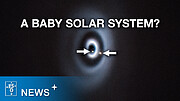
Zooming into the young planetary system around the WISPIT 2 star
“WISPIT 2 is the best look into our own past that we have to date,” says Chloe Lawlor, PhD student at the University of Galway, Ireland, and lead author of the study published today in The Astrophysical Journal Letters.
The system is only the second known, after PDS 70, where two planets have been directly observed in the process of forming around their host star. Unlike PDS 70, however, WISPIT 2 has a very extended planet-forming disc with distinctive gaps and rings. "These structures suggest that more planets are currently forming, which we will eventually detect,” Lawlor says.
"WISPIT 2 gives us a critical laboratory not just to observe the formation of a single planet but an entire planetary system," says Christian Ginski, study co-author and researcher at the University of Galway. With such observations, astronomers aim to better understand how baby planetary systems develop into mature ones, like our own.
The first newborn planet found in the system — named WISPIT 2b — was detected last year, with a mass almost five times that of Jupiter and orbiting the central star at around 60 times the distance between Earth and the Sun. “This detection of a new world in formation really showed the amazing potential of our current instrumentation,” said Richelle van Capelleveen, PhD student at Leiden Observatory, the Netherlands, and leader of the previous study. After an additional object was identified near the star [1], measurements made with ESO’s Very Large Telescope (VLT) and the VLT Interferometer (VLTI) confirmed its planetary nature. The new planet — WISPIT 2c — is four times closer to the central star and is twice as massive as WISPIT 2b. Both planets are gas giants, like the outer planets in our Solar System.
To confirm the existence of WISPIT 2c the team employed the SPHERE instrument on ESO's VLT, which captured an image of the object. The team then used the GRAVITY+ instrument on the VLTI to confirm that the object was indeed a planet. "Critically our study made use of the recent upgrade to GRAVITY+ without which we
would not have been able to get such a clear detection of the planet so close to its star," says Guillaume Bourdarot, study co-author and researcher at the Max Planck Institute for Extraterrestrial Physics, Garching, Germany.
Both planets in WISPIT 2 appear in clear gaps within the disc of dust and gas circling the young star. These gaps result from each planet's development: particles in the disc accumulate, their gravity pulling in more material until an embryo planet forms. The remaining material, around each gap, creates distinctive dust rings in the disc.
Besides the gaps that the two planets were found in, there is at least one smaller gap farther out in the WISPIT 2 disc. "We suspect there may be a third planet carving out this gap" says Lawlor, "potentially of Saturn mass owing to the gap’s being much narrower and shallower". The team are eager to make follow-up observations, with Ginski noting that “with ESO’s upcoming Extremely Large Telescope, we may be able to directly image such a planet.”
Notes
More information
The team is composed of C. Lawlor (School of Natural Sciences, Centre for Astronomy and Ryan Institute, University of Galway, Ireland [Galway]), R. F. van Capelleveen (Leiden Observatory, Leiden University,The Netherlands [Leiden]), G. Bourdarot (Max Planck Institute for Extraterrestrial Physics, Garching, Germany [MPE]), C. Ginski (Galway and Center for Astronomical Adaptive Optics, Department of Astronomy, University of Arizona, Tucson, USA [CAAO]), M. A. Kenworthy (Leiden), T. Stolker (Leiden), L. Close (CAAO), A. J. Bohn (Leiden), F. Eisenhauer (MPE and Department of Physics, Technical University of Munich, Garching, Germany), P. Garcia (Faculdade de Engenharia, Universidade do Porto, Portugal and CENTRA – Centro de Astrofísica e Gravitação, IST, Universidade de Lisboa, Portugal), S. F. Honig (School of Physics and Astronomy, University of Southampton, United Kingdom), J. Kammerer (European Southern Observatory, Garching Germany), L. Kreidberg (Max Planck Institute for Astronomy, Heidelberg, Germany), S. Lacour (LIRA, Observatoire de Paris, Université PSL, CNRS, Sorbonne Université, Université de Paris, Meudon, France), J.-B. Le Bouquin (Univ. Grenoble Alpes, CNRS, IPAG, Grenoble, France), E. Mamajek (Jet Propulsion Laboratory, California Institute of Technology, Pasadena, California, USA), M. Nowak (LIRA), T. Paumard (LIRA), C. Straubmeier (1st Institute of Physics, University of Cologne, Germany), N. van der Marel (Leiden) and the exoGRAVITY Collaboration.
The European Southern Observatory (ESO) enables scientists worldwide to discover the secrets of the Universe for the benefit of all. We design, build and operate world-class observatories on the ground — which astronomers use to tackle exciting questions and spread the fascination of astronomy — and promote international collaboration for astronomy. Established as an intergovernmental organisation in 1962, today ESO is supported by 16 Member States (Austria, Belgium, Czechia, Denmark, France, Finland, Germany, Ireland, Italy, the Netherlands, Poland, Portugal, Spain, Sweden, Switzerland and the United Kingdom), along with the host state of Chile and with Australia as a Strategic Partner. ESO’s headquarters and its visitor centre and planetarium, the ESO Supernova, are located close to Munich in Germany, while the Chilean Atacama Desert, a marvellous place with unique conditions to observe the sky, hosts our telescopes. ESO operates three observing sites: La Silla, Paranal and Chajnantor. At Paranal, ESO operates the Very Large Telescope and its Very Large Telescope Interferometer, as well as survey telescopes such as VISTA. Also at Paranal, ESO will host and operate the south array of the Cherenkov Telescope Array Observatory, the world’s largest and most sensitive gamma-ray observatory. Together with international partners, ESO operates ALMA on Chajnantor, a facility that observes the skies in the millimetre and submillimetre range. At Cerro Armazones, near Paranal, we are building “the world’s biggest eye on the sky” — ESO’s Extremely Large Telescope. From our offices in Santiago,Chile we support our operations in the country and engage with Chilean partners and society.
Links
- Research paper
- Photos of the VLT/I
- Find out more about ESO's Extremely Large Telescope on our dedicated website and press kit
- For journalists: subscribe to receive our releases under embargo in your language
- For scientists: got a story? Pitch your research
Contacts:
Chloe Lawlor
University of Galway
Galway, Ireland
Email: c.lawlor13@universityofgalway.ie
Christian Ginski
University of Galway
Galway, Ireland
Email: christian.ginski@universityofgalway.ie
Richelle van Capelleveen
Leiden Observatory, Leiden University
Leiden, the Netherlands
Email: capelleveen@strw.leidenuniv.nl
Guillaume Bourdarot
Max Planck Institute for Extraterrestrial Physics
Garching, Germany
Tel: +498930000-3295
Email: bourdarot@mpe.mpg.de
Bárbara Ferreira
ESO Media Manager
Garching bei München, Germany
Tel: +49 89 3200 6670
Cell: +49 151 241 664 00
Email: press@eso.org


