Credit: Adapted from NASA’s Goddard Space Flight Center
What if there was one process capable of creating every type of detectable stellar-mass black hole system? Recent research suggests there might be, and that it involves a triple-star system.

Three Separate Contexts
Stellar-mass black holes, or black holes that are at most a few hundred times the mass of the Sun, pop up in a number of different environments in the Milky Way. Astronomers have known since the 1960s that these black holes are the engines behind accreting low-mass X-ray binaries; more recently, researchers at gravitational wave observatories such as LIGO have found pairs of black holes orbiting each other just prior to merging; and, in just the past few years, scientists using the Gaia spacecraft have found black holes on wide, prowling orbits around still-burning stars.
Although each of these scenarios involves a black hole, it’s unclear how exactly these black holes are related to one another, or if they’re related at all. For instance, do low-mass X-ray binaries form the same way as the binary black holes observed with LIGO? Are the wide star–black hole binaries discovered by Gaia destined to eventually merge as two black holes, or are they a separate population altogether?
Recent research led by Smadar Naoz (University of California, Los Angeles) offers a potential answer to this question of relatedness — that each of these situations forms through the same underlying process.
Although each of these scenarios involves a black hole, it’s unclear how exactly these black holes are related to one another, or if they’re related at all. For instance, do low-mass X-ray binaries form the same way as the binary black holes observed with LIGO? Are the wide star–black hole binaries discovered by Gaia destined to eventually merge as two black holes, or are they a separate population altogether?
Recent research led by Smadar Naoz (University of California, Los Angeles) offers a potential answer to this question of relatedness — that each of these situations forms through the same underlying process.

Triples Systems
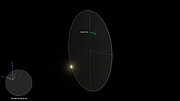
The mechanism Naoz and collaborators describe would work as follows. First, three stars begin their lives all bound together via gravity. Two of these stars orbit each other fairly closely, but the third hangs back much farther away. After the two inner stars burn out and collapse into black holes, they undergo the kind of collision commonly observed by LIGO and merge together. This process gives the resulting larger black hole a “kick,” meaning it goes flying off away from the site of the impact with some new velocity.
What happens next depends on the geometry of the system and the direction of the kick. If the remnant black hole gets shot away from the third star, it might just drift off on its own and leave the star behind. If the kick isn’t too strong, the remnant will remain gravitationally bound to that third star, and the system will eventually look like the star–black hole pairs observed by Gaia. Finally, if the kick sends the remnant toward the third star, some dramatic outcomes become possible: either the black hole starts nibbling on the star and the system becomes a low-mass X-ray binary, or the black hole simply smashes into the star, destroying it completely in a large, flashy explosion paired with a gravitational wave signal.
The authors stress that this mechanism is almost certainly not the only way that these three stellar-mass black hole systems form. However, it is exciting to consider a common thread underlying such seemingly different scenarios, and with upgrades coming to gravitational wave observatories, we can hope for tests of its feasibility in the near future.
What happens next depends on the geometry of the system and the direction of the kick. If the remnant black hole gets shot away from the third star, it might just drift off on its own and leave the star behind. If the kick isn’t too strong, the remnant will remain gravitationally bound to that third star, and the system will eventually look like the star–black hole pairs observed by Gaia. Finally, if the kick sends the remnant toward the third star, some dramatic outcomes become possible: either the black hole starts nibbling on the star and the system becomes a low-mass X-ray binary, or the black hole simply smashes into the star, destroying it completely in a large, flashy explosion paired with a gravitational wave signal.
The authors stress that this mechanism is almost certainly not the only way that these three stellar-mass black hole systems form. However, it is exciting to consider a common thread underlying such seemingly different scenarios, and with upgrades coming to gravitational wave observatories, we can hope for tests of its feasibility in the near future.
By Ben Cassese
Citation
“Triples as Links Between Binary Black Hole Mergers, Their Electromagnetic Counterparts, and Galactic Black Holes,” Smadar Naoz et al 2025 ApJL 992 L12. doi:10.3847/2041-8213/ae0a20