Showing posts with label ultraluminous X-ray sources (ULXs). Show all posts

Thursday, September 06, 2018

AM 0644-741: Cosmic Collision Forges Galactic One Ring -- in X-rays

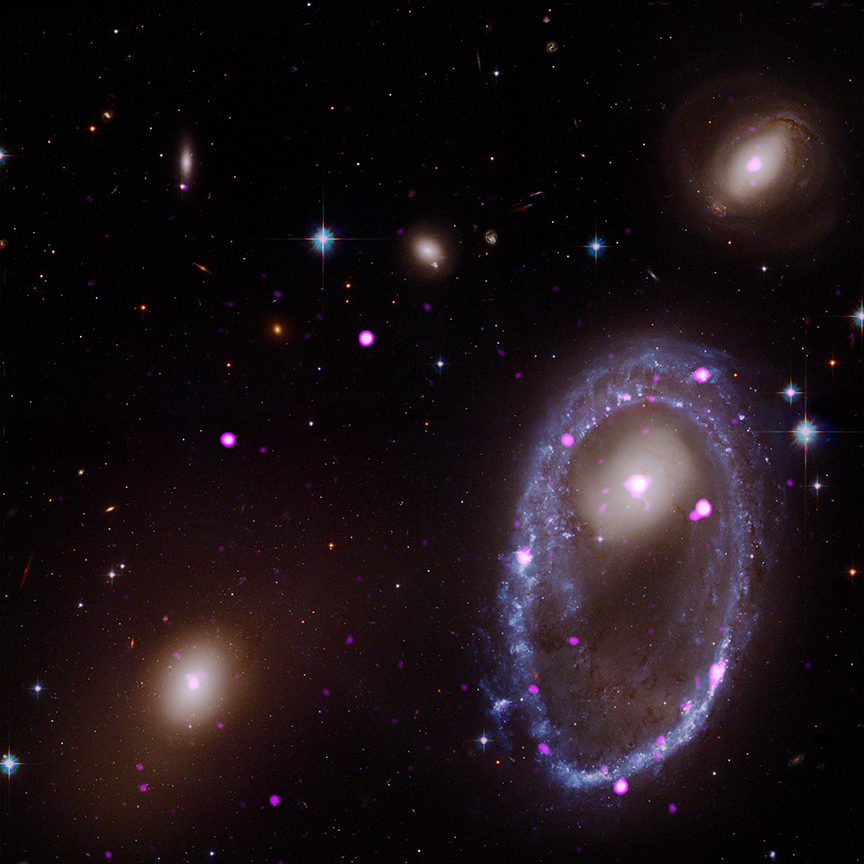
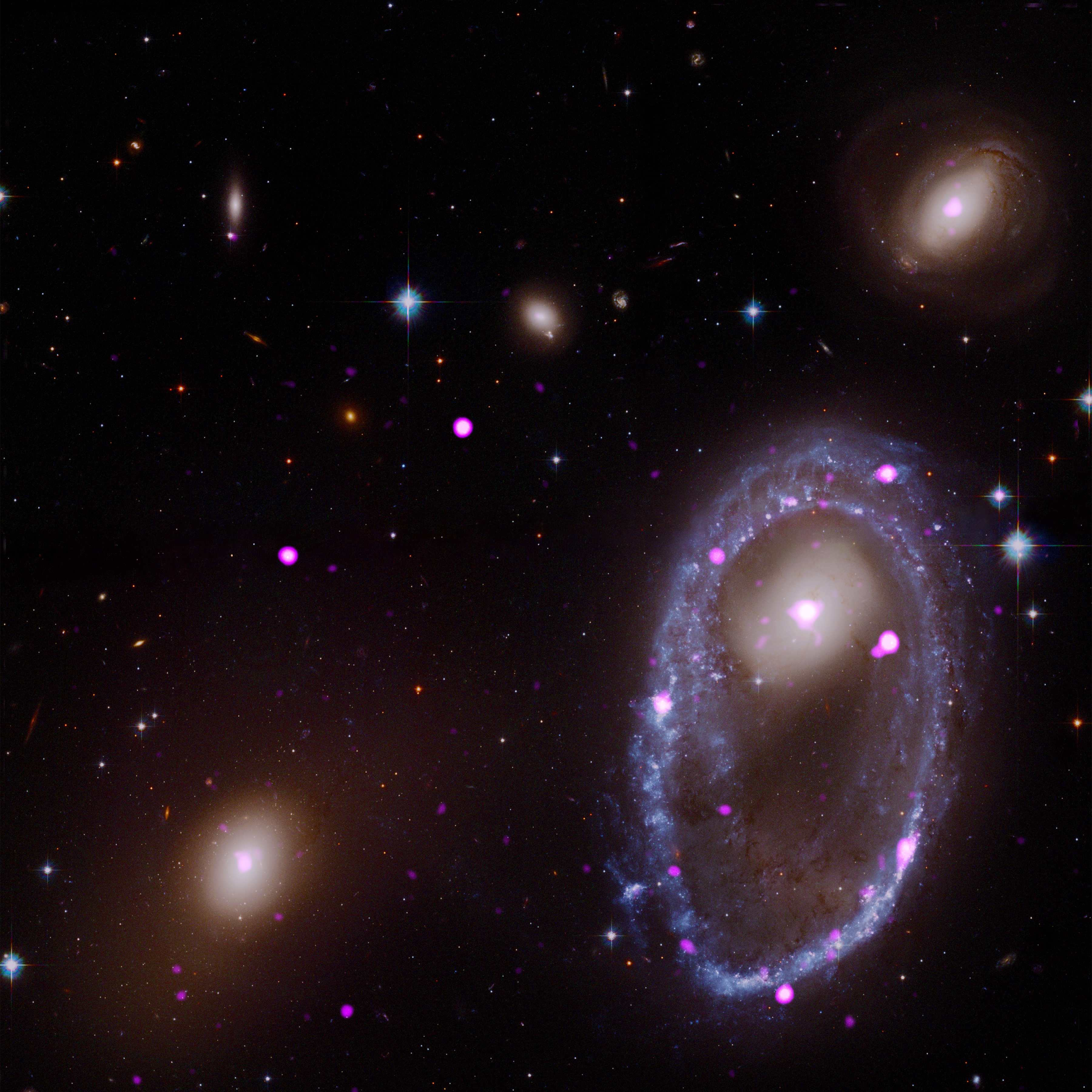
 AM 0644-741
Credit X-ray: NASA/CXC/INAF/A. Wolter et al; Optical: NASA/STScI


Astronomers have used NASA's Chandra X-ray Observatory to discover a ring of black holes or neutron stars in a galaxy 300 million light years from Earth.

This ring, while not wielding power over Middle Earth, may help scientists better understand what happens when galaxies smash into one another in catastrophic impacts.

In this new composite image of the galaxy AM 0644-741 (AM 0644 for short), X-rays from Chandra (purple) have been combined with optical data from NASA's Hubble Space Telescope (red, green, and blue). The Chandra data reveal the presence of very bright X-ray sources, most likely binary systems powered by either a stellar-mass black hole or neutron star, in a remarkable ring. The results are reported in a new paper led by Anna Wolter from INAF-Osservatorio Astronomico di Brera in Milano, Italy.

Where did the ring of black holes or neutron stars in AM 0644 come from? Astronomers think that it was created when one galaxy was pulled into another galaxy by the force of gravity. The first galaxy generated ripples in the gas of the second galaxy, AM 0644, located in the lower right. These ripples then produced an expanding ring of gas in AM 0644 that triggered the birth of new stars. The first galaxy is possibly the one located in the lower left of the image.

The most massive of these fledgling stars will lead short lives — in cosmic terms — of millions of years. After that, their nuclear fuel is spent and the stars explode as supernovas leaving behind either black holes with masses typically between about five to twenty times that of the Sun, or neutron stars with a mass approximately equal to that of the Sun.

Some of these black holes or neutron stars have close companion stars, and siphon gas from their stellar partner. This gas falls towards the black hole or neutron star, forming a spinning disk like water circling a drain, and becomes heated by friction. This superheated gas produces large amounts of X-rays that Chandra can detect.

While a ring of black holes or neutron stars is intriguing in itself, there is more to the story of AM 0644. All of the X-ray sources detected in the ring of AM 0644 are bright enough to be classified as ultraluminous X-ray sources (ULXs). This is a class of objects that produce hundreds to thousands of times more X-rays than most "normal" binary systems in which a companion star is in orbit around a neutron star or black hole. Until recently most astronomers thought that ULXs generally contained stellar-mass black holes, with the possible presence in some cases of intermediate-mass black holes (IMBHs) that contain over a hundred times the mass of the Sun. However, this thinking was overturned when a few ULXs in other galaxies, including M82 and M51, were found to contain neutron stars.

Several other explanations besides IMBHs have been suggested for the intense X-ray emission of ULXs. They include unusually rapid growth of the black hole or neutron star, or geometrical effects arising from the funneling of infalling material along magnetic field lines. 

The identity of the individual ULXs in AM 0644 is currently unknown. They may be a mixture of black holes and neutron stars, and it is also possible that they are all black holes or all neutron stars.

Not all of the X-ray sources in the image are located in the ring of AM 0644. One of the sources is a rapidly growing black hole that's located well behind the galaxy at a distance of 9.1 billion light years from Earth. Another intriguing source detected by Chandra is a growing supermassive black hole located at the center of the galaxy. In the new study, the researchers also used Chandra observations to study six other ring galaxies in addition to AM 0644. A total of 63 sources were detected in the seven galaxies, and 50 of them are ULXs. The authors see a larger average number of ULXs per galaxy in these ring galaxies than in other types of galaxies. Ring galaxies have stimulated the interest of astronomers because they are ideal testbeds for examining models of how double stars form, and understanding the origin of ULXs.

The paper describing the study of AM 0644 and its sister ring galaxies appeared in the August 10, 2018 issue of the Astrophysical Journal and is available online. The co-authors of the paper are Antonella Fruscione from the Harvard-Smithsonian Center for Astrophysics in Cambridge, Mass., and Michela Mapelli from INAF-Osservatorio Astronomico di Padova in Padova, Italy.

NASA's Marshall Space Flight Center in Huntsville, Alabama, manages the Chandra program for NASA's Science Mission Directorate in Washington. The Smithsonian Astrophysical Observatory in Cambridge, Massachusetts, controls Chandra's science and flight operations.


Fast Facts for AM 0644-741:

Scale: Image is about 3.25 arcmin (280,000 light years) across
Category: Normal Galaxies & Starburst Galaxies, Black Holes
Coordinates (J2000): RA 06h 43m 06.1s | Dec -74° 13´ 35
Constellation: Volans
Observation Date: November 17, 2003
Observation Time: 10 hours
Obs. ID: 3969
Instrument: ACIS
References: Wolter, A. et al, 2018, ApJ, 863,43; arXiv:1806.02746
Color Code: X-ray: purple; Optical: red, green, blue
Distance Estimate: About 300 million light years


Friday, March 02, 2018

ULX in M51: Beaming with the Light of Millions of Suns

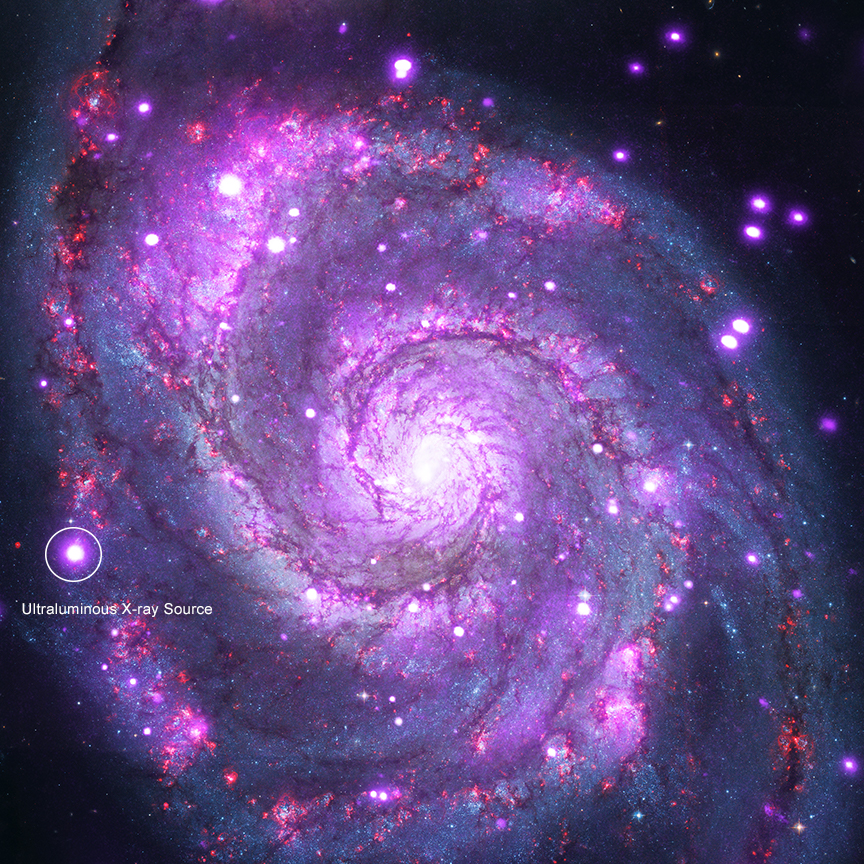
ULX in M51 
Credit  X-ray: NASA/CXC/Caltech/M. Brightman et al.; Optical: NASA/STScI


In the 1980s, scientists started discovering a new class of extremely bright sources of X-rays in galaxies. These sources were a surprise, as they were clearly located away from the supermassive black holes found in the center of galaxies. At first, researchers thought that many of these ultraluminous X-ray sources, or ULXs, were black holes containing masses between about a hundred and a hundred thousand times that of the sun. Later work has shown some of them may be stellar-mass black holes, containing up to a few tens of times the mass of the sun.

In 2014, observations with NASA's NuSTAR (Nuclear Spectroscopic Telescope Array) and Chandra X-ray Observatory showed that a few ULXs, which glow with X-ray light equal in luminosity to the total output at all wavelengths of millions of suns, are even less massive objects called neutron stars. These are the burnt-out cores of massive stars that exploded. Neutron stars typically contain only about 1.5 times the mass of the sun. Three such ULXs were identified as neutron stars in the last few years. Scientists discovered regular variations, or "pulsations," in the X-ray emission from ULXs, behavior that is exhibited by neutron stars but not black holes.

Now, researchers using data from NASA's Chandra X-ray Observatory have identified a fourth ULX as being a neutron star, and found new clues about how these objects can shine so brightly. The newly characterized ULX is located in the Whirlpool galaxy, also known as M51. This composite image of the Whirlpool contains X-rays from Chandra (purple) and optical data from the Hubble Space Telescope (red, green, and blue). The ULX is marked with a circle.

Neutron stars are extremely dense objects — a teaspoon would weigh more than a billion tons, as much as a mountain. The intense gravity of the neutron stars pulls surrounding material away from companion stars, and as this material falls toward the neutron star, it heats up and glows with X-rays. As more and more matter falls onto the neutron star, there comes a time when the pressure from the resulting X-ray light becomes so intense that it pushes the matter away. Astronomers call this point — when the objects typically cannot accumulate matter any faster and give off any more X-rays — the Eddington limit. The new result shows this ULX is surpassing the Eddington limit for a neutron star.

The scientists analyzed archival X-ray data taken by Chandra and discovered an unusual dip in the ULX's X-ray spectrum, which is the intensity of X-rays measured at different wavelengths. After ruling out other possibilities, they concluded that the dip was likely from a process called cyclotron resonance scattering, which occurs when charged particles — either positively charged protons or negatively charged electrons — circle around in a magnetic field. The size of the dip in the X-ray spectrum, called a cyclotron line, implies magnetic field strengths that are at least 10,000 times greater than those associated with matter spiraling into a stellar-mass black hole, but are within the range observed for neutron stars. This provides strong evidence that this ULX is a neutron star rather than a black hole, and is the first such identification that did not involve the detection of X-ray pulsations.

An accurate determination of the magnetic field strength depends on whether the cause of the cyclotron line, either protons or electrons, is known. If the line is from protons, then the magnetic fields around the neutron star are extremely strong, comparable to the strongest magnetic fields produced by neutron stars, and may in fact be helping to break the Eddington limit. Such strong magnetic fields could reduce the pressure from a ULX's X-rays — the pressure that normally pushes away matter — allowing the neutron star to consume more matter than expected.

If the cyclotron line is from circling electrons, by contrast, then the magnetic field strength around the neutron star would be about 10,000 times less strong, and thus not powerful enough for the flow onto this neutron star to break the Eddington limit.

The researchers currently don't have a spectrum of the new ULX with enough detail to determine the cyclotron line's origin. To further address this mystery, the researchers are planning to acquire more X-ray data on the ULX in M51 and look for cyclotron lines in other ULXs.

A paper describing this research, led by Murray Brightman of the California Institute of Technology, appears in the latest issue of Nature Astronomy. The other authors include F. Fürst of the European Space Astronomy Centre; M.J. Middleton of University of Southampton, United Kingdom; D.J. Walton and A.C. Fabian of University of Cambridge, United Kingdom; D. Stern of NASA's Jet Propulsion Laboratory; M. Heida of Caltech; D. Barret of France's Centre national de la recherche scientifique and University of Toulouse; and M. Bachetti of Italy's Istituto Nazionale di Astrofisica.
NASA's Marshall Space Flight Center in Huntsville, Alabama, manages the Chandra program for NASA's Science Mission Directorate in Washington. The Smithsonian Astrophysical Observatory in Cambridge, Massachusetts, controls Chandra's science and flight operations.


Fast Facts for ULX in M51:

Scale: Image is 6 x 6 arcmin across. (About 52,000 x 52,000 light years.)
Category: Neutron Stars/X-ray Binaries, Normal Galaxies & Starburst Galaxies
Coordinates (J2000): RA 13h 29m 55.7s | Dec +47° 13´ 53"
Constellation: Canes Venatici
Observation Date: 11 pointings between Mar 2000 and Oct 2012
Observation Time: 232 hours 10 min (9 days 16 hours 10 min )
Obs. ID: 353, 354, 1622, 3932, 13812-13816, 15496, 15553
Instrument: ACIS
References: "Magnetic field strength of a neutron-star-powered ultraluminous X-ray source", M. Brightman et al., 2018, Nature Astronomy, in press.
Color Code: X-ray (Purple); Optical (Red, Green, Blue)
Distance Estimate: About 30 million light years


Wednesday, October 08, 2014

NASA’s NuSTAR Telescope Discovers Shockingly Bright Dead Star

A rare and mighty pulsar (pink) can be seen at the center of the galaxy Messier 82 in this new multi-wavelength portrait. NASA's NuSTAR mission discovered the "pulse" of the pulsar — a type of dead star — using is high-energy X-ray vision. Image Credit: NASA/JPL-Caltech. Full image and caption

This animation shows a neutron star -- the core of a star that exploded in a massive supernova. This particular neutron star is known as a pulsar because it sends out rotating beams of X-rays that sweep past Earth like lighthouse beacons. Image Credit: NASA/JPL-Caltech. Larger view
 
This image shows the core of galaxy Messier 82 (M82), where two ultraluminous X-ray sources, or ULXs, reside (X-1 and X-2). ULXs are regions that shine intensely with X-rays.Image Credit: NASA/JPL-Caltech/SAO. Full image and caption
 
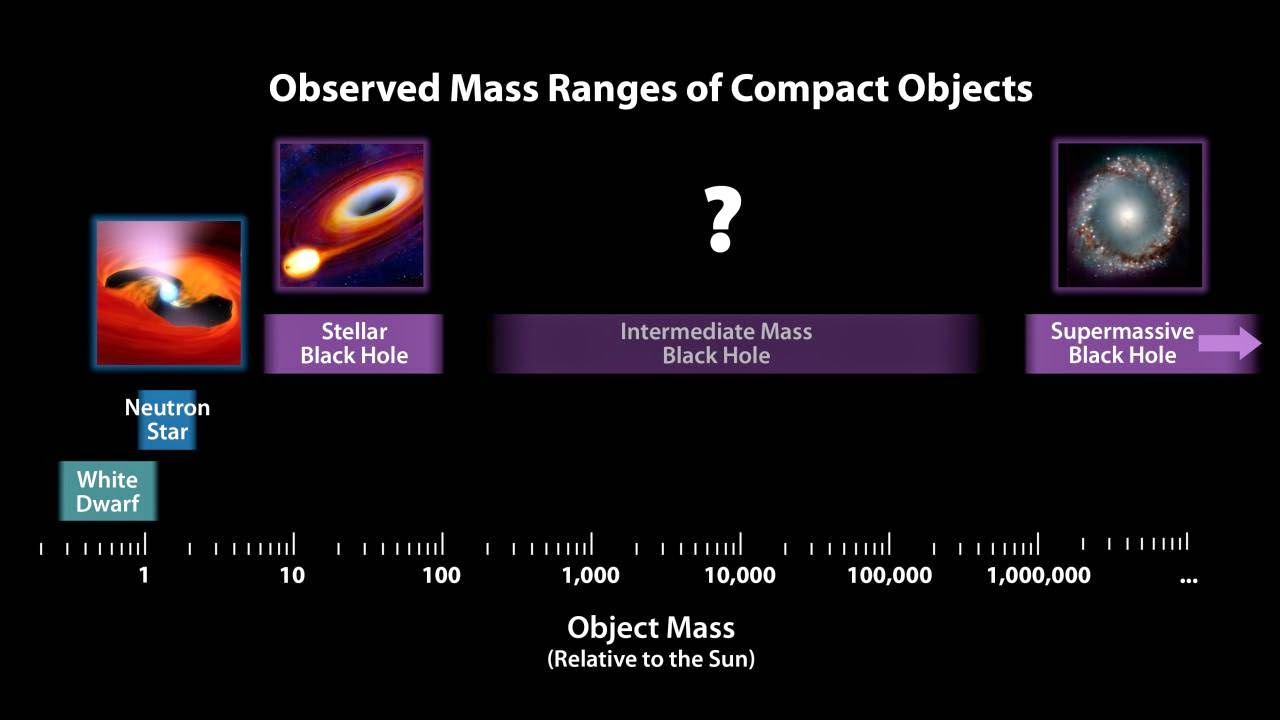
This chart illustrates the relative masses of super-dense cosmic objects, ranging from white dwarfs to the supermassive black holes encased in the cores of most galaxies.Image Credit: NASA/JPL-Caltech.  Full image and caption

The galaxy Messier 82 (M82) is seen here in two different lights. A visible-light view from NASA's Hubble Space Telescope is at left, and an X-ray view from NASA's Chandra X-ray Observatory is at right. Image Credit: NASA/STScI/SAO.  Full image and caption

Astronomers have found a pulsating, dead star beaming with the energy of about 10 million suns. This is the brightest pulsar – a dense stellar remnant left over from a supernova explosion – ever recorded. The discovery was made with NASA's Nuclear Spectroscopic Telescope Array, or NuSTAR.

"You might think of this pulsar as the 'Mighty Mouse' of stellar remnants," said Fiona Harrison, the NuSTAR principal investigator at the California Institute of Technology in Pasadena, California. "It has all the power of a black hole, but with much less mass."

The discovery appears in a new report in the Thursday Oct. 9 issue of the journal Nature.

The surprising find is helping astronomers better understand mysterious sources of blinding X-rays, called ultraluminous X-ray sources (ULXs). Until now, all ULXs were thought to be black holes. The new data from NuSTAR show at least one ULX, about 12 million light-years away in the galaxy Messier 82 (M82), is actually a pulsar.

"The pulsar appears to be eating the equivalent of a black hole diet," said Harrison. "This result will help us understand how black holes gorge and grow so quickly, which is an important event in the formation of galaxies and structures in the universe."

ULXs are generally thought to be black holes feeding off companion stars -- a process called accretion. They also are suspected to be the long-sought after "medium-size" black holes – missing links between smaller, stellar-size black holes and the gargantuan ones that dominate the hearts of most galaxies. But research into the true nature of ULXs continues toward more definitive answers.

NuSTAR did not initially set out to study the two ULXs in M82. Astronomers had been observing a recent supernova in the galaxy when they serendipitously noticed pulses of bright X-rays coming from the ULX known as M82 X-2. Black holes do not pulse, but pulsars do.

Pulsars belong to a class of stars called neutron stars. Like black holes, neutron stars are the burnt-out cores of exploded stars, but puny in mass by comparison. Pulsars send out beams of radiation ranging from radio waves to ultra-high-energy gamma rays. As the star spins, these beams intercept Earth like lighthouse beacons, producing a pulsed signal.

"We took it for granted that the powerful ULXs must be massive black holes," said lead study author Matteo Bachetti, of the University of Toulouse in France. "When we first saw the pulsations in the data, we thought they must be from another source."

NASA's Chandra X-ray Observatory and Swift satellite also have monitored M82 to study the same supernova, and confirmed the intense X-rays of M82 X-2 were coming from a pulsar.

"Having a diverse array of telescopes in space means that they can help each other out," said Paul Hertz, director of NASA's astrophysics division in Washington. "When one telescope makes a discovery, others with complementary capabilities can be called in to investigate it at different wavelengths."

The key to NuSTAR's discovery was its sensitivity to high-energy X-rays, as well as its ability to precisely measure the timing of the signals, which allowed astronomers to measure a pulse rate of 1.37 seconds. They also measured its energy output at the equivalent of 10 million suns, or 10 times more than that observed from other X-ray pulsars. This is a big punch for something about the mass of our sun and the size of Pasadena.

How is this puny, dead star radiating so fiercely? Astronomers are not sure, but they say it is likely due to a lavish feast of the cosmic kind. As is the case with black holes, the gravity of a neutron star can pull matter off companion stars. As the matter is dragged onto the neutron star, it heats up and glows with X-rays. If the pulsar is indeed feeding off surrounding matter, it is doing so at such an extreme rate to have theorists scratching their heads.

Astronomers are planning follow-up observations with NASA's NuSTAR, Swift and Chandra spacecraft to find an explanation for the pulsar’s bizarre behavior. The NuSTAR team also will look at more ULXs, meaning they could turn up more pulsars. At this point, it is not clear whether M82 X-2 is an oddball or if more ULXs beat with the pulse of dead stars. NuSTAR, a relatively small telescope, has thrown a big loop into the mystery of black holes.

“In the news recently, we have seen that another source of unusually bright X-rays in the M82 galaxy seems to be a medium-sized black hole," said astronomer Jeanette Gladstone of the University of Alberta, Canada, who is not affiliated with the study. "Now, we find that the second source of bright X-rays in M82 isn’t a black hole at all. This is going to challenge theorists and pave the way for a new understanding of the diversity of these fascinating objects."

More information about NuSTAR is online at: http://www.nasa.gov/nustar

Felicia Chou
Headquarters, Washington
202-358-0257

felicia.chou@nasa.gov

Whitney Clavin
Jet Propulsion Laboratory, Pasadena, Calif.
818-354-4673

whitney.clavin@jpl.nasa.gov