Showing posts with label Kepler's Supernova Remnant. Show all posts

Tuesday, January 13, 2026

Supernova Remnant Video From NASA's Chandra Is Decades in Making


Kepler's Supernova Remnant
Credit: X-ray: NASA/CXC/SAO; Optical: Pan-STARRS

JPEG (226.7 kb)-Large JPEG (4.3 MB) - Tiff (109 MB) - More Images

A Tour of MSH 15-52 - More Videos


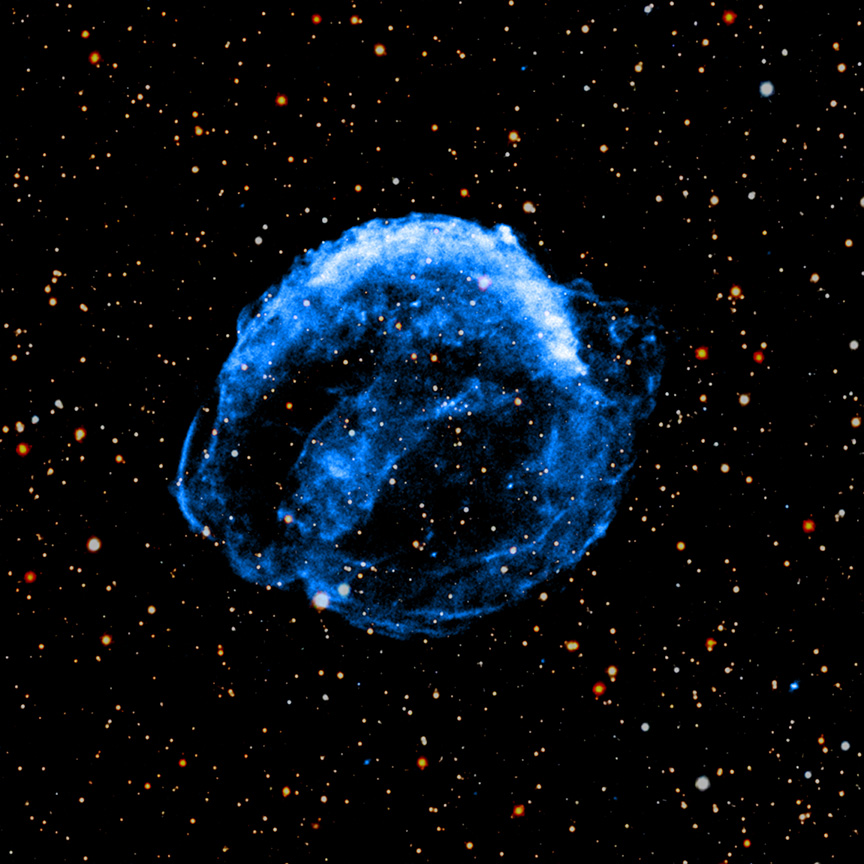

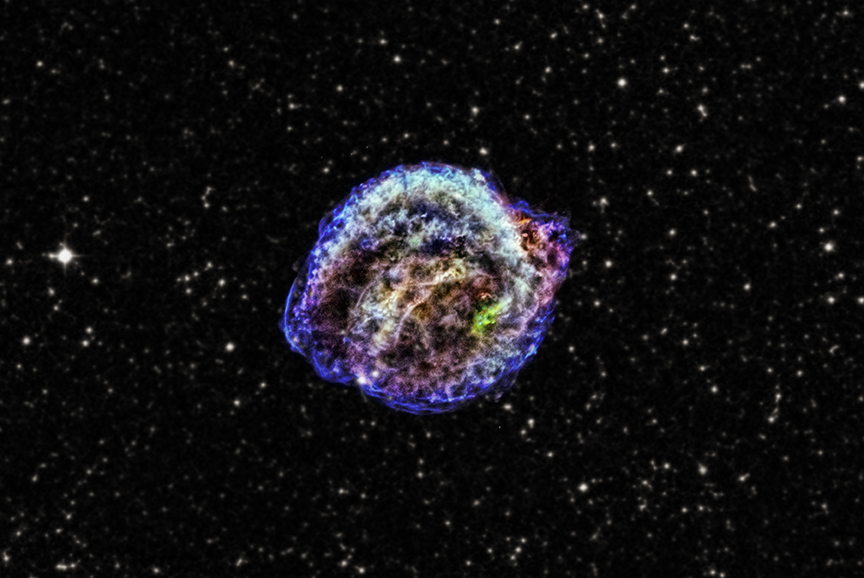
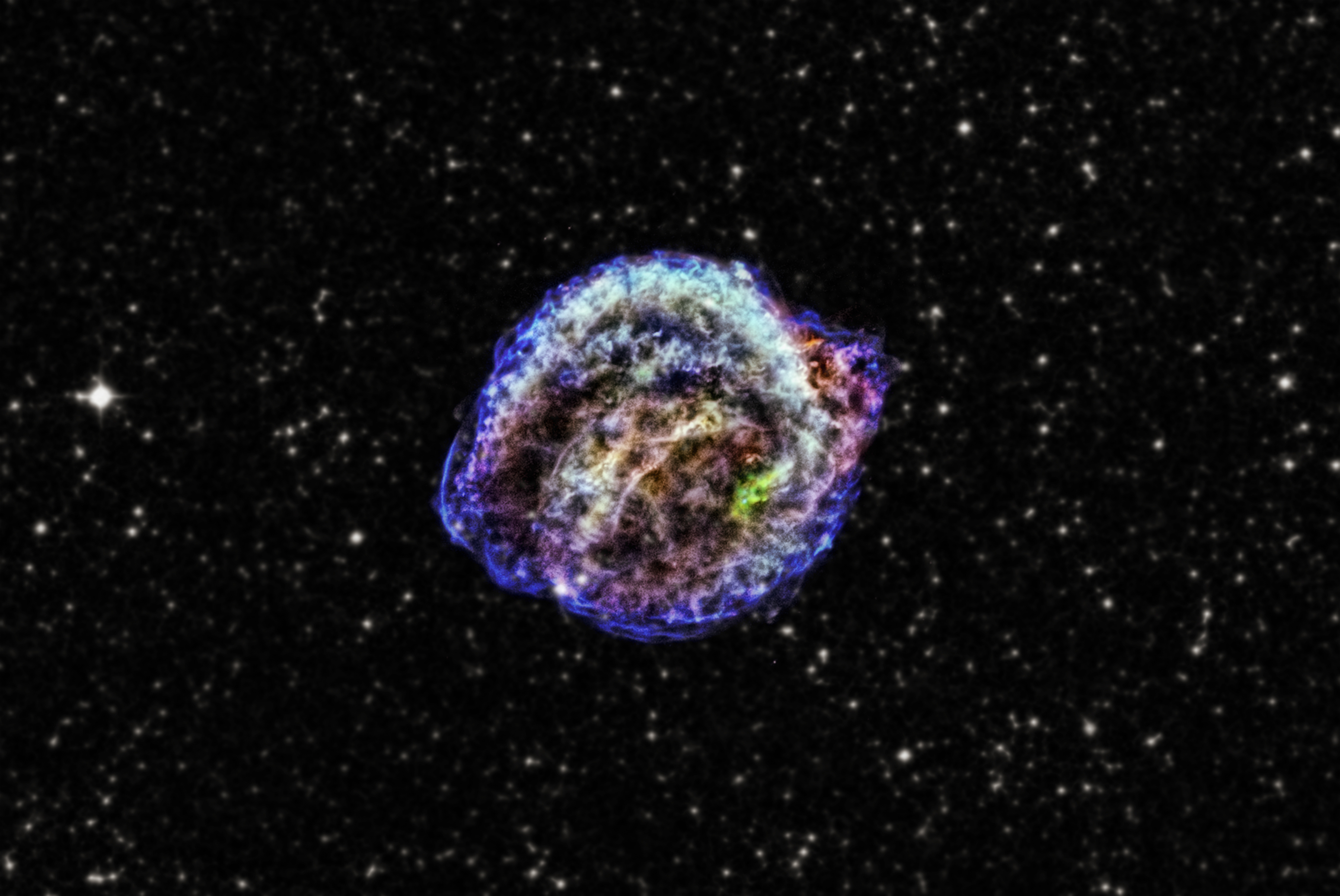
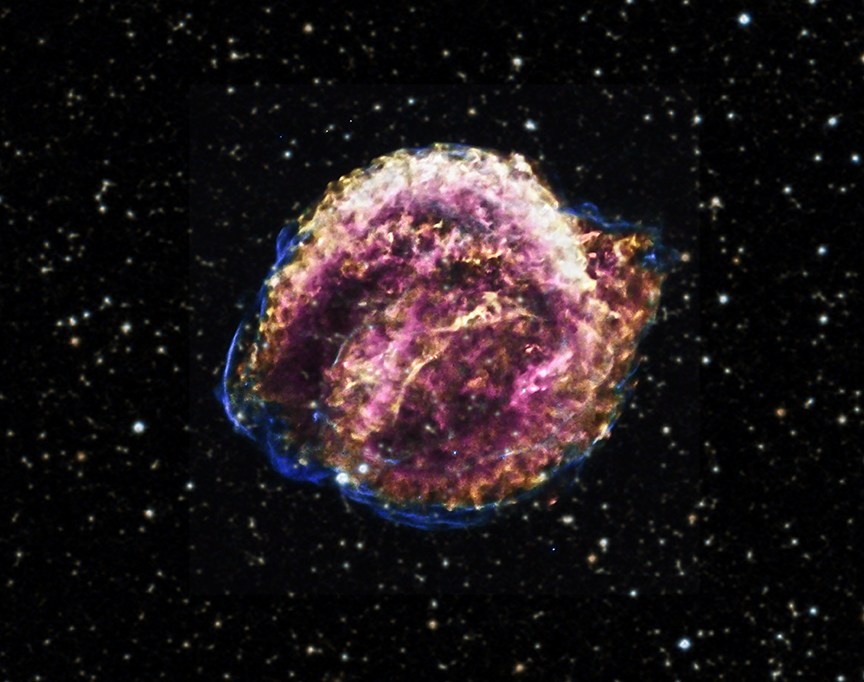
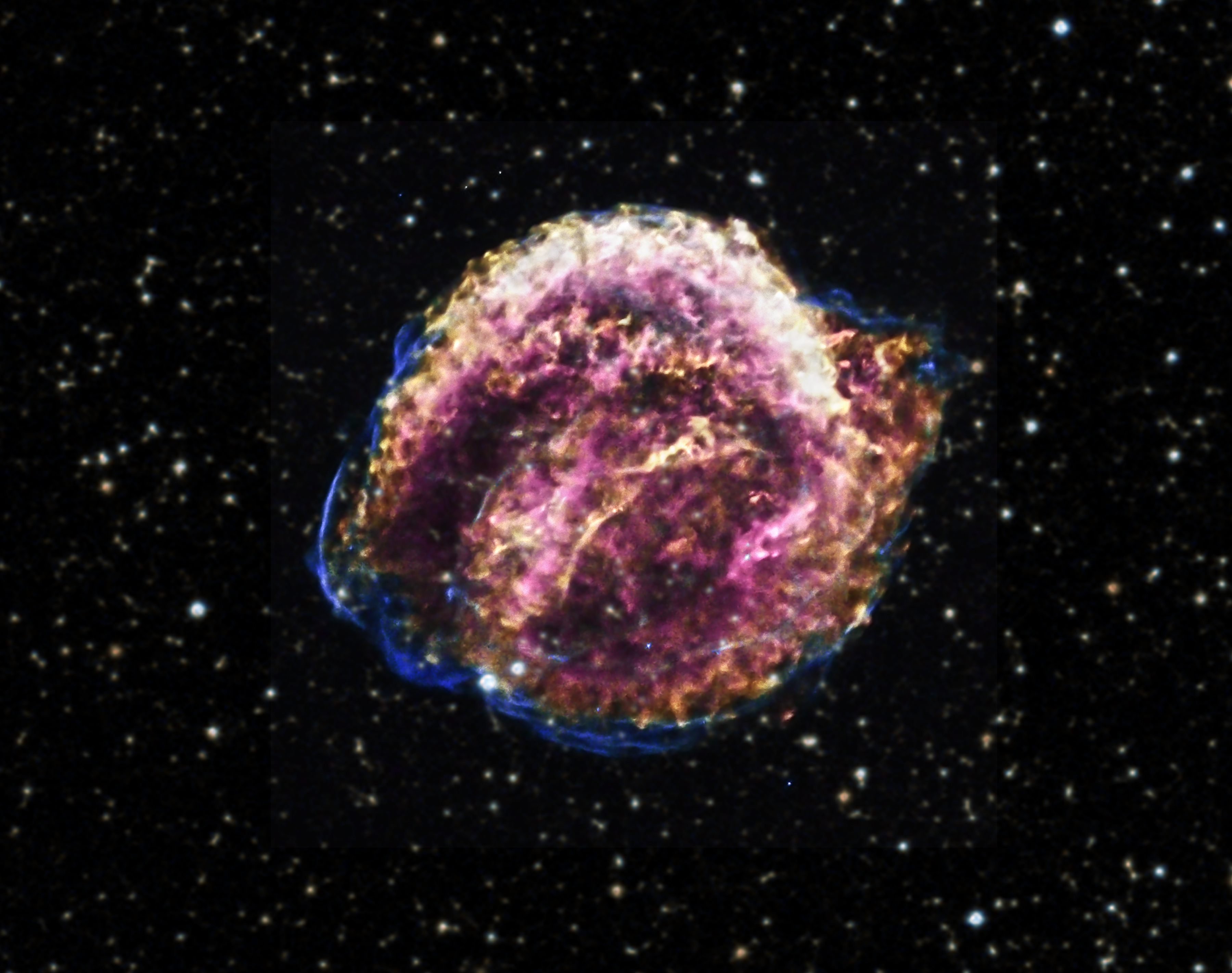
A new video shows changes in Kepler’s Supernova Remnant using data from NASA’s Chandra X-ray Observatory captured over more than two and a half decades with observations taken in 2000, 2004, 2006, 2014, and 2025. In this video, which is the longest-spanning one ever released by Chandra, X-rays (blue) from the telescope have been combined with an optical image (red, green, and blue) from Pan-STARRS.

Kepler’s Supernova Remnant, named after the German astronomer Johannes Kepler, was first spotted in the night sky in 1604. Today, astronomers know that a white dwarf star exploded when it exceeded a critical mass, after pulling material from a companion star, or merging with another white dwarf. This kind of supernova is known as a Type Ia and scientists use it to measure the expansion of the Universe.

Supernova remnants, the debris fields left behind after a stellar explosion, often glow strongly in X-ray light because the material has been heated to millions of degrees from the blast. Kepler’s Supernova Remnant is located in the Milky Way galaxy about 17,000 light-years from Earth. Although this is relatively close in cosmic terms, only Chandra, with its sharp X-ray images and longevity, can see changes like those seen here.

The video allows astronomers to watch as the remains from this shattered star expand and crash into material already thrown out into space. The researchers found that the fastest parts of the remnant are traveling at about 13.8 million miles per hour — or about 2% of the speed of light — moving towards the bottom of the image. Meanwhile, the slowest parts are traveling towards the top at about 4 million miles per hour. This is a large difference in speed, and astronomers think it comes from the fact that the gas that the remnant is plowing into towards the top of the image is denser than the gas towards the bottom. This gives scientists information about the environments into which this star exploded.

Supernova explosions and the elements they hurl into space are the lifeblood of new stars and planets. Understanding exactly how they behave is crucial to knowing our cosmic history.

Jessye Gassel (George Mason University) presented the new Chandra video and the associated research at the 247th meeting of the American Astronomical Society (AAS) meeting in Phoenix, AZ. Quotes from Gassel and co-author Brian Williams from NASA’s Goddard Space Flight Center are provided in our press release.

NASA's Marshall Space Flight Center in Huntsville, Alabama, manages the Chandra program. The Smithsonian Astrophysical Observatory's Chandra X-ray Center controls science operations from Cambridge, Massachusetts, and flight operations from Burlington, Massachusetts


Visual Description:

This release features a ten second silent video of Kepler's expanding Supernova Remnant, located in our own galaxy, about 17,000 light-years from Earth. The video was created using X-ray data gathered in 2000, 2004, 2006, 2014, and 2025. Those distinct datasets were turned into highly-detailed visuals, creating a 25-year timelapse-style video of the growing remnant.

Kepler's Supernova Remnant was once a white dwarf star that exploded when it exceeded its critical mass. Here, in X-ray light, the remnant resembles a cloudy neon blue ring with a diagonal cross line stretching from our upper right down to our lower left. The ring appears thinner and wispier at the bottom, with a band of white arching across the top.

As the video plays, cycling through the 5 datasets, the ring subtly, but clearly, expands, like a slowly inflating balloon. In the video, this sequence is replayed several times with dates included at our lower right, to give sighted learners time to absorb the visual information. Upon close inspection, researchers have determined that the bottom of the remnant is expanding fastest; about 13.8 million miles per hour, or 2% of the speed of light. The top of the ring appears to be expanding the slowest; about 4 million miles per hour, or 0.5% of the speed of light. The large difference in speed is because the gas that the remnant is plowing into towards the top of the image is denser than the gas towards the bottom.

Collecting and interpreting this data over decades has provided information about the environment into which the white dwarf star exploded, and has helped scientists understand how remnants change with time.


Fast Facts for Kepler's Supernova Remnant:

Release Date: January 6, 2026
Scale: Image is about 7.2 arcmin (36 light-years) across.
Category: Supernovas & Supernova Remnants
Coordinates (J2000): RA 17h 30m 40.80s | Dec -21° 29´ 11.00"
Constellation: Ophiuchus
Observation Dates: 18 pointings between June 2000 and July 2025
Observation Time: 298 hours 21.5 minutes (12 days 10 hours 21.5 minutes)
Obs. ID: 116,4650,6714-6718, 7366, 16004, 16614, 29846, 30138, 30140, 30950-30951, 30969-30970, 30986
Instrument: ACIS
Also Known As: SN 1604, G004.5+06.8, V 843 Ophiuchi
References: J. Gassel et al., 2026, 247th AAS meeting
Color Code: X-ray: blue; Optical: red, green, and blue
Distance Estimate: About 17,000 light-years from Earth


Thursday, April 10, 2025

Shedding Light on Candles That Burn a Bit Too Bright

Kepler's Supernova, the remnant of which is shown here in X-ray observations from the Chandra X-ray Observatory, is the most recent known Type Ia supernova in the Milky Way. It was discovered in 1604.  Credit:
NASA/CXC/Univ of Texas at Arlington/M. Millard et al.


Title: 1991T-Like Type Ia Supernovae as an Extension of the Normal Population
Authors: John T. O’Brien et al.
First Author’s Institution: Michigan State University
Status: Published in ApJ

Figure 1: Example of a “Branch classification” diagram for Type Ia supernovae. This figure compares the width of two silicon lines in Type Ia supernovae. Four groups are shown: shallow silicons (SS), broad lines (BL), cools (CL), and core normals (CN). Event SN 1991T is a member of the shallow silicons group (green triangles), indicating that the widths of the minor and major silicon lines are smaller than normal Type Ia supernovae (core normals). Credit:
Burrow et al. 2020

Figure 2: A plot showing the fraction of intermediate-mass elements (IME) as a function of the ionization ratio of the authors’ simulations. Moving to the right on the bottom axis indicates higher ionization states, whereas moving up on the left axis indicates more intermediate-mass elements for a given total ejecta mass. The break between blue stars (normal Type Ia supernovae) and orange stars (1991T-like supernovae) is called the “turnover.” Because the turnover is fairly smooth, it suggests that the progenitor, or stellar origin, of 1991T-like events might be similar to normal events. Credit: O’Brien et al. 2024


Famously, Type Ia supernovae have been used to measure the local Hubble constant, or the rate at which our universe expands. These objects earned the nickname “standard candles” since their near-constant intrinsic luminosities allow us to measure distances in space. Slowly but surely, however, we’ve learned that some of our standard candles aren’t that “standard” after all…

Historically, Type Ia supernovae were proposed to develop from the transfer of mass between two stars, where the star receiving the mass was a carbon–oxygen white dwarf — the core of a low-mass to intermediate-mass star that’s reached the end of its life. After the white dwarf accretes a certain amount of mass, it explodes as a Type Ia supernova. Spectroscopic studies of these supernovae over the decades have shown a wide range of absorption features, one major absorption line being silicon, a key element produced in the explosion. In fact, a subclassification scheme of Type Ia supernovae — often referred to as the Branch classification — emerged based on the relative strengths of particular absorption features commonly identified in the spectra of these events (see Figure 1). One of these subclassifications is “shallow silicon,” which signifies a lack of silicon produced in the explosion. This subclassification (compared to other subclassifications in Figure 1) shows how Type Ia supernovae are like snowflakes: they have very similar structures yet vary in detail.

The supernova SN 1991T was the first observed event of its kind. What was so special about it? This event was considered over-luminous, or more luminous than the typical “near-intrinsic luminosity” of the average Type Ia supernova. Later, as observations improved, more events like SN 1991T were detected, contributing to the growing class of aptly named “1991T-like” events. The spectra of these events have shallow silicon lines compared to the normal range of Type Ia supernovae. The peculiarity of these absorption lines hints at something unique about these events, and the answer lies in studying the ejecta, or the ejected material in which chemical elements are produced. This article is a step toward understanding what differentiates these events from the norm and what we can infer about their origins.

Outside of this work, recent hydrodynamic simulations of various progenitor models, or stellar origins, have successfully recreated some of the observable signatures of Type Ia supernovae, including synthetic, or computed, optical spectra of theoretical events. Except, as previously mentioned, the observable signatures of Type Ia supernovae can vary quite a bit amongst all these subtypes and classifications! Instead of hydrodynamic simulations, the authors of this article chose to reconstruct the supernova ejecta using Bayesian inference and active learning conducted on early-time (within a few days after explosion) optical spectra of already observed normal and 1991T-like events.

This is the time when 1991T-like events show their features! After training the model on this data, the authors developed a model to link the optical spectra and the ejecta properties corresponding to normal and 1991T-like events.
The team’s emulator successfully recreated both normal and 1991T-like events, at least with 68% confidence (think one sigma!). Furthermore, the authors discovered that the variety in the parameters used in their model illuminates some differences between these 1991T-like events and normal Type Ia supernovae. Remember those silicon features? They recreated those pesky absorption lines, particularly the major iron and silicon features experts look for. Their model successfully recreated silicon absorption features that were suppressed, or not as deep. This indicates a low fraction of intermediate-mass elements, which range from lithium to iron, produced in the explosion compared to the total mass. They also matched the deep, major iron line seen in 1991T-like events. Fewer intermediate-mass elements in 1991T-like supernovae suggest that these elements exist at higher ionization states than in normal Type Ia supernovae (see Figure 2). This suggests that there isn’t just a single mechanism that produces a 1991T-like supernova; it’s likely a combination of different physical processes.

The question now becomes: what can we learn about 1991T-like origins from this? Can a single progenitor model lead to different pathways? Or do we need different progenitor models to explain these differences in spectroscopic features? The authors believe fewer intermediate-mass elements and higher ionization states hint at normal and 1991T-like events sharing similar progenitor systems. In other words, 1991T-like events might just be an extension, or extreme, of the normal population. Perhaps the candle just burned a bit too bright!

Aside from this work, in addition to these over-luminous 1991T-like events, there also exists another interesting class of Type Ia supernovae dubbed “super-luminous,” which are roughly one, maybe two, magnitudes brighter than normal Type Ia supernovae. (Only in astronomy could the words over-luminous and super-luminous mean different things, right?) Because of this, researchers advocate for Type Ia supernovae to be called “standardizable” candles instead because, as you now know, their intrinsic luminosities really aren’t that uniform after all.

Original astrobite edited by Ansh Gupta and Dee Dunne.


About the author, Mckenzie Ferrari:

I’m a grad student at the University of Chicago. Most of my research focuses on simulations of Type Ia supernovae and galaxy formation and evolution.


Editor’s Note: Astrobites is a graduate-student-run organization that digests astrophysical literature for undergraduate students. As part of the partnership between the AAS and astrobites, we occasionally repost astrobites content here at AAS Nova. We hope you enjoy this post from astrobites; the original can be viewed at astrobites.org.


Thursday, August 20, 2020

Kepler's Supernova Remnant: Debris from Stellar Explosion Not Slowed After 400 Years

A Quick Look at Kepler's Supernova Remnant 

JPEG (307.5 kb) - Large JPEG (2.2 MB) - Tiff (74.2 MB) - More Images

Tour: Kepler's Supernova Remnant - Kepler's SupernovaRemnant Knots - More Animations


Astronomers have used NASA's Chandra X-ray Observatory to record material blasting away from the site of an exploded star at speeds faster than 20 million miles per hour. This is about 25,000 times faster than the speed of sound on Earth.

The Kepler supernova remnant is the debris from a detonated star that is located about 20,000 light years away from Earth in our Milky Way galaxy. In 1604 early astronomers, including Johannes Kepler who became the object's namesake, saw the supernova explosion that destroyed the star.

We now know that Kepler's supernova remnant is the aftermath of a so-called Type Ia supernova, where a small dense star, known as a white dwarf, exceeds a critical mass limit after interacting with a companion star and undergoes a thermonuclear explosion that shatters the white dwarf and launches its remains outward.

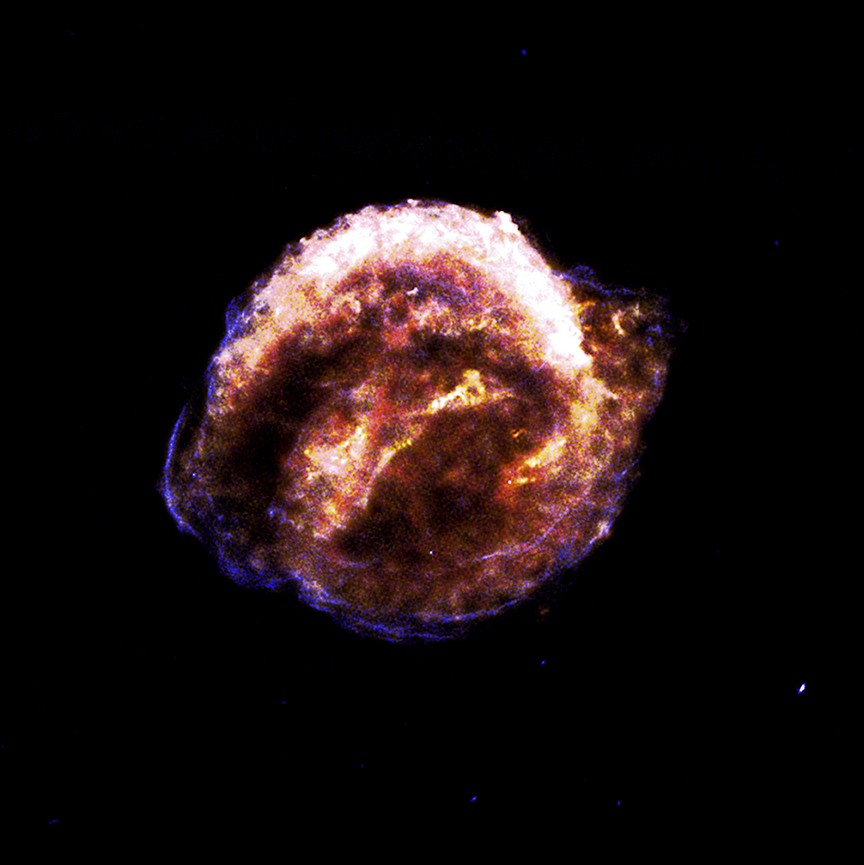
The latest study tracked the speed of 15 small "knots" of debris in the Kepler supernova remnant, all glowing in X-rays. The fastest knot was measured to have a speed of 23 million miles per hour, the highest speed ever detected of supernova remnant debris in X-rays. The average speed of the knots is about 10 million miles per hour, and the blast wave is expanding at about 15 million miles per hour. These results independently confirm the 2017 discovery of knots travelling at speeds more than 20 million miles per hour in the Kepler supernova remnant.

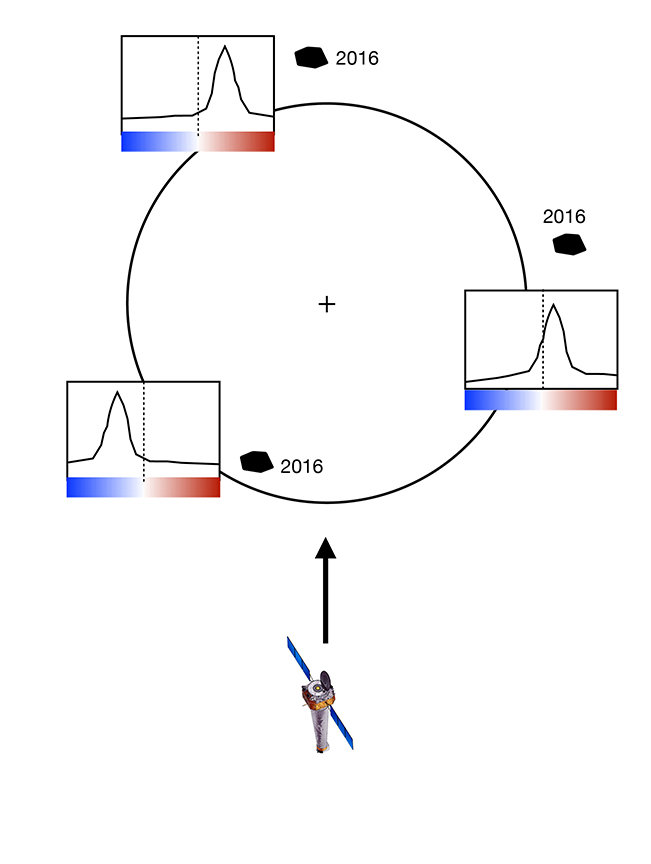
Researchers in the latest study estimated the speeds of the knots by analyzing Chandra X-ray spectra, which give the intensity of X-rays at different wavelengths, obtained in 2016. By comparing the wavelengths of features in the X-ray spectrum with laboratory values and using the Doppler effect, they measured the speed of each knot along the line of sight from Chandra to the remnant. They also used Chandra images obtained in 2000, 2004, 2006 and 2014 to detect changes in position of the knots and measure their speed perpendicular to our line of sight. These two measurements combined to give an estimate of each knot's true speed in three-dimensional space. A graphic gives a visual explanation for how motions of knots in the images and the X-ray spectra were combined to estimate the total speeds.

The 2017 work applied the same general technique as the new study, but used X-ray spectra from a different instrument on Chandra. This meant the new study had more precise determinations of the knot's speeds along the line of sight and, therefore, the total speeds in all directions.

In this new sequence of the four Chandra images of Kepler's supernova remnant, red, green, and blue reveal the low, medium, and high-energy X-rays respectively. The movie zooms in to show several of the fastest moving knots.

The high speeds in Kepler are similar to those scientists have seen in optical observations of supernova explosions in other galaxies only days or weeks after the explosion, well before a supernova remnant forms decades later. This comparison implies that some knots in Kepler have hardly been slowed down by collisions with material surrounding the remnant in the approximately 400 years since the explosion.

Based on the Chandra spectra, eight of the 15 knots are definitely moving away from Earth, but only two are confirmed to be moving towards it. (The other five do not show a clear direction of motion along our line of sight.) This asymmetry in the motion of the knots implies that the debris may not be symmetric along our line of sight, but more knots need to be studied to confirm this result.

The four knots with the highest total speeds are all located along a horizontal band of bright X-ray emission. Three of them are labeled in a close-up view. These four knots are all moving in a similar direction and have similar amounts of heavier elements such as silicon, suggesting that the matter in all of these knots originated from the same layer of the exploded white dwarf.

One of the other fastest moving knots is located in the "ear" of the right side of the remnant, supporting the intriguing idea that the three-dimensional shape of the debris is more like a football than a uniform sphere. This knot and two others are labeled with arrows in a close-up view.

The explanation for the high-speed material is unclear. Some scientists have suggested that the Kepler supernova remnant is from an unusually powerful Type Ia, which might explain the fast-moving material. It is also possible that the immediate environment around the remnant is itself clumpy, which could allow some of the debris to tunnel through regions of low density and avoid being decelerated very much.

The 2017 team also used their data to refine previous estimates of the location of the supernova explosion. This allowed them to search for a companion to the white dwarf that may have been left behind after the supernova, and learn more about what triggered the explosion. They found a lack of bright stars near the center of the remnant. This implied that a star like the Sun did not donate material to the white dwarf until it reached critical mass. A merger between two white dwarfs is favored instead.

The new results have been reported in a paper led by Matthew Millard, from the University of Texas at Arlington, and published in the April 20th, 2020 issue of the Astrophysical Journal. The paper is also available online. The co-authors of the paper are Jayant Bhalerao and Sangwook Park (University of Texas at Arlington), Toshiki Sato (RIKEN in Saitama, Japan, and NASA's Goddard Space Flight Center in Greenbelt, Maryland), John (Jack) Hughes (Rutgers University in Piscataway, New Jersey), Patrick Slane and Daniel Patnaude (Harvard-Smithsonian Center for Astrophysics in Cambridge, Mass.), David Burrows (Penn State University, University Park, Penn.), and Carles Badenes (University of Pittsburgh, Penn).

A paper by Toshiki Sato and Jack Hughes reported the discovery of fast-moving knots in Kepler's supernova remnant and was published in the August 20th, 2017 issue of The Astrophysical Journal. The paper is available online.

The X-ray spectra used by Millard and collaborators were obtained with the Chandra High Energy Transmission Grating.

NASA's Marshall Space Flight Center manages the Chandra program. The Smithsonian Astrophysical Observatory's Chandra X-ray Center controls science from Cambridge Massachusetts and flight operations from Burlington, Massachusetts.
 

Source:  NASA’s Chandra X-ray Observatory


Fast Facts for Kepler's Supernova Remnant:

Credit: NASA/CXC/Univ of Texas at Arlington/M. Millard et al.
Scale: Image is about 7 arcmin (40 light years) across.
Category:
Supernovas & Supernova Remnants
Coordinates (J2000): RA 17h 30m 40.9s | Dec -21° 29´ 38"
Constellation: Ophiuchus
Observation Date: 4 observations: Jun 2000, Oct 2004, Aug 2006, May 2014
Observation Time: 80 hours 38 minutes (3 days 8 hours 38 minutes)
Obs. ID: 116, 4650, 6715, 11614
Instrument:
ACIS
Also Known As: SN 1604, G004.5+06.8, V 843 Ophiuchi
References: Millard M.J. et al., 2020 ApJ, 893, 98;
arXiv:1905.04475
Color Code: X-ray: red (0.5-1.2keV), green (1.2-2.0keV), blue (2.0-7.0keV)
Distance Estimate: About 20,000 light years


Friday, June 06, 2014

New Suspect Identified in Supernova Explosion

This infrared image from NASA's Spitzer Space Telescope shows N103B -- all that remains from a supernova that exploded a millennium ago in the Large Magellanic Cloud, a satellite galaxy 160,000 light-years away from our own Milky Way.Image Credit: NASA/JPL-Caltech/Goddard. Full image and caption

Tuesday, March 19, 2013

Kepler's Supernova Remnant: Famous Supernova Reveals Clues About Crucial Cosmic Distance Markers

 Kepler's Supernova Remnant
 Credit  X-ray: NASA/CXC/NCSU/M.Burkey et al; Optical: DSS 


This is the remnant of Kepler's supernova, the famous explosion that was discovered by Johannes Kepler in 1604. The red, green and blue colors show low, intermediate and high energy X-rays observed with NASA's Chandra X-ray Observatory, and the star field is from the Digitized Sky Survey.

As reported in our press release, a new study has used Chandra to identify what triggered this explosion. It had already been shown that the type of explosion was a so-called Type Ia supernova, the thermonuclear explosion of a white dwarf star. These supernovas are important cosmic distance markers for tracking the accelerated expansion of the Universe.

However, there is an ongoing controversy about Type Ia supernovas. Are they caused by a white dwarf pulling so much material from a companion star that it becomes unstable and explodes? Or do they result from the merger of two white dwarfs?

The new Chandra analysis shows that the Kepler supernova was triggered by an interaction between a white dwarf and a red giant star. The crucial evidence from Chandra was a disk-shaped structure near the center of the remnant. The researchers interpret this X-ray emission to be caused by the collision between supernova debris and disk-shaped material that the giant star expelled before the explosion. Another possibility was that the structure is just debris from the explosion.

The disk structure seen by Chandra in X-rays is very similar in both shape and location to one observed in the infrared by the Spitzer Space Telescope. This composite image shows Spitzer data in pink and Chandra data from iron emission in blue. The disk structure is identified with a label.

 X-ray Image (Elements)

This composite figure also shows a remarkably large and puzzling concentration of iron on one side of the center of the remnant but not the other. The authors speculate that the cause of this asymmetry might be the "shadow" in iron that was cast by the companion star, which blocked the ejection of material. Previously, theoretical work has suggested this shadowing is possible for Type Ia supernova remnants.

The authors also produced a video showing a simulation of the supernova explosion as it interacts with material expelled by the giant star companion. It was assumed that the bulk of this material was expelled in a disk-like structure, with a gas density that is ten times higher at the equator, running from left to right, than at the poles. This simulation was performed in two dimensions and then projected into three dimensions to give an image that can be compared with observations. The good agreement with observations supports their interpretation of the data.

These results were published online and in the February 10th, 2013 issue of The Astrophysical Journal.


Fast Facts for Kepler's Supernova Remnant:

Scale: Image is 12 arcmin across (45 light years)
Category: Supernovas & Supernova Remnants
Coordinates (J2000): RA 17h 30m 40.80s | Dec -21° 29' 11.00"
Constellation: Ophiuchus
Observation Date: 6 pointings between April and July, 2006
Observation Time: 205 hours 50 min (8 days 13 hours 50 min)
Obs. ID: 6714-6718, 7366
Instrument: ACIS
Also Known As: SN 1604, G004.5+06.8, V 843 Ophiuchi
References:  Burkey, M.T. et al, 2013, ApJ, 764, 63; arXiv:1212.4534
Color Code: X-ray (Red, Green, Blue); Optical (Grayscale)

Tuesday, September 11, 2012

Kepler's Supernova Remnant: Was Kepler's Supernova Unusually Powerful?

Kepler's Supernova Remnant
Credit X-ray: NASA/CXC/SAO/D.Patnaude, Optical: DSS

JPEG (434.9 kb) - Large JPEG (3 MB) - Tiff (8.9 MB)
More Images


Tour of Kepler's Supernova Remnant
More Animations

In 1604, a new star appeared in the night sky that was much brighter than Jupiter and dimmed over several weeks. This event was witnessed by sky watchers including the famous astronomer Johannes Kepler. Centuries later, the debris from this exploded star is known as the Kepler supernova remnant.

Astronomers have long studied the Kepler supernova remnant and tried to determine exactly what happened when the star exploded to create it. New analysis of a long observation from NASA's Chandra X-ray Observatory is providing more clues. This analysis suggests that the supernova explosion was not only more powerful, but might have also occurred at a greater distance, than previously thought.

This image shows the Chandra data derived from more than 8 days worth of observing time. The X-rays are shown in five colors from lower to higher energies: red, yellow, green, blue, and purple. These various X-ray slices were then combined with an optical image from the Digitized Sky Survey (light yellow and blue), showing stars in the field.

Previous analysis of this Chandra image has determined that the stellar explosion that created Kepler was what astronomers call a "Type Ia" supernova. This class of supernovas occurs when a white dwarf gains mass, either by pulling gas off a companion star or merging with another white dwarf, until it becomes unstable and is destroyed by a thermonuclear explosion.

Illustration: NASA/CXC/M.Weiss

Unlike other well-known Type Ia supernovas and their remnants, Kepler's debris field is being strongly shaped by what it is running into. More specifically, most Type Ia supernova remnants are very symmetrical, but the Kepler remnant is asymmetrical with a bright arc of X-ray emission in its northern region. This indicates the expanding ball of debris from the supernova explosion is plowing into the gas and dust around the now-dead star.

The bright X-ray arc can be explained in two ways. In one model, the pre-supernova star and its companion were moving through the interstellar gas and losing mass at a significant rate via a wind, creating a bow shock wave similar to that of a boat moving through water. Another possibility is that the X-ray arc is caused by debris from the supernova expanding into an interstellar cloud of gradually increasing density.

The wind and bow shock model described above requires that the Kepler supernova remnant is located at a distance of more than 23,000 light years. In the latter alternative, the gas into which the remnant is expanding has higher density than average, and the distance of the remnant from the earth is between about 16,000 and 20,000 light years. Both alternatives give greater distances than the commonly used value of 13,000 light years.

In either model, the X-ray spectrum - that is, the amount of X-rays produced at different energies – reveals the presence of a large amount of iron, and indicates an explosion more energetic than the average Type Ia supernova. Additionally, to explain the observed X-ray spectrum in this model, a small cavity must have been cleared out around the star before it exploded. Such a cavity, which would have a diameter less than a tenth that of the remnant's current size, might have been produced by a fast, dense outflow from the surface of the white dwarf before it exploded, as predicted by some models of Type Ia supernovas.

Additionally, to explain the observed X-ray spectrum in this model, a small cavity must have been cleared out around the star before it exploded. Such a cavity, which would have a diameter less than a tenth that of the remnant, might have been produced by a fast, dense outflow from the surface of the white dwarf before it exploded, as predicted by some models of Type Ia supernovas.

Evidence for an unusually powerful Type Ia supernova has previously been observed in another remnant with Chandra and an optical telescope. These results were independently verified by subsequent observations of light from the original supernova explosion that bounced off gas clouds, a phenomenon called light echoes. This other remnant is located in the Large Magellanic Cloud, a small galaxy about 160,000 light years from Earth, making it much farther away than Kepler and therefore more difficult to study.

These results were published in the September 1st, 2012 edition of The Astrophysical Journal. The authors of this study are Daniel Patnaude from the Smithsonian Astrophysical Observatory in Cambridge, MA; Carles Badenes from University of Pittsburgh in Pittsburgh, PA; Sangwook Park from the University of Texas at Arlington, TX, and Martin Laming from the Naval Research Laboratory in Washington DC.

NASA's Marshall Space Flight Center in Huntsville, Ala., manages the Chandra program for NASA's Science Mission Directorate in Washington. The Smithsonian Astrophysical Observatory controls Chandra's science and flight operations from Cambridge, Mass.

Fast Facts for Kepler's Supernova Remnant:

Scale: Image is about 5 arcmin across (19-33 light years)
Category:
Supernovas & Supernova Remnants
Coordinates: (J2000) RA 17h 30m 40.80s | Dec -21° 29' 11.00"
Constellation:
Ophiuchus
Observation Date: 6 observations between April - August 2006
Observation Time: 208 hours 48 min (8 days 16 hours 48 min)
Obs. ID: 6714-18, 7366
Instrument:
ACIS
Also Known As: SN 1604, G004.5+06.8, V 843 Ophiuchi
References: Patnaude, D. et al, 2012, ApJ, 756, 6;
arXiv:1206.6799
Color Code: X-ray: (Red=0.7-0.9 keV, Orange=1.6-2.1 keV, Green=2.7-3.4 keV, Blue=4-6 keV, Magenta=6-6.8 keV); Optical: light yellow, blue

Thursday, December 17, 2009

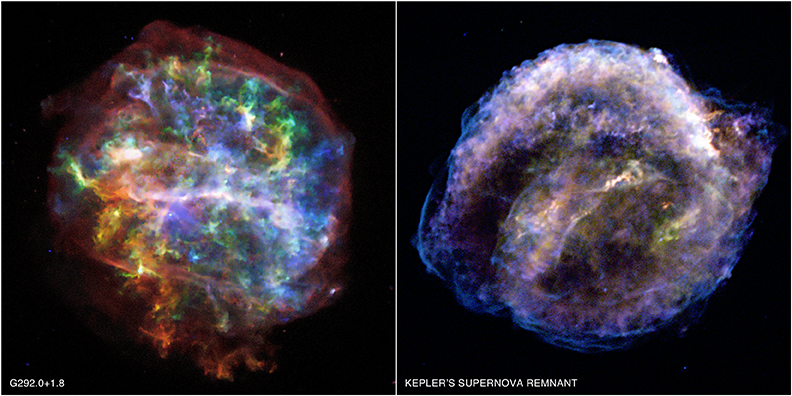
G292.0+1.8 & Kepler's Supernova Remnant: Supernova Explosions Stay In Shape

Credit NASA/CXC/UCSC/L. Lopez et al.


These two supernova remnants are part of a new study from NASA's Chandra X-ray Observatory that shows how the shape of the remnant is connected to the way the progenitor star exploded. In this study, a team of researchers examined the shapes of 17 supernova remnants in both the Milky Way galaxy and a neighbor galaxy, the Large Magellanic Cloud.

The results revealed that one category of supernova explosion, known as "Type Ia," generated a very symmetric, circular remnant. This type of supernova is thought to be caused by a thermonuclear explosion of a white dwarf, and is often used by astronomers as a "standard candle" for measuring cosmic distances. The image in the right panel, the so-called Kepler supernova remnant, represents this type of supernova.

On the other hand, remnants tied to the "core collapse" family of supernova
explosions were distinctly more asymmetric, which is seen in the morphology of the G292.0+1.8 remnant (left). The research team measured asymmetry in two ways: how spherical or elliptical the supernova remnant was and how much one side of the remnant mirrors its opposite side. In G292, the asymmetry is subtle but can be seen in elongated features defined by the brightest emission (colored white).

Out of the 17 supernova remnants sampled, ten were independently classified as the core-collapse variety, while the remaining seven of them were classified as Type Ia. One of these, a remnant known as SNR 0548-70.4, was a bit of an "oddball". This one was considered a Type Ia based on its chemical abundances, but has the asymmetry of a core-collapse remnant.

Fast Facts for G292.0+1.8:

Scale: 11.5 arcmin across.
Category:
Supernovas & Supernova Remnants
Coordinates: (J2000) RA 11h 24m 36.00s | Dec -59° 16' 00.00"
Constellation: Centaurus
Observation Dates: 6 observations between September - October 2006
Observation Time: 144 hours
Obs. IDs: 6677-6680, 8221, and 8447
Color Code: Energy: Red (low energy); Orange (medium-low energy); Green (medium energy); Blue (high energy)

Instrument: ACIS
References Lopez, L. et al, 2009 706 L106-L109; Park, S. et al, 2007, ApJ, 670 L121-L124
Distance Estimate: 20,000 light years


Fast Facts for Kepler's Supernova Remnant:

Scale: 5 arcmin across.
Category: Supernovas & Supernova Remnants
Coordinates: (J2000) RA 17h 30m 40.80s | Dec -21° 29' 11.00"
Constellation: Ophiuchus
Observation Dates: 6 observations between April - August 2006
Observation Time 208 hours
Obs. IDs 6714-18, 7366
Color Code: Energy: Red (low energy);Yellow/Green (medium energy); Blue (high energy)
Instrument:
ACIS
Also Known As: SN 1604, G004.5+06.8, V 843 Ophiuchi
References: Lopez, L. et al, 2009 706 L106-L109; Park, S. et al, 2007, ApJ, 670 L121-L124
Distance Estimate: 13,000 light years