Showing posts with label RCW 86. Show all posts

Wednesday, June 17, 2026

'Crisis averted' as experts confirm universe's expansion IS accelerating

Studying Type Ia supernovae – violent, luminous white dwarf star explosions – led to the Nobel Prize-winning discovery that the universe's expansion is accelerating. This image combines data from four space telescopes to create a multi-wavelength view of all that remains of RCW 86, the oldest documented example of a supernova. Credit: X-ray: NASA/CXC/SAO & ESA; Infared: NASA/JPL-Caltech/B. Williams (NCSU)
Licence type: Attribution (CC BY 4.0)


Our universe's expansion is still accelerating despite recent claims suggesting otherwise, an international team of astrophysicists say.

They refuted a study published last year claiming the growth of the universe is slowing and insist there is no flaw in the widely-accepted theory that a mysterious force known as dark energy is driving the expanding cosmos.

The researchers, who include two Nobel Laureates and represent institutions worldwide, say the debate that followed last November’s revelations was the result of a scientific misunderstanding rather than a cosmic grenade threatening to blow apart everything we know about the universe.

Their paper has been published today in Monthly Notices of the Royal Astronomical Society.

It is a direct rebuttal of a study by a team of South Korean researchers that made the erroneous claim the universe's expansion may have entered a deceleration phase, caused by the influence of dark energy – which acts as a kind of anti-gravity – weakening over time.

"The previous and well accepted measurements were, in fact, fine and our current understanding of the fate of the universe remains robust," said lead author Dr Phil Wiseman, from the University of Southampton.

"Thankfully we have averted this crisis, but the mystery about why the rate of expansion of the universe is still accelerating remains.

"By proving our measurements are correct, we can get back to trying to understand what this dark energy actually is, rather than wondering if it exists at all."

The international team of researchers involved in the new study included Professor Adam Riess and Professor Brian Schmidt, who won the 2011 Nobel Prize in Physics alongside Professor Saul Perlmutter.

The trio studied Type Ia supernovae – violent, luminous white dwarf star explosions – and determined that more distant objects appeared to move faster, leading to their conclusion that the universe's expansion was accelerating.

This has been the globally-accepted theory ever since, although last year's research by the South Korean team threatened to upset the apple cart. It claimed that, as the universe aged, these supernovae had different maximum brightnesses, tricking astronomers into thinking the cosmos was accelerating when it was in fact slowing.

But the University of Southampton-led researchers found an error in how the age of these stars was estimated. They say the previous findings incorrectly assumed the age of a galaxy was the same as the age of the star that exploded.

The experts also said the South Korean paper failed to account for the mass of host galaxies, a standard correction used in modern cosmology to prove accuracy.

Professor Riess added: "Extraordinary claims require especially careful testing.

"What we find is that when we calibrate these supernovae, accounting for different host environments and populations, the evidence for cosmic acceleration remains remarkably consistent."

Professor Mark Sullivan, also from the University of Southampton, said challenging accepted theories and observations was fundamental to science.

"This is how progress is made. Although this idea did not turn out to be correct, it has opened up new ways of thinking about how supernovae explode and how we can measure dark energy more accurately," he added.

Fellow co-author Dr Brodie Popovic agreed. "We've recently been really focused on astrophysics of the explosions and how they impact cosmology," he said.

"This was a good opportunity to go back and go over all of our assumptions – it turns out, yes, we do understand this stuff and we're accounting for it in our cosmology measurement."


Media contacts:

Sam Tonkin
Royal Astronomical Society
Mob: +44 (0)7802 877 700
Email:
press@ras.ac.uk

James Haigh
University of Southampton
Mob: +44 (0)7584 368684
Email:
J.haigh@soton.ac.uk

Science contacts:

Dr Phil Wiseman
University of Southampton
Email:
P.S.Wiseman@soton.ac.uk

Dr Brodie Popovic
University of Southampton
Email:
B.A.Popovic@soton.ac.uk


Images & video

Supernova

Caption: Studying Type Ia supernovae – violent, luminous white dwarf star explosions – led to the Nobel Prize-winning discovery that the universe's expansion is accelerating. This image combines data from four space telescopes to create a multi-wavelength view of all that remains of RCW 86, the oldest documented example of a supernova. Credit: X-ray: NASA/CXC/SAO & ESA; Infared: NASA/JPL-Caltech/B. Williams (NCSU)

Type Ia supernova animation

Caption: This animation shows the explosion of a Type Ia supernova, where the white dwarf's gravity steals material away from a nearby stellar companion until it can no longer sustain its own weight and blows up. Credit: NASA/JPL-Caltech


Further information

The paper '
Still Accelerating: Type Ia supernova cosmology is robust to host galaxy age evolution' by Wiseman et al. has been published in >Monthly Notices of the Royal Astronomical Society. DOI: 10.1093/mnras/stag797.


Notes for editors

About the Royal Astronomical Society

The Royal Astronomical Society (RAS), founded in 1820, encourages and promotes the study of astronomy, solar-system science, geophysics and closely related branches of science.

The RAS organises scientific meetings, publishes international research journals, recognises outstanding achievements by the award of medals and prizes, maintains an extensive library, supports education through grants and outreach activities and represents UK astronomy nationally and internationally. Its more than 4,000 members (Fellows), a third based overseas, include scientific researchers in universities, observatories and laboratories as well as historians of astronomy and others.

The RAS accepts papers for its journals based on the principle of successful peer review, following which experts on the Editorial Boards accept the papers for publication. The Society issues press releases based on a similar principle, but the organisations and scientists concerned have overall responsibility for their content.

Keep up with the RAS on Instagram, Bluesky, LinkedIn, Facebook and YouTube.

Download the RAS Supermassive podcast

Submitted by Sam Tonkin on Thu, 11/06/2026 - 00:01


Friday, April 03, 2026

NASA's IXPE and Chandra Take a New Look at an Old Supernova

RCW 86
Credit: X-ray: Chandra: NASA/CXC/SAO, XMM: ESA/XMM-NEWTON, IXPE:NASA/MSFC;
Optical: NSF/NOIRLab; Image Processing: NASA/CXC/SAO/J. Schmidt


JPEG (278.7 kb) - Large JPEG (4.2 MB) - Tiff (21.4 MB) - More Images

Tour: NASA's Chandra Rings in New Year With Champagne Cluster (Video)


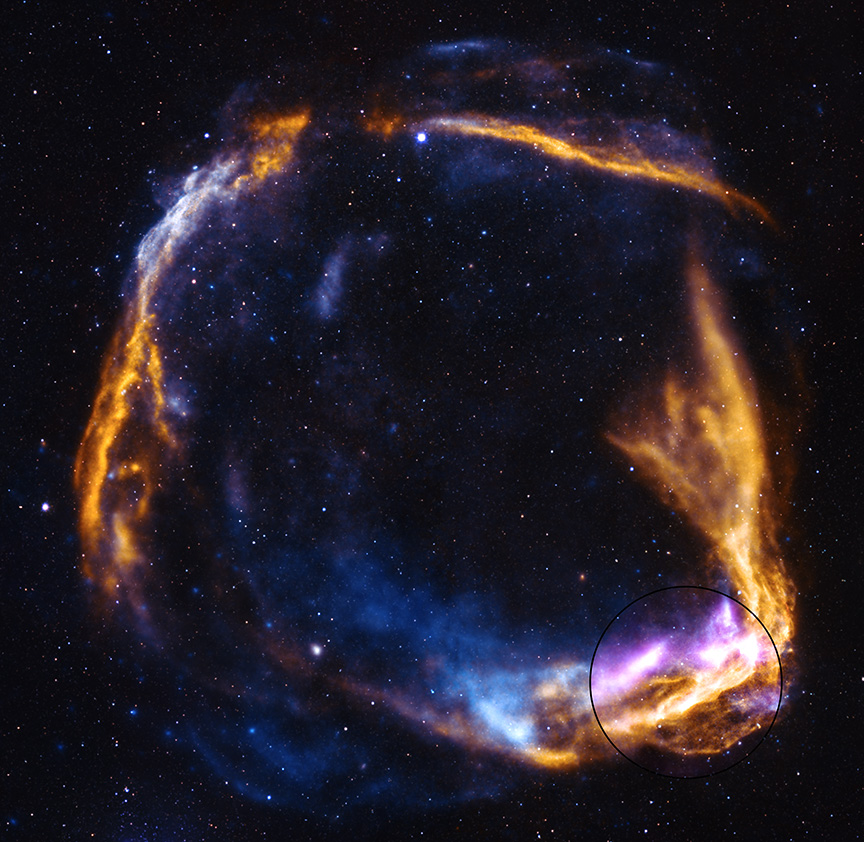
RCW 86 is approximately 8,000 light-years from Earth in the Southern constellation of Circinus, occupying a region of the sky slightly larger than the full moon. In the year 185 AD, Chinese astronomers recorded witnessing a “guest star” in this area of the night sky that remained visible for 8 months.

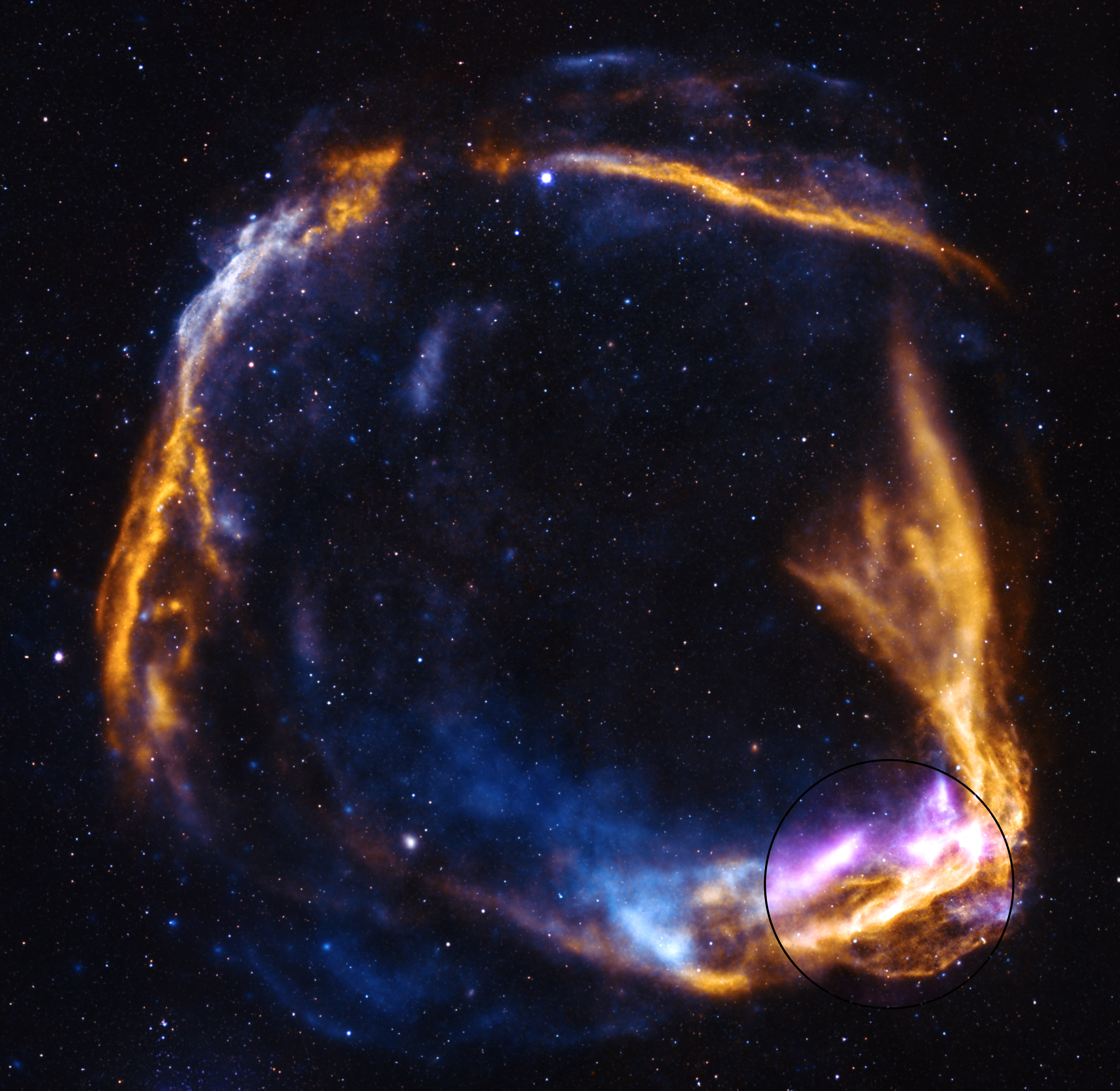
NASA’s IXPE observed the outer rim of the supernova remnant highlighted in purple at the lower right. When NASA’s Chandra X-ray Observatory targeted RCW 86, they discovered that a large “cavity” region around the system led the supernova to expand larger in a shorter amount of time than expected. The low-density cavity region could have led to RCW 86’s unique shape as well.

The full image puts IXPE’s data into context with legacy observations from two other X-ray telescopes: Chandra and the European Space Agency’s XMM-Newton. The yellow represents low-energy X-rays, while blue shows high-energy X-rays detected by Chandra and XMM-Newton. The starfield in the image comes from the National Science Foundation’s National Optical-Infrared Astronomy Research Laboratory (NOIRlab).

NASA's Marshall Space Flight Center in Huntsville, Alabama, manages the Chandra program. The Smithsonian Astrophysical Observatory's Chandra X-ray Center controls science operations from Cambridge, Massachusetts, and flight operations from Burlington, Massachusetts.


Visual Description:

This is an X-ray and optical image of supernova remnant RCW 86, which appears to be two slightly mismatched halves of a broken rough circle. The colors in the image are predominantly blue and gold with a spot of bright purple in the lower right corner. The texture of RCW 86 resembles that of nebulous and patchy fingers, and swirls of gas. This image combines data from four different telescopes to create a multi-wavelength view of the remains of an exploded star. X-ray images from NASA's Chandra X-ray Observatory and the ESA's XMM-Newton are combined to form the blue and gold colors in the image. The X-rays show the interstellar gas that has been heated to millions of degrees by the passage of the shock wave from the supernova. Additional X-ray data from NASA's IXPE are shown in purple, confined to a small circle in the lower right where IXPE observed. A faint starfield, a sprinkling of white stars across the image, from NSF's NOIRlab is also included.


Fast Facts for RCW 86:

Credit: X-ray: Chandra: NASA/CXC/SAO, XMM: ESA/XMM-NEWTON, IXPE:NASA/MSFC; Optical: NSF/NOIRLab; Image Processing: NASA/CXC/SAO/J. Schmid
Release Date: March 25, 2026
Scale: Image is about 43.5 arcmin (101 light-years) across.
Category: Supernovas & Supernova Remnants
Coordinates (J2000): RA 14h 43m 20.6s | Dec -62° 29´ 52.8"
Constellation: Circinus
Observation Dates: 16 observations from Feb 2001–Jan 2021
Observation Time: 164 hours 10 minutes (6 days 20 hours 10 minutes)
Obs. ID: 1993, 2805, 4611, 7642, 10699, 13748, 14890, 15608-15611, 16952, 23597, 24330, 24331, 24931
Instrument: ACIS
Also Known As: G315.4-2.1
References: Silvestri, S. et al, 2026, ApJ, 988, 172.
Color Code: X-ray: (Chandra and XMM) blue and orange, (IXPE) purple; Optical: red, green, blue
Distance Estimate: About 8,000 light-years from Earth.


Monday, March 06, 2023

Supernova From the Year 185: A Rare View of the Entirety of This Supernova Remnant


DECam Images RCW 86, Remains of Supernova Witnessed in 185 
 

Videos

Cosmoview Episode 63:  Supernova From the Year 185: A Rare View of the Entirety of This Supernova Remnant
Cosmoview Episode 63: Supernova From the Year 185: A Rare View of the Entirety of This Supernova Remnant 
 
Cosmoview Episodio 63: Cerro Tololo logra un retrato único de una supernova que explotó hace más de 1.800 años


Dark Energy Camera captures the glowing remains of the first-ever documented supernova

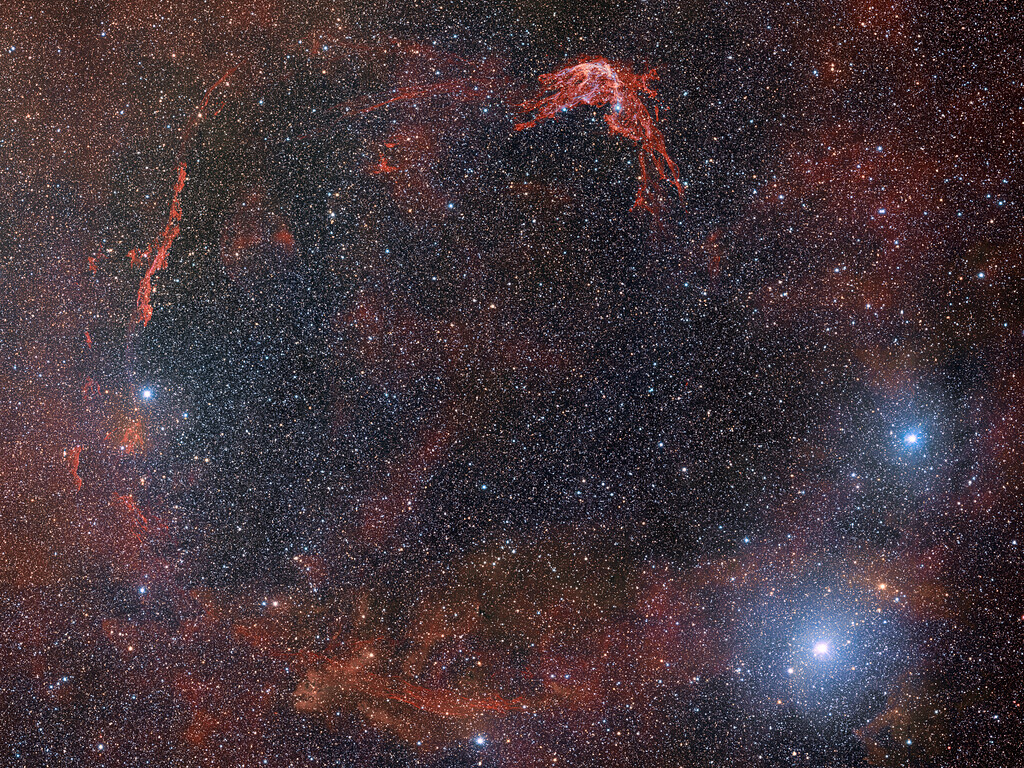
The tattered shell of the first-ever historically recorded supernova was captured by the US Department of Energy-fabricated Dark Energy Camera, which is mounted on the National Science Foundation’s (NSF) Víctor M. Blanco 4-meter Telescope at Cerro Tololo Inter-American Observatory in Chile, a Program of NSF’s NOIRLab. RCW 86’s ring of debris is all that remains of a white-dwarf star that exploded more than 1800 years ago, when it was recorded by Chinese stargazers as a ‘guest star’.

Draped around the outer edges of this star-filled image are wispy tendrils that appear to be flying away from a central point, like the tattered remains of a burst balloon. These cloud-like features are thought to be the glowing remains of a supernova that was witnessed by Chinese astronomers in the year 185 C.E. When it appeared, this baffling addition to the night sky was referred to as a ‘guest star’ by ancient astronomers. It remained visible to the naked eye for about eight months before fading from view. 

This historical supernova, which astronomers now refer to as SN 185, occurred more than 8000 light-years away in the approximate direction of Alpha Centauri, between the constellations of Circinus and Centaurus. The resulting structure, RCW 86 — as imaged by the Dark Energy Camera (DECam) mounted on the Víctor M. Blanco 4-meter Telescope at Cerro Tololo Inter-American Observatory in Chile, a Program of NSF’s NOIRLab — helps shed light on how the remains of the supernova evolved over the past 1800 years. DECam’s amazing wide-field vision enabled astronomers to create this rare view of the entire supernova remnant as it is seen today.

Though the link between RCW 86 and SN 185 is now well established, that wasn’t always the case. For decades, astronomers thought it would take about 10,000 years for a traditional core-collapse supernova — one in which a massive star blows material away from itself by exploding — to form the structure as we see it today. This would make the structure far older than the supernova observed in the year 185. 

This preliminary estimate largely came from measurements of the supernova remnant’s size. But, a 2006 study found that the large size was due instead to an extremely high expansion velocity. The new estimate is much more in line with a comparatively youthful age of about 2000 years, which strengthened the link between RCW 86 and the guest star observed centuries ago.

While a more accurate age estimate brought astronomers one step closer to understanding this unique stellar feature, one mystery still remained. How did RCW 86 expand so fast? The answer was uncovered when X-ray data of the region revealed large amounts of iron present, a tell-tale sign of a different kind of explosion: a Type Ia supernova. This type of blast occurs in a binary star system when a dense white dwarf (the end-of-life remains of a star like our Sun) siphons material from its companion star to the point of detonation. These supernovae are the brightest of all and no doubt SN 185 would have awed observers while it shone brightly in the night sky.

Astronomers now have a more complete picture of how RCW 86 formed. As the white dwarf of the binary system swallowed the material of its companion star, its high-velocity winds pushed the surrounding gas and dust outward, creating the cavity we observe today. Then, when the white dwarf could not support any more mass falling onto it from the companion star, it exploded in a violent eruption. The previously formed cavity gave ample room for the high-velocity stellar remnants to expand very quickly and to create the monumental features we see today. 

This new image of RCW 86 gives astronomers an even deeper look into the physics of this perplexing structure and its formation.

The image was obtained by NOIRLab’s Communication, Education & Engagement team as part of the NOIRLab Legacy Imaging Program.


More information

NSF’s NOIRLab (National Optical-Infrared Astronomy Research Laboratory), the US center for ground-based optical-infrared astronomy, operates the international Gemini Observatory (a facility of NSF, NRC–Canada, ANID–Chile, MCTIC–Brazil, MINCyT–Argentina, and KASI–Republic of Korea), Kitt Peak National Observatory (KPNO), Cerro Tololo Inter-American Observatory (CTIO), the Community Science and Data Center (CSDC), and Vera C. Rubin Observatory (operated in cooperation with the Department of Energy’s SLAC National Accelerator Laboratory). It is managed by the Association of Universities for Research in Astronomy (AURA) under a cooperative agreement with NSF and is headquartered in Tucson, Arizona. The astronomical community is honored to have the opportunity to conduct astronomical research on Iolkam Du’ag (Kitt Peak) in Arizona, on Maunakea in Hawai‘i, and on Cerro Tololo and Cerro Pachón in Chile. We recognize and acknowledge the very significant cultural role and reverence that these sites have to the Tohono O’odham Nation, to the Native Hawaiian community, and to the local communities in Chile, respectively.

Contacts

Charles Blue
NSF’s NOIRLab
Cell: +1 202 236 6324
Email: charles.blue@noirlab.edu

Source: NSF’s National Optical-Infrared Astronomy Research Laboratory (NOIRLab)/News


Thursday, January 22, 2015

IYL 2015: Chandra Celebrates The International Year of Light

M51, SNR E0519-69.0, MSH 11-62, Cygnus A, RCW 86


The year of 2015 has been declared the International Year of Light (IYL) by the United Nations. Organizations, institutions, and individuals involved in the science and applications of light will be joining together for this yearlong celebration to help spread the word about the wonders of light.

In many ways, astronomy uses the science of light. By building telescopes that can detect light in its many forms, from radio waves on one end of the "electromagnetic spectrum" to gamma rays on the other, scientists can get a better understanding of the processes at work in the Universe.

NASA's Chandra X-ray Observatory explores the Universe in X-rays, a high-energy form of light. By studying X-ray data and comparing them with observations in other types of light, scientists can develop a better understanding of objects likes stars and galaxies that generate temperatures of millions of degrees and produce X-rays.

To recognize the start of IYL, the Chandra X-ray Center is releasing a set of images that combine data from telescopes tuned to different wavelengths of light. From a distant galaxy to the relatively nearby debris field of an exploded star, these images demonstrate the myriad ways that information about the Universe is communicated to us through light.


The images, beginning at the upper left and moving clockwise, are:


M51
Messier 51 (M51):
This galaxy, nicknamed the "Whirlpool," is a spiral galaxy, like our Milky Way, located about 30 million light years from Earth. This composite image combines data collected at X-ray wavelengths by Chandra (purple), ultraviolet by the Galaxy Evolution Explorer (GALEX, blue); visible light by Hubble (green), and infrared by Spitzer (red).


SNR E0519-69.0
SNR E0519-69.0:
When a massive star exploded in the Large Magellanic Cloud, a satellite galaxy to the Milky Way, it left behind an expanding shell of debris called SNR 0519-69.0. Here, multimillion degree gas is seen in X-rays from Chandra (blue). The outer edge of the explosion (red) and stars in the field of view are seen in visible light from Hubble.


MSH 11-62
MSH 11-62:
When X-rays, shown in blue, from Chandra and XMM-Newton are joined in this image with radio data from the Australia Telescope Compact Array (pink) and visible light data from the Digitized Sky Survey (DSS, yellow), a new view of the region emerges. This object, known as MSH 11-62, contains an inner nebula of charged particles that could be an outflow from the dense spinning core left behind when a massive star exploded.


Cygnus A
Cygnus A:
This supernova remnant is the remains of an exploded star that may have been witnessed by Chinese astronomers almost 2,000 years ago. Modern telescopes have the advantage of observing this object in light that is completely invisible to the unaided human eye. This image combines X-rays from Chandra (pink and blue) along with visible emission from hydrogen atoms in the rim of the remnant, observed with the 0.9-m Curtis Schmidt telescope at the Cerro Tololo Inter-American Observatory (yellow).


RCW 86
RCW 86:
This galaxy, at a distance of some 700 million light years, contains a giant bubble filled with hot, X-ray emitting gas detected by Chandra (blue). Radio data from the NSF's Very Large Array (red) reveal "hot spots" about 300,000 light years out from the center of the galaxy where powerful jets emanating from the galaxy's supermassive black hole end. Visible light data (yellow) from both Hubble and the DSS complete this view.


In addition to these newly released images, the Chandra X-ray Center has created a new online repository of images called "Light: Beyond the Bulb" for IYL. This project places astronomical objects in context with light in other fields of science and research.

NASA's Marshall Space Flight Center in Huntsville, Alabama, manages the Chandra program for NASA's Science Mission Directorate in Washington. The Smithsonian Astrophysical Observatory in Cambridge, Massachusetts, controls Chandra's science and flight operations.

For more information on "Light: Beyond the Bulb," visit the website at http://lightexhibit.org

For more information on the International Year of Light, go to http://www.light2015.org/Home.html


Fast Facts for Whirlpool Galaxy:

Credit: X-ray: NASA/CXC/SAO; UV: NASA/JPL-Caltech; Optical: NASA/STScI; IR: NASA/JPL-Caltech
Scale: Image: is 6 x 10 arcmin across. (About 52,000 x 87,000 light years)
Category: Normal Galaxies & Starburst Galaxies
Coordinates (J2000): RA 13h 29m 52.3s | Dec +47° 11' 54
Constellation: Canes Venatici
Observation Dates: 11 pointings between Mar 2000 and Oct 2012
Observation Time: 232 hours 10 min (9 days 16 hours 10 min)
Obs. IDs: 353, 354, 1622, 3932, 13812-13816, 15496, 15553
Instrument: ACIS
Also Known As: NGC 5194, NGC 5195
Color Code: X-ray (Purple); Ultraviolet (Blue); Optical (Green); Infrared (Red)
Distance Estimate: About 30 million light years


Fast Facts for SNR E0519-69.0:

Credit: X-ray: NASA/CXC/Rutgers/J.Hughes; Optical: NASA/STScI
Scale: Image is 1.5 arcmin across. (about 70 light years)
Category: Normal Galaxies & Starburst Galaxies
Coordinates (J2000): RA 05h 19m 34.90s | Dec -69° 02' 07.30"
Constellation: Dorado
Observation Dates: 4 pointings between Jun 2000 and Feb 2010
Observation Time: 25 hours 16 min (1 day 1 hour 16 min)
Obs. IDs: 118, 11241, 12062, 12063
Instrument: ACIS
Color Code: X-ray (Blue); Optical (Red, Green, Blue)
Distance Estimate: About 160,000 light years


Fast Facts for MSH 11-62:

Credit: X-ray: NASA/CXC/SAO/P.Slane et al; Optical: DSS; Radio: CSIRO/ATNF/ATCA
Scale: Image is 55 arcmin across. (256 light years)
Category: Normal Galaxies & Starburst Galaxies
Coordinates (J2000): RA 11h 11m 52.00s | Dec -60° 39' 12.00"
Constellation: Carina
Observation Dates: 1 pointing in Apr 2002 and 8 between Oct 2013 and Jan 2014
Observation Time: 131 hours 17 min (5 days 11 hours 17 min)
Obs. IDs: 2782, 14822-14824, 16496, 16497, 16512, 16541, 16566
Instrument: ACIS
Color Code: X-ray (Blue); Optical (Yellow); Radio (Pink)
Distance Estimate: About 16,000 light years


Fast Facts for Cygnus A:

Credit: X-ray: NASA/CXC/SAO; Optical: NASA/STScI; Radio: NSF/NRAO/AUI/VLA
Scale: Image is 2.7 arcmin across. (about 550,000 light years)
Category: Normal Galaxies & Starburst Galaxies
Coordinates (J2000): RA 19h 59m 28.30s | Dec +40° 44' 02.00"
Constellation: Cygnus
Observation Dates: 11 pointings between Mar 2000 and Sep 2005
Observation Time: 67 hours 35 min (2 days 19 hours 35min)
Obs. IDs: 359, 360, 1707, 5830, 5831, 6225, 6226, 6228, 6229, 6250, 6252
Instrument: ACIS
Color Code: X-ray: Blue; Optical: Yellow; Radio: Red
Distance Estimate: About 700 million light years


Fast Facts for RCW 86:

Credit: X-ray: NASA/CXC/MIT/D.Castro et al, Optical: NOAO/AURA/NSF/CTIOScale: Image is 19.5 arcmin across. (about 46.5 light years)
Category Normal Galaxies & Starburst Galaxies
Coordinates (J2000): RA 14h 45m 02.30s | Dec -62º 20' 32.00"
Constellation: Circinus
Observation Dates: 3 pointings in Feb, 2013
Observation Time: 28 hours 57 min (1 day 4 hours 57 min )
Obs. IDs: 14890, 15608, 15609
Instrument: ACIS
Also Known As: G315.4-2.1
Color Code: X-ray (Blue and Pink); Optical (Yellow)
Distance Estimate: About 8,200 light years 


Monday, December 22, 2014

Multicoloured view of supernova remnant

Multicoloured view of supernova remnant
Copyright: ESA/XMM-Newton & NASA/Chandra (X-ray); NASA/WISE/Spitzer (Infrared)
Hi-Res (JPG) (893.97 kB) - Hi-Res (TIF) (6.11 MB)


Most celestial events unfold over thousands of years or more, making it impossible to follow their evolution on human timescales. Supernovas are notable exceptions, the powerful stellar explosions that make stars as bright as an entire galaxy for several days.

Although they are very rare – only a few such explosions take place every century in a typical galaxy – supernovas can be seen with the naked eye if they are reasonably nearby. In fact, when supernovas were discovered they were thought to be new stars appearing in the sky – ‘nova’ means new in Latin.

Astronomers have recorded supernovas long before a theoretical understanding of these events as stellar explosions was developed in the 20th century. The most ancient documented record dates back to 185 AD, when Chinese astronomers saw a ‘guest star’ that remained visible for several months, in the vicinity of the two stars Alpha and Beta Centauri.

The material ejected during these explosions sweeps up gas and dust from the surroundings, creating picturesque supernova remnants that can be observed long after the explosion. Modern astronomers believe that the object shown in this image, the supernova remnant RCW 86, is what remains of the supernova that was discovered in 185 AD.

The blue and green glow at the edges of the bubble represents X-ray emission from hot gas, heated to millions of degrees by shock waves generated after the explosion. The diffuse red glow marks infrared emission from warm dust in the interstellar medium around RCW 86. Sprinkled across the image, in yellow, are young stars that shine brightly at infrared wavelengths.

This image combines X-ray data from ESA’s XMM-Newton and NASA’s Chandra X-ray Observatory (combined to form the blue and green colours) with infrared observations from NASA’s Spitzer Space Telescope and Wide-Field Infrared Survey Explorer (yellow and red).

The supernova remnant RCW 86 is some 8000 light-years away.

This image was first published in 2011.


Monday, October 24, 2011

NASA Telescopes Help Solve Ancient Supernova Mystery

This image combines data from four different space telescopes to create a multi-wavelength view of all that remains of the oldest documented example of a supernova, called RCW 86. Full image and caption

Infrared images from NASA's Spitzer Space Telescope and Wide-field Infrared Survey Explorer (WISE) are combined in this image of RCW 86, the dusty remains of the oldest documented example of an exploding star, or supernova. It shows light from both the remnant itself and unrelated background light from our Milky Way galaxy.

PASADENA, Calif. -- A mystery that began nearly 2,000 years ago, when Chinese astronomers witnessed what would turn out to be an exploding star in the sky, has been solved. New infrared observations from NASA's Spitzer Space Telescope and Wide-field Infrared Survey Explorer, or WISE, reveal how the first supernova ever recorded occurred and how its shattered remains ultimately spread out to great distances.

The findings show that the stellar explosion took place in a hollowed-out cavity, allowing material expelled by the star to travel much faster and farther than it would have otherwise.

"This supernova remnant got really big, really fast," said Brian J. Williams, an astronomer at North Carolina State University in Raleigh. Williams is lead author of a new study detailing the findings online in the Astrophysical Journal. "It's two to three times bigger than we would expect for a supernova that was witnessed exploding nearly 2,000 years ago. Now, we've been able to finally pinpoint the cause."

A new image of the supernova, known as RCW 86, is online at http://go.nasa.gov/pnv6Oy .

In 185 A.D., Chinese astronomers noted a "guest star" that mysteriously appeared in the sky and stayed for about 8 months. By the 1960s, scientists had determined that the mysterious object was the first documented supernova. Later, they pinpointed RCW 86 as a supernova remnant located about 8,000 light-years away. But a puzzle persisted. The star's spherical remains are larger than expected. If they could be seen in the sky today in infrared light, they'd take up more space than our full moon.

The solution arrived through new infrared observations made with Spitzer and WISE, and previous data from NASA's Chandra X-ray Observatory and the European Space Agency's XMM-Newton Observatory.

The findings reveal that the event is a "Type Ia" supernova, created by the relatively peaceful death of a star like our sun, which then shrank into a dense star called a white dwarf. The white dwarf is thought to have later blown up in a supernova after siphoning matter, or fuel, from a nearby star.

"A white dwarf is like a smoking cinder from a burnt-out fire," Williams said. "If you pour gasoline on it, it will explode."

The observations also show for the first time that a white dwarf can create a cavity around it before blowing up in a Type Ia event. A cavity would explain why the remains of RCW 86 are so big. When the explosion occurred, the ejected material would have traveled unimpeded by gas and dust and spread out quickly.

Spitzer and WISE allowed the team to measure the temperature of the dust making up the RCW 86 remnant at about minus 325 degrees Fahrenheit, or minus 200 degrees Celsius. They then calculated how much gas must be present within the remnant to heat the dust to those temperatures. The results point to a low-density environment for much of the life of the remnant, essentially a cavity.

Scientists initially suspected that RCW 86 was the result of a core-collapse supernova, the most powerful type of stellar blast. They had seen hints of a cavity around the remnant, and, at that time, such cavities were only associated with core-collapse supernovae. In those events, massive stars blow material away from them before they blow up, carving out holes around them.

But other evidence argued against a core-collapse supernova. X-ray data from Chandra and XMM-Newton indicated that the object consisted of high amounts of iron, a telltale sign of a Type Ia blast. Together with the infrared observations, a picture of a Type Ia explosion into a cavity emerged.

"Modern astronomers unveiled one secret of a two-millennia-old cosmic mystery only to reveal another," said Bill Danchi, Spitzer and WISE program scientist at NASA Headquarters in Washington. "Now, with multiple observatories extending our senses in space, we can fully appreciate the remarkable physics behind this star's death throes, yet still be as in awe of the cosmos as the ancient astronomers."

NASA's Jet Propulsion Laboratory, Pasadena, Calif., manages the Spitzer Space Telescope mission for NASA's Science Mission Directorate, Washington. Science operations are conducted at the Spitzer Science Center at the California Institute of Technology in Pasadena. Caltech manages JPL for NASA. For more information about Spitzer, visit http://spitzer.caltech.edu/ and http://www.nasa.gov/spitzer .

JPL manages, and operated, WISE for NASA's Science Mission Directorate. The spacecraft was put into hibernation mode after it scanned the entire sky twice, completing its main objectives. Edward Wright is the principal investigator and is at UCLA. The mission was selected competitively under NASA's Explorers Program managed by the agency's Goddard Space Flight Center in Greenbelt, Md. The science instrument was built by the Space Dynamics Laboratory in Logan. The spacecraft was built by Ball Aerospace & Technologies Corp. in Boulder, Colo. Science operations and data processing take place at the Infrared Processing and Analysis Center at Caltech. Caltech manages JPL for NASA. More information is online at http://www.nasa.gov/wise and http://wise.astro.ucla.edu and http://www.jpl.nasa.gov/wise .

Whitney Clavin 818-354-4673
Jet Propulsion Laboratory, Pasadena, Calif.
whitney.clavin@jpl.nasa.gov

Trent J. Perrotto 202-358-0321
NASA Headquarters, Washington
trent.j.perrotto@nasa.gov