Showing posts with label Pinwheel Galaxy. Show all posts

Wednesday, September 16, 2026

NASA's Chandra Unveils Mysterious X-ray Objects

Fast Facts for M101 The Pinwheel Galaxy)
Credit: X-ray: NASA/CXC/Univ. of Alabama/M. Muhibullah et al.; Optical: NASA/ESA/STScI;
Image Processing: NASA/CXC/SAO/N. Wolk


  • Astronomers found a new class of objects using NASA’s Chandra X-ray Observatory.

  • They dubbed these “hypersoft X-ray sources” (HSS) because they give off very low-energy X-rays that are difficult to detect.

  • Despite their stealth output, HSS may be emitting large amounts of ultraviolet radiation.

  • This discovery may help scientists unravel mysteries around Type Ia supernovas and the intergalactic medium.


Astronomers have discovered a new class of objects in multiple galaxies. This result, made possible by NASA’s Chandra X-ray Observatory and outlined in our latest press release, may help scientists solve two outstanding mysteries in astrophysics.

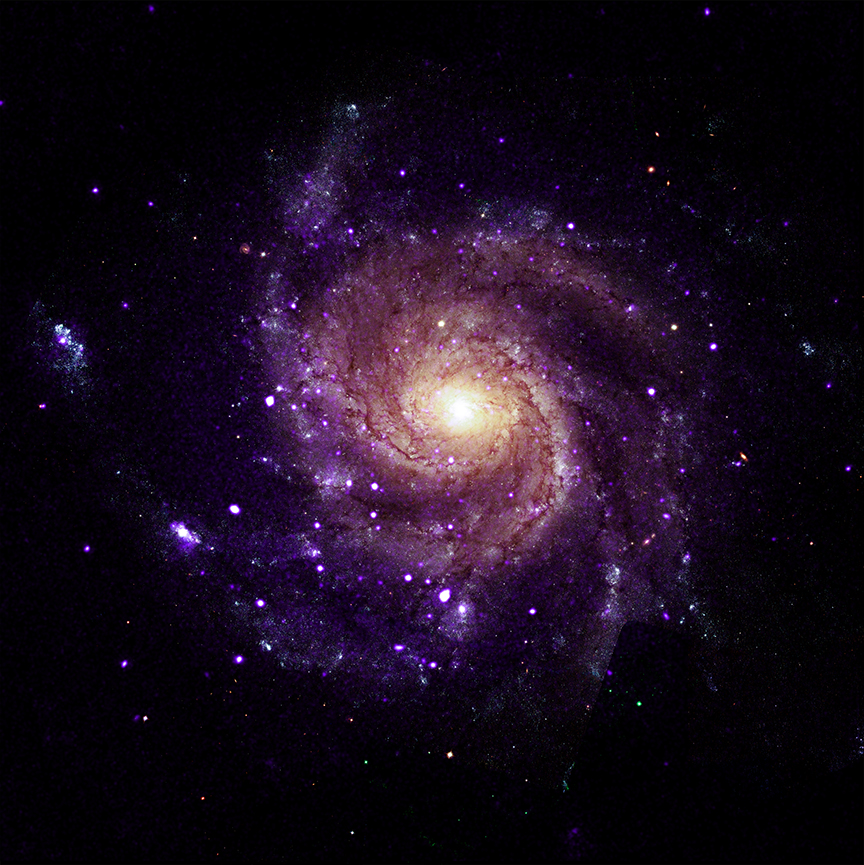
The face-on spiral galaxy M101, also known as the Pinwheel, is one of the galaxies where the new type of object was found. This new M101 composite image contains X-ray data from Chandra (purple) that have been combined with an optical image from the Hubble Space Telescope (red, green, and blue). Circles in an annotated version of the image show the location of the seven newly-discovered objects in M101.

M101 with illustrated circles calling out seven of the newly-discovered objects. (Labeked)
Credit: X-ray: NASA/CXC/Univ. of Alabama/M. Muhibullah et al.; Optical: NASA/ESA/STScI;
Image Processing: NASA/CXC/SAO/N. Wolk

Researchers found a total of 84 of these mysterious objects in M101, Messier 31, and four elliptical galaxies. The objects were named “hypersoft X-ray sources” because they give off very low-energy X-rays that Chandra was only able to detect after long exposures. Because low-energy X-rays border energetic ultraviolet radiation on the electromagnetic spectrum, the team determined that these sources are likely producing large amounts of energetic ultraviolet radiation.

Astronomers are trying to determine what type — or types — of objects are responsible for these low-energy X-rays and intense ultraviolet radiation outputs. The most likely explanation, according to the team, is that these systems involve a black hole, neutron star or white dwarf pulling material from a companion star. The material pulled from the companion star is heated up to produce X-rays before falling onto the white dwarf or neutron star, or into the black hole. While scientists have discovered many binary systems over the years, astronomers have never seen any behaving like this before.

The discovery of this new class of sources suggests that astronomers have missed large populations of binary systems with energetic ultraviolet radiation until now. One idea is that these binary systems are the precursors to Type Ia supernova explosions, which astronomers used to discover the acceleration of the universe’s expansion.

Another open question that these hypersoft X-ray sources could help answer involves the stripping of electrons from gas in between galaxies. Scientists know this phenomenon plays an important role in the lifecycle of the stars, but they still need to accurately account for all of the energy sources that contribute to this process. This newly-discovered class of objects may play a significant role in this stripping.

These hypersoft X-ray sources were not found until now because in addition to the low-energy X-ray output that requires large amounts of observing time from a telescope like Chandra, the high-energy ultraviolet radiation is readily absorbed by helium and hydrogen gas that fills the space in between the stars. This creates a “nearly impenetrable barrier” to look through.

A paper describing this result appears in the most recent issue of Nature Astronomy and is available here. The authors of this paper are Mustafa Muhibullah (University of Alabama), Jimmy Irwin (University of Alabama), and Rosanne DiStefano (Center for Astrophysics | Harvard & Smithsonian).

NASA's Marshall Space Flight Center manages the Chandra program. The Smithsonian Astrophysical Observatory's Chandra X-ray Center controls science operations from Cambridge, Massachusetts, and flight operations from Burlington, Massachusetts.


Fast Facts for M101, The Pinwheel Galaxy

Credit: X-ray: NASA/CXC/Univ. of Alabama/M. Muhibullah et al.; Optical: NASA/ESA/STScI; Image Processing: NASA/CXC/SAO/N. Wolk
Release Date: September 9, 2026
Scale: Image is about 14 arcmin (86,000 light-years) across.
Category:
Normal Galaxies & Starburst Galaxies
Coordinates (J2000): RA 14h 03m 12.5s | Dec +54° 20´ 56.2"
Constellation:
Ursa Major
Observation Dates: 25 observations from March 2000 to January 2005
Observation Time: 274 hours (11 days 10 hours)
Obs. ID: 934, 3095, 4731-4737, 5296, 5297, 5300, 5309, 5322, 5323, 5337-5340, 6114, 6115, 6118, 6152, 6169, 6170, 6175
Instrument:
ACIS
Also Known As: NGC 5457, The Pinwheel Galaxy
References: Muhibullah, M., Irwin, J.A., and Di Stefano, R., 2026, Nature Astronomy (
available here)
Color Code: X-ray: purple; Optical: red, green, and blue
Distance Estimate: About 21 million light-years from Earth


Monday, December 09, 2024

Dark Energy Camera Spies the Outskirts of the Swirling Southern Pinwheel Galaxy

PR Image noirlab2429a
The Outskirts of the Southern Pinwheel Galaxy

PR Image noirlab2429b
The Southern Pinwheel Galaxy (rotated)

PR Image noirlab2429c
Features of the Southern Pinwheel Galaxy


Videos

Cosmoview Episode 90: Dark Energy Camera Spies the Outskirts of the Swirling Southern Pinwheel Galaxy
PR Video noirlab2429a
Cosmoview Episode 90: Dark Energy Camera Spies the Outskirts of the Swirling Southern Pinwheel Galaxy


Cosmoview Episodio 90: Cerro Tololo registra un tesoro cósmico de estrellas nacientes y supernovas exclusivo de los cielos del Sur


The picturesque spiral arms of Messier 83 exhibit a magnificent display of star formation in new image released by NSF NOIRLab

Twelve million light-years away lies the galactic masterpiece Messier 83, also known as the Southern Pinwheel Galaxy. Its swirling spiral arms display a high rate of star formation and have been host to six observed supernovae. This image was captured with the Department of Energy-fabricated Dark Energy Camera, mounted on the U.S. National Science Foundation Víctor M. Blanco 4-meter Telescope at Cerro Tololo Inter-American Observatory in Chile, a Program of NSF NOIRLab.

Messier 83, also known as the Southern Pinwheel Galaxy, is one of the most prominent spiral galaxies in the night sky. It’s named for its resemblance to the Pinwheel Galaxy and spans around 50,000 light-years, making it much smaller than the Milky Way galaxy, although it has a higher rate of star formation, as evidenced by the striking bursts of pink throughout its spiral arms. This display of intense starburst activity likely results from a past merger with another galaxy.

This image was captured with the Department of Energy-fabricated Dark Energy Camera (DECam), mounted on the U.S. National Science Foundation Víctor M. Blanco 4-meter telescope at Cerro Tololo Inter-American Observatory (CTIO), a Program of NSF NOIRLab.

Between 1750 and 1754, French astronomer Nicolas-Louis de Lacaille was studying the night sky with the aim of determining the distances to the planets. During this period he observed and cataloged 10,000 stars and identified 42 nebulous objects, including Messier 83, which he discovered in 1752 during his expedition to the Cape of Good Hope.

In 1781 Charles Messier added it to his famous catalog, describing it as a “nebula without stars,” reflecting the limited knowledge of galaxies at the time. It wasn’t until the 20th century, through the work of Edwin Hubble, that astronomers realized objects like Messier 83 are actually other galaxies far outside the Milky Way.

This image shows Messier 83’s well-defined spiral arms, filled with pink clouds of hydrogen gas where new stars are forming. Interspersed amongst these pink regions are bright blue clusters of hot, young stars whose ultraviolet radiation has blown away the surrounding gas. At the galaxy’s core, a yellow central bulge is composed of older stars, and a weak bar connects the spiral arms through the center, funneling gas from the outer regions toward the core. DECam’s high sensitivity captures Messier 83’s extended halo, and myriad more distant galaxies in the background.

Just as Messier 83 is filled with countless newly formed stars, the galaxy is also host to many dying stars. In the past century, astronomers have witnessed a total of six stellar explosions, called supernovae, in Messier 83 — a number matched by only two other galaxies. And while we have only detected these six stellar deaths, the galaxy is estimated to be filled with hundreds of thousands of ‘ghosts’ of dead stars called supernova remnants.

In 2006 a mysterious feature of Messier 83 was discovered by NSF NOIRLab astronomer Ruben Diaz and an international team of astronomers using the Gemini South telescope, one half of the International Gemini Observatory, funded in part by the NSF and operated by NSF NOIRLab. At the heart of this galaxy, they discovered a previously unseen concentration of mass resembling a second nucleus, likely the remnant of another galaxy that is being consumed by Messier 83 in an ongoing collision — possibly the same collision responsible for the starburst activity. The two nuclei, which likely contain black holes, are expected to merge to form a single nucleus in another 60 million years.


More information

NSF NOIRLab (U.S. National Science Foundation National Optical-Infrared Astronomy Research Laboratory), the U.S. center for ground-based optical-infrared astronomy, operates the International Gemini Observatory (a facility of NSF, NRC–Canada, ANID–Chile, MCTIC–Brazil, MINCyT–Argentina, and KASI–Republic of Korea), NSF Kitt Peak National Observatory (KPNO), NSF Cerro Tololo Inter-American Observatory (CTIO), the Community Science and Data Center (CSDC), and NSF–DOE Vera C. Rubin Observatory (operated in cooperation with the Department of Energy’s SLAC National Accelerator Laboratory). It is managed by the Association of Universities for Research in Astronomy (AURA) under a cooperative agreement with NSF and is headquartered in Tucson, Arizona. The astronomical community is honored to have the opportunity to conduct astronomical research on I’oligam Du’ag (Kitt Peak) in Arizona, on Maunakea in Hawai‘i, and on Cerro Tololo and Cerro Pachón in Chile. We recognize and acknowledge the very significant cultural role and reverence that these sites have to the Tohono O’odham Nation, to the Native Hawaiian community, and to the local communities in Chile, respectively


Links


Contacts:

Josie Fenske
Jr. Public Information Officer
NSF NOIRLab
Email:
josie.fenske@noirlab.edu


Sunday, April 07, 2024

A Hundred Million Suns

SN 2023ixf occurred in a spiral arm of the pinwheel galaxy near several star-forming regions.
Credit: Travis Deyoe, Mount Lemmon SkyCenter, University of Arizona


Maunakea, Hawai – Accounts of supernovae – exploding stars – go back thousands of years, and while we know today these events create the building blocks of life itself, there are still unanswered questions about the conditions that cause a star to explode.

Researchers from the Weizmann Institute of Science have now made major headway in better understanding these fascinating phenomena. Using multiple telescopes, including W. M. Keck Observatory on Maunakea, Hawaiʻi Island, they were able to gather data from a once-in-a-lifetime supernova called SN 2023ixf. Their findings are published in today’s edition of the journal Nature.

Until recently, supernovae were considered rare with known occurrences in the Milky Way happening once a century at best, lighting up the night sky with the intensity of 100 million suns; the last observable explosion in our galaxy took place hundreds of years ago.

Advances in telescope technology have since helped identify supernovae in distant galaxies, supplying more data than was previously possible. Still, the same problem persists; since explosions can’t be predicted, astrophysicists are like space archeologists, usually arriving at the scene after the event and trying to piece together information from the remains.

“That’s what makes this particular supernova different,” says PhD student Erez Zimmerman of Prof. Avishay Gal-Yam’s group at Weizmann. “We were able – for the very first time – to closely follow a supernova while its light was emerging from the circumstellar material in which the exploding star was embedded.”

The discovery was equivalent to getting to the scene of the crime while the crime was still taking place.

A composite image taken with the Liverpool Telescope showing the location of SN 2023ixf, a red supergiant supernova (the most blue object in the rectangle) that occurred 22 million light-years from Earth in the Pinwheel Galaxy. Credit: E. Zimmerman et al., Weizmann Institute of Science/Liverpool Telescope.

The scientists admit they were lucky. Gal-Yam’s team applied for research time on NASA’s Hubble Space Telescope, hoping to gather ultraviolet (UV) spectral data on any supernova interacting with its environment. Instead, they got the chance to witness in real-time one of the closest supernovae in decades: a red supergiant exploding in a neighboring galaxy called Messier 101, also known as the Pinwheel Galaxy.

Koichi Itagaki, an amateur astronomer from Japan, discovered SN 2023ixf and reported it on a Friday night, which was in the middle of the weekend in Israel (the work week in Israel is Sunday-Thursday) and right before the weekend in Baltimore’s Space Telescope Science Institute – the operations center for the Hubble Telescope. Complicating things even further, it took place two days before Zimmerman’s wedding. But his team quickly conducted follow-up observations of the supernova, pulling an all-nighter on Friday and delivering the necessary measurements to NASA in the nick of time.

“It’s very rare, as a scientist, that you have to act so swiftly,” says Gal-Yam. “Most scientific projects don’t happen in the middle of the night, but the opportunity arose, and we had no choice but to respond accordingly.”

Not only did they succeed in getting Hubble to assume the right coordinates and angle for recording the necessary data, but because of the explosion’s relative proximity, it turned out Hubble had already made recordings in this sector of the universe many times before. Turning to the NASA archives, Gal-Yam’s team and many other groups were able to acquire data from before the star’s eventual demise – when it was still just a red supergiant in its final stages of life – thus creating the most complete portrait of a supernova ever: a composite of its last days and death.

Observations of SN 2023ixf consisted of UV and X-ray data from NASA’s Hubble and Swift satellites, as well as many of the best telescopes across the globe.

This included spectra captured using three of Keck Observatory’s instruments – the Keck Cosmic Web Imager (KCWI), Deep Imaging and Multi-Object Spectrograph (DEIMOS), and Low Resolution Imaging Spectrometer (LRIS) – with each instrument offering a unique view of the supernova and how it changed over time.

The compilation of high-quality space- and ground-based data enabled the researchers to map out the two outer layers of the exploding star and come up with an extraordinary hypothesis.

“Calculations of the circumstellar material emitted in the explosion, as well as this material’s density and mass before and after the supernova, create a discrepancy, which makes it very likely that the missing mass ended up in a black hole that was formed in the aftermath of the explosion – something that’s usually very hard to determine,” says PhD student Ido Irani of Gal-Yam’s team.

“Stars behave very erratically in their senior years,” says Gal-Yam. “They become unstable and we usually cannot be sure which complex processes occur within them because we always start the forensic process after the fact, when much of the data has already been lost.”

“This study presents a unique opportunity to better understand the mechanisms that lead to the conclusion of a star’s life and the eventual formation of something entirely new,” said Zimmerman.

Scientists may never find out what will happen to the matter that made up Messier 101’s former red supergiant. However, the later stages of the supernova are ongoing and new data are still coming in, which means this study, along with follow-up studies of SN 2023ixf, could provide more insight into these explosive events.


About KCWI

The Keck Cosmic Web Imager (KCWI) is designed to provide visible band, integral field spectroscopy with moderate to high spectral resolution formats and excellent sky-subtraction. The astronomical seeing and large aperture of the telescope enables studies of the connection between galaxies and the gas in their dark matter halos, stellar relics, star clusters, and lensed galaxies. KCWI covers the blue side of the visible spectrum; the instrument also features the Keck Cosmic Reionization Mapper (KCRM), extending KCWI’s coverage to the red side of the visible spectrum. The combination of KCWI-blue and KCRM provides simultaneous high-efficiency spectral coverage across the entire visible spectrum. Support for KCWI was provided by the National Science Foundation, Heising-Simons Foundation, and Mt. Cuba Astronomical Foundation. Support for KCRM was provided by the National Science Foundation and Mt. Cuba Astronomical Foundation.


About DEIMOS

The DEep Imaging and Multi-Object Spectrograph (DEIMOS) boasts the largest field of view (16.7arcmin by 5 arcmin) of any of the Keck Observatory instruments, and the largest number of pixels (64 Mpix). It is used primarily in its multi-object mode, obtaining simultaneous spectra of up to 130 galaxies or stars. Astronomers study fields of distant galaxies with DEIMOS, efficiently probing the most distant corners of the universe with high sensitivity.


About LRIS

The Low Resolution Imaging Spectrometer (LRIS) is a very versatile and ultra-sensitive visible-wavelength imager and spectrograph built at the California Institute of Technology by a team led by Prof. Bev Oke and Prof. Judy Cohen and commissioned in 1993. Since then it has seen two major upgrades to further enhance its capabilities: the addition of a second, blue arm optimized for shorter wavelengths of light and the installation of detectors that are much more sensitive at the longest (red) wavelengths. Each arm is optimized for the wavelengths it covers. This large range of wavelength coverage, combined with the instrument’s high sensitivity, allows the study of everything from comets (which have interesting features in the ultraviolet part of the spectrum), to the blue light from star formation, to the red light of very distant objects. LRIS also records the spectra of up to 50 objects simultaneously, especially useful for studies of clusters of galaxies in the most distant reaches, and earliest times, of the universe. LRIS was used in observing distant supernovae by astronomers who received the Nobel Prize in Physics in 2011 for research determining that the universe was speeding up in its expansion.


About W. M. Keck Observatory/News

The W. M. Keck Observatory telescopes are among the most scientifically productive on Earth. The two 10-meter optical/infrared telescopes atop Maunakea on the Island of Hawaii feature a suite of advanced instruments including imagers, multi-object spectrographs, high-resolution spectrographs, integral-field spectrometers, and world-leading laser guide star adaptive optics systems. Some of the data presented herein were obtained at Keck Observatory, which is a private 501(c) 3 non-profit organization operated as a scientific partnership among the California Institute of Technology, the University of California, and the National Aeronautics and Space Administration. The Observatory was made possible by the generous financial support of the W. M. Keck Foundation. The authors wish to recognize and acknowledge the very significant cultural role and reverence that the summit of Maunakea has always had within the Native Hawaiian community. We are most fortunate to have the opportunity to conduct observations from this mountain.