Showing posts with label M101. Show all posts

Tuesday, July 16, 2019

New Hubble Constant Measurement Adds to Mystery of Universe's Expansion Rate

Galaxies Used to Refine the Hubble Constant
Credit: NASA, ESA, W. Freedman (University of Chicago), ESO, and the Digitized Sky Survey

Astronomers have made a new measurement of how fast the universe is expanding, using an entirely different kind of star than previous endeavors. The revised measurement, which comes from NASA's Hubble Space Telescope, falls in the center of a hotly debated question in astrophysics that may lead to a new interpretation of the universe's fundamental properties.

Scientists have known for almost a century that the universe is expanding, meaning the distance between galaxies across the universe is becoming ever more vast every second. But exactly how fast space is stretching, a value known as the Hubble constant, has remained stubbornly elusive.

Now, University of Chicago professor Wendy Freedman and colleagues have a new measurement for the rate of expansion in the modern universe, suggesting the space between galaxies is stretching faster than scientists would expect. Freedman's is one of several recent studies that point to a nagging discrepancy between modern expansion measurements and predictions based on the universe as it was more than 13 billion years ago, as measured by the European Space Agency's Planck satellite.

As more research points to a discrepancy between predictions and observations, scientists are considering whether they may need to come up with a new model for the underlying physics of the universe in order to explain it. 

"The Hubble constant is the cosmological parameter that sets the absolute scale, size and age of the universe; it is one of the most direct ways we have of quantifying how the universe evolves," said Freedman. "The discrepancy that we saw before has not gone away, but this new evidence suggests that the jury is still out on whether there is an immediate and compelling reason to believe that there is something fundamentally flawed in our current model of the universe.”

In a new paper accepted for publication in The Astrophysical Journal, Freedman and her team announced a new measurement of the Hubble constant using a kind of star known as a red giant. Their new observations, made using Hubble, indicate that the expansion rate for the nearby universe is just under 70 kilometers per second per megaparsec (km/sec/Mpc). One parsec is equivalent to 3.26 light-years distance.

This measurement is slightly smaller than the value of 74 km/sec/Mpc recently reported by the Hubble SH0ES (Supernovae H0 for the Equation of State) team using Cepheid variables, which are stars that pulse at regular intervals that correspond to their peak brightness. This team, led by Adam Riess of the Johns Hopkins University and Space Telescope Science Institute, Baltimore, Maryland, recently reported refining their observations to the highest precision to date for their Cepheid distance measurement technique.

How to Measure Expansion

A central challenge in measuring the universe's expansion rate is that it is very difficult to accurately calculate distances to distant objects.

In 2001, Freedman led a team that used distant stars to make a landmark measurement of the Hubble constant. The Hubble Space Telescope Key Project team measured the value using Cepheid variables as distance markers. Their program concluded that the value of the Hubble constant for our universe was 72 km/sec/Mpc.

But more recently, scientists took a very different approach: building a model based on the rippling structure of light left over from the big bang, which is called the Cosmic Microwave Background. The Planck measurements allow scientists to predict how the early universe would likely have evolved into the expansion rate astronomers can measure today. Scientists calculated a value of 67.4 km/sec/Mpc, in significant disagreement with the rate of 74.0 km/sec/Mpc measured with Cepheid stars.

Astronomers have looked for anything that might be causing the mismatch. "Naturally, questions arise as to whether the discrepancy is coming from some aspect that astronomers don't yet understand about the stars we're measuring, or whether our cosmological model of the universe is still incomplete," Freedman said. "Or maybe both need to be improved upon."

Freedman's team sought to check their results by establishing a new and entirely independent path to the Hubble constant using an entirely different kind of star.

Certain stars end their lives as a very luminous kind of star called a red giant, a stage of evolution that our own Sun will experience billions of years from now. At a certain point, the star undergoes a catastrophic event called a helium flash, in which the temperature rises to about 100 million degrees and the structure of the star is rearranged, which ultimately dramatically decreases its luminosity. 

Astronomers can measure the apparent brightness of the red giant stars at this stage in different galaxies, and they can use this as a way to tell their distance.

The Hubble constant is calculated by comparing distance values to the apparent recessional velocity of the target galaxies — that is, how fast galaxies seem to be moving away. The team's calculations give a Hubble constant of 69.8 km/sec/Mpc — straddling the values derived by the Planck and Riess teams.

"Our initial thought was that if there's a problem to be resolved between the Cepheids and the Cosmic Microwave Background, then the red giant method can be the tie-breaker," said Freedman.

But the results do not appear to strongly favor one answer over the other say the researchers, although they align more closely with the Planck results.

NASA's upcoming mission, the Wide Field Infrared Survey Telescope (WFIRST), scheduled to launch in the mid-2020s, will enable astronomers to better explore the value of the Hubble constant across cosmic time. WFIRST, with its Hubble-like resolution and 100 times greater view of the sky, will provide a wealth of new Type Ia supernovae, Cepheid variables, and red giant stars to fundamentally improve distance measurements to galaxies near and far.

The Hubble Space Telescope is a project of international cooperation between NASA and ESA (European Space Agency). NASA's Goddard Space Flight Center in Greenbelt, Maryland, manages the telescope. The Space Telescope Science Institute (STScI) in Baltimore, Maryland, conducts Hubble science operations. STScI is operated for NASA by the Association of Universities for Research in Astronomy in Washington, D.C.


Contact:  

Ray Villard
Space Telescope Science Institute, Baltimore, Maryland
410-338-4514

villard@stsci.edu

Louise Lerner
University of Chicago, Chicago, Illinois
773-702-8366

louise@uchicago.edu


Related Links:


Friday, April 01, 2016

A distinctly disorganised dwarf

Credit:ESA/Hubble & NASA
Acknowledgement: Judy Schmidt (
Geckzilla)


Despite being less famous than their elliptical and spiral galactic cousins, irregular dwarf galaxies, such as the one captured in this NASA/ESA Hubble Space Telescope image, are actually one of the most common types of galaxy in the Universe. Known as UGC 4459, this dwarf galaxy is located approximately 11 million light-years away in the constellation of Ursa Major (The Great Bear), a constellation that is also home to the Pinwheel Galaxy (M101), the Owl Nebula (M97), Messier 81, Messier 82 and several other galaxies all part of the M81 group.

UGC 4459’s diffused and disorganised appearance is characteristic of an irregular dwarf galaxy. Lacking a distinctive structure or shape, irregular dwarf galaxies are often chaotic in appearance, with neither a nuclear bulge — a huge, tightly packed central group of stars — nor any trace of spiral arms — regions of stars extending from the centre of the galaxy. Astronomers suspect that some irregular dwarf galaxies were once spiral or elliptical galaxies, but were later deformed by the gravitational pull of nearby objects.

Rich with young blue stars and older red stars, UGC 4459 has a stellar population of several billion. Though seemingly impressive, this is small when compared to the 200 to 400 billion stars in the Milky Way!

Observations with Hubble have shown that because of their low masses, star formation is very low compared to larger galaxies. Only very little of their original gas has been turned into stars. Thus, these small galaxies are interesting to study to better understand primordial environments and the star formation process.


Wednesday, January 06, 2016

NASA's Spitzer, Hubble Find "Twins" of Superstar Eta Carinae in Other Galaxies

Eta Carinae's great eruption in the 1840s created the billowing Homunculus Nebula, imaged here by Hubble, and transformed the binary into a unique object in our galaxy. Astronomers cannot yet explain what caused this eruption. The discovery of likely Eta Carinae twins in other galaxies will help scientists better understand this brief phase in the life of a massive star. Credits: NASA, ESA, and the Hubble SM4 ERO Team.

The nearby spiral galaxy M83 is currently the only one known to host two potential Eta Carinae twins. This composite of images from the Hubble Space Telescope's Wide Field Camera 3 instrument shows a galaxy ablaze with newly formed stars. A high rate of star formation increases the chances of finding massive stars that have recently undergone an Eta Carinae-like outburst. Bottom: Insets zoom into Hubble data to show the locations of M83's Eta twins. Credits: NASA, ESA, the Hubble Heritage Team (STScI/AURA) and R. Khan (GSFC and ORAU). Hi-res image


In a follow-on survey in 2015, the team found two candidate Eta twins in the galaxy M83, located 15 million light-years away, and one each in NGC 6946, M101 and M51, located between 18 and 26 million light-years away. These five objects mimic the optical and infrared properties of Eta Carinae, indicating that each very likely contains a high mass star buried in five to 10 solar masses of gas and dust. Further study will let astronomers more precisely determine their physical properties. The findings were published in the Dec. 20 edition of The Astrophysical Journal Letters.

Researchers found likely Eta twins in four galaxies by comparing the infrared and optical brightness of each candidate source. Infrared images from NASA's Spitzer Space Telescope revealed the presence of warm dust surrounding the stars. Comparing this information with the brightness of each source at optical and near-infrared wavelengths as measured by instruments on Hubble, the team was able to identify candidate Eta Carinae-like objects. Top: 3.6-micron images of candidate Eta twins from Spitzer's IRAC instrument. Bottom: 800-nanometer images of the same sources from various Hubble instruments. Credits: NASA, ESA, and R. Khan (GSFC and ORAU)


NASA's James Webb Space Telescope, set to launch in late 2018, carries an instrument ideally suited for further study of these stars. The Mid-Infrared Instrument (MIRI) has 10 times the angular resolution of instruments aboard Spitzer and is most sensitive at the wavelengths where Eta twins shine brightest. 

"Combined with Webb's larger primary mirror, MIRI will enable astronomers to better study these rare stellar laboratories and to find additional sources in this fascinating phase of stellar evolution," said Sonneborn, NASA's project scientist for Webb telescope operations. It will take Webb observations to confirm the Eta twins as true relatives of Eta Carinae.

The Spitzer Space Telescope is managed by NASA's Jet Propulsion Laboratory in Pasadena, California. The Spitzer Science Center at the California Institute of Technology in Pasadena conducts science operations. 

The Hubble Space Telescope is a project of international cooperation between NASA and the European Space Agency. NASA's Goddard Space Flight Center manages the telescope. The Space Telescope Science Institute (STScI) in Baltimore, Maryland, conducts Hubble science operations. STScI is operated for NASA by the Association of Universities for Research in Astronomy in Washington, D.C.

For more information about Spitzer, visit:  http://www.nasa.gov/spitzer
For more information about Hubble, visit: http://www.nasa.gov/hubble

Francis Reddy
NASA's Goddard Space Flight Center, Greenbelt, Maryland


Saturday, July 12, 2014

Hi-ho! Astronomers discover seven dwarf galaxies

This image shows the field of view from the Dragonfly Telephoto Array, centered on M101. 
Inset images highlight the seven newly discovered galaxies.

Yale astronomers used a new telescope, the Dragonfly Telephoto Array, to detect the diffuse light of the new galaxies.

Meet the seven new dwarf galaxies

Yale University astronomers, using a new type of telescope made by stitching together telephoto lenses, recently discovered seven celestial surprises while probing a nearby spiral galaxy. The previously unseen galaxies may yield important insights into dark matter and galaxy evolution, while possibly signaling the discovery of a new class of objects in space.

For now, scientists know they have found a septuplet of new galaxies that were previously overlooked because of their diffuse nature: The ghostly galaxies emerged from the night sky as the team obtained the first observations from the “homemade” telescope.

The discovery came quickly, in a relatively small section of sky. “We got an exciting result in our first images,” said Allison Merritt, a Yale graduate student and lead author of a paper about the discovery in The Astrophysical Journal Letters. “It was very exciting. It speaks to the quality of the telescope.”

Pieter van Dokkum, chair of Yale’s astronomy department, designed the robotic telescope with University of Toronto astronomer Roberto Abraham. Their Dragonfly Telephoto Array uses eight telephoto lenses with special coatings that suppress internally scattered light. This makes the telescope uniquely adept at detecting the very diffuse, low surface brightness of the newly discovered galaxies.

These are the same kind of lenses that are used in sporting events like the World Cup. We decided to point them upward instead,” van Dokkum said. He and Abraham built the compact, oven-sized telescope in 2012 at New Mexico Skies, an observatory in Mayhill, N.M. The telescope was named Dragonfly because the lenses resemble the compound eye of an insect.

“We knew there was a whole set of science questions that could be answered if we could see diffuse objects in the sky,” van Dokkum said. In addition to discovering new galaxies, the team is looking for debris from long-ago galaxy collisions.

“It’s a new domain. We’re exploring a region of parameter space that had not been explored before,” van Dokkum said.

The Yale scientists will tackle a key question next: Are these seven newly found objects dwarf galaxies orbiting around the M101 spiral galaxy, or are they located much closer or farther away, and just by chance are visible in the same direction as M101?

If it’s the latter, Merritt said, these objects represent something entirely different. “There are predictions from galaxy formation theory about the need for a population of very diffuse, isolated galaxies in the universe,” Merritt said. “It may be that these seven galaxies are the tip of the iceberg, and there are thousands of them in the sky that we haven’t detected yet.”
Merritt stressed that until they collect more data and
determine the distances to the objects, researchers won’t know their true nature. But the possibilities are intriguing enough that the team has been granted the opportunity to use the Hubble Space Telescope for further study.

“I’m confident that some of them will turn out to be a new class of objects,” van Dokkum said. “I’d be surprised if all seven of them are satellites of M101.”

Meanwhile, there is also more work to be done with the new telescope. “We are collecting new data with the Dragonfly telescope every clear night. We’re all curious to see what other surprises the night sky has in store for us,” Merritt said.

Contact

Jim Shelton
203-361-8332

Thursday, May 24, 2012

M101: A Pinwheel in Many Colors

NGC 5467 - M101
The Pinwheel Galaxy
Credit X-ray: NASA/CXC/SAO;
IR & UV: NASA/JPL-Caltech;
Optical: NASA/STScI


JPEG (188.1 kb) - Tiff (7.3 MB) - More Images

Download Desktop

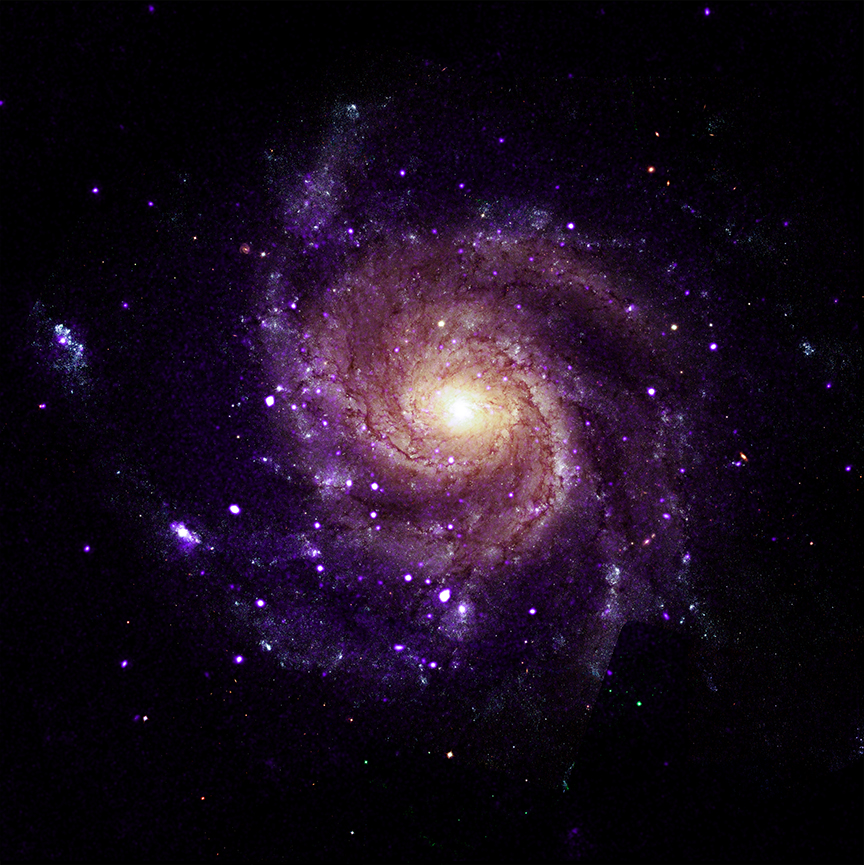
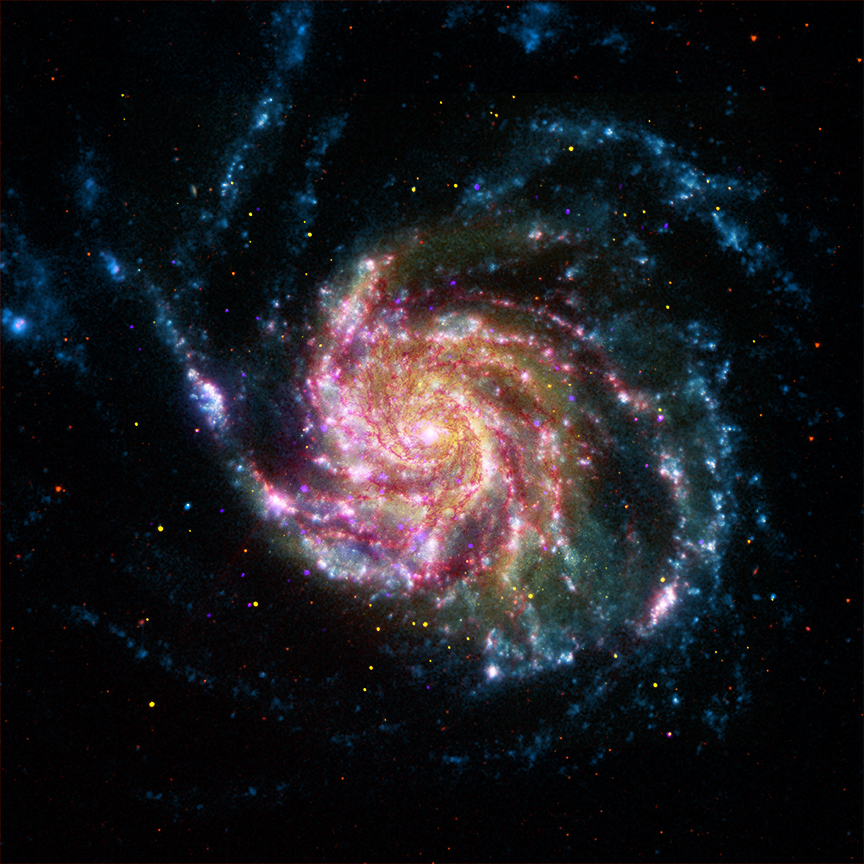
This image of the Pinwheel Galaxy, or also known as M101, combines data in the infrared, visible, ultraviolet and X-rays from four of NASA's space-based telescopes. This multi-spectral view shows that both young and old stars are evenly distributed along M101's tightly-wound spiral arms. Such composite images allow astronomers to see how features in one part of the spectrum match up with those seen in other parts. It is like seeing with a regular camera, an ultraviolet camera, night-vision goggles and X-ray vision, all at the same time.

The Pinwheel Galaxy is in the constellation of Ursa Major (also known as the Big Dipper). It is about 70% larger than our own Milky Way Galaxy, with a diameter of about 170,000 light years, and sits at a distance of 21 million light years from Earth. This means that the light we're seeing in this image left the Pinwheel Galaxy about 21 million years ago - many millions of years before humans ever walked the Earth.

The hottest and most energetic areas in this composite image are shown in purple, where the Chandra X-ray Observatory observed the X-ray emission from exploded stars, million-degree gas, and material colliding around black holes.

The Electromagnetic Spectrum.
Wavelengths and energies from gamma rays to radio

The red colors in the image show infrared light, as seen by the Spitzer Space Telescope. These areas show the heat emitted by dusty lanes in the galaxy, where stars are forming.

The yellow component is visible light, observed by the Hubble Space Telescope. Most of this light comes from stars, and they trace the same spiral structure as the dust lanes seen in the infrared.

The blue areas are ultraviolet light, given out by hot, young stars that formed about 1 million years ago, captured by the Galaxy Evolution Explorer (GALEX).

Fast Facts for M101:

Scale: Image is 16.8 arcmin across
Category: Normal Galaxies & Starburst Galaxies
Coordinates (J2000) RA 14h 03m 12.59s | Dec +54° 20’ 56.70''
Constellation: Ursa Major
Observation Dates: 03/26/2000 - 01/01/2005 with 26 pointings
Observation Time: 274 hours (11 days 10 hours)
Obs. IDs: 934, 2065, 4731-4737, 5296-5297, 5300, 5309, 5322-5323, 5337-5340, 6114-6115, 6118, 6152, 6169-6170, 6175
Color Code: X-ray (Purple); Infrared (Red); Optical (Yellow); Ultraviolet (Blue)
Instrument: ACIS
Also Known As: NGC 5457 - The Pinwheel Galaxy
Distance Estimate: About 21 million light years

Tuesday, March 20, 2012

Explosive Stars with Good Table Manners

These images from Swift's Ultraviolet/Optical Telescope (UVOT) show the nearby spiral galaxy M101 before and after the appearance of SN 2011fe (circled, right), which was discovered on Aug. 24, 2011. At a distance of 21 million light-years, it was the nearest Type Ia supernova since 1986. Left: View constructed from images taken in March and April 2007. Right: The supernova was so bright that most UVOT exposures were short, so this view includes imagery from August through November 2011 to better show the galaxy. Credit: NASA/Swift/Peter Brown, Univ. of Utah. High Resolution Image (jpg) - Low Resolution Image (jpg)

Cambridge, MA - An exploding star known as a Type Ia supernova plays a key role in our understanding of the universe. Studies of Type Ia supernovae led to the discovery of dark energy, which garnered the 2011 Nobel Prize in Physics. Yet the cause of this variety of exploding star remains elusive.

All evidence points to a white dwarf that feeds off its companions star, gaining mass, growing unstable, and ultimately detonating. But does that white dwarf draw material from a Sun-like star, an evolved red giant star, or from a second white dwarf? Or is something more exotic going on? Clues can be collected by searching for "cosmic crumbs" left over from the white dwarf's last meal.

In two comprehensive studies of SN 2011fe - the closest Type Ia supernova in the past two decades - there is new evidence that indicates that the white dwarf progenitor was a particularly picky eater, leading scientists to conclude that the companion star was not likely to be a Sun-like star or an evolved giant.

"It's hard to understand how a white dwarf could eat itself to death while showing such good table manners," said Alicia Soderberg of the Harvard-Smithsonian Center for Astrophysics (CfA).

Soderberg and her colleagues examined SN 2011fe with a suite of instruments in wavelengths ranging from X-rays to radio. They saw no sign of stellar material recently devoured by the white dwarf. Instead, the explosion occurred in a remarkably clean environment.

"This white dwarf was a tidy eater," said Laura Chomiuk of the CfA, lead author of one of the two papers.

Additional studies using NASA's Swift satellite, which examined a large number of more distant Type Ia supernovae, appear to rule out giant stars as companions for the white-dwarf progenitors. Those results were described in a NASA press release.

Taken together, these studies suggest that Type Ia supernovae likely originate from a more exotic scenario, possibly the explosive merger of two white dwarfs.

"This is an exciting time in Type Ia supernova research since it brings us closer to solving one of the longest-standing mysteries in the life cycles of stars," said Raffaella Margutti of the CfA, lead author of the second paper.

The two papers on SN 2011fe are available online at http://arxiv.org/abs/1201.0994 and http://arxiv.org/abs/1202.0741.

Headquartered in Cambridge, Mass., the Harvard-Smithsonian Center for Astrophysics (CfA) is a joint collaboration between the Smithsonian Astrophysical Observatory and the Harvard College Observatory. CfA scientists, organized into six research divisions, study the origin, evolution and ultimate fate of the universe.

For more information, contact:

David A. Aguilar
Director of Public Affairs
Harvard-Smithsonian Center for Astrophysics
617-495-7462
daguilar@cfa.harvard.edu

Christine Pulliam
Public Affairs Specialist
Harvard-Smithsonian Center for Astrophysics
617-495-7463
cpulliam@cfa.harvard.edu