Showing posts with label Cygnus OB2. Show all posts

Monday, November 04, 2024

Planets Beware: NASA Unburies Danger Zones of Star Cluster

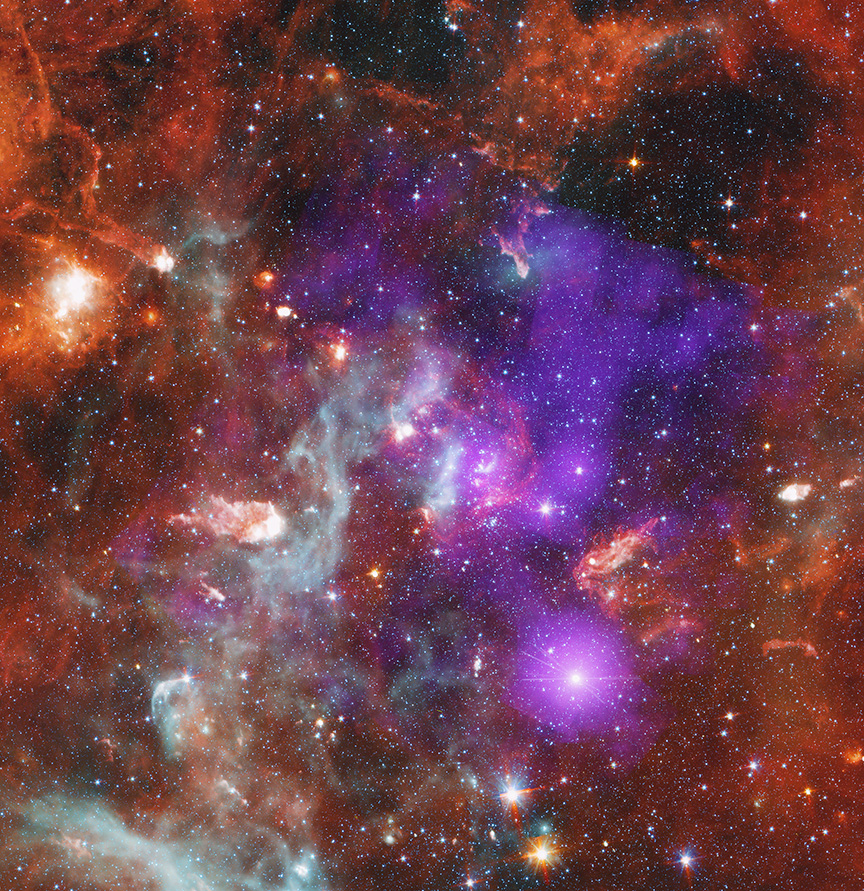
Cygnus OB2

Credit X-ray: NASA/CXC/SAO/J. Drake et al, IR: NASA/JPL-Caltech/Spitzer; Image Processing: NASA/CXC/SAO/N. Wolk

JPEG (697.3 kb) - Large JPEG (14.3 MB) - Tiff (24 MB - More Images

A Tour of 3C 58 - More Videos


Most stars form in collections, called clusters or associations, that include very massive stars. These giant stars send out large amounts of high-energy radiation, which can disrupt relatively fragile disks of dust and gas that are in the process of coalescing to form new planets.

A team of astronomers used NASA’s Chandra X-ray Observatory, in combination with ultraviolet, optical, and infrared data, to show where some of the most treacherous places in a star cluster may be, where planets’ chances to form are diminished.

The target of the observations was Cygnus OB2, which is the nearest large cluster of stars to our Sun — at a distance of about 4,600 light-years. The cluster contains hundreds of massive stars as well as thousands of lower-mass stars. The team used long Chandra observations pointing at different regions of Cygnus OB2, and the resulting set of images were then stitched together into one large image.

The deep Chandra observations mapped out the diffuse X-ray glow in between the stars, and they also provided an inventory of the young stars in the cluster. This inventory was combined with others using optical and infrared data to create the best census of young stars in the cluster.

In this new composite image, the Chandra data (purple) shows the diffuse X-ray emission and young stars in Cygnus OB2, and infrared data from NASA’s now-retired Spitzer Space Telescope (red, green, blue, and cyan) reveals young stars and the cooler dust and gas throughout the region.
In these crowded stellar environments, copious amounts of high-energy radiation produced by stars and planets are present. Together, X-rays and intense ultraviolet light can have a devastating impact on planetary disks and systems in the process of forming.

Planet-forming disks around stars naturally fade away over time. Some of the disk falls onto the star and some is heated up by X-ray and ultraviolet radiation from the star and evaporates in a wind. The latter process, known as “photoevaporation,” usually takes between 5 and 10 million years with average-sized stars before the disk disappears. If massive stars, which produce the most X-ray and ultraviolet radiation, are nearby, this process can be accelerated.

The researchers using this data found clear evidence that planet-forming disks around stars indeed disappear much faster when they are close to massive stars producing a lot of high-energy radiation. The disks also disappear more quickly in regions where the stars are more closely packed together.

For regions of Cygnus OB2 with less high-energy radiation and lower numbers of stars, the fraction of young stars with disks is about 40%. For regions with more high-energy radiation and higher numbers of stars, the fraction is about 18%. The strongest effect — meaning the worst place to be for a would-be planetary system — is within about 1.6 light-years of the most massive stars in the cluster.

A separate study by the same team examined the properties of the diffuse X-ray emission in the cluster. They found that the higher-energy diffuse emission comes from areas where winds of gas blowing away from massive stars have collided with each other. This causes the gas to become hotter and produce X-rays. The less energetic emission probably comes from gas in the cluster colliding with gas surrounding the cluster.

Two separate papers describing the Chandra data of Cygnus OB2 are available. The paper about the planetary danger zones, led by Mario Giuseppe Guarcello (National Institute for Astrophysics in Palermo, Italy), appeared in the November 2023 issue of the Astrophysical Journal Supplement Series, and is available here. The paper about the diffuse emission, led by Juan Facundo Albacete-Colombo (University of Rio Negro in Argentina) was published in the same issue of Astrophysical Journal Supplement, and is available here.

NASA's Marshall Space Flight Center in Huntsville, Alabama, manages the Chandra program. The Smithsonian Astrophysical Observatory's Chandra X-ray Center controls science operations from Cambridge, Massachusetts, and flight operations from Burlington, Massachusetts.

JPL managed the Spitzer Space Telescope mission for NASA’s Science Mission Directorate in Washington until the mission was retired in January 2020. Science operations were conducted at the Spitzer Science Center at Caltech. Spacecraft operations were based at Lockheed Martin Space in Littleton, Colorado. Data are archived at the Infrared Science Archive operated by IPAC at Caltech. Caltech manages JPL for NASA.


Visual Description:

This release features a composite image of the Cygnus OB2 star cluster, which resembles a night sky blanketed in orange, purple, and grey clouds.

The center of the square image is dominated by purple haze. This haze represents diffuse X-ray emissions, and young stars, detected by the Chandra X-ray observatory. Surrounding the purple haze is a mottled, streaky, brick orange cloud. Another cloud resembling a tendril of grey smoke stretches from our lower left to the center of the image. These clouds represent relatively cool dust and gas observed by the Spitzer Space Telescope.

Although the interwoven clouds cover most of the image, the thousands of stars within the cluster shine through. The lower-mass stars present as tiny specks of light. The massive stars gleam, some with long refraction spikes.


Fast Facts for Cygnus OB2:

Scale: Image is about 1.5 arcmin (120 light-years) across.
Category: Normal Stars & Star Clusters
Coordinates (J2000): RA 20h 33m 12s | Dec +41° 19´ 00"
Constellation: Cygnus
Observation Dates: 40 pointings between January 2004 and March 2010
Observation Time: 331 hours 30 minutes (13 days 19 hours 30 minutes)
Obs. ID: 4501, 4511, 7426, 10939-10974, 12099
Instrument: ACIS
References: Guarcell, M.G. et al, 2023, ApJS, 269, 13; Albacete-Colombo, J.F. et al, 2023, ApJS, 269, 14.
Color Code: X-ray: purple; Infrared (IRAC): red, green, blue; Infrared (MIPS): cyan;
Distance Estimate: About 4,600 light-years


Saturday, August 07, 2021

Tracking Down Diffuse Gamma Rays


The most prominent feature of the Fermi LAT 60-month sky map is the bright band of diffuse glow along the map’s center, within the central plane of the Milky Way galaxy. Credit: NASA/DOE/Fermi LAT Collaboration

The disk of the Milky Way glows with continuous emission of high-energy gamma-ray photons. Where does this diffuse emission come from? A new study suggests that we may be missing the complete picture.

Smashing Cosmic Rays

Roughly 80% of the gamma-ray photons detected by the Fermi LAT gamma-ray detector come from diffuse emission — emission produced in the plane of our galaxy that isn’t associated with specific sources. Scientists have identified speeding cosmic rays as the primary culprit: high-energy protons and atomic nuclei whiz through space at nearly the speed of light, slamming into the interstellar medium and producing byproducts of gamma rays, neutrinos, and more.

But does this picture tell the whole story? In a recent study, Nanjing University scientists Ruo-Yu Liu and Xiang-Yu Wang point out a possible concern with this model: if cosmic-ray collisions produce the galaxy’s diffuse gamma-ray emission … where are all the neutrinos?

Observations from this cosmic-ray observatory in Tibet reveal the diffuse gamma-ray emission in our galaxy’s disk
Credit: Institute of High Energy Physics of the Chinese Academy of Sciences

A Conflict from Missing Neutrinos

By modeling the interaction of galactic cosmic rays with the interstellar medium in the Milky Way, Liu and Wang illustrate the problem: in order to reproduce the spectrum of diffuse gamma-ray emission recently observed by detectors on the Tibetan Plateau, the cosmic-ray collisions would also produce a large number of neutrinos — so many, in fact, that they should be observable by detectors on Earth, like the IceCube neutrino observatory. The problem? Based on IceCube’s most recently released results, these predicted neutrinos aren’t there!

Since the neutrino and diffuse gamma-ray observations conflict, Liu and Wang argue, then the model must be missing something. The source of the seemingly diffuse gamma-ray emission from the galactic disk cannot only be cosmic-ray collisions with the interstellar medium. Instead, there must be a contribution from some additional source that produces high-energy gamma rays without also creating lots of neutrinos.

What is that source? The authors have found a potential culprit.


A grayscale infrared map of the Cygnus cocoon is overlaid here with colored gamma-ray data showing the excesses of high-energy photons. Credit: IFJ PAN / HAWC

Another Player

Of the highest-energy diffuse gamma-rays detected by the Tibet observatory, 40% come from a single region: the center of the Cygnus cocoon, a superbubble surrounding a site of massive star formation. Could this area be producing the extra gamma rays observed in the diffuse emission?

Liu and Wang describe several potential sources of gamma rays in the cocoon — like the massive star cluster Cygnus OB2, the supernova remnant γ Cygni, and a pulsar wind nebula — and demonstrate that, by adding contributions from these sources, they can successfully reproduce the diffuse gamma-ray emission we observe while not exceeding the upper limits on neutrino production set by the IceCube observations.

More exploration of this picture is still needed, but the authors’ work shows that we still plenty more to learn about the sources that produce high-energy particles in our galaxy!

Citation

“Origin of Galactic Sub-PeV Diffuse Gamma-Ray Emission: Constraints from High-energy Neutrino Observations,” Ruo-Yu Liu and Xiang-Yu Wang 2021 ApJL 914 L7. doi:10.3847/2041-8213/ac02c5 

By Susanna Kohler

Source: American Astronomical Society (AAS/Nova)


Wednesday, July 24, 2019

NASA's Chandra X-ray Observatory Celebrates Its 20th Anniversary


Credit:  X-ray: NASA/CXC/Univ of Waterloo/H. Russell et al.; Optical: NASA/STScI


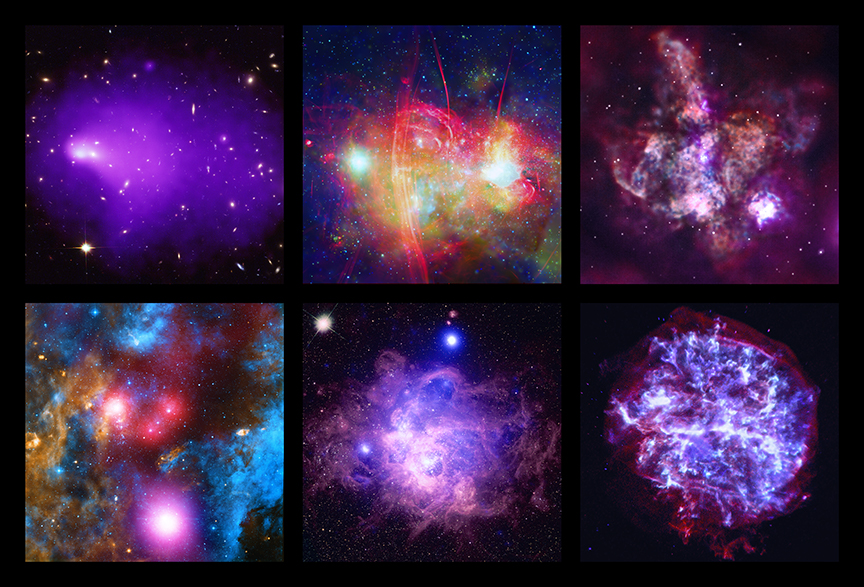
To commemorate the 20th anniversary of NASA's Chandra X-ray Observatory, an assembly of new images is being released. These images represent the breadth of Chandra's exploration, demonstrating the variety of objects it studies as well as how X-rays complement the data collected in other types of light. Some of these images contain Chandra data exclusively and the rest show how X-rays fit with the different types of light that other telescopes collect.

The 20th anniversary images are from left to right:

Top Row:

Abell 2146
  Credit: X-ray: NASA/CXC/Univ. of Waterloo/H. Russell et al.; Optical: NASA/STScI.

The colossal system Abell 2146 is the result of a collision and merger between two galaxy clusters. Astronomers think that galaxy clusters, the largest structures in the Universe held together by gravity, grow by colliding and merging with one another. Mergers of galaxy clusters are some of the most energetic events since the Big Bang. Chandra has observed many galaxy cluster mergers, giving scientists insight into how these mega-structures that dominate the Universe came to be.

In this image of Abell 2146, X-rays from Chandra (purple) show hot gas and optical data from the Hubble Space Telescope shows galaxies and stars. The bullet-shaped feature shows the hot gas from one cluster plowing through the hot gas in the other cluster.

Sagittarius A* (Galactic Center)
Credit: X-Ray:NASA/CXC/UMass/D. Wang et al.; Radio:NRF/SARAO/MeerKAT 

The central region of our galaxy, the Milky Way, contains an exotic collection of objects, including a supermassive black hole weighing about 4 million times the mass of the Sun (called Sagittarius A*), clouds of gas at temperatures of millions of degrees, neutron stars and white dwarf stars tearing material from companion stars and beautiful tendrils of radio emission.

The region around Sagittarius A* is shown in this new composite image with Chandra data (green and blue) combined with radio data (red) from the MeerKAT telescope in South Africa, which will eventually become part of the Square Kilometer Array (SKA).  

30 Doradus
Credit: NASA/CXC/Penn State Univ./L. Townsley et al.
At the center of 30 Doradus, one of the largest star-forming regions located close to the Milky Way, thousands of massive stars are blowing off material and producing intense radiation along with powerful winds. Chandra detects gas that has been heated to millions of degrees by these stellar winds and also by supernova explosions that mark the end of some giant stars' lives. These X-rays come from shock fronts, similar to sonic booms produced by supersonic airplanes, that rumble through the system.

This new Chandra image of 30 Doradus, which is nicknamed the "Tarantula Nebula," contains data from several long observations totaling almost 24 days of observing spread out over about 700 days. The colors in this Chandra image are red, green and purple to highlight low, medium and high X-ray energies respectively.

Astronomers used the long set of Chandra observations to discover that one of the bright X-ray sources shows regular variations in its X-ray output, with a period of 155 days. This variation originates from two massive stars orbiting each other, in a double-star system called Melnick 34. Follow-up observations with the European Southern Observatory's Very Large Telescope and the Gemini Observatory, both in Chile, measured the change in velocities of both stars during their orbit, leading to mass estimates of 139 and 127 times the mass of the sun. This makes Melnick 34 the most massive binary known, as reported in a paper published earlier this year, led by Katie Tehrani of the University of Sheffield in the UK. Within about two or three million years, both stars should implode to form black holes. If the binary survives these violent events, the black holes might eventually merge to produce a burst of gravitational waves.

The X-rays likely originate from shock waves generated by the collision of material blowing away from the surfaces of both stars, making Melnick 34 a "colliding-wind binary". Credit: NASA/CXC/Penn State Univ./L. Townsley et al.


Bottom row:

Cygnus OB2
Credit: X-ray: NASA/CXC/SAO/J. Drake et al; 
H-alpha: Univ. of Hertfordshire/INT/IPHAS; Infrared: NASA/JPL-Caltech/Spitzer

Stars come in different sizes and masses. Our Sun is an average-sized star that will have a lifespan of some 10 billion years. More massive stars, like those found in Cygnus OB2, only last a few million years. During their lifetimes, they blast large amounts of high-energy winds into their surroundings. These violent winds can collide or produce shocks in the gas and dust around the stars, depositing large amounts of energy that produce X-ray emission that Chandra can detect.

In this composite image of Cygnus OB2, X-rays from Chandra (red diffuse emission and blue point sources) are shown with optical data from the Isaac Newton Telescope (diffuse emission in light blue) and infrared data from the Spitzer Space Telescope (orange).

NGC 604
Credit: X-ray: NASA/CXC/CfA/R. Tuellmann et al.; Optical: NASA/AURA/STScI/J. Schmidt.

The nearby galaxy Messier 33 contains a star-forming region called NGC 604 where some 200 hot, young, massive stars reside. The cool dust and warmer gas in this stellar nursery appear as the wispy structures in an optical image from the Hubble Space Telescope. In between these filaments are giant voids that are filled with hot, X-ray-emitting gas. Astronomers think these bubbles are being blown off the surfaces of the young and massive stars throughout NGC 604.

NGC 604 also likely contains an extreme member of the class of colliding-wind binaries, as reported in a recent paper led by Kristen Garofali of the University of Arkansas in Fayetteville, Arkansas. It is the first candidate source in this class to be discovered in M33 and the most distant example known, and shares several properties with the famous, volatile system called Eta Carinae, located in our galaxy.

Chandra's X-ray data (blue) are combined in this image with optical data from Hubble (purple).

G292
Credit: NASA/CXC/SAO

Supernova remnants are the debris from exploded stars. G292.0+1.8 is a rare type of supernova remnant observed to contain large amounts of oxygen. Because they are one of the primary sources of the heavy elements (that is, everything other than hydrogen and helium) necessary to form planets and people, these oxygen-rich supernova remnants are important to study. The X-ray image of G292+1.8 from Chandra shows a rapidly expanding, intricately structured field left behind by the shattered star. The image is colored red, green, teal and purple in X-rays ranging from the lowest to highest energy levels.

Recently the first detection was made of iron debris from the exploded star, as reported in a paper led by Jayant Bhalerao of the University of Texas at Arlington in Texas. They constructed a map of this debris, along with that of silicon and sulphur, to understand more about the explosion. They found that these three elements are mainly located in the upper right of the remnant. This is in the opposite direction from the neutron star that was formed in the explosion, and was then kicked towards the lower left of the remnant. This suggests that the origin of this kick is gravitational and fluid forces from an asymmetric explosion. If more than half of the star's debris is ejected in one direction, then the neutron star is kicked in the other direction so that momentum is conserved. This finding argues against the idea that the copious amounts of neutrinos formed in the supernova explosion were emitted in a lop-sided direction, imparting a kick to the neutron star. 

For more information about Chandra's 20th anniversary, visit: http://chandra.si.edu/20th/

NASA's Marshall Space Flight Center in Huntsville, Alabama, manages the Chandra program for NASA's Science Mission Directorate in Washington. The Smithsonian Astrophysical Observatory in Cambridge, Massachusetts, controls Chandra's science and flight operations.


Wednesday, November 07, 2012

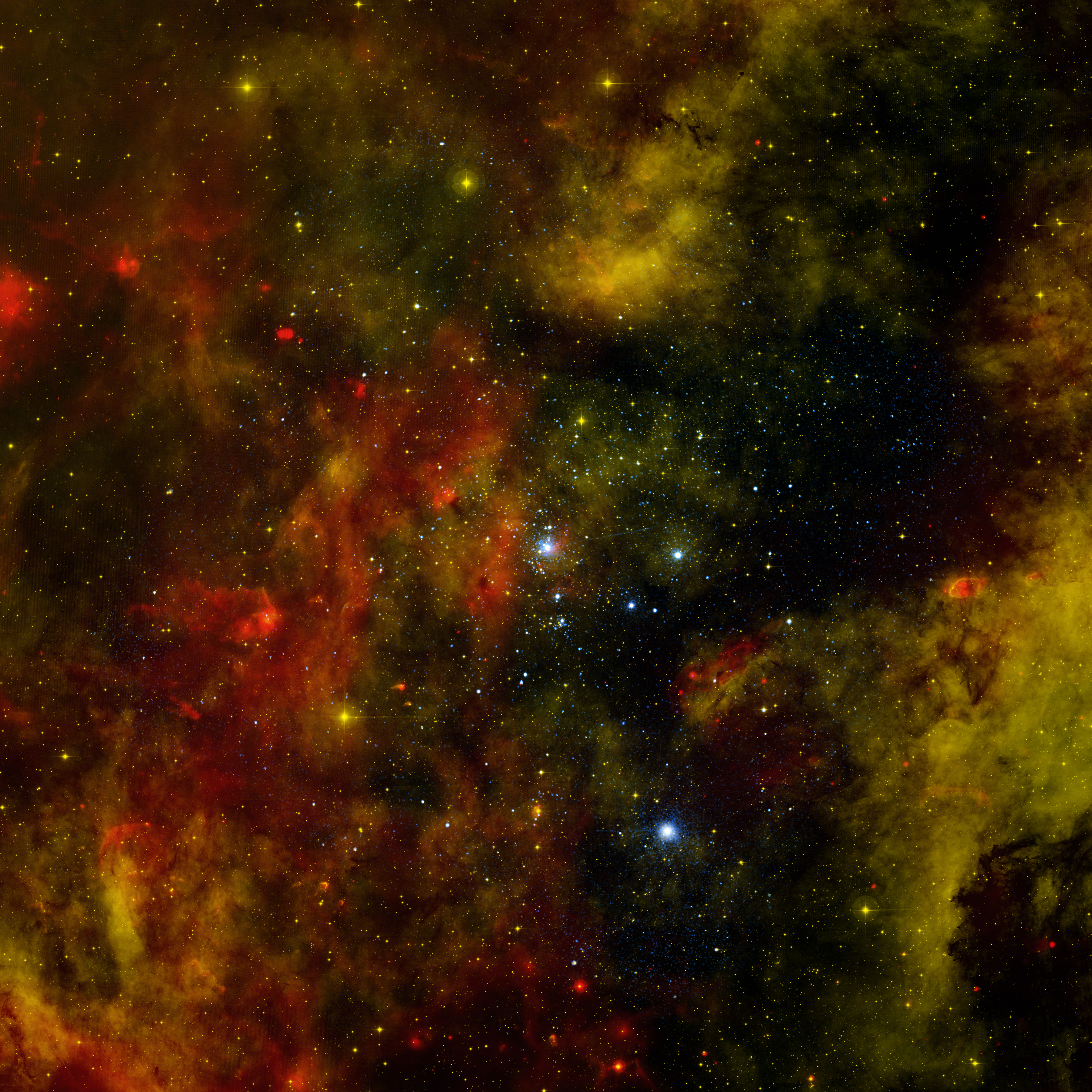
Cygnus OB2: Probing a Nearby Stellar Cradle


Cygnus OB2 (Composite)
Credit X-ray: NASA/CXC/SAO/J.Drake et al, 
Optical: Univ. of Hertfordshire/INT/IPHAS, I
nfrared: NASA/JPL-Caltech


Videos


The Milky Way and other galaxies in the universe harbor many young star clusters and associations that each contain hundreds to thousands of hot, massive, young stars known as O and B stars. The star cluster Cygnus OB2 contains more than 60 O-type stars and about a thousand B-type stars. At a relatively nearby distance to Earth of about 5,000 light years, Cygnus OB2 is the closest massive cluster. Deep observations with NASA's Chandra X-ray Observatory of Cygnus OB2 have been used to detect the X-ray emission from the hot outer atmospheres, or coronas, of young stars in the cluster and to probe how these great star factories form and evolve. About 1,700 X-ray sources were detected, including about 1,450 thought to be stars in the cluster. In this image, X-rays from Chandra (blue) have been combined with infrared data from NASA's Spitzer Space Telescope (red) and optical data from the Isaac Newton Telescope (orange). 

Young stars ranging in age from one million to seven million years were detected. The infrared data indicates that a very low fraction of the stars have circumstellar disks of dust and gas. Even fewer disks were found close to the massive OB stars, betraying the corrosive power of their intense radiation that leads to early destruction of their disks. Evidence is also seen that the older population of stars has lost its most massive members because of supernova explosions. Finally, a total mass of about 30,000 times the mass of the sun is derived for Cygnus OB2, similar to that of the most massive star forming regions in our Galaxy. 

NASA's Marshall Space Flight Center in Huntsville, Ala., manages the Chandra program for NASA's Science Mission Directorate in Washington. The Smithsonian Astrophysical Observatory controls Chandra's science and flight operations from Cambridge, Mass.

Fast Facts for Cygnus OB2:

Credit X-ray: NASA/CXC/SAO/J.Drake et al, Optical: Univ. of Hertfordshire/INT/IPHAS, Infrared: NASA/JPL-Caltech
Release Date:  November 7, 2012
Scale:  Image is 11.8 arcmin across (16 light years)
Category:  Normal Stars & Star Clusters
Coordinates (J2000):  RA 20h 37m 11.00s | Dec +38° 41' 52.00"
Constellation:  Cygnus
Observation Date:  39 pointings between January 2004 and March 2010 
Observation Time:  341 hours 40 min (14 days 5 hours 40 min)
Obs. ID:  4501, 4511, 10939-10974, 12099 
Instrument: ACIS 
Color Code:  X-ray (Blue), Optical (Yellow), Infrared (Red)